Friday, September 17, 2010

Peel Me a Grape

How I do love weird pies! Of course, it seems that almost any pie that’s not apple, peach, cherry, blueberry, or cafeteria-style chocolate cream is “out of the ordinary.” Considering all the wonderful possibilities, the sameness is kind of sad.

Tonight I’m reflecting on the good ol’ Concord grape pie, which you rarely see. At least, not around here. I had never heard of grape pie until about 1988, which is when I made—and tasted—my first-ever Concord grape pie.


The occasion was that I was dating someone whose mother used to make grape pies, back in the forties and fifties. Mrs. S had made her legendary grape pies in a tiny town in northwestern Ohio, and I came to suspect that grape pies must simply be more common in northern Ohio, where folks grow more Concords than we do. That, or maybe women were more willing to "peel grapes" back then.


So after hearing my paramour glorify the exquisite joys of Concord grape pie, I decided I needed to learn to make it. I phoned Mrs. S up in Ohio for instructions, and I could almost hear her shrugging: “Well, you know . . . you just slip the skins off the grapes and get the seeds out, then add some sugar and flour, or tapioca, or cornstarch—whatever—Oh! and add some nutmeg, too.” Aha! Nutmeg’s the secret ingredient. (Many recipes suggest lemon juice and/or grated lemon peel, too.)


Wow, I remember that phone conversation so well! But it was long ago; Mrs. S has been gone nearly twenty years. Times change.

But during that time with my pie-hungry flame, I got pretty good at making Concord grape pies. Of course, I received a great deal of encouragement. And it was one thing I could do right.

Concords are available only in the fall, usually just in September, but I soon learned to buy a quantity, process them to remove the seeds, and freeze them so I could earn extra “girlfriend points” when they were out of season—for instance, as a February birthday-pie.

Honestly, who has the time to make pies? I was in grad school and working. During those years, grape pies were about the only ones I ever made, and I did it almost entirely for the “girlfriend points” in that troubled relationship.

Today, I find it ironic that grape pie—so tedious and time-consuming—has become the pie most people request of me. It just figures.


“Show me you love me . . . Hop when I holler, Skip when I snap; When I say ‘do it,’ jump to it . . . Peel me a grape.”


Three cups, enough for one pie, is about 240 grapes, for your information, each individually plucked from the bunch and hand skinned. And then there’s the cooking and processing to remove the seeds, all before you even think about rolling out any pastry.

I should have grown a backbone much sooner. But my pies are good.


Although that relationship couldn’t last, the reputation I developed among friends and family for making grape pies did. So I came to have at least one thing in common with good Mrs. S, who had peeled her grapes for her own famous pies all those years ago. Funny.


With my fame for grape pies, then, it’s no surprise that my mother, so generous, who loves to shop and give us things, dropped off a package of Concords she’d found at the grocery store this week. And so once again another one of my “signature” grape pies will be born.

. . . Now I can see why mom always warned me to be careful about my reputation.


(Here is what I did with these grapes, by the way; and here is a fun, retro alternative to the traditional grape pie.)

Thursday, September 16, 2010

Community Effort

More reflections on the subject of church suppers. One of the things I marvel at during these parish festivals is that they are truly a communal effort—men, women, and youngsters all have something to do; all can contribute. And the organization is truly impressive.

As we dined in the cafeteria at St. Anthony’s at Folk, Missouri, last Sunday, we sat beside one of the older members of the parish, who offered us some information. For instance, each family was in charge of donating five pies and three loaves of bread. (The pies, she noted, could not be cream pies, since the church’s refrigerated storage would be devoted to other foods.)

She also mentioned that the meat was local; in fact, her family’s farm had provided some of the beef. The sausage, also from local meat, had been prepared by a locally owned meat-packing company down by Vienna, and the people of Folk had stuffed it themselves a few days before the festival.

The Work Schedule!

After eating, Sue and I entered the church to look around. In the narthex I spied a stack of sheets listing the work assignments for the day’s events. Very interesting! Here are the categories, with the number of people listed for each shift. I’m leaving off personal names.

Most jobs have two shifts; the first starts at “beginning” or “10:45” and lasts until 3:00; the second shift starts at 3:00 and lasts until “end,” or about 7:00 p.m.

Dining Room, 26 persons per shift
Bread and Pies, 3 or 4/shift
Steam Table: 4/shift
Tea and Coffee: 3/shift
Kitchen: 5/shift
Dish Washing: 5/shift
Supper Tickets: 3 or 4/shift
Carry Food and Trash: 3/shift
Sandwich Stand: 4/shift
Sandwich Stand Tickets: 2/shift
General Raffle: 2 or 3/shift
Selling Raffle Tickets: 2/shift
Game Tickets: 2/shift
Arts and Crafts: 4/shift
Bingo: 5/shift
Toy Store and Grab Bag: 2/shift
Bounce House: 3/shift

Then, the folks assigned to the following jobs work all day, “start–end”:

Cookshed: 10 people
Carryout Meals: 5 people
Sausage Fryers: 9 men
Cooler and Meat Sales: 4 men
Shooting Match: 9 men
Splatter Cards: 3 people
Beer Stand: 10 men
Traffic: 10 men
Games: one shift, from noon to 6:45, a total of 15 folks, to oversee kiddie games of “Golf,” “Muffin Pan,” “Hoopla,” and “Plinko”


Analysis?

Looking at the names on the list—and observing workers at the festival—you can see there’s a separation of labor by gender, as might be expected; men typically work at the beer wagon, help drivers find parking spots on the grassy hill nearby, cook the meat, and oversee the “shooting match” (which their immigrant grandparents probably called a Schützenfeste).

Women are generally in charge of the baked goods and desserts, the beverages, dishwashing, side dishes, and most things pertaining to children.

Women and men work shoulder-to-shoulder in the kitchen—feeding thousands within a few hours requires a lot of heavy lifting, so any notions of cooking being “women’s work” are brushed away, since man-muscles are clearly needed.

The names on the list also provide hints to ages and family relationships—the teens and young adults are undoubtedly the ones with names like Tyler, Megan, Brooklyn (yes! such a name in little bitty ol’ Folk!), Ashley, and Cody. They carry platters of food to tables, serve the beverages, and bus, clean, and reset the tables. They’re working at the Bounce House and the games of “Muffin Tin.” The boys carry bags of trash out to the dumpster.

Folks of my generation have names like Kevin, Jennifer, Mike, and Lori. They’re doing all the stuff that’s responsible, complex, and hard: Kitchen. Beer wagon. Sausage frying. Shooting match. Sandwich stand.

Then there are the people with names like Gertie, Dick, Norma, Betty, and Herb—the retirement generation; they’re selling supper and raffle tickets, and some of the women continue with kitchen work. They also work at the “country store.” Most of these can be sit-down jobs, and most allow for plenty of “visiting.” They’ve earned it. Twenty years ago, at this exact same location, these persons were handling the tough, demanding jobs; fifty years ago, they were bussing tables and taking out the trash.

Finally, the surnames—a study in Germanness. Here are some names from the Folk parish: Baumhoer, Gabelsberger, Heckman, Huhn, Luebbering, Temmen, Veit, Welschmeyer, Stegemann, Lueckenhoff, Hagenhoff, Woehr, Massman, Reinkemeyer, Kempker, Werdehausen, Scheppers, and Leucke. And more. And if you visit the little cemetery across the road, you know you’ll see these same names well represented.

There’s something really cool about all this; from Augustus to Andy to Ashley, from Johanna to Judy to Justin, and Henrietta to Hank to . . . “Fallon”??—well, yeah!—there’s a daily continuity here that families spread across the continent miss almost entirely.

Wednesday, September 15, 2010

Fall Supper Time


Fresh, local, whole-hog sausage. Beef roast (or turkey, with all the fixings). Kraut, mashed potatoes, green beans, corn, applesauce, homemade bread, and your choice of homemade pie or other dessert. Sometimes there are extras; Taos, I recall, always has cooked turnips!

The rural ethnic-German communities in the area have begun their fall suppers. There’s at least one to attend every Sunday, from now through Thanksgiving. (These are not to be confused with the summer “picnics,” which end about Labor Day—these feature fried chicken and plenty of fresh local summertime produce—slaw, tomatoes, peppers, etc.)

The fall festivals—which include activities such as quilt raffles, bake sales, kids’ games, bingo, and the beer wagon—are fund-raising efforts by the parishes. And efforts they must be! Everyone has a job to do; thankfully, “many hands make light work.”

Last Sunday was the festival at Folk. (That’s Folk, Missouri, located west of Westphalia off Route 133—and just north of Painted Rock Conservation Area).

We usually take some time, after eating, to look inside the sanctuary of each church. They are always quite beautiful, and each unique according to the history and personality of the parish.


Schedule

I wish I could give you a definitive calendar of the upcoming church suppers this fall, but I’m not Catholic, so I’m not privy to the diocese or parish newsletters that provide such information. Pity.

As far as I know, the only other ways to find out “which suppers are when” are by:

1. Scanning for ads in the Jeff City newspaper;

2. Reading the Coca-Cola building billboard facing the 63/54 Expressway at its Jefferson Street intersection (one of our Munichburg treasures); or

3. Simply asking your Catholic friends.


I guess I could, some year, make notes of which festivals are on which weekends, since these rarely change: “Oh, we’re always on the second weekend in September.”

But frankly, it’s more fun to look at our beloved Coke Sign. Long may she wave!


(Thanks, Sue, for letting me post some of your lovely pictures from St. Anthony's in Folk!)

Saturday, September 11, 2010

Trepidation; Elation

I feel like I’ve fallen behind in posting, but then I do realize that the only expectations here are my own. It’s my blog; I can do what I want with it. Somehow, though, I feel like it’s gotten away from me. My posts are feeling like articles or research papers, instead of, say, the real thoughts in my head.

For about three decades, now, I’ve kept a journal, so writing about my day, my thoughts, my “here is where I am right now,” is indeed the only form of writing I feel truly qualified to attempt; thus so much of my blog here is a tangent, a lark.

I honestly don’t know nuthin’ about cooking—I’ve never even taken a basic home ec class. I don’t know nuthin’ about science—I defer all definitive statements to the specialists. I’m not an authority on Missouri: I grew up here; I left; I came back. But I always feel woefully lacking in an understanding of its history and landscapes. As for Jefferson City, I am a total fraud: I come from across the river, from the rival town and ultra-rival school. I only decided to start learning about this place when I moved here a decade ago. I’m a Columbian, by birth and by culture—that means I’ll never really be accepted here.

But I do know how to tell you what’s going on right now. I’m sitting on our recently repaired sunporch, and the late-afternoon sun is slicing in. Patches, the original Opulent Opossum, is lying in the middle of the soft new carpet, on her back, her hind legs in the air, snoozing as only she can do.

It’s one of those early cool days in September, when the pleasant north breeze is still a surprise, because you’re still expecting the Missouri summertime steam bath. It will take several more days like this before our bodies begin to accept that autumn is really here.

Well, it seems that way to me.

---------------------------------------------

Here’s the big news today: We said goodbye to two elderly, beat-up chairs and a sofa. But it’s only temporary—when we see them again, around the end of October (I understand), they will be transformed into elegant, fine furniture fit for high society: We’re getting them reupholstered (and repaired, and refinished).

Here’s the history: The sofa is the one Grandma S always had in her living room . . . well, until Aunt Minnie got sick and moved in with Grandma, and her (nicer) sofa was placed into the living room. Grandma’s older sofa, more beat up, was demoted to the sunporch, where it’s been since Aunt Minnie got sick—when was that? The late seventies?

Here’s a picture of Aunt Min sitting on Grandma’s sofa; back in the good ol’ days. Christmas ’75, I think.


Hmmm. I’ve always liked the old sofa—good memories, good vibes.


And one of the chairs—a “wingback” chair with nice soft arms—had long been my favorite place to sit when visiting Grandma. The fabric was a satiny damask, soft and cool, and I don’t know . . . just comfortable. When it was time to sit down and talk, I’d make a beeline for that chair.

Please understand that I’m not insane with nostalgia; when Grandma died and auctioneers were brought in to tote away everything that could possibly be valuable enough to sell—and my parents and uncles and aunts encouraged us to keep the stuff we wanted—I held back.


It’s a difficult social calculation: Would I appear greedy if I prevented something valuable from being sold and adding to the estate, just because I “want” it? If I let something be sold that really should be kept in the family for the next generation, then am I being blind, or callous? Would I appear greedy if I held on to such a thing, for that reason?

We kept things that seemed heirloom-ish, like the china cabinet, like the table. We kept some furniture and other objects just because we knew we would use them.

Understand: when they sell stuff at estate auctions, most of it goes for very cheap, sadly cheap; I couldn’t feel very guilty for keeping things that might sell for twenty dollars, for which I would have to spend a hundred to replace.


Anyway, there was another category of Grandma’s old possessions: Ones that the auctioneer rolled his eyes at and explained were worthless. The sofa and two old chairs we’re having reupholstered fit into this category. “They’re not even worth carting away.”


They were in sad shape. Poor old sofa; it will have to be disassembled and put back together. The chairs, pretty much, too. Our upholsterer helped me to feel better about it: Never were these pieces of furniture abused—they were simply worn out. Fabric ages; springs push through their bindings. It happens after, oh, several decades of use.

Yes, it will cost us some money. We’ve already purchased the fabric, which of course is no cheap thing right there. And the fabric for the sofa came from a store in St. Louis—so you can add the cost of travel to the expenses.


But I think we’ve been showered with luck, if my instincts and this fellow’s estimate are correct. We had gotten an estimate for the chairs a few years ago, and the prices from that fellow were completely beyond what we could pay. We were heartbroken; the sofa, of course, would have been impossible, if the chairs were already far too high.

We threw a big canvas sheet over the sofa, to hide its thousand imperfections. And the chairs sat in the basement. We considered putting the chairs out by the side of the road, so they could dematerialize, one way that many household items find “new homes” here in Jeff.

But I couldn’t bear to do it. You might as well have asked me to leave a box of kittens by a busy highway.

Then, earlier this year, a chance conversation with an acquaintance introduced this new fellow, who is supposed to do fabulous work and have surprisingly low rates.

I finally got around to calling him; he came over, prepared an estimate for us, told us how much fabric to buy, told us he wouldn’t be able to start until early September. And meanwhile, it has taken us this time to select and procure the fabrics—which brought us to today.

Of course, it is more complicated that that—we had to disassemble one wall of our screened porch in order to get the sofa out of the house and down the back porch steps. And you know that kind of thing is easier said than done.

But we did it, and we got it all put back (need to touch up some paint now—one thing leads to another). And so here I sit, looking at this room without the sofa. So strange.

I’m slightly fearful—what if this upholsterer is horrible? What if we’re appalled, and then still have to pay for the work? We’ll be kicking ourselves: Should have checked references! Should have asked to see some of his work!

. . . But sometimes you just trust. My friend said he does good work; and the price was indeed very doable for us. For the cost of buying a fine new sofa and two fine new chairs, we are resuscitating some of my favorite furniture in the world, with fabrics that do them justice, fabrics I’m in love with.

Yes, there’s some trepidation—but there’s also anticipation. I think we’re going to be very pleased in another month and a half.

Tuesday, September 7, 2010

Little Friend, 2010

Sue and I went out for dinner tonight, then stopped to pick up a prescription, and when we came out to the car, it was starting to get dark—and I realized I’d have to drive home extra carefully.

Remember I told you how, when I was a kid, one of our neighbor ladies used to call my mom and invite me over whenever her gardening activities had revealed a cool bug, snake, or frog? She would say, “Send Julie over—I’ve found another one of her little friends.


Yes, tonight the subject is another creepy critter—a spider. I’ve been holding off on writing about this, because I’ve been unable to identify her to my satisfaction. It’s darned annoying. It’s vexing. But I’m trying to let go of her name and just enjoy having her around.

The only sure name I have for her is “Araneidae,” which is simply the family name for the orb-weavers. This is the group of spiders whose females make the stereotypical ornate, rounded, flat web. One of the big rock stars of this group is the black-and-yellow garden spider, Argiope aurantia; so is Micrathena gracilis.

But I’m really busted on this one. As for genus, I suspect she is in either Araneus or Neoscona—but the only reason I say this is merely because those two groups seem to be large and “difficult to identify.”


One thing that makes her so hard to identify is that she is strictly nocturnal and hides during the day—within the casing of my car’s rear-view mirror. Yes: she lives behind the mirror itself. Sometimes I can see her peeking out from the crack at the bottom of the mirror.

(She’s one of the orb-weavers who, during her “off hours,” hides in a crevice near her web, gripping a line connected tangentially to the orb—when the orb quivers with a trapped insect, she feels the vibrations in the line and comes out to see who’s dropped in for dinner.)


So I’ve had a hard time photographing her—it’s always too dark, plus she’s in front of a mirror, and that confuses my camera’s autofocus. It’s just impossible! Of course, I apologize for these pictures—I wish I had a better picture of her just for myself, because she’s worth remembering as an individual.


Yes. Her companionship this summer has reminded me of how an individual spider can set up residence in your yard, in your life, and you can see her grow and develop, carry on the business of life, mate, lay eggs, mature, and die, over the long course of the growing season. You’ve read Charlotte’s Web—it’s kind of like that. You don’t have to be a pig to form a relationship with a spider—it only takes a little time, and awareness.


I first became aware of this spider on Saturday, July 31, in the early morning. We had just set out for a trip to northern Ohio. Her web was strung right in front of the mirror, parallel to its surface, and doggone if that little brown spider wasn’t out there bouncing around in the wind, as we sped to St. Louis around seventy miles per hour. What was she trying to do? Silly nut. Hide, darn it!

I was sure she’d be a goner—whisked into the screaming traffic—but no, she managed to creep back behind the mirror.


She actually ventured out a few more times before we got to the Highway 370 bypass, but after that, I didn’t see her anymore for the rest of the trip.

But she hung in there. We stayed a week in Ohio—I wonder if she found the bugs tasty up there?—and then we drove all the way back to Missouri. We put fourteen hundred miles on the Civic, and still she was there.


And she’s been there ever since. We’ve taken several trips since then—at least three to St. Louis, plus one long afternoon drive on dusty gravel roads from Claysville through Hartsburg to Easley. I don’t know how many times she’s ridden with me to Columbia and back.


After all that hard traveling, I guess I shouldn’t have been too worried about her safety this evening, but as we progress toward the chill of autumn, which eventually brings death to most spiders, she seems more delicate to me now, and more precious.

Monday, September 6, 2010

My Favorite Juicer Juice

As a general rule, I’m skeptical of cooking gadgets. My knife, my cutting board, a favorite pot or two, and hey—most of that other stuff is just another scheme to part you from your hard-earned money.

But I have a few countertop appliances that I appreciate and actually do keep in the kitchen. You already know about my ice cream maker. And the food processor makes short work of pesto-making.

I guess my most indulgent countertop kitchen appliance is my “Juiceman Professional Series 210” juicer.


Here’s a link to something pretty close to the model I have; here’s a link to the same company’s current, similar model.

I won’t go into how useful a juicer can be; I’ll let you visit the Juiceman website on your own. But before you think I’m off my nut for having such a large, overly specific gadget in my kitchen, remember: It can be used for more than just beverages—think about its applications for frozen desserts, gelatins, soups, or for adding liquid to, say, muffins or quick breads. Does a recipe call for tomato juice, and all you have is fresh or canned? Ta-dahh!

I should also point out that I’m a huge, huge fan of Main Squeeze, Columbia’s juice bar and organic cafe. If you’re unfamiliar with the whole “juicing scene,” I encourage you to go there and learn how delicious fresh juices can be. Ultra-healthy stuff; and it tastes great! Sign me up!

When I first got my juicer several years ago, I started with the recipes that came in the instructions. For instance, did you know you can make super-healthy lemonade by juicing whole chunks of lemon (yes, with the rind) and apple? No sugar required. Just “chop-chop, whirr-whirr, splash-splash,” and you’ve got this smooth, super-lemony elixir of life.

Then I started looking around. In Kansas City, the Nutty Girl (now closed), and Main Squeeze, too, were creating juices with some leafy vegetables—such as wheatgrass, spinach, or parsley (Main Squeeze has a great drink called “Elvis Parsley” which is to V-8 what Elvis was to . . . Lawrence Welk).

And since I love my herb garden, I started thinking: why not add a little fresh basil to add some nuance to my tomato juice? Everyone knows tomato and basil love each other from the time they are sprouts in the garden all the way to the autumnal compost heap. (And yes, that juice combination is pretty good!)

But here’s my favorite of these juice/fresh-herb combinations. As far as I know, I’ve completely invented it.

At Main Squeeze, the orange/carrot juice combination is called a “Sunny Bunny.” (What a fun name!) So my concoction is basically a “Sunny Bunny” plus mint. The Sunny Bunny went hippity-hop through the mint patch.


Relative quantities can vary however you want, but I think the largest portion should be of orange and not carrot—and I don’t recommend going overboard with the mint. Here you go.


ORANGE-CARROT-MINT JUICE

2–3 oranges or other citrus fruit, peeled and cut into chunks to fit your juicer’s feed tube. (I like to combine oranges and grapefruit.) (By the way, juicers vary, but the instructions on mine say to peel all citrus except for lemons—the peels can make the juice taste bitter.) (Meanwhile, my juicer says to leave the “white” part of the orange on—supposedly it packs lots of nutrients—and it provides a pleasant, non-acidic creaminess to the juice that is sadly lost when people simply “squeeze” citrus.)

2–3 carrots, washed if organic, pared if not organic; cut into chunks to fit your juicer. (I like to cut the carrot the night before and soak it in a bowl of water overnight in the fridge—it makes more juice that way.)

A small handful of fresh mint—4 or 5 good sprigs—rinsed.


Feed everything through the juicer according to the appliance’s directions. Stir juice, pour into glasses, and enjoy. Makes at least enough to share with a friend—depending on size and juiciness of oranges and carrots . . . and how thirsty you are.


Thursday, September 2, 2010

Schwartz Exhibit: A Must-See

Mark your calendars for this if you appreciate any of the following: nature, the outdoors, biology, critters, conservation, fine art.

From September 10 through January 2011, original artwork by Missouri’s master wildlife artist Charles W. Schwartz will be on display for anyone to see. For free. It behooves you to jump on the early end of this exhibition. Details at the bottom of this post.

Of course, you can’t talk about the artwork without describing the artist and his lifelong interests.


Charles and Elizabeth Schwartz

If you grew up in America during the last sixty years or so, you have probably seen Charles Schwartz’s artwork. His sketches, drawings, and paintings appear in innumerable publications, including Aldo Leopold’s A Sand County Almanac (required reading for anyone even remotely interested in the environment), and a bazillion publications by conservation organizations. His art is copied all over the Web, too, sometimes without any credit. It’s just everywhere.

Charles Schwartz worked for the Missouri Department of Conservation for forty years, serving as biologist, author, wildlife photographer, and wildlife artist. His wife, Elizabeth (Libby), also worked for the MDC, as a biologist, author, and photography assistant. They worked for the MDC during its golden years, providing real wildlife education to the public, conducting groundbreaking research, and creating several award-winning nature films, over a dozen books, and numerous articles for both scientific and popular audiences. Schwartz’s art is still commonly used in MDC publications.


Perhaps the couple’s greatest achievement is The Wild Mammals of Missouri, which presents all the information you would want to know about each species of mammal in the state. It first came out in 1959, a copublishing arrangement with the “Missouri Conservation Commission” and the “University of Missouri.”

Every twenty years or so, it’s time for an update. The Schwartzes created an immensely popular revised edition that was published in 1981, and then Libby Schwartz—a widow by this time—prepared a second revised edition, copublished in 2001 by the descendant organizations of the originals: the University of Missouri Press, and the Missouri Department of Conservation.


The Wild Mammals of Missouri

If you live in Missouri, there’s a good chance that you or someone you know has a copy of one of the editions of this book; for decades it’s been a best-seller for the University of Missouri Press.

Since its debut in 1959, The Wild Mammals of Missouri has been required reading for anyone who wants to learn about the state’s mammals. Missourians purchased this book as a matter of course, just as they purchased their copies of Peterson’s guide to Eastern birds and their Denison wildflower guides.

As the authors said in the preface to the first edition: “The Missouri Conservation Commission has long recognized the need for such a reference as this, and it is because of the Commission’s interest that this book was written.” Much of the material was published first, in abstracted form, in the Missouri Conservationist magazine, the MDC’s broadest outreach publication.

The language is formal in an encyclopedic fashion, not chit-chatty, but it is not overly technical. Anyone with a high school or college education can understand it. With its wealth of interesting information, it is valuable to both professionals and “lay” people. But the illustrations! They make the volume truly stand out.


The Artwork

That is what this exhibition is about: Charles Schwartz’s artwork. I understand that much of the exhibition will be works Schwartz created for The Wild Mammals of Missouri. This original artwork is held in the collections of the State Historical Society, which is sponsoring this exhibit.

Foremost are the official portraits that Schwartz created for each species—in the book they are numbered as “plates”—these are fully rendered, incredibly detailed, full-body drawings of each mammal, in a natural setting. The eastern gray squirrel, for instance, is depicted on a tree limb—and boughs of a white oak tree form a backdrop. These painstakingly rendered, flawless portraits ought to be enough to draw you to this show.


Next, there are the more technical illustrations—easily skimmed over by the nonspecialist, but deserving of more than just a second glance. These are the closeups of forepaws and hind feet, teeth, skulls, jaws, track patterns, scats, and other details that help one to really identify a mammal. These detailed works prove that each of Schwartz’s illustrations are taxonomically and anatomically accurate.


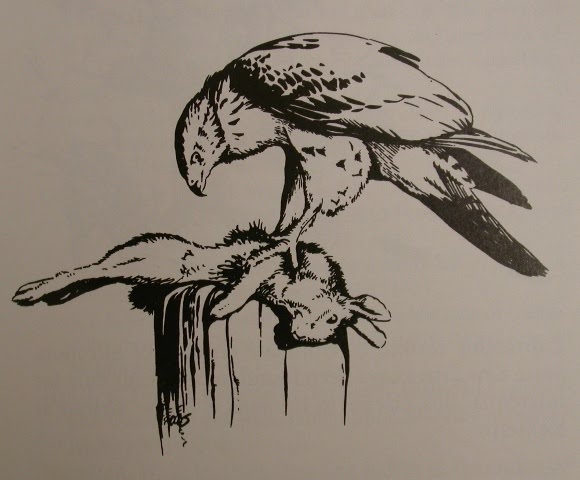
Finally, there are numerous vignettes that show animals engaging in characteristic behaviors and other fascinating scenes. A hibernating ground squirrel, all curled up in its burrow. An owl flying off with a limp mouse. A rodent negotiating a power line. A hairless newborn eastern mole, even more blind than the adult. An opossum toting leaves in its tail. A fox with a deceased chicken in its mouth. Some of these vignettes will make you chuckle; others are sobering; all are truthful.


In these small scenes, Schwartz often betrays his personal feelings about the animals. A scene of a bobcat pawing playfully at an overturned tortoise shows us he identifies with the animal’s curiosity and thrill of discovery. A scene of a house mouse leaping from a drawer, and human hands frozen in a gesture of surprise, captures a startled fear we can all identify with. And when we see these same hands cradling a young cottontail or sleeping baby raccoon, we know he feels warmly toward these vulnerable innocents.


By taking the time to study and to render these scenes, the artist lets us know it’s okay for us to feel the same way. Not many science illustrators are able—or permitted—to venture that far today.

-------------------------------

In guidebooks, there are tradeoffs with using photos or illustrations. Many enthusiasts prefer photos, since photos provide literal views of the animal in question. And today, from the publisher’s viewpoint, photographs are much less expensive and easier to obtain than original artwork, keeping publication costs down.

But illustrations have definite strengths—the animal can be shown in a typical pose that also allows all the diagnostic characteristics to be visible, and clear. Nonessential characteristics can be downplayed, and key characteristics accentuated.

And then “artistry” can come into play. This is what makes the difference between a perfectly good, purely technical illustrator, and someone like Charles Schwartz. This is how a guidebook can transcend its role as an identification guide, and become a record, a testament, of the species.


Have you seen those awesome prints by Audubon, in his Birds of America? In them, Audubon captures more than the beauty, more than the plumage, physiques, anatomy, and colors—he captures each bird’s personality. His prints are so valuable today not because they are technically accurate—but because they are sheer treasures, emotionally moving works of art.

Schwartz’s artwork is in the same category—he captures the soul of his subjects; he makes them come alive. Most of the time, his animals are unaware of your presence and are acting out their natural behaviors—sometimes playfully, sometimes ruthlessly. On other occasions, they stare right into you. In either case, there is no candy coating. Each animal is true to its own wild self.


Go to this exhibit—before it all goes back in a drawer.


Here’s What You Need to Know

The exhibition opens on Friday, September 10, with a ticketed event, 3–8 p.m., at Columbia’s Bass Pro Sportsman’s Center. Proceeds benefit the State Historical Society of Missouri, which holds a collection of over 500 Schwartz drawings and studies, sculptures, and paintings. Tickets are a measly $10, and there’ll be guided tours by the people who know the most about Schwartz’s art, with wine and cheese to boot.

Then, Saturday and Sunday, September 11 and 12, the display remains at Bass Pro. There will be tours, landscape and wildlife art and photography seminars, and conservation educational activities. Bring the kids.

Then, the exhibit moves to the State Historical Society’s Main Gallery, located in the Ellis Library building on the University of Missouri–Columbia campus. It will remain on display through January 2011.

After that, it goes back into protective storage. So don’t miss this, okay?

For more information, contact Laura Wilson at the State Historical Society: 573-884-7904 (wilsonlo@umsystem.edu); and be sure to look at this official website:
http://shs.umsystem.edu/art/schwartz.html


CREDITS

All the pictures in this post are horrible, horrible photographs made from my copy of The Wild Mammals of Missouri, Second Revised Edition (Columbia: University of Missouri Press, with the Missouri Department of Conservation, 2001).

I’m including these pictures as samples—partly to illustrate my “review,” but mainly as an incentive for you to go see the real things at this exhibit. The original art, held at the State Historical Society of Missouri, is much, much better!