Showing posts with label Clifty Creek. Show all posts

Saturday, March 12, 2016

Springtime Crayfish Happiness

Okay, here’s a real “Opulent Opossum” subject for you: the glory of crayfishes in early spring! Plus, the Missouri Department of Conservation has just published a new booklet to help you learn to identify our state’s 36 crayfish species!


Chris Riggert, the Volunteer Water Quality Monitoring Coordinator for the Conservation Department’s Stream Team program, headed up the project. The new booklet is an excellent introduction for identifying the state’s crayfishes—a good “jumping in” place to get you started in learning about (and thus appreciating) our beloved crawdads.


I love to see rocky creeks come alive in early spring.
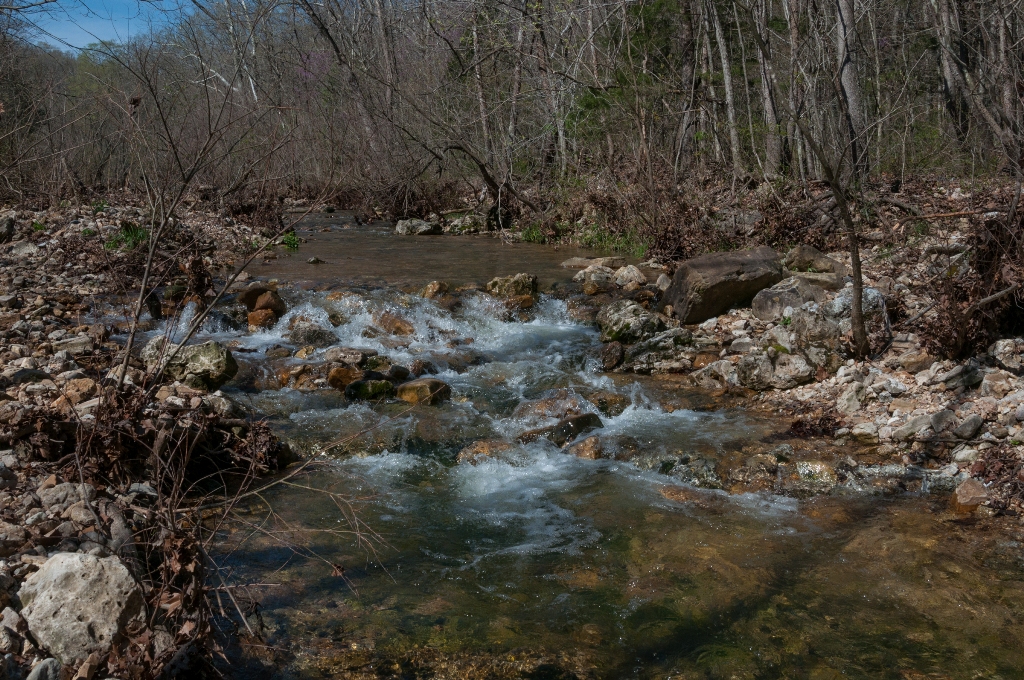


In early spring, with the leaves still off the trees, light penetrates through the bare branches of the forest canopy and shines on the creekbeds. This light creates a short-lived “bloom,” first, of a matlike brown algae (I think it’s a diatom), and then of a wispy filamentous green algae—like flowing green tresses, wafting in the current. That algae is to creeks what bloodroot, trilliums, and spring beauties are to the springtime forest floor.


And though the water’s pretty cold, it’s no longer frozen, so the animals start getting active. I have spent hours and hours by streams, watching the snails crawl around on the rocks, minnows glide and dart hither and thither, and crayfish explore the miniature aquatic caves and canyons.


It’s our midcontinent version of tidepooling, and it’s a fun as all get-out.


Last weekend, when we had some really nice weather, Sue and I visited Clifty Creek Conservation Area (which is fast becoming my favorite hikin’ place; click here for the MDC web page on it).


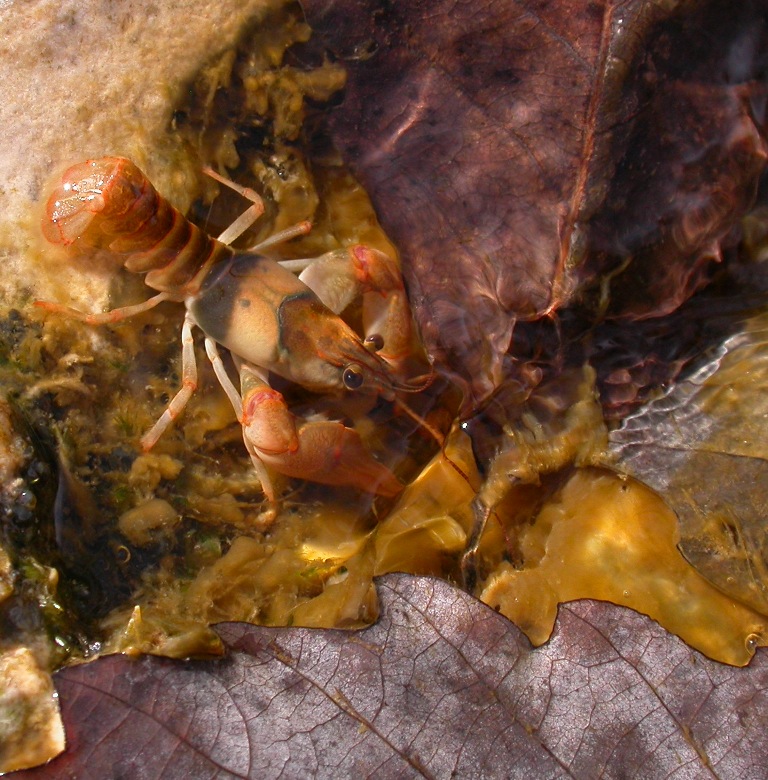
When we were there, we saw lots of golden crayfish (Orconectes luteus) scooting around in that crystal clear water. They were nearly all about one and a half inches long.

See?


One of the things that the new MDC brochure (and their other printed crayfish publications, and the online Missouri field guide) emphasize is that crayfish identification involves more than just colors, spots or stripes, and body shape. First, you narrow your search by habitat and geographic range.

Although a handful of our crayfishes are found nearly everywhere, most are restricted to certain parts of the state, and certain watersheds within those regions.

Some crayfish species occur only in the glaciated and unglaciated plains of north and northwest Missouri, where they live in streams that are rather sluggish and turbid, or where they tunnel clear down to the water table in prairies. Others occur only in the Ozarks, where the streams tend to be clear, brisk, cool, and rocky. And others are found (in our state) only in the Bootheel, where swamps and ditches prevail.

And within those broad ranges and habitat types, many crayfish species are confined to certain particular river drainages. An example is the Neosho midget crayfish, which occurs only in the Spring River and Elk River systems, so in our state, you probably won’t find it anyplace besides our far southwestern corner.

So if you want to identify a crayfish, first, identify the region, habitat, and watershed, and then start looking at the color, the spots or stripes, and peculiarities of pincer shape and so on. The new brochure organizes our crayfishes by location: Ozarks, Prairie, Lowland (Bootheel), and Statewide, and each entry has a distribution map showing watersheds, which helps you immediately narrow down your search.

This, by the way, is the same situation when you’re trying to identify fish, particularly minnows and darters, which are also numerous and diverse—unless you know where they’re from, they can be kind of a pill to identify to species.

I love being able to identify plants and animals. It’s not so much that knowing the name has some kind of magic (though it helps me remember)—it’s that the process of identifying forces me to look, really look, at the organism, and see things I might not notice before. That’s the value; that’s the fun.

For example, did you know that one of the keys to identifying crayfish can be the shape of the rostrum? Crayfish bodies are quite different from ours, so you have to learn a little “Crayfish Anatomy 101.” The rostrum is the triangular little beaklike structure between the eyes. It’s shaped differently in different species of crayfish—pointier or less pointy, long or stubby, ridged or furrowed (or furrowed with a little ridge within), with or without spines flanking the tip . . . Isn’t that fascinating? Now, you can really see it!

Anyway . . . these and many other thoughts pass through my mind as I peer into a creek like Clifty, watching the crayfish explore like little armored vehicles among the rocks and crannies. Crayfish happiness!

It’s my happiness, too.

Do you want a copy of this nifty booklet? It’s hot off the presses, so it hasn’t been promoted much yet. Send an e-mail to pubstaff@mdc.mo.gov, and ask for A Guide to Missouri’s Crayfishes FIS011.”


Friday, April 17, 2009

Family Archives

One of the hiking places I’ve recently “discovered” is actually a rediscovery. Considering I grew up the daughter of two native Missourians, one of whom is an acknowledged authority on the history and geography of the state, it’s no surprise that many of our family outings were spent exploring nooks and crannies of the Ozarks, the glaciated plains, the prairies. So I have indeed been to Clifty Creek before, and my parents recently showed me the evidence, in the form of slides.

There’s not a lot to say about the pictures, except to explain a few things. First, it was 1972, sometime in the summer (the next slides in the series show my brother’s birthday in early September), so I was six, almost seven, and Paul (with me in the pictures) was nearly nine.


Monday, March 16, 2009

Clifty Creek Conservation Area

Hi, folks, I’m taking you on a little hike with me. Along with restaurant reviews, and all the rest of the junk I want to comment on (you might recall), I intend to tell you about some of the good hikin’ areas around these parts. Here is one of our new discoveries.


Clifty Creek CA is run by the Missouri Department of Conservation. Its 256 acres are grouped in with the adjacent Clifty Creek Natural Area of 230 acres, so it’s a nice big chunk of land to explore, in Maries County, a little northeast of Dixon. Beautiful Ozark scenery. (The picture above is of a rocky glade along a high ridge.)

I was out there and thinking: Oh, man, I wish I could show this to “_____.” To every one of you who aren’t here and think that Missouri must be the most dreary place to be. Because the place is full of treasures. Even in early March.

There’s a sweet trail to hike. The literature we picked up at the trailhead says the trail was completed in 2008. No wonder it was in such great shape! It’s a fun trail, about 2.5 miles, with lots of elevation changes; it angles up and down the sides of valleys and dips down to the creek, rises again to the ridgetops, and passes through oak-hickory forest, mixed bottomland, sandstone glades, and limestone glades and cliffs.

The rocks are fantastic—lots of beautiful swirly zebra-striped chert, sparkly sandstone of various hues, limestone and dolomite riddled with holes, and more. Down at the creek, you could spend hours snooping around, oohing and ahhing over the purty rocks. The rocks tinkle like glass when you walk. Along the trail, especially this time of year, you appreciate the many different greens and textures of lichens and mosses that coat the rocks.

We first went out there February 8, when there was still ice on the creek and nothing green save for all the mosses, lichens, ferns, and cedars. But we had a blast even then and vowed to come back. So we went again on Saturday (March 14).

This time, the earliest wildflowers were starting to sprout up. I spied spring beauties, trillium, and Dutchman’s breeches—all just the foliage at this point. The award for “first bloomer” goes to the dogtooth violets (Erythronium albidum)—they were out in force, many sprouting up right in the middle of that new trail. Dogtooth violets, you might recall, are in the lily family and are not violets at all. “Second place” will most likely be awarded to toothwort (Cardamine concatenata) sometime this next week (they’re a type of mustard, and we saw them in bud; see the picture at the very end of this post). (And if there were any harbingers of spring, either we missed them already, or they are looking at third place.)


The trail is a loop, which is a big plus for me, since I appreciate not having to retrace my steps; I like to see new stuff all along the way. But here’s the biggest hoorah of Clifty Creek CA, the pièce de résistance: There’s a natural arch! How cool is that?


Its span is about 40 feet, and it’s right where the Little Clifty Creek (tributary) joins Clifty Creek. Depending on how you take the loop, you can visit the dolomite arch either three-fifths of the way along the trail, or two-fifths. (Looking at the map, it’s 1.4 miles to the arch if you go clockwise; counterclockwise, it’s 1 mile.)

Next time, I think I’ll bring us some tofu salad sandwiches with onion sprouts and some strawberries and feta cheese to enjoy at the base of the arch. (Then, on the way back to Jeff, we can stop at the Vienna Drive-In for a hot-fudge sundae if we’re still hungry!)


I’m also thinkin’ this will be great in summer, when we can put our feet down into that pool of water. Won’t it feel good! Meanwhile, this spring I’m satisfied to track the wildflowers’ progress.