Showing posts with label wine. Show all posts

Sunday, May 29, 2022

Jar of Goodness 5.29.22: Missouri Wines

. . . The weekly virtual “gratitude jar.”

This week, I’m expressing thanks for Missouri wines.

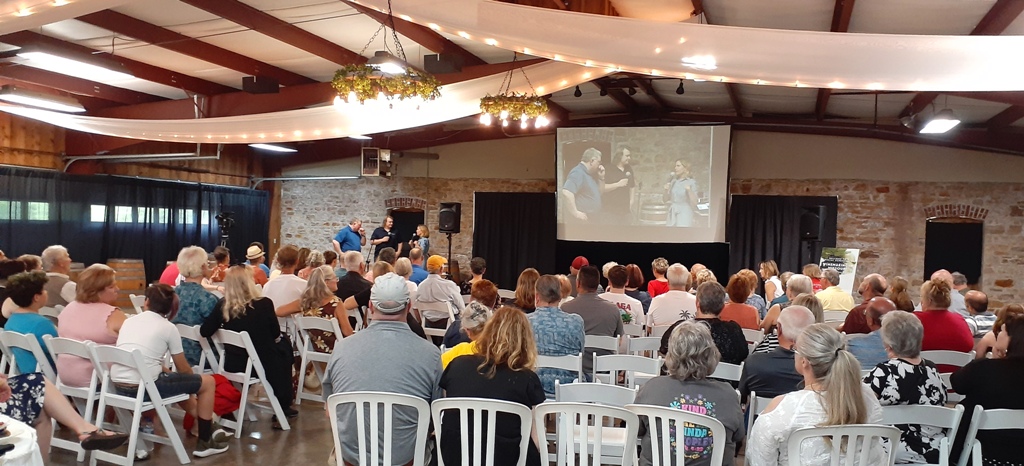
This afternoon we went to Stone Hill for a screening of a new documentary about the history of wine in Missouri, including a big dose of Stone Hill history in Hermann. It’s called Winemaking in Missouri: A Well-Cultivated History, and apparently it will be coming to a PBS station near you soon (starting in St. Louis, eventually being distributed nationally by American Public television).

Seriously, keep an eye out for it. It's well made, well-researched, and well worth watching.

Directed by Cat Neville as part of her tasteMAKERS series, it covers a long, interesting history: How German immigrants brought wine culture with them, how it was a challenge to try to grow European grapes in Missouri, how an invasive root pest introduced to Europe nearly destroyed the wine industry there, but Missourians figured out that North American grape rootstocks were naturally resistant and European grapes could be grafted onto them, saving them from utter destruction. And then, when Missouri wineries were producing the most wine in the country, then came Prohibition. So Missouri wines themselves had to come back from utter destruction.

One of my favorite points made in the movie is that here in Missouri, we don’t grow Zinfandel, Merlot, Cabernet, Chardonnay, Sauvignon Blanc. Our climate and soils aren’t right for those. BUT! We have the Norton, and we have a number of interesting hybrids of those European grapes with native varieties. So yeah, Missouri wines are not the same as the others. If you drink them expecting them to taste just like the wines made in California or Europe, you’ll be disappointed. . . . But why would you hold such an expectation? And why would you want them to be the same? . . . Variety is the spice of life! Travel broadens the mind! And wine is never about having that same exact delicious flavor again and again and again. That’s for fast-food connoisseurs. No! Wine is about trying and sampling new things. It’s about the journey; making discoveries.

We were a little late, so we missed most of the hors d’oeuvres before the showing, but we got to see the film. Afterward, as people milled about and sifted away, we sat at one of the outdoor picnic tables to enjoy a bottle of Norton.

Even though there had been a formal Q&A session before the film, the Held family and other Stone Hill people were still busy afterward speaking with tons of guests. (You could have figured that people would want to stand around and talk more after viewing the film!) The servers were removing the demolished trays of food, the leftover napkins, the plates. As the place emptied, we waved and did the hip-hip-hooray sign at Betty Held, the honored matriarch of Stone Hill, as she rode away with friends in a van. A little later, Jon and Nathan Held walked by and chatted with us for a while, so we had a really nice conservation with them after all. Truly the highlight of the evening.

John Thorne, my favorite food writer, said that good wines are always worth trying, because you can usually see why some people really like them. They’re interesting. Even if it’s not to your personal taste, you can at least appreciate them for what they are: different. Somebody’s beloved local flavor. “Malbec, for instance,” he says, “is a varietal that tastes rather like ink; a highly rated one tastes like delicious ink.”

Variety is the spice of life. . . . Variety is the spice of life.

Friday, August 27, 2021

Stone Hill Ozark Hellbender Red: A Great Wine for a Greater Cause

Hey, I want to remind you to pick up a few bottles of Ozark Hellbender next time you’re out buying wine.

Now if you’re going, “whatever is she talking about?” then you need to read on, because this is really cool.

In 2018, Hermann, Missouri’s own Stone Hill Winery—the historic 1847 winery that, with its restoration in the 1960s, almost single-handedly started the renaissance of Missouri’s wine industry—started producing a dry red blend they call Ozark Hellbender.

Why the weird name? A portion of the profits go to help fund the research and restoration efforts of several conservation organizations to restore the Ozark hellbender, an endangered native Missouri aquatic salamander.

Actually, in the past year, both of Missouri’s subspecies of hellbenders have been declared federally endangered, so restoration efforts are more critical ever.

Here are some links to learn more about hellbenders, their conservation status, and the Saint Louis Zoo’s captive breeding and restocking efforts.

In a nutshell—as if you could fit one into such a small place—hellbenders are huge, slimy, brown salamanders with small eyes and loose skin. They spend most of their time hiding under big flat rocks in cool, fast-flowing Ozark streams. Adults can be 11 to 20 inches long, making them the largest salamander in North America (three relatives in the giant salamander group are larger and live in East Asia; all of them range from threatened to possibly extinct in the wild). Missouri is the only state to hold both subspecies of North American hellbenders.

The reasons for their decline are numerous and are compounded by the fact that females usually don’t breed until they’re about seven or eight years of age. And even then, they may only breed every two or three years. They typically live for three decades in nature, but that’s assuming their streams remain habitable for them, and even then, their small, vulnerable offspring need to have a decent shot at surviving to breeding age. One hellbender was documented as living to age fifty-five—no wonder they don’t breed until they’re seven or eight; they’re kinda like us.

And so there’s a captive breeding and restocking program, which, combined with efforts to improve and protect their natives streams, might bring them back to the point where their populations are stable.

A personal reverie: MU’s legendary zoology professor Dean Metter used to keep the university’s herpetology collection (enclosures with live snakes, lizards, and such) in a hallway on the second floor of Stewart Hall. My dad, with the rest of the geography department, had their offices in the basement of that building. Often, when we were there to pick up Dad after work and there was a delay of some kind, I’d go upstairs and visit Doc Metter’s herps.

As a pigtailed Campfire Girl, and before, as a tagalong little sister with my brother’s Cub Scout den, we had a guided tour of the collection by Doc Metter himself. I’ll never forget him gently removing a speckled kingsnake from its cage and letting me hold it.

Along one, rather dark wall was a big, long, galvanized tub about waist-high. It must have had a chiller on it, in addition to the circulation/filtration. It was always humming and moving the water around. And there, in the tub, was a fourteen- or sixteen-inch-long hellbender. It never seemed to move, except to kind of waver a little with the current; it just rested in there like a shadow. It was there forever, it seemed. Knowing what I know now, it’s sad to think of that creature living in a galvanized tub in a lonely university hallway, educating those of us too young or citified to discover hellbenders on our own.

Nature had designed it for a life creeping around on Ozark stream bottoms, exploring amid boulders and bunches of watercress, crawling under large flat rocks, hunting crayfishes. Of living as one with the quick freshness, in the higher oxygen content of springfed sections of the river, and the richness and quietude of the pools.

. . . Anyway, there’s something primordial and shadowy about hellbenders; something uncanny and otherworldly. Very fascinating. It’s heartbreaking that something so . . . so . . . seemingly eternal could become extinct, wiped from existence forever.

So, this wine helps raise funds to help the hellbenders.

But it does a few other things, too.

It shows the maturation of Missouri’s wine industry, when one of its leaders is able to step well beyond the tried-and-true, by now rather formulaic marketing angles of “quaint local winery,” “historic ethnic German winery,” and “have your wedding receptions here, folks!”

I really like how Stone Hill, with this project, is connecting with Missouri's natural history and showing a dedication to its future. The “German heritage” angle is an obvious focus and starting point for most Missouri wineries, but this is showing Stone Hill's maturity as an institution.

Also, German immigrants brought a tremendous love of nature with them to the New World. While the English-derived Americans liked trees, grass, and gardens when they were trimmed, mowed, or planted in rows, the Germans held romantic feelings about wild places, where plants and animals grow free and take the forms and patterns innate to them. Yes, many German immigrants were (or became) master horticulturalists, but alongside their love of cultivation, they held a deep love of untamed nature. So this project, which celebrates an aspect of wild Missouri that many Missourians would feel squeamish about, continues that Germanic love of wilderness.

When I communicated this idea recently on Stone Hill’s Facebook page, I got this nice reply from someone at the company: “Thanks for the kind words! We are really glad we can play a small part in continuing that tradition and supporting this special Missouri species! As farmers, it is so important to keep our natural world healthy for the future.” . . . To which I say, Right On!

I don’t think they’ll mind me flat-out copying their descriptive text for the 2018 Ozark Hellbender wine:

BLEND INFORMATION: Since the Ozark Hellbender spends most of its life secretively hiding under rocks in the bottom of Ozark streams we are keeping our blend a secret as well. But we’ll give you some hints! All variety of grapes used are grown in the Ozark Mountain AVA. Some grapes aged for one year in neutral oak barrels to bring out complexity, softness and drinkability. Then just before bottling, like any good family recipe, we add the final variety which is held secret only for our winemakers to know.

TECHNICAL INFORMATION: Alcohol - 13%; Residual Sugar - 1.5%

TASTING INFORMATION: A smooth red blend with aromas of sweet cherry, blueberry and a touch of toasted oak. Creating a soft, complex and very drinkable wine, made from grapes all grown in the Ozark Mountain AVA. *A portion of the proceeds from every bottle of Ozark Hellbender wine sold is donated to the Saint Louis Zoo and hellbender conservation. (750ml)

AWARDS:

Bronze - 2019 Missouri Wine Competition

Yes, it's an award-winning wine! In fact, just recently, the 2019 Ozark Hellbender won "Best of Class Semi-Dry Red," and the 2018 Ozark Hellbender received a gold medal, at the 2021 Missouri Wine Competition. Way to go, Stone Hill!

Seriously, what are the grapes, you wonder: Here’s what they told me (in response to my Facebook question, subtly hinting if Merlot was one of the ingredients): “No Merlot in it! It is a blend of three grapes: Norton, Chambourcin, and #3 is a secret. [Finger-to-lips "shh!" emoji.] All three are grown on our own vineyards though.”

Norton is the strongest part of the blend. Have you ever tasted Norton wine? It’s distinctive. It’s North America’s native, sophisticated dry red grape variety. It’s Missouri’s premier wine grape. It has a fascinating history; if you want to read more, I heartily suggest Todd Kliman, The Wild Vine: A Forgotten Grape and the Untold Story of American Wine.

Norton isn’t for everybody. It has a distinctive flavor. It’s like this: If you’re hankering for oranges, a grapefruit will taste just wrong; it’s so close, it seems almost an insult to oranges; so close, well—just give me an apple. But the fun of wines is their variety. Thank goodness wines aren’t all the same! There are many really good wines—you simply won’t like all of the types. In his insightful essay “Knowing Nothing about Wine,” John Thorne described it like this: “Needless to say, wines with the same rating don’t taste equally good (Malbec, for instance, is a varietal that tastes rather like ink; a highly rated one tastes like delicious ink).”

But Thorne goes on to talk about how really good wines, highly rated ones—even if you don’t end up liking the variety—will still be worth trying, because you can usually see why some people really like them. They offer food for thought. They’re interesting. I suggest trying Norton with this in mind.

I heard somewhere that Ozark Hellbender red became the top-selling red at Stone Hill Winery in Hermann when it was released (apparently, it still is). That’s pretty remarkable, because the average Missourian typically prefers sweet wine. That Hellbender Red is selling so well could mean that Missourians have suddenly become conscientious consumers, choosing products that give back to good causes . . . or it could mean that Missourians have suddenly developed more cultivated palates . . . or it could mean that Ozark Hellbender red is a deviously clever blend that offers enough berry flavor to satisfy the average palate but enough complexity to make it good for people who prefer dry reds. And serving it chilled makes it smoother for red-wine newbies. Indeed, this blend can be kind of a “gateway drug” for Norton, and even “dry red” appreciation. Or it could be a combination of all three.

I think lot of people would like to drink dry red wines because of their purported health benefits and because, as you sit among your friends, a glass of deep red wine simply looks groovier than white—but many can’t make the leap in terms of flavor. I can see someone trying a Norton varietal and thinking, “I can’t enjoy this.” But after a few weeks enjoying Ozark Hellbender red here and there, you could easily acquire an appreciation for Norton: “Oh, this is that unique flavor I’ve come to enjoy in my Ozark Hellbender red, only more of it.” . . . And if this is what Hellbender red achieves for Stone Hill, then bully for them! Smart-smart-smart-smart-smart.

I hope you will go out and try a bottle of Ozark Hellbender red—for the tasting experience . . . and to help the hellbenders.

Thursday, August 8, 2019

Vines on Broadway, Jefferson City

“Here’s That Place I Was Talking About”

That’s a quote from one of the early social-media reviews for Vines, and the more I think about it, the more it seems perfectly apt for this friendly, cozy, relaxing piece of heaven on Jefferson City’s Southside. The place is a huge success without doing a speck of advertising; people just bring their friends, who bring more friends, and so on. “It’s a great place! Let’s meet there Thursday after work!”


There’s so much I want to write about Vines. I really could go on and on, singing praises and hallelujahs about it, but I kind of have a deadline: tomorrow (Friday, August 9, 2019) is its one-year anniversary of being in business, and I want to have this posted for it.

I remember its first night in business, because I was there, poking around, taking pictures, enjoying a glass of the Malbec. The appearance of a new business just steps away from our house was exciting, especially since Vines on Broadway is an establishment that sells wine and appetizers. And no joke about its nearness to our house. It’s exactly one hundred steps from our basement door. I counted. (This might mean that I’m “livin’ the dream,” folks!)

So I’ve been a regular customer for a year, now, so I can reflect on the development of this business. Sorry if you’re looking for a tough-minded critique—I decided long ago that I don’t have time to “review” places I don’t like. I do, however, have time for cheerleading sessions, so that’s what you’ll get from me: here is why you should check out this place.

Basic information: As of this post, Vines on Broadway is open Thursdays, Fridays, and Saturdays, from 4 to 9 p.m. It’s at 510 Broadway Street, which is just south of the Highway 50/63 Expressway, about three blocks south of the Missouri capitol building. If you really want the “ins,” I suggest following Vines on Facebook, so you’ll know when they’re open for, say, Halloween night (which fell on a Wednesday), or New Year’s Eve (which was on a Monday). On social media, you’ll also be notified of any featured foods—because it changes—and other events, such as this summer’s new grilled goodies on the patio on Saturdays. Lorie, the owner, does not advertise . . . because she does not need to.


Vines, Like Real Vines, Likes to Grow and Develop

One thing that’s been a constant over the past year is growth and development—change—in an organic fashion. Think of how vines grow upward, into free spaces, toward light—that’s how this business has developed. Lorie Smith, the owner of Vines, has an artistic sensibility and approaches her business with a creative mindset. She tries new things. If something’s unpopular, she’s okay with letting it go. But if her customers like it, then she flies with the concept. Here are some of the things we’ve noticed in the past year:
  • The furniture changes. Lorie’s always discovering nifty old chairs, sofas, tables, and more, and she’s open to rearranging it, always looking for ways to make her customers more comfortable, in open conversational groups.
  • The decorations change with the seasons—she has collections of vintage holiday decorations, framed prints, colored lights, floral arrangements—and you can tell she has fun placing these around the parlors where customers sit. Even the decor in the bathroom is fun, even heartwarming (yeah, I know, in the john even!). Soon after Vines opened, she had a friend paint stylized grapevines all along the floor of her front porch. The decorations and furniture are eclectic. Most of it is vintage, which goes with the building. It’s like being in someone’s home. Lorie’s artistic tastes are apparent, with stained glass, chandeliers, nifty antique-mall and auction finds, and occasional quirky pieces, like a carved end table shaped like a hand. The table decorations change with the seasons. It’s all very attractive and creative.
  • The patio in back is a new development as of this spring. It had been about four parking spaces, but Lorie and her compatriots transformed it, enclosed it with a fence (a city requirement for serving alcohol), adding a variety of chairs, tables, string lights, patio umbrellas, and potted plants ranging from tropical elephant ears to tomato vines. When the temperatures got hot, she installed a fine-mist system that drops the temperature by at least 10 degrees. And now, she’s found friends who do outdoor grilling each Saturday night.
  • Special events happen; for a while, each Thursday was “Vegan, Vinyl, and Vino” night, featuring a bona fide record player and a bunch of LPs (think Bonnie Raitt, James Taylor, Jim Croce, Neil Diamond, and Rita Coolidge . . .). Now, Alexa typically churns out Van Morrison songs and similar. Then there was the Halloween Party, and the New Year’s Eve party, and the Fourth of July Party, and . . .
  • And the food has changed. In addition to the new Saturday-night offerings from the grill, there has been a lot of change and creativity in the past year. But the food should be its own category.


Tasty Nibbles

Vines has been described as a wine and beer bar with tapas. But calling it a “bar” seems wrong, because it doesn’t have a bar. It’s more like . . . a laid-back cocktail party in someone’s home. You’re sitting on real furniture, this is an actual coffee table, and that’s a genuine smile. And to me, “tapas” implies a distinct emphasis on Spanish tapas cuisine. But if you’re expecting oiled sardines, fresh squid and oysters, Spanish chorizo and butifarro, manchego cheese, and tortilla de patatas, you’ll be let down.

Actually, the menu at Vines started out much more eclectic than its traditional Spanish forebears. Changing the dishes makes it interesting, and it lets Lorie try different ideas, and have some fun in the process. It was also a way for Lorie to explore what her customers wanted. Over time, the menu has stabilized into two items that are available every night, plus two or three additional items that always change.


The “Vines Platter” is one of the two choices that are available every night. It’s a basic cheese and summer sausage plate, with sliced baguette, oil-cured olives, grapes, nuts, plus olive oil and seasoned grated parmesan for dipping. Usually, there’s a few squares of nice, healthy dark chocolate as well. (I've been lobbying for the possibility of a “Vines Plus Platter,” which would include some tastier, fancier, more adventuresome cheeses, and I am hopeful this will eventually happen.)

The other dish that’s available every night is the “Slap Yo Mama shrimp”: plump, juicy, shrimp sautéed in butter and garlic, served on crostini and dressed with a blend of Cajun spices. A customer favorite!

As for the other foods available on any given night, the choices have included
  • Sliders (like, roast beef and provolone with au jus, for example)
  • Wings (all sorts of sauces and glazes; now, especially nice on Saturdays, when they’re grilled)
  • Crostini (beef and herbed cheese; steak, caramelized onion, and gorgonzola; reuben—a favorite of mine; tomato, basil, and mozzarella . . . for example)
  • Spreads and dips (smoked salmon; homemade hummus; pizza hummus; spinach and artichoke dip . . .)
  • Soups (French country vegetable; Italian roasted sweet potato; Tuscan; creamy Italian sausage and tortellini . . . the soups were popular last fall and winter)
  • Miscellaneous appetizers (prosciutto-wrapped asparagus; goat-cheese-stuffed, bacon-wrapped dates; stuffed mushrooms; sweet potato taquitos; BLT lettuce wraps; pot pies; mini quiches)
  • Desserts (Oreo and cream cheese truffles; blackberry cobbler; pecan pie bread pudding; apple pie; salted caramel pecan cheesecake dip . . . and now, gelato and sorbetto from a locally owned food truck business)

When soups are served, Lorie and company are happy to divide the order into separate small bowls, which is an incredibly nice touch, so you and your friends don’t have to pass a bowl back and forth. They’re also fine with splitting orders on the bill, which is one reason Vines is popular with groups of friends: it’s a sharing menu, so they know that the food bill will be split between, say, four people.

Another wonderful thing is the kitchen’s flexibility and willingness to alter dishes for people with dietary restrictions, such as gluten-free foods. Indeed, Vines used to have weekly “gluten-free Fridays,” and although that idea got dropped for lack of enough interest, you can always request gluten-free options. If you have a special dietary need, you’ll find Lorie a sympathetic host. She’ll come out herself and ask about your preferences. She’ll work out something for you. Her hospitality is amazing.

And at some point, you’ll have to “ask about our balls.” One night last winter, Lorie and her friends were in the kitchen experimenting with making white-chocolate-dipped bonbons, and they produced a completely unique combination of creamy, tangy, sweet, rich, crunchy, chewy flavors and textures. She kept going around to her customers, asking them, “try one, and tell me what you think is in it.” Few people could guess, because the flavors blend so mysteriously and so well. I won’t tell you what’s in them, but it’s a very tasty, not-too-sweet, grown-up truffle—and “unique” does mean “there are absolutely no others like it.”


“Tonight’s Forecast: 99 Percent Chance of Wine”

Yes, Vines sells wine, by the bottle and by the glass. There’s a corkage fee if you bring your own, but why would you? Lorie and her distributor have curated for you a lovely selection that covers all the bases, and you can try samples, so you’re sure to find something you like.

The wines are subject to change, of course, but they are all great examples of their styles, including domestic and imported, dry, sweet, and everything in between. There is no “goof wine” (as Sue’s dad would call it) on the menu. Here’s a quick description of what you’ll find, from a recent list. (And hey, if you want to know the names of specific wineries/brands, then you’ll have to go there and find out.)
  • Whites: a Sonoma Chardonnay (CA); a Marlborough Sauvignon Blanc (New Zealand); a Veneto Pinot Grigio (Italy), and a Mosel Riesling (Germany).
  • Reds: a San Joaquin Valley Moscato (CA); a rich Spanish red blend called Berola (which is kind of the house favorite); a Sonoma Cabernet (CA), an Uco Valley Malbec (Argentina) (my favorite of the reds); and a Pinot Noir and Merlot, both organic from Mendocino (CA).
Also available are a French Rosé and an Italian Prosecco, plus a selection of beer, and truly delicious water supplied by EcoWater.

By the way, I keep lobbying for Vines to offer at least one Missouri wine—for example, Stone Hill’s Hellbender Red (a dry, complex Norton blend, which is also a fundraiser for efforts to restore an endangered species) . . . but so far no traction. (I’ll keep pushing, my friends.)

“Home of the 7-Ounce Pour”

You want to know about the cost, don’t you. A glass of wine ranges from six to nine dollars, depending on the wine. Bottles start at eighteen (the Pinot Grigio); the most expensive is the Berola, at twenty-seven. In case you are interested, Lorie (who is also an accomplished stained-glass artist) etched a tiny little dash onto each of her wine glasses to mark the correct level for a perfect (and consistent) 7 oz. pour. (The industry standard, FYI, is 5 oz.) They won’t short you.

As for the other prices, unless you require large amounts of food (I’ve seen the enormous portions served at some restaurants), you will probably be impressed at how reasonable the food prices are. These are small plates—appetizers—tasty bites—prepared in a small kitchen, to order, just for you, and served on interesting little plates. Other, swankier places would charge you double for less. Which leads me to my last subject: The ambience, the feel, the vibe.

“What a Great Place . . . Warm, Inviting, and Unique!”

Okay, so they serve an interesting parade of fun, tasty little snacky-snacks, and there’s a reliably satisfying selection of good wine . . . but then there’s another, even better thing about Vines that I’d like to share with you: It’s just fun to go there.

First, it has to do with the layout and the decor. I’ve already told you about the changes Lorie’s made over the course of a year, but the basic framework—a charming historic brick home built by German immigrants about a hundred years ago—gives the restaurant a feeling of history and lots of charm. Lorie has learned about the family that owned it, the Schlehers, who had a hardware store uptown, back in the twenties. A recent renovation brought the building into the twenty-first century with flying colors, and Lorie’s using the first floor for the Vines business, while she actually lives upstairs.

So here’s the basic layout. You park on the street or in a small lot off the alley, walk up steps to the front porch, and enter the front door. There’s a host stand at the bottom of a staircase, and beyond the stand is a hallway leading to the small kitchen and to the restroom. Your greeter will lead you to the left, where there are three rooms for seating.

The first room is a front parlor, with a cozy gas fireplace, a sofa, coffee table, and antique stuffed chairs.


The next room is a second parlor, with another sofa and coffee table, plus a few other café tables with chairs. (I bet most people think of it as The Purple Room.)


Behind it, the third room has a big dining table. It can be used for small conferences or meetings. Nifty wooden pocket doors allow you to close off this room for privacy. I find myself thinking, Don’t I belong to some group that could have its meeting here—?


The patio is truly pleasant; I described its development above. The crowning achievement for the patio thus far was the Independence Day party. The place was packed with all Lorie’s regulars. She had some musicians on the back porch strumming guitars and singing. And the views of the Jefferson City fireworks display were excellent—while other people were a few blocks north, gathering chiggers on the capitol lawn and dreading the traffic to come, we were all sitting in patio chairs, sipping our beverages, enjoying the cooling effects of the misters.


I’ve been searching for the right way to say this: Vines is attractive, and beautiful, without seeming snooty or untouchable. There’s a casual feeling that tempers the elegance into something genuinely approachable, like the difference between some wealthy person’s mansion and your own beautiful, comfortable living room. Or Architectural Digest versus Shabby Style. Which leads me to my final subject: the mood itself.

“One Visit and You Feel Right at Home”

Lorie told me that when she opened Vines, her goal was to create a space where people could get together, socialize, and relax, and she’s achieved that goal. Her success, in large part, is due to the host herself; she is outgoing, kind, shrewd, and has an easy laugh. She is genuinely welcoming; she makes it personal. This is a chemistry that all the chain restaurants in the world cannot touch.

It really does start with Lorie; I don’t think anyone can long remain a stranger to her. She greets her customers, sits down with them if they seem agreeable, and chats. It’s not uncommon for her to bring out samples of something she’s cooking up or experimenting with. Like the time she brought around a plate of bonbons made by mixing crushed whole Oreos with cream cheese, rolling it into balls, and dipping them in chocolate. “Hey, wanna try one of these? Check it out. I just made them.”

When she was thinking of opening Vines, she had friends tell her, “You have to be on High Street,” and she insisted: “No.” She found the place on Broadway and knew it was ideal for her. Okay, if you’re not from around here, you might not “get” this. Jefferson City’s High Street (which runs atop a high ridge parallel to the river) is the main business district of the town, frequented by bankers, lawyers, judges, legislators, and lobbyists. But when you cross south of the 50/63 Expressway (which occupies the low valley of a now-diverted creek), you ascend up more hills as you enter Old Munichburg, Jefferson City’s German-settled southside. Working-class people lived here; innumerable state workers—clerks, secretaries, and charwomen—lived here; and the funky ghosts of sauerkraut-odor linger in the woodwork of many of these sturdy brick homes. Lorie, a Tipton native, I think, picked up on this vibe immediately and recognized its cozyness.

And this is the real reason to celebrate the first year of Vines on Broadway: its society. Don’t go there if you want to be in a bad mood, or if you want to sit alone in dour silence. Vines is built for conversations and interconnections.

You’d think by now I’d get used to it, but it thrills me each time: As I’m sitting there, sipping and chatting with my companions, I almost always see two separate groups of people become one. It’ll start with someone overhearing some part of the conservation at a nearby table: “Sorry for butting in, but I couldn’t help hearing you mention _____, and . . .” And the response is usually an enthusiastic, “Oh, you’re not butting in at all, and that’s interesting what you said about _____.” Eventually, often, the parties end up repositioning their chairs in a big circle so they can all visit together.


A few weeks ago, one couple was staying at the nearby motel and kind of stumbled upon Vines; they were sitting on the patio; and another couple, nearby, were visiting Vines for the first time, too. The topic that linked them was “Isn’t this a great place? I wish we had something like this where we live!” Soon, the first couple just flat-out said to the other two, “Why don’t you just come over here and join us at our table?” So that’s what they did, and they spent the rest of the evening there, chatting and having a grand ol’ time.

“Because It’s Not Good to Keep Things Bottled Up”

Vines is a place for the Chardonnay moms to get together and deconstruct their week. It’s a perfect place for date night (or double-date night), where there are no TVs to distract you from the one person you want to focus on the most. It’s a place for the gals at the office to meet after work on a Thursday, to share a bottle of wine and snort about their jobs. It’s a place for certain Munichburgers (ahem) to meet and strategize about the organization. It’s a place for book clubs to meet. Middle-aged Harley bikers staying at the hotel have turned the patio into their own mini meet-and-greet party.

Then there was the night were some women showed up with a board game they’d just bought at Carrie’s Hallmark uptown, called “Chardonnay Go!” Everyone at Vines that night was drawn in to the game and had a great time.


And it has occurred to me, more than once, that Vines is on some level “feminine space”—in the same sense that a parlor with nice furniture is feminine. You are expected to use your manners here; this is not a sports bar with a concrete floor that can be bleached and hosed off. Keep your feet off the furniture; use your “indoors” voice. Buckets of beer are not available. There are no televisions, so there are no flickering images of sweating athletes, no corrupt politicians and “shouting guys,” and no shoot-em-up cop shows. No strobelike TV commercials to agitate your mind. No wonder it feels serene.

One of my favorite memories of last winter was the night of January 11, a Friday night, when we got an exceptionally heavy, wet snowfall starting in mid-afternoon. Lorie had mentioned that Fridays were her slowest night, and as the snow accumulated, and moving cars gone from the streets, I peered out my window to see if Vines was even open. Her light was on. So Sue and I walked our one hundred steps through the snow, opened the door, and stamped the snow off our boots: “Are you really open? We didn’t want you to not have any customers!” So the three of us sat together, enjoying wine and chatting . . . about the neighborhood, about art, about ideas; about people; telling our stories . . . as the snow accumulated and the blue sky turned to deep midnight snow-cloud gray. It was well after closing time when we walked back home. And we had had a terrific time.


Vines is a place to not take yourself too seriously. It’s a place to enjoy life, cherish your friends, and cultivate new ones.


Although some people seem to think wine is a beverage for snobs, and use it to pretend they are somehow upperclass, I’ve read recently that wine has a very long history of being viewed as a “civilizing” beverage, compared to beer and especially to hard liquor. Wine asks to be examined, swirled, tasted, contemplated . . . sipped again. It inspires conversation, creativity, ideas, and sociality. Indeed, apparently Thomas Jefferson himself—our city’s namesake—believed this was so. How appropriate for Vines on Broadway to offer its tasty, friendly, civilized, social atmosphere to our City of Jefferson.


Friday, August 31, 2018

Capitol City Cork and Provisions

UPDATE: Capitol City Cork, and its owner, Jami Wade, celebrated Cork's last nights in business on Friday and Saturday, June 28 and 29, 2019. As of early July 2019, the business is for sale. Jami was ready to move on to something else; said the business had never taken a loss. Anyone want to take the reins of one of JC's premier hospitality businesses?

----------------------------------

This post is soooooo long overdue. Capitol City Cork has been in Jeff City for years, now, and it’s become an institution. And it’s a lot of things to a lot of people. In my opinion, it’s an oasis.


Located at 124 E. High Street, it’s almost exactly in the center of town, just a brief walk from the State Capitol, the Cole County Courthouse, and gaggles of law offices, lobbying groups, PR firms, and state office buildings. Being uptown, having an elegant ambiance, and serving beautiful food and beverages, it receives plenty of uptown customers. And you never know who you might see in there.


Disclaimer: As you might have gathered, my “restaurant reviews” are no longer critiques—instead they are cheerleading sessions about places I genuinely like, meditations on places that are great on levels deeper than the superficial. Places whose presence make our community better. Thus I describe my beloved Cork.

When I started this blog and named it the Opulent Opossum, I had in mind the juxtaposition of having big city tastes while living in a small town. How does one lead an opulent life in a place where the majority are thrilled with fast food and interstate chain restaurants and are suspicious of cuisines and foods none of us grew up with?

And how does one embrace the benefits of a small town—its neighborliness and warmth, its charm, its unabashed community spirit—without also caving in to the provincialism, self-satisfaction, and fear of change that’s the flip side of small communities?

How can we live in Jefferson City as Opulent Opossums?

Well, Cork exemplifies the best solution to this question: it strives for the best and highest tastes while being completely grounded in the warm and friendly neighborly hospitality people in big cities have nearly forgotten about. It’s elegant, but it’s a laid-back kind of elegant. A place to relax and celebrate this precise moment, in this exact place.

So, if you’re reading this, and if you’re wondering what kind of place Cork is, then let me describe it to you. In a word, it’s a bistro. It’s a long narrow room with a small bar in the back and a hallway beyond that leading to the back door. They make the most of what is actually a rather small space.


There are a variety of tables and seating options, including tables by the front window, so you and your friends can check out all the action on High Street (yes, that’s a small-town joke) . . . but there are more secluded tables farther in. (Think: date night.)


. . . Or you can sit at the bar, and no doubt make a new friend . . .


. . . Or you can enjoy the café tables out on the sidewalk.


You even have options getting in. In addition to the High Street entrance, there’s another entrance in the rear, along with opportunities for nearby parking in the lot behind the row of buildings. So you can usually park pretty close. (Big-city people, be jealous.)


The emphasis, as the name implies, is on wine. The list includes an array of tasty special offerings, but then the house wines are much better than average. The glasses are enormous, allowing you to properly swirl, sniff, and savor your beverage. (Some people have actually complained that their glasses aren’t filled enough—but they don’t take into account the large size of the glasses!)


And if you’re not into wine, there are good beers and other beverages as well. There’s a reason they call it Cork and Provisions!


And here’s a nice touch: They keep glass bottles of water chilling in the fridge and bring these to the tables, so guests can refill their own water glasses.

Their chow is called “new American,” but I think “fresh bistro fare” is a better label. If you find menus for Cork online, be skeptical—the menu has had several changes over the years, and it can change seasonally. Websites can’t keep up. Cork doesn’t use a food service, and sometimes something just looks really great at the farmer’s market, and suddenly that’s the day’s special.

So the menu can change, and that’s a good thing, my friends! Fairly recently, they’ve added burgers to the menu. Juicy, handmade burgers! And they do this thing with a bleu cheese cream sauce as a topping, and, well . . . you just have to try it. I did, and got perfectly prepared Brussels sprouts as a side.


When people criticize Cork, what do they say? The biggest complaint, I think, is about the hours, which would be easier to understand if they were more traditional or conventional. According to Cork’s Facebook page, they’re open Tuesday through Friday, 5:00 p.m. to 9:00 p.m., and closed Saturdays, Sundays, and Mondays. So: no lunches; no weekends at all; and no Mondays. Meanwhile, they may be closed (or open) certain nights for special events. And special events are pretty common, both at the restaurant and catering offsite. If you’re in doubt, call them (573) 632-2675 or message them (as on the Facebook page).

You’ve probably heard the old saw about “Do you want it fast, cheap, or good? Because you can’t have all three.” At Cork, the primary emphasis is on the last: quality and freshness is the priority. As international travelers know, not everyone in the world agrees that food should appear instantaneously, or that all diners are understood to be in a hurry. Cork has the sensibility of a café in, say, Paris, where dining is valued as a social occasion, for conversation, tasting, lingering, enjoying. Here in Jefferson City, this is high praise indeed.

One more thing about Cork: It is connected, philosophically, stylistically, and (by means of a small hallway in back) literally, to Capitol City Cinema, Jefferson City’s community-supported arthouse theater. This nonprofit single-screen cinema shows independent, foreign, and documentary films, and it partners with other nonprofit groups to improve the community. It, too, is an elegant space, with chandeliers and comfortable seating, and you can purchase gourmet appetizers, beer, and wine at next-door Cork to enjoy before and during the movie.


The two entities benefit one another: What could be more perfect than dinner and a movie? —Oh yeah! A lovely dinner and an awesome movie! It’s a brilliant strategy for helping the restaurant business, while also contributing to the cultural scene in this small town. Maybe you won’t want to see all the movies, but I’m sure there are some you’ll love.

And so here’s my call to action: Check out Cork and the cinema. Become a “regular”! “Like” ’em on social media so you know about upcoming movies and events at the cinema and can stay up-to-date on Cork’s specials and special events. The people who run these conjoined institutions are your neighbors, who love Jefferson City and are contributing to it, via their daily work, every single day. As with all locally owned businesses, you can “vote” for their continued presence with your meal and entertainment dollars. You won’t be let down.


Friday, July 29, 2016

Bub’s Sangria

When I lived in Montana back in the 1990s, one of my coworkers shared with me a homemade cookbook—a smallish, green-covered loose-leaf job full of hand-typed recipes and hilarious commentary. The author, whom my coworker declined to identify (perhaps it was he himself), had apparently made the book just for fun. My coworker said he had encouraged this fellow to seek publication, but that he had repeatedly declined. Too bad!


I photocopied a few of the recipes, but I wish I’d copied the whole book.

The writer of this cookbook had adopted an alter-ego with the pseudonym “Snodgrass,” who was part hillbilly buffoon, part everyday Joe, a guy-in-the-kitchen making tasty chow with whatever’s available. Except this common Joe had an extraordinary vocabulary and wit. There’s a deceptively well-educated writer behind the bumbling cook sharing his culinary discoveries, describing his cooking techniques in hilariously perfect descriptive terms.

Today, I imagine this writer has a blog somewhere and is entertaining the hell out of his readers. I hope so. (Trust me, I’ve looked.)

And I hope the writer finds my post, here, and contacts me, because I’d like to thank him (her?) for creating such a fun cookbook. And like my coworker, I’d like to encourage him to seek publication—even if just an Amazon publication. Even if just online. And I’d love to credit him by name.

Below is one of the recipes I copied from “Snodgrass’s” little masterpiece. I hope you hoot at it just like I did when I first read it. By the way, it loses something when converted to prettified computer-kerned type. Its writer took great care in typing out the whole work in glorious Courier and hand-drawing text boxes and arrows, and affixing color prints on the pages. Yes, there were staged photographs of rustic characters sprinkled throughout the book, too. Apparently it was the author and his friends, in disguise.

After reading this recipe, you’ll wish I would also share the other recipe I copied from this book, three entertaining pages of “Wilson’s Legendary Incandescent De-Escalated Thermonuclear Enchiladas” . . . just as I wish I could peruse the entire “Snodgrass” cookbook again.

Enjoy! And if you are the original anonymous Snodgrass, I hope you’ll contact me.


33. Snodgrass’s Brother Robert’s Salubrious Native Fruit Elixir
and All-Purpose Inebriant
more generally known as
BUB’S SANGRIA

Snodgrass discovered the formula for this important health-food beverage during one of his latter-day expeditions to New England. Bub wrote it down on a piece of old Kleenex box and gave it to Wifey who lost it for several weeks before rediscovering it under a stack of five-week-old mail and paraphernalia on the kitchen counter.

This is an excellent way to dispose of about a gallon of cheap rot-gut Burgundy. It requires no cooking and very little proficiency in any enterprise other than pouring, mixing, and drinking. It does need to age at least a day after you’ve assembled it. The end product is a nice sharp fruity punch with certain edifying inebrious properties.

Bub’s original formula was for half a gallon of wyne. But Snodgrass has made a few strategic volumetric modifications in order to enhance the more efficient exploitation of metric wyne bottles. This recipe makes enough Sangria for a whole Sunday School picnic.


  • a 3-liter jug of BURGUNDY or some other cheap RED WYNE
  • 1½ cups of BRANDY
  • ¾ cup of SUGAR
  • 3 LEMONS—squoze
  • 3 ORANGES—squoze
  • 3 APPLES—sliced thin (greenish apples, Bub says)


1. Go down to the store and see what kind of BURGUNDY is on sale. Buy a 3-liter jug. When you get it home, drink 2 or 3 big mugfuls. You need that much space in the jug.
2. Squeeze Yr LEMONS and ORANGES into a big pitcher. And fish out the seeds. Pour in the BRANDY and the SUGAR and mix it up. Dissolve as much of the sugar as you can. Then pour it into the wyne jug.
3. Finally, slice Yr APPLES and stuff them into the jug with everything else. Shake it all up until everything seems to be properly scrambled and the sugar is dissolved.
4. Let it sit at least 24 hours before you drink it.


. . . Isn’t that a hoot? Wouldn’t you like to read more of Snodgrass’s recipes and culinary commentary?

In all seriousness, sangria is not exactly quantum physics; adjust everything to your tastes. Most people mix it in a big pitcher instead of stuffing the fruits all down the neck of a wine jug (as funny as that idea is). Basically, you fortify and sweeten the red wine with sugar and brandy and flavor it with sliced fruits; let it sit overnight, and the result should be rather syrupy and thick. Adjust flavors to taste. Sometimes I add some lemonade or orange juice.

Then, what most people do (which Bub’s recipe doesn’t mention—perhaps he misplaced the bit of Kleenex box this part was written on) is, upon serving, to add club soda or seltzer, or possibly a lemon-lime soda such as Sprite, to thin it out a bit and make it bubbly. Serve it over ice and garnish with fruit slices. A perfect punch for a hot summer evening!

Monday, January 4, 2010

In Northern Ohio, Shop at the Vermilion Farm Market


Well, I’ve reviewed restaurants, why not review some grocery stores, too? Like I told you, we spent Christmas with Sue’s family in northern Ohio. I’ve been visiting up there enough years to get a real feel and appreciation for the regional specialties. One thing that strikes me as unique—compared to here in Central Missouri—is the blend of the “Firelands” New England–types with a large population of Eastern Europeans.

There are several cultural commonalities between here and there, however, including many ethnic Germans and some relatively large Amish communities.

In the rural landscapes between Sandusky and Cleveland, where we spend most of our time, there are miles of country highways past colorful orchards and truck farms, vineyards and wineries, dairies, horse breeders, and plenty of cornfields. And compared to here, the farms are tidy. It looks like the landowners must spend a lot of time with weed-whackers and lawnmowers, and buckets of paint for touching up the barns and fences.


Because of the proximity to Lake Erie, there is a healthy freshwater fishery, providing good walleye, perch, and more, fresh to an appreciative population. This region is often called “America’s North Coast,” and for good reason. Summertime lake tourism is a major industry here.

So it comes as no surprise that there’s a kick-ass farm market in Vermilion, Ohio, which is right in the thick of all this good farmland and shoreline, and all these people who demand fresh, good products.

First, here’s the official Web site for the Vermilion Farm Market. They are located at 2901 Liberty Avenue, in the town of Vermilion, Ohio.

You know how I feel about locally owned, non-mega-chain places, and this is one. This store is unique and directly reflects the needs of its actual customers. Its owners and workers are friendly and knowledgeable. If they don’t have an answer for you, they’ll find one. If you have a store like this nearby, buy your stuff there. Help them stay in business.

The Vermilion Farm Market boasts of its “Gourmet specialties, extended wine selection, and full-service bakery,” but truly, that’s just the tip of the iceberg. A lot of stores can tout these things. But what sets this grocery apart is the ratio of interesting things to the square footage of the store. This ain’t no Walmart.


The place is packed with goods without being cramped, and all the displays are tidily arranged. And despite all the meat and fish they sell, it doesn’t smell bad in there at all; neither does it smell like disinfectant. It just smells like a market.

Practically everywhere you look, from the Amish cheeses to the Polish sausages, you see something that reflects the region, its specialties, the preferences of the local palates, and ethnic traditions.

Here’s a list of some of the things I noticed. Most of these products I just don’t see here in Central Missouri—so when I saw them in Vermilion, I knew I was in a real market, and not some dreadful mega-food-industry clone.


Pierogies (and not just the nationally marketed Mrs. T’s brand). Here, they carry Sophie’s Choice pierogies, which come in a joyous array of flavors: potato, cheddar, sauerkraut, cabbage, apple . . . prune . . . apricot. . . . I’m not kidding you! These puppies are good! No matter what your ethnic heritage, these ravioli-like packets will holler “mom-food” to you, and “home.”

Sauerkraut Balls. Another regional dish; I’d never heard of it until I went bowling with Sue’s family one year. These things are delicious! I’m sure they’re not perfectly good for you, but still, if you haven’t tried them, you really oughta. They’re in the frozen food section. Oh, they don’t have these at Walmart? Huh! Wonder why?

Meats and Smoked Fish. A full-service meat counter; they know what they’re doing here. Do you know what Kizka is? It’s an Eastern European beef blood sausage. Same with Hurka, I guess, though I’m not sure. They had both. There was also Baccala (salted cod—a traditional Italian Christmas Eve dish), as well as a fine selection of dry-smoked trout, carp, salmon, and other fish. No, they’re not much to look at, but neither is bacon, and you know how good bacon tastes.


Mrs. Miller’s Homemade Noodles. Amish-style egg noodles (plus no-yolk, veggie, and organic ones) produced by a small company in Fredericksburg, Ohio (which is in the Amish country south of the city of Wooster). Nice wide noodles, kluski, pot pie squares, etc. The same company also makes a full line of pasta sauces, jams and jellies, and other preserves.

Bell-View Specialty Foods. Another regional company, a fourth-generation family business based in northern Pittsburgh. They specialize in pickles, preserves, mustards, dressings, and so on. Sue’s brother-in-law pulled me aside and pointed at a big jar of hot pepper rings: “These are the best I’ve ever had. They retain a good crunchiness, have excellent heat, but pack a good flavor as well.” I declined to try to carry a big jar of peppers home with me on the plane, but after he gave me a sample the next evening, I’m regretting my decision now.


Ballreich’s Marcelled Potato Chips. I’ve told you about these before. These are the best chips in the universe, made by a family-run business in Tiffin, Ohio. I don’t know why they’re so good; you don't look a gift horse in the mouth. Ballreich's are available all over the region, but why not pick up a bag while you’re here?

The Bakery. Of course this is another section where ethnic colors shine brightly. I noticed Italian breads from Cleveland’s Orlando Bakery (which was founded by Italian immigrants) and “Charlie’s Kolachi,” which are festive nut rolls, another Eastern European specialty—apricot filling, walnut filling. And the market has its own in-store bakery, so the goods are fresh and delicious.


The Produce. Though the selection isn’t mind-blowing, it is ample, fresh, and well-tended. There are enough special items to keep it far from average, and I noted—or perhaps by now I was looking for it—a certain slant that said “ethnic tradition” to me. Plenty of turnips and beets, for instance. And packages—nice big packages!—of fresh dill. Someone’s making home cooking with these, and it’s like nothing you’d find at a Rubee Tewsdee’s.


Wines. Naturally, there’s a good selection of domestic and imported wines here, but even more exciting, you’ll enjoy exploring the great selection of local wines produced in northern Ohio and the Lake Erie islands—including Catawba Island (which is not really an island, but you might recognize the name anyway). Grapes have been grown in this region for generations, and you can find excellent Niagaras, Catawbas, Concords, Sauternes, Rieslings, Cabernets, and late harvest wines among their products.


Indeed, here are some of the wineries represented at the Vermilion Farm Market: Lonz, whose historic winery is located on Middle Bass Island; Mon Ami, on the mainland at Port Clinton; Pelee Island Winery (Pelee’s across the border and belongs to Canada, but on a good day you can see Pelee from North Bass); and Quarry Hill Winery, located in good ol’ Berlin Heights, my sweetie’s hometown.

Sigh. . . . I never quite know how to conclude these “reviews,” since by now it’s pretty clear that I’m telling you to go there if you can. I know it’s really a cheerleading session about local color, ethnic diversity, and small, family-run businesses.

As I explored the store on my vacation and photographed the aisles here and there, a fellow approached me and asked what I intended to “do” with my pictures. Well, I, uh . . .

Okay, I put them on my blog.

. . . I hope he doesn’t mind.

Vermilion Farm Market
2901 Liberty Ave.
Vermilion, OH 44089
(440) 967-9659

http://www.vermilionfarmmarket.com/

Hours:
Monday–Saturday: 8–7
Sunday: 10–6