Showing posts with label common grackle. Show all posts

Monday, May 17, 2010

Grackle Voices


The grackle couple living in our big yew tree have been rather quiet the last few days, but their young have been making up for it!

Only a few days ago, it seems, the babies were simply little peeps deep in the nest. (And yeah, it's a deep nest!) Newly hatched, their voices were shrill cheeps seemingly no different than those of any other new hatchlings.

Within only a few days, their cheeps were deeper and had lost their shrillness. The sound was more like someone wiping a window with a rag. And then, I swear, it was only a few days, and their voices had developed a creakiness reminiscent of their parents’.

Throughout, they tended to stay quiet most of the time—until one of their parents arrived with big juicy grubs! Then they let loose; the nest was a squabbling, chattering melee until each little gullet was filled.

And the parents have been busy, incredibly busy. Not even much time for their own brief “check” calls to keep track of one another—now, they are obsessed with collecting food and flying it to the babies. Honestly, sunup to sundown, they stalk our backyard for grubs and other morsels. (I’ll be durned. Who knew there were so many grubs near the surface of the soil?) And the robins, of course, are doing their best to find every earthworm possible—fortunately, the grackles care more about grubs.

Thursday morning, the young grackles started venturing out of the nest. When I first looked at them, two or three were perching on the rim of the nest or on nearby branches. I took all the pictures for this post on that day.


I’m not sure how many babies there are—four or five. Grackles’ preference for thick evergreen trees fixes it so I can’t tell! Once the babies were hopping around within the tree, they were incredibly hard to locate. . . . Until the parents showed up with more food!
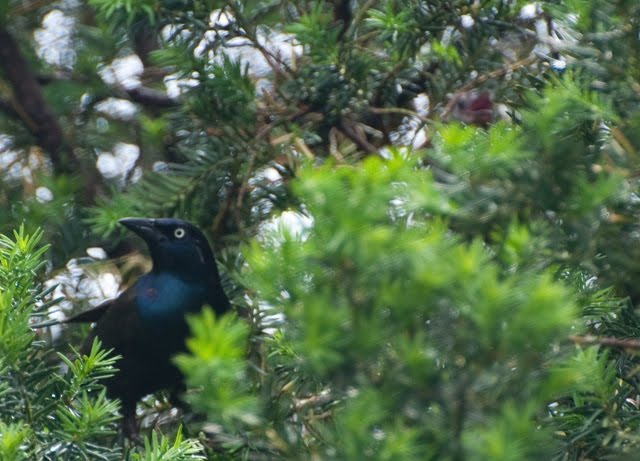


So the parents are mainly silent as they work, and the young are quiet most of the time, except for their intermittent frenzy of feeding squawks.


With the surprising silence in our backyard, it’s given me time to reflect on the strangeness of the grackle’s voice. Many people find their creaks and squeaks “ugly,” but I find them intriguing. Here’s an example of the disparaging reviews their songs often receive:

A mistake which this Grackle makes is in trying to sing. But perhaps the bird isn’t entirely to blame for this, for he may know that the scientists have put him among the Oscines, a suborder composed of “song-birds,” a term which, however, in this connection, means simply that the bird included possesses well-developed vocal apparatus, and entirely disregards the question as to how he uses that apparatus, or whether he uses it at all. Perhaps the Grackle isn’t able to make the scientific distinction between the song-bird who can sing and the song-bird who can’t, and therefore supposes himself to be a singer. His demonstration of his proficiency in the “art divine” consists in drawing in his head in turtle fashion, puffing out his body, ruffling up his feathers and then emitting a sort of asthmatic squeak, which suggests the protest of a rusty hinge. When a considerable number of Grackles do this at or about the same time, the result is what somebody has aptly termed a “good wheel-barrow chorus.” (Pearson, ed., Birds of America, 2:268)


But honestly? I think the “problem” is that they make sounds that we humans simply can’t imitate. I think if we call their voice “ugly,” it’s because we can’t imitate it. Even an onomatopoeic word like “squeak” doesn’t sound like a real squeak. Just the S, Q, and K parts.

Grackle language, like other percussive sounds, lacks vowels. They only speak in consonants—stops, fricatives, the occasional liquid. It is like the language a space alien might use, employing only sounds that we can’t even recognize as a language—thus a voice that doesn’t count as a voice.

If I were to transcribe a grackle’s song, I would use a lot of K’s, CH’s, and X’s, connected maybe by S’s and L’s. “Kxxxxchsssssslllchk!!”

Others have tried to transcribe the untranscribable voice. Allaboutbirds.org translates the song as a “gutteral readle-eak” that is “often described as sounding like a rusty gate.” Sue agrees with the rusty gate description. To me, it sounds a bit more like the squeak of a children’s swingset.

My vintage copy of the Audubon Bird Guide, by Richard H. Pough (Garden City, NY: Doubleday, 1946), says the grackle’s voice consists of “harsh cacks and a series of ascending squeaky notes with a pronounced metallic quality.”

Metallic? Hmm, I don’t quite get that. Maybe the purple grackle subspecies sounds more metallic than our bronzed subspecies?

In the Conservation Department’s book Birds in Missouri, Missouri state ornithologist Brad Jacobs described the grackle’s song as “kree del eeeek,” and the call as “chlak.”

Okay, this one is close. If there’s one vowel sound they might use, it’s “ee.”

My National Geographic Field Guide to the Birds of North America suggests the song is a “short, creaky koguba-leek” and the call a “loud chuck.” —Really? “Koguba”? I think they must be describing that purple phase again, and not the kind we have around here.

At any rate, the grackle’s voice simply astounds and confounds me, and it’s something I take great pleasure in.


I hear them beginning their day while I lie in bed in the mornings, and I try to think of what I would guess I was hearing, if I heard a grackle voice out of context and was asked to identify the sound. This morning, I was thinking of someone whacking a big metal spoon on a large piece of heavy screen, hardware cloth. A few minutes later I thought it sounded like two small, hard, round creek stones being struck together, the sharp chuck and the strange subtle ringing they make. It’s a sound-association game for me as I lie there, picturing them stalking the grass for grubs.


The strangeness of their voice reasserts, with a shock, my knowledge that despite their backyard familiarity, grackles are creatures wholly apart from us. And then I consider the very real gulf that separates us humans from all our compatriots on this spinning world. It is hopelessly out of our hands; we cannot ever really “know” them. But I am not saddened about this state of affairs—I am awed by the mystery of it.


Saturday, May 8, 2010

Common Grackles


Here is a true “Opulent Opossum” topic for you: the common grackle. I’m choosing this bird as today’s subject because right now, I can hear the peeping of newly hatched grackles up in our big yew tree.

I can see the nest in the branches of that evergreen, though it’s too high for me to be able to see into it. The parents are busy gathering food. The “noise level” in our backyard plummeted as soon as courtship ended and egg-laying commenced. Indeed, the adults are practically silent, except for an occasional song or call as they fly to or from the nest, to check in with one another. Indeed, it sounds just like that. Grackle 1: "Check." Grackle 2: "Check."

Their songs aren’t as lusty and vigorous as they were a few weeks ago; instead they are softer, understated, isolated. I think the two are simply reaffirming their bond even though they are preoccupied with the business of feeding the young. I think the change is the same as when we humans experience between the breathless I love yous of new love (the “honeymoon stage”) and the I love you that people remark to each other right before heading to the office in the morning: And don’t forget your umbrella!


The reason I say that grackles are a fitting subject for this blog is that they are one of those critters, like the opossum, that’s so common people take the miracle of their existence for granted. Yes, it is true that flocks of grackles can cause serious damage to agricultural crops. They’re not “perfect” in every way in our viewpoint. But still, there is much to admire about them.

First, the bad stuff. From day one, grackles have been in love with European-style agriculture, which was imported to America, their native continent, with white settlers and spread westward from New England. Before the widespread clearing of land and establishment of crop fields, grackles undoubtedly were much less numerous. And you can’t blame them for taking advantage of a good thing: If someone offered you a free gift certificate to a fine restaurant, wouldn’t you take it?


So they feed hungrily on crops, particularly rice and corn, eating the new sprouts, eating the young kernels as they are still ripening, and then feeding on the ripe corn as well. They also hang around feedlots and any other place where grain is spilled on the ground. (They like to eat off the ground.) Supposedly, a group of grackles is called a “plague.” That sounds like prissy New England Puritan-talk to me.

But being an agricultural pest isn’t the whole story; grackles also eat plenty of insects, too, many of which are destructive. I’ve seen our backyard grackles picking big white juicy grubs out of the ground, and I know that some people resent those grubs so much that they spray poison on their lawns. Grackles also follow behind plows, picking insects from the split-open soil, even eating the occasional (destructive) rodent as well.

At any rate, Sue and I are not farmers—indeed, we purchase grain from farmers in order to feed it to the birds! (It is rather ironic, isn’t it!) The grackles in our yard aren’t overly abundant, and they don’t even seem to be the “bullies” toward other birds that some folks say they are. At the feeder, they more or less coexist with the other birds. For example, they and the mourning doves both feed off the ground, and any pushing and intimidating between them goes both ways, with the searching, stalking grackles encountering a plump, immoveable object in the seed-hoovering dove.

In terms of personality, the grackles in our backyard are simply direct. Their attitude toward the other birds at the feeder and the birdbath is nothing personal—instead, it’s as if they don’t even see the other birds. The grackles focus on what they want—the food, the water—and then get it. I haven’t seen them peck at the other birds or show aggression toward them. Instead, their foraging is as direct as their flight, as purposeful as their long strides through the grass. And I rather admire that. Grackles are cool.


Try this sometime, if you haven’t already: Next time you walk down a sidewalk with a fair number of people on it, try an experiment by altering your posture, facial expression, and gaze to see how other passersby respond. First, if you act lost in thought, eyes low, shoulders slumped, you will find yourself shifting to the side to allow more room for oncoming pedestrians to pass you.

However, if you push out your chest, shoulders back, hold your head high, stride with confidence, and gaze ahead with a proud, aware look, you might notice even big burly guys slouching a bit to the side as you pass by.

I think this is what we see at our bird feeders; the grackles simply intimidate the other birds with their body language. And the weird, pale yellow eyes might help. They give the bird an aware, penetrating expression, an intensity. Maybe it unnerves the other birdies.


I am always impressed by the grackle’s plumage. Calling it a “blackbird” is practically an insult, like calling Vincent van Gogh an “illustrator.” Though the grackle’s plumage is technically black, the structure of the feathers creates rainbows of iridescence. The subspecies or “phase” that we have here in Central Missouri is the bronzed grackle (I’m pretty sure), which has a hood of bluish-green iridescence on the head, and an indescribably nuanced rainbow of bronzy color over the rest of the body, with the tail emphasizing purple hues. The males are the most striking, but the females, though duller, still have quite a bit of iridescent beauty.


When the grackles were a-courtin’ this past month or so, the males were spectacular, with their various courtship postures accentuating their iridescence and the sleekness and splendor of their forms. When they flew, they seemed to be showing off their athleticism, the fineness of being alive. The oddly V-shaped way they hold their tail feathers when they fly during this time seems an expression of pure vitality.


Grackles are not starlings—they belong here in North America. If their numbers seem overwhelming at times, it is because we humans have created conditions perfect for their expansion. One Web source I looked at recently said, however, that grackle populations have declined in North America by 61 percent; at one point, there had been more than 190 million grackles, but now there are more like 73 million. One more declining species of bird in North America! So Sue and I don’t have a single problem with feeding them, and letting them nest in our yew tree.


----------------------

Special thanks to Sue for taking these nice pictures for me, and for letting me use them on my blog. These photos are from a few weeks ago, when they were courting, pair-bonding, and mating. Now we need to get some pictures of their nest!

ADDENDUM

See my slightly newer post for a discussion of grackle voices and pictures of the babies!