Showing posts with label summer. Show all posts

Sunday, July 31, 2022

Jar of Goodness 7.31.22: Wait. Jar of Goodness?

. . . The weekly virtual “gratitude jar.”

This week, I’m expressing thanks for . . .

Well, it’s just been kind of hard recently.

I know I shouldn’t complain. There are so many people worse off than us. And my uncle just had a major health scare (fortunately, he seems to be feeling much better now). . . . But we’re getting tired of trouble, expensive trouble.

At the end of June, as we drove home around 9 p.m. after spending Father’s Day in Columbia, my elderly car died on US 63. (I posted about it earlier.) It was a late night as we had to have the car towed the rest of the way to Jeff City, and then, having been dropped off at the (closed) repair place, we had to wait for the one taxi cab in town. It was not marked; it was just some guy’s smoky-smelling SUV. This is a taxi? Anyway, he was pleasant enough. We didn’t get home until about midnight.

The very next day, as we were driving back to Columbia on the very same highway, Sue’s front right brake calipers went bad, and we pulled off at the very same place on the highway. The wheel was sizzling hot. So, we called AAA again and got another tow.

That’s right: we got two tows, for two different cars, from the exact same spot, within a single twenty-four-hour period.

Some of the good parts: We have AAA. We have AAA Plus. We were not physically injured. We have cell phones that work (you young things, try to imagine how much of a pain it was when your car broke down in the middle of nowhere, and cell phones didn't exist). The truck was able to be fixed within a few days. The service rep at our local Honda dealer, where both cars were taken for service, offered us a car to rent, which was very convenient.

But back to the complaining . . .

Trying to buy a car is a bitch in 2022, especially if you’re in a small town. In a nutshell: The available used cars are crappy and overpriced. Few in the Honda dealer’s lot are Honda Certified; in fact, few on the Honda dealer’s lot are even Hondas. As for new cars, they are simply not available. We find ourselves in the lucky/unlucky position of being able to purchase a new car, to make a sizeable down payment, and have excellent credit, being preapproved for a lowest-interest loan, and yet . . . there’s nothing to buy. So we paid a deposit and are on a waiting list. It will probably be months before our car is manufactured and arrives in Missouri. Meanwhile I can only dream about having a lovely, reliable, sexy new car.

Yes, the above image is shamelessly stolen from the Honda website. Why wouldn't they want someone like me sharing their lovely promotional photo of their top-selling sedan in its most desirable color this model year?

More complaining: the local Honda dealer appears to have done some kind of bait-and-switch on us, promising us that if we paid a deposit before someone else did, we’d be able to put our names on a car that’d been ordered by someone else who’d declined the vehicle, thus getting us ahead of the usual schedule . . . But then that evaporated. I think our young sales associate offered us something he wasn’t allowed to offer. They won’t tell us he screwed up, but that’s apparently what he did. I’m allowed to be angry about that, right? He told us we’d get “that cool Sonic Gray Metallic, by early August, instead of September!”; then he called a few weeks later and said “in early or middle September, maybe, and it’ll be white!” Wait, what? No!

It’s a long story. This crazy COVID economy is most of the problem; computer chips from China are in scant supply, so production is way down. The Honda company, the factory, has to allocate the few cars that are dribbling out of its assembly lines to all the dealers on the continent, and guess what? The rinky-dink small-town dealers like the one in this town are getting the dregs. They’re getting the black and the white cars. I think they’re getting just one or two a month.

Meanwhile, the big-city dealers that sell more cars in a bigger market get many more cars from the factory, and they get a greater variety of colors. So this is why we ended up putting a deposit and placing an order from a St. Louis dealer, too. Geez. It this crazy, or what? It’s about like what happened with us trying to get a new refrigerator this winter.

Again: It could be far worse. We have a neighbor who uses a riding lawn mower as his principal mode of transportation. Our problems are laughable to him. Our problems are “First World problems.” I know it. And we are so lucky that my parents, who are doing much less driving these days, are glad to let us use their car for out-of-town excursions.

THEN, with the one-car situation kind of settling in, Sue and I were driving back home from a trip to Columbia this past Monday, and AGAIN her truck started acting weird. It was making a funny noise. The engine heated up. The battery light came on. The power steering went out. We pulled over, again, on US 63 again, again near Hartsburg (actually, this time it was along the shoulder near the Boone and Callaway county line). (I’m starting to hate Hartsburg!)

Called AAA. Again. By this time, Tyler, the smiling young tow-truck driver for Kendall’s, knows us. “Oh, yeah, when they said it was a purple pickup, I knew it was you!” . . . Again, I’m glad we have AAA. Again, I’m grateful that the repair place was able to fix it. It was a malfunctioning pulley on the serpentine belt, and a broken serpentine belt. (This time, since we’re kind of honked off at the local Honda-everything, we had it towed to Telle Tire, and though they were busy, and we’d dropped it off after-hours without an appointment, they fixed it within a few days, and it was okay.) But I’m not liking this car stress.

Okay, next topic: Did I mention we’re finally getting a new roof and gutters? Supposedly? Yeah. We’re lucky that insurance is covering it, considering the damage occurred in the hailstorm in late March 2020, but fortunately it’s covered, and we have a surprisingly low deductible. But it’s stressful, anyway. We’ve been expecting them all month. We recently found out that the reason for the delay is the combination of our steep roof and the super-f-ing-hot weather we’ve been having. The roofing company doesn’t want the shingles and other materials to be compromised because of the heat. Not to mention the safety of their workers . . . And yeah, we have a sense of PTSD regarding the roofers. When we had the current roof installed in 2006, we unfortunately had a clown/ex-con/ripoff company rip us off. (You might remember our sunporch disaster, thanks to them.)

So we approach this roof work with trepidation. How can we not? This has been the biggest problem with owning this old house: We’re not fix-it people. We’re not carpenters, electricians, plumbers, roofers. And we have a hell of a time finding people to a) do the work, and b) trust to do it right.

Then, Tuesday, the day after Sue’s recent truck incident, and while it was being repaired, we discovered that one of our central air-conditioning units was making a funny sound, like it was straining. The coils had frozen up to the point where we were seeing frost on the outside of the unit. We turned off the system, and the thing defrosted, and we worried. It’s a 21-year-old system, and the maintenance folks have been telling us in recent years that it has a 15-year lifespan.

Fortunately, our annual scheduled a/c maintenance was only two days later, so that service call was covered by our contract . . . but unfortunately, the news was grim. The unit isn’t worth fixing; any fix would require retrofitting the coolant system for a different type of coolant, since the kind our system uses is no longer available . . . and any fix they did would still be a band-aid, as the aging compressor is no longer operating very efficiently anymore . . . So, tomorrow, we’ll meet with a sales representative and see what kind of suggestions and offers they can make.

Of course, they’ll offer us a discount on replacing both systems at once (we have two systems, one for the first-floor apartment, one for the second). But who wants to buy two air conditioners and two furnaces at once? Yeah, it would be nice to have them all be new and identical. But, but . . .

And yeah, I'm glad we have a separate first-floor air-conditioning unit that's working fine, so we can kind of live on the first floor if we need to. And I'm glad we've had relatively cool temperatures this week. But it's going to get back up into the nineties this next week. Ugh, ugh, ugh. The service man said the company might be able to tide us through with some loaner window a/c units until our new a/c unit(s) are installed, in something like one and a half to two weeks.

But who wants to make these purchases when preparing to buy an new car at the same time? And do you know what our retirement investments have been doing recently? Ugh!

So, “Jar of Goodness.” I’m giving you a mixed review this week. We’re just feeling really stressed and tired.

Friday, June 17, 2022

Sunporch Screens

Well, it was about time! Now that we’re having an entire week of 90-plus temperatures, you’d think we would have changed them sooner.

Taking out the storm windows and putting in the screens: This is the easy part! This year, it barely registered a “2” on the cussometer.

The hard part is in fall: attaching the windows on the hooks, not un-attaching them (usually). To get them on the hooks, you have to position the window angled outward and lifted up, just so. And you can’t see it very well. And the storm windows are much heavier than the screens, yet more fragile. So the screens are easier. Lots easier.

And when we’re done, it’s so nice! All that fresh air, and nice breezes. Lois can look out the screens and sniff the air, and watch the birds. It’s so much more interesting with the screens in, like being in a treehouse.

Why the heck did we wait until the middle of June to do this?

Ohhhh it’s a long story. Here are our excuses. First, in April we decided to wait a few weeks because of all the pollen. Man, it was pretty bad again this year. Even Sue was suffering. In previous years, I’ve been able to write my name in the coating of yellow pollen that covers the table and chairs out there. So it just stays cleaner, and the air quality is better, to keep keep the storm windows up through pollen season.

And then we got rains here and there. And the windows are wood. The sunporch frames are wood, too. When it’s damp, it all swells up just enough to make a serious, 5- to 7-degree difference in the cussometer rating, so we’ve learned to wait a few days after the rain is gone to do this procedure. And as it happened, our occasional dry storm-window “windows” never happened at a time when it was convenient for us.

And finally, we’ve spent a lot of time enjoying the backyard, when the weather’s nice, so we haven’t been on the porch much to miss the screens.

Anyway, that’s my story, and I’m stickin’ to it.

We got the screen windows up. Hooray!

Sunday, June 12, 2022

Jar of Goodness 6.12.22: Air Conditioning

. . . The weekly virtual “gratitude jar.”

This week, I’m expressing thanks for the miracle invention called air conditioning.

Our units (we have two, since we have a large house), are getting old, so I especially do not take them for granted. Especially as we are entering a heat wave for the coming week. They’re predicting temperatures of 95 or higher every day.

I’m suspecting that this will be a hot, dry summer. Missouri, with its humidity, would be unbearable without a/c. Y’all take care.

Monday, September 6, 2021

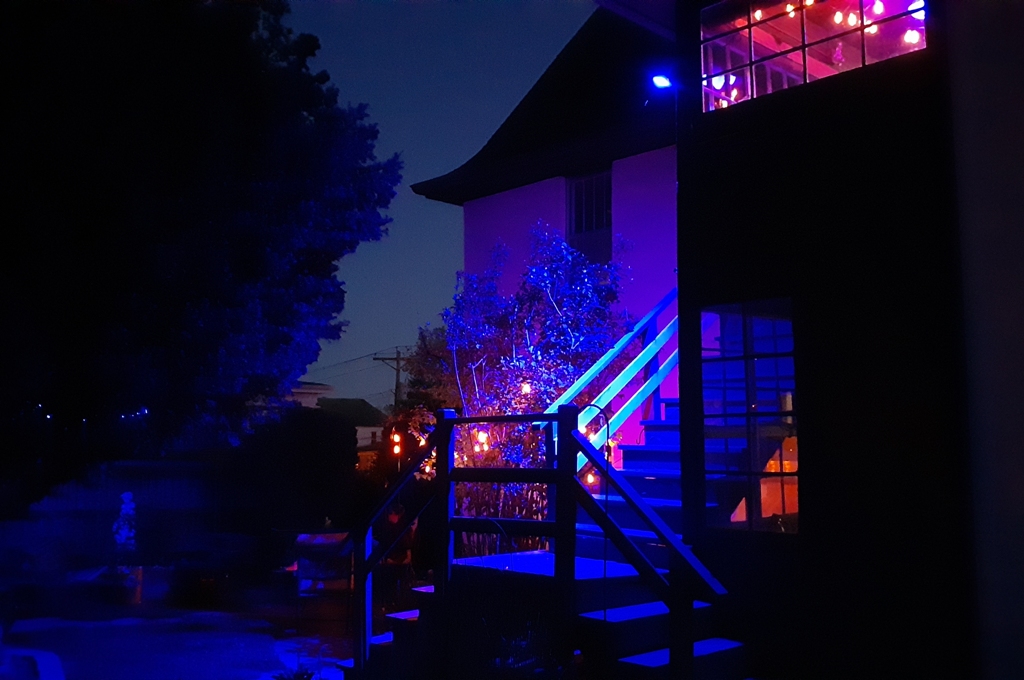
Our House of Blue Lights

Gosh, we’ve had a hot summer, with plenty of bugs. Odgen Nash, as usual, hit the nail right on the head: “In this fairly temperate clime / Summertime is itchy time. . . . Beneath the orange August moon / Overfed mosquitoes croon. / After sun-up, flies and midges / Raise on people bumps and ridges.”

But as the weather seems to be getting cooler, I’m hoping we’ll also have breezes enough to push aside some of the insects while also making it more pleasant to be outdoors in general. So we’ll be spending more time on our patio. (Such as it is.)

I’ve mentioned our little oasis in Central Missouri before (like when I wrote about playing the zither or our guitars out there), but today I’m frankly just crowing about our outdoor lighting, which I’m so proud of.

Sue and I were recently sitting out there, playing our guitars, and Sue mentioned that we have “The House of Blue Lights.” She hummed a few bars, and I was like, “What song is this?” She said, “Don’t you know that song?” So we had to Google it, and I learned a new song. And I got a title for this blog post! . . . Here.

I started the lighting project in 2018. I basically copied an idea from Kansas City’s Cafe Trio (yeah, one of my happy places). (And yeah, you should really go there and check it out.) That restaurant has a deck/patio with an attractive view overlooking the iconic Nichols Memorial Fountain and looking beyond toward the KC Plaza. I was fortunately able to be there alone one night and noticed the lighting.

They had gobs of those bright, cold LED Christmas lights overhead—enough to cast a cool, cobalt-blue glow over the entire patio. So that people could see (and read the menu and stuff)—but also to create a compelling visual contrast—they also had regular warm-colored patio lights overhead, too. The warm and cool lights combined to produce interesting reddish or even purplish hues where they intersected.

Then—and here they were really inspired—they had a number of rotating LED projecting spotlights (you know, the kind that people use to beam rotating snowflakes onto their homes at Christmas) mounted overhead, too, facing down onto the bar, the chairs, the floor, everything. Because it beamed down from above, it wasn’t in anyone’s eyes. And it wasn’t snowflakes, though—it was just blue revolving and rotating splotches of color. The lights overlapped a bit, so there was no discernible pattern. The overall effect was like being underwater.

I took note of the idea.

I started with the screened-in part of our sunporch. While Sue was out of town for a while, I did it all unilaterally. I put a super-blue LED light bulb into our overhead fixture, and it emits enough glow for that small portion of the porch. Then, I copied Cafe Trio’s method, stringing plain patio lights overhead and rigging our rotating LED projector so it would beam down onto the table and the rest of the room. We don’t use it for Christmas decorations anymore! And it has a little remote control, so I can change the colors a bit: blue, red, green, or combinations of the three. (It looks best when it’s set on all-blue.)

I was so pleased with the effect, I extended it to the backyard patio area. I found a LED blue spotlight for above the steps (you can still see to get up and down them, but it’s blue now). I purchased a bunch of plastic blue LED stringlights and hung them in the lower portion of the canopy of our big yew tree that overlooks part of our patio area.

Next, I strung regular patio lights from our downstairs back door along the walkway to the patio area. I was proud of myself for using some plant hooks for those. . . . And we already had our tiki torches, and the firepit.

We still really miss Vines, but even when it was still open, there were many nights when we had opted to stay in our own little private oasis in our backyard. Hopefully, now that the weather’s starting to get nice again (with, I pray, a corresponding decrease in itchy bugs), we’ll be out there again.

Monday, August 17, 2015

The Patio Tables, Part 2

This is part 2 of two posts about a pair of patio tables my parents bought in the 1960s or early ’70s: Repainting them was one of my summertime projects this year! Click here for part 1, the history of these little tables.

So here we are in 2015, and the tables are renewed. This is at least the sixth redo! I wanted them to scintillate again, to have something “groovy” on them.

Preparing the surfaces is always a bear—scraping, sanding, and scouring off the rust and flaking paint is never fun, but it gives you time to think, and to visualize.

Since I’ve been enjoying the Bhagavad Gita in recent years, I thought the symbol for Om would be kinda neat. I visualized it as being so large that it kind of dripped off the edges.


Sue scanned the quarter-inch-high Om character that appears as a decorative type dingbat at the end of each chapter in my book, then enlarged it to table-size with her amazing computer graphics skills. She printed it out for me, tiling it on four sheets of typing paper, making me a pattern.

From the moment I hatched the plan, I envisioned the character as dark or forest green on a lilac background . . . but as I kept thinking about it, I decided I wanted it to be more energetic, less restful. I wanted it to scintillate!


Why the Om? I like the idea that sound, vibration, music underlies or permeates all of creation. This sound, this music, is not only creation itself but also the name of God, the true nature of reality, and Om is a sound we can produce that connects us to all of the above. And I don’t see it as a counterculture or anti-Christian symbol at all. I see it as one of many human efforts to express and celebrate the vast, majestic, all-encompassing oneness of God, the All That Is.

Plus, it’s an elegant symbol, appealing on a purely visual level. (Especially when it scintillates!)


The second table was much more challenging to paint, with all its persnickety straight lines and perfect corners. At its center is a pan-Asian, Greek, European, African, and Native American symbol for good luck, eternity, and other sacred and auspicious ideas. Before Hitler appropriated that symbol and gave it evil connotations, it was a commonly used decorative element worldwide, with nothing but positive connotations. (Gee, thanks, Hitler, ya asshole. You also ruined a perfectly good mustache style, as well as the once-fine name of Adolph.)


As you can see, my table includes a much more elaborate design than just “that symbol” (long called a gammadion, from the Greek)—and hopefully by making the positive and negative spaces somewhat ambiguous I’ve downplayed anything startling, and emphasized the symbol’s original meaning. Visually, you kind of have to follow a maze before you can see the “eternity” symbol in the center. Hopefully, by then, the act of looking at the entire design has gotten my intended meaning across intuitively.

What do you think? Pretty cool, eh?


. . . Anyway, I’m happy with ’em!

And yes, we’ll be bringing them inside when we’re not actively using them outdoors. I think I want to keep them nice for a while!


Bonus fun! I made a wonderful discovery soon after I’d finished painting the first table: If I stare steadily at the center of these designs for about 20 or 30 seconds, then close my eyes or look at a blank paper or wall, the image remains as a retinal negative-colored afterimage—the red parts of the designs appear as blue, which fades gradually into turquoise and green. What a cool surprise! Try it with the images above! (Remember, you can click on any image on my blog to see it larger.)

Sunday, August 16, 2015

The Patio Tables, Part 1

This is part 1 of two posts about a pair of patio tables my parents bought in the 1960s or early ’70s: Repainting them was one of my summertime projects this year! So first, a little walk down memory lane. As far as I can tell, this is at least their sixth refurbishment since about 1970.

I’ve found some pictures of them in my parents’ photo albums, so you can have glimpses of their former incarnations.

I love these tables, though maybe they’re not the best design for lawn furniture. There’s a small lip along the edge, so they tend to collect water. They’re slightly top-heavy on their tripod legs, so in strong winds they tend to tip over, banging the edges on whatever concrete or patio bricks they’re on. And they’re steel, so they rust.

But I like them. First, they’re not plastic! Woo-hoo! Second, they’re the perfect size for holding a cold beverage plus a book, or a hardcopy printout of that chapter or bibliography you have to edit. That’s how my dad used them on the patio beneath our back porch.


Third, at this point, they’re “vintage,” thus cool. Dialing back, I think their first paint job was white—flat white. Or maybe that was their second paint job. I wonder how they came from the factory? Soon after, Mom dressed ’em up by putting Peanuts (Charlie Brown, Snoopy, et al.) decals on them. See?


As a kid, I loved those Peanuts decals! Mom’s putting them on the tables was a brilliant idea! We all loved Peanuts! (And I liked to paint with watercolors beneath the shade of a lawn chair! Hard to imagine I was ever that small . . .)

By the time I was well into elementary school, Mom had stripped off the decals, sanded off the rust that had accumulated, and given them a nice coating of hot orange-red Rust-Oleum. (Remember, it was the seventies.) At some point, she (or maybe we kids) added a bunch of stickers to decorate them.


The tables were starting to acquire rust again by the time I was in junior high and high school, and by then I’d discovered the fun of enamel paints. (My folks gave me some “beautification projects” to do.) So I’d had a little practice using Rust-Oleum in a creative way.


In ninth grade geometry class, Miss Avery had provided us (for fun) a dittoed handout showing a variety of super-cool geometric designs. I think she was trying to remind us that there were actual creative applications to mathematics, that it wasn’t all just proofs, apothems, and other headaches. (Hooray for teachers who keep in mind that some students are simply more interested in other subjects, and who make an effort to connect their subject to other fields!)

So my parents invited me to do a new paint job on the tables. Being a smarty-pants overachiever (or an obsessive little nerd, I don’t know which), I looked through the designs from Miss Avery (which I had saved—okay, more evidence for the “nerd” category) and selected one that seemed easy enough, though it was intricate. It was really just a series of concentric circles expanding by equal radial increments, overlain with a series of parallel lines intersecting them. Alternate boxes are in contrasting colors, like a chessboard. (It’s been called a “circular chessboard.”) I painted it in Rust-Oleum paints: a bright blue (almost a cyan), and a bright red. It scintillated!

I put a lot of work into it, using the fine paintbrushes I used on my model cars (oops, more evidence of nerdiness!) and even toothpicks to nudge the paint into the narrow, pointy corners, and to touch up the many, many places where paint blurped over my penciled outlines. (The lines had to be absolutely precise in that design, or it wasn’t gonna work.) It took a lot of patience!

It was a masterpiece when it was done! Fortunately, my parents let me keep it in my room as part of my indoor furniture, or that paint job wouldn’t have lasted the ca. 15 years that it did. The one picture I could find of it shows it in my bedroom in 1982 or 1983, in front of my aquarium, with Katie perched on it in order to view the fishes better. (Awww, Katie, what a sweet little girl!)


Then a lot of time passed. I was at college, then went to Arizona for graduate school, then to Montana for my first publishing job. By the time I was back in Missouri and Sue and I had moved to Jeff City, my folks had let us have the tables. We’d been using that table and its twin outdoors again, and they’d received some dings and gotten rusty and needed a new paint job.

So most recently, I just sprayed it: All red. (Yawn!) We painted its twin with a yellow center in a gradient to red edges. Still pretty boring. I’m kind of glad we kept them outside, where they collected rain, acquired some blackish mildew, got dinged, and developed rust spots . . . and finally needed another new paint job!

. . . And my next post will show pictures of their new incarnations!

Thursday, July 30, 2015

Switchel, Stichel, Switzel, Swizzle: Ginger Water for Hot Days

Six years ago, in a post I’d almost forgotten about, I talked about our sweltery summertime heat. And that’s where we’re at again: heat and humidity. Well? It makes the corn and the tomatoes grow!

But it makes me wilt. And it, with all the rain we’ve had, makes the watergrass, crabgrass, or whatever-it-is grow like crazy. So I’ve gotta mow the lawn it again. I’m going to wait until the sun starts to set tonight. Ugh! I’m dreading it. (Compared to this heat, my hot flashes seem cool!)

Revisiting that older post I did about “Heat,” I recalled John Madson’s description of an old-timey lemonade-like beverage that farmers used to gulp when they had to thresh wheat in the hottest part of summer. It must have been hell on earth. That’s how Madson describes it, anyway.


Madson called this beverage “stichel,” but from what I can see online, it’s more commonly called switchel, switzel, swizzle, ginger-water, haymaker’s punch, or switchy. It’s an incredibly old concoction, a centuries-old thirst-quencher, an antique equivalent to today’s “energy drinks” or “electrolyte beverages.”

Wikipedia’s entry on “Switchel” notes that the beverage is also mentioned by Laura Ingalls Wilder in her book The Long Winter. In it, Laura’s mom tells her to make up a bunch of the stuff to take to the laboring men, explaining that cold well water, alone, would make the overheated men feel sick, while the ginger-beverage would quench their thirst better.

Today it’s a super-trendy hipster beverage! Who knew? All the cool kids are drinking it!

You can find plenty of different recipes online, but here’s the one I tried. It seemed simple, basic, and it seemed to fit what Madson described Iowa farmers drinking “by the gallon.” (Sorry, but I can’t remember where I got this particular recipe.)

Use this recipe as an idea starter, and mess around with it until you get it just right: try pure maple syrup instead of brown sugar, as they do in Vermont, here and here. Molasses and honey were probably popular in some areas, too. Or try using the juice from fresh ginger instead of powdered.

---------------------------

Stichel

3/4 cup brown sugar
1 tsp. ginger (powdered)
1/2 cup cider vinegar
1 quart cold water

Dissolve together the first three ingredients, then shake with the cold water. Serve chilled.

The recipe, wherever I got it from, also suggested you could mix it with equal quantities of ginger ale. Or, I would suggest, mix in some club soda or seltzer, if you wanted it bubbly and less strong.


How does it taste? Well—Sue and I think it’s actually pretty darned tasty! The hardest part is the first sip, because you can smell the vinegar, and the immediate thought is: This is going to taste like something you’d dip Easter eggs into. Or: “Ugh! pickle juice!”

But despite that initial panicked thought, it really does taste very good, and it goes down easy, and I’ll probably be making it again. The vinegar does the same thing that lemons do in lemonade. (Hey, remember the Greek lemonade recipe I shared with you a while back?)

I hope you’ll give switchel a try! When you do, let me know what you think of the flavor. Bonus points if you report on its efficacy as a thirst-quencher during these beastly hot days!

Monday, July 6, 2015

Red, White, and Blueberry Jell-O Salad, alias "Blueberry Salad"

Trust me, this looked excellent before we demolished it.


And the fact that we demolished it implies (correctly) that it tasted really good, too!

It’s the perfect Jell-O salad for a Fourth of July meal. Like all Jell-O salads, its cool fruitiness is a great complement to barbecue, hamburgers, hotdogs, or whatever. And it’s refreshing on a hot day (like it always is here, in July). And face it, most Jell-O salads are more like dessert than a health food, and it’s a holiday, so hey, rock on!

But you gotta be fast if you want to take a picture of it.

File this one under “retro recipes.” I found it in the 125 Year Anniversary Commemorative Cookbook from Trinity Lutheran Church, published in 1995 or 1996. The original recipe, according to that collection, was in “the Kitchen Klatter Cookbook, published in 1982.” (Does that mean the magazine? I can’t find evidence that a Kitchen-Klatter cookbook was published in 1982; only in 1977. Hmm.)

Or it could have come from Country Woman magazine, July/August 2000, p. 42, where apparently it was called “Red, White, and Blueberry Salad”? Online, it’s frequently called “4th of July Party Jello.” (Sic.) (We all know how it’s officially spelled and capitalized: Jell-O.)

Anyway . . . there aren’t many pictures of this particular Jell-O concoction because, no doubt, it gets eaten up before anyone gets a chance to take a picture of it!


I amended the recipe just a tad: It was apparently created before Jell-O had come out with its blueberry flavor/color, so the original called for the blue layer to be created with raspberry Jell-O plus the fruit and juice from a can of blueberries. But shoot! Why not use blueberry, now that it’s available here in the modern age? Real or artificial, flavor-wise, blueberries and raspberries are great friends!

I interpreted the “coffee cream” it called for as “half-and-half,” and I substituted Neufchâtel cheese for the cream cheese in the recipe—it’s got less fat, but darned if I can tell much difference between the two.

Here’s how to make it. Be sure to allow time for each layer to get hard before adding the next—I suggest making it a day ahead. (Which is to say, July 3!)

The recipe suggests using an 8 x 8 or 9 x 11 inch dish. (I used an 8 x 8.)

1. First layer (red):

1 box raspberry Jell-O (regular size box; not the big one)
1 cup boiling water
1 cup cold water

Make the raspberry Jell-O per the usual directions on the box. Pour it into the dish and chill until firm.

2. Second layer (white):

1 envelope plain (Knox) gelatin
1/2 cup cold water
1 cup half-and-half (or milk)
1/2 cup sugar
1 (8-oz.) package of cream cheese (I use the lighter Neufchâtel cheese), softened a bit
1 tsp. vanilla
1/2 cup pecan pieces

In a little bowl, stir the gelatin into the water and let soften. In a saucepan, heat the half-and-half with the sugar until hot but not boiling. Add the gelatin, mix, and let cool. When it’s no longer hot, in a blender or food processor, mix the gelatin mixture with the cream cheese, vanilla, and pecans.

Pour this white layer over the red layer and chill until firm.

3. Third layer (blue):


1 package blueberry Jell-O (again, regular size box)
1 cup boiling water
1 (approx. 15-oz.) can blueberries with juice (such as Oregon brand)

Dissolve the Jell-O in the boiling water. Stir in blueberries, with their juice. Let it cool so that it’s not hot (you don’t want it to melt the gelatin you’re pouring it on), then pour this blue layer over the white layer and chill until it’s firm.

----------------------------

This is really delicious. If you’re like me, the slightly tangy, creamy white layer, with its pecans, will really transport you back to childhood potlucks from the sixties and seventies. Back then, I would have had no idea what was in that white “mystery” layer—but I sure would have given it my approval!


Saturday, July 4, 2015

Independence Day 2016

Greetings, my friends! It’s the Fourth of July—Independence Day!—and this year it’s extra special. By now, I’m sure everyone’s sick and tired about hearing about “gay marriage” (which, from now on, hopefully will be called just “marriage”). Even the bigots will be relieved not to read about it in the papers every day. Now we can all move on with our lives, working, mowing the lawn, doing the laundry, paying our taxes, and so on.

For me this is a special year. The recent Supreme Court ruling has been more than a validation of marriage—it has seemed like a validation of my rights, in general, as a U.S. citizen, and an acknowledgment of a turning point in public opinion, as well. It has helped me feel more “united” with the United States, and less “divided.”


I didn’t do a blog post about it at the time, but Sue and I got married last November, in St. Louis, the day after a federal court ruled Missouri’s anti-marriage amendment unconstitutional. We solemnized it on November 11 in our living room, with my parents, and Uncle Richard and Aunt Carole, in attendance. My mom and dad were our official witnesses! Reverend Coletta Eichenberger, who was then interim pastor at Jefferson City’s Central UCC, performed the ceremony. Sue and I have lived together as a couple since 1994.

A few days later, with all our paperwork signed, we drove back to St. Louis City Hall and got our official certificate.

It’s funny how people seem to forget the legal aspects of marriage—the trip to the courthouse, the paperwork, the document. But this “forgettable” part is the part we gay folks have been fighting for. For years—forever—we have found allies in the religious community to perform our ceremonies, in the eyes of God and our closest friends and family. We’ve had access to the spiritual aspect of marriage for ages, even if only in our hearts, but the legal part of marriage has been elusive, until now. We want those “boring” rights and responsibilities that other married couples apparently take for granted.

So Sue and I drove to St. Louis for the Pride parade last weekend. What a spectacle! (It always is.) In past years, I have felt somehow “apart” from the goings-on at Pride. Like, “those are the younger folks.” And “those are people who like to go to bars and stuff.” “These are big-city people.” This year, however, I felt that a great spectrum of folks were represented, including people like me—however you might define that.


Pride did indeed seem “bigger” this year—no doubt because we were all celebrating the court ruling. And I was moved to tears any number of times. It started at the front of the parade, with a contingent of St. Louis Police officers, many walking with their partners, husbands, or wives. It was moving to see these public servants—our public servants, who potentially risk their lives each day—able to walk down the street without having to hide “who they are.” (The irony of even writing that . . .) Why not support the families who support our police officers?

Soon after, the U.S. flag was carried carefully down the street, and there was tremendous cheering. Considering where we’ve come from, in the last fifty years—that cheering was almost heartbreaking. Someone behind the flag was walking, holding a real live bald eagle. One of our great American symbols. So beautiful. And yes, more tears. I didn’t realize how jaded I had become. It’s interesting how the court ruling renewed my sense of belonging here in this country, a sense that it’s our country, too, and that I’m proud of it.


And the parade went on and on. Hooray for the marching band! Hooray for all the politicians whose participation in the parade signaled their willingness to see LGBT folks as American citizens and constituents! Hooray for the Lambda Car Club, whose members’ vintage vehicles the dignitaries rode in! Hooray for the big corporations that now see the potential PR gain in having a contingent in the parade. (It wasn’t so long ago when those same corporations would have completely shied away from any association with the perverts and their “march.”)


And hooray for the many LGBT groups and allies, including PFLAG, the United Church of Christ, the Disciples of Christ, the Metropolitan Community Church, and many, many others. It bugs me so many in the media try to create a binary of opposition between LGBT people and “Christians.” As if all Christians are anti-gay. As if gay folks can’t be Christians, too. As if it’s impossible to be both pro-gay-rights and Christian. Thankfully, there are many religious groups who stick up for the rights of LGBT folks. And even the fundamentalists aren’t in lockstep against gay people: Their tide is turning, too.

Then there was the AIDS quilt—another opportunity for tears to roll down my face. I remember . . . so many of us remember: getting the news, learning about it, getting involved, and having friends die. Where were you when you first heard about the “gay plague”? So much has happened since then. I think we’ve all gotten stronger, together.


And there were the quilt panels, being carried down the street. I didn’t recognize any of the names, but I didn’t have to; I have plenty of other names to come to my mind. And the strange juxtaposition, the memory of those people who died in the late eighties and nineties, somehow frozen in history just how they were, and what we were all fighting for then—but today, they were being carried symbolically, proudly down the street, on this new day, this new morning, with a Supreme Court ruling that affirms that our marriages are equal under the law to those of straight people.

It’s a day they could only have dreamed about. And a black president, too? Even I have trouble really believing this has happened, even in my lifetime. We’ve all played a part, every day, by simply being who we are, and refusing to hide our love. Yeah, I wept and applauded as those memorial quilt sections went by.

So this year, the Fourth of July means more to me somehow. Is this how black folks felt the first year after emancipation? Maybe a little. Like it is somehow “our” United States, too.


And this is what Barack Obama said:

“Our nation was founded on a bedrock principle that we are all created equal. The project of each generation is to bridge the meaning of those founding words with the realities of changing times—a never-ending quest to ensure those words ring true for every single American.

“Progress on this journey often comes in small increments. Sometimes two steps forward, one step back, compelled by the persistent effort of dedicated citizens. And then sometimes there are days like this, when that slow, steady effort is rewarded with justice that arrives like a thunderbolt.

----------------------

“We are big and vast and diverse, a nation of people with different backgrounds and beliefs, different experiences and stories but bound by our shared ideal that no matter who you are or what you look like, how you started off or how and who you love, America is a place where you can write your own destiny.

“We are people who believe every single child is entitled to life and liberty and the pursuit of happiness. There is so much more work to be done to extend the full promise of America to every American. But today, we can say in no uncertain terms, that we’ve made our union a little more perfect.

“That’s the consequence of a decision from the Supreme Court, but more importantly, it is a consequence of the countless small acts of courage of millions of people across decades who stood up, who came out, talked to parents, parents who loved their children no matter what, folks who were willing to endure bullying and taunts, and stayed strong, and came to believe in themselves and who they were.

“And slowly made an entire country realize that love is love.

“What an extraordinary achievement, but what a vindication of the belief that ordinary people can do extraordinary things; what a reminder of what Bobby Kennedy once said about how small actions can be like pebbles being thrown into a still lake, and ripples of hope cascade outwards and change the world.

“Those countless, often anonymous heroes, they deserve our thanks. They should be very proud. America should be very proud.

“Thank you.”

—Present Barack Obama, June 26, 2015


Friday, August 31, 2012

Not-So-Opulent Armadillos


They still seem like newcomers, and why shouldn’t they? Here in Central Missouri, we never “see” them—unless you count their poor bodies lying lifeless—like overturned baskets—on the roadsides.

Poor critters . . . cars are so rude.


And to people north of the Missouri River, they truly are newcomers; the river serves as a serious barrier to their northward expansion. Each time a few of them manage to get across the river here and there, and begin new population centers, a hard winter eradicates them from the whole region. Or, that’s what people have thought.

Armadillos are insectivores, and they don’t hibernate. A hard winter that freezes the ground and prevents them from getting to delicious, hibernating insects wipes them out. It hits the “restart” button, and when that happens, Missouri has few, if any, armadillos until immigrants of that species, expanding from firm populations south of us, replenish the species in our state.

In 1959, when Charles and Elizabeth Schwartz published the first edition of The Wild Mammals of Missouri (a book I could not live without), armadillos were not known to live in our state. By the time they first revised the book, in 1981, the Schwartzes listed the armadillo as “possibly occurring.” By 2001, when Elizabeth Schwartz presented to our state the second revised edition—an endlessly fascinating guidebook, textbook, encyclopedia, and lavishly, perfectly illustrated volume—armadillos had definitely become established as “full residents,” “having been collected in 66 counties.”


So the armadillo is no longer just the “state bird of Texas”!

Dr. Lynn Robbins and his students at Missouri State University have for decades studied the range expansion of these curious critters, which so many of us still equate with the Longhorn State, and not the Show-Me State. Here’s a request for citizens to help with their studies; this appeared in the March 1993 issue of the Missouri Conservationist (the official monthly publication of the Missouri Department of Conservation):


So Why Am I Writing about Armadillos Today?

Well, Sue and I have been hiking recently at Painted Rock Conservation Area, south of Jefferson City along the Osage River where it bends (at Osage Bend), and we were astonished to see several armadillos abroad in daylight. It was midafternoon, and they were wandering around in the leaf litter, in the oak-hickory forest, foraging constantly.


What does a foraging armadillo look like? Nose-to-ground! Their conical heads poke through the leaf litter, snout-first, and the rest of the body follows. They plow through the fallen leaves in a random zigzag path, leaving a rounded tunnel behind. The leaves atop the “tunnel,” parted by the body, fall back together somewhat, but you can see through them to the ’dillo trail.


Armadillos specialize in eating insects (though they opportunistically eat other little critters, as well). They whiffle along the ground, snuffling for grubs, beetles, ants, and whatever else. They dig into the earth as far as six inches to locate a juicy insect their noses have detected.

It’s really interesting to watch them. They have terrible vision and next-to-terrible hearing, so they tend not to notice if they’re being observed. I think the constant crunching of dry leaves around their heads drowns out the sound of voices and footsteps.

Apparently, armadillos have been remarkably active this summer in general. One of my friends thinks it’s armadillos that have been rooting up her garden over at Osage Bluff.


They’re supposed to be mostly nocturnal during the summer—so why are they out in daylight?

It appears to be environmental: Remember last winter, when it never really got to be truly “winter”? Presumably a large number of armadillos survived Missouri’s winter last year. During our usual cold, freezing winters, many of them simply perish. Even in good years, they don’t put on much body fat to shiver away to stay alive—and any mammal that doesn’t hibernate has to “stoke the fires” of life in freezing weather by “eating hearty.” Frozen ground is not conducive to digging. So many ’dillos die.

But it was hardly even cold last winter, so we probably had record numbers of armadillos survive until springtime. Then we had a nice wet spring (remember?) and plenty of insects had survived the mild winter, too. Things were looking up for the armadillos at that point—but then the drought set in.


I suppose the drought is doing to the armadillos what winter failed to do—limit the populations. By the end of August, insects have become hard to find, and so has water. The armadillos are close to starving—and that’s why they’re out during the day, even, hunting relentlessly for bugs, grubs, beetles, weevils, pupae, lizards, darn near anything, to eat.


I recently contacted Dr. Robbins with my hypothesis, and responding in an e-mail of August 27, 2012, he said he thinks I’m on the right track. He mentioned, however, that many armadillos do seem to be surviving our midwestern winters—somehow, decent numbers of them manage to find shelter and food, so the idea of them all perishing with cold weather is not as strict as once supposed. That they’ve been continuously present in Nebraska for fifteen years, he says, “leads me to believe that even if a high percentage do not make it through a winter, they do find refuges where they can find enough food to make it.” They don’t seem to “fatten up” before winter, but they seem to survive anyway, by finding “large amounts of food under the leaf litter and by digging in unfrozen ground.”

Regarding what we saw at Painted Rock, and the drought, Dr. Robbins noted, “If the drought continues, I too will be concerned, and the conditions you observed are similar to the way they [the armadillos] looked after the [recent] big snow event, including their frantic behavior to catch up. I have been seeing increasing numbers of road kills north of the Missouri River this summer.” He continued, “if there is a reduction in food as a carryover from this drought, it could be a problem.”

(Thank you, Dr. Robbins, for helping me understand this interesting animal, and for your work in helping humanity to understand many kinds of mammals, too!)

So there you have it—although Sue and I were thrilled to see our first ever—living—armadillos, the situation wasn’t optimal for all parties. I hate the thought of anything suffering. Let’s hope the rain is bringing them some relief.


Bonus info! The scientific name for the nine-banded armadillo is Dasypus novemcinctus. Dasypus is the genus name for our armadillo and is used for six other closely related (living) armadillo species as well. (Dasypodidae is the name for the whole armadillo family, which comprises about 21 species, in various genera.) Dasypus means “rough-footed.” Since armadillos are diggers by trade, they have coarse, sturdy feet!

The only species of armadillo found in the United States is the nine-banded armadillo, Dasypus novemcinctus. The second half of the name means “nine-banded” (“novem-” for “nine,” and “-cinctus” for “belted”—as in “cincture,” an encircling belt, or to “cinch” up something).

SPECIAL THANK YOU to Susan Ferber, who took all the great photos in this post and has graciously allowed me to use them on my blog. Not only is she a talented and skilled photographer, but also: She is the best person in the world to go hiking with!

Saturday, August 25, 2012

The Green, Green Grasses of This Horrible Drought Year

I'd like you to notice something about our native prairies: All summer long, despite this awful drought, they've stayed green, green, green!

Unlike our pastures and old fields, which are filled with cool-season grasses, our native prairies have grasses whose favorite growing season is the hottest part of summer. Really, instead of calling them "warm-season" grasses, we should call them "hot-season" grasses. Because that's what they truly are. Not only is this their peak growing season, but also, they have super-deep roots that allow them to survive horrible droughts. (Like this one.)

For proof, here are some pictures I took at Tucker Prairie on July 29. All the pastures we drove through to get there had turned golden and dry. But the prairie--though not having a fabulous year--was getting along okay.


Tucker Prairie, in case you didn't know, is owned by the University of Missouri and is used as an ecological research area. This is 146 acres of true, virgin prairie, folks. You can see it as you drive along I-70: It's just west of Kingdom City. Apparently somebody knocked the sign down that used to be visible from the interstate, but you can easily recognize the native prairie by its greenness and the uniquely textured look of its vegetation. (By the way, the little research station building has attracted a great deal of vandalism, too. Which is very sad to see!)

You might have noticed that I-70 has a prominent curve between Tucker Prairie and Kingdom City, and this is no coincidence. When the government was planning the new superhighway, conservationists had to fight to keep it from plowing through and destroying this tiny remnant of original, untouched, native landscape.

Among the green grasses and sedges are hundreds of "forbs," which are herbaceous plants that aren't grasslike--in other words, broad-leaved nonwoody plants. There are something like 260 species of plants living on this small, precious patch of earth.

Below is one of my favorite prairie plants: Rattlesnake master! It looks a lot like a spiny ol' yucca plant, but Eryngium yuccifolium is actually in the celery, carrot, or parsley family. It's more closely related to "harbinger of spring" and "Queen Anne's lace" than it is to "Spanish bayonet"!


This is one of six species of sunflowers that occur at Tucker Prairie (I think it's ashy sunflower, Helianthus mollis, but I didn't photograph enough of the vegetative parts for this amateur botanist to be certain). There are 48 members of the sunflower family on this one small prairie (statewide, there are about 400 different taxa in the sunflower family).


Below is one of my favorite pictures from our visit--it's an insect you don't want to play with, though it's awfully interesting to watch one. This is a female robber fly (Promachus vertebratis) depositing her eggs into the flowerhead of an ironweed (Vernonia missurica, I believe).


Yeah, she was big and made an ominous buzz when she flew--she looked and sounded "stingy"! Robber flies are insect "wolves" that often prey on creatures much bigger than themselves. And they have a venomous bite that every account says hurts very bad.

Like all other wild creatures during this drought, she seemed pretty frantic, trying to do what she needed to do before water, and life, ran out on her. The 100-degree temperature itself must have cranked her metabolism up about as high as it ought to go. The wild critters of Growing Season 2012 deserve medals of valor! These will be awarded in spring of 2013, upon the hatching of their progeny.

One more thing. Every Missourian should know about the Missouri Prairie Foundation. They have some upcoming events of interest:

Thurs. Aug. 30: Doug Tallamy, author of Bringing Nature Home: How You Can Sustain Wildlife with Native Plants, will speak at Lincoln University's Scruggs University Center. There will be a whole bunch of native plant stuff going on, too, with food, tours of Lincoln's Native Plant Outdoor Laboratory, and so on.

Sat. Sept. 8: Workshop on Prairie Planting from Seed, with Jon Wingo and Frank Oberle. Learn how to convert lawn or fescue fields to drought-tolerant, beautiful native prairie plants that provide habitat for pollinators and other wildlife. Morning presentations, lunch, and tours of Prairie Star Restoration Farm (between Belle and Bland, Mo.). You have to RSVP for this. Click on the link at the bottom of this post.

Sat. Sept. 15: Prairie Day at Shaw Nature Reserve, Gray Summit, Mo. This is fun event for the whole family!

Sat. Sept. 22: "In Touch with Nature Field Day," at the Alan Busby Farm on US 54 west out of Jefferson City. Exhibits, hands-on demos, tours; more family fun!

Sat. Sept. 29: Prairie Jubilee at Prairie State Park, near Nevada, Mo. Celebrate Prairie State Park's 30th anniversary! Another family-friendly event.

FOR MORE INFORMATION ON THESE MISSOURI PRAIRIE FOUNDATION EVENTS, CLICK ON THE MPF'S "EVENTS" PAGE, HERE.