The year 2024 has been a notable nature year in several ways. Sure, there were some significant tornado, flooding, and other severe-weather events (some part of Missouri gets those every year); but if you lived in any of the places affected, it was definitely a year of “big nature” for you.
And we had an exceptionally mild spring, which is something, and by fall, most of the state was in some level of flat-out drought. (Which affected fall color in our state.)
In October, the drought stress caused our lilacs to bloom even as our green ash tree turned yellow. It was a really odd sight.
But I want to talk about much bigger nature. Like, once-in-a-lifetime nature. Like, there was that amazingly beautiful total solar eclipse in April (I still need to blog about it). Of course, I didn't even try to take pictures of it, but I sure soaked in the time and place—the way the event felt, and how unique it looked—sunny but shady, at once.
And there was that solar storm that ignited aurorae visible exceptionally far-south in May and October. If you got to see that, or get photographs of what you wished you could see with your bare eyes, then bully for you!
But let’s not forget the coolest nature thing that happened in eastern North America: the coincidental emergence of two big periodical cicada broods the same year! It was Broods XIII (17-year) and XIX (13-year). Realize, every “normal” periodical cicada emergence is an amazement in itself. That these insects can live 13 or 17 years below ground, sucking juices from tree roots, then somehow all emerge within the space of a few weeks, the same year, like clockwork, is a staggeringly cool example of big nature.
The last time the two broods emerged the same year was in 1803, the year the Louisiana Purchase was signed!
As of 2024, there appeared to be nowhere that the two broods overlapped, so it was a geeky thing to geek out over. It’s not like there were twice as many cicadas in most places (indeed, cicadas generally decline thanks to habitat disruption, and climate change is affecting them, too).
So it’s a mathematical convergence. When one thing happens every 13 years, and another thing happens every 17 years, it’s rare when they synch up.
So, when will the two broods emerge during the same summer again? How do you figure that out? Well, here you go: 13 x 17 = 221, and 2024 + 221 = 2245. The year 2245!!
What will the year 2245 be like? None of us alive today will see it . . . but Star Trek at least has offered some suggestions. According to Star Trek, 2245 is the year, on April 11, of the launch of the USS Enterprise, NCC-1701 (yes, THAT Enterprise!). Its first captain will be Robert April (who appears in later Star Trek series, including Strange New Worlds). James T. Kirk will take the captain’s chair in 2265.
It’s also the launch year of the Enterprise’s sister starships, the USS Cayuga (NCC-1557), later destroyed by the Gorn, and the USS Constellation (NCC-1017), under Captain Matthew Decker; both are destroyed by the Bugles-shaped planet killer in a memorable Original Series episode, “The Doomsday Machine.”
Star Trek canon also has it that 2245 is the year that Pavel Chekov will be born, and it’s the year that Leonard McCoy will decide to pursue a career in medicine.
I love it that these musings for 2024 have started with astronomical phenomena—the solar eclipse, the aurorae—then took a dive underground to consider the years our cicadas lived in soil, then fast-forwarded to the Star Trek universe. Science can predict, even project natural events: solar cycles, solar and lunar eclipses, and cicada emergences. And what do you think 2245 will be like?
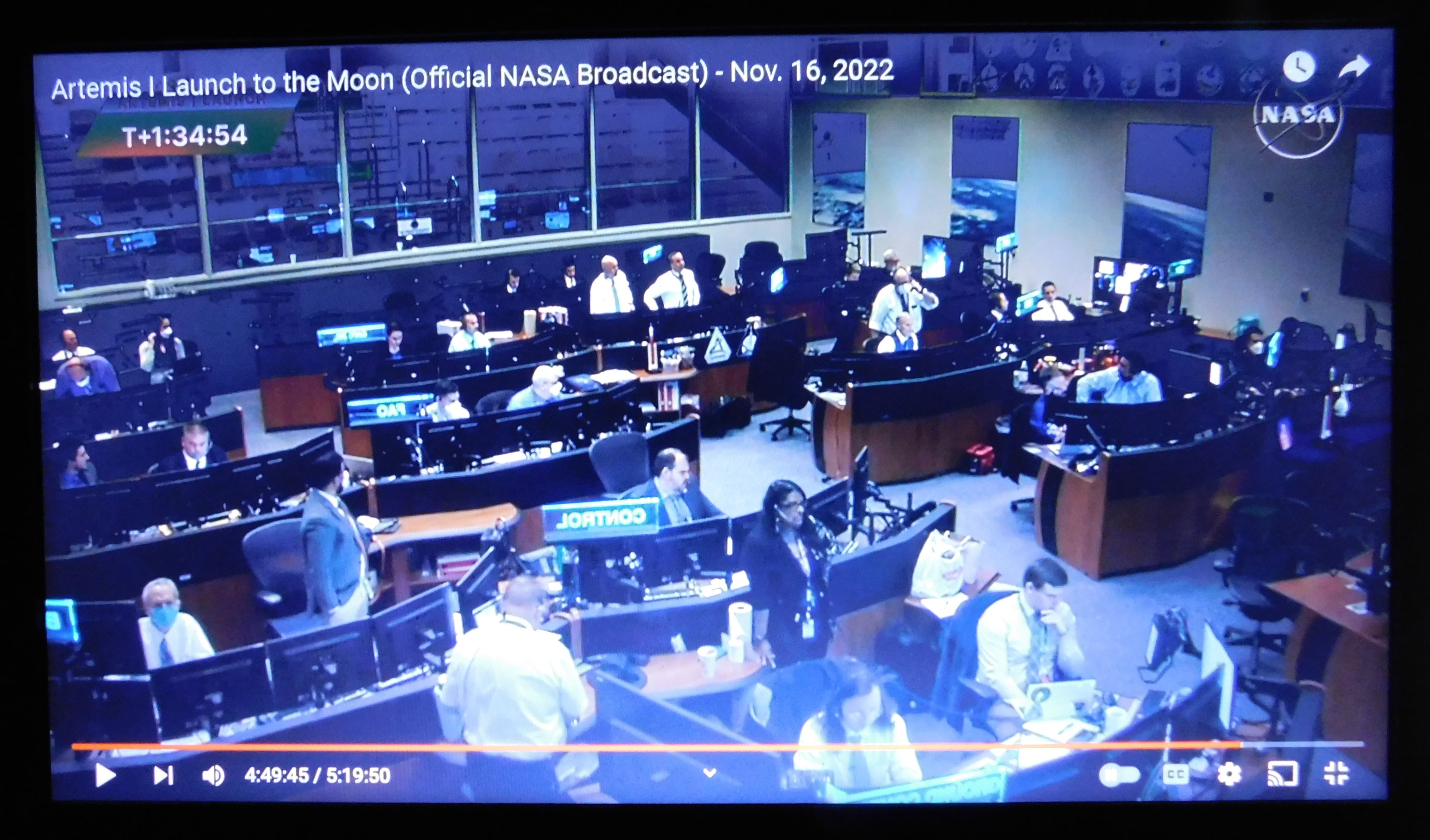
This week, I’m expressing thanks for NASA’s Artemis I.
“We are going back to the moon.” Did you watch the launch of Artemis I Wednesday morning? It was worth getting up early to see! If you missed it, you can see the official NASA broadcast on YouTube here. And here’s a link to NASA’s Artemis I web page.
All the pictures of this post are screenshots from the YouTube video, or else they are photos of that video playing on my computer monitor. Because sometimes you want to remember what it was like, personally, to participate in this event.
This Space Launch System (SLS) and spacecraft (Orion) are designed to get people to the Moon and back, and eventually allow people to travel from the Moon to Mars. The Artemis I mission is un-crewed, operated by programming and remote transmissions, as they’re testing the system before sending living people up in it. It’s also multitasking with several other experiments and stuff.
The biggest deal on Wednesday was the SLS—the massive rocket system that launched the capsule out of Earth’s atmosphere and into space, heading toward the Moon and beyond.
The launch system is simply fantastic. The liftoff was intensely dramatic—like watching a volcano erupt, but on cue and perfectly in control: “Three, two, one, boosters and ignition . . . And liftoff of Artemis I! We rise together—back to the Moon, and beyond!”
After about 1 minute after liftoff, the rocket was going over 600 mph, with 8 million pounds of maximum thrust. About 20 seconds later, it was 1,420 mph. Just 2 minutes and 11 seconds after liftoff, the two solid rocket boosters had done their job and were jettisoned. Soon after that, the rocket was traveling at more than 3,400 mph.
Three minutes into the launch, the speed was 4,060 mph; after another minute, it was up to 5,200 mph. At 5 minutes, the speed had increased to more than 6,800 mph, and a minute later to 8,800 mph. At T+06:20, the speed had exceeded 10,000 mph, and at T+07:00 it was up to 12,000.
Then, after 8 minutes of flight, the main rocket engine cutoff occurred, and the core stage separated from the Orion capsule, which was then considered to be in Earth’s orbit. After that, in following days, it would continue on to the Moon. At the point of main engine cutoff, the speed was more than 16,000 mph.
Do you know how orbiting works? Think about it this way. If you hold a ball in the air and then let it drop, it falls straight down to the earth, thanks to gravity. If you flip the rock sideways a little, it still falls to earth, but it follows a curved path. If you throw or pitch the rock a little harder and faster, the rock travels farther, and its curved path is wider. If you shot the rock out of a cannon, it would travel even farther, tracing an even wider curve, before falling to earth. But what if you shot the rock so fast and far that its curved, falling path actually matches the curvature of the planet? It would continually be falling . . . but it would never fall to earth.
By the way, the current land speed record is 760 mph. The air speed record (by ducted jet engine aircraft, within the atmosphere) is something like 2,193 mph, set by a Lockheed SR-71 “Blackbird” Mach 3+ jet.
The Orion spacecraft, with its 26-day mission, will eventually take a far-distance elliptical orbit around the moon, traveling a maximum of 280,000 miles away from Earth and 40,000 miles beyond the far side of the moon. That’s substantially farther than the 1970 Apollo 13 mission, during which the astronauts traveled a maximum of 248,655 miles away from Earth.
This is a big deal, you all! Yes, we’ve sent amazing remote-controlled equipment into space, to Mars, to Jupiter, and beyond. . . . And as for crewed space flights, the various space shuttles and space stations have all remained in low Earth orbit. No humans have truly gone out into space since the Apollo 17 mission in 1972.
Exploring is what humans do. Learning, identifying, describing, making connections, questioning, making predictions, testing, understanding, recording, and communicating about it . . . that’s what humans do. That is our superpower. It’s our ministry. It’s in our DNA.
We are the portion of the Earth that is programmed and equipped to allow Earth to see and try to understand itself. We animals are its eyes, brains, and conscience.
And are you excited that NASA is pointing out, strongly, that the Artemis missions will land the first woman and the first person of color on the moon? You should be. It’s an indication that we’re not stuck in the 1950s, even though some people seem to think that’s where we should return. So including all types of our nation’s people in the space program is a strong signal that everyone in our country is encouraged to contribute—because diversity is our nation’s strength. And we need to get back to that thinking!
One of the big themes this summer has been the eclipse, and preparations for our Michigan cousins to visit. The whole thing was kind of like New Year’s: All the preparation and anticipation; then the compression of time the closer we got to the event (the family visit and logistics) and finally the eclipse itself, which seemed to last about ten seconds, and then it was over—we were spewed out the other side of the event and into the vastness of the future, the rest of our lives, all the stuff we weren’t thinking about as we were focusing on the point of time that was the boundary.
I used the event of my brother’s and cousins’ visit as a catalyst for doing a great deal of straightening, cleaning, and fixing up of our place. It hasn’t looked this good in a long time. It’s still not a showplace, but it’s much, much improved. And the progress we’ve made on the house, I think, will motivate us to do more—to continue the trend. “An object in motion . . .”
I have to admit that the eclipse itself underwhelmed me somewhat—Annie Dillard’s masterful essay “Total Eclipse” had me psyched and ready for a spiritually, existentially, chronologically, anthropologically (etc., etc.) moving experience. But the silence of it, the gradual movement into darkness was more subtle than I’d expected. It looked a lot like an approaching thunderstorm, which is normal enough around here, especially with a line of puffy cumulous, as there was, along the northern horizon. It just looked like a thunderstorm on the way. Or passing us by on the north.
Sue and I opted to view the eclipse by ourselves, while the rest of the family viewed it from near my parents’ home in Columbia (in the parking lot of a Baptist church, where a nearby lawn-mowing man didn’t ever stop mowing the lawn to view the eclipse). Sue and I didn’t want to spend our precious few minutes of totality in a parking lot. We invited the others to join us at our spot, but none of them felt confident there wouldn’t be horrible traffic between Columbia and our soybean field—and who wants to see an eclipse from a traffic jam?
I felt strongly that because it’s a natural event, I wanted to be in nature. I didn’t want to be with the hordes at the state capitol, or the crowds at Columbia’s official viewing party. Ugh! Later, we watched the NASA broadcast that had shown the Jeff City capitol area, and they actually had people blowing AIR HORNS to signal the beginning and end of totality. Godawful ~~~AIR HORNS!~~~ I’m soooooooo glad I wasn’t there.
Weeks before the eclipse, Sue and I had scouted out a little “numbered” county road (479) just southwest of the tiny town of Mokane. It was almost right on the center line of totality. This little road is a straight line between MO 94 and a Conservation Department access point (the Mokane Access) on the Missouri River. It’s in the broad, flat river bottoms, with wide-open sky, and except for a strip of forested land along the river, soybean fields all around.
On the morning of August 21, 2017, the great eclipse-viewing day, we packed our stuff into Sue’s truck: lawn chairs, our patio umbrella, and an ice chest full of beverages and comestibles. And we set out for our spot. We expected to see a lot of crazy traffic, but that wasn’t ever the case, before or after.
We got there super early, which was fine, because we spent time just enjoying the anticipation and taking pictures of insects and things. Of course! Like this peacock fly and straight-lanced meadow katydid.
We were a little worried about a pretty persistent layer of gauzy clouds that would seem to be in the wrong part of the sky during totality, but those clouds pretty much cleared up just in time, and what was left of them created cool, moody atmospheric effects all around the sky. (St. Joseph, to our northwest, was screwed, however, with thick clouds.)
The silvery light before totality was pretty interesting, and it might be what I will remember the most. Since we were parked on a (limestone) gravel road through soybean fields, the contrasty lighting was especially pronounced, since the shadows cast by the broad leaflets of soybeans already look kind of sharp, and the plants nearby were coated with white dust from the gravel road.
We got a good view of the sunset/twilight effect on the horizon, with yellow, salmon, pink hues all around us. It kept getting more and more interesting! We kept saying: Wow . . . look at that!
From a line of trees off to the south, close to the river, a colony of scissors-grinder cicadas, which usually only chorus in the evening, sang when it got dark: wheee-ooo, wheee-ooo, wheee-oooooo . . .
Using solar sunglasses, we didn’t see the diamond-ring effect or Bailey’s beads before totality; the last edge of the sun just seemed to “wink out” in the glasses—when we removed the glasses, all that could be seen was just the darkness of the moon and the corona. . . . And a really interestingly blue sky, a color that doesn’t show up in any of the photos people took.
Instead of looking like something . . . dynamic, or tremendous, the eclipsed sun mainly just looked weird, like a new kind of star, a black moon, or a small cloud, or a balloon. A tiny round hole in the sky that hadn’t been there before. Knowing it would only last a few minutes, we looked around and tried to notice as much stuff as possible. We kept spinning around and pointing: “WOW! Look at THAT! . . . Oh, WOW, look at THIS!” We saw some pink prominences. And although we got something like 2 minutes and 40 seconds of totality, it seemingly lasted about ten seconds.
We did see the diamond-ring effect as it left totality, then everything started happening in reverse, and we watched the shadow drift away from us toward Kentucky.
My camera and video recorder, with their automatic light metering, didn’t capture the true changes in the amount of light. They kept compensating for the darkness, and lightening the images. I’ll have to remember that in 2024.
We were not the only people on our little gravel road—there were about fifteen other vehicles, which all arrived after we’d settled in. Some of the cars that drove by were hauling boats, heading to the MDC river access, to no doubt see the eclipse from the water. (That’d be sweet, eh?) Of the viewers parked along the road, we saw license plates from Minnesota, Wisconsin, Iowa, Illinois, Missouri, Oklahoma, Texas, and Ontario. Some of these folks packed up and took off as soon as totality was over; others took longer to leave. We stayed the longest.
The other cars were pretty far away from us, but most of the people seemed to have some sort of setup like ours: a patio umbrella, a few chairs, an ice chest.
My photographic capabilities are quite limited, and so is my knowledge. I did venture to take one picture of the sun, once it was getting close to totality (I could tell because I was using my protective eclipse-viewing glasses). The sun, of course, was all blown out in the photo, but the lens flare, below it, replicated the crescent shape of the sun, rather like a pinhole camera. Anyway, I thought it was cool.
I didn’t spend any time trying to take photos during the eclipse; I only took pictures beforehand of the place, our setup, the road, the horizon, the soybeans, the insects. Then, a few minutes before totality, I started my video camera (on a tripod, aimed at the northwest horizon) and just let it run and record what we were saying. I’d share it with you, but it’s nearly 530 MB and I don’t know how to upload it without completely destroying the quality of sound and image. I guess I need to upload it to YouTube, then embed it here. (Sheesh, so much work.)
But anyway, we fiddled with our cameras, video, tripods so much during the hours before the eclipse that we didn’t have our picnic before, but after. So while the other cars were departing, we broke out our little fruit, wine, and cheese party.
Everyone had been warned that there could be some serious traffic before, during, and after the eclipse, so we weren’t interested in getting involved in it. As it turned out, the crowds were seemingly minimal except at major highway interchanges and bridges.
I have real sympathy for our local restaurateurs, who were told by festival planners and city officials to expect lots and lots of business . . . and it was a big fizzle. The restaurants had stocked up on foodstuffs, then, for many of them: hardly a customer. True, the motels were all completely booked months ago, but apparently not many people ate out. It might have been that the locals were scared away from the town center by the warnings of possible traffic.
But who can blame anyone for such guesses being wrong? This kind of event has never happened before in the United States, and there were hundreds and thousands of places where people could go to see it, ranging from big, organized city festivals, to nearly anyone’s backyard, to our lonely sea of soybeans along the Missouri River.
Today is part 1 of me telling you something of my past shenanigans. If you know me, you probably already know about this stuff; sorry if it’s boring. If this is old news to you, check back in a week or so.
But if you don’t know me very well, maybe you’ll think this is pretty cool. I recommend trying it yourself, especially if you’ve got kids.
Before Sue and I bought the house—before home repairs, and finding ways to pay for them, became our number-one pastime (come on, smile—life could be worse, right?)—we used to have a “theme” each year.
It was like our very own “continuing education” seminar. It was always about natural history. Each year we’d pick some category of things in the natural world, and make it our theme for the year. We’d focus on it, read about it, plan activities around it. Whatever the theme was, we’d be conscious of it the whole year.
Making it an annual cycle makes sense when you’re learning about natural things. From the progression of the constellations to the lives of mosses, you need all four seasons to witness a complete cycle, the thing in all stages of life, in all positions and forms.
One year, we learned about spiders. One year, it was all trees. And we actually had two years where we studied mushrooms and fungi. Naturally, we only scratched the surface of these subjects, but we did learn more than most people know, and we also gained something in the way of consciousness—after spending a year focusing on something, you are pretty much always going to be aware of it.
This annual “focus” emerged from my sense of “withdrawal” after I got my master’s degree. I had loved taking “ology” classes: ornithology, mammalogy, ichthyology, invertebrate zoology, plant ecology, and so on. Each semester immersed me in some wonderful new realm.
After spending months intensively studying something—say, plant taxonomy—you can’t go outside without keeping an eye out for novel plants, or noting and appreciating the familiar, characteristic structures of, say, a flower in the mustard family—4 petals, 4 sepals, tetradynamous stamens, the seeds enclosed in a silique. Good ol’ mustard flower.
And suddenly it seemed mustard flowers were everywhere—though before I took the class, I usually saw only weeds.
Each class opened my eyes, caused me to appreciate a chunk of this fantastically diverse world. Georgia O’Keeffe is famous for saying, “Nobody sees a flower really; it is so small. We haven’t time, and to see takes time—like to have a friend takes time.” Taking those “ology” classes caused me to take that time, and taking that time made the world into something like a friend.
So when I got done with my schoolin’, I quickly realized I was missing something: learning. That year (and this was the perfect time for it, as I was between school and my first job, and I was living in Arizona), was for me the Year of the Star.
I had never taken an astronomy class, and I had never seriously studied the night sky. So for that year, I made it a point to drive into the desert at least once a week and learn the constellations, and the names of the stars. I quizzed myself on them, naming all I could before opening my book and trying to learn some more. I kept abreast of interesting events—bright stars being occulted by the moon, times when two or three planets drew close in the sky, meteor showers, the moons of Jupiter, lunar and solar eclipses, and much more. Whatever I could witness without a telescope.
I read books and magazines by day; by night, I spent hours supine on the hood of my Civic, off the side of the road, looking through binoculars. This was way out on an Indian reservation, in open range, where small bands of horses would sometimes drift quietly past. Clear, dark skies. Later, at 2 or 3 in the morning, I’d sit in the Waffle House on Baseline and I-10 and write notes in my journal, sketching the lights I saw in the sky.
Once, I convinced a new “friend” I’d met at a bar to leave that smoky dive and join me on one of my stargazing outings. In retrospect, it must have seemed like an invitation to do far more, but in the end we both had a wonderful and innocent time, out in the quiet night, talking and taking in the mystery of it all.
Ever since my year of saturating myself with the stars in the night sky, I find myself looking upward at night, noting the phase of the moon, mentally rehearsing star names to myself, renewing my acquaintance.
And I experience a sense of reunion when I’m up late enough to see, reaching above the eastern horizon, a favorite constellation from the coming season—stars not seen since they vanished with the sun beneath the western horizon months ago. Seeing Sirius in October is like spying the first wildflower of the spring, or noting the first tinges of gold on leaves in mid-September.
And even more than this, I discovered that I am somehow deeply comforted by the fact that no matter where I go (unless I travel far into the southern hemisphere), the constellations and planets will always be there with me, doing their thing, predictable clockwork overhead.
On some level, it’s a terribly romantic concept, to think that we all—you, me, and all the ones we love, and all the ones we have trouble with—live beneath the same stars, the same silent heavens.
(Yes, I'm going somewhere with this. Check back again in a few days.)
Why? So you can easily comment on posts! Also, you can yak with Julie and other Op Op readers. Plus, you'll get notification and links to new Op Op posts automatically on your FB page. Ain't technology grand?
(Just Who Do I Think I Am, Anyway?)
I was born and grew up in Columbia, Missouri, moved out of state for grad school and jobs, then came back to Missouri . . . and somehow I’m still here. My sweetie and I bought my grandma’s house in Jefferson City in 2001, and all kinds of things have resulted from that—both frustrations and glory.
Oh, by the way, I’m a freelance book editor and publishing consultant, but this blog is my chance to be anything but an editor! Apologies in advance, but I’m too poor to hire an editor for my own writing, and I don’t have the time to devote to editorial polish here.
My interests are wide, but there are some things that can hold my attention for especially long periods of time. For instance, I love natural history—plants, fungi, bugs, aquatic things, birds, you name it—and hiking is what truly brings me home.
I also love good food. Most recently, I’ve been teaching myself how to cook German dishes, since that’s my heritage and the older generation is slipping away, but I love Indian cuisine as well and can also make an awesome Mexican fiesta. Mediterranean? Yes. Vegetarian? Often. Sushi? Check. Grandma’s vintage Maytag Dutch Oven gas range came with the house, and the whole kitchen has excellent mojo.
I should also mention that I have a tendency to be depressed; I created this blog in part to remind myself of all the things there are here in Central Missouri, in the Ozarks, and all around me, to be happy and enthusiastic about.
Of course it’s not all sunshine and rainbows, but you really can find coolness and authenticity in unlikely places. And that’s what I’m trying to highlight here.
If you want to contact me, simply leave a comment on a post and I’ll see that you have done so and respond. Maybe I’m overcautious at this point, but well, you know—I’m trying to avoid spammers and stalkers and what-not.
Finally, thank you for reading my blog. Leave me a comment to let me know you’ve stopped by!
I hope you enjoy your little peek into my day-to-day observations and reflections.
In recent years, I've been using Blogspot's "comments moderation" feature: All comments come to me first as an e-mail, and then I approve them, before they are posted.
I don't like this at all, but it seems the only way to deal with spam. Maybe someday Blogger will develop a spam filter that's smart enough to screen out certain words (such as "viagra" or "cialis").
Sorry that comments won't appear instantly. I do see them, and if they're genuine posts and not spam or other ham-handed attempts at advertising, they will get posted. Have faith!




 Posts
Posts

