Showing posts with label winery. Show all posts

Sunday, May 29, 2022

Jar of Goodness 5.29.22: Missouri Wines

. . . The weekly virtual “gratitude jar.”

This week, I’m expressing thanks for Missouri wines.

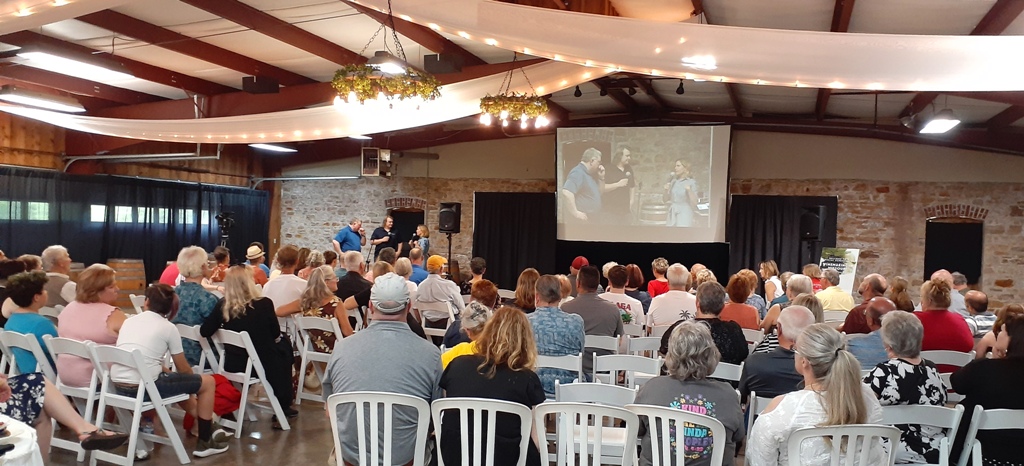
This afternoon we went to Stone Hill for a screening of a new documentary about the history of wine in Missouri, including a big dose of Stone Hill history in Hermann. It’s called Winemaking in Missouri: A Well-Cultivated History, and apparently it will be coming to a PBS station near you soon (starting in St. Louis, eventually being distributed nationally by American Public television).

Seriously, keep an eye out for it. It's well made, well-researched, and well worth watching.

Directed by Cat Neville as part of her tasteMAKERS series, it covers a long, interesting history: How German immigrants brought wine culture with them, how it was a challenge to try to grow European grapes in Missouri, how an invasive root pest introduced to Europe nearly destroyed the wine industry there, but Missourians figured out that North American grape rootstocks were naturally resistant and European grapes could be grafted onto them, saving them from utter destruction. And then, when Missouri wineries were producing the most wine in the country, then came Prohibition. So Missouri wines themselves had to come back from utter destruction.

One of my favorite points made in the movie is that here in Missouri, we don’t grow Zinfandel, Merlot, Cabernet, Chardonnay, Sauvignon Blanc. Our climate and soils aren’t right for those. BUT! We have the Norton, and we have a number of interesting hybrids of those European grapes with native varieties. So yeah, Missouri wines are not the same as the others. If you drink them expecting them to taste just like the wines made in California or Europe, you’ll be disappointed. . . . But why would you hold such an expectation? And why would you want them to be the same? . . . Variety is the spice of life! Travel broadens the mind! And wine is never about having that same exact delicious flavor again and again and again. That’s for fast-food connoisseurs. No! Wine is about trying and sampling new things. It’s about the journey; making discoveries.

We were a little late, so we missed most of the hors d’oeuvres before the showing, but we got to see the film. Afterward, as people milled about and sifted away, we sat at one of the outdoor picnic tables to enjoy a bottle of Norton.

Even though there had been a formal Q&A session before the film, the Held family and other Stone Hill people were still busy afterward speaking with tons of guests. (You could have figured that people would want to stand around and talk more after viewing the film!) The servers were removing the demolished trays of food, the leftover napkins, the plates. As the place emptied, we waved and did the hip-hip-hooray sign at Betty Held, the honored matriarch of Stone Hill, as she rode away with friends in a van. A little later, Jon and Nathan Held walked by and chatted with us for a while, so we had a really nice conservation with them after all. Truly the highlight of the evening.

John Thorne, my favorite food writer, said that good wines are always worth trying, because you can usually see why some people really like them. They’re interesting. Even if it’s not to your personal taste, you can at least appreciate them for what they are: different. Somebody’s beloved local flavor. “Malbec, for instance,” he says, “is a varietal that tastes rather like ink; a highly rated one tastes like delicious ink.”

Variety is the spice of life. . . . Variety is the spice of life.

Thursday, October 7, 2021

ElderBlossom View Orchard and Winery

Here’s a new place we’ve discovered, and I know you’re going to love it, too: ElderBlossom View Orchard and Winery. It’s not your standard winery; it’s not your standard anything. And we really like that: it’s different! It’s smart. It’s unique.

First, your typical winery uses grapes, while ElderBlossom View (EBV) focuses on elderberries. They grow them right there. Second, while your typical winery makes wines, and sometimes also juices, EBV has a dual mission: they make both high-quality wines and juices, including some juice blends suitable for a wide range of uses. For example, their Elderberry Relief juice with ginger, sweetened with organic honey and cinnamon, clove, and elderflower extracts, can be used as a tonic, to relieve a sore throat, but it can also be used in imaginative cocktails or nonalcoholic beverages. Same goes for their pure elderberry juice, which is full of antioxidants.

They also make a product called Elderflower Nectar that combines fresh lemon juice, cane sugar, and their own hand-harvested elderberry flowers. You can add this to hot tea on a cold winter’s night, or you can add it to club soda to make something much more interesting than a Pepsi, or you can mix it in cocktails, or even in a glass of sparkling wine.

I like the juice just dashed into a glass of club soda. And they're happy to serve it to you that way at ElderBlossom View.

See where they’re going with this? Although your first thought might be “oh, all they offer is elderberry wine, and I can’t picture my whole gang sitting around drinking just elderberry wine,” instead, realize that they have a truly wide variety of tasty and refreshing (many quite healthy) beverage choices. Including non-elderberry drinks. The special beverage menu changes seasonally. This summer, they offered an elderberry mojito and an elderberry mule, among other intriguing choices. They had a fresh, locally sourced watermelon-elderberry cooler, perfect for a hot summer evening. The watermelon is from a grower right across the highway in Hartsburg! So many options. Ooh-la-la!

Now that the weather’s cooled, you can have an Autumn Blossom Martini, made with elderflower vodka and blossom sauce, apple butter, half and half; a Sassy Cider, served hot, made with a house blend apple cider, elderberry juice, infused with smoked sassafras wood; an Eldershine peach moonshine cocktail with bourbon-barrel-aged syrup, and the house Elderberry Relief spiced juice blend; and a Persimmon Old Fashioned, made with whisky, a dash of elderberry wine vinegar and a splash of pure elderberry juice.

And the wines are good! When you do a tasting, you will certainly find one you like; they have a range of styles, from sweet to dry. Dry is my personal favorite; you may find it rather tart, but I like it that way. They even have a sparkling elderflower mead called “Elder Bee,” which can go into some fun cocktails (such as this summer’s mango-pineapple “Meadosa”).

You can purchase snacks at the winery, but you are also quite welcome to bring your own picnic basket. We brought sandwiches (jack-and-cooked-kale on multigrain bread), which paired well with our refreshing elderberry beverages in terms of flavor and in healthfulness. Bring whatever food you like—just remember, though, that they want to sell beverages to you, so you’re not allowed to bring outside beverages in.

While we’re on the subject of house rules, here are a few more: don’t let your kids roam around unsupervised; don’t get in the lake (no matter how inviting it may look); and don’t bring your dogs. (Their dogs, Tulip and Aster, already live there, and they’re kind animals, so you won’t miss your own poochies.)

Background

Their story is on their website, but when you hear it, you’ll probably be jealous. John and Heather Uhlig, upon retiring from whatever it was they did, decided to transform stale pasture land into acres and acres of elderberries. Elderberries.

Common elderberry (Sambucus canadensis) is a native shrub that you often see growing in thickets along roadsides and edges of fields. In May, June, and July, elderberry lifts up great, round, dense, fragrant clusters of tiny white or cream-colored flowers. In August, September, and October, these mature into big, flat-topped clusters of BB-sized, purple or black, berrylike fruits on the finely branching reddish stalks. The leaves, stems, and twigs are toxic and should not be eaten, but the berries and flowers are edible, given the proper preparation.

The preparation is painstaking. Each tiny berry must be liberated from the stem, and not all the berries mature at the same time. If elderberry anything seems kind of pricey, then it reflects the effort it takes to harvest and process the fruit.

If you’ve ever popped ripe elderberries into your mouth, you might have been disappointed; first, there are a lot of seeds (four) for such a small fruit. Second, the fruits are bittersweet or tart, so if you’re going to cook with them, you need to keep that in mind and sweeten accordingly.

If you use proven recipes, you’re in for a treat: elderberry jam and jelly, elderberry pie, elderberry muffins and pancakes, and elderberry wine are old-fashioned favorites. The flowers are also used in a variety of ways—for example, rubbed from the flowerheads and mixed into pancake or muffin batter, or made into an herbal tea.

So, for the next chapter of their lives, the Uhligs determined to grow elderberries and sell elderberry products. The name, ElderBlossom View, is a reminder of their retirement project: the blooming of something, well, old—them; the land; and the growing and culture of elderberries. Elderberry has an ancient history as a healthful food, and modern science is supporting it as a “superfood.”

The Uhligs grow several varieties (cultivars or strains) on their land, each with its own properties, flavor profile, harvest time, and so on. Their products, including the wines, are blends of what amount to different elderberry varietals. In addition to the artistry of blending the juices and turning these into tasty wines and other products, a lot of effort has to go into simply extracting the juice: remember, four seeds per berry.

The Place

EBV is much more than their products: it’s an event space. A big event space! Like everything else about EBV, it’s unique. Pleasant meandering walkways lead to lots of different benches, chairs, and picnic tables, accommodating different sized groups.

Throughout, there are lots of native wildflower plantings, which attract a variety of native pollinators and birds, even a little creek and pond system, where—the first time we were there—we saw a bunch of toad tadpoles swimming around.

The interest in native plants, birds, and pollinators is refreshing. The Uhligs get it! Everywhere you look, there are native shrubs and wildflowers, from milkweeds that give life to monarch butterflies, to the sumacs that turn brilliant scarlet in September, to the bluebird boxes that provide a home to our beautiful state bird, which no doubt feasts on the insects attracted by all the blooming native plants.

Tired old ideas still prejudice many fruit growers against frugivorous birds. Instead, EBV welcomes the fruit-eating birds, knowing that a certain percentage of the crop will be eaten by mockingbirds catbirds, robins, and others. They are enlightened enough to know that birds are an important part of nature. Likewise, plenty of insects make their living from elderberry plants, too, including the pollinators as well as those that feed on the leaves, stems, and sap. Insects are bird food, too, especially during nesting season. Again, these are the cycles of nature. Sustainable agriculture: How refreshing!

The theme of making old things new again is reflected in the big repurposed farm silo that, as of this year, forms the roof of the shelter that’s a focal point of the winery’s grounds. Sitting under its pleasant shade, you have a gorgeous view of their big lake. It’s spectacular at sunsets.

What are you waiting for? Oh, yeah, the weekend, when they’re open!

Where Is This Place?

The website says “New Bloomfield,” but for people in Columbia and Jefferson City, it’s probably better to think of it as east of Hartsburg. It’s about halfway between Hartsburg and New Bloomfield, as the crow flies. Most people will get to it from US 63. If you’re from Columbia, go south on US 63 about 15 miles. If you’re from Jefferson City, go north on US 63 about 12 miles.

From US 63, turn east on Zumwalt Road (it’ll be gravel for most of the rest of the way); it will soon veer right (south) and then wind around a bit, but continue on it about 3.7 miles. In the process, you’ll cross the bridge over Cedar Creek. (Who else remembers the longtime KOPN bluegrass music show called Cedar Crick Pickaway?) At that point, Zumwalt Road becomes County Road 398. Not too long after crossing Cedar Creek, you come to a T: the county road turns sharply left (east), while the drive to ElderBlossom View is the turn to the right. They have a sign; it’s not huge, but it’s there. Follow that drive through the woods and elderberry plantings to the winery.

The hours (starting in mid-October 2021) are Fridays and Saturdays, 4–9 pm, and Sundays, 2–6 pm.

The address is 208 County Road 398, New Bloomfield, MO 65063. Be advised that the road near ElderBlossom View can be flooded and impassable during times of high water, so if you’re unsure, call ahead: 573-268-8597.

They also sell their products at the Columbia Farmers Market.

Keep Your Eye On The View!

They’ve got lots of events planned. You should especially note their upcoming Samhain Festival, 11–4 on Saturday, October 23: a Celtic harvest celebration with merriment, elderberry refreshments, food, music, and art booths.

Follow EBV on Facebook or Instagram, and watch their website: EBV has been hosting live music, including some pretty good rhythm and blues and bluegrass bands. They’re proud of their good sound system, which enables them to amplify the music without blasting it from overly loud speakers.

As the weather gets nicer this fall, ElderBlossom View will be the place to be. It’ll compete with places like Cooper’s Landing, Les Bourgeois, Logboat Brewing, and Rose Music Hall. It’s where all the cool kids will be. I hope to see you there!

Friday, August 27, 2021

Stone Hill Ozark Hellbender Red: A Great Wine for a Greater Cause

Hey, I want to remind you to pick up a few bottles of Ozark Hellbender next time you’re out buying wine.

Now if you’re going, “whatever is she talking about?” then you need to read on, because this is really cool.

In 2018, Hermann, Missouri’s own Stone Hill Winery—the historic 1847 winery that, with its restoration in the 1960s, almost single-handedly started the renaissance of Missouri’s wine industry—started producing a dry red blend they call Ozark Hellbender.

Why the weird name? A portion of the profits go to help fund the research and restoration efforts of several conservation organizations to restore the Ozark hellbender, an endangered native Missouri aquatic salamander.

Actually, in the past year, both of Missouri’s subspecies of hellbenders have been declared federally endangered, so restoration efforts are more critical ever.

Here are some links to learn more about hellbenders, their conservation status, and the Saint Louis Zoo’s captive breeding and restocking efforts.

In a nutshell—as if you could fit one into such a small place—hellbenders are huge, slimy, brown salamanders with small eyes and loose skin. They spend most of their time hiding under big flat rocks in cool, fast-flowing Ozark streams. Adults can be 11 to 20 inches long, making them the largest salamander in North America (three relatives in the giant salamander group are larger and live in East Asia; all of them range from threatened to possibly extinct in the wild). Missouri is the only state to hold both subspecies of North American hellbenders.

The reasons for their decline are numerous and are compounded by the fact that females usually don’t breed until they’re about seven or eight years of age. And even then, they may only breed every two or three years. They typically live for three decades in nature, but that’s assuming their streams remain habitable for them, and even then, their small, vulnerable offspring need to have a decent shot at surviving to breeding age. One hellbender was documented as living to age fifty-five—no wonder they don’t breed until they’re seven or eight; they’re kinda like us.

And so there’s a captive breeding and restocking program, which, combined with efforts to improve and protect their natives streams, might bring them back to the point where their populations are stable.

A personal reverie: MU’s legendary zoology professor Dean Metter used to keep the university’s herpetology collection (enclosures with live snakes, lizards, and such) in a hallway on the second floor of Stewart Hall. My dad, with the rest of the geography department, had their offices in the basement of that building. Often, when we were there to pick up Dad after work and there was a delay of some kind, I’d go upstairs and visit Doc Metter’s herps.

As a pigtailed Campfire Girl, and before, as a tagalong little sister with my brother’s Cub Scout den, we had a guided tour of the collection by Doc Metter himself. I’ll never forget him gently removing a speckled kingsnake from its cage and letting me hold it.

Along one, rather dark wall was a big, long, galvanized tub about waist-high. It must have had a chiller on it, in addition to the circulation/filtration. It was always humming and moving the water around. And there, in the tub, was a fourteen- or sixteen-inch-long hellbender. It never seemed to move, except to kind of waver a little with the current; it just rested in there like a shadow. It was there forever, it seemed. Knowing what I know now, it’s sad to think of that creature living in a galvanized tub in a lonely university hallway, educating those of us too young or citified to discover hellbenders on our own.

Nature had designed it for a life creeping around on Ozark stream bottoms, exploring amid boulders and bunches of watercress, crawling under large flat rocks, hunting crayfishes. Of living as one with the quick freshness, in the higher oxygen content of springfed sections of the river, and the richness and quietude of the pools.

. . . Anyway, there’s something primordial and shadowy about hellbenders; something uncanny and otherworldly. Very fascinating. It’s heartbreaking that something so . . . so . . . seemingly eternal could become extinct, wiped from existence forever.

So, this wine helps raise funds to help the hellbenders.

But it does a few other things, too.

It shows the maturation of Missouri’s wine industry, when one of its leaders is able to step well beyond the tried-and-true, by now rather formulaic marketing angles of “quaint local winery,” “historic ethnic German winery,” and “have your wedding receptions here, folks!”

I really like how Stone Hill, with this project, is connecting with Missouri's natural history and showing a dedication to its future. The “German heritage” angle is an obvious focus and starting point for most Missouri wineries, but this is showing Stone Hill's maturity as an institution.

Also, German immigrants brought a tremendous love of nature with them to the New World. While the English-derived Americans liked trees, grass, and gardens when they were trimmed, mowed, or planted in rows, the Germans held romantic feelings about wild places, where plants and animals grow free and take the forms and patterns innate to them. Yes, many German immigrants were (or became) master horticulturalists, but alongside their love of cultivation, they held a deep love of untamed nature. So this project, which celebrates an aspect of wild Missouri that many Missourians would feel squeamish about, continues that Germanic love of wilderness.

When I communicated this idea recently on Stone Hill’s Facebook page, I got this nice reply from someone at the company: “Thanks for the kind words! We are really glad we can play a small part in continuing that tradition and supporting this special Missouri species! As farmers, it is so important to keep our natural world healthy for the future.” . . . To which I say, Right On!

I don’t think they’ll mind me flat-out copying their descriptive text for the 2018 Ozark Hellbender wine:

BLEND INFORMATION: Since the Ozark Hellbender spends most of its life secretively hiding under rocks in the bottom of Ozark streams we are keeping our blend a secret as well. But we’ll give you some hints! All variety of grapes used are grown in the Ozark Mountain AVA. Some grapes aged for one year in neutral oak barrels to bring out complexity, softness and drinkability. Then just before bottling, like any good family recipe, we add the final variety which is held secret only for our winemakers to know.

TECHNICAL INFORMATION: Alcohol - 13%; Residual Sugar - 1.5%

TASTING INFORMATION: A smooth red blend with aromas of sweet cherry, blueberry and a touch of toasted oak. Creating a soft, complex and very drinkable wine, made from grapes all grown in the Ozark Mountain AVA. *A portion of the proceeds from every bottle of Ozark Hellbender wine sold is donated to the Saint Louis Zoo and hellbender conservation. (750ml)

AWARDS:

Bronze - 2019 Missouri Wine Competition

Yes, it's an award-winning wine! In fact, just recently, the 2019 Ozark Hellbender won "Best of Class Semi-Dry Red," and the 2018 Ozark Hellbender received a gold medal, at the 2021 Missouri Wine Competition. Way to go, Stone Hill!

Seriously, what are the grapes, you wonder: Here’s what they told me (in response to my Facebook question, subtly hinting if Merlot was one of the ingredients): “No Merlot in it! It is a blend of three grapes: Norton, Chambourcin, and #3 is a secret. [Finger-to-lips "shh!" emoji.] All three are grown on our own vineyards though.”

Norton is the strongest part of the blend. Have you ever tasted Norton wine? It’s distinctive. It’s North America’s native, sophisticated dry red grape variety. It’s Missouri’s premier wine grape. It has a fascinating history; if you want to read more, I heartily suggest Todd Kliman, The Wild Vine: A Forgotten Grape and the Untold Story of American Wine.

Norton isn’t for everybody. It has a distinctive flavor. It’s like this: If you’re hankering for oranges, a grapefruit will taste just wrong; it’s so close, it seems almost an insult to oranges; so close, well—just give me an apple. But the fun of wines is their variety. Thank goodness wines aren’t all the same! There are many really good wines—you simply won’t like all of the types. In his insightful essay “Knowing Nothing about Wine,” John Thorne described it like this: “Needless to say, wines with the same rating don’t taste equally good (Malbec, for instance, is a varietal that tastes rather like ink; a highly rated one tastes like delicious ink).”

But Thorne goes on to talk about how really good wines, highly rated ones—even if you don’t end up liking the variety—will still be worth trying, because you can usually see why some people really like them. They offer food for thought. They’re interesting. I suggest trying Norton with this in mind.

I heard somewhere that Ozark Hellbender red became the top-selling red at Stone Hill Winery in Hermann when it was released (apparently, it still is). That’s pretty remarkable, because the average Missourian typically prefers sweet wine. That Hellbender Red is selling so well could mean that Missourians have suddenly become conscientious consumers, choosing products that give back to good causes . . . or it could mean that Missourians have suddenly developed more cultivated palates . . . or it could mean that Ozark Hellbender red is a deviously clever blend that offers enough berry flavor to satisfy the average palate but enough complexity to make it good for people who prefer dry reds. And serving it chilled makes it smoother for red-wine newbies. Indeed, this blend can be kind of a “gateway drug” for Norton, and even “dry red” appreciation. Or it could be a combination of all three.

I think lot of people would like to drink dry red wines because of their purported health benefits and because, as you sit among your friends, a glass of deep red wine simply looks groovier than white—but many can’t make the leap in terms of flavor. I can see someone trying a Norton varietal and thinking, “I can’t enjoy this.” But after a few weeks enjoying Ozark Hellbender red here and there, you could easily acquire an appreciation for Norton: “Oh, this is that unique flavor I’ve come to enjoy in my Ozark Hellbender red, only more of it.” . . . And if this is what Hellbender red achieves for Stone Hill, then bully for them! Smart-smart-smart-smart-smart.

I hope you will go out and try a bottle of Ozark Hellbender red—for the tasting experience . . . and to help the hellbenders.