Showing posts with label science. Show all posts

Monday, December 23, 2024

Big Nature, 2024

The year 2024 has been a notable nature year in several ways. Sure, there were some significant tornado, flooding, and other severe-weather events (some part of Missouri gets those every year); but if you lived in any of the places affected, it was definitely a year of “big nature” for you.

And we had an exceptionally mild spring, which is something, and by fall, most of the state was in some level of flat-out drought. (Which affected fall color in our state.)

In October, the drought stress caused our lilacs to bloom even as our green ash tree turned yellow. It was a really odd sight.

But I want to talk about much bigger nature. Like, once-in-a-lifetime nature. Like, there was that amazingly beautiful total solar eclipse in April (I still need to blog about it). Of course, I didn't even try to take pictures of it, but I sure soaked in the time and place—the way the event felt, and how unique it looked—sunny but shady, at once.

And there was that solar storm that ignited aurorae visible exceptionally far-south in May and October. If you got to see that, or get photographs of what you wished you could see with your bare eyes, then bully for you!

But let’s not forget the coolest nature thing that happened in eastern North America: the coincidental emergence of two big periodical cicada broods the same year! It was Broods XIII (17-year) and XIX (13-year). Realize, every “normal” periodical cicada emergence is an amazement in itself. That these insects can live 13 or 17 years below ground, sucking juices from tree roots, then somehow all emerge within the space of a few weeks, the same year, like clockwork, is a staggeringly cool example of big nature.

The last time the two broods emerged the same year was in 1803, the year the Louisiana Purchase was signed!

As of 2024, there appeared to be nowhere that the two broods overlapped, so it was a geeky thing to geek out over. It’s not like there were twice as many cicadas in most places (indeed, cicadas generally decline thanks to habitat disruption, and climate change is affecting them, too).

So it’s a mathematical convergence. When one thing happens every 13 years, and another thing happens every 17 years, it’s rare when they synch up.

So, when will the two broods emerge during the same summer again? How do you figure that out? Well, here you go: 13 x 17 = 221, and 2024 + 221 = 2245. The year 2245!!

What will the year 2245 be like? None of us alive today will see it . . . but Star Trek at least has offered some suggestions. According to Star Trek, 2245 is the year, on April 11, of the launch of the USS Enterprise, NCC-1701 (yes, THAT Enterprise!). Its first captain will be Robert April (who appears in later Star Trek series, including Strange New Worlds). James T. Kirk will take the captain’s chair in 2265.

It’s also the launch year of the Enterprise’s sister starships, the USS Cayuga (NCC-1557), later destroyed by the Gorn, and the USS Constellation (NCC-1017), under Captain Matthew Decker; both are destroyed by the Bugles-shaped planet killer in a memorable Original Series episode, “The Doomsday Machine.”

Star Trek canon also has it that 2245 is the year that Pavel Chekov will be born, and it’s the year that Leonard McCoy will decide to pursue a career in medicine.

I love it that these musings for 2024 have started with astronomical phenomena—the solar eclipse, the aurorae—then took a dive underground to consider the years our cicadas lived in soil, then fast-forwarded to the Star Trek universe. Science can predict, even project natural events: solar cycles, solar and lunar eclipses, and cicada emergences. And what do you think 2245 will be like?

Sunday, November 20, 2022

Jar of Goodness 11.20.22: Artemis I

. . . The weekly virtual “gratitude jar.”

This week, I’m expressing thanks for NASA’s Artemis I.

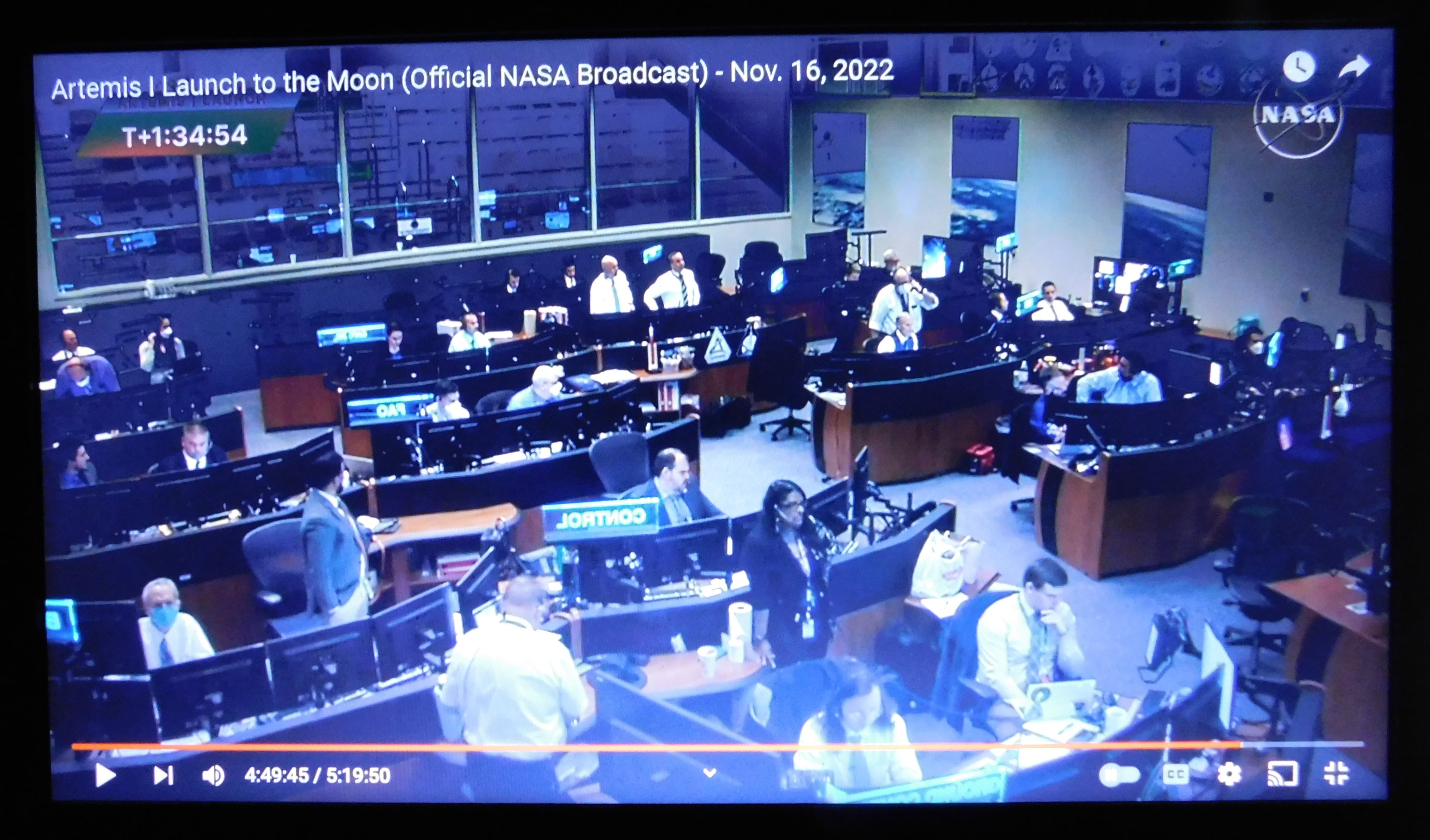
“We are going back to the moon.” Did you watch the launch of Artemis I Wednesday morning? It was worth getting up early to see! If you missed it, you can see the official NASA broadcast on YouTube here. And here’s a link to NASA’s Artemis I web page.

All the pictures of this post are screenshots from the YouTube video, or else they are photos of that video playing on my computer monitor. Because sometimes you want to remember what it was like, personally, to participate in this event.

This Space Launch System (SLS) and spacecraft (Orion) are designed to get people to the Moon and back, and eventually allow people to travel from the Moon to Mars. The Artemis I mission is un-crewed, operated by programming and remote transmissions, as they’re testing the system before sending living people up in it. It’s also multitasking with several other experiments and stuff.

The biggest deal on Wednesday was the SLS—the massive rocket system that launched the capsule out of Earth’s atmosphere and into space, heading toward the Moon and beyond.

The launch system is simply fantastic. The liftoff was intensely dramatic—like watching a volcano erupt, but on cue and perfectly in control: “Three, two, one, boosters and ignition . . . And liftoff of Artemis I! We rise together—back to the Moon, and beyond!”

After about 1 minute after liftoff, the rocket was going over 600 mph, with 8 million pounds of maximum thrust. About 20 seconds later, it was 1,420 mph. Just 2 minutes and 11 seconds after liftoff, the two solid rocket boosters had done their job and were jettisoned. Soon after that, the rocket was traveling at more than 3,400 mph.

Three minutes into the launch, the speed was 4,060 mph; after another minute, it was up to 5,200 mph. At 5 minutes, the speed had increased to more than 6,800 mph, and a minute later to 8,800 mph. At T+06:20, the speed had exceeded 10,000 mph, and at T+07:00 it was up to 12,000.

Then, after 8 minutes of flight, the main rocket engine cutoff occurred, and the core stage separated from the Orion capsule, which was then considered to be in Earth’s orbit. After that, in following days, it would continue on to the Moon. At the point of main engine cutoff, the speed was more than 16,000 mph.

Do you know how orbiting works? Think about it this way. If you hold a ball in the air and then let it drop, it falls straight down to the earth, thanks to gravity. If you flip the rock sideways a little, it still falls to earth, but it follows a curved path. If you throw or pitch the rock a little harder and faster, the rock travels farther, and its curved path is wider. If you shot the rock out of a cannon, it would travel even farther, tracing an even wider curve, before falling to earth. But what if you shot the rock so fast and far that its curved, falling path actually matches the curvature of the planet? It would continually be falling . . . but it would never fall to earth.

By the way, the current land speed record is 760 mph. The air speed record (by ducted jet engine aircraft, within the atmosphere) is something like 2,193 mph, set by a Lockheed SR-71 “Blackbird” Mach 3+ jet.

The Orion spacecraft, with its 26-day mission, will eventually take a far-distance elliptical orbit around the moon, traveling a maximum of 280,000 miles away from Earth and 40,000 miles beyond the far side of the moon. That’s substantially farther than the 1970 Apollo 13 mission, during which the astronauts traveled a maximum of 248,655 miles away from Earth.

This is a big deal, you all! Yes, we’ve sent amazing remote-controlled equipment into space, to Mars, to Jupiter, and beyond. . . . And as for crewed space flights, the various space shuttles and space stations have all remained in low Earth orbit. No humans have truly gone out into space since the Apollo 17 mission in 1972.

Exploring is what humans do. Learning, identifying, describing, making connections, questioning, making predictions, testing, understanding, recording, and communicating about it . . . that’s what humans do. That is our superpower. It’s our ministry. It’s in our DNA.

We are the portion of the Earth that is programmed and equipped to allow Earth to see and try to understand itself. We animals are its eyes, brains, and conscience.

And are you excited that NASA is pointing out, strongly, that the Artemis missions will land the first woman and the first person of color on the moon? You should be. It’s an indication that we’re not stuck in the 1950s, even though some people seem to think that’s where we should return. So including all types of our nation’s people in the space program is a strong signal that everyone in our country is encouraged to contribute—because diversity is our nation’s strength. And we need to get back to that thinking!

. . . So that we can rise together!