Showing posts with label German heritage. Show all posts

Sunday, December 18, 2022

Jar of Goodness 12.18.22: Heirloom Christmas Cookies

. . . The weekly virtual “gratitude jar.”

This week, I’m expressing thanks for heirloom Christmas cookie recipes.

“These are the cookies of my people.”

I could go on and on about how strongly I feel about our precious family Christmas cookie recipes, but I’d rather just talk about the reasons why these connections are so strong.

But first, honestly, do I love these cookies the best? I sure didn’t when I was a child. I grew up accustomed to sweets that were, well, sweet, like candy, or cookies that are sugary or chocolaty. Each Christmas, when I was confronted with the old-fashioned and Germanic cookies of my forebears, I was rather let down. Dates, raisins, and candied fruits are a different kind of sweet than chocolate chips and Oreo “stuf.” Brown sugar, molasses, and sorghum are also different from white sugar. A lot of it’s the difference between sucrose and fructose. Nuts? They aren’t hardly sweet at all. Finally, when I was a child, I found assertive spices challenging. It’s not that I didn’t like spices—but when a cookie like a pfeffernüsse presented me with a punchy, bewildering blend of cinnamon, anise, cloves, ginger, cardamom, and/or nutmeg, it just seemed “weird.”

So you can imagine my less-than-enthusiastic response to biting into a billy goat cookie, full of dates and black walnuts, when I thought I had picked up a chocolate chip cookie. They do look a lot alike. They taste very different. So I learned to hesitate, my hand hovering over the cookie tray. I learned to carefully inspect my choices before making a commitment to any.

And this is why cookie trays, during my childhood, always included kid-friendly choices. My brother and I learned to scope out the animal cookies (that is, sugar cookies cut into animal and Christmas-themed shapes such as pine trees, bells, stars, and angels, always with straight-ahead icing on them). We also snarfed up the good ol’ chocolate chippers, the snickerdoodles, and the like. Mild flavors; Rice Krispies treats; spritz cookies. Cookies a kid can count on!

But it’s not like I wouldn’t eat the old-fashioned, Germanic cookies. Springerles, I thought, were pretty good, albeit often tough to chew (I didn’t drink coffee, so I didn’t discover the joys of dunking until much later). Lebkuchen, especially with a glaze and decorated with sprinkles, or with half of a candied cherry pressed into the glaze, weren’t too bad, even though the candied fruit was sort of “meh.” Billy goats were tasty, as long as you didn’t have your heart set on it being a chocolate chip cookie.

And so on. My brother and I ate the Germanic favorites, but like the sauerbraten and red cabbage we had only a few times a year (always at Grandma’s), they were “weird.” They were German things, things our school chums in Columbia, whose surnames were English like Wilson and Smith, didn’t have a clue about. The cookies their moms offered us were just “regular” cookies.

And soon enough, we realized our family’s Christmas cookies were special. Everyone who was older, our parents and uncles and aunts, and everyone older than they, oohed and aahed over them: “Ooh, yum, you made springerles! They’re so beautiful! I’ve got to have one of them!” They wouldn’t have gushed so much if it was, say, oatmeal-raisin cookies or peanut butter cookies, because those were everyday cookies; they weren’t special.

By the time I was a teenager, I was hooked on these cookies. Like the Schroeder Weinachtspyramide, I knew they were special to my family and other ethnic Germans. I never cooked, but I knew these required some special skills to make. I was grateful for my grandmas, my mom, my aunts, and the other ladies who made them. When I lived in Arizona and Montana, my grandmas’ abilities were waning. Grandma Renner had dementia; Grandma Schroeder had lost most of her vision. (Where did their springerle rollers or presses end up? I don’t know.)

Uncle Richard had always doled out his lebkuchen for months after Christmas, keeping a coffee can full of them in his conservation-agent patrol car. Shivering, he’d nibble on leppies and sip from his coffee thermos on his late-night stakeouts for catching deer poachers.

He ultimately refrained from eating the last bite of his last lebkuchen made by his mother; he put a tiny eyescrew in it and dipped it in varnish or polyurethane. It’s preserved and it has his bite marks on it. He made a necklace out of it—a totem—which he wears during holiday get-togethers: “The last bite of my mom’s last leppie.”

So yeah, I started looking for the recipes.

Since then I’ve gotten them pretty much figured out. There’s been a lot of trial-and-error, since it was too late for me to lean on my grandmas for advice. But food memories, it turns out, can be acute, so I’ve had a lot of help and encouragement.

The sense of smell and taste are strongly linked to memory and emotion. That’s why certain scents evoke such nostalgia—like the smell of freshly cut green grass in spring, or the first whiff of a wood fire on a crisp, early winter evening.

With the winter holidays so linked with family and spiritual celebrations, and with holiday foods repeated so many years, it only ingrains and strengthens the many associations of those flavors and smells. So when you smell those special cookies baking, each year the memories and layers of meaning accumulate.

It’s about so much more than the cookies. They’re just a trigger, the portal, the crystal ball, the talisman. They link me to my family, my ancestors, to a continent I barely know. They link me to fifty years of memories, some sad, but nearly all sweet. They invoke a mini meditation, a reverie, a quick portal into another dimension. They have power.

Any other time of year, I’ll make other kinds of cookies (recently, I’ve been partial to hermits and “pride of Iowa” cookies, for instance). But it’s my pleasure and honor to make family Christmas cookies and then share nearly all of them.

I didn’t start this. Ancestors who traveled across the Atlantic Ocean brought their holiday recipes with them; they couldn’t bear to have Christmas without them. . . . And who am I to break the chain?

Sunday, May 29, 2022

Jar of Goodness 5.29.22: Missouri Wines

. . . The weekly virtual “gratitude jar.”

This week, I’m expressing thanks for Missouri wines.

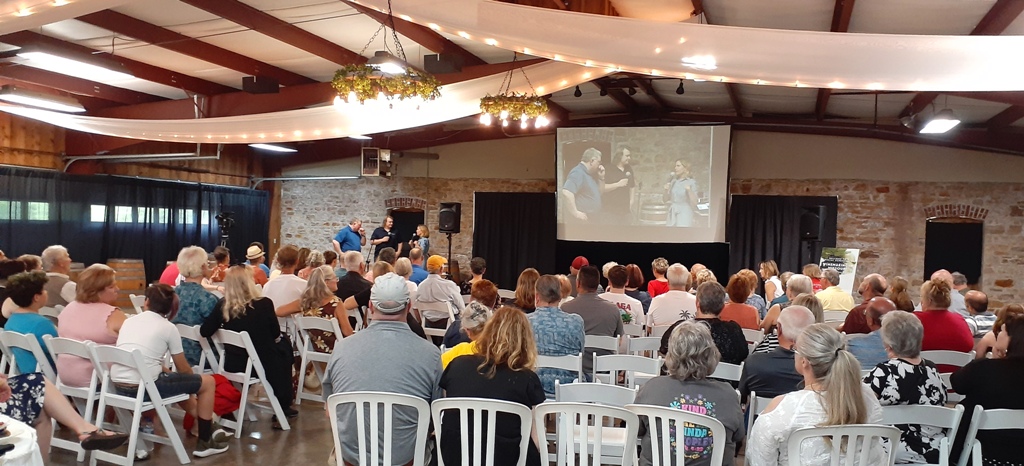
This afternoon we went to Stone Hill for a screening of a new documentary about the history of wine in Missouri, including a big dose of Stone Hill history in Hermann. It’s called Winemaking in Missouri: A Well-Cultivated History, and apparently it will be coming to a PBS station near you soon (starting in St. Louis, eventually being distributed nationally by American Public television).

Seriously, keep an eye out for it. It's well made, well-researched, and well worth watching.

Directed by Cat Neville as part of her tasteMAKERS series, it covers a long, interesting history: How German immigrants brought wine culture with them, how it was a challenge to try to grow European grapes in Missouri, how an invasive root pest introduced to Europe nearly destroyed the wine industry there, but Missourians figured out that North American grape rootstocks were naturally resistant and European grapes could be grafted onto them, saving them from utter destruction. And then, when Missouri wineries were producing the most wine in the country, then came Prohibition. So Missouri wines themselves had to come back from utter destruction.

One of my favorite points made in the movie is that here in Missouri, we don’t grow Zinfandel, Merlot, Cabernet, Chardonnay, Sauvignon Blanc. Our climate and soils aren’t right for those. BUT! We have the Norton, and we have a number of interesting hybrids of those European grapes with native varieties. So yeah, Missouri wines are not the same as the others. If you drink them expecting them to taste just like the wines made in California or Europe, you’ll be disappointed. . . . But why would you hold such an expectation? And why would you want them to be the same? . . . Variety is the spice of life! Travel broadens the mind! And wine is never about having that same exact delicious flavor again and again and again. That’s for fast-food connoisseurs. No! Wine is about trying and sampling new things. It’s about the journey; making discoveries.

We were a little late, so we missed most of the hors d’oeuvres before the showing, but we got to see the film. Afterward, as people milled about and sifted away, we sat at one of the outdoor picnic tables to enjoy a bottle of Norton.

Even though there had been a formal Q&A session before the film, the Held family and other Stone Hill people were still busy afterward speaking with tons of guests. (You could have figured that people would want to stand around and talk more after viewing the film!) The servers were removing the demolished trays of food, the leftover napkins, the plates. As the place emptied, we waved and did the hip-hip-hooray sign at Betty Held, the honored matriarch of Stone Hill, as she rode away with friends in a van. A little later, Jon and Nathan Held walked by and chatted with us for a while, so we had a really nice conservation with them after all. Truly the highlight of the evening.

John Thorne, my favorite food writer, said that good wines are always worth trying, because you can usually see why some people really like them. They’re interesting. Even if it’s not to your personal taste, you can at least appreciate them for what they are: different. Somebody’s beloved local flavor. “Malbec, for instance,” he says, “is a varietal that tastes rather like ink; a highly rated one tastes like delicious ink.”

Variety is the spice of life. . . . Variety is the spice of life.

Tuesday, December 21, 2021

Schroeder Weihnachtspyramide 2021

This is a Weihnachtspyramide (Christmas pyramid) built by Albert Thomas ca. 1890. Albert and his wife, Wilhelmine, were German immigrants who arrived in Jefferson City, Missouri, in 1888. The pyramide was already about twenty years old when their youngest daughter, Edna, was about five, in 1910, per our family's earliest photo of it. Edna married Walter Schroeder in 1930, and the couple lived in the same house as Albert and Wilhelmine Thomas and continued to display it each year after the Thomases passed away in the 1940s.

With few exceptions, this Weihnachtspyramide has no doubt been used as a Christmas decoration every year since it was built around 1890. That's about 130 years!

Albert Thomas constructed the Weihnachtspyramide from a variety of materials. The paddles at the top were made from scrap wood from fruit crates. The central axle is a broomstick; on it rests the three circular platforms (made of cardboard). One of the hooplike, horizontal supports around the outer structure is from a discarded band saw. In its earliest form, when rising candle heat made the angled top paddles spin, friction was minimized at the pivot point at the bottom of the rotating broomstick by having a downward-pointing nail attached at the base of the broomstick, and the nail tip rested on a piece of glass. It had to be adjusted to balance perfectly in order for it to spin properly.

The family refers to this as a Christmas "tree," but it is more closely related to the wooden pyramiden that are hand-carved in the Erzgebirge region of Germany. Those often have little candles at the four bottom corners to provide the heat necessary to turn the platforms into little processionals at the center. Our family's pyramide has been altered so much over the years it's truly unique; a form of living folk art that changes slightly every year.

We have several photos of the "tree" taken over the decades. Many of the ornaments and figurines go back to the early 1900s and are visible in the old photos. The Thomases used to attach sprigs of real cedar or other greenery to the frame, in addition to the ornaments.

An early change was when the original candles were replaced with small coal-oil (kerosene) lanterns (three of these are still used as ornaments). Then, in the 1940s, those were replaced with strands of multicolored electric lights. A small electric fan, mounted on a nearby window frame, was directed on the paddles, turning the central platforms. (We even still have the fan, though it doesn't work, and the holes in the window frame are still there!)

In the 1950s, Edna's son Walter ("Buddy") procured a music box designed for rotating a small Christmas tree, and the tree was transformed again. This allowed Edna to greatly increase the amount of ornaments, greenery, and other decorations on the frame, the inner platforms, and even hanging from the paddles. Today, in the interest of being kind to the now-antique music box, we have opted to reduce the amount of objects hanging from the paddles.

Edna (my grandma) passed away in 2000, and we purchased her house in 2001. The Weihnachtspyramide (with its special attic closet) came with the house. I'm doing my best to care for it. We've made some changes--for example, replacing some ca. 1950s light strings that no longer worked and whose plastic sockets were literally crumbling away--but that's what Grandma would have done. She kept it "young." So it's my job to fiddle with it, too.

Apologies for the defects of my video. I'll keep working on my skills with the camera. I hope you enjoy this glimpse into our family's unusual "tree," and I hope you have a merry, and a blessed Christmas.

For more information about our Weihnachtspyramide, see my blog posts about it. Here's a good place to start.

And if you're wondering how this comes apart for storage, here's where you look.

Sunday, September 26, 2021

Jefferson City’s Das Stein Haus: Retro Menu

With a chill in the air and time Oktoberfests starting up, we turn our thoughts to the Holy Trinity of Bratwurst, Sauerkraut, and German Potato Salad (GPS). And beer. And other Germanic things. And look what I found at a local flea market recently: an old menu from Jefferson City’s longtime German restaurant, Das Stein Haus.

I’m old enough to remember when it first opened in 1981. It was a big deal, because it was very near to where my Grandma Renner lived (her house is gone now; Southwest Animal Hospital is where her house used to be, so you can see how close it was to Das Stein Haus).

Grandma Renner, who was already pretty housebound at that point, especially being practically deaf, was really tickled when the dashing young restaurateurs—native Germans, no less!—stopped by her house to introduce themselves with their German accents! Later, they even brought her some food. Helmut und Dieter!

It was so thrilling to have such a nice, fancy restaurant so near! And German!

. . . Yet we rarely went there. I wonder why not? Perhaps because it was too fancy . . . or pricey. Or perhaps because Grandma had trouble getting around and couldn’t hear well in crowds. Perhaps Grandma Renner—despite growing up knowing some German and having learned her “Vater unser im Himmel, geheiligt werde dein Name” in German—was not quite a German cook. She was more of a Midwestern American cook, more familiar with fried chicken, mashed potatoes, and country ham.

Or, perhaps the family just wasn’t in the habit of going out to fine restaurants very much. Frugal Midwesterners. We all mostly ate at home. And with its tablecloths, cloth napkins, and use of charger plates, Das Stein Haus certainly seemed high falutin’, for the early 1980s.

Anyway, a lot of years have gone by. I have no idea what happened to Dieter, but Helmut’s still there running the place. Reviews of the restaurant vary widely. Some people say it’s the Greatest Ever, Five Stars; others say it’s abysmal, dark and dusty, with overpriced “meh” food and pathetic service. Apparently some of the problems people have with Das Stein Haus is that Jefferson Citians are not accustomed to making advance reservations; we rarely need them in Missouri restaurants, so if you show up and no table is available, it seems outrageous.

The last time I went there was a night I needed a little cheering up. The neon lights appealed to me, and I thought it might be fun to go there, where nobody knows me, to sit at a bar, and have a drink. Maybe to strike up an interesting conversation. . . . And hey, I’m Germanic, sort of. . . . The bar was awful. First, it was smoky (this was before JC’s non-smoking ordinance went into effect, but I’ll bet it still has that stale stench). No one in there seemed happy, or perky, or even very awake. It was the kind of bar where, if you sit there too long, looking around, you’ll decide to stop drinking forever, because you don’t want to end up like this crowd. . . . And then I overheard some loud, homophobic conversation nearby, so I decided I truly didn’t belong there at all. So I haven’t been back. It’s not my scene.

Could be, the dining room is much better. But then, the last time we ate in the dining room (nearly twenty years ago), I realized my cooking is just as good, plus I would have better bread and better salads (at the time, I recall it being a standard iceberg lettuce salad and mass-produced soft sandwich bread, very underwhelming).

Anyway, I’m not here to review Das Stein Haus; it’s been a long time since we’ve been there, so who knows. The place is a true Jeff City treasure that has withstood the test of time, and at least the exterior of the building, as it’s aged a little, has actually gained in charm.

And—not counting frankfurters and hamburgers—where else in town can you get an array of German food?

So, here you go—a blast from the past—an old menu from Jefferson City’s Das Stein Haus. I’ll bet it’s from their first decade in business, ca. 1981–1991. If you know more, please leave me a comment below.

It’s interesting how the menu hasn’t changed much at all, except for the prices doubling or more. (See their current website, where the menu is under “services”.) There’s a good chance that the recipes might have changed somewhat over the years, even though the name of the dish is the same, but who knows.

Also, I’m pretty sure the display type on this menu was originally hand drawn line art. “Jerry Sanford” is the artist’s signature at the bottom of the second page. You don’t see much hand-lettered type anymore; it’s all digital today.

Das Stein Haus has been around a long time—forty years!—and it’s been a lot of things to a lot of people. So what do you think? What are your memories of Das Stein Haus?

Sunday, August 15, 2021

Grandma Schroeder’s Peach Kuchen Recipe

Here is the venerable kuchen recipe from my grandma Edna Schroeder. It’s a family favorite; every time I make it, all the Schroeder-clan people ooh and ahh. I grew up understanding that a kuchen was a special, special thing.

From my youngest age, I remember our family going to visit Grandma in Jeff City, and if she’d made a kuchen, there’d be excitement (which Grandma herself helped to generate): “Look what I made for dessert!” “Ooh, a kuchen! What kind is it?” “Peach!” “Oooh, a peach kuchen, I can’t wait!” . . . If it was a larger family get-together, each group to arrive would go through the same ritual, so I often heard it numerous times in a day, as my uncle and aunt and cousins arrived, as Marie arrived, as anyone else came. “Look, Mom made a kuchen!” “What kind?” “Peach!” “Oh, boy!”

Apparently Grandma never wrote down the recipe, but fortunately my Aunt Carole made notes one day as Grandma was making it. I’m not much of a baker, but I’ve been plugging away trying to master this recipe for a few decades (hard to master when I don’t make it very often). But even when I’m not personally satisfied with the texture, it has always tasted incredibly good.

First, let us review our German. In German, Kuchen means “cake” or “something baked,” so the word applies to a huge variety of Germanic baked goodies. Think of how we use the word “cake” for a wide range of dishes—pancakes, birthday cake, cheesecake, crabcakes, sponge cake, coffee cake, angel food cake, pound cake, fruit cake . . . This explains why your German grandma’s kuchen is nothing like my German grandma’s kuchen.

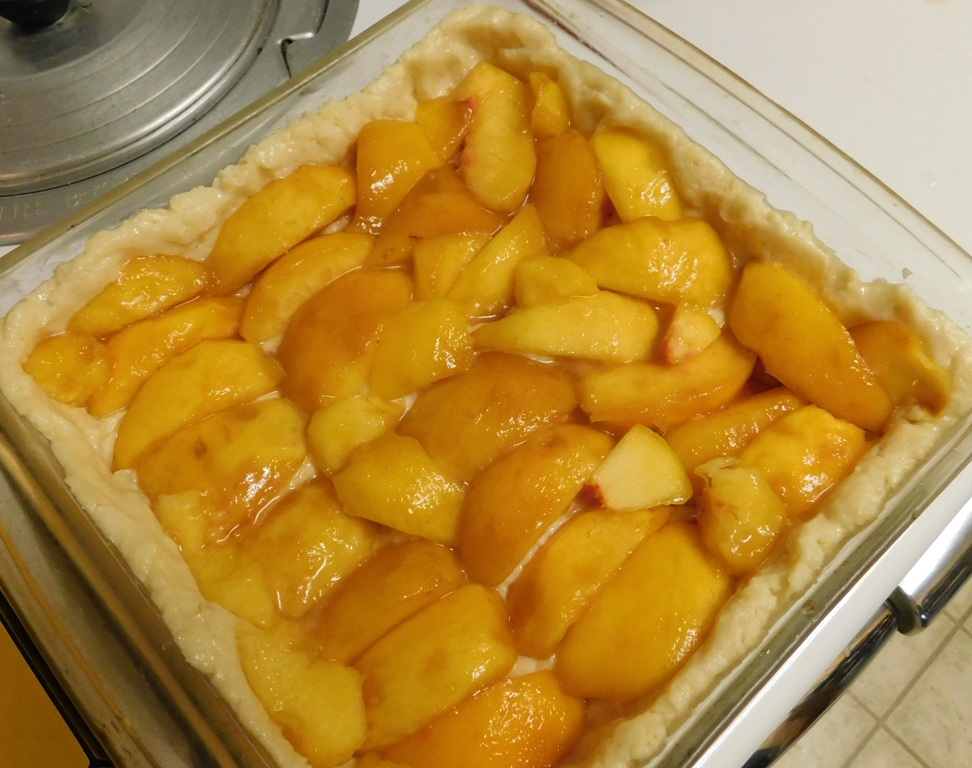
Well, Grandma Schroeder’s kuchen is like this: it has a shortbread-cookie-like “crust,” which is topped with fresh fruit lubricated with a gooey custard matrix and baked; when that is fairly set, it is topped with meringue and browned. (The meringue topping explains why the type of fruit is always a mystery; you can’t tell what kind of fruit was used just by looking at it.)

This is a wonderful way to celebrate whatever kind of fruit is in season. Right now, the peaches are perfect. Lovely, sweet, divine peaches. So we’re making a peach kuchen in this post.

A typical serving of this dessert (or coffee cake) is a 3 x 3 inch square (so, 9 servings in a 9 x 9 inch baking dish). I often stretch this out, using more fruit and meringue, to a 9 x 13 inch size, for groups.

The biggest challenge I usually have with this recipe is getting the center of the fruit/custard portion to bake firm enough to have meringue spread over it, without also overcooking the crust. This recipe can (and should) use a variety of seasonal fruits, so the juiciness can vary a lot. Therefore, I advise reducing the amount of custard for juicy fruits like peaches—just drizzle it on, but don’t force yourself to pour it all on, if it will make a pool of “soup” in the middle. I have the best results with sliced apples (apple kuchen)—where the fruits are somewhat dry.

The final result should have, at the base, about ½ to ¾ inch crust/cake; then about ¾ to 1 inch of fruit, within a gooey matrix of custard; then, on top, about ¾ to 1 inch of meringue. The corner pieces will have the most cake; the center pieces will be the gooiest.

Grandma made all kinds of kuchens, depending on what was fresh—Concord grapes, plums, blueberries, peaches, and combinations of these. Dad says Grandma never deseeded her Concords; she just put them in whole and let people chew on the seeds(!) My own variations have included a banana kuchen with peanut butter in the crust (recipe is here), and a kuchen with sliced tart apples plus big golden raisins that I’d soaked overnight in vanilla–infused cognac. (Grandma would’ve loved that one!)

I have seen what are apparently very “authentic” German recipes for plum kuchens that skip the meringue and are much flatter and more spread out. These are made in 9 x 13 baking dishes or cookie sheets. The plums are washed, halved, pitted, and placed on the crust in a decorative, overlapping pattern. Some type of glaze (sometimes heated-up jam) is drizzled or brushed over the top, then it’s baked, and that’s that. You can find several recipes for this plum kuchen (Pflaumenkuchen) online. You can certainly do that with this recipe, simply omitting the meringue and making a wider, flatter dish.

The base of the kuchen, in many recipes, is made with a sweet yeast dough (similar to that used for cinnamon rolls), but that’s not the way my grandma made it.

By the way, we always assumed that Grandma’s kuchen was a recipe she learned from her mother, who immigrated from Germany, but I found a very similar recipe in a cookbook that my Grandma used in her high school Domestic Science (home ec) class. Indeed: that particular page of her book (p. 412) is firmly adhered to the facing page by hundred-year-old, dried-up cooking goo. (I didn’t dare try to peel the pages apart; instead, I found a scanned version of the book online.) Some of the many kuchen dough recipes and variations in that book are very similar, too. So perhaps Grandma learned this recipe from her high school cooking text, The Settlement Cook Book, 11th ed., 1921. (Digitized versions of several editions of this book are online at the Hathi Trust; here’s a link to the 1921 edition.)

So here you go, another family secret unveiled . . .

Grandma Schroeder’s Peach Kuchen Recipe

Overall ingredients list:

  • 2 + ¼ cups flour (divided)
  • 2 tsp. baking powder
  • pinch salt
  • ½ + ½ + ½ cup sugar (divided)
  • ¾ stick butter
  • 4 eggs (divided: 1 beaten; the other 3 separated)
  • ½ + ⅓ cup milk (divided)
  • 2–3 cups fresh peaches, sliced (or other fruit)
  • ½ tsp. vanilla (optional)
  • ¼ tsp. cream of tartar

1. Make the dough. Combine the following:

  • 2 c. flour
  • 2 tsp. baking powder
  • pinch salt
  • ½ cup sugar
  • ¾ stick butter (it helps to use a pastry cutter and rather softened butter)

. . . then, add 1 beaten egg and enough milk (about ½ cup) to make it the consistency of cookie dough (e.g., rather stiff and sticky).

Spread the dough in the bottom and slightly up the sides of a 9 x 9 inch baking dish (Pyrex is good); with the dough so sticky, I spread it with moistened hands.

2. Make the custard. Separate the 3 eggs (reserving whites for meringue); beat together the 3 yolks, add ⅓ cup milk, ½ cup sugar, and about ¼ cup flour. This is for the custard matrix for fruit: depending on the juiciness of the fruit, consider making less, or using less milk, or including a whole egg instead of a couple of the yolks. (I usually make the full amount of custard; then whatever isn’t drizzled over the fruit in the kuchen I pour over additional/extra fruit in a couple of single-serving ramekins and cook in a bain-marie as a fruit custard.)

3. Fill the kuchen. Spread approx. 2–3 cups fresh fruit (sliced peaches, or whatever) evenly over the dough. It helps to gently press the fruit down into the kuchen; the crumb will raise and puff up, and the fruit will add moisture to the crumb. Drizzle custard on top of fruit. (See previous comment about not using too much custard—you don’t want it too full of liquid in the center.)

4. Bake at 350F for about 20–30 minutes. Watch it, because ovens vary; it’s done when the dough is cooked (browns) and the custard is relatively firm. Sometimes it never quite firms up due to the juices; it usually firms nicely with apples but rarely with grapes, blueberries, or peaches.

5. Make the meringue. This is a standard meringue recipe, as I don’t have any indication about how Grandma made her meringue. Beat the 3 room-temperature egg whites on medium with ½ tsp. vanilla (if using) and ¼ tsp. cream of tartar for about a minute (until soft peaks form); then switch to high speed and gradually add up to about ½ cup sugar; beat for about 4 minutes, or until shiny and stiff peaks form. If making meringue seems like kind of a pain, remember that Grandma used a manual rotary eggbeater.

6. Finish the kuchen. You’re in the home stretch, now. Spread the meringue carefully on top; dabbing it into artistic shapes, and return it to the oven to brown the top. Let it cool gradually. Store it in the refrigerator.

If it falls apart when you cut it, who cares? It's delicious! And I'm sure you'll love it.

. . . My people do.

Thursday, October 1, 2020

More About Great-Grandma Wilmesherr

. . . and her zither. So don’t you want to hear more about my great-grandma? Pauline Wehmeyer (1875–1950) was born and raised in Kansas. She married my great-grandpa William August Wilmesherr (1872–1936) and lived with him on her family’s farm in Kincaid, Kansas. They had their first three children, including my grandma, Clara (who was born September 17, 1897), while they were farming there. She used to help her husband with the farm work while her mother babysat the kids. William Wilmesherr wasn’t a big sturdy guy; he was “slightly built,” and a childhood bout of what may have been typhoid might have diminished his constitution.

At the end of the 1800s, falling farm prices helped convince the couple to relocate to Washington, Missouri, about 1900. So they moved all their possessions, including a couple of horses, from eastern Kansas to Washington, Missouri, by boxcar. William rode in the boxcar with the horses, to take care of them.

In Washington, they bought an old house on Henry Street, south of a city ballfield in a neighborhood then called “Goosetown” (east of MO 47 and north of MO 100). In addition to a thriving economy, they had plenty of relatives in the city. William worked as a teamster, hauling brick to locations where houses were being built. The brickyard guys would throw a stack of four bricks to my great-grandpa, and he’d catch them and load them onto his horse-drawn wagon. (So much for being “slightly built,” huh?)

I never could have known them, but I can’t visit Washington without thinking of my great-grandparents, and remembering all the many relatives who lived there.

The German community in Washington was very musical, and the various members of the extended Wehmeyer and Wilmesherr families were involved with the pipe factory band, the Elks band, and the Washington Civic Orchestra. Some of them were very involved with music.

The zither dates to about 1900, so we’re not sure if Pauline bought it before or after moving to Missouri. We think she must’ve bought it soon after moving to Washington, though it’s possible she got it in Kansas. No one knows. My mom suspects she might’ve gotten it via a Sears catalog. There was a famous zither manufacturer in Washington, but I bet those instruments were much more expensive.

In addition to the zither, my great-grandma also had a parlor organ, which she taught herself how to play. Mom says she liked to play “lively hymns” like “Heavenly Sunshine.” Before marriage, she must’ve been a Presbyterian or maybe a Methodist, but her husband was German Lutheran, and that’s what she became after they were married. Apparently, she never much liked the dour, serious hymns of the Lutherans, and that was the one thing she really didn’t care for about her new denomination.

Really, everyone likes to have a fun time. Grandma Renner described how her parents would have get-togethers in their home. The Wilmesherrs would have the Fillas, or the Noelkers over. Or the Dennlers, Lohmeiers, Kampschmidts, Schmidts, Kampschroeders, Huxels, or the Stumpes. They’d serve “dishpans” full of popcorn to their guests, and they’d play cards, or people would bring instruments over and play and sing with Pauline’s parlor organ. Homemade wine might be brought out for the guests, too, and everyone would sip the precious, sweet liquid from little wine glasses.

Great-Grandma Wilmesherr must’ve been a remarkable woman. No nonsense, practical, a capable mother and farmwife, yet musical, curious, and creative. She was famous for her ability to make anything green grow, including vegetables and flowers. She had coldframes and sold flowers and bedding plants to people who stopped by. She had a goldfish pond. My grandma, her daughter, followed in these footsteps and had the same talents and pastimes. Even a goldfish pond.

In winter, Great-Grandma Wilmesherr read “Westerns.” Why not? She had known the plains of windswept Kansas in the late 1800s, and the West was a real thing for her. It might have been the closest thing to actual travel she could have. I think she had an independent streak. I grew up hearing stories about how, as a widow, she’d drive, solo, on curvy, hilly Highway 50 from Washington to Jefferson City, peering at the road through the space between the top of her steering wheel and the dashboard.

When I got married, my mom gave me Pauline Wilmesherr’s wedding ring to use in our ceremony. (She also gave me my great-grandma Renner's wedding band, as well, and that's what Sue used.) It’s the most beautiful wedding ring I could’ve imagined, invented, or asked for, and I see no reason to replace it with anything else—it’s such an honor just to have received it.

Sometimes when I practice my trumpet, I play in my office, where the zither rests in an honored position. With its open strings, it sounds with resonance when I play notes in accordance with its tuning—concert Cs, Gs, Fs, and all their overtones. I play the notes . . . and it breathes again.

Monday, October 24, 2016

Some Birthday Bonbons: Fun Germanic Music

Hi, friends! It’s my birthday, but I’m giving you the bonbons! Well, I’m sharing, anyway!

My brother, Paul, recently told me about some fun YouTube music videos he’s found. He’s really into Germanic/Northern European stuff, history, language, ancient and Medieval cultures, and Game of Thrones. (I guess that’s a TV series—?) (Remember, we don’t have a TV anymore.)

So I watched his recommendations, and yep, they’re pretty interesting. So interesting, in fact, that I thought I’d turn around and share ’em with you. (I know a lot of my readers have similar interests.) I won’t go into great detail about these music groups and the meanings of the songs—I know you can Google all that for yourselves, if you want. I’ll just provide a few links for more info.


Faun is a German music group that plays “pagan folk, darkwave, and medieval music” (per Wikipedia). They play on a lot of traditional European folk instruments. Give ’em a listen! Where else are you going to hear a hurdy-gurdy? And there’s nice video storytelling, too.


Finally, for my friends who like Celtic music, you’ll find this interesting. As one commenter put it, “German root version of Siúil a Rún! Dear Gods . . . Bless you.”


Then, there’s a song called “Herr Mannelig” performed by Garmarna, a Norwegian group specializing in medieval ballads and such. The video shows scenes from the movie Beowulf and Grendel, but I’m not sure if there’s any official connection between the movie and the song, much less Garmarna’s performance of it.


Saving the best for last, my favorite of Paul’s suggestions is this one by Faroe Island native Eivør Pálsdóttir. The video below, of her song “Tròdlabùndin” (Trøllabundin), pretty much speaks for itself. Not many performers can completely mesmerize an audience with just singing and simple drumming. The setting for the live concert, Aurlandsfjord, in Norway, is absolutely spectacular.


Friday, January 22, 2016

Haben Wir Zusammengewesen!

. . . But wait, there’s more!

I’m still talking about our New Year’s Eve traditions. Here’s another one: We have a family theme song! I’ll bet you think I’m kidding—but I’m not!

Actually, it’s a “parting song,” and we sing it not just on New Year’s Eve, but at the end of potentially any family gathering. Indeed, we sang it out at Riverview Cemetery in 2000, after Grandma Schroeder’s interment ceremony—undoubtedly confusing to any who were unfamiliar with our customs!

But especially, we sing it at the end of the New Year’s Eve party. After the food, the drink, the conversation, the singing, the bell-ringing, and one-too-many mützens, this song is the cap to the evening.

When the first departing guests start brushing the powdered sugar from their clothes and putting on their coats, it is time to form a circle, join hands, and sing the family parting song. It was taught by my great-grandpa Albert Thomas to his daughters, who always sang it with great glee and vigor:

Haben wir zusammengewesen
Haben wir uns gefreuet
Ist der Vater kommen
Hat ein Stock einnommen
Hat uns wieder mal durch gebleuet
Ist der Vater kommen
Hat ein Stock einnommen
Hat uns wieder mal durch gebleuet.

We all got together
We had a good time
Then father came
Took up a stick
And thrashed us many times
Then father came
Took up a stick
And thrashed us many times.


I would love to know more about this song—where it came from, when it was composed, and who composed it, if that’s known. Does anyone else in the entire world even know of this song? (Click on it to see it bigger!)


I suspect it’s a children’s or “novelty” folksong, kind of like “John Jacob Jinkelheimer Schmidt.” But maybe it’s a Vaudeville or beer hall song. Maybe my great-grandfather picked it up in his boyhood in Germany, or maybe he learned it when he visited his family there in the 1920s. We don’t know.

If you are reading this, and you know this song or a version of it, please, please contact me! I want to learn more about it!

At any rate, he taught it to my grandma and her sisters, and they started the tradition of singing it at the end of our family gatherings. I can't tell you how tickled they were to sing it!


The style is remarkable: It is generally sung quietly, as if by children who are sharing a deliciously fun and mischievous secret . . . but the iterations of Hat! (pronounced like “hot!”) are sung explosively, vociferously, mimicking the blows of father’s stick and heightening the song’s novelty and excitement. Yeah, we really do shout it! (Again, it’s a lot like the explosively loud “La-la-la-la-la-la-las” in “John Jacob Jinkelheimer Schmidt.”)

It’s possible that the “stick” in the lyrics could be a reference to the switches Knecht Ruprecht shows to children before Christmas, to threaten them into good behavior.

But it makes me think of the story Grandma told of how she and her lifelong best friend, Marie Korsemeyer, at about age five, were naughty and picked a bunch of green apples, ate them—then promptly felt sick!

Traditionally, our family repeats the song once or twice. After the first rendition, Grandma or one of her sisters would generally sigh, shake her head, and explain, “We have to do it over. Someone wasn’t singing that time.” We do this in part to perform some mild, Schroeder-style hazing on any new members of the group (such as girlfriends and boyfriends), who are usually entirely bewildered by the song and its German lyrics. (I feign exasperation, and make a point of staring directly at the newcomers!)

Then, after another run-through, with people at least attempting to mouth the words, the comment is: “We sang it too loudly; that’s not the way Papa taught us; we have to sing it again. Softer!” (We still always make that complaint: “We sang it too loudly—we’ve gotta sing it again, only a lot softer, okay?”)

. . . In truth, we repeat it because we have so much fun laughing and singing it, and because we want to be together just a few more moments—before we must hug goodbye and go out into the bracing early air of January the first.


A technical note on my music transcription above: I couldn’t decide if the “Ist der” of the first “Ist der Vater kommen” should be a pickup to the repeated section, or beat one of it. If the latter, then the accented Hats would fall on the first beat of the measure, which I suppose is more straightforward. Hey, I don’t know. I guess it’s how you hear it. It could go either way.

Finally, as with everything else on my blog, please don’t copy this without giving credit to me and my blog. For one thing, I really do want people to be able to contact me if they know anything about this song!

Monday, January 18, 2016

New Year’s Eve on Elm Street

Hello, friends—happy new year! It’s a little belated, but I wanted to write a bit about the process of starting a new year, and bidding adieu to the old. I realize if I don’t post this belatedly, then I’ll never post it at all, because each year, I’m far too busy before Dec. 31 to spend time writing about it.

In our diverse American culture, the phrase “happy holidays” has become the most useful and inclusive way of articulating the joy of our mutual year-end celebrations. Yet whether we observe the winter solstice, Hanukkah, Christmas, or Kwanzaa, nearly all of us do something on December 31 to recognize the night—the instant—that we cross over the bridge spanning the past and the future.


I’ve found an intriguing diversity in the ways people celebrate New Year’s Eve. Some people don’t do more than get out a new wall calendar. Others watch the “ball drop” on TV, or go to parties (private or public). Often, people eat special foods, supposed to bring luck or money, such as black-eyed peas or bean soup, hoppin’ John . . . or black bun, oatcakes, and whiskey (as they do in Scotland).

I’m partial to pickled herring, because everyone knows you need to eat that on New Year’s Eve in order to have some money in your pocket!


My family has a tradition of having a New Year’s Eve party each year. In many ways, it’s a fairly normal party, in that we have an array of snack foods and beverages, and amicable and animated conversations develop and overlap as people move about, mixing, sharing one another’s news and ideas.


By the time New Year’s Eve rolls around, the bulk of the holidays—the decorating, the gift-giving, the churchgoing, the entertaining—is over, and everyone is relaxed and ready to have a good time. But what really distinguishes my family’s New Year’s Eve party from all others is the mützens.


The Thomas/Schroeder family of Elm Street in Jefferson City has been celebrating New Year’s with mützens for at least four generations. My great-grandparents Albert and Wilhelmina Thomas came to Jefferson City from Germany around 1895 and raised their family (a son and four daughters) on West Elm Street, in the little “Germantown” of Muenchberg, or Old Munichburg. In 1930, the youngest of their children, my paternal grandmother, Edna Thomas, married my grandfather Walter A. F. Schroeder, and the couple moved, with Albert and Wilhelmina, into a duplex created for them by Albert. This home—formerly the German Methodist Episcopal church the Thomases had been members of—still stands at the northeast corner of Broadway and West Elm. It’s where I live today.

This house has been the setting for the family’s New Year’s Eve mützen celebrations for about seventy-five years. The tradition apparently started in the 1930s as a gathering for Walter and Edna’s bridge club, which had formed in the 1920s.


As the couple’s children grew and married, and as grandchildren came along, the New Year’s party evolved into a family-and-friends gathering. Serving mützens at midnight has been a part of the celebration all along.


What are mützens? As far as I’ve been able to tell, mützen are a festival food, a kind of fritter or donut, eaten in Germany the same way we in America enjoy funnelcakes. I understand that German mützen are enjoyed particularly at Fastnacht (Mardi Gras) celebrations. I’ve seen similar goodies called Fastnachts, which are sometimes rolled out, then sliced into diamond shapes before frying.

Indeed, there are some basic similarities between mützens and funnelcakes: Both are made with a sweet dough that is fried and served topped with powdered sugar, and both are especially good when they’re hot and fresh. Mützens, however, are made with a much thicker and stickier yeast dough than funnelcakes, and in my family they are flavored with mace and currants.

Some recipes I’ve seen for mützen incorporate raisins, apple chunks, cinnamon, and/or nuts. The mace and currants, however, combine for a unique flavor, which for me powerfully recalls New Year’s Eve celebrations.

Anyway—nudged off a spoon into hot oil, the dough bobs, rises, and puffs out into a ball, but often taking bizarre shapes with odd “appendages.”


Across the German border, in Holland, a similar treat is made called Olie Bollen (“oil balls”; sometimes called Dutch donuts). Edna—again, my Grandma Schroeder—lived under the same roof as her German immigrant parents and therefore learned to prepare their favorite foods. It makes geographical sense that she learned to make this pastry from her mother, who was raised in northwestern Germany, where German and Dutch cultures form a gradient. To our knowledge, Edna never used a written recipe for mützens.

Edna’s reputation for her mützens grew. Albert and Wilhelmina passed away in the 1940s; Walter, my Grandpa Schroeder, passed away in 1966, but Edna’s sisters and their families, her sons and their families, and a number of dear friends continued the New Year’s Eve tradition of getting together and having mützens at midnight.

At some point, the job of applying powdered sugar to the outsides of the freshly made mützens (that is, shaking them in a paper sack with the sugar) became the general responsibility of any grandchildren who were old enough to perform the task. It felt like a great honor to be enlisted to help in the kitchen—especially since kids can get kind of bored with hours of grown-up conversations as the clock ticks toward midnight.


Grandma was an enthusiastic entertainer. In between punching down the dough and, as the evening progressed, frying batches, she would dance through the living room, singing “Here comes a duke a-riding, a-riding, a-riding . . . !” She also circulated among her guests, making sure everyone had enough to eat and drink.


There was always plenty to drink!

At midnight, Grandma would bring out a huge platter full of mützens. By this time, the deliciously sweet mützen smell was all over the house, so getting to finally eat them has always brought a climax to the evening, which is a climax to the year. In a sense, mützens are like a dessert to the year passed, and breakfast for the year to come.


Yes, we continue this tradition—and yes, in my next post I’m gonna tell you how to make mützens yourself!


Tuesday, April 24, 2012

Munichburg Online!

Hey, folks, I’m way behind the game here, but I wanted to tell you about a new blog! It’s called “Munichburg Memories,” and I’m sure it will appeal to all you folks who are interested in Jefferson City and German American history.

The blog is sponsored by the Old Munichburg Association, and it’s written by my dad, who’s a retired professor from the University of Missouri and is a professional geographer. One of his longstanding interests is the historical geography of Missouri, and this blog is one way he can share some of the wealth of information he’s got stored in his noggin.


The tone of the posts varies a bit (Dad’s new at “blogging”!), but I think that’s just fine. Some of them are heartwarming and nostalgic, some of them reflect his career as an educator.

My favorites are the ones that tell his quirky growing-up stories, like the post about Herr Goldammer’s glass eyeball, and the ones that illustrate the past by describing particular episodes in precise and personal detail (like the post about how my grandpa’s barbershop was integrated). The humorous ones kind of remind me of Jean Shepherd’s Christmas Story.

(By the way, I’m one of the administrators for the blog, which is one reason my posts here at the Op Op have been kind of thin lately; I’m just busy, with a lot of fun stuff!)

I really hope you’ll bookmark Munichburg Memories and visit it often, because it’s full of interesting nuggets about Jefferson City’s Southside and the German immigrant experience. And, it’s just fun!

Saturday, January 28, 2012

Non-Bavarian, Non-Westphalian, Non-Tyrolean . . .

Personality test: It’s two o’clock in the morning, downtown, and you’re wanting to cross the street, but there’s a “Don’t Walk” sign warning you not to. There is absolutely no traffic in sight. What do you do?

Well, if you’re Germanic, you wait for the sign to say “Walk.” But if, let’s say, you’re French, you simply cross.

I told you that I don’t really get tired of our pretty Christmas things—the glass ornaments, the fruit baskets, the birds and such—but I do admit that the traditional Germanic stuff gets to feeling kinda old. Backward-looking. Hymns and carols, and all their chordal logic set down hundreds of years ago by Johann Sebastian Bach, sound just right all through Advent, but once we pass into the new year, I’m ready to shake it up.

And I’m not talking about raucous music here, like rock. That’s loud, but it is not really new. It doesn’t generally shake up the foundations set forth by the basic hymn and its I-IV-V-I progressions. I mean, those are the “power chords” on a guitar. And Twisted Sister readily admits to lifting the music of “O Come, All Ye Faithful” for its heavy metal hit, “We’re Not Gonna to Take It.”

So for the past month I’ve been enjoying twentieth-century French music. The last century was a tremendously experimental and creative time, and from what I’ve observed, I doubt that the twenty-first century has the total intellectual power to approach it. And French music has a deftness and delicacy that is missing from those heavy hymns.

I’ve been enjoying my Pandora these last few weeks: My “Francis Poulenc station.” Try it; go to Pandora.com and type in “Francis Poulenc,” and just let it spin interesting and amazing music to you. In addition to Poulenc, it will add similar composers. Early Stravinsky, Darius Milhaud, Virgil Thomson, Gabriel Fauré, and so on.

This music is not unmelodic, though it takes you down unfamiliar paths, and it’s strongly rhythmic, but the chords can blow you away. If you know anything about music, polychords are one of Poulenc’s trademarks—two different chords being played simultaneously. Listening, you might lose track of the key, whether it’s major or minor or what, if it weren’t for the melody line.

Even though this music is rather “old” by today’s standards, the compositions still sound fresh and challenging to my ear. And they sound very French, as opposed to Germanic. They suggest new perspectives and possibilities, and that, my friends, is just right for a new year.


Wednesday, December 7, 2011

We Can Has Lebkuchen!


You know it’s Advent when the house smells like a German bakery! . . . Or better yet, like your Grandmas’ kitchens at Christmastime!

We made two different lebkuchen recipes this week: One is my mom’s current recipe, and the other is my Great-Grandma Thomas’s.

We always have to collect a bunch of wonderful ingredients; local black walnuts, sorghum from the Mennonite store, candied fruits from the “holiday baking aisle” at Schnuck’s, and more.


Mom’s Recipe

The recipe my mom has used for the past several years always gets rave reviews by everyone who eat those cookies. “Best lebkuchen ever!” is the general assessment. No kidding—they’re awesome. This is my first year to try making them. Why? Because Mom said she wasn’t going to bake them this year!

Mom’s recipe is based on one she found in a church-ladies cookbook: The Fruit of the Spirit: A Collection of Recipes by Heisinger Lutheran Home Auxiliary, Jefferson City, Missouri (Kearney, Neb.: Cookbooks by Morris Press, 2001). It appears on page 295 of that book and is named “Leb Cookies.” It was contributed by Goldie Kirchner, who noted that it “was given to my son, Ray, by Herbert Ehrhardt when they worked together at Stockman Feed Store many years ago.”

It’s got butter in it, and the liquid “lift” is provided by buttermilk and baking soda, so it’s got a good buttery richness to it. And who doesn’t like that?

In addition to molasses, it uses brown sugar, while many other recipes call for white.

Mom adjusts the fruits per her own mom’s way of making lebkuchen: It’s about 50 percent candied mixed fruit, 40 percent raisins, 5 percent citron, and 5 percent candied cherries. No, I don’t think these proportions have to be exact.


Here is something else that is a hallmark of both my mom’s and her mom’s lebkuchen: Grandma Renner always ground her mixed candied fruit in a small, hand-cranked meat grinder—the kind you clamp onto a table to use in making sausage.


I remember watching her push that sticky candied fruit into the grinder and turn the crank. What emerged was even stickier than before! But it had a nice, even texture, with much smaller pieces. Her idea, I think, was to distribute the flavors of the candied fruit more evenly.

Another plus is that by grinding the candied fruit, no one has to bite down on a big hunk of candied-whatever. Well—it’s a plus for people who don’t truly like candied mixed fruit.

Grinding the fruit, I noticed, also makes the dough easier to roll and cut.

Great-Grandma Thomas’s Recipe

This was passed down from the mother of my paternal grandmother. Grandma Schroeder’s mom’s name was Wilhelmine Thomas. I’ve told you a charming story about her and her husband, Albert, in an earlier blog post. Albert and Wilhelmine emigrated from Germany in the late 1800s.


We have a lot of different versions of her recipe, since it was used both by my paternal grandmother (naturally) as well as—get this—by my maternal grandmother! Yes, they were neighbors, and Grandma Renner liked and used the recipe.

Grandma Renner was usually careful to credit it as “Mrs. Thomas’s recipe,” but whether or not it’s marked as such, I can identify the recipe at a glance because, for the liquid rising agent, it calls for X tablespoons of baking soda mixed with Y cups of “cold black coffee.”


Also, although Grandma Renner amended the recipe by substituting her own blend of mixed fruit, grinding it with her sausage grinder, Great-Grandma Thomas’s recipe always only called for candied citron and lemon peel, and raisins and currants. No grinding required.


It never called for butter; early versions of it use lard, but most later renditions specify Crisco.

This recipe uses white sugar with the molasses—not brown.

The resulting cookies aren’t as buttery and sweet as the ones my mom makes. They have a darker flavor, and the chunks of fruit are chunkier.


Despite the thoughtful and well-reasoned alterations made by Grandma Renner, as far as I know, Grandma Schroeder did not change her mom’s recipe much . . . although she did write it down in English. Hmm: Maybe her biggest innovation was to decorate the leppies with stuff like candied cherries and colored sprinkles!


As a kid, I probably wouldn’t have liked them without these additions. I’m glad she used them on some of her leppies, because it started me trying and liking lebkuchen at a young age. (Kids can be kind of dense about really good foods, can’t they? I know I was.)


What Kind of Molasses?

When I started making lebkuchen, my first question on all these old recipes was, “Okay, it calls for ‘molasses,’ but what kind of molasses should I use?” I’m a late-twentieth-century gal; I’m used to having more shopping choices than I know what to do with.

I experimented with sorghum (presumably that’s what they had back in the early 1900s), but also regular ol’ Brer Rabbit, as well as blackstrap. (Wow, that batch was dark and distinctive! And the men in the family seemed to enjoy it, in particular.) I don’t think you can go wrong, though I’m sure everyone will have a preference.


Recently, as I reviewed some handwritten versions from Grandma Schroeder, I found this on one sheet: “Be sure to use ‘ripe’ sorghum or else Brer Rabbit brand.” There you go! Sorghum it is.


Then, from my Grandma Renner, I see in the ingredients list: “32 oz. jar Waconia molasses.” (Which—I think—is either a popular cultivar of sorghum, or else a brand of sorghum molasses that is now long gone.)


After all my experimenting, I’ve pretty much decided that real sorghum is the best, for its rich, light flavor.

Did you know that in Germany, honey is the usual sweetener for lebkuhen? Apparently here in the United States, back in our great-grandmothers’ day, sorghum was much less expensive than honey, so that’s why our grandmothers used it. It’s the same with the walnuts: In the Old World, they must have used English walnuts with their milder flavor, but here in Missouri black walnuts have become the tradition—they add a strong, distinctive flavor that we love but which would probably get our Missouri lebkuchen tossed out of a German bakery like so many inedible hockey pucks.

The Verdict!

Oh, come on. You don’t honestly expect me to pronounce one of these recipes “superior” to the other! All I can say is, they are different, but they are more alike than they are different. And I feel rich indeed to have so many good recipes, from so many wonderful mothers and grandmothers, to bake at Christmastime.