Showing posts with label Hermann. Show all posts

Sunday, May 29, 2022

Jar of Goodness 5.29.22: Missouri Wines

. . . The weekly virtual “gratitude jar.”

This week, I’m expressing thanks for Missouri wines.

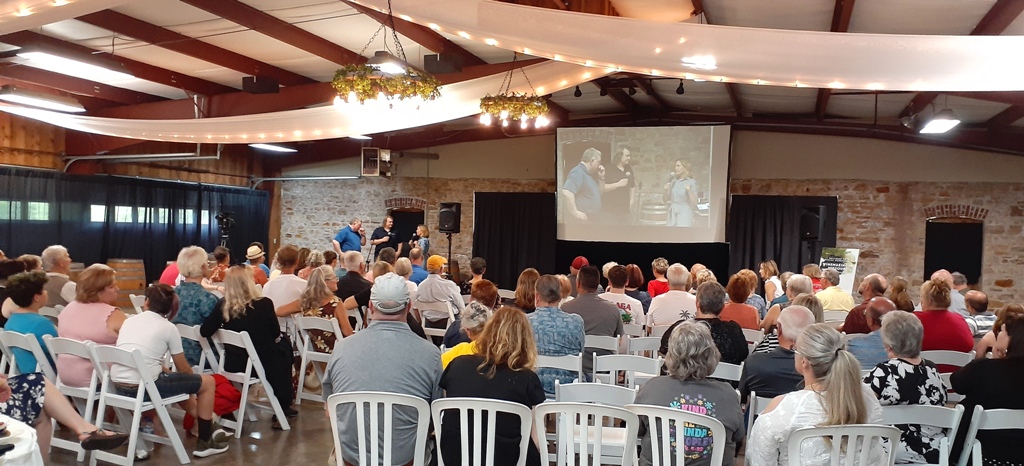
This afternoon we went to Stone Hill for a screening of a new documentary about the history of wine in Missouri, including a big dose of Stone Hill history in Hermann. It’s called Winemaking in Missouri: A Well-Cultivated History, and apparently it will be coming to a PBS station near you soon (starting in St. Louis, eventually being distributed nationally by American Public television).

Seriously, keep an eye out for it. It's well made, well-researched, and well worth watching.

Directed by Cat Neville as part of her tasteMAKERS series, it covers a long, interesting history: How German immigrants brought wine culture with them, how it was a challenge to try to grow European grapes in Missouri, how an invasive root pest introduced to Europe nearly destroyed the wine industry there, but Missourians figured out that North American grape rootstocks were naturally resistant and European grapes could be grafted onto them, saving them from utter destruction. And then, when Missouri wineries were producing the most wine in the country, then came Prohibition. So Missouri wines themselves had to come back from utter destruction.

One of my favorite points made in the movie is that here in Missouri, we don’t grow Zinfandel, Merlot, Cabernet, Chardonnay, Sauvignon Blanc. Our climate and soils aren’t right for those. BUT! We have the Norton, and we have a number of interesting hybrids of those European grapes with native varieties. So yeah, Missouri wines are not the same as the others. If you drink them expecting them to taste just like the wines made in California or Europe, you’ll be disappointed. . . . But why would you hold such an expectation? And why would you want them to be the same? . . . Variety is the spice of life! Travel broadens the mind! And wine is never about having that same exact delicious flavor again and again and again. That’s for fast-food connoisseurs. No! Wine is about trying and sampling new things. It’s about the journey; making discoveries.

We were a little late, so we missed most of the hors d’oeuvres before the showing, but we got to see the film. Afterward, as people milled about and sifted away, we sat at one of the outdoor picnic tables to enjoy a bottle of Norton.

Even though there had been a formal Q&A session before the film, the Held family and other Stone Hill people were still busy afterward speaking with tons of guests. (You could have figured that people would want to stand around and talk more after viewing the film!) The servers were removing the demolished trays of food, the leftover napkins, the plates. As the place emptied, we waved and did the hip-hip-hooray sign at Betty Held, the honored matriarch of Stone Hill, as she rode away with friends in a van. A little later, Jon and Nathan Held walked by and chatted with us for a while, so we had a really nice conservation with them after all. Truly the highlight of the evening.

John Thorne, my favorite food writer, said that good wines are always worth trying, because you can usually see why some people really like them. They’re interesting. Even if it’s not to your personal taste, you can at least appreciate them for what they are: different. Somebody’s beloved local flavor. “Malbec, for instance,” he says, “is a varietal that tastes rather like ink; a highly rated one tastes like delicious ink.”

Variety is the spice of life. . . . Variety is the spice of life.

Friday, August 27, 2021

Stone Hill Ozark Hellbender Red: A Great Wine for a Greater Cause

Hey, I want to remind you to pick up a few bottles of Ozark Hellbender next time you’re out buying wine.

Now if you’re going, “whatever is she talking about?” then you need to read on, because this is really cool.

In 2018, Hermann, Missouri’s own Stone Hill Winery—the historic 1847 winery that, with its restoration in the 1960s, almost single-handedly started the renaissance of Missouri’s wine industry—started producing a dry red blend they call Ozark Hellbender.

Why the weird name? A portion of the profits go to help fund the research and restoration efforts of several conservation organizations to restore the Ozark hellbender, an endangered native Missouri aquatic salamander.

Actually, in the past year, both of Missouri’s subspecies of hellbenders have been declared federally endangered, so restoration efforts are more critical ever.

Here are some links to learn more about hellbenders, their conservation status, and the Saint Louis Zoo’s captive breeding and restocking efforts.

In a nutshell—as if you could fit one into such a small place—hellbenders are huge, slimy, brown salamanders with small eyes and loose skin. They spend most of their time hiding under big flat rocks in cool, fast-flowing Ozark streams. Adults can be 11 to 20 inches long, making them the largest salamander in North America (three relatives in the giant salamander group are larger and live in East Asia; all of them range from threatened to possibly extinct in the wild). Missouri is the only state to hold both subspecies of North American hellbenders.

The reasons for their decline are numerous and are compounded by the fact that females usually don’t breed until they’re about seven or eight years of age. And even then, they may only breed every two or three years. They typically live for three decades in nature, but that’s assuming their streams remain habitable for them, and even then, their small, vulnerable offspring need to have a decent shot at surviving to breeding age. One hellbender was documented as living to age fifty-five—no wonder they don’t breed until they’re seven or eight; they’re kinda like us.

And so there’s a captive breeding and restocking program, which, combined with efforts to improve and protect their natives streams, might bring them back to the point where their populations are stable.

A personal reverie: MU’s legendary zoology professor Dean Metter used to keep the university’s herpetology collection (enclosures with live snakes, lizards, and such) in a hallway on the second floor of Stewart Hall. My dad, with the rest of the geography department, had their offices in the basement of that building. Often, when we were there to pick up Dad after work and there was a delay of some kind, I’d go upstairs and visit Doc Metter’s herps.

As a pigtailed Campfire Girl, and before, as a tagalong little sister with my brother’s Cub Scout den, we had a guided tour of the collection by Doc Metter himself. I’ll never forget him gently removing a speckled kingsnake from its cage and letting me hold it.

Along one, rather dark wall was a big, long, galvanized tub about waist-high. It must have had a chiller on it, in addition to the circulation/filtration. It was always humming and moving the water around. And there, in the tub, was a fourteen- or sixteen-inch-long hellbender. It never seemed to move, except to kind of waver a little with the current; it just rested in there like a shadow. It was there forever, it seemed. Knowing what I know now, it’s sad to think of that creature living in a galvanized tub in a lonely university hallway, educating those of us too young or citified to discover hellbenders on our own.

Nature had designed it for a life creeping around on Ozark stream bottoms, exploring amid boulders and bunches of watercress, crawling under large flat rocks, hunting crayfishes. Of living as one with the quick freshness, in the higher oxygen content of springfed sections of the river, and the richness and quietude of the pools.

. . . Anyway, there’s something primordial and shadowy about hellbenders; something uncanny and otherworldly. Very fascinating. It’s heartbreaking that something so . . . so . . . seemingly eternal could become extinct, wiped from existence forever.

So, this wine helps raise funds to help the hellbenders.

But it does a few other things, too.

It shows the maturation of Missouri’s wine industry, when one of its leaders is able to step well beyond the tried-and-true, by now rather formulaic marketing angles of “quaint local winery,” “historic ethnic German winery,” and “have your wedding receptions here, folks!”

I really like how Stone Hill, with this project, is connecting with Missouri's natural history and showing a dedication to its future. The “German heritage” angle is an obvious focus and starting point for most Missouri wineries, but this is showing Stone Hill's maturity as an institution.

Also, German immigrants brought a tremendous love of nature with them to the New World. While the English-derived Americans liked trees, grass, and gardens when they were trimmed, mowed, or planted in rows, the Germans held romantic feelings about wild places, where plants and animals grow free and take the forms and patterns innate to them. Yes, many German immigrants were (or became) master horticulturalists, but alongside their love of cultivation, they held a deep love of untamed nature. So this project, which celebrates an aspect of wild Missouri that many Missourians would feel squeamish about, continues that Germanic love of wilderness.

When I communicated this idea recently on Stone Hill’s Facebook page, I got this nice reply from someone at the company: “Thanks for the kind words! We are really glad we can play a small part in continuing that tradition and supporting this special Missouri species! As farmers, it is so important to keep our natural world healthy for the future.” . . . To which I say, Right On!

I don’t think they’ll mind me flat-out copying their descriptive text for the 2018 Ozark Hellbender wine:

BLEND INFORMATION: Since the Ozark Hellbender spends most of its life secretively hiding under rocks in the bottom of Ozark streams we are keeping our blend a secret as well. But we’ll give you some hints! All variety of grapes used are grown in the Ozark Mountain AVA. Some grapes aged for one year in neutral oak barrels to bring out complexity, softness and drinkability. Then just before bottling, like any good family recipe, we add the final variety which is held secret only for our winemakers to know.

TECHNICAL INFORMATION: Alcohol - 13%; Residual Sugar - 1.5%

TASTING INFORMATION: A smooth red blend with aromas of sweet cherry, blueberry and a touch of toasted oak. Creating a soft, complex and very drinkable wine, made from grapes all grown in the Ozark Mountain AVA. *A portion of the proceeds from every bottle of Ozark Hellbender wine sold is donated to the Saint Louis Zoo and hellbender conservation. (750ml)

AWARDS:

Bronze - 2019 Missouri Wine Competition

Yes, it's an award-winning wine! In fact, just recently, the 2019 Ozark Hellbender won "Best of Class Semi-Dry Red," and the 2018 Ozark Hellbender received a gold medal, at the 2021 Missouri Wine Competition. Way to go, Stone Hill!

Seriously, what are the grapes, you wonder: Here’s what they told me (in response to my Facebook question, subtly hinting if Merlot was one of the ingredients): “No Merlot in it! It is a blend of three grapes: Norton, Chambourcin, and #3 is a secret. [Finger-to-lips "shh!" emoji.] All three are grown on our own vineyards though.”

Norton is the strongest part of the blend. Have you ever tasted Norton wine? It’s distinctive. It’s North America’s native, sophisticated dry red grape variety. It’s Missouri’s premier wine grape. It has a fascinating history; if you want to read more, I heartily suggest Todd Kliman, The Wild Vine: A Forgotten Grape and the Untold Story of American Wine.

Norton isn’t for everybody. It has a distinctive flavor. It’s like this: If you’re hankering for oranges, a grapefruit will taste just wrong; it’s so close, it seems almost an insult to oranges; so close, well—just give me an apple. But the fun of wines is their variety. Thank goodness wines aren’t all the same! There are many really good wines—you simply won’t like all of the types. In his insightful essay “Knowing Nothing about Wine,” John Thorne described it like this: “Needless to say, wines with the same rating don’t taste equally good (Malbec, for instance, is a varietal that tastes rather like ink; a highly rated one tastes like delicious ink).”

But Thorne goes on to talk about how really good wines, highly rated ones—even if you don’t end up liking the variety—will still be worth trying, because you can usually see why some people really like them. They offer food for thought. They’re interesting. I suggest trying Norton with this in mind.

I heard somewhere that Ozark Hellbender red became the top-selling red at Stone Hill Winery in Hermann when it was released (apparently, it still is). That’s pretty remarkable, because the average Missourian typically prefers sweet wine. That Hellbender Red is selling so well could mean that Missourians have suddenly become conscientious consumers, choosing products that give back to good causes . . . or it could mean that Missourians have suddenly developed more cultivated palates . . . or it could mean that Ozark Hellbender red is a deviously clever blend that offers enough berry flavor to satisfy the average palate but enough complexity to make it good for people who prefer dry reds. And serving it chilled makes it smoother for red-wine newbies. Indeed, this blend can be kind of a “gateway drug” for Norton, and even “dry red” appreciation. Or it could be a combination of all three.

I think lot of people would like to drink dry red wines because of their purported health benefits and because, as you sit among your friends, a glass of deep red wine simply looks groovier than white—but many can’t make the leap in terms of flavor. I can see someone trying a Norton varietal and thinking, “I can’t enjoy this.” But after a few weeks enjoying Ozark Hellbender red here and there, you could easily acquire an appreciation for Norton: “Oh, this is that unique flavor I’ve come to enjoy in my Ozark Hellbender red, only more of it.” . . . And if this is what Hellbender red achieves for Stone Hill, then bully for them! Smart-smart-smart-smart-smart.

I hope you will go out and try a bottle of Ozark Hellbender red—for the tasting experience . . . and to help the hellbenders.

Saturday, March 26, 2011

Well, Boo-Hiss!

Sue says that March in Missouri always comes in like a lamb and goes out like a lion, and here we go. They're predicting up to 5 inches of snow here in Jeff (though as of last night, it wasn't looking like there was much chance at all). So, pooh.

Although I'm not using crutches at this point (I'm "weight-bearing"), and therefore balance on a slippery surface isn't such a problem, I'm still in a cast. Since I'm not allowed to get it wet, and since Hermann is getting just about the same amount of snow we're getting . . . I guess we have to put off our trip to the Wurstfest. Tomorrow the driving will be better. And so will the limping.

I hope there's some sausage left by the time we get there!

But dang, I'm sorry to be missing the Braunschweiger Ball!

. . . Next year.

Thursday, March 24, 2011

32nd Annual Wurstfest


Hey, folks, I know this is late notice, but I'd be horribly remiss if I didn't remind you about Hermann, Missouri's annual Wurstfest.

It's this weekend! Here's a link to it.

There's something new this year, which I found out via a kind comment by Constance LaBoube--check this out!

A fun new addition to the Wurstfest is the Bank Bar Braunschweiger Ball. This event, the first of its kind ever last year, will begin at 7 p.m., Saturday, March 26 at the corner of 2nd and Schiller Streets (115) in Hermann. Contestants will be entering Braunschweiger Balls for judging. This is a zany, quirky, fun event. Prizes will be awarded - 1st and 2nd - best tasting. 1st - Best Presentation. Music will be provided by The Bluff-Tones. There is no charge for entering, but donations to the food pantry will be accepted by the band the evening of the event.

Whoaaaah, Nelly!!! A Braunschweiger Ball! It's a braunschweiger-pâté-making contest and a dance! What a perfect Opulent Opossum kind of event! (As you know, for a while I was on a roll with my "Jefferson City Braunschweiger Reports"! I even shared a Lutheran-ladies retro braunschweiger ball recipe with you.)

(The only thing that slowed me down on that was the realization that such activity was leading me toward the brain sandwiches up at the Towne Grille--you know: "Food at it's best" [sic]--and I'm not sure I'm ready to "go there.")

But I'm soooooo ready to hit the road for Hermann this weekend!

I hope to see some of you there--this is an awesome "foodie" event. You get to sample locally produced, gourmet sausages from many different small meat markets. And then, you can buy the ones you like! We always bring a cooler, buy a bunch, and freeze sausage to be used over the next months.


Plus, there's all the music and dancing, wine-tasting and winery tours, that new Tin Mill microbrewery to visit, the weiner-dog races, museums and historic sites, etc., etc.

Again, here's the link for more information on Hermann's wonderful Wurstfest.

And (for fun), here's a link to my "Wurstjaegering" post I wrote a few years ago describing the event. I like to think it's fun to read. I hope you'll agree!

See you there!


Tuesday, March 9, 2010

Wurstfest Reminder

Just a reminder! Put it on your calendar: Hermann's 31st Annual Wurstfest will be held Saturday and Sunday, March 27 and 28!


I told you all about the Wurstfest last year, and if you like sausage, then you simply must go this year. They don't tend to change the festival radically from year to year, so what I told you in my "Wurstjaegering" post pretty much goes the same for this year.

Only I see this year, in addition to the Dachshund "derby dash" race and "fashion show," they're also having a "longest weiner dog contest." Oh, my. That sounds like something to see!

But seriously, though, the emphasis is on all the fantastic gourmet sausage that's being made by Missouri's sausage makers.


As in the past, the two locations (each with different sausage makers) are the Stone Hill Winery Pavilion and the Hermannhof Festhalle; a single fee gets you into both venues.

Bring a cooler! Basically, you walk around to each sausage maker's tables and sample their various sausages. The variety is mind-boggling. When you decide you want a sausage, you buy it directly from that vendor. Most of them have packages of frozen sausage all ready to go.

I highly recommend Schubert's horseradish sausage, which tastes great without blowing your face off, and their andouille, which could blow your face off. Their kielbasa is a revelation; it has nothing to do with that greasy, over-salted insult to swine that you get at the grocery store.

In June, we had to drive to Schubert's just on the other side of St. Louis, to get more of the kielbasa and horseradish sausage. Yes, it's that good.

And if Kurzweil's has it, snatch up some of their bratwurst flavored with portobello mushrooms that were sauteed in Norton red wine. Their "Zorba the Greek" sausage is really good, too.

Williams Brothers had a delicious sausage with apples and cinnamon that we liked a lot, and their traditional-style summer sausage was really excellent.

But most of all, look for new styles and flavors that you haven't tried before.

Oh! --Are you worried about how healthy this is for you? Here is what we often do: We make a dinner of a bunch of sauteed or steamed vegetables, brown rice, and then a single sauteed tilapia filet and one gourmet sausage link. Each of us gets half a piece of fish, and half a piece of sausage. How about them apples?

Anyway, Hermann's Wurstfest is highly recommended. I'm telling you now, so you can put it on your calendar. You seriously don't want to miss this.

Here's a link to Hermann's Web site; click on "calendar" and scroll down to March 27 and 28.

And again, see my last year's post for the real low-down and for more pictures.

Sunday, March 29, 2009

Wurstjaegering

Today we attended the Thirtieth Annual Hermann Wurstfest to sample sausages. Talk about yer slow foods and localvorism. Talk about your local color! And things that are sincere, and good, and true.

If you’re not already familiar with it, let me explain a little. Hermann is only one of many Missouri towns boasting a strong and continuing German cultural heritage, but it’s the one that’s made the most of it in terms of tourism and “branding” (as marketing folks call it). It’s a picturesque town with hills and lots of historic buildings. It’s on the south side of the Missouri River, between Jefferson City and St. Louis. (Now you can find it on Google Maps.)

Most people think of the town’s wineries and Oktoberfest first among the “things to do” in the Hermann area, but there are lots of other attractions and festivals. Perhaps it’s best to go in midweek, hole up in one of their charming bed and breakfasts, and simply . . . slow down.

But one of our favorite times to visit Hermann is during the Wurstfest. The sausage tasting, competition, and judging is just part of this springtime festival. There are wiener dog races (and costume and talent contests—all very popular with children), a display of antique sausage-making equipment (ooh, shudder-shudder: renewed respect for the whole butcher “thing”), and a whole-hog sausage breakfast at the fire department.


Of course, all the local wineries have special tastings, tours, sausage samplings, and so on. If you haven’t taken a tour of the Stone Hill cellars, you should. You not only learn how wines are made (in case you didn’t know), but also see their historic cellars and learn about the state’s winemaking history.

There’s a great view of the town from the hilltop at Stone Hill, which naturally is enhanced when you and your sweetie are relaxing with glasses of their Norton. Hermannhof Winery, downtown on Highway 100 along Frene Creek, has a wonderful wine garden where you can sit comfortably with your companions and enjoy a bottle of Spring Blush. Five more local wineries and the town’s brewpub were open this weekend for tastings and tours.

Also, the Deutschheim State Historic Site is a must-see for anyone visiting Hermann, and then if you’re going there, you’d better visit the German School Museum as well. This year, they were offering free admission to the museum to anyone who’d purchased admission to the Wurstfest.

Admission? Yes, six bucks for adults, but it’s worth it. Get your hand stamped, and you can go in and out of two sausage-tasting venues: The Stone Hill Winery Pavilion (where we went again this year) and the Hermannhof Festhalle downtown (where we’ve been in previous years).


One of the big draws for me each year is the music and dancing. Today accordionist Marilyn Loehnig of the Loehnig Family Band played at the Stone Hill Pavilion from noon to four. We always enjoy hearing her play those happy German polkas and other melodic favorites. (Remember when music had a melody?) She even the temerity to play that notoriously catchy Disney song—you know the one, about the “planet” being “of a little, little size”?—surprisingly it didn’t get stuck in my head. (Another polka tune did instead.)


Yes, the German music, of course, and then there’s the Wurstjaegers. A word about them: If I was at all interested in dancing, that’s the first group I would join. They look like they have such a great time, doing all these traditional German folk dances. Every time I see them I wish for more hours in my week, in my life! The group formed in 1948, and two charter members were dancing with them today. One of them is looking forward to her ninety-second birthday!


The group’s signature dance is a Wurstjaeger dance, wherein they act out the sausage-hunting (wurst-jaegering!) that traditionally took place the Tuesday night before Ash Wednesday: The menfolks go door-to-door with a carrying stick on which they collect, in dangling abundance, the whole town’s store of sausages; then they bring it all to the local festival hall for the Fat Tuesday “eat up all the sausage” feast. It’s a Fastnacht tradition—the German version of Mardi Gras.


On to the sausage. Hermann basically becomes a top-flight sausage market at Wurstfest. Bring money. Bring an ice chest. Be prepared to stock up. Your freezer at home will be honored to hold such special items for you.

Despite what I’ve written recently about pâté de foie gras, Sue and I are not exactly true devotees of the butcher’s art. We tend toward vegetarianism. We don’t eat a lot of meat; the food on our dinner plates doesn’t “orbit” the meat as a gravitational center. Meat, for us, is for stir-fries, for example. It’s an “ingredient.” That is, unless there’s something special about it . . . like when I marinate a sauerbraten for days, turning and massaging it, and cook it for hours before a big family gathering. Or, well . . . if we’ve got some gourmet sausage or something . . .

The judging and awards ceremony took place yesterday, so the vendors had their plaques positioned prominently near their winning sausages. Helping you to decide, of course.

There were five sausage vendors at the Stone Hill Pavilion: Heintz Processing (from Cuba) (Mo., of course!), Stonie’s Sausage Shop (Perryville, Mo.), Williams Brothers Meat Market (Washington, Mo.), Kurzweil’s Country Meats (Garden City, Mo.), and Schubert’s Packing Co. (Millstadt, Ill.). The biggest line was for Schubert's—they bring a huge variety of sausages to sample. It’s almost overwhelming.

But I can narrow my selections down immediately by category: I’m not into the “snack sticks” and jerky, and there’s only so much of the “pizza brats,” “bacon cheeseburger brats,” and “pepper jack Polish sausage” that I can even think about. And I really don’t see the point of “sauerkrautwurst,” because to me sauerkraut is supposed to be cooked and served with the bratwurst, not in it—it’s far better to enjoy the simple brat with the kraut in its traditional position, hugging and cradling the brat—on the outside, the way nature intended.

I didn’t buy any maple sausage this year, even though I always enjoy tasting it. It tastes just like breakfast. But for some reason, I’d rather dip regular sausage into my syrup when I’m having pancakes.

Many of the vendors, being full-time meat companies, also had other meats besides sausages—cured hams, bacons, kabobs, BBQ pork, turkeys, and so on. But I wasn’t shopping for that stuff today.

There were definitely some very special wursts available. Potato sausage? (Hmmm! Very smooth and mild!) Ukrainian bratwurst? (What’s that like?) Some really yummy andouilles. Chorizo. Several types of Italian-style sausages.

And there were all these traditional kinds of wursts and more: Nuernberger, Krakow, Thuringer, mettwurst, Hungarian kolbasz, bockwurst, braunschweiger, head cheese, blutwurst, leberwurst, scrapple, and more. A wonderment of sausages.

Unusual critters can become sausage, too: Duck salami, summer sausage made with elk or buffalo, and even chicken. We picked up some Italian chicken sausage with sun-dried tomatoes and Asiago cheese. It was light, but incredibly delicious—the flavors bloomed in my mouth as I chewed. This is food to savor.

The Wurstfest is the place to find great, fresh sausage and buy it directly from the butchers who made it. Schubert’s Packing makes a kielbasa that makes the shrink-wrapped stuff at the grocery taste like nothing more than a big pink crayon—well, that, or something made out of silicone—flavored primarily with MSG. The Schubert’s kielbasa is meaty and much leaner than the supermarket kind. The flavor was nuanced. I had to get some more of that.


The sausages that always draw the most oohs and ahhs are the flavored brats, the sausages with unusual ingredients. Last year my grand discovery was a bratwurst flavored with portobello mushrooms that had been sautéed in Stone Hill Norton (which is a full-bodied red wine, aged in oak). The people at Kurzweil’s Country Meats had it on their table . . . Whoa, Nelly! That one put me in sausage heaven. Last year, I couldn’t wait to get up to the cashier lady to place my order. I hope they won a prize for it. Whoo, doggies! Words fail me. . . . It was awesome, served with simple mashed potatoes and a lightly dressed salad of fresh greens—it didn’t need anything else.

So this year, I had my money out and everything, and the Kurzweil’s people had sold out of it! But there was plenty else to occupy my interest. They had a good applewurst that had big chunks of apple in it, and we had to pick up some of their roasted red pepper and asparagus sausage, as well as something they had named in honor of “Zorba the Greek,” which was basically a straight-ahead sausage with a good blend of herbs (thyme and so forth). I’m thinking it would be good on a pizza, or on pita.


Schubert’s, as usual, had scads of sausages to try, and it was hard to decide, but their bratwurst with horseradish was unique and good enough we knew we needed to pick up a package of that. Williams Brothers has a pork sausage with apples and cinnamon that was another automatic “keeper.” Williams also had won an award for their traditional-style summer sausage, and it was another automatic standout, something to host a party over.


I suppose I could have written this and complained about the weather (it was pretty cold, and there was still snow on the ground from yesterday), and I could have complained about the lines (though they were much better than last year), but instead I wanted to just rave about the sausage and the care and creativity that these small meat companies put into their work.


It’s just fun to see big grown men standing around and wearing hot-dog hats (like Larry Schubert wore as he sold sausage and laughed, his eyes wrinkling in merriment). Other men wore huge grins on their faces while sporting tee-shirts that promised: “Thick, hot, and juicy!” And the Kurzweil’s people had a new slogan this year: Eat Our Meat.


There’s something ancient, even primitive about the making of sausage—turning the less-than-choice bits of the beast into something irresistibly delicious—and about the celebration that accompanies it. When the Rhineland Wurstjaegers dance about the bounty and abundance of sausage, they are performing, in a specific, sophisticated, ritualized way, an act of thanksgiving that every single human can understand.