Showing posts with label cookies. Show all posts

Saturday, December 30, 2023

Christmas Cookies from Aunt Ann!

Look what WE got! They arrived last Wednesday, December 20, in perfect time for Christmas! They are from Aunt Ann in Michigan!

For the past several years, Sue and I have been the family cookie purveyors, baking and shipping our family heritage Christmas cookies to friends and family. This year, with their various health concerns, and with the year kind of rough overall, my Mom and Dad bankrolled the annual cookie production, so that our cookie-gifts were from all four of us.

But this year, Aunt Ann, who is 96, found a way to make cookies and send them to family, including us! Whoaaa!!!

Can you imagine how this felt, after Sue and I’ve spent years trying to figure out how to make several types of cookies? Baking, tasting, critiquing, comparing the cookies in hand (in mouth) with the cookies in my memory? “The recipe says ‘butter,’ but do you think we should’ve used margarine—?”

I’m honestly not much of a baker. I didn’t learn at my mom’s or grandmas’ side. I’ve asked Mom and others for tips, but when it comes to it, I’ve had to figure it out on my own, trial and error.

And one of the reasons I make all these old-fashioned, family cookies—from my family and from Sue’s—is that I’m one of the few left making them. And I know how much my parents and the others in their generation enjoy having them at Christmas. . . . And Sue and I enjoy them, too, and we know others in our generation like them the way we do.

So we got this box in the mail, and it had cookie tins, and they were filled with these beautiful, gorgeous, precious, delicious creations from my Aunt Ann. Eight kinds! A note with them said that she had help from my cousin Sue Ann and from Aunt Ann’s helper/caregiver, Jennifer. I suppose Sue Ann and Jennifer were the “hands,” while Aunt Ann mostly did “supervision,” but hey, it counts.

Bully for her! Bully for all of them! I feel blessed beyond all reason to have the opportunity to enjoy these cookies, made by my aunt.

So, before we got too far into eating up these cookies, I did a little photo shoot, to the best of my ability. I’m providing the names, and links to possible similar recipes, if I can figure out what kind they are. Aunt Ann and my cousins might have different names for them. Every family has their own traditions, their own suite of “must haves.” So although a few of these are well-known, some of these cookies are rather unfamiliar to me.

But here’s the fun part: even the ones that are “unfamiliar” are still somehow familiar. They are the kind of Christmas cookies that my mom or Sue’s mom might have made. They are midcentury recipes, the kind I grew up with at Christmas bazaars at church, classroom mothers, Blue Bird gatherings, visits to friends’ houses. The kinds of cookies that won bake-off contests in the fifties and sixties. Also, when I was young, we spent some Christmases in Michigan with Aunt Ann and her family, so there’s a good chance I’ve had these very recipes before, made, for the most part, by the same hands.

White Chocolate–Dipped Ginger Cookies; Dipped Gingersnaps

I found a couple of promising online versions of these cookies, here and here. The white chocolate smoothed the edges of the spices. And these cookies weren’t as “snappy” (hard!) as the ones you get at the grocery store. Eighty-two thumbs up!

Lepkuchen!

Everyone’s got their own version of this German and German-immigrant favorite. There are a lot of variations because there are a lot of different ingredients to vary.

  • Germans tend to use honey, while German immigrants used sorghum or molasses—and then the molasses type can vary, too.
  • The leavening varies; eggs usually are included; my usual recipe, from my Dad’s grandma, uses strong, cold black coffee plus baking soda, but I’ve seen other recipes that use buttermilk and baking soda, which yields a richer flavor.
  • The amount and types of dried fruits and nuts varies. I’ll bet that today’s mass-produced candied fruits are horrible compared to whatever was used 150 years ago. (Like, do you think people candied their own citron, lemon, or orange peel in great-grandma’s day? That would be a game-changer!)
  • Also, in both sides of my family, black walnuts are necessary, while Germans in Germany would surely find our strongly flavored New World nut an abomination.
  • And the array of spices varies.

I’ve seen two different recipes that Aunt Ann has used. I wonder which one she used this year. Obviously, she makes hers like bars, in a sheet pan, then cuts them after cooking. I roll out the dough, cut it into rectangles (I use a roller pizza cutter), then bake the rectangular cookies on cookie sheets. Aunt Ann’s were much more tender than the ones I make. But as with most everything else in this world, Variety is the spice of life!

Cherry Christmas Slices; Christmas Jeweled Icebox Cookies

I really, really want her recipe for these. They’re so pretty, they’re delicious, and because they’re icebox cookies, I know they’re fairly easy to make. Also, you can prep them ahead. And the idea of rolling the dough in colored sanding sugar before slicing is genius. I love those candied cherries, and the butter (yeah, real butter!) shortbread base is perfection.

These strike me as a midcentury recipe, one from the 1950s, 60s, or 70s, thus a mom/aunts/friends’ mom cookie, and not one from my grandmas’ and great aunts’ generation. And at this point (creak!) cookies from my own childhood are considered “old fashioned”!

I've found three possible online recipes for these, here, here, and here.

Snickerdoodles

The old favorite. Everybody loves these. I don’t usually make them because they’re pretty easy to make, and they’re often available year round. I put them in the category with chocolate chips and oatmeal-raisin cookies. They’re good on a cookie tray because picky eaters who are skeptical about raisins, dried fruits, nuts, and spices can nosh on them with comfort. And boy, are they a comfort cookie.

I Don’t Know These Cookies

But they were good! They were cake-like, and some kind of drop/ball cookie. With a tasty glaze.

Chocolate or Cocoa Crinkle Cookies

These were nice and chocolaty. There are lots of recipes for these, including this one here. I’ve even made crinkle cookies using Filipino ube, so they were a lovely purple. I’ve also seen recipes for pretty green matcha crinkle cookies! Still, I want Aunt Ann's recipe, because hers were really, really good.

Billy Goats

A Renner family favorite. Akin to “hermits” and “rocks,” these are perhaps the most undersung cookies of Christmas. Lebkuchen have an intriguing pedigree back to the Old World, but billy goats hearken to 1930s kitchens, where mothers tried to push as much nutrition as possible into their family’s foods. High school girls took Domestic Science classes that were abuzz with chemistry, physics, the relatively new discovery of vitamins, the importance of minerals and calories. During the Great Depression, providing your family with calories was considered important, because it gave them energy for all the physical activity Americans did: walking to school, walking to church, walking to stores, walking everywhere, because plenty of people didn’t own cars. Women and men labored physically in almost every job. Even clerical work required moving around a lot; even flinging something in the trash required physical movement, because trash cans were real, not virtual.

But I digress. The best thing about billy goats, hermits, and rocks cookies is not just that they were kind of a precursor to the granola bar, or fruit leather, or trail mix, it’s that they are greater than the sum of their parts. The combination of dates, black walnuts, brown sugar, and cinnamon yields a flavor that can only be called “billy goat.” If you can’t fathom how this can be, try it yourself. Seriously, these are elevated cookies. See here for the recipe I use, that came from Grandma Renner, the mother of my mom and of Aunt Ann.

Meringue Cookies

Unfortunately, these didn’t survive the shipping with a high degree of beauty. I think in order for cookies like these to arrive in a pristine state, they’d need to be wrapped like a wine glass in something fluffy and then tucked into their own hard-sided container, so that heavier cookies wouldn’t jostle and smush them. (These aren’t criticisms; just notes for myself, for future packaging situations.) Anyway, fortunately, and much more importantly, none of the flavor was damaged! There are lots of delicious flavors and morsels that can be incorporated with meringue cookies. I think that these were close, here.

These were very delicious! Again, I think a midcentury recipe; I’d say fifties or sixties. I’d love to have the recipe for this!

There you have it. Delicious cookies, but much sweeter to enjoy them from my dear Aunt Ann. What a nice gift, and a memorable one.

Gratitude.

. . . Okay, if you've read this far, then you deserve to receive one little tip I KNOW that Aunt Ann would want to share with you: Always use real vanilla extract. Not that ersatz stuff! If you're going to the trouble to bake your own cookies, then you want the nice, rich, opulent flavor of real vanilla.

Friday, December 2, 2022

Notes on Grandma Renner's Billie Goat Cookies

I’ve written about Billie Goats, also spelled Billy Goat Cookies, before. But it’s time for a more nuanced version of the instructions. Look, no matter how you make them, they’ll be delicious. But I’ve been taking notes every year, so I can get the shape and texture just right. Until now, it’s been hit-or-miss. But I think I’ve got the techniques figured out, now. (As Chef John says, “Never let the food win.”) By golly.

So yes, there's a recipe at the end of this post.

A true, enduring gift from my grandma Clara Renner, these cookies take the strong, separately distinctive flavors of brown sugar, cinnamon, black walnuts, and dates and combine them into a new flavor I can only call “Billie Goat.” It’s a genuine meld; the combination is much greater than the sum of its parts. If you don’t like one of the ingredients, don’t rule out these cookies, because each flavor is tempered and transformed by the others. This is one of the best cookies anyone can make, in my opinion.

And for us, it’s a must-have for the Christmas cookie tray.

I have used this combination of brown sugar, cinnamon, dates, and black walnuts in other recipes, and I’ve found they have the same profound, synergistic effect, where they meld into a new, milder, but very unique flavor. I think of it as “Billie Goat seasoning.” I use this combination in my bran muffins, for example. You could also apply it to a bowl of oatmeal, or use it in pancake batter or a quick bread.

Grandma Renner said these are called “Billie Goats” because they are lumpy and have little points that stuck out, like a goat. (This is why the shape and the texture of the dates is important; read on.) I don’t know why Grandma spelled it “Billie” instead of “Billy.” Grandma Renner, her sister, Lydia Meyer, and their friends apparently all started making Billie Goats about the same time.

Billie Goats/Billy Goats are in a family of similar drop cookies that were really popular among mothers in the 1930s and 40s. This was a generation of moms who were keenly conscious of their role as household managers. In school, their “domestic science” classes taught them to be faithful guardians of their family’s health and good stewards of the family food budget. Vitamins were a new discovery with their generation. These women wanted to pack maximum nutrition into the foods they made, including their children’s after-school snacks—while being very economical (first, because of the Great Depression; next, rationing during World War II).

So, instead of sugar cookies or candies, they made these proto-health-food snacks, using nuts, plus raisins, dates, and/or currants, and sweetening with surprisingly small amounts of brown sugar (some recipes call for a combination of brown and white). Other cookies in this group include “hermits” and “rocks”; oatmeal-raisin cookies are also close relatives. Look for all these recipes in old cookbooks and church ladies’ cookbooks. The names “billy goats” and “rocks” both apparently refer to the chunky, knobby look of these cookies. I don’t know how “hermits” got named.

Some notes about texture and form, since I’ve had some time to figure these out. They’ll taste great no matter what you do, but the goal is to have a chewy, cakelike inside, and a lumpy, chunky shape. So here’s a discussion of challenges, and my “pro tips.”

For generations, most American cooks could only get Dromedary brand dates, which were apparently Deglet Noor dates. They were packed tightly in cellophane (this was before plastic), stuffed into cardboard boxes, and, after languishing in a warehouse or on grocery shelves, they were as tough as shoe leather. Clipping them with kitchen shears, as Grandma’s recipe instructs, would literally hurt your scissors hand. (Grandma’s kitchen shears were stainless steel, dull old things; you know the type—the ones with the rounded “claws” for opening bottles at the base of the red-painted, hard metal handles. The base of my thumb still hurts, just thinking of them. This was way before “Fiskars” scissors were available!)

So billy goat cookies, being a midcentury recipe, were developed using the ingredients that, at that time, were available to most people: dried-up dates. The cooking softened them, but not to the point where they lost a distinctive, chewy, chunky presence.

Today, the Dromedary brand seems to have gone out of business, and you just cannot buy dry, hard dates like them; instead, they are all moist and tender, either packed in plastic or shipped absolutely fresh. This is actually a good thing, but it presents a problem for replicating this cookie’s texture, since moist dates tend to dissolve into gooey molasses during baking, producing a flat, uniformly chewy cookie, instead of distinct, chunky, jagged lumps of chewy dates and nuts in a cakey, rounded matrix of dough.

I’ve learned to replicate the type of dates Grandma had by purchasing them (Deglet Noors) a few weeks ahead of baking, clipping them in the prescribed herringbone pattern while they’re still soft (which is a much easier task, now), spreading these out on cookie sheets, and letting them sit (under wax paper) in a quiet place while they dry. The house isn’t at all humid in November. Or, you can put them in the oven warmed only by the pilot light. Or you can try a dehydrator. An alternative might be to try to find one of the so-called bread dates (varieties such as Thoories that are sold rather dry, dry enough you can carry them in your pocket)—but those might lack sweetness. Also, I think it’s cheaper and easier to use regular Dole (or whatever) brand Deglet Noors, cut them, and let them dry. That seems the best way to replicate the texture and flavor of old-fashioned Dromedary dates.

Another point about texture: These cookies have caused me more vexation than any others, except perhaps when I was first figuring out springerles. If you only make a cookie once a year, it’s hard to fine-tune the recipe! My Billie Goats recipe card is full of penciled-in notes: “try doing _____ next time.” You don’t want the cookies to be so soft they spread out, but you don’t want them crunchy or hard. How to get that cakey, chewy texture, and chunky look? Here are some key tips:

  • Use a 50/50 combination of margarine and butter-flavored Crisco. Real butter does make them taste better, but it complicates the texture; the cookies turn out drier, less moist. Save your butter for some other recipe.
  • Pack the flour; forget the rule about spooning fluffed-up flour into your measuring cup and leveling it off with a knife. It turns out Grandma R used her measuring cups as scoops: swipe the cup through the flour, like you’re using a dip net to fish something out of water. You can level it off if you want, or just kind of shake off the excess, but you need to pretty much pack the flour into the cups.
  • Let the dough sit overnight in the refrigerator or on an unheated sunporch. The flour will absorb the liquids and be easier to work.
  • . . . But the dough will still be sticky and hard to handle. Put on some happy music. Use parchment-lined cookie sheets. Try dabbing the dough into little rounds with two spoons, or (if you haven’t much patience for the spoon method) use your fingertips to pinch off bits of dough (put some water on your hands so it doesn’t stick so bad; even then, you’ll have to clean your hands and start again several times).
  • I tend to make smallish cookies, because I figure twenty-first-century people would rather select six different morsels from the tray than settle on just two huge cookies. Big cookies are a joy, but variety is the spice of life. Also, with smaller cookies, a single batch of dough goes farther. A 1¼-inch blob of dough, slightly flattened before cooking, produces about a 1½-inch diameter cookie. Back in the day, Mom and Grandma’s cookies tended to end up about 2 to 2½ inches in diameter. Different sizes account for the difference in cooking time; smaller cookies cook faster.
  • Do a single tray of cookies first and see how they turn out. These shouldn’t flatten very much. If they spread out flat, you may have to add a bit more flour to the dough, or you might need to adjust the size of the cookies.
  • Finally, don’t overcook these, or they will be too hard. Mom says this was a principal criticism Grandma R had about her sister, Lydia’s billy goats: “she bakes them too long, and they get too hard.” (I’ve heard this criticism plenty, too.)
  • But if they come out kind of hard, don’t panic. Seal them in a tin, with the layers of cookies divided by wax paper, and take half of a tart apple, wrap it loosely in wax paper, and nestle it in the tin with the cookies. After a week or so, you’ll discover the cookies have softened and developed a je ne sais quoi in terms of flavor.

. . . Does all this sound too hard? Please don’t be put off by these tips; it’s all stuff I’ve learned the hard way, and I’m sharing it here, so you have a super-duper head start!

Finally, again, you can’t really ruin these. They’ll taste great regardless of the texture and shape.

Billie Goats/Billy Goat Cookies

1½ c. brown sugar
1 c. butter [Pat S. uses margarine, sometimes butter-flavor Crisco; I use half margarine and half butter-flavor Crisco; real butter tastes good, but then the texture will be off]
-----------Cream together butter and sugar.

3 eggs: beat whites [till light; use a hand mixer or whisk] and [then] add [whisk in] yolks

1 level tsp. baking soda dissolved in
¼ c. lukewarm-to-hot water

1 Tbs. cinnamon
1 tsp. vanilla
1 c. black walnuts [chopped]
1 lb. clipped dates [using a scissors, clip whole, pitted dates in an alternating herringbone pattern; the idea is to have them big enough to kind of “poke out” of the cookies; if you buy pre-chopped dates, it’s okay, but the pieces are too small to achieve the characteristic lumpy look.]
2½ c. flour [basically pack it]

Make the cookie dough [let it sit overnight in the fridge] and drop it onto [parchment-lined] cookie sheets by small spoonfuls. Bake in a moderate (ca. 350-degree) oven like you would other cookies, about 8–11 minutes. [Don’t overcook; they should be rather chewy and cakey inside.]

Makes about 100 cookies.

Sunday, August 7, 2022

Jar of Goodness 8.7.22: Dad’s Homemade Cookies

. . . The weekly virtual “gratitude jar.”

This week, I’m expressing thanks for Dad’s homemade oatmeal-raisin cookies.

That’s all. Just something simple.

Cookies.

When you’re having a summer of frustrations, and then your air-conditioning goes belly-up, when your dad makes cookies and gives you some . . . it’s just really nice.

Thanks, Dad!

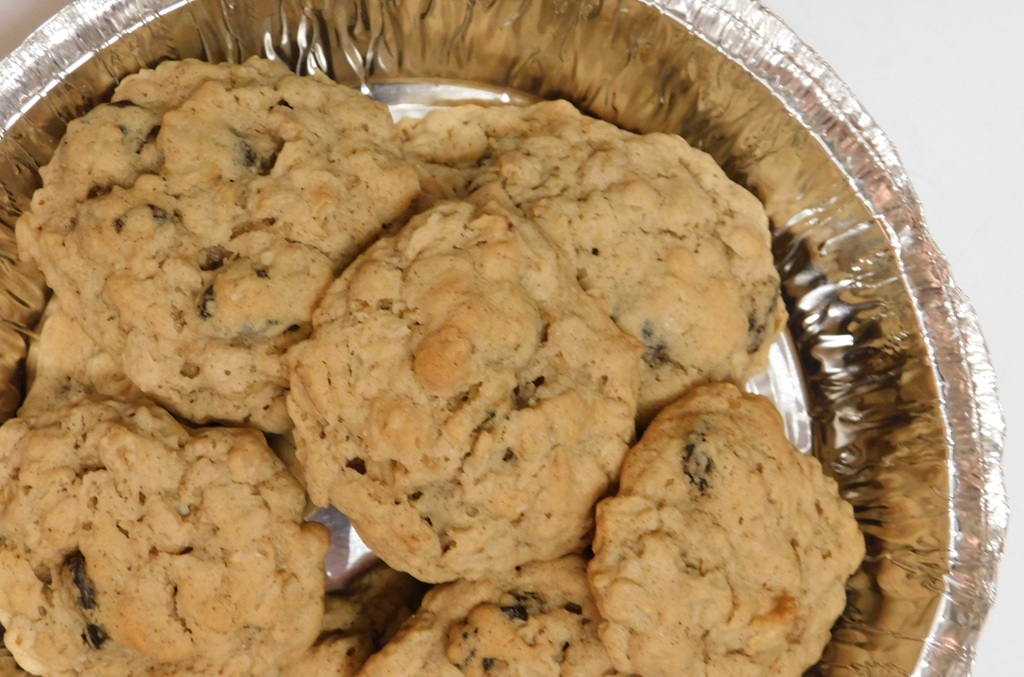
They were delicious.

Monday, January 17, 2022

Reflections on Holiday Baking and Gratitude

Here’s an unusual post for you: a letter I sent to my aunt last month. I enclosed it with the box of Christmas cookies I sent her. She financed our new refrigerator back in 2002, soon after we’d bought the house. She’s an excellent cook, a master cookie baker, and I hoped she’d enjoy reading about some of my kitchen adventures and reflections.

Maybe you will, too.

Dear Aunt Ann,

Merry Christmas!

I hope this letter and package finds you well and feeling warm and satisfied this winter. Twenty-twenty-one!

As I packed up your cookies last night, I thought again of the kind comments you have made about my springerle cookies. Mom told me that you’ve said they were “the best you’d ever had” (or something like that). My immediate reaction was to laugh—to snort out a healthy Pshaw!!—because my dilettante, amateur-level cookie-making “explorations” certainly are nowhere near the level of the cookies made by all the grandmothers, great-aunts, aunts, friends, and family of my childhood (including Mom and yourself).

When I was a kid, it seems all the ladies made a good variety of cookies, using recipes they’d used for decades, which were handed down to them from their mothers, grandmothers, friends, and neighbors. They were sure-handed, confident cookie bakers. . . . At least that’s how it seemed to me. If there were any disasters, I sure never knew about it. (Now I know: cookie-making “disasters” stay at home and are not shared, except with children who are none the wiser. Even if the texture or the shape is wrong, the “failures” usually are still delicious. And if they’re really bad, the squirrels and opossums get a Christmas treat!)

. . . And it seems everyone would try out a new recipe each year, just for fun, and for the variety. Like people sometimes say, “throw a lot of ideas at the wall and see what sticks.” Sometimes one of these novel recipes would “stick” and became a new family favorite. Sue’s mom did that a lot and ended up with plenty of kinds of cookies to bake each year!

I was present, as a child, when the venerable “orange balls” recipe joined the family. I keep that cookie alive singlehandedly today for the warm memories it brings to me. The recipe came from the then-secretary of the MU Geography Department—she must’ve brought some orange balls into the office to share, or maybe she made plates of cookies to give as gifts—and Dad got the recipe from her. He and I adopted it as one of our favorites, a dad-and-daughter activity during the holidays. Not having a food processor then, we’d grind the vanilla wavers on the slick, Formica-topped kitchen table using Mom’s wooden rolling pin. It was great fun to sit there and crush up those wafers with Dad! You can’t go wrong with no-bake cookies!

This year, I’ve tried a new recipe. It’s called a “spumoni” cookie, and it has chocolate chips, pistachios, and dried sour cherries. I first had them a few years ago at Kingston, the assisted-living place where Mrs. Ferber was living. The cooks of the cafeteria organized a cookie-exchange party for the residents. The Kingston residents could invite their families, and everyone got to try a variety of cookies fresh-baked in Kingston’s cafeteria kitchen, with live Christmas music by a local-favorite entertainer and his electric piano. There was eggnog, hot chocolate, and coffee. What a fun afternoon that was! All told, Kingston wasn’t perfect (what place can be?), but it’s the kind of place that I would be lucky to live in one day . . . Unfortunately, the night I made the spumoni cookies, I ran out of almond extract, so it has half the amount it should have, plus I kinda overbaked them . . . but what the heck: chocolate! I really love this combination.

I am lucky to have so many family favorites—from both sides of my family, as well as from Sue’s mom, now—to choose from. I’m one of the few who bakes them anymore. Christmas is about the only time I ever make cookies, but boy-howdy, it’s a whirlwind of cookie baking!

The date-nut bars and spice cookies are two of Mrs. Ferber’s longtime favorites. Other Ferber favorites include pecan puffs (“delectabites”), haystacks (so easy to overcook and turn into rocks), peanut butter no-bake cookies (or, as Sue’s brother-in-law blasphemously called them, “yard sausages”—if you don’t know what that means, ask any dog owner), jubilee jumbles (with that magical browned-butter icing), and green-colored spritz cookies in the shape of wreaths (I’ve never attempted those; I lack the equipment and, probably, the temperament). She was also a big candy maker: Fudge! White-chocolate peppermint bark! Buckeye candies! (Mr. Ferber had a sweet tooth!) Mrs. Ferber used to tell stories of growing up during the depression on North Bass Island in Lake Erie, and how she and the neighbor girls would get together to pull taffy.

I find it so interesting to see how recipes change. Great-grandma Thomas’s lebkuchen recipe was passed down to both of my grandmas: her daughter Edna Schroeder, and her neighbor Clara Renner. I’m lucky to have handwritten recipes from all three, so I can track the changes. Wilhelmina Thomas’s recipe called for lard, and a later version, in Grandma Schroeder’s hand, switched it to Crisco. Grandma Renner swapped citron and lemon peel, raisins, and currants with candied mixed fruit and raisins, and she’d grind the fruit in her hand-cranked meat grinder. These are just some of the changes.

And none of them specified what was meant by “molasses.” Maybe it would change in different years, depending on what they could get their hands on. I’ve read that authentic German lebkuchen (gingerbread) are pretty much synonymous with honigkuchen (gingerbread made with honey). In America, German immigrants—if they had access to honey—sold it for cash. Then, for their own baking, they used the more frugal and readily available sorghum molasses (sweet sorghum syrup), which has a bland flavor unlike that of sugarcane molasses (such as Brer Rabbit or Grandma’s). I’ve read that the honey/molasses distinction is one quick way to tell the difference between a German lebkuchen recipe and one from German-American immigrants.

In most recent years, I’ve gone out of my way to find nice, mild sorghum molasses for my leppies. (It’s a trip to the Mennonite store.) But this year, I was inspired to substitute a bit of Brer Rabbit Full Flavor just for fun. I think they taste better for it.

I’ve had to figure out a lot of stuff that wasn’t written in the recipes that have come down to me. I didn’t learn at my grandmas’ knees. It seems they were never baking cookies when we visited, and I wasn’t much interested in cooking, anyway. If I’ve tweaked recipes over the years (as I’m sure they did, too), it’s because I’m merely trying to figure out how to more perfectly match the cookies I remember gobbling up as a child.

Beside all the smudges and spatters, my recipe cards are full of penciled-in notes: “don’t crowd these on the cookie sheets”; “Mom uses margarine”; “2012: this made ___ dozen”; “DOUBLE THIS”; “2 tsp. 4 tsp. ground cardamom (Evelyn Baur doubles it, Yay for cardamom! :-D)”; “dough has to be really stiff, so it hurts your arm to stir”; “don’t double this and use big pan; instead, make two separate batches in 8 x 8 pans.” (Blah, blah, blah. If I didn’t pencil them in, I’d forget them over the course of the following year.)

This year I finally realized that Grandma Renner scooped her flour out of her flour bin or canister with her measuring cup, then used a knife to level the top; whereas I had learned to spoon the flour into the cup before leveling, which makes it fluffy, not packed, so the amount of flour is different. No one ever writes the method for measuring flour on their recipes—you’re just supposed to know. And if you don’t, then you should at least know how stiff the dough should be, and adjust accordingly as you mix it . . . well. As I said, I’m a dilettante. More than twenty years into this, and I’ve finally figured out a key to getting billy goats right. So the first half of this year’s batch of billy goats, once again, spread out flat in the oven, while the second half, after I’d stirred another half-cup of flour into the dough, finally lumped up properly.

And Grandma Renner’s recipe calls for a cup of butter. But Mom told me that she (Mom) always used margarine. Of course, this affects the texture and flavor. So I, myself, split the difference and use a stick of both, to equal one cup. This year, Mom announced my billy goats are on the dry side and suggested I left them in the oven too long, the way she says Grandma Renner routinely critiqued Aunt Lyd’s billy goats. Ah, the relentless pursuit of perfection! Fortunately, it’s nothing that a week sealed up in a tin with half an apple loosely wrapped in wax paper won’t fix.

I think billy goats are my current favorite (the date-nut bars are right up there, too). I love how the dates, black walnuts, brown sugar, cinnamon, and vanilla come together to the point where not one of them really tastes the same. It’s a synergistic combination that creates a new flavor, which I like to call “billy goat.” I’ve made “billy goat” pancakes and “billy goat” oat bran muffins. I ought to try a “billy goat” quick bread, too.

While I’m on the subject of black walnuts: as usual, please be advised that some of the nuts were hand-shelled, and even the mechanically shelled ones aren’t perfect. So chew carefully. I’d hate for you to have to make a trip to the dentist.

I’ve recently been paying close attention to recipes in old cookbooks (my favorite bedtime reading) for billy goats and their close relatives, hermits and “rocks.” These chunky-looking drop cookies all have a large proportion of dried fruits (raisins, currants, and/or dates) and nuts (usually pecans, walnuts, black walnuts), and they usually call for at least half the sugar to be brown sugar. They were very popular in the 1930s and 40s among the moms who had taken “domestic science” classes, endured the depression, and viewed themselves very seriously as the manager of their children’s health, as well as the food budget. Billy goats, hermits, and rocks not only taste great but also are relatively healthy, providing actual nutrition, compared to handing your children sugar cookies or candies after school. I see billy goats, hermits, and rocks as the grandmothers of the granola bars and fruit roll-ups so popular today.

Springerles: they’re everyone’s favorite. I was already making them for some years before I found a very old recipe from Great-grandma Thomas, which called for hartshorn (baker’s ammonia, or ammonium carbonate). I’ve never even tried that recipe, though I’ve had plenty of other people’s springerles made with that unusual ingredient—and I think mine are better. They’re lighter. Mine are made from my precious 1949 edition of the Good Housekeeping Cook Book, one of the possessions of Dad’s Cousin Marguerite (Fieker/Donovan/Miskell) that I claimed when the family was emptying her house . . . Although the book’s binding is shot, and the front cover is long gone, still tucked within its thin, brittle pages is the cute, pink-flocked Christmas card from Great Aunt Esther and Uncle Emil that accompanied it when they gave it to her. (What a treasure!) It’s full of great, basic recipes, made with whole foods.

So, no hartshorn in the springerles—this is a modern recipe from 1949!—it calls for sifted cake flour, baking powder, eggs, powdered sugar, and grated lemon rind. For anise flavor, it tells you to sprinkle anise seeds on the trays and lay the freshly rolled and cut cookies on them. I soon learned, for a punchier, less haphazard flavor, to use anise extract. Then, a few years ago, shopping at a Mennonite store, I unwittingly purchased anise oil. (You’ve got to read those labels carefully!) That year, they tasted like black jelly beans! (Though . . . some people really liked them that way, so there’s no accounting for taste!)

-------------------------------

I should probably end this meditation on Christmas cookie baking, but I want to add one more thought—something that’s been on my mind the last few weeks, as our refrigerator that you bought for us back in 2002 became intermittent, seemed to recover for a week, then finally chilled its last. I’m sure Mom has told you of its demise, that white Frigidaire side-by-side that has served us so well. We picked it out at Lowe’s about a year after buying Grandma’s house. I don’t remember what was wrong with Grandma’s old fridge, but it must have been going south. Our new fridge, though fairly basic by 2002 standards, nevertheless had an ice and water dispenser, and it has always seemed like a luxury to me, a real treat.

I think I recall that when we bought it, it had come with a projected lifespan of about 15 years. (Today, fridges are projected to last for a mere decade, while my parents still have their General Electric from 1965 in their garage as their soda-and-extra-stuff fridge; it’s still going strong!) We have another Frigidaire in our first-floor kitchen that we bought in 2009, when the one down there quit. It’s a no-frills, freezer-top version that has been invaluable as our main fridge has gone kaput.

Mom probably filled you in on some of the details of our finding a new refrigerator. Being very careful to look for fridges that were no larger than our current one, which had been a headache to get up the staircase, we finally ordered a new, very similar Frigidaire, of about the same size, from Lowe’s. Then we had to wait for it to be shipped to Jeff City from their warehouse. Finally, on delivery day, the moving guys (after making several measurements), expressed concern that they wouldn’t be able to get the new fridge up our stairway, so they shook their heads, apologized, and drove off. We never saw the new fridge, and now our old fridge just sits there, silent and empty, in our kitchen.

(I’ve started to put our magnets back on it. I may start using it as extra storage space for pots and pans.)

A few days after the aborted delivery, a Lowe’s appliance manager called and told me they’d scolded the mover guys and said they’d “make” them deliver the fridge—also, that the fridge had a ding in the right side, now, and that’d garner us a 15 percent discount. Or, they could order us a new, ding-less fridge. Hmm. So now the moving guys have hard feelings, and there’s no sign that a manager would accompany them to oversee the job? What about our walls? Also, they wouldn’t be doing any installation (again, Lowe’s). We decided to go shopping again.

We ended up at Columbia’s Downtown Appliance, a locally owned, longtime business that (hooray!) now finally delivers to Jefferson City. Installation included. We picked out a GE that is indeed smaller than the one we have now, and therefore more fitting for our small kitchen, anyway. It still has the ice maker and ice and water dispenser. It’s a French-door model with bottom freezer drawer (which is trendy, but whatever). It’s stainless steel, which doesn’t particularly go with our kitchen, but I recently realized that it’s only our stove that’s white, anyway; our other two appliances (microwave and toaster oven) are stainless, so . . . what the heck. We’ll cover it with magnets, clipped-out comics, and dry-erase “do lists,” anyway.

Given COVID-era supply problems, our new refrigerator won’t be manufactured and available until “late January or early February,” so until then, we’ll be leaning heavily on our first-floor fridge. It’s inconvenient to run downstairs for some eggs for breakfast, but it’s annoying to climb back up to the second-floor kitchen with the eggs and realize I forgot to grab the butter! We are lucky that this happened during winter, since we can use the unheated sunporch for things that are best stored in the cold but don’t require refrigeration—nuts, breads, seeds, sodas, and so on. Mom and Dad have offered to let us put some of our sausage and other frozen meats in their garage freezer. So we’re doing well.

Anyway, it kind of blows my mind that the refrigerator you bought for us has come to an end. It performed well for us, and I’ve never forgotten your kindness and generosity in paying for it. It makes me rather frustrated that something that seems to be in great shape (except for the ugly buzzing the compressor makes if you plug it in) is kaput. It still feels like “my nice new refrigerator.” But it also seems like only yesterday when we moved here! The years have gone by quickly.

But here’s the point I really wanted to make: even though I’m forever grateful for your financial gift in the form of the refrigerator (and all the other gifts you’ve given me over the years, and never properly thanked you for), the gift from you that really touches me most, the one that will never wear out, the one that I cherish above all others, is your kindness and your positive appraisal of my cookies. That means the world to me, coming from you, and I just wanted you to know it.

I hope this holiday season is filled with all your favorite things. Merry Christmas!

Thursday, December 23, 2021

Fruitcake Bars

I haven’t been posting much because my evenings have been filled with elvish baking projects! Like I’ve been doing for years now, I made a bunch of Christmas cookies and gave them as gifts this year. Many of my recipes, especially the oldtime family favorites, make dozens and dozens of cookies (even when I quarter the recipe!). But here’s one that makes a smaller amount.

On the “up” side, they are completely delicious, AND they ship well. I love these.

This is not one of my traditional family favorites, passed down through the ages. It’s one I’ve acquired and added to my annual list because “I make these for me.”

They are fruitcake bars. I begged the recipe from Marilynn Keil, who at that time was the longtime executive staff assistant at the University of Missouri Press. (She was the kind of executive staff assistant who truly ran the whole operation. You know the type: soft-spoken, but she knew more about everything than everyone else put together. These days, we call them “unicorns” because they are often believed not to exist in real life.) Anyway, she had brought in a batch to share with us at the press. (Yes! “And she brought cookies!” . . . Can a single human being be any more awesome?) She had gotten the recipe from her mother, Marge Ball.

After a bit of internet searching, I found that her mom must have adapted the recipe from the venerable Maida Heatter, who included a nearly identical recipe in her famous Maida Heatter’s Cookies, now a classic cookbook. I’ll bet her mom owned a copy.

Apparently, Maida Heatter’s original, published version is different, as it apparently suggests, for the candied fruit, a mixture of red or green candied cherries, candied pineapple, and/or the mixed candied-fruit blend you can get at the store. BUT because Marilynn’s mom suggests dried, not candied fruits, specifically pineapple and apricots, it really changes the flavor. I think it must be for the better.

Hold on—I can hear you saying, “EW! Fruitcake!!! Blechh!!!” But no—seriously—these are excellent. Addictive. I have to slap my own hand to keep from gobbling these up and having to make a second batch for gifts.

If you follow Mrs. Ball’s version, you’ll use dried, not candied fruit, which is what so many people object to. Many people strongly dislike the commercially available candied fruits made for home baking. (I also urge you to reflect on what it is about “candied fruit” you dislike. Chances are, you’ve only had the preservative-laden, garishly colored stuff from the grocery store. But if you make your own candied fruit, or buy from a boutique maker, or purchase—ooh-la-la—what les français call “les fruits confits,” you’ll realize that candying fruit is a fine art, an ancient art, and one well worth pursuing.) Here in America, plain dried pineapple and apricots are readily available and high quality. So like Mrs. Ball, let’s use those.

I’d also like to add that I’ve been making these for years, now, and I’ve heard no complaints.

These are easy, rather healthy, and an excellent “fix” if you’re longing for some fruitcake but don’t want to commit to making an entire loaf. They also look pretty on a cookie tray, especially dusted (or as I do, drenched) in powdered sugar.

I’ve edited it slightly.

Thanks, Marilynn. I hope you’re having a lovely Christmas season! I miss you.

Fruitcake Bars

  • 1½ cups walnuts, broken into pieces
  • 1 cup raisins (I use a combination of golden and dark —JS)
  • 1 cup pitted dates (in large pieces)
  • 1 cup candied or dried fruit (a combination of dried pineapple and dried apricots is good) (— YES! —JS)
  • 1 cup flour, divided (¼ cup + ¾ cup)
  • 4 eggs
  • ½ tsp. salt
  • 1 cup packed brown sugar
  • 1 tsp. vanilla
  • finely grated peel of one large orange (I use a microplane zester; you only want the orange part, not the pith —JS) confectioner’s sugar (optional)

Preheat oven to 325 degrees F. Combine all fruit and nuts in a large bowl, sprinkle with ¼ cup flour, and toss till coated; set aside. In a smaller bowl, beat the eggs just until blended; add salt, brown sugar, and vanilla; and stir in the remaining ¾ cup flour until blended (use wire whip). Stir in the orange peel. (The batter will be thin.) Pour the batter over the fruit/nut mixture and blend well. Spread in a greased ca. 10 x 15 x 1 inch (jelly-roll) pan; bake in 325-degree oven for 30–35 minutes or until golden brown on top. Halfway through baking, swap it end-for-end to ensure even baking. Cool in pan. With a small knife, loosen the edge, cut into small bars or squares. Can dust with confectioner’s sugar, before cutting, if desired. Or you can roll/coat individual cut bars in confectioner’s sugar. Store in an airtight container. These ship well.

Friday, December 13, 2019

Mrs. Ferber’s Spice Cookies

It’s Advent and time for a Christmas cookie recipe! This is an all-time favorite of Sue’s family, and the recipe comes from Sue’s mom. It’s one of those cookies you can’t have Christmas without.

Mrs. F is currently in a rehab facility after recently falling in her assisted living apartment. So this year, since we’re in Ohio to be with her, I’m baking these cookies in Mrs. Ferber’s own kitchen.

At some point, after we get back to Missouri, I’ll be shipping these and other cookies to family and friends on my cookie gift list.

Note that these will be quite soft when you take them out of the oven. They will become crisp and firm when they cool. These are best when they are both crunchy and slightly chewy. If they turn out slightly too crispy, store them in a sealed tin with half an apple wrapped in some wax paper—that’ll fix the texture.

You will probably want to double this recipe, because everyone will want some.

3/4 cup shortening
1 cup brown sugar
1 egg
1/4 cup molasses (such as Brer Rabbit)
2 cups flour
2 tsp. baking soda
1/4 tsp. salt
1 tsp. cinnamon
3/4 tsp. ground cloves
3/4 tsp. dried, ground ginger

Mix dough and chill. Roll it into balls the size of walnuts. Dip in a bowl of granulated sugar and place 2 inches apart on a greased (or parchment-lined) cookie sheet. Bake at 375°F for about 8 minutes. Makes about 60 cookies.

Monday, December 12, 2016

Orange Balls, and My Dad

In past years, I’ve shared with you recipes and memories of German-American cookies, with their nuts and spices, dates and candied fruits. Those are “grandma cookies,” the “Cookies of my People”; they connect me with my deep past, with places, times, and people long before my birth. Lebkuchen, springerle, billy goats, pfeffernusse . . . like my blue eyes and fair skin, those cookies are in my DNA, I think.

But on my Christmas dessert tray I also include cookies that are just for me, cookies that have become my personal tradition, regardless of what anyone else thinks. Orange balls fit this category. I make them every year.


And each year I make them, I appreciate them more and more for what they mean, for their special sparks that kindle warm memories.

To understand why I make orange balls every year, you have to get a picture of a little tradition that my Dad and I developed when I was a child.

Dad was a member of the University of Missouri Department of Geography, and he got the recipe from a lady named Brooksie Jennings, who was the secretary of that department in the early 1970s. I suppose she had offered a plate of orange balls at an office Christmas party. Or maybe she just brought some of these little gems in to work one day, just to share.

I imagine my Dad taking a bite of one, chewing it, and remarking on how tasty they were, and I imagine Mrs. Jennings, soon afterward, handing him an index card with the recipe on it. The card’s still there in my parents’ recipe collection.

Like a lot of similar no-bake cookie-balls recipes, it calls for crushed vanilla wafers. In the days before every kitchen had a food processor, Dad figured out how to render a box or two of crunchy vanilla wafers into a fine crumb: Clear off the smooth Formica kitchen table, get Mom’s wooden rolling pin, and start crunching them up.

It was great fun—I helped! And Dad encouraged me. It got to be an annual “Dad and Julie” activity, and we both became skilled and merciless crushers of vanilla wafers. I looked forward to it. We’d sit across from each other at the table. First, we’d pour a few cups of the cookies on the table; then, we’d use the roller to just press straight down on them for some initial crunches; then, as they got finer, we actually rolled the crumbs. The flat pile of slightly oily crumbs wanted to slide around on the slick table, but we managed.

Dad and I would always have a nice conversation while we worked. I can still hear the gentle crunching sound as we rolled the pin over the deconstructed cookies.

Working in batches, and sliding each finished pile of smooth crumbs off the edge of the table into the mixing bowl, we’d soon have our vanilla wafers properly demolished and ready for the next step.

The mixing of powdered sugar, margarine, concentrated orange juice, and the wafer crumbs was the forgettable part, as far as I was concerned, but when that was done, Dad and I rolled the dough into balls in our hands (fun!), and then rolled the balls around in a shallow bowl of coconut flakes. I would sometimes get creative and shape some of the dough into pyramids, or into cubes. (You know . . . kids.)

It became a father-and-daughter tradition because Paul and Mom both said they didn’t care much for orange balls. (I was incredulous: “Whaaat? How could you not love these amazing sweet little orangey-coconutty gems?” . . . But you know how kids are; I just thought, “Oh, well, too bad for you; that just means there’s more for Dad and me!”) (I still always include some orange balls with the cookies I send Paul—I think of it as an inside joke, though I wonder if he even remembers how much he didn’t care for them as a kid.)

So naturally, if Mom and Paul didn’t really like orange balls, they certainly were’t going to participate in their construction. So it became a father-daughter activity, something we’d do on some early December weekend afternoon.

I suppose, for someone of my vintage, it might seem strange to have even one dear and vivid cooking memory associated with one’s father, but I have several. Dad has always liked to experiment in the kitchen—to make tasty things and enjoy them. His mom didn’t use a lot of written recipes; she cooked by feel. And he passed along to me a healthy independence from conventional cooking strictures, a willingness to stray at bit off of a recipe’s path, to color it up, to paint with a wider brush.

So here, my friends, is the simple recipe for orange balls. And after it, a few more notes and memories.


Orange Balls
(from Brooksie Jennings, former secretary of the University of Missouri–Columbia Department of Geography during the 1970s)

1 lb. vanilla wafers, crushed [approx. 4 cups of crushed wafers]
1 lb. confectioner’s sugar
1 stick oleo
1 6-oz. can frozen orange juice (thawed and undiluted)
6 oz. Angel coconut

Cream powdered sugar and softened oleo. Add the thawed orange juice. Add the vanilla wafers (crumbs) and mix well. Form into small balls and roll in the coconut. Serves 40 to 60.


1. The recipe does call for 1 pound of vanilla wafers, crushed, but a standard box of them contains 11 ounces. Each year, Dad and I would work out the quantity: “16 ounces is a pound, one box is 11 ounces, so we need 5 more ounces . . . that’s about half of a second box.” We’d eyeball it. Dad knew it wasn’t rocket science. It always worked, and Dad helped me see how the math I dreaded so much at school had an actual useful application (you know . . . kids). Today, I just throw vanilla wafers into the food processor and turn them into crumbs in seconds. We are all so much busier during the holidays, now, aren’t we. Not like when I was a kid, and Dad and I spent all afternoon making orange balls, enjoying each other’s company in the kitchen. The food processor’s much, much faster than using the rolling pin—but it’s noisy; it sounds like one of those wood-chipper contraptions—plus it’s not nearly as much fun.


2. Because I make rum balls, too, which also uses crushed vanilla wafers, I usually buy about four boxes and pulverize them all at the same time. I have a digital kitchen scale, which simplifies the weight measurement.

3. Oleo is margarine—you knew that, right? You can also use butter, of course. I’ve made them both ways. I think they stay a little moister with margarine.

4. Can you still buy 6-ounce cans of frozen concentrated orange juice? I haven’t seen one in years. I always buy a 12-ounce can, let it thaw a little, and spoon or pour out half. The rest we make into half a pitcher of orange juice.

5. Your hands will get sticky when you’re rolling the balls. It can help to put a little cooking oil on your palms, or to just wash them occasionally. (Or, if you’re feeling kid-like, go ahead and occasionally use your teeth to scrape the delicious goo off your palms! —Just make sure to wash your hands again!)


6. Some people roll them in chopped pecans instead of coconut. But I figure if the recipe specified Angel (Flake) brand coconut, then they probably developed the initial, official recipe, and the least we can do to thank them is to make at least some of them with coconut. And I personally like the tropical fruitiness of these cookies—a breath of fresh air amid all the black walnuts, molasses, raisins, dates, and so forth.


7. You should pack these in a container so they don’t dry out too quickly. Also, keep them in a cool place. We have an unheated sun porch, which is perfect.

8. I tried something new this year, and extremely decadent: Instead of rolling them all in coconut, I dipped some of them in melted dark chocolate morsels, which turned them into awesome orange-flavored little bonbons. It instantly transformed them from “cookies” into “candies.” I had to slap my own hand to keep away from them. Definitely recommended! (See, it pays to experiment in the kitchen!)


Tuesday, December 15, 2015

No-Bake Peanut Butter–Oatmeal Cookies: The Christmassy Version!

Middle of December: As you can imagine, in addition to work and all the other stuff I’m doing, I’ve been completely busy making cookies, which is a great deal of my overall holiday “gift-giving” effort. I’ve made three kinds of lebkuchen; I’ve made springerles; I’ve made billy goats. I’ve made date-nut bars, rum balls, orange balls, and more. (Wait: I haven’t given you the recipe for orange balls yet? That’s another “must-have” cookie!)

This year, in part because Mrs. Ferber is feeling much better than she did last year (yay!!!) and is making her own cookies again, I’ve decided not to make a bunch of the ones she usually makes. Which frees me up a little to make some other types.

So this year one of my “extras” is the famous chocolate and peanut butter no-bake cookies I told you about back in 2009 when this blog was only three months old!

I won’t repeat the recipe now, since you can find it on my earlier post.

However, because these cookies, though delicious, aren’t very attractive, or Christmassy-looking, I did want to show you how I doctored them up, so they’ll look nice on the cookie platter I set out for guests!


And here’s the fun part: Back in 2009, if you recall, I wrote about how Sue’s brother-in-law referred to these shapeless chocolate-brown, gooey-looking blobs as “yard sausages.”

You know—“yard sausages” is a euphemism among dog owners for the “presents” that dogs leave in the yard for you to inadvertently step in.

So we’d be sitting around the big dining room table, and the cookie tray would be there, and Gene would say, “Please pass me one of the yard sausages.”

It’s true that they aren’t much to look at, but this year, with the decorations, I think they’re much prettier!


But I suppose it could simply be that the dog “got into the Christmas decorations”! I’ve heard of dogs having glitter in their poop after the holidays. If fact, I chose the silvery sprinkles because it kind of looked like tinsel.

There! Now you have another lovely picture to go with these cookies!

But seriously, now, these are really good! Bon appétit!


This post is dedicated to the memory of Buffy Davis: Gone but never forgotten.


Thursday, December 23, 2010

Date Nut Bars: A Christmas Classic from “Ann Pillsbury”


A few posts ago I told you about Sue’s mom’s Christmas cookies. Just a day after I posted it, the postman brought us a box containing . . . Sue’s mom’s Christmas cookies!

Oh, joy!

Here’s the first one we chomped: Date Nut Bars!

They’re cakey and chewy and a little crumbly. Not too sweet. And they look great, too.

They’re ex-cel-lent with coffee and tea!!! (Three exclamation points = Big emphasis!)

Mrs. F. says to double this for a 10×15 inch pan, or a 9×12. And yes, you’ll want to make plenty.


Date Nut Bars

“Developed by Ann Pillsbury.”

“Easy and quick to make! Chewy and moist to eat!”

“Makes 2 dozen.”

Bake at 350 degrees for 25–30 minutes.

Sift together into a large bowl:

3/4 c. sifted Pillsbury’s Best Enriched Flour*
1/2 t. double-acting baking powder
1/2 t. salt

Add:

1 c. firmly packed brown sugar; mix well.

Blend in, and mix thoroughly:

2 well-beaten eggs
2 T melted butter

Stir in:

1 c. walnuts or pecans, chopped [Mrs. F. uses pecans!]
1 c. dates, cut in small pieces

Spread in well-greased 11×7 or 9×9 inch pan.

Bake in moderate oven (350 degrees) 25–30 minutes. While warm, cut into bars. If desired, roll in confectioners’ sugar before serving.


* “If you use Pillsbury’s Best Enriched Self-Rising Flour (sold in parts of the South), omit baking powder and salt.”


A Few Notes

Mrs. Ferber got the recipe from a vintage Pillsbury cookie cookbook from the fifties: Pillsbury’s Best Butter Cookie Cookbook, volume 2. Hers is a well-loved and well-used cookbook! You can find copies of the publication for sale online.

Originally this cookbook was only 20 cents a copy, but now it and volume 3 of the same book are selling for $10–13 for a decent copy. (Hey, Pillsbury! Maybe it’s time to think about a special vintage-reprint edition, with all the same cool artwork, typesetting, and recipes, just modified slightly where your products have changed?) (I mean, look what Better Homes and Gardens recently did—they’re offering a glorious facsimile edition of their 1950 Picture Cookbook! What a cool thing, huh?)

Not thinking I was ever going to quote it for anything but my own use, I didn’t copy the recipe word-for-word. So Capital “T” means tablespoon; lowercase “t” means teaspoon. The original had that kinda stuff spelled out. I did copy the important points of the recipe. It’s from p. 36.

By the way, I’m pretty sure that “Ann Pillsbury” is a myth, like Betty Crocker, Aunt Jemima, and Mrs. Butterworth. (Duncan Hines, however, was indeed a real person!)

Finally, my blog-formatting skills don’t allow me to reproduce the unique and helpful two-column typesetting pioneered in the original publication. If you can find a copy, you’ll see it’s pretty neat.

Friday, December 17, 2010

Sue’s Mom’s Awesome Christmas Cookies!

Okay. Here is something we can all agree on: the awesomeness of “Mom’s Christmas Cookies.”

You know what I mean—it’s when your mom makes at least, oh, a half dozen different types of cookies, and makes them in abundance. She always makes the favorites, the traditional ones you “can’t have Christmas without.”


And then, because she loves baking so much, each year she usually tries out at least one new cookie recipe, or a variation of an old one, just for fun. Sometimes these receive such an enthusiastic response that they’re added to the list of “must-haves.”

So there’s a cookie platter available all winter long, replenished by the dozens of cookies in tins and plastic tubs out on the back sunporch.

Yeah!

Sue’s mom is one of these holiday bakers. Now, she doesn’t make many of the cookies I personally find necessary for the holidays—lebkuchen, billy goats, “animal cookies,” orange balls, springerle. Mostly German-ethnic stuff from my family.

But she makes her own set of “regulars” that are just as necessary to her family as leppies are to mine, and she shares abundantly with Sue and me. Over the years, naturally, most of her cookies have become “Christmas must-haves” for me, too. I guess that is one of the benefits of being in a marriage with someone: You not only gain a second family, you also gain a whole new set of Christmas cookie traditions!

Let me introduce you to some of her Christmas cookies!

First, her spice cookies! Yes, they look kind of like ginger snaps, but they’re not crunchy at all—no danger of chipping a tooth on these! They’re soft and chewy. The ingredients include brown sugar, molasses, cinnamon, cloves, and ginger; you chill the dough, roll them into balls, then dip in white sugar before baking briefly. Mrs. F. always makes them to perfection!

Sue’s brother-in-law has always adored these, and Sue’s brother in South Carolina and one of his sons, I hear, raid the box of cookies Sue’s mom sends them, picking out the spice cookies, then squirreling them away like hoarded treasure. It’s Mark and Michael’s hands-down favorite. Good pick, guys!


These are incredibly tasty, though not cloyingly sweet. There’s something tangy, almost salty about them. Is it the molasses? The baking soda? Anyway, as Sue described them, they’re “a yearly absolute-can’t keep-them-on-the-plate favorite.”

Here are some “jubilee jumbles”—also chewy, but more cakelike and with crushed pecans inside. So good! Brown sugar, white sugar, evaporated milk, vanilla, and chopped pecans are the flavoring ingredients. And that’s a burnt butter glaze: browned butter plus powdered sugar plus evaporated milk. My mouth is watering just writing this.


Sue’s mom makes candy, too. She’s the queen of fudge, and she usually makes several types—Sue’s partial to the peanut butter fudge; but the black walnut is good, too. And of course, the straight-ahead chocolate. And there in Ohio, those chocolate-dipped peanut butter balls known as "buckeyes" are de rigueur, too.

Then, there’s the white-chocolate peppermint bark, the preparation of which calls for you to pound up candy canes! I really have to watch myself with this one, folks.


But here’s my real weakness: the peanut butter kisses. Also known as peanut blossoms. Uh-oh! I literally have to have people move the cookie platter away from me when there are peanut butter kisses on it. I know, that’s really bad. . . . But these cookies are really good!

The recipe was probably invented in the Hershey’s Corp. test kitchens, but man, whoever invented this recipe deserves a medal.


Other favorites are:

“Delectabites,” also known as “pecan puffs,” crescent-shaped nut cookies coated with powdered sugar;

Oatmeal cookies without the raisins. Mrs. F. has always hated raisins, so she makes raisinless oatmeal cookies. This year she used chocolate chips instead. There were no complaints about it!

“Honey bunches,” also called “haystacks,” an oats-coconut-flour-brown sugar-butter-and-honey concoction; and

Date nut bars,” from a vintage Pillsbury cookie cookbook—chewy and nutty and dusted with powdered sugar. A beautiful celebration of The Date.

Friday, May 22, 2009

“Yard Sausages”

. . . Better Known as No-Bake Peanut Butter–Oatmeal Cookies

It’s been getting warmer here. And with Memorial Day weekend upon us, it’s time to start thinking of cookies that don’t require baking.

Sue’s brother-in-law calls these “yard sausages” because of the way they look. The Davises used to have an elderly dog, Buffy, who had to be let out real often for you-know-what. She was a sweet, fat old dog with soft, loving eyes, but you had to watch your step when you walked in their yard. You know what I mean.

Now: Once you shake the image of a squatting Buffy out of your mind and try one of these cookies, you’ll agree these are really good.

This recipe came from The Southern Living Cookbook, compiled and edited by Susan Carlisle Payne (Birmingham, Ala.: Oxmoor House, 1987). Everyone knows that Southern Living has lots of excellent recipes.

But most directly, this recipe came to me via Sue’s mom, who generally didn’t appreciate having her cookies compared to doggie doo. I copied it from her at Christmas 1997—back when Buffy was still around, bless her sweet heart.

The Recipe

2 c. sugar
1/4 c. cocoa
1/4 c. butter or margarine
1/2 c. milk
2 1/2 c. regular oats, uncooked
3/4 c. crunchy peanut butter
2 tsp. vanilla extract

Combine sugar, cocoa, butter, and milk in a heavy saucepan; stir well. Cook over medium heat until mixture comes to a boil, and boil 1 minute. Stir in oats, peanut butter, and vanilla. Drop dough by heaping teaspoonfuls onto lightly greased wax paper; cool thoroughly. Yield: about 4 dozen.

Note: I certainly hope I’m not going to get in trouble with Southern Living for quoting a recipe from them; I’ve credited them, right? And said nice things about their high-quality publications, right? And my genuine endorsement of this recipe amounts to a glowing review, right? (Big, ingratiating smile.)