Showing posts with label Native Americans. Show all posts

Saturday, April 13, 2024

Totem Pole

It’s a project! With a history! Oh, boy! I’ve been going around showing pictures on my phone to anyone who’ll look at them! It’s a totem pole, and my work is almost finished. About the only thing left is to stand it up in the yard.

First, the history. My cousin Phil made this in the late 1970s, I think as part of a Boy Scout project. Or maybe it was just for fun. Did Uncle Richard help him or at least inspire him? Probably, at least as a scoutmaster.

It was made out of a utility pole. The wings, bill, nose, and ears were nailed on. The features were chiseled in. The paint was Rust-Oleum, in the standard colors available in the seventies. Phil’s initials are carved into the back of the wings.

When first created, it was installed in the backyard of Aunt Minnie’s, out on Forest Hill. She had it in the far southwest (left) corner. It added a really unusual touch to her otherwise quite proper, upscale landscaping. She loved her family and appreciated everyone’s unique characters, so it probably didn’t faze her at all to have a totem pole in her yard.

It also has strong connections to scouting’s early, and sincerely held admiration of Native American spirituality and philosophy. Today, we call it cultural appropriation and know that it isn’t the innocent thing we used to think it was. We see that white people’s “take” on Indigenous people’s culture was indeed just that: a gleaning, from people who had had nearly everything taken from them: their land, their property, their rights, their language, their culture. But I contend that we should also recognize that early scouting’s admiration was sincere, even if flawed in hindsight, and that their idealized understanding of Native American perspectives and life-ways helped produce better people. It represented a bend toward nature and ecological wisdom, toward harmony, toward quietude and humility, toward simplicity. These are good things, considering the overall trajectory of US culture in the twentieth century: commercialization, natural illiteracy, discord, selfishness, materialism.

Anyway, I recognize that the totem pole could be viewed as problematic, but I appreciate it for what it has meant to my family. For me, it’s a totem of a time when scouting unselfconsciously admired and emulated Native American culture, and it produced some generations of people who were better humans for it.

So after Aunt Minnie passed away, by 1982 the totem pole was moved to my parents’ house in Columbia. There, it stood in the southwest (right) corner of their backyard. I was about sixteen, then, so the totem pole doesn’t figure into my childhood memories. But I sure mowed around it, lived with it, and it has long been a fixture in my parents’ backyard.

Here it is in April 2008.

Well, last year, it finally pitched over. (It was a rough year all around, I guess.) The base had rotted to the point that it fell over.

Dad picked up the pieces that broke off (the bill, the nose, the ears, a bit of the wing) and moved it all under his screened-in porch. And there it lay for months. He was wondering what to do with it. Last fall, he asked me if I had any ideas. Did I want it? Should we just chuck it down the ravine on top of fifty years’ of yard waste? So I took it, and all the pieces. It actually fit in my Civic, if I folded down the seats.

And so it ended up in our garage for the winter. The last few months, I started on its renovation. I decided, first, that I wanted it to remain looking elderly. I wanted to embrace its weathered look, its impermanence. Wabi-sabi. I would mix the paint with thinner so it would not look too dressed-up.

Here's a picture of it laying in my backyard, in early March. It had been rained on, so it looks dark. Remnants of the original paint are more visible, looking like flecks of white.

The wings were hanging on by only one screw, its nails having rusted and broken clean through, so it needed to be secured. That was pretty easy.

The bill, fortunately, was still in pretty good shape. A light sanding, and some thinned-out yellow Rust-Oleum, and it was ready to reattach.

The original nose had split in half, so it needed replacing. I’ve replaced it with a section of sweet gum from a limb that fell out of my parents’ front-yard tree. It is pretty sound wood, and I left the bark (with lichen!) on it. I think it gives a nice woodsy, organic look.

The ears, however, were a problem. Only one of the originals survived, and it’s pretty rotten. I’m no woodcarver, so I couldn’t fabricate new ones on the original pattern—even if I thought brand-new wooden parts would look good.

But I wanted to do something different, also woodsy, so we found some cedars that had been culled at a local conservation area. (MDC had cut them down in order to improve the native woodland habitat. Did you know that before white settlement, the only places cedars lived in Missouri was on cliff faces? Pretty much!) With loppers, I extracted some good-looking branching portions and brought those home.

After a bit of reflection, cocking my head to one side and the other, some careful trimming, and holding different branches in place against the totem pole, I selected my two new antlers. It’s a different look, but I like it.

I’m surprised I got them to balance as well as they do. I’m not convinced I’ve attached them very securely, but I think we’ll get at least a season out of the current construction. Reevaluate next spring.

Before I got too far with any repainting, I wanted to find some old photos. I kept looking through my parents’ old photo albums and striking out.

A lot of the photos I found were generic views of the backyard, and the totem pole was so blurry, I couldn’t tell much. But we sure had some pretty fall color! And my parents have a beautiful backyard.

The day before Uncle Richard’s memorial a few weeks ago, I finally found a photo of it from 1982, which turned out to be the year it was put in my parents’ yard (apparently). I was surprised at how much color had been on it—it had faded so much over the years!

I changed some of the color patterns, though I kept the same “palette” of 1970s Rust-Oleum paints: royal blue, sunburst yellow, regal red, gloss black, gloss white. I think it’s looking pretty good!

The only thing left to do is figure out how to repair a chunk of wood missing from the top edge of the wing. I glued a broken portion back on, but there is still a hole where (I think) a knot had been. Should I cut out a square-edged hole and replace it with a squarish piece of wood that fits in it? Or cut an old piece of wood to “kind of” fit and fill with wood putty? Or maybe leave it as is? Maybe I can think of a clever workaround. Beads or feathers. A big scallop shell?

After that fix, it’s time for the ceremonial placement in our backyard. It will be in the north corner, next to The Door. It will stand on a small circular concrete platform (so the rotten bottom won’t sit in water or stay moist), and it will lean against two stout metal fence posts, to which it will be wired. I could instead sink it into the ground, but with it already rotting and shorter, and the depth it would need to be sunk, I think it would end up shorter than me. And we can’t have that.

Because I think you’re supposed to look up at totem poles.

So, we’re in the home stretch with this project. More news soon.

Thursday, March 9, 2017

Squaw Creek National Wildlife Refuge, Now Loess Bluffs National Wildlife Refuge

In January, the US Fish and Wildlife Service finally changed the name of Squaw Creek National Wildlife Refuge to Loess Bluffs National Wildlife Refuge. This NWR, near St. Joseph, Missouri, is now aptly named for the spectacular hills lining the refuge on the east, which are made not of rock but of loess, a kind of compacted soil made of dusty, yellowish silt that was blown into great rolling dunes after the last glacial period.


Nearby Mound City is named for the large loess hills in the area.

I hope that people aren’t bent out of shape about the name change. Sure, there’s a Squaw Creek that runs through the area, and that name hasn’t changed, but the NWR’s name isn’t exactly historic, as it goes back only to 1935, when the NWR was created.

Back in 1935, almost every American understood the term squaw to be sort of a Native American equivalent of the German frau, the Spanish señora or mujer, or the French madame or femme. Obviously, no one meant it as a derogative term because they had no idea it had such connotations. People probably thought they were honoring Native American women by naming the creek and later the refuge after them. I hope that in the future, people don’t look back and think that people who used the word squaw were being disgusting, insensitive, insulting. They simply didn’t know about the original meaning of the term. In fact, through their longstanding, benign use of the word, you can argue that they gave it a new, non-insulting meaning.

But finally, Native Americans made it clear to us other Americans (immigrants and children of immigrants, all of us), that squaw was for them a deeply offensive term, used for part of a woman’s private anatomy, so ever since then, place-names of lakes, mountains, trails, and so on, that had long used the word, have been changing.

And it’s a good thing! Some people might grouch and moan about “political correctness,” but I’m convinced it’s simply about being gracious and respectful of others’ feelings. Why continue using a word, a name that essentially insults someone, when we can use a new name that is better, anyway?

So now it’s the Loess Bluffs National Wildlife Refuge. And who knows how to pronounce it? Ha-hahh! Hopefully the people in northwest Missouri have already picked out a pronunciation they can live with, whether it’s “luss,” “less,” or (definitely the weirdest choice) “low-ess.” These are Americanized pronunciations, however, of a German word with a vowel sound we don’t make in English, the German “umlaut o” (spelled ö or oe).

It’s a mix of the vowels “ee” (or “eh”) and “ohh.” In a nutshell, you say “ee” (or “eh”) with your tongue, inside of your mouth, and you say “ooh” with your lips. Try saying “oh” with your lips, rounding them, but position your tongue as if to say “ee” (or “eh”). (Here’s a fun explanation of German umlaut sounds.)

French coeur, German Goethe, and my own surname use the ö/oe sound.

So after listening to these examples, you might start saying it more like “lurse” or “loorse” (light on the r’s, in both cases). I have been trying to pronounce “loess” correctly for about as long as I’ve been able to talk, since my dad is a physical geographer who specializes in Missouri landscapes, and he always taught his students (and my brother and me) how to say loess the original German way. Loess! Loess! Loess!

So! On Saturday, we drove up to the northwest corner of the state not to see the Loess Bluffs National Wildlife Refuge, particularly, but to see the birds taking refuge on it! And what a treat it was!

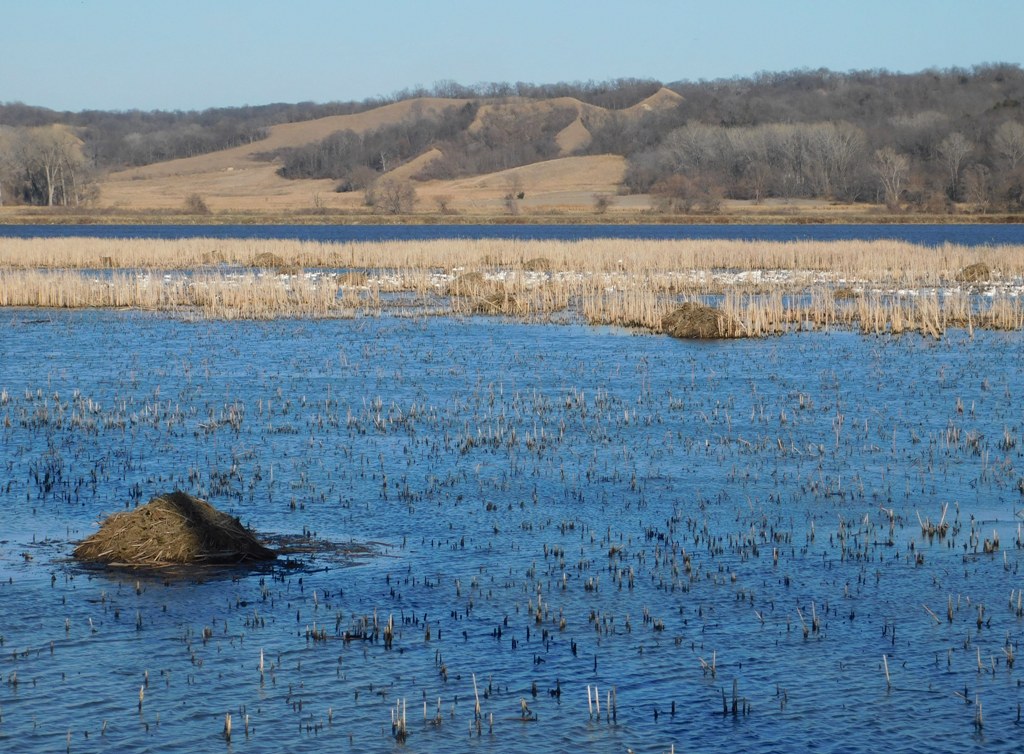
The big show, of course, was the snow geese, which were so numerous as to look like, yes, large areas of snow. Like, 28,000 of them. (In previous weeks, there’d been as many as 283,000 of them!) White and blue forms. I’ll bet there were some Ross’s geese among them, but picking them out would have distracted me from the main attraction: their multitudes.


Occasionally vast numbers of them would rise and fly off northward, an overwhelming chorus of their thousands of high voices. They were getting a nice brisk tailwind from the south!


They vanished into the whiteness of the northern sky. But there were still thousands left in the wetlands.


We saw lots of other birds, too, of course. There were plenty of Canada geese around; they seemed to love standing on top of the many muskrat homes that poked up out of the water. This one was all “honked off” at something—looking at it through our binoculars, we could see it hissing at something below it, then turning around and complaining the other direction.


Other birds that we saw (in the afternoon) included several trumpeter swans, American white pelicans, mallards, northern shovelers, blue-winged teal, gadwall, American coots, killdeer, common grackles and red-winged blackbirds (but unfortunately we didn’t see any yellow-headed blackbirds, but I certainly looked), and my favorite sight of the day, a female belted kingfisher that was hunting for fish. (Yes, in Squaw Creek itself, so see? It pays to take your eyes away from the vast wetlands and look all around.) Sorry, no pictures of her.

Sue, of course, was the one who first spied the kingfisher. As we watched, the kingfisher flew down to the water and captured a fish. (Judging by the shape, I’m betting it was a green sunfish or something similar.) She flew with it to a nearby wood duck nest box, perched atop the box, and started the process of swallowing it. True to form, she smacked it on the box a few times to subdue it, then got it flipped around so it would go down headfirst (the smooth way).

This was the weekend of Columbia’s True/False film festival, (or as some of my friends who work at restaurants and bars call it, “Hipster Christmas,” “Hipster Homecoming,” or the “Bunning Man” festival). Why would anyone want to be cooped up in a dark movie theater when they could be out watching these miracles of nature? Oh well. Maybe people don’t know you can see these amazing sights for free. Or maybe, because it’s free, they don’t value it as much as something you have to buy a ticket for?


Anyway, during one particularly large and raucous liftoff of zillions of snow geese, we noticed that a few non–snow geese were caught up in the excitement of the crowd. Amid the multitudes of basic sameness were a few different shapes, different wing-flapping patterns: One was a blue heron, and the other an adult bald eagle.

Well! That made our day! Can you pick out the eagle in this photo? (Remember you can click on these pictures to make them bigger.)


It was also great fun to watch some of the muskrats.


One sat on a completely muddy area amid dried cattails near a muskrat home and groomed itself for several minutes. I kept thinking, Dang, with all this mud, it must be a never-ending chore for them to try to keep clean!

As with so many other rodents, you can’t help thinking it’s really pretty cute-looking. Look at the little fist this one made with its left hand while it worked to clean its right arm.


Yeah, pretty cute, huh?

Well, it was a very memorable day. We need to keep going out and seeing these sights. What a beautiful and fantastic world we live in!


Sunday, March 6, 2011

Miss Rhue and the Deer Print


I thought you’d like to read this. After reading my last post, my dad sent me an e-mail that said:

Since I don’t do blogging or Facebook, this will have to do. I enjoyed your vignette of Lena Rhue. When I started reading, I expected to find something about the deer painting at your front door, probably because I took time the other day to look at it closely again and reread what was written on the back. Mom treasured it not just because of its beauty but because, well, as Mom would say, “Lena gave that to me!” Lena gave away a lot of her precious “things.” I suppose many people around central Missouri have mementos of her.

The other thing on my mind is my Mom talked to her about her name, Rhue, which is pronounced just like the German Ruhe, meaning peace. Mom thought it fitted her perfectly—a peaceful lady.

So I will share with you a few views of this painting (actually a silkscreen print), front and back, so you can see for yourself how my grandma treasured this gift.

I believe the work is entitled Frolic. If you search the Internet with the artist’s names, you’ll find more silkscreens of this very image for sale on eBay and elsewhere. (Fifteen bucks!)

I haven’t been able to tell when the original was painted, though the artist, Percy Tsisete Sandy, or Kai Sa (Red Moon), lived from 1918 (he was born on Armistice Day!) to 1974. Apparently Lena Rhue bought this print during a trip to Taos, where, I assume, they were selling them at Carl Schlosser’s trading post (now, I think, it’s part of a bed and breakfast). (The “Knpobo” on the back is Cradle Flower, the wife of Schlosser—Google her name, and you can find many nifty silkscreen prints featuring her poetry.)


Kai Sa studied painting in Albuquerque and at Santa Fe; the “maiden” he married was Peggy Mirabel, from Taos Pueblo. Apparently, Kai Sa became unwelcome in his home pueblo, Zuni, because he had had the temerity to depict sensitive, sacred subjects in his artworks. Thus he relocated to Taos.

Another interesting fact about Kai Sa: He was the illustrator for a children’s book by Ann Nolan Clark entitled Sun Journey: A Story of Zuni Pueblo (1945). (Maybe this is the artwork that got him in trouble with his pueblo?) It’s the story of a ten-year-old Zuni boy who has spent the last three years at a government boarding school and has forgotten or missed out on his own culture. But now, he has returned to his pueblo, and his grandfather and others teach him what it means to be Zuni. Thus, in the course of the book, this child is reintroduced to his people. And the reader learns about Zuni lifeways along with the protagonist.

I think this was a progressive notion for 1945, and I found it even more interesting when I read that the book was originally published by the education branch of the Bureau of Indian Affairs. I had thought the BIA in those years was generally insensitive to Native cultures—and I understand the bureau is still controversial among Native Americans—but here, they employed Clark to provide multicultural educational materials for both Native children and mainstream Americans. Fascinating, huh?


Clark, by the way, was born and educated in New Mexico and spent many years teaching Native American children. She discovered (naturally) that the children learned better when the reading material bore some relation to their own lives, so she ended up writing her own books and primers. She eventually wrote more than forty children’s books that we would today call “multicultural.”


So, Lena Rhue, an unmarried woman and professional sociologist, visited Taos at some point, and I can infer that she had a prescient interest in multiculturalism, too. She gave this picture to my grandma, who in turn gave it to me, in 1993. And now I get to look at it every time I head out the front door—and feel layers of appreciation.


Tuesday, October 5, 2010

Ha Ha Tonka: On the Name

In my previous post I told you about Ha Ha Tonka State Park, which is perhaps the most popular of Missouri’s state parks. Today, I want to zero in on a subject that’s been bothering me a while: The name.

From what I’ve been able to learn, a Colonel R. G. Scott, one of the first white men to own and/or write about the area, said that Osage Indians (basically, the “previous owners”) had told him they called the land Hahatonka, which supposedly meant “laughing water” (some sources give the purported translation as “smiling waters,” or some other variation).

Many sources repeat and repeat this etymology, which I think bears serious questioning, given the cultural sensitivity Americans have cultivated nowadays to partially rectify the injustices and cultural tramplings of the past.

Are we to take it that -tonka (used so often in tourism-associated names) means “water,” and that haha- means “laughing”? Come on.

Sure, in all languages, some words (like smack, slither, and plop) are onamatopoetic, but I remain skeptical about the Indians saying “haha” when they wanted to say “laugh.”

Honestly, I know very little about Osage or any other Native American languages, but something seems fishy here. From what I’ve been able to learn from Internet sources, tonka means “great” in the language of the Dakotas—as in Wakan-Tonka, “Great Spirit” (the adjective great follows the verb Wakan/spirit). And Minnetonka (a city name in Minnesota) is supposed to mean “great water.” (Minnesota, by the way, is supposed to mean “sky-tinted water”; mni- or minne- would be the “water” part.) This is in the Dakota language. I don’t know about the language of the Osage.


Tonka can also refer to a type of bean, a tonka bean, the fruit of a tree from Guinea. (Which is completely different.)

On the specific naming of our beloved state park, I’ve looked at several sources, and the one I’m most inclined to trust is Robert L. Ramsay, Our Storehouse of Missouri Place Names (Columbia: University of Missouri Press, 1973). Ramsay was a scholar who specialized in the study of place-names and constructed his book from painstaking and exacting historical research. And on page 42, he states: “Often the white man simply made up an Indian sounding name which actually means nothing at all, as he seems to have done in Hahatonka, Mendota, Mineola, Owasco, and Wasola.

He mentions the place-name again in his section “Coined Names”: “The man who owned the land around Winnetonka joined what he supposed to be an Indian suffix -tonka to his own name Winn. Perhaps he modeled it upon Hahatonka, whose founder mistakenly thought he had derived it from Indian words meaning ‘smiling waters’” (116).

Maybe Colonel Scott, or whoever he learned it from, had simply heard it wrong or spelled it clumsily, or—this seems more likely—someone back there in history flat-out made it up.

In my recent ponderings, it’s occurred to me that new information might have arisen on the Ha Ha Tonka name. I asked a longtime member of the Missouri Board on Geographic Names, and he told me that Ramsay has not yet been superseded on this matter.

I’m absolutely not suggesting we discard this long-established, beloved, and honestly, rather silly place-name as “culturally insensitive” (the way I generally support the replacement of “squaw” place-names, which many Native folks find deeply offensive).

Instead, I contend that the name “Ha Ha Tonka” reflects an important historical fault line* in the region’s history: the acquisition of Osage lands by whites, and the collision, confusion, appropriation, and misappropriation of Native language and culture and territory—whether intentional or accidental—and all the “development” and marketing that has followed. It’s like the rubber toy tomahawks decorated with dyed turkey feathers that they used to sell at souvenir shops on the Bagnell Dam strip. Let’s just accept it for what it is.


_________________________
* Pun intended, indeed.