Showing posts with label yard pictures. Show all posts

Wednesday, May 18, 2022

The Black Walnut Tree

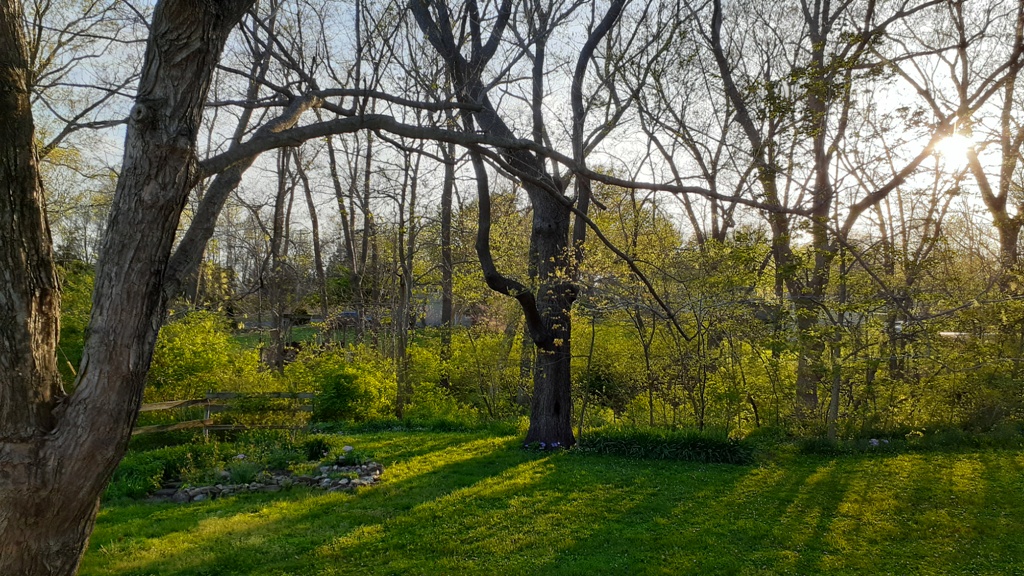
There’s a big old black walnut tree in my parents’ backyard. It’s right in the center, in the back, where the lawn meets the edge of the woods above the drainage ravine.

It was already a giant when they bought the house when I was on the way in sixty-five. All the branches are high out of reach.

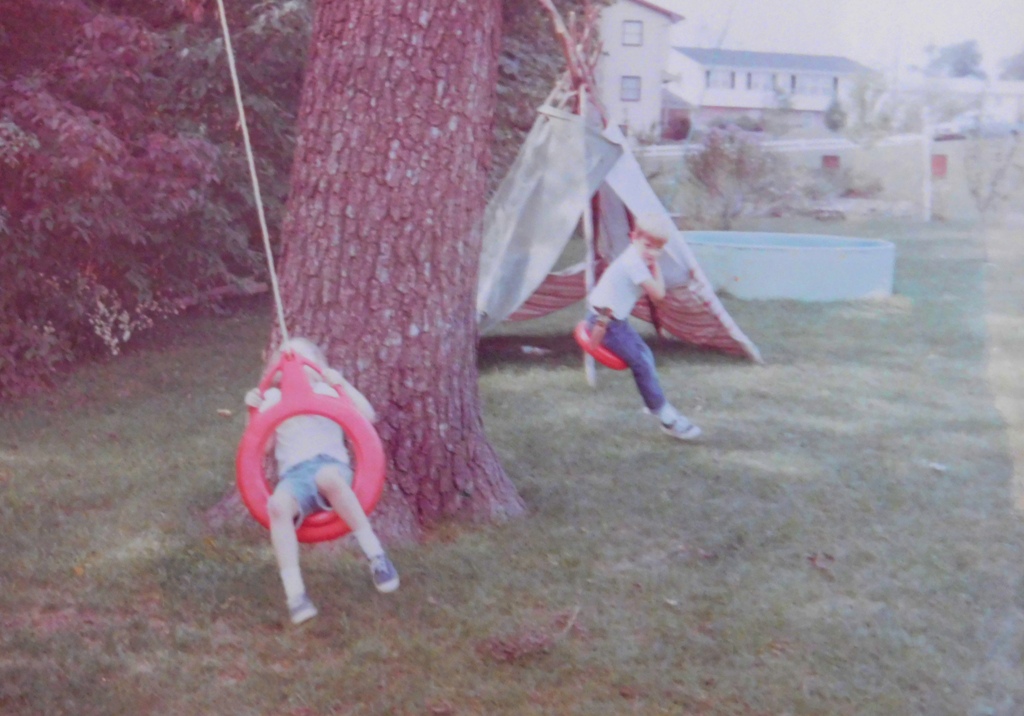
Dad hung swings for us from its huge lower limbs when I was a kid.

The night of Saturday, July 26, 1969, a severe storm blew the top out of the tree. A hard day’s work with saws cleared the debris from the lawn. Mom and Dad had plenty of help.

My brother and I didn't particularly help, but we sure had fun that day.

From that windfall and more, my folks used some of the fallen branches and some old blankets and pieces of canvas to build a tepee for us kids in the backyard. So that summer and following years, our yard was popular among the neighborhood kids.

Some of the large sections of walnut became woodworking projects. Mom squirreled away several nice thick pieces. To this day, I use one of the smaller chunks—which I carefully sanded and polished, as a preteen—as an incense burner. There's a public side and a private side.

Then in the late 1970s, Mom learned about juglenone when she tried to grow a tomato back near the tree. The tomato plant grew tall and spindly, and it begrudged us flowers and fruit. At the time, I didn’t care much, since I never cared much for raw tomatoes. (They’re still not a favorite.)

The nutmeats from the tree didn’t amount to much, as too many of them were dried and shriveled to make it worthwhile to crack them open. The squirrels found plenty of them to eat, however, and nested in its branches and ran around, like rollercoaster cars, on its wide, undulating, spreading limbs. Recently, my parents had a clan of gray squirrels with a lot of white patches in their fur, which was fun to see.

There has always been a vertical split in the trunk facing the house. It’s morphed over time into a more rounded hole. But the split was always a curious thing for me. Over the years, it became an entry way for the carpenter ants, bees, snakes, and other animals that have inhabited its hollow interior.

Paul and I used to pick up fallen walnuts and chuck them into the woods, practicing our pitches by aiming for random tree trunks. My fingers turned black from the juices, but I didn't care, since I wasn’t such a girly-girl. Chucking the nuts into the woods served a useful purpose, too, since it made mowing easier, and walking, too, for that matter.

I have so many memories of enjoying the backyard with that big tree providing us shade. It’s still standing, doing fine, its hollow space quite recently a home for a family of barred owls.

It’s truly a grandmother tree, and I thought I’d sing you this little song of praise.

Monday, September 6, 2021

Our House of Blue Lights

Gosh, we’ve had a hot summer, with plenty of bugs. Odgen Nash, as usual, hit the nail right on the head: “In this fairly temperate clime / Summertime is itchy time. . . . Beneath the orange August moon / Overfed mosquitoes croon. / After sun-up, flies and midges / Raise on people bumps and ridges.”

But as the weather seems to be getting cooler, I’m hoping we’ll also have breezes enough to push aside some of the insects while also making it more pleasant to be outdoors in general. So we’ll be spending more time on our patio. (Such as it is.)

I’ve mentioned our little oasis in Central Missouri before (like when I wrote about playing the zither or our guitars out there), but today I’m frankly just crowing about our outdoor lighting, which I’m so proud of.

Sue and I were recently sitting out there, playing our guitars, and Sue mentioned that we have “The House of Blue Lights.” She hummed a few bars, and I was like, “What song is this?” She said, “Don’t you know that song?” So we had to Google it, and I learned a new song. And I got a title for this blog post! . . . Here.

I started the lighting project in 2018. I basically copied an idea from Kansas City’s Cafe Trio (yeah, one of my happy places). (And yeah, you should really go there and check it out.) That restaurant has a deck/patio with an attractive view overlooking the iconic Nichols Memorial Fountain and looking beyond toward the KC Plaza. I was fortunately able to be there alone one night and noticed the lighting.

They had gobs of those bright, cold LED Christmas lights overhead—enough to cast a cool, cobalt-blue glow over the entire patio. So that people could see (and read the menu and stuff)—but also to create a compelling visual contrast—they also had regular warm-colored patio lights overhead, too. The warm and cool lights combined to produce interesting reddish or even purplish hues where they intersected.

Then—and here they were really inspired—they had a number of rotating LED projecting spotlights (you know, the kind that people use to beam rotating snowflakes onto their homes at Christmas) mounted overhead, too, facing down onto the bar, the chairs, the floor, everything. Because it beamed down from above, it wasn’t in anyone’s eyes. And it wasn’t snowflakes, though—it was just blue revolving and rotating splotches of color. The lights overlapped a bit, so there was no discernible pattern. The overall effect was like being underwater.

I took note of the idea.

I started with the screened-in part of our sunporch. While Sue was out of town for a while, I did it all unilaterally. I put a super-blue LED light bulb into our overhead fixture, and it emits enough glow for that small portion of the porch. Then, I copied Cafe Trio’s method, stringing plain patio lights overhead and rigging our rotating LED projector so it would beam down onto the table and the rest of the room. We don’t use it for Christmas decorations anymore! And it has a little remote control, so I can change the colors a bit: blue, red, green, or combinations of the three. (It looks best when it’s set on all-blue.)

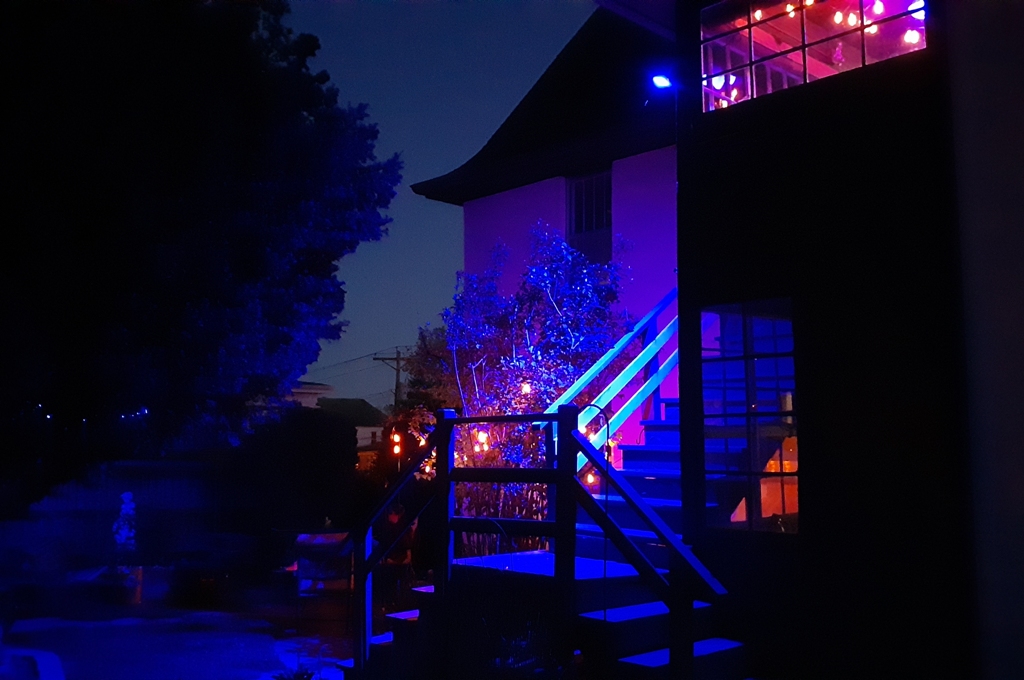
I was so pleased with the effect, I extended it to the backyard patio area. I found a LED blue spotlight for above the steps (you can still see to get up and down them, but it’s blue now). I purchased a bunch of plastic blue LED stringlights and hung them in the lower portion of the canopy of our big yew tree that overlooks part of our patio area.

Next, I strung regular patio lights from our downstairs back door along the walkway to the patio area. I was proud of myself for using some plant hooks for those. . . . And we already had our tiki torches, and the firepit.

We still really miss Vines, but even when it was still open, there were many nights when we had opted to stay in our own little private oasis in our backyard. Hopefully, now that the weather’s starting to get nice again (with, I pray, a corresponding decrease in itchy bugs), we’ll be out there again.

Wednesday, May 2, 2018

Violets Variation

Happy spring! For me, the preeminent flower of springtime is the violet: the ubiquitous "common violet" (Viola sororia) that grows in yards that are not poisoned by chemicals on a regular basis.

The taxonomy of these free and pretty little jewels has apparently given botanists fits. George Yatskievych, in Steyermark's Flora of Missouri vol. 3, summarizes "the tortuous nomenclatural history (and longest synonymy)" of this highly variable species. The species (as it's understood today, for now) differs in amount of hairiness, colors and color patterns on the petals, and lobing of leaves. Some apparently are not 100 percent wild; cultivated forms exist. I think that's what we have in our yard, mostly.

One reason, he says, for the variation and confusion might be because this species might hybridize with closely related violet species, but also that, because these violets also can create viable seeds from cleistogamous (non-opening, self-pollinating) flowers, an unusual specimen may easily reproduce its own weird genetic line in an area, filling the vicinity with its own non-sexually-reproduced offspring (basically clones of the parent plant).

I have kind of given up on trying to key out violets because of these differences. Every time I read technical and even nontechnical treatments of Missouri's violets, I get confused. It doesn't help that older references have them divided up into different species that newer references don't recognize.

But mostly, I simply hesitate to do the serious work in keying out the plants: picking and teasing and pulling apart the flowers, for instance. It pains me even to run the lawn mower over them. And they only last for a few months in the springtime.

So I will just enjoy them and let them be. They are a central reason I don't treat my lawn with weed killers.

Here's a little portfolio of the violets that grow in our yard. Enjoy!

First, some pictures of some "unusual" blue violets I transplanted them to Missouri from Sue's parents' yard in northern Ohio in May 2016, right after Mr. Ferber passed away. These rather pale violets are the most common type up there! Their yard is full of these violets. For all I know, they might be a different species. Anyway, the two little clumps I brought home have gotten pretty well established. I wonder if they're breeding with the other violets in our yard?


Next, the standard plain purple violets; most of the violets in our yard are these.


The next most common kind of violet in our yard are the "Confederate" violets, which Yatskievych calls Viola sororia f. priceana, "a form with grayish white corollas marked with violet or blue veins and sometimes also the lower petal spotted or mottled with purple." He says if you see any growing in a natural area, they are probably "plants that have escaped from cultivation rather than truly native occurrences."

Here is a typical purple and a Confederate together:


This year, I've noticed we seem to have a lot of variation in the "Confederate" violets. Yatskievych says, "Where such plants grow within natural populations of plants with bluish purple petals, individuals with intermediate corolla color patterns may also occur."

So here are some examples. First, some "regular" Confederates:


Then, there are some that look especially dark:


And here's one that seemed to have very pronounced dark veins:


On the other hand, here's one that's remarkably pale, but still with the "Confederate" patterning:


And I could only find a single pure white violet. Its stems and leaves are pure green, lacking the kind of reddish tinge the purple violets can have. And the petals are pure white. Sorry my photo's so lame. If it blooms again, I'll try to take a better picture. But you can get the idea even from this shitty out-of-focus photo.


(Really, I should be ashamed of myself for even posting this piece-of-crap photo...)

Finally, there is a different species of violet that occurs in our yard, and it's clearly separate. This one is Viola striata, the pale violet or cream violet. It has aerial stems (that have alternate leaves and flowers coming off of it) as opposed to having each leaf stem and each flower stem arising directly from the rhizome (like the other yard violets do). The flowers are narrower, and the stipules on the aerial stems are distinctly fringed with deep lobes or teeth (they look kind of comblike). The lower petal usually has dark purple veins (I guess that explains the species name, striata). Here are a couple views of it.


Sunday, August 13, 2017

Progress At Home

In past months, we’ve been focusing on improving the house, inside and out. This is spurred, as it so often is, by impending visits! We have family coming to Missouri to see the total eclipse this week!

We don’t tend to have houseguests very much—in large part because our house is such a “work in progress.” After living in it for sixteen years, you’d think we’d have gotten it into fair shape, but we do have a few explanations. Okay, excuses.

First, it’s a big house, and it’s easy to keep the public parts rather presentable by using other parts for storage. (Don’t criticize, unless your garage or attic is perfectly clean! By the way, we don’t have an attic, and closet space is minimal by today’s standards.)

Second, we had a good amount of expenses when we first bought the house. Electric upgrades, new roof, repaint the exterior, and more; plus the mortgage payments. That put us into a pattern of working days and nights to keep ahead financially, which left us little energy for patching walls, picking out wallpaper, painting, putting down new flooring. We even fell behind on basic electrical fixes and weeding/landscaping. Having half our front yard infested with hedge bindweed is enough to take the wind out of any gardener’s sails.

And I suppose some people would consider it a crippled work ethic, but we actually do take time for both “big” vacations as well as plenty of small ones—day trips, afternoon excursions, going to dine in another city just for the change of scenery. (As you can tell from this blog.) This is a fundamental choice of ours: yes, our house is generally not very presentable at any given moment—but we intend not to go to our graves, or to hit retirement, without having had lives that balance work and play, output and input, labor and fun.

But we’ve been making up for some of those sins in the past few months. A cool spring, Roundup, and generous use of mulch helped with the landscaping scenario. Some parts are still rather unsightly, but it looks a lot better than last year. I pitted that fast-growing, colorful sweet potato vine–stuff against the hedge bindweed, and it actually seems to be working. Hah!!

Late May:


Middle August:


(I’m still making the rounds of the yard every few weeks with the Roundup, though. I don’t like the idea of herbicides, but I’m sick and tired of pulling weeds manually. And bindweed is like a cancer of the lawn . . . once it has a toehold, has “metastasized,” I doubt you can ever completely get rid of it; instead, just keep it in remission. Make it “feel unwelcome.”)

Mulch hides a multitude of sins.


Our backyard's been looking so good (and the weather's been so mild this summer), we've actually been sitting on the patio and enjoying breakfast or, um, happy hour after work, and feeling that "life is good."


Indoors, we’ve been cleaning and straightening and polishing. Replacing blinds and curtains. Finally putting privacy window film and curtains on our basement windows! Getting rid of stuff. Making guest rooms look like they’re ready for guests!


I’ve patched and primered some of the walls on the third floor (which are made of Celotex, or “Beaverboard,” the 1930 fiberboard equivalent of drywall, with ancient wallpaper over it)—part of what will be a bigger ongoing project, but at least the worst places now look decent.

I called the plumber, who fixed the bathroom sink’s cold-water faucet so that it doesn’t shriek when you turn on the tap, and he replaced the toilet innards (once again) so that it isn’t running and hissing all the time.

I called an electrician, who did three-quarters of a day’s worth of small fix-its that I won’t touch in our old house. Here are some of the tasks that we’ve been wanting to have done, in most cases, for years:

  • Fix the three-way wall switches for the wall-sconce light on the third-floor staircase (a switch at the base, a switch at the top, and a switch on the sconce itself).
  • Check antique sconce in bathroom that flickers when you wiggle the bulb a little.
  • Replace iffy wall switches in the front hall, and the dining room (including an elderly 1970s rheostat that had started turning itself off for no apparent reason).
  • In the kitchen, completely replace the overhead light fixture in the room, and replace the incandescent pull-string fixture over the sink, and repair the pull-string on the small florescent fixture over the sink (which I’d been turning on and off by twirling the florescent tub in its fixture).
  • Replace the light fixture over our front doors.
  • Install a florescent fixture right above our workbench, and added an electrical outlet there, too.

Some of these have been “on my list” for years! It’s amazing how you can get accustomed to life in a hovel. But don’t judge—there’s something in your life that you aren’t paying attention to, too, I’ll betcha.

Of course, I know that our guests would not expect, ask, or wish us to go to any “trouble” about hosting them—but that is not the point, really. We’ve simply been using their visit as a motivation to do many of the kinds of things we’ve wanted to do for a LONG, LONG time. A deadline. An impetus.

And so, from the top . . .

The third-floor sitting area and space for guest to sleep is now actually a place where someone could comfortably sit or sleep. (It’s really nice up there, so high above the street, and with such good breezes.)


And my office is looking much less cluttered than usual.

The second-floor front hall, living room, and dining room are looking respectable again—but these are our “public” rooms, so they usually don’t need a lot of work, besides dusting and vacuuming.

The second-floor sunporch is once again a pleasant place to sit (when it’s not super hot).


The downstairs front bedroom, which in winter turns into a veritable greenhouse of potted plants, is once again habitable by humans (and quite comfortable, I might add).


Sue’s office, in the downstairs living room, is a lot tidier, and we’ve gotten new pinch-pleat sheers and had the drapes dry-cleaned. It’s an amazing improvement. Of course, now this doubles as Lois's apartment, so we're keeping the sheers tucked back away from her needle-like claws. (Wish us luck!)


As mentioned above, the back yard is inviting again, and the front yard is not given over to bindweed and other nightmares this year.

I suppose it's kind of lame that we make our house not be shameful, for once, and then take pictures of it before it gets bombed-out looking again. And there is of course much more we should do—we have 20 rooms in our house, if you count the basement, the bathrooms, and the sunporches. All the rooms are smallish by today’s standards, but they all need something—painting, wallpapering, a new rug—something. But we’ve added appreciably to the “public” portions of the house, and raised our self-esteem in the process.

So there you are—I’m not showing you any “before” pictures, but trust me, these are some major improvements.

Bring on the guests!