Showing posts with label healthy eating. Show all posts

Friday, July 31, 2026

Healthy, Frugal, Simple, Kind

Yes, we need to exercise more, but a big component has been the food. Sue and I need to be eating more healthfully and more frugally, thanks to a confluence of stimuli. We’re both overweight. My A1C and cholesterol have been heading in the wrong direction. And “frugal”? That reflects national trends and my current personal situation.


There have been other stimuli that are more “carrot” than “stick.” First, the death—no, the memory—of Columbia, Missouri’s shining light of vegetarianism, Leigh Lockhart, founder, owner, and high priestess of Main Squeeze café, has led me to re-re-re-reconsider my attitude toward organic, sustainable, healthy, whole-grain vegetarian cooking. She was filled with joy about a sustainable, organic, healthy vegetarian lifestyle. Her slogan was “Goodness for all.” And she meant it!

Since her memorial gathering on June 27, I’ve been poring over Main Squeeze brochures I’ve kept in my recipe scrapbooks. Juices, smoothies, sandwiches, wraps, bowls, breakfasts, soups, hot dishes . . . the only real reason I stopped going to her café was because it was always incredibly busy at lunchtime. We’re talking lines out the door. And I didn’t work anywhere near downtown. Then, we moved out of town and were never even in Columbia for breakfast or lunch.


Also, I’ve been making my way through a new (to me) book, Johnathan Kauffman, Hippie Food: How Back-to-the-Landers, Longhairs, and Revolutionaries Changed the Way We Eat. It describes the historical and cultural ingredients, and movements, that created the cuisine we’d call “health food” in the 1960s, 70s, and 80s. This was the culture and the foods I encountered in Columbia at the food coop and with lots of college friends who made dishes such as “tofu and sprouts.” This was long before Whole Foods commodified health foods, added lots of fancy-schmantzy techniques and top-dollar ingredients, and quadrupled or sextupled the price. (Which is why suddenly it’s become a questionably unquestioned “truism” that “only the rich can afford to eat healthy food.” Hmm.)


Did you know that in college and grad school, I often ate a macrobiotic diet? Brown rice and beans with steamed vegetables. I always kept sea vegetables—hijiki and wakame—on hand! I was quite vegetarian. This was before I got really interested in cooking. And yet I was never strict about anything; I could always turn around, visit a restaurant, and enjoy kung pao pork, chicken mole, or yes, the occasional Quarter Pounder® with Cheese. But at home, I was quite frugal. Brown rice, beans, and veggies matched my checking account, for one thing, and it never, um, disagreed with me.

And I liked avoiding “factory food.” I grew up in a house where margarine was favored because, first, it was low in cholesterol, thus healthier, and second, it was a lot less expensive than real butter. But things changed, and by about 2000, I was switching to butter or olive oil for cooking, and relegating “I Can’t Believe” to a role as a basic bread or pancake spread. I quickly grew skeptical of Hamburger Helper and so on. A close friend in college turned me on to simple steaming and stir-frying vegetables, with only a small bit of lean meat.

So that was the diet I ate for several years.

Eating vegetarian food is also a positive for me because it has always made me feel MUCH less guilty whenever I had to see one of those awful livestock semis on the highway. Don’t tell me it doesn’t bother you, too, when you glimpse the eyes, faces, legs, and tails, or see a snout protruding from the holes, amid the excrement seeping around the bottom of the trailer. Don’t tell me it doesn’t make you feel uncomfortable to think about those living, breathing, intensely worried animals, trying to keep standing, breathing nasty diesel fumes at seventy miles per hour as they endure their one-way route to extermination. I’ve seen too many movies about the holocaust, when humans were treated that way, and I’ve never lost my innate empathy toward animals. I didn’t grow up on a farm and have that kindness and sensitivity crushed entirely out of me. Where does our innate empathy toward animals come from, do you suppose? I think we have more in common than we have differences.

The recent national and statewide cyclosporiasis outbreaks also give me pause. I suppose most stupid Americans will take that as an excuse to eat fewer “green things” and more beef and bacon. Look at how the spate of E. coli cases linked to fast-food restaurants’ handling of alfalfa sprouts led to alfalfa sprouts almost completely disappearing from all restaurants and grocery stores. The answer wasn’t to ensure that employees would simply wash their hands after wiping themselves in the bathroom. It was to remove the ingredient that couldn’t be cooked above 160°F.

It seems one of the best ways to avoid cyclosporiasis is to eat produce that comes from our local farmers markets. It’s not that I ever fully trusted that prerinsed, pretrimmed, prebagged, “where-did-this-some-from” greenery from the big groceries. I’m guessing those giant-ass nationwide produce companies rely on hardworking migrants who are given few potty breaks and nowhere to go when they are. And yes, I have trusted, even admired the produce department of my local Schnuck’s grocery. . . . But beyond that, our local farmers markets are happy places for me. For sheer shopping fun, I’d rather go there than, say, to any mall. Yeah, give me a little more of a push to go to the farmers market!

I’m sensing a new direction. I’ve learned a lot more about cooking since the first time I plunged into healthy eating. I know how to deploy a wide range of spices and how to make masalas, how to cook without scorching stuff, how to make crêpes and sauces and omelets, how to adjust baking times and temperatures to my old, idiosyncratic oven. I know how to make my own sprouts, which will of course be completely free of cyclospora and E. coli. The only thing that can’t really be shortened is prep time, but it appears I might have some extra time on my hands. Healthy, high-fiber food is filling. So be it. Time to lose some weight, anyway.

Tuesday, May 28, 2024

My Tuna Pasta Salad

My humble contribution to the universe of pasta salads. I devised it in college, and it’s had real longevity among my go-to dishes. It’s tasty, filling, relatively healthy, and it makes a can of tuna go a long, long way.

As with other dishes of this nature, relative quantities are up to you. I’ve never codified it with exact quantities. I adjust the mayonnaise dressing as I go.

Serving: Serve it on a lettuce leaf, or on a bed of shredded lettuce, mixed spring greens, or alfalfa sprouts. Triscuits are a nice accompaniment. You’ll probably eat the last portion right out of the plastic storage tub you had it in, standing over the sink.

Julie’s Tuna Pasta Salad

  • 1 lb. box of rotini pasta, cooked in salted water until done (I often use tricolor rotini)
  • 12-oz. can tuna, packed in water (not oily) (break the large chunks into smaller pieces)
  • 1 crown broccoli, trimmed to small pieces (include peeled, chopped stalks, too) (extra points: consider blanching the broccoli a few seconds in boiling water, then shocking it in ice water to stop the cooking, then drain completely)
  • one half to 1 crown cauliflower, trimmed to small pieces (total volume about equal to the broccoli)
  • 1 medium to large carrot, peeled, cut in matchsticks or coarsely shredded (about ½ cup)
  • ½ cup sliced black olives, chopped, California/ripe (about half of a regular 6-oz. can)
  • ½ lb. cheddar cheese (orange, boing-boing, government-style; medium or sharp) (but pepper jack or Monterey jack is good, too), cut into little bricks or cubes
  • mayonnaise, your favorite kind, about 1 cup
  • apple cider vinegar, about 1/2 cup
  • salt, black pepper (to taste)

Mix it all together gently in a large bowl or stock pot. I usually whisk together the dressing ingredients (mayo, vinegar, salt, and pepper) separately before folding it in to the rest.

You may need to add more dressing or mayo. Adjust all the ingredients to your liking.

Preparation tip: after cutting the cheese into bricks or cubes, toss them with a pinch of flour, and the pieces of cheese won’t stick together before you stir them in with the rest of the salad.

This yields about 14 cups (or about 3 quarts) of tuna pasta salad.

Yes, it makes a lot, but part of the charm is that it’s tasty enough that we’re happy to eat it for lunch several days in a row. Just spoon it into a bowl and eat it with a few crackers; it takes virtually no time in the kitchen during our lunch breaks.

Friday, December 2, 2022

Notes on Grandma Renner's Billie Goat Cookies

I’ve written about Billie Goats, also spelled Billy Goat Cookies, before. But it’s time for a more nuanced version of the instructions. Look, no matter how you make them, they’ll be delicious. But I’ve been taking notes every year, so I can get the shape and texture just right. Until now, it’s been hit-or-miss. But I think I’ve got the techniques figured out, now. (As Chef John says, “Never let the food win.”) By golly.

So yes, there's a recipe at the end of this post.

A true, enduring gift from my grandma Clara Renner, these cookies take the strong, separately distinctive flavors of brown sugar, cinnamon, black walnuts, and dates and combine them into a new flavor I can only call “Billie Goat.” It’s a genuine meld; the combination is much greater than the sum of its parts. If you don’t like one of the ingredients, don’t rule out these cookies, because each flavor is tempered and transformed by the others. This is one of the best cookies anyone can make, in my opinion.

And for us, it’s a must-have for the Christmas cookie tray.

I have used this combination of brown sugar, cinnamon, dates, and black walnuts in other recipes, and I’ve found they have the same profound, synergistic effect, where they meld into a new, milder, but very unique flavor. I think of it as “Billie Goat seasoning.” I use this combination in my bran muffins, for example. You could also apply it to a bowl of oatmeal, or use it in pancake batter or a quick bread.

Grandma Renner said these are called “Billie Goats” because they are lumpy and have little points that stuck out, like a goat. (This is why the shape and the texture of the dates is important; read on.) I don’t know why Grandma spelled it “Billie” instead of “Billy.” Grandma Renner, her sister, Lydia Meyer, and their friends apparently all started making Billie Goats about the same time.

Billie Goats/Billy Goats are in a family of similar drop cookies that were really popular among mothers in the 1930s and 40s. This was a generation of moms who were keenly conscious of their role as household managers. In school, their “domestic science” classes taught them to be faithful guardians of their family’s health and good stewards of the family food budget. Vitamins were a new discovery with their generation. These women wanted to pack maximum nutrition into the foods they made, including their children’s after-school snacks—while being very economical (first, because of the Great Depression; next, rationing during World War II).

So, instead of sugar cookies or candies, they made these proto-health-food snacks, using nuts, plus raisins, dates, and/or currants, and sweetening with surprisingly small amounts of brown sugar (some recipes call for a combination of brown and white). Other cookies in this group include “hermits” and “rocks”; oatmeal-raisin cookies are also close relatives. Look for all these recipes in old cookbooks and church ladies’ cookbooks. The names “billy goats” and “rocks” both apparently refer to the chunky, knobby look of these cookies. I don’t know how “hermits” got named.

Some notes about texture and form, since I’ve had some time to figure these out. They’ll taste great no matter what you do, but the goal is to have a chewy, cakelike inside, and a lumpy, chunky shape. So here’s a discussion of challenges, and my “pro tips.”

For generations, most American cooks could only get Dromedary brand dates, which were apparently Deglet Noor dates. They were packed tightly in cellophane (this was before plastic), stuffed into cardboard boxes, and, after languishing in a warehouse or on grocery shelves, they were as tough as shoe leather. Clipping them with kitchen shears, as Grandma’s recipe instructs, would literally hurt your scissors hand. (Grandma’s kitchen shears were stainless steel, dull old things; you know the type—the ones with the rounded “claws” for opening bottles at the base of the red-painted, hard metal handles. The base of my thumb still hurts, just thinking of them. This was way before “Fiskars” scissors were available!)

So billy goat cookies, being a midcentury recipe, were developed using the ingredients that, at that time, were available to most people: dried-up dates. The cooking softened them, but not to the point where they lost a distinctive, chewy, chunky presence.

Today, the Dromedary brand seems to have gone out of business, and you just cannot buy dry, hard dates like them; instead, they are all moist and tender, either packed in plastic or shipped absolutely fresh. This is actually a good thing, but it presents a problem for replicating this cookie’s texture, since moist dates tend to dissolve into gooey molasses during baking, producing a flat, uniformly chewy cookie, instead of distinct, chunky, jagged lumps of chewy dates and nuts in a cakey, rounded matrix of dough.

I’ve learned to replicate the type of dates Grandma had by purchasing them (Deglet Noors) a few weeks ahead of baking, clipping them in the prescribed herringbone pattern while they’re still soft (which is a much easier task, now), spreading these out on cookie sheets, and letting them sit (under wax paper) in a quiet place while they dry. The house isn’t at all humid in November. Or, you can put them in the oven warmed only by the pilot light. Or you can try a dehydrator. An alternative might be to try to find one of the so-called bread dates (varieties such as Thoories that are sold rather dry, dry enough you can carry them in your pocket)—but those might lack sweetness. Also, I think it’s cheaper and easier to use regular Dole (or whatever) brand Deglet Noors, cut them, and let them dry. That seems the best way to replicate the texture and flavor of old-fashioned Dromedary dates.

Another point about texture: These cookies have caused me more vexation than any others, except perhaps when I was first figuring out springerles. If you only make a cookie once a year, it’s hard to fine-tune the recipe! My Billie Goats recipe card is full of penciled-in notes: “try doing _____ next time.” You don’t want the cookies to be so soft they spread out, but you don’t want them crunchy or hard. How to get that cakey, chewy texture, and chunky look? Here are some key tips:

  • Use a 50/50 combination of margarine and butter-flavored Crisco. Real butter does make them taste better, but it complicates the texture; the cookies turn out drier, less moist. Save your butter for some other recipe.
  • Pack the flour; forget the rule about spooning fluffed-up flour into your measuring cup and leveling it off with a knife. It turns out Grandma R used her measuring cups as scoops: swipe the cup through the flour, like you’re using a dip net to fish something out of water. You can level it off if you want, or just kind of shake off the excess, but you need to pretty much pack the flour into the cups.
  • Let the dough sit overnight in the refrigerator or on an unheated sunporch. The flour will absorb the liquids and be easier to work.
  • . . . But the dough will still be sticky and hard to handle. Put on some happy music. Use parchment-lined cookie sheets. Try dabbing the dough into little rounds with two spoons, or (if you haven’t much patience for the spoon method) use your fingertips to pinch off bits of dough (put some water on your hands so it doesn’t stick so bad; even then, you’ll have to clean your hands and start again several times).
  • I tend to make smallish cookies, because I figure twenty-first-century people would rather select six different morsels from the tray than settle on just two huge cookies. Big cookies are a joy, but variety is the spice of life. Also, with smaller cookies, a single batch of dough goes farther. A 1¼-inch blob of dough, slightly flattened before cooking, produces about a 1½-inch diameter cookie. Back in the day, Mom and Grandma’s cookies tended to end up about 2 to 2½ inches in diameter. Different sizes account for the difference in cooking time; smaller cookies cook faster.
  • Do a single tray of cookies first and see how they turn out. These shouldn’t flatten very much. If they spread out flat, you may have to add a bit more flour to the dough, or you might need to adjust the size of the cookies.
  • Finally, don’t overcook these, or they will be too hard. Mom says this was a principal criticism Grandma R had about her sister, Lydia’s billy goats: “she bakes them too long, and they get too hard.” (I’ve heard this criticism plenty, too.)
  • But if they come out kind of hard, don’t panic. Seal them in a tin, with the layers of cookies divided by wax paper, and take half of a tart apple, wrap it loosely in wax paper, and nestle it in the tin with the cookies. After a week or so, you’ll discover the cookies have softened and developed a je ne sais quoi in terms of flavor.

. . . Does all this sound too hard? Please don’t be put off by these tips; it’s all stuff I’ve learned the hard way, and I’m sharing it here, so you have a super-duper head start!

Finally, again, you can’t really ruin these. They’ll taste great regardless of the texture and shape.

Billie Goats/Billy Goat Cookies

1½ c. brown sugar
1 c. butter [Pat S. uses margarine, sometimes butter-flavor Crisco; I use half margarine and half butter-flavor Crisco; real butter tastes good, but then the texture will be off]
-----------Cream together butter and sugar.

3 eggs: beat whites [till light; use a hand mixer or whisk] and [then] add [whisk in] yolks

1 level tsp. baking soda dissolved in
¼ c. lukewarm-to-hot water

1 Tbs. cinnamon
1 tsp. vanilla
1 c. black walnuts [chopped]
1 lb. clipped dates [using a scissors, clip whole, pitted dates in an alternating herringbone pattern; the idea is to have them big enough to kind of “poke out” of the cookies; if you buy pre-chopped dates, it’s okay, but the pieces are too small to achieve the characteristic lumpy look.]
2½ c. flour [basically pack it]

Make the cookie dough [let it sit overnight in the fridge] and drop it onto [parchment-lined] cookie sheets by small spoonfuls. Bake in a moderate (ca. 350-degree) oven like you would other cookies, about 8–11 minutes. [Don’t overcook; they should be rather chewy and cakey inside.]

Makes about 100 cookies.

Tuesday, June 14, 2022

Alfalfa Sprouts in 2022

We used to eat alfalfa sprouts all the time back in the day. We used to be able to buy them at the store, at regular grocery stores. Back in the 1980s, all the salad bars had sprouts. (Remember Roseanne Barr’s Pizza Hut commercial where she talked about “grazing on a delightful array of sprouts and garbayennnzo beans”?) (Well, hey, remember salad bars?)

And all the health food groceries had deli cases with freshly made sandwiches full of alfalfa sprouts. And on the other end of the spectrum, until quite recently (at least) the sandwich chain Jimmy John’s had a sandwich or two that featured alfalfa sprouts . . . though it seems they’ve dropped the sprouts entirely, though.

You used to be able to buy a variety of sprouts, even: onion sprouts, broccoli sprouts, "spicy" sprouts (a blend with radish sprouts, which taste peppery), and clover sprouts. What happened?

Now it seems that sprouts are impossible to get, unless you grow your own. Jimmy John’s had a problem with its sprouts by the name of E. coli; maybe that made people scared of sprouts. (Though that’s silly, because there’ve been plenty of E.coli incidents with pre-packaged lettuce, and people keep buying that. . . . And the problem has more to do with worker hygiene and proper rinsing of the produce than it does with the produce itself.)

Or maybe people decided that sprouts symbolized something that’s uncool today: All that not-indulgent, low-fat food from previous decades’ health food movements. And honestly, I’m guilty of referring to that era’s health foods as “tofu-and-sprouts” cuisine. But it’s one thing to laugh at them as a symbol, but another to actually dislike them.

Or maybe people today have no concept of how to care for their sprouts, once purchased. Unlike grocery store strawberries, they’re not immortal. And you can’t think of a more tender produce item.

. . . Or maybe grocery stores’ produce suppliers can’t provide the right kind of schedule to keep the stores’ stock fresh. And proper care extends to the stores, too: there are times I’ve seen a produce department’s automatic sprayers dripping water into the sprouts’ plastic containers, flooding them, turning them into a mossy brown little swamp.

And yeah, it does seem like the most recent times I’ve seen alfalfa sprouts at the store, they’re old and brownish and wilty, also known as “no good.” No one wants them when they’re bad, but if no one buys them quickly enough, they go south and you can’t sell ’em. Pretty soon, the store has a reputation as “not a place to buy sprouts.”

But guess what? Alfalfa sprouts are ridiculously easy and cheap to grow on your own. They are tasty and nutty. They are a great way to add crunch and nutrients to your sandwiches. And! They contribute to a sandwich’s or burrito’s structural integrity, because they behave like a sponge with sauces, tomatoes, or other slippery ingredients, holding them in place (lettuce, on the other hand, is incredibly slippery and causes your sandwich ingredients to slide right out of the bread). (I hate that so much, I often chop lettuce before putting it on a sandwich, to make it more like sprouts.)

I love to have alfalfa sprouts on three of my favorite health-food sandwiches: tofu salad, brick-a-broc, and ye olde samurai sandwich. But they’re also great on just about any other kind of sandwich. They’re great on peanut-butter-and-jelly sandwiches, even. Yes!

You can also use sprouts on salads, of course, or use them as a garnish on just about anything, because they’re pretty. The original “microgreens.”

Have you ever grown sprouts before? It’s incredibly easy.

Here’s the deal: Go to your local health food store (or go online) and get what you need. There are alternatives, but I use a simple plastic mesh lid—a sprouting lid—created for growing sprouts. The kind I have fits on a wide-mouth one-quart canning jar.

And yeah, you’ll need the jar. And you’ll need the seeds for the sprouts (again, get it at the health food store, where they might just have them in bulk). (Fresher is better.) (And yeah, they make a lot of sprouting seed mixes—it’s not just alfalfa sprouts; you can have fun trying different sprouts.) Oh, and you’ll need a towel and a dish drainer.

If you follow the directions (see my well-used copy, above), a mere tablespoon and a half of alfalfa seeds will become a quart-jar full of sprouts, in about a week. Yes, you will need to tend to them, three times a day. Don’t worry; you don’t even have to open the jar until they’re all done. Three times a day, run some fresh water in through the mesh lid of the jar, swirl it a little to rinse the seeds/sprouts, then turn the jar on its side, at an angle, and let the water drain out. Keep the jar wrapped with a towel (or some other way in the dark) and tilt it at an angle while they’re growing.

I do all this in the dish drainer of my kitchen sink. Because I visit the kitchen sink many times a day, the thrice-daily tending is no problem. I certainly can’t forget them, because there they are.

They really grow rapidly. It's fun to see.

On the last day, give them some light (not too much; you don’t want to cook them via the greenhouse effect), and their tiny little leaves will turn green.

At the end, you’ll want to remove the the brown seed coats that have separated from the sprouts. I use a stock pot: put the sprouts into the pot and run fresh cool water over them. Swish them around a little. The seed coats will float on top while the sprouts swim around below. You can skim away the seed coats, or just pour or flick them off the top. Then, fish out the sprouts (I use my hand) or use a colander, and set them in the colander or on paper towels for a few minutes. Then, transfer them into a plastic bag, and you’re done. If you have extra cold spots in your refrigerator, make sure the sprouts don’t freeze. And use them while they’re fresh.

You’ll be amazed at how delicious they are, and so fresh.

Sunday, May 1, 2022

Jar of Goodness 5.1.22: Clovers Natural Market

. . . The weekly virtual “gratitude jar.”

This week, I’m expressing thanks for Clovers Natural Market in Columbia.

Today, Clovers celebrated 16 years of having their store at 2012 E. Broadway! They had a beautiful, sunshiny day for vendors indoors and inside to offer samples of their goodies and other products. Annie’s Breads, River Hills Harvest, Logboat Brewing Company, Raw Roots Turmeric, and more. We sampled candy-like turmeric and beet gummy supplements, chatted with the rep from Logboat while he poured us generous samples of their locally made beer, and made new friends with Ranjana Hans, of Raw Roots Turmeric, who sells her fresh Ayurvedic herbs and products at the Columbia Farmer’s Market as well as at Clovers.

Oldtimers (like me) will remember Clovers when it was at 802 Business Loop 70 East. The original business, called Columbia Specialty Foods, was run by Richard Catlett and had opened in 1965. I remember the elderly Mr. Catlett as an owl-like presence in his store and in the community, an unwavering liberal, an outspoken pacifist, and like Thoreau, a war-tax resister who was sent to jail for refusing to give his money to a government that was waging war. He was a Quaker, and he lived according to his principles. I honestly didn’t know the half of who he was; but knowing his legacy now, I think Columbia should have a monument to him. Or at least a big mural.

In college in the eighties, I used to stop by Columbia Specialty Foods often. Since I was on the run so much, balancing classes on campus and my job at Parkade Plaza (on the Business Loop), plus hiking a lot and visiting friends, I loved their grab-and-go sandwiches. I could always count on picking up a tasty, righteous, tofu-eggless-salad-and-sprouts pita sandwich, an organic yellow apple, and a Hansen’s sody to carry me through the afternoon. (The recipe for that vintage tofu salad sandwich is here.)

Often, I’d throw my lunch in my daypack and carry it out to that overlook at Gans Creek, and eat it there. You know the place—it’s what they now call Shooting Star Bluff. (This is back when shooting stars used to cover that gladelike area, which is now just trampled mud. But I remember when it was bird’s-foot violets and shooting stars there, all April. But I digress.)

In 1991 (after I’d moved out of state), the current owners, Patty Clover and Scott Nirmaier, purchased the store and renamed it “Clover’s.” Before buying it, Clover and Nirmaier had been employees at Columbia Specialty Foods.

Clover’s opened their fancy new second location on Chapel Plaza Court (at Forum and Chapel Hill) in 1999. That allowed them to reach a lot of people whose lives are centered in that section of town. I’d say the two stores have different characters; the one on Broadway is a former laundromat nearer the center of town and has a more soulful feeling. A little more crowded and worn, a little more loved.

A lot of the transition happened during times when I didn’t live in Missouri, but I visited Clover’s often when back for the holidays, and after we returned in the late 1990s we visited the Chapel Hill store a lot, since we lived in that part of town. Both stores have a unique vibe; they’re still at heart mom-and-pop stores; stepping in the door, you can tell you’re not at a chain. You’re in a place where someone cares.

Now that we live in Jeff City, our visits to Columbia for groceries are fewer, but I’m making a point of shopping more often at Clovers Natural Market.

Thursday, April 28, 2022

The Dandy Lion Cafe, Ashland, Missouri

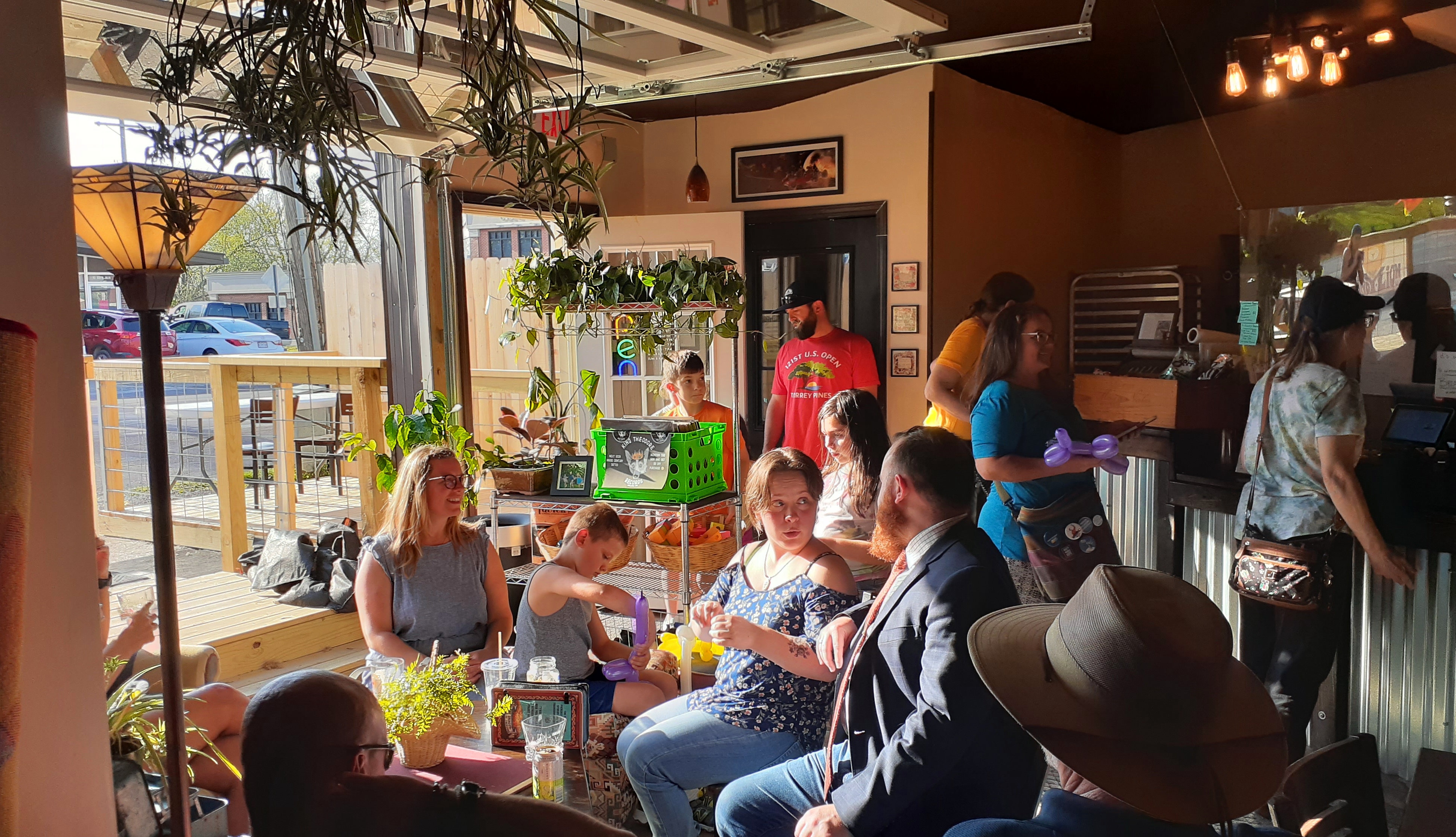
Also known as The Dandy Lion on Main, this is the new cafe in Ashland, Missouri. They just had their ribbon-cutting ceremony with the Southern Boone County Chamber of Commerce on Friday, April 22, with a packed house enjoying the wide-open doors, blue sky, and sunshine, which seemed very, well, Dandy-Liony. I’ve been there a few times, now, starting with the ribbon-cutting day. (My pictures are from that day.)

So what is this place, you ask? Well, it’s a new cafe on the southeast corner of Ashland’s Broadway and Main, nestled between Century Tattoo and a carwash in what clearly used to be a garage attached to the back of the tattoo parlor. To spiff up such a hole-in-the-wall place—to add a picnic patio, to replace the routine garage door with a glass one that admits sunshine, to decorate the space with living plants and colorful, boopfy furniture, to decorate the walls with fanciful art, to fill the air with the sound of laughter and the scents of coffee and freshly baked, legendary cinnamon rolls, to have the gall to fly rainbow, transgender, and BLM flags outside for all to see—well, that’s very much like the stubborn glory of a dandelion.

Indeed, Dandy Lionness is very much like Opulent Opossumness, and they have my high approbation.

(By golly, we both even seem to have a "Jar of Goodness"/gratitude thing going on!)

Here’s their official description: “Serving: specialty espresso drinks and cocktails; local beers and coffees; delicious sandwiches and soup; legendary cinnamon rolls; good vibes.” Here’s another statement from them: “A space for creation, connection, and caffienation in Ashland, MO.” And their hours? “Dandy Hours: W–F: 7 to 7; S/S: 8 to 3.” I suggest checking their Facebook or Instagram pages, or calling or texting ahead, if the weather’s dicey or if you want to make sure their hours haven’t changed. (I suspect they may be adjusting for a while.)

A core mission of Dandy Lion is to create a welcoming space open to everyone (hence the flags that fly outside their doors), and they’ve had at least one drag queen story hour (yes, a kid-friendly event), right there in downtown Ashland. (If you’re not from Missouri, you might not know what this means, but trust me, this is big, almost as big as the fact that Ashland how has a few traffic roundabouts, which in some circles is practically countercultural in itself.) They also had a drag Bingo & Brunch, with performances and bingo for adults and kids hosted by queens Amanda Lay, Karma Cassidy, and Faye King.

Another focus is on sustainability, by sourcing foods from local farmers, and on sheer deliciousness. The sandwiches are grilled in a panini press, making them hot and simultaneously gooey and crispy. Examples include the Fluffer Nutter (which is just fun to say, already), with peanut butter, marshmallow fluff, banana, and honey; the Classic Grilled Cheese (with your choice of two cheeses, plus hot pepper jelly); the Caprese Grilled Cheese (with pesto, sun-dried tomato mayo, mozzarella, and balsamic vinegar); and the Chicken Bacon Pesto (with the obvious ingredients plus the sun-dried tomato mayo, cream cheese spread, and greens). There are soups, the afore-mentioned legendary cinnamon rolls (“we were told they should come with a warning and a cigarette for afterwards”), yogurt parfaits (also highly lauded), and various brunch/breakfast dishes (such as egg, bacon, sausage, cheese combo sandwiches).

The beverages are just as much of a feature as the food, and someone there is very serious about making sure you have plenty of delicious beverage choices while you sit and talk. The coffee is from Columbia’s Fretboard Coffee and Z Best Coffee in Rocheport, and they offer a variety of lattes, espressos, and teas, plus lemonade and orange juice and a variety of milks and milk alternatives. We’ve also spied local favorite Central Dairy ice cream. And then there’s the adult beverages.

On the current menu, the alcoholic beverages are summed up with “Full Bar Available! (Let us impress you with our limited experience.)” Which I think means that, in addition to beer (Logboat and 4 Hands cans) and a basic decent selection of wines, “we’ll mix drinks for you to the best of our ability and with whatever liquors we have on hand.” Since they’re open for breakfast and brunch, they offer mimosas and bloody Marys, for sure.

There’s such an eagerness to be a part of the community. This would be a great place for your reading group, or your deconstruct-after-the-workday coven. Stop by on your commute between Jeffy C and Como. Get a bunch of cinnamon rolls, bring ’em to work, and be a hero. You get the idea. If you're not sure you agree with all the politics of this place, I hope you'll give it a try. One of the BEST things about small towns is that we're small enough to know you and know that you're a good-hearted, decent person, even if we might disagree about some things.

I think Dandy Lion on Main is very much a work in progress, but I find it infinitely more fun and interesting than a corporate behemoth with an astronomical budget, billboards on the interstate, a sleepwalking marketing department, a zillionaire CEO who only wants your money. You know, those kind of places introduced by the indefinite article (such as an Olive Garden or a McDonald’s).

No, this here is THE Dandy Lion Cafe. It’s the only one . . . and Missouri’s lucky to have it.

Sunday, April 24, 2022

Jar of Goodness 4.24.22: Natural Foods Stores

. . . The weekly virtual “gratitude jar.”

This week, I’m expressing thanks for the natural foods movement in America, and the organic, health-food stores and restaurants that helped us all to eat better (better for us, and better for the Earth).

I’ve timed this post for Earth Day, because our food and the environment are so closely intertwined. How we treat the earth, how we till it, what we plant on it, which and whether we are applying chemicals, affects the soil and its natural communities, including all the organisms, from native plants, pollinators, birds, and yeah, us.

The natural foods movement has been pointing this out for more a century, a century that corresponds with our civilization’s increasing capacity for industrialized agriculture.

It goes back to religious groups in the late 1800s who practiced vegetarianism and temperance for physical and mental health. It goes back to Rudolf Steiner in the 1920s, with his spiritualized view of agriculture called anthroposophy. It goes back to J. I. Rodale’s emphasis on organics, starting in the 1950s and continuing into day with its institute. (Alas, the publishing branch of the company went the way of lots of other natural foods companies, being bought up and sold and merged into oblivion.)

Southern California and the Hollywood set made their contributions to health foods, too, undoubtedly spurred by their desire to remain youthful and desirable. Their fad diets included juices, sprouts, avocados, lots of dietary supplements, and so on.

In the 1960s, macrobiotics came on the scene, founded by George Ohsawa and promoted by Michio and Aveline Kushi. It was basically Japanese peasant food: brown rice and beans (adzuki and soy were big favorites), miso soup, seaweed, some fish. It was bland, because when you balance yin and yang in your food, you avoid anything strongly sweet and light or strongly savory and meaty. So, a flame-broiled cheeseburger followed by a milkshake are no-nos. Turns out the brown rice, which peasants ate because they couldn’t afford white (processed) rice, is healthier for its fiber and whole-grain nutrients. Macrobiotics was still going strong when I started paying attention in the 1980s.

And hooray for the hippies! All those ideals! We are indebted to them. They’d read about the dangers of America’s increasingly synthetic agricultural practices. They’d read Rachel Carson and knew that we have to be vigilant about pesticides and herbicides. Many of them remembered growing up on family farms and were concerned about what they were seeing, and reading about. (It was just the tip of the iceberg compared to how it is today. Geez, there are no fencerows and thickets anymore! They even mow the field edges like grass lawns. Farm fields used to be so much smaller. Weeds and wildflowers, birds and butterflies, used to abound in those thickets and other scruffy places. Now, huge farms have Roundup-Ready crops which they blast with herbicides, removing all non-crop plants from acres and acres and acres . . .)

But I digress. The hippies! Their communes, their experiments. I’ve read that their first experiments in organic and whole foods cooking were pretty awful. I’ve experienced some of it. I’ve actually had dishes like “tofu and Spike” and “tofu and sprouts” at potlucks (back in the day). Notoriously tasteless. And we were all catechized: Vegetarianism is moral. What kind of vegetarian are you? There were three kinds (at that point): ovo-lacto, lacto, and what we’d call today “vegan.” Was it okay to have honey? Were beekeepers enslaving bees and stealing their honey, so is that wrong? Brown rice syrup, or natural sorghum, seemed like a better choice.

Sometime in the 1970s there was a turning point. The cream was rising to the top. Each commune was finding individuals who excelled at making the food taste delicious. Think of Edward Espe Brown, cheffing at Tassajara Zen Center and writing his groundbreaking Tassajara Cooking . . . or Ruth Reichl, who started out working at the collectively owned Swallow Restaurant in Berkeley and rose to become the restaurant critic for the Los Angeles Times and then for the New York Times, then editor in chief of Gourmet Magazine. Influencing people’s thinking about food and sustainability the whole time. Think of Mollie Katzen and her Moosewood Cookbook and Enchanted Broccoli Forest; everybody had at least one of her books. And who else remembers The Vegetarian Epicure, with its whimsical line drawing on the cover, which promised to “bring vegetarian cooking to new gastronomic heights”? All that hand-lettering. These books were true labors of love.

These promised much, much tastier foods. The whole-grain bakery coops and health-food restaurants were turning out delicious foods, genuine treats. In addition to the brown rice and other whole grains, the soy products and other beans, the steamed vegetables, the overreliance on onion and garlic, they were looking around the world for spices, sauces, and recipes.

This is about when I got on board, when I was in late high school and college. Columbia had a cooperative health food store on the southeast corner of Hitt and Locust. Next to it was the Catalpa Tree Cafe, a vegetarian restaurant. On Business Loop 70, in that little business strip squeezed between the Loop and little North Blvd., east of Coats Street, there was Columbia Specialty Foods, which in the 1990s became Clover's, which is still going strong. By the mid-1980s, too, grocery stores were starting to pay attention. The Gerbes on Broadway had a large natural foods section.

At all these groceries, there were bulk foods in bins, which you scooped out for yourself. Carob, rice, beans, spices, brewer’s yeast, teas, and so on. (Gosh, remember kukicha twig tea?) There were also increasing amounts of prepared or packaged organic foods from national companies. Many of them still exist today (though now, after corporate acquisitions and mergers, often in much different forms). Santa Cruz Organics, Blue Sky and Hansen’s sodas, Arrowhead Mills, Eden Organics, Food for Life (Ezekial 4.9 bread is still available, though the flour is not, and I miss it); Yogi Tea (their line of products is quite changed these days, and I miss their carob-flavored tea); Celestial Seasonings (which you can buy nearly everywhere, though I’ve found their good ol’ flavors, such as Red Zinger and Morning Thunder, are hard to find in big mainstream groceries).

By the late 1980s, the corporate acquisitions and mergers had begun. There was money to be made! And in the 1990s, many of the idealistic cooperatives (community-owned food coops) were starting to fold. They couldn’t compete with places like Trader Joe’s, which sold what were apparently a full line of healthy or organic foods, but also gourmet treats made with white flower and white sugar, plus meat (sustainably produced), and alcohol.

My beloved Gentle Strength Cooperative in Tempe, Arizona, folded, thanks in large part to competition from the for-profit Trader Joe’s. The Gentle Strength board of directors was conflicted about the choice between sticking to the core mission of healthy, whole foods, versus moving forward with a business-minded savvy, selling the items, such as meat alcohol, that people wanted. By the time they went through their lengthy, contentious, consensus-building process and decided to move forward and be competitive, they had already lost. (There’s an enormous apartment building now, where Gentle Strength once stood; nearby is a slick, new, for-profit, Amazon-owned Whole Foods Market.)

Somewhere along the way, now, the natural foods movement has been watered down, appropriated, lost sight of its core mission. In addition to the white sugar, refined flour, meat, and alcohol, even the juices and other canned products have departed from the high road, using evaporated cane juice, or concentrated apple or grape juices as sweeteners, which are not much different from white sugar . . . they just sound better. A far cry from the natural brown rice syrup.

And the corporate buyouts are regrettable, too. Whole Foods is owned by one of our biggest twenty-first-century lords and masters, corporate behemoth Amazon; it went and tried to engulf-and-devour Wild Oats (which had itself engulfed-and-devoured Alfala’s Markets), but the FTC got after them, and someone else bought Wild Oats, and now Wild Oats is partnered with—brace yourself—Walmart.

As the acquisitions and mergers proceeded in the 1990s and early 2000s, the federal government decided it should create national standards for claims like “organic.” Naturally (no pun intended), big agriculture and food processing companies got involved and watered down the official definitions, so now we have to have a variety of confusing labels on our foods.

I saw an article awhile back in which a nutrition scientist at a large, public midwestern university did research into the nutritive quality and healthfulness of “processed foods.” She started by defining “processing” as anything that happens to a food item before it reaches the supermarket, such as picking an apple off a tree and rinsing it, or trimming bunches of grapes and portioning them into bags; or it could mean heating, cooling, or fermentation; or it could be mixing two or more kinds of foods together. With that definition of processing, her study inevitably ended up with “processed foods aren’t necessarily bad; many of them are quite healthy! My research shows that processed foods are not necessarily bad!” Her study, of course, can be pointed to by any number of corporate factory foodmakers, ultra-processors, food technologists, who will cite her out of context and proclaim that the businesses, providing cheap chips and cheese-doodles to the masses, are healthful.

And the health-food crowd seems to have decided that GMOs are the new devil, when in actuality, big corporations, their ownership of nearly all broad-casting media, their enormous advertising budgets, and their grip on government regulations, are much bigger threats to environmental health and human well-being.

So . . . with all this history, I have to proclaim that the locally owned, idealistic, crunch-granola, vegetarian places are complete treasures, so you should patronize them. Savor the fact that they exist. The vegetarian cafes, the cooperative food buying clubs, the health-food stores.

You’ll know you’ve arrived when you step in the door and inhale. I guess it’s the combined scents of the bulk foods and teas and spices, the carob powder, the fresh, organic roasted coffee, the nontoxic, lavender-scented bulk cleaning supplies, the essential oils (including the patchouli that cute babe of a shelf-stocker is wearing), the olive-oil bath soaps and candles, the hand-built wooden shelving units . . . and the produce section, with all its colorful fruits and veggies. If you’re in an especially older health-food store, you might also pick up a clean, musky scent of sweat, from the generations of hippies who donated their labor to the cause.

Tuesday, February 20, 2018

Sunshine Inn Menu

Greetings, friends! It’s so dreary today, I decided to share a little “sunshine” with you—in this case, an old to-go menu from the Sunshine Inn, a wonderful vegetarian (well, mostly vegetarian) restaurant that used to be one of the best reasons in the world to visit St. Louis’s Central West End. It opened in 1972 and quickly became a landmark. Plants in the windows. And rather plain, but somehow quite elegant decor. Cloth napkins.

Ahhhh . . . the Garden of Eden Salad; the house Creamy Sesame dressing. The quiches. The Great Harvest dinner rolls. Cream Cheese on Date Nut Bread. I used to like their egg salad sandwich, served open-faced, with cheese. Let’s not forget “RZOJ,” iced Red Zinger (Celestial Seasonings’ hibiscus blend tea) with orange juice, and the Viennese coffee (they were serving that waaaay before there was a Starbuck’s on every corner). And, joy of joys, the Golden Lion—the Sunshine Inn’s signature vegetarian burger.

It closed in 1998, and ever since then, the earth has always been a little off-kilter. Losing restaurants like this are a prime reason I needed to learn how to cook.

This to-go menu was printed on both sides of a single sheet of paper, and I’m pretty sure it dates to the late 1990s—I wish I had one from the late eighties, which was when I went there the most. (Alas.)

I’m posting this because I know there are other people out there who pine for the Sunshine Inn perhaps more than I do. Of course, I mean no copyright infringement. I’m keeping the files kind of big so you can hopefully read the type better. (Remember: you can click on the images to see them larger.)

I see value in old menus like this—what were the main ingredients of a dish you liked so much. What things went well with other things. Ideas for reconstruction and inspiration for new construction. I’ll bet there are restaurants you miss like crazy, too.

If you’re someone who misses the Sunshine Inn, I hope you’ll leave a comment and tell me which menu items you loved the most.

Enjoy.


Tuesday, May 19, 2015

I Make Brown Bread

I suppose to many people this post will be completely boring, but it’s about something I found incredibly interesting: I made brown bread for the first time, as in “Steamed Boston Brown Bread.”

I think it fascinated me because it seems no one makes it anymore. No one eats it, no one serves it. (At least not around here. I’ll bet it’s still proudly served in households throughout New England.) Yet I’m pretty sure it used to be fairly common throughout America. And that would make it a “retro recipe,” or a “mom” or “grandma recipe.” And that means: Let’s not forget it. Let’s check it out. Let’s have it sometimes, because it inspires nostalgia and reverence.


When I was a kid, we used to have brown bread pretty often. I think Mom used to buy it at the grocery store, canned. She’s told me that her mom used to make it. And like a lot of moms and grandmas, grandma used to make it in a largish tin can.

It would seem to be very healthy and full of nutrients: My recipe calls for equal parts of whole wheat flour, rye flour, and corn meal—plus molasses (I used Brer Rabbit full flavor). The leavening is buttermilk (or sour milk, but you can’t really buy that) plus baking soda and salt. Pretty simple, actually.

Raisins are commonly added—I intended to put them in, but forgot at the last moment. Yes, I really was that excited!

For those of you who don’t know anything about brown bread, here’s its most remarkable trait: It is not baked; it is steamed.

In my brain, that seems silly: Wouldn’t steaming make bread soggy? Well, not if you wrap up the batter/dough so that no extra moisture can get in.

And so, if you want to make brown bread, you need some kind of steamer. I used a big enamel-ware canning pot that Sue’s mom gave us. The recipe I used said to use a 2-quart pudding mold (filled 2/3’s full), and I didn’t have one of those. Well, I do, but I wanted something fairly loaf-shaped. (All our tin cans had gone out in the recycling, so I didn’t have any around!)

Digging around in our bakeware cupboard under the counter, I found some disposable aluminum-foil-type loaf tins that each hold 1 quart, and I found they would fit in the pot nicely side-by-side. I wrapped each tightly with heavy-duty aluminum foil, so no steam would get into the bread.

The instructions said to steam it for 3 1/2 hours, but they didn’t need to go that long (two 1-quart loaf tins would cook faster than one big mass in a single 2-quart mold). Even at 3 hours, it still seemed like a hell of a long time to cook anything on the stovetop (not counting the braising of sauerbraten, which is always worth doing). But at least it didn’t need much watching. The canning pot didn’t let out much water vapor at all, so the water never got close to needing replenishing.

The recipe is from my beloved copy of The Good Housekeeping Cook Book, ed. Dorothy B. Marsh (New York: Rinehart, 1949), pp. 446-47.


There was something magical about fishing those foil-wrapped tins out of the steamer, opening them, and finding nice little loaves of moist, spongy bread where before there had been a blob of quick-bread batter glop.


To celebrate, we followed the rest of the instructions in my 1940s cookbook, which suggested to serve the brown bread hot “with baked beans, codfish cakes, frankfurters, etc.” I didn’t have any codfish cakes lying about, but I did go to the store and found some actual frankfurters (as opposed to hot dogs)—plump, pudgy, flavorful franks with skins that kind of “snapped” when we bit into them. And yes, baked beans, too.

The next day, we made little sandwiches with the bread, now chilled, filled with cream cheese, and had them with red-grape-laced chicken salad (a delicious combo that my Aunt Ann served us for lunch a few years ago; she’d spiked the chicken salad with a hint of microplane-grated orange peel, too, and that was especially good).

My apologies: There are no pictures of our plates, because we consumed these meals before I even thought of taking any photos for the blog. (I do wonder about bloggers who seem to take pictures of every morsel they put into their mouths . . . !)

So although this wasn’t the most “colorful” of posts, I hope you’ll appreciate this humble culinary exploration of mine. Maybe it will inspire you to try making brown bread, too!

Friday, January 16, 2015

Watch This Blog: “The Five Pillars of Health”

It’s a new year, and naturally most everyone is thinking (after the holidays): “I need to focus on my health again.”

Well, here’s some good mind-chow to help you with your goals: Doc Bea’s The Five Pillars of Health. What are these five pillars? Love, Sleep, Water, Play, and Eat.


Notice that “diet and exercise” are not named (per se) in that list. And there’s a reason for it, which you’ll learn about in Doc Bea’s January 14 post, “Secrets of Good Health from DOT Drivers.” (I know, you’re thinking, “What-what-what?? Is she talking about truckers?!”)

Well, yes, as a matter of fact, she is.

My disclaimer, here, is also a big part of my endorsement for this young blog (which started in December): Doc Bea is a personal friend of mine. I went to high school with her, and for this reason I’m biased. But it’s also the reason I know this is a blog to watch. Bea (Beatrice) has led an interesting life. She comes from an interesting “place,” with her strong Greek heritage which in several ways set her apart (above, actually) from the rest of us silly, more Americanized high schoolers.

Bea was writing (very good) poetry, excelling in all her classes (even math!), and debating politics and philosophy while the rest of us were obsessing over our silly boyfriends and girlfriends, worrying about who was sitting next to whom during the football games, and hyperventilating over the new Star Wars movie.

While the rest of us were contracting our tight little circles of friends, Bea was expanding hers. She befriended all the kids—including the immigrants, the nerds, the holy kids, the atheists, the shy kids, and the loudmouths. Bea has an insatiable curiosity; she listens carefully, and cares deeply.

Doc Bea is getting close to age 50, yet she’s only recently gone to med school and earned her medical degree. She had already pretty much raised her children. She was a caregiver for her grandmother who had Alzheimer’s, and her father, who died of colon cancer. She has struggled with her own health problems, surgeries, weight issues, and she understands the difficulties of common people leading busy lives, who are trying to find some way to stay healthy.

As she says, “I have lived medicine long before I even considered going to medical school, . . . and I chose to take this journey because I made my dying father a promise to do so, and he made me promise, because he was comforted by my care and advocacy and wanted this for others. I was a non-traditional (aka OLD) medical student in my 40’s. I had a 14-year previous career in Information Systems as a Help Desk Analyst. I helped people to fix their computer issues. Now I have graduated to life issues.”

Actually, Doc Bea has always been involved with life issues, and that’s why I’m watching her blog. Don’t expect the status quo from her. She has strong feelings about the medical and insurance industries, and she has even stronger feelings about the dignity and rights of patients.

So check out her blog. Bookmark it, add it to your blog feed, friend it on Facebook. Because this is one to watch!


Thursday, July 11, 2013

Leftover Veggies: From Crudités to Veggie Sandwich

Here’s a clever and delicious way to use up leftover veggies from your raw veggie tray. And it’s healthy, too! A bit of jack cheese and walnuts add deliciousness, and soy sauce and Spike seasoning mix add the je ne sais quoi.

I made some recently, when Sue’s sister sent leftover veggies home with us after we’d been on a visit to Ohio. We were supposed to eat it in the car, but there was so much we still ended up with a bag of mixed-up miscellaneous crudités.

A variety of vegetables will do here, but the standard veggie-tray types work well: carrots, broccoli, cauliflower, celery. For their texture and flavor, I’d be sure to include plenty of cauliflower, broccoli, or both.

Because this isn’t rocket science, I won’t give you rigid quantities. Just a list of ingredients with notes.


Veggie Salad Sandwich with Walnuts and Jack Cheese

First, schnittle up your veggies:

Broccoli and/or cauliflower, chopped into quarter- to half-inch pieces
Carrots, in large shreds or thin matchsticks
Celery, if you want, sliced thinly to reduce the effect of the strings

Do you want to use a food processor on the veggies? I’d use it with care—you won’t want it to become confetti, or mush. A sharp knife and a grater is what I use.

Then add the next three:

English walnuts, chopped into chunks in about the same size range as the broccoli
Monterey jack cheese, sliced and cut into little brick-shaped chunks about 1 inch long
Green onions, chopped

Then make a simple dressing from the following:

Mayonnaise (eggless is the vegan preference)
Soy sauce (or tamari), go easy on it; treat it like you would salt, because that’s its purpose here
Spike (ah, yes, our favorite spice blend/low-salt seasoning mix from way back! If yours is stale, time to get a new jar!)

Then mix it up; taste, and adjust however you want it.

This works well in a pita pocket sandwich, or as a filling for a wrap, or on a sandwich with bread stout enough to hold together. Today, I put it on ciabatta bread. You could also just put a mound of it onto a bed of lettuce, and serve with crackers.


I Give Credit for the Idea

Oh, so many years ago, when I was an undergraduate, I went with a friend to the National Women’s Music Festival, when it was held at Indiana University in Bloomington, Indiana. For lunch a few of those days, I ventured to the nearby Bloomingfoods Coop—now it’s Bloomingfoods Market and Deli—at 419 E. Kirkwood. (Those wonderful old vegetarian coops and restaurants always used to be right next to university campuses. Anyone remember Columbia Community Grocery, next to the, Catalpa Tree Café, on Hitt and Locust?)

At Bloomingfoods in 1988, I remember picking through their cold case of premade sandwiches. Most of them, as I recall, were vegetarian pita pocket sandwiches—tofu salad and such-like. One day, I tried a “Samurai sandwich,” which had a chickpea-based, hummus-like filling with a Japanese twist (miso, sautéed onions, bell peppers), and (naturally . . .) alfalfa sprouts. (Maybe I’ll get around to sharing that one with you someday.) [Addendum, July 30, 2016: I did post my version of the samurai sandwich recipe! —You're welcome!]

But on this day—June 4, 1988—I selected something they called a “Bric-a-Broc Sandwich.” It was named for brick cheese and broccoli, two of the primary ingredients. As I sat in the grass eating it under a big old tree on the IU campus, I was a little let down—I thought the various ingredients would have kept their own identities a little better, but they were all chopped up so finely it seemed too homogenous. (Now I understand the logic of that: Crisp veggies like carrots need to be cut finely so they don’t tear through the pita bread, and so you don’t spend the rest of the afternoon chewing!)

But I’m glad I jotted down the ingredients in my journal, as they were printed on the little adhesive label sealing the plastic wrapping: broccoli, carrots, brick cheese, onions, Spike, walnuts, tamari, eggless mayo (and the pita bread—some whole-wheat healthy stuff).

I’ve made this salad mixture occasionally since then, and I’ve always been surprised at how tasty it is, and easy to make. In the Bloomingfoods version, broccoli was abundant, carrots less so (in matchsticks, as I recall—or thick shreds). I think the onions were chopped white or yellow, but I prefer the green onions I suggest above. Tamari, by the way, was a mystery to me at the time. Seriously, you can use soy sauce, which is its close cousin. Spike I did know about, because I had so many friends who were concocting recipes like “Tofu and Spike”! (We can laugh at that today!)

I actually miss the days when sandwiches at the health food store were simpler and cheaper (the health food now seems overstimulating, ostentatious, by comparison), and I’m glad I took notes on some of them (I already told you about the tofu salad sandwich recipe I got from one of Columbia’s venerable health-food stores). Today, I wish I had the recipes for the famous nutburgers of Gentle Strength Cooperative in Tempe, Arizona; though I think I could “wing” the cashew-tuna salad sandwich, which was another favorite from that store.

Friday, March 2, 2012

Sesame Crunch Bars

When I first started getting interested in cooking, I was mostly interested in health foods, not “retro” recipes, and one of my favorite books of that time is called Uprisings: The Whole Grain Bakers’ Book. I’ve got the “revised edition” of 1990, which was published by the Cooperative Whole Grain Educational Association. This fun book features recipes from eighteen cooperative bakeries across the nation—many, alas, which are now closed.


Some apparently are still in operation, such as Blue Heron Bakery in Olympia, Washington, and Open Harvest Bakery in Lincoln, Nebraska. Hooray for them! And one of my favorites, though not represented in the book, is Small Planet Bakery in Tucson, Arizona (their “vegie bread” is the best!) Most of these kinds of bakeries were started in the 1970s.

Although the book is out of print, a former member of the Uprisings collective in Berkeley has been digitizing portions of it and posting them online, at uprisingsbakersbook.org. For more information, click here.


I encourage you to get a print version of the book, because it’s very fun—all the recipes were written out by hand by members of the collectives and cooperatives supplying the recipes, with lots of cute drawings, too. There is also a lot of good introductory stuff about baking in general, and baking with a variety of whole grains, in particular. Plus, there’s a helpful index to recipes by major ingredients, and recipes separated by dietary characteristics (such as “no eggs or dairy,” “no wheat,” and “low- or no-fat”). This book is a treasure.

The recipes make delicious food you can feel good about eating, and if you have warm memories of eating or working at health food coops, you’ll particularly adore recipes such as Carob Chip Cookies (with tahini and tamari, yes, tamari); Carrot Celery Bread, “Peanut Minus” cookies (“eggless, dairyless, wheatless, but NOT peanut-less!”), 7-Grain Currant Muffins, Ozark Barley Bread, Banana Rice Cupcakes (wheat-free), and the best damn whole-wheat pizza crust you ever had (it’s spiffed up with oregano, cayenne, and basil—yum, yum!).

The recipe I’m sharing with you today is from the section contributed by Uprisings Baking Collective, formerly in Berkeley, California. You can read about that collective online here.

These sesame crunch bars are sweet, but not overly so. They keep well. They’re a terrific snack or light breakfast. They’re a perfect hiking snack! You can alter the flavorings a bit with other nuts, dried fruit, and so on.

Note that in the recipe below, transcribed from the book (page 224), I’m offering some comments and ideas for substitutions (which are in brackets).


Sesame Crunch Bars

Makes about 30 2-inch squares. Use an 8 x 14 inch pan, or similar.
[I use two 9 x 13 inch pans and spread dough to about 1/2 inch high, which yields 48 bars, each about 2 1/2 x 2 inches.]

  • 5/8 cup peanut butter
  • 1 1/4 cups honey
  • 2 tsp. vanilla
  • 1 1/4 cups oats [rolled is what I use, as in Quaker]
  • 1 1/4 cups cashews [I don’t care much for cashews, so I use raisins or chopped dried apricots]
  • 1 cup wheat germ [I was getting low, so I substituted some crushed breakfast cereal flakes]
  • 6 1/4 cups sesame seeds [rather hard to find; I finally scored these at an international/ethnic grocery; by the way, sesames can get rancid quickly, so when buying, check for freshness, and refrigerate or freeze them when you get home]
  • 5/8 cup sunflower seeds [raw]

Cream together peanut butter, honey, and vanilla [it helps if you heat the honey and peanut butter; heating softens it up and makes it easier to stir]. Add the rest of the ingredients [in a big bowl!] and mix well with your hands—it works best and saves on dishes [if you heated the goo part, you can stir it with a spoon]. With wet hands or rolling pin, flatten mixture to uniform thickness on oiled pan. Dough will be stiff—be patient. Bake at 350 degrees for about 25 minutes [my oven runs hot and my bars are thinner, so I go for about half this time; watch it; if it gets too toasty and tan, it will be hard; and if you use raisins, don’t let them scorch]. Let cool [then cut into bars and store in a closed container, separated with waxed paper].