Showing posts with label vegetables. Show all posts

Monday, February 17, 2025

Aloo Palak Tacos

Rejoice! Today, I present to you: the Aloo Palak Taco!

It’s a tasty, hearty, Indian-inspired vegetarian sandwich.

In the process, I’m also giving you a straight-up recipe for making aloo palak, a north Indian/Punjabi “dry curry” vegetable dish (sabji) of potatoes and spinach, which you can have on its own as part of an Indian-inspired meal, with, say, rice (chawal) plus a sauced/wet curry dish (ones with a lot of sauce or gravy, such as butter chicken or anything-korma), or with a dal (bean/legume dish).

(Here, I serve my aloo palak taco along with a basic masoor dal and white rice. Delicious!)

Not counting the sections for appetizers, salads, and breads/rice, my recipe file of Indian dishes has separate sections for dals (the bean dishes, which are typically a little soupy); “wet curries” (whether with meat or vegetables, these have a kind of “gravy”); and “dry curries” (sabji/sabzi, “dry vegetables”).

Dry curries, or sabji, are vegetable dishes lacking a gravy, though they are usually spiced up really thoroughly. You typically make a masala (say, with oil, onions, ginger, garlic, plus your spices), then add your main ingredient, and cook (carefully, usually at a relatively lower temperature), sprinkling water in the pan only to keep the ingredients from sticking, but not so much as to make the dish “wet.” The masala flavors permeate the main ingredient. You might be familiar with aloo jeera (cumin-flavored potatoes), bhindi masala (okra fried with onions and spices), aloo gobi (potatoes and cauliflower), or bund gobi and mater (cabbage with peas).

If you are not interested in learning how to make your own Indian food, you can simply order a dry curry/sabji from your local Indian restaurant, and use the leftovers from that.

Well, I like to play around with these vegetable dishes, since recipes usually make plenty for leftovers, and they’re already nicely flavored. They make delicious vegetarian sandwiches, burritos, and tacos. They’re good in omelets, too. For big burritos, you can add some leftover rice. For burritos and tacos, I usually add some neutral-flavored cheese, such as mozzarella, Monterey jack, or provolone (sliced or shredded). Having a layer of melty cheese against the burrito or taco tortilla helps give it some structural integrity. Which is so important for hand-held foods.

Which brings us to aloo palak tacos.

Making the tacos is straightforward, if you know how to treat flour tortillas nicely. Whether for burritos or tacos, you need to heat your flour tortillas so they will bend and not break. I use a big, heavy skillet. You might have a griddle or tava. You might need to very lightly oil the surface to make sure the tortilla doesn’t stick. Heat on one side, turn it over, add a layer of cheese, let it get warmed up. Don’t heat the tortilla until crispy, only until pliable. Then add your filling—in this case, a few spoonfuls of reheated leftover aloo palak. Bonus points for garnishing with some chopped fresh tomatoes. Ta-da!

And now, here’s my recipe for aloo palak (potatoes and spinach). It’s based on a recipe I received from Aman and Gurcharan Aulakh, a mother-daughter duo who, in March 2009, taught a series of “Punjabi Home Cooking” classes at the Missouri Botanical Garden. The ingredients are the same, but I’ve tweaked the method a bit from what they told us. (The biggest difference is that they precook the potatoes in a casserole dish in the oven, covered with sliced lemons to prevent browning, while I simply steam the potatoes.)

Aloo Palak

Prepare the two main ingredients:

  • 4 c. peeled and diced potatoes (approx. 1-inch-long rectangles): steam until just done, not mushy, but completely done, and set aside
  • 2 c. frozen chopped spinach: thaw and squeeze out moisture (I thaw in water, then squeeze out in a wire sieve); set aside

Make the masala; note that at any time the ingredients start to stick, sprinkle some water, but not so much water that you make a sauce:

  • 3 T. vegetable oil
  • 1 medium onion, chopped
  • 2 t. minced garlic
  • 1 T. minced ginger

In a wide, heavy-bottom skillet, cook the above until the onions are translucent. Then add the masala spices all at once; lower the heat to prevent burning; sprinkle water as necessary:

  • 1 t. turmeric
  • 1 t. cumin seeds
  • 1 t. black pepper
  • ½ to 1 t. red chili powder (ground) (I use Kashmiri red chili powder, but use whatever ground red chilis you want, or none at all; it’s to your taste)
  • 1⅓ T. ground coriander seed (yes, it’s a lot, but you’ll be glad because this is really good)
  • 1½ t. salt (or to taste; I usually use 1 t., then taste at the end)

After the masala has cooked enough (about five minutes) (you’ll know when, because the oil kind of starts separating out, and it looks and smells like the spices, oils, and onion are all melded), stir in the spinach. Again, you’ll need to sprinkle water to keep it moist. Then add the potatoes and stir gently. Again, sprinkle water if necessary. The potatoes should absorb the flavors of the masala.

Finally, add:

  • 1 T. kasoori methi (dried fenugreek leaves, which you can buy at an international store) (I rub the dried leaves in my hands to break them up a little)

Stir and heat through. Taste for salt.

Thursday, November 24, 2022

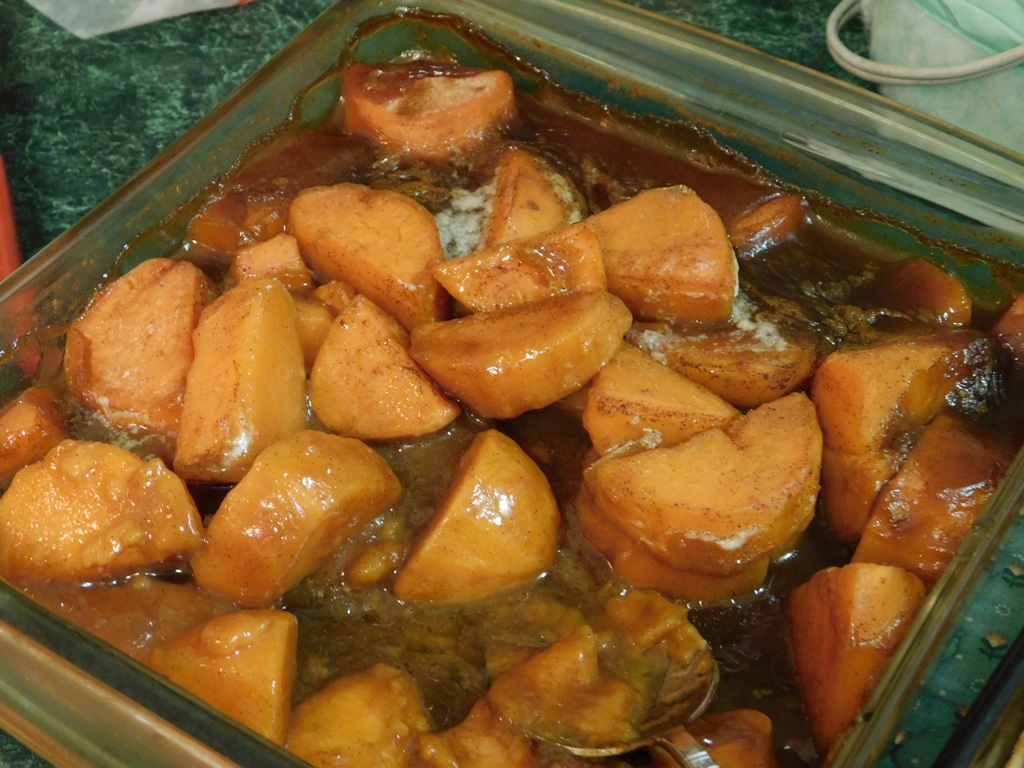
Florence Biffle’s Sweet Potato Bake

Happy Thanksgiving!

This fantastic yet simple recipe, titled “Sweet Potato Bake,” is from Mrs. Florence M. Biffle (1914–2006), who was a member of Faith Lutheran Church in Jefferson City. I recently found her obituary online. I’ll bet my Great Aunt Lydia Meyer knew her well, since she was a longtime member of the same church and was also a quilter. Also, I’ll bet my Grandma Schroeder and Great Aunt Minnie Bartlett new Mrs. Biffle, too, since they were all longtime members of Jefferson City’s Hawthorn Garden Club.

I never knew Mrs. Biffle, but I feel I could easily have known her. There’s a good chance I was in the same room with her at some point, and just never knew it. Anyway, I’m grateful to her for this recipe, and for these small connections between our worlds.

I noticed she was buried out at Hawthorn Memorial Gardens cemetery, so in a few weeks when I'm out decorating Grandma and Grandpa Renner's grave, I'll see if I can find Mr. and Mrs. Biffle.

This recipe was on p. 49 of Cooking with Faith: Favorite Recipes of Faith Lutheran Church Women, Jefferson City, Missouri, by the Faith Lutheran Ladies Guild, Jefferson City, Missouri [ca. 1975].

This is an interesting, fruity-glazed alternative to the standard (and I think tiresome) sweet potato casseroles made with brown sugar, pecans, and marshmallows, so common at the Thanksgiving table. I think you’ll really like this for a change of pace.

I’ll offer my tips and suggestions after the recipe.

Sweet Potato Bake

Cook 4 to 6 sweet potatoes until almost tender. Skin and cut to desired size (chunks). Place in a casserole dish.

Combine and bring to a boil:

1 c. apricot nectar
2 T. orange juice concentrate (not diluted)
½ c. brown sugar
1½ T. cornstarch
1 t. salt
½ t. cinnamon
2 T. butter
½ c. water

Pour over the potatoes and bake 30 to 40 minutes at 350°F.

Julie’s notes:

You can peel the sweet potatoes and cut them into chunks, then cook them in gently boiling water if you don’t want to bake them. I have also steamed them, and that works, too. But don’t overcook the potatoes; remember they will be cooking for another half hour in the oven.

I use a 9 x 9 Pyrex baking dish. You will cook it uncovered, so what begins as a liquid dressing reduces to a gooey glaze over the potatoes. Pull them out of the oven when the sauce is gooey enough for your taste.

The dressing mixes up most easily if you first combine all the dry ingredients together before adding them to the liquid.

Kern’s Apricot Nectar, which is no doubt what Mrs. Biffle had in mind, used to be available at all the grocery stores around here, but I haven’t seen it in years. I think the company’s out of business. There’s another brand called Jumex, but I’ve never seen it except online. I’ll bet it’s something to look for at an international store. Both seem to contain high fructose corn syrup and other less-than-desirable ingredients. But it’s no problem if you can’t find apricot nectar. Just take some canned apricots and some of their juice and puree it in a food processor or bullet blender, so it gets to the consistency of a thick “nectar” type juice. You only need a cup. A bonus of doing it this way is that you can decide how much corn syrup to include (since you are selecting your can of apricots—in heavy syrup, light syrup, or whatever). You can even puree the apricot pieces with just water, if you want.

There's no reason you couldn't use dried apricots, simmered in water until they're perfectly soft, then process those in a bullet blender or run them through a food mill, to make them into a liquid puree. I suppose that would be healthier. But I think using canned apricots with their corn syrup is more authentic to the midcentury church ladies cooking style.

Do-ahead tip: You can put the peeled, precooked potato chunks and the uncooked sauce into the casserole dish, dotting the butter on top, covered with plastic wrap, and refrigerate overnight. Or out on your unheated sunporch, if it’s cool enough. Finish it in the oven the next day.

Tuesday, June 14, 2022

Alfalfa Sprouts in 2022

We used to eat alfalfa sprouts all the time back in the day. We used to be able to buy them at the store, at regular grocery stores. Back in the 1980s, all the salad bars had sprouts. (Remember Roseanne Barr’s Pizza Hut commercial where she talked about “grazing on a delightful array of sprouts and garbayennnzo beans”?) (Well, hey, remember salad bars?)

And all the health food groceries had deli cases with freshly made sandwiches full of alfalfa sprouts. And on the other end of the spectrum, until quite recently (at least) the sandwich chain Jimmy John’s had a sandwich or two that featured alfalfa sprouts . . . though it seems they’ve dropped the sprouts entirely, though.

You used to be able to buy a variety of sprouts, even: onion sprouts, broccoli sprouts, "spicy" sprouts (a blend with radish sprouts, which taste peppery), and clover sprouts. What happened?

Now it seems that sprouts are impossible to get, unless you grow your own. Jimmy John’s had a problem with its sprouts by the name of E. coli; maybe that made people scared of sprouts. (Though that’s silly, because there’ve been plenty of E.coli incidents with pre-packaged lettuce, and people keep buying that. . . . And the problem has more to do with worker hygiene and proper rinsing of the produce than it does with the produce itself.)

Or maybe people decided that sprouts symbolized something that’s uncool today: All that not-indulgent, low-fat food from previous decades’ health food movements. And honestly, I’m guilty of referring to that era’s health foods as “tofu-and-sprouts” cuisine. But it’s one thing to laugh at them as a symbol, but another to actually dislike them.

Or maybe people today have no concept of how to care for their sprouts, once purchased. Unlike grocery store strawberries, they’re not immortal. And you can’t think of a more tender produce item.

. . . Or maybe grocery stores’ produce suppliers can’t provide the right kind of schedule to keep the stores’ stock fresh. And proper care extends to the stores, too: there are times I’ve seen a produce department’s automatic sprayers dripping water into the sprouts’ plastic containers, flooding them, turning them into a mossy brown little swamp.

And yeah, it does seem like the most recent times I’ve seen alfalfa sprouts at the store, they’re old and brownish and wilty, also known as “no good.” No one wants them when they’re bad, but if no one buys them quickly enough, they go south and you can’t sell ’em. Pretty soon, the store has a reputation as “not a place to buy sprouts.”

But guess what? Alfalfa sprouts are ridiculously easy and cheap to grow on your own. They are tasty and nutty. They are a great way to add crunch and nutrients to your sandwiches. And! They contribute to a sandwich’s or burrito’s structural integrity, because they behave like a sponge with sauces, tomatoes, or other slippery ingredients, holding them in place (lettuce, on the other hand, is incredibly slippery and causes your sandwich ingredients to slide right out of the bread). (I hate that so much, I often chop lettuce before putting it on a sandwich, to make it more like sprouts.)

I love to have alfalfa sprouts on three of my favorite health-food sandwiches: tofu salad, brick-a-broc, and ye olde samurai sandwich. But they’re also great on just about any other kind of sandwich. They’re great on peanut-butter-and-jelly sandwiches, even. Yes!

You can also use sprouts on salads, of course, or use them as a garnish on just about anything, because they’re pretty. The original “microgreens.”

Have you ever grown sprouts before? It’s incredibly easy.

Here’s the deal: Go to your local health food store (or go online) and get what you need. There are alternatives, but I use a simple plastic mesh lid—a sprouting lid—created for growing sprouts. The kind I have fits on a wide-mouth one-quart canning jar.

And yeah, you’ll need the jar. And you’ll need the seeds for the sprouts (again, get it at the health food store, where they might just have them in bulk). (Fresher is better.) (And yeah, they make a lot of sprouting seed mixes—it’s not just alfalfa sprouts; you can have fun trying different sprouts.) Oh, and you’ll need a towel and a dish drainer.

If you follow the directions (see my well-used copy, above), a mere tablespoon and a half of alfalfa seeds will become a quart-jar full of sprouts, in about a week. Yes, you will need to tend to them, three times a day. Don’t worry; you don’t even have to open the jar until they’re all done. Three times a day, run some fresh water in through the mesh lid of the jar, swirl it a little to rinse the seeds/sprouts, then turn the jar on its side, at an angle, and let the water drain out. Keep the jar wrapped with a towel (or some other way in the dark) and tilt it at an angle while they’re growing.

I do all this in the dish drainer of my kitchen sink. Because I visit the kitchen sink many times a day, the thrice-daily tending is no problem. I certainly can’t forget them, because there they are.

They really grow rapidly. It's fun to see.

On the last day, give them some light (not too much; you don’t want to cook them via the greenhouse effect), and their tiny little leaves will turn green.

At the end, you’ll want to remove the the brown seed coats that have separated from the sprouts. I use a stock pot: put the sprouts into the pot and run fresh cool water over them. Swish them around a little. The seed coats will float on top while the sprouts swim around below. You can skim away the seed coats, or just pour or flick them off the top. Then, fish out the sprouts (I use my hand) or use a colander, and set them in the colander or on paper towels for a few minutes. Then, transfer them into a plastic bag, and you’re done. If you have extra cold spots in your refrigerator, make sure the sprouts don’t freeze. And use them while they’re fresh.

You’ll be amazed at how delicious they are, and so fresh.

Tuesday, February 13, 2018

Potato Soup

If ever there was an opulently opossumish dish, this is it: It is humble, it is sublime. I have based my recipe on a few versions of it that Sue’s mom has provided. I feel justified in offering my own rendition because Sue’s mom has tinkered with the recipe plenty herself.

This is a perfect supper for a cold wintry night! So comforting and warm!

I encourage you to improvise your own version, too. After my version of the recipe, I’ll provide two of the potato soup recipes just as I’ve received them from Mrs. Ferber, so you can get ideas for alterations, substitutions, and shortcuts.


Julie’s Potato Soup

2 pieces of bacon
1 onion (white or yellow), chopped
1 carrot, coarsely grated
2 or 3 potatoes, peeled and diced into bite-size pieces (Yukon golds are good)
3/4 tsp. salt (or to taste, remembering that bacon adds saltiness)
1/2 tsp. pepper
water or chicken or vegetable stock
1–2 tbsp. cornstarch, mixed into a pourable slurry with about 1/2 cup water
milk
1–2 tbsp. butter
parsley (or other herbs—summer savory? basil? oregano?) for garnish

In a large, heavy-bottomed saucepan or soup pot, fry the bacon until crisp. Put it on a paper towel to drain and set aside. Pour off the grease into your grease jar. (You do save it, right? I mean, you’ll need it later when you want to cook kale!) Don’t clean the pan; leave the cooked bits of bacon and some grease at the bottom.

Put the onion and carrot into the pot and sauté them in what’s left of the bacon grease. As moisture comes out of the onions, scrape the bottom of the pan to liberate the bacon goodies. You might add a little water to help the process. When that’s accomplished, add the potatoes, salt, and pepper, and cover with water or stock. Cook on medium, covered, until the potatoes are done.

While the potatoes are cooking, crumble up the bacon—it will be a garnish. This is the time to make the cornstarch-and-water slurry if you haven’t already. Also, get out the saltines (or Chicken in a Biskit crackers; both are traditional), pieces of cheese or summer sausage, pickles, and whatever else you’ll be having. Set the table. Get the drinks ready.

Once the potatoes are cooked, stir in the cornstarch slurry and cook to get it really pretty thick; then stir in some butter, and thin it out with milk to get the consistency to your liking. Make sure it’s heated through, stir in any parsley or other herbs you want, and then serve. Garnish with the crumbled bacon.


Betty Ferber’s Potato Soup (Version 1, her preferred way)


2 nice-size Idaho potatoes (or less)
1 onion
coarse-grated carrot
salt, pepper
chicken stock (or water)
cornstarch
milk
margarine (Parkay)
crumbled bacon (optional garnish)

Peel and dice about 2 potatoes. Chop the onion. Add carrot, salt, pepper—cook until done in water or chicken stock. Thicken with cornstarch—get it really thick—then add milk to get consistency right. Add a hunk of margarine. Garnish with crumbled bacon; serve with saltine crackers.

Betty Ferber’s Potato Soup (Version 2, as of Dec. 2006)

1 onion (white)
water
1 tsp. salt
1/2 tsp. pepper
about 5 lbs. (4 large) potatoes (Irish) (or more)
parsley
milk
1 stick butter or equivalent of “I Can’t Believe”
cornstarch (note, as of 2015: Mrs. F says you can use some instant potato flakes instead of cornstarch)
milk
crumbled bacon (optional, for garnish)

Chop onion and add to soup pot. Cover onion with water; add salt and pepper. Peel and dice potatoes, cover with water. Add parsley to make it pretty. Add thickener (cornstarch)—get it pretty thick, then add milk to make it the right consistency, and add the butter/margarine. Garnish with bacon crumbles. (Sue likes to ladle the soup over some crushed saltines in the bowl.)

________________________________


. . . And now, a bonus related recipe from notes I made during an Ohio visit during Christmas 2013: it’s very, very easy to make, though the sodium is probably frightful. Still, when you’re both disabled, can’t drive anymore, it’s cold out, and you’re eating out of the cupboard, this hits the spot! It’s probably from the back of a scalloped potatoes box.

Corn Potato Chowder

3 tsp. margarine
1 small onion, chopped
1 box scalloped potatoes (yes, including the seasoning packet)
2 cups hot water
2 cups milk
1 can of corn (drained)

In a saucepan big enough to hold everything, sauté the onion in the margarine. Then add the rest of the stuff and simmer, covered, for 20–25 minutes.


Thanks Mrs. Ferber, for letting me share your recipes, and thanks much more for sharing them with me! (Susan says thanks, too!)

Tuesday, February 7, 2017

Healthy Tiffin: Frozen Meals Are Finally Delicious

Just a quick note today to tell you about something I really like: Healthy Tiffin frozen meals, made by Deep Foods, an Indian food company in New Jersey.

Unfortunately, you cannot buy these in just any grocery store, but hopefully someday you will. Meanwhile, do like us and stock up on them at an international grocery in the nearest large city. (We've been buying Healthy Tiffins at Global Foods Market in Kirkwood, a suburb of St. Louis.)

Why frozen? Because it's extremely convenient, especially when you're freelancin' and you don't want to take time off to fix anything, and you want something you can eat at your desk while you get back to work! And all the Healthy Tiffins I've had have turned out fine, even in the dreaded microwave.

A tiffin, by the way, is basically "lunch," and a tiffin carrier is the standard lunchbox used in India. You might have seen these nifty stacking metal containers, which many people are using now to avoid plastics.

And why Indian food? Because at least in this case, it's vegetarian and delicious at the same time. Indians have been vegetarian for so long, their vegetarian cuisine is completely satisfying in terms of flavors, textures, and nutrition. My friends who eat meat, try Indian for your "meatless Mondays."

Although you can buy plenty of frozen Indian dishes at the international store, what makes the Healthy Tiffin line so nice is that each one is a complete three-part meal, with rice, a dal (beans), and a vegetable (usually a wet curry, one with lots of tasty "gravy" to have with your rice).

So here's four of 'em, and I think there are more:

  • Paneer makhani + rajma + onion Basmati rice (cubes of homemade cheese in a spicy tomato-based gravy; kidney bean dal; rice flavored with onion and cumin)
  • Kofta curry + chhole + spinach Basmati rice (kofta are vegetarian dumplings; chhole is garbanzo bean dal; the rice is fortified with spinach)
  • Palak paneer + dal makhani + turmeric Basmati rice (cubes of homemade cheese in pureed, nicely spiced spinach; a luxuriously creamy dal; beautifully yellow seasoned rice)
  • Mutter paneer + dal palak + cumin Basmati rice (cubes of homemade cheese in a gravy with green peas; a soft creamy moong dal preparation mixed with spinach; a relatively plain rice seasoned with cumin)

Finally, here's another reason to seek out Healthy Tiffin frozen meals: they really do make an effort to make these meals "healthy." They swap out or reduce the cream and butter for olive oil; they offer lots of fiber and protein; they have reduced the sodium from the "traditional" recipes. (I think they could do further with the last item, as each meal supplies about 25 percent of one's sodium for the day; I would rather they use less sodium in their preparations, so I can enjoy my salty Indian mango pickles without knowing I'm going overboard.)

Here's another thing: one of my friends can't get out much because of a disability, but she loves vegetarian food . . . but she's also missing a lot of teeth. These Healthy Tiffins are just the thing for her! Every time we get them, we buy extra for her!

Keep your eyes out for Healthy Tiffins! I'm sure you'll love them.

Saturday, July 30, 2016

Samurai Sandwich: Retro Veggie Recipe

Here’s another recipe inspired by Bloomingfoods Coop in Bloomington, Indiana, from god-knows-how-long-ago . . .

Okay, actually, I do know how long ago, because as an inveterate journaler, I took notes at the time. I know the exact day I ate the original sandwich that inspired this. I cribbed this recipe, sort of, from a visit to Bloomingfoods Coop (now Bloomingfoods Market and Deli) in June 1988, when I was taking a break from the National Women’s Music Festival, which was then held on the IU campus.

Like my beloved concoction called “Bric-a-Broc,” this is another stuffed-pita sandwich I had purchased from the deli case at Bloomingfoods. I devised my “recipe” from the ingredients listed on the label stuck to the sandwich wrapper. . . . I mean, ingredients list? I just figured it out. By now, it might be very far from the original; but hey, I like it.


Here are the ingredients, more or less, as I copied them: Pita bread, chickpeas, tahini, miso, sautéed onions, bell peppers, lemon, sea salt, garlic . . . and, of course, sprouts.

From this, my current recipe has evolved, basically a good ol’ fashioned veggie hippie hummus with Japanese influences. I’m enthusiastic about this blend, and I hope you’ll try it!


Samurai Sandwich
Based on a 1980s deli offering from Bloomingfoods Coop, Bloomington, Indiana

  • 1 15-oz. can garbanzos/chickpeas, rinsed and drained
  • approx. 2 big T’s of tahini (it’s basically a ground sesame butter; get it at the health-food store)
  • approx. 2 big T’s of miso (another health-food-store item; I suggest light miso, in the summer, and darker in winter; trust me, it’s a macrobiotic thing) (also, get the kind in the refrigerator case, because you want the good stuff)
  • juice of one lemon
  • sea salt (to taste)—or soy sauce or tamari, I say, to go with the theme
  • 1 clove garlic, crushed or pressed
  • 1 onion, chopped, sautéed until starting to brown/caramelize (add a little mirin or rice wine, if you have it, or a little splash of sherry or a pinch of sugar)
  • 2 T sesame seeds (optional)
  • half a large green bell pepper, chopped
  • pocket pitas, halved, bonus points for whole wheat, because this is a crunchy vegetarian recipe
  • crunchy greenery, such as alfalfa sprouts, or bean sprouts, or shredded raw cabbage, chopped lettuce, whatever

1. Put the garbanzos, tahini, miso, lemon juice, salt or soy sauce, garlic, and half the sautéed onion into a food processor and whirl it around until it’s super creamy. Add a tiny bit more water or more lemon juice, if necessary. Turn out into a mixing bowl.

2. Stir in the rest of the sautéed onion, the sesame seeds, and the bell pepper.

3. Pita pockets are more flexible and fillable if you nuke them or heat them in a skillet for a bit. (To honor our hippie heritage, microwaving or “nuking” them is not recommended; it’s just out of character.)

4. Spoon the mixture into pita pockets and add the crunchy greenery (sprouts, cabbage, whatever). (You could also use this as a stuffing in a wrap, made with a flour tortilla like a burrito.)


Truly, this is a recipe to mess around with to suit your own tastes. I like the sweetness of the caramelized onions and mirin. As with any hummus, you’ll need something to add crunch. Chopped cabbage or sprouts are a nice complements.


Sunday, February 9, 2014

Indian Cabbage and Peas

Mmmmmmm! I’ve found a new Indian recipe that I really like, and I think you’ll like it too. It’s incredibly easy to make with fairly standard American ingredients (there’s one substitution you’ll probably have to make, but it’s an easy one).

I’m not going to write it all out for you, because I want to encourage you to go to the source: Manjula’s Kitchen. Manjula Jain is a wonderful lady from northern India who moved to the United States in the 1960s. On her website, she graciously offers a ton of delicious and healthy recipes, with an easy-to-follow, how-to video for each one.

These videos are filmed, literally, in Manjula’s kitchen. I’m pretty sure it’s her husband or son behind the camera. She’s been making these videos since at least 2007. Her recipes include many traditional favorites as well as creative “fusion” dishes. For instance, she has some really good sandwich ideas.

Additionally, she’s just published a collection of her recipes as an e-book, available on Amazon.com. Pretty nifty, huh?

Her recipes are all completely vegetarian. Also—and this is notable—she doesn’t cook with onions or garlic. Many Indian dishes begin with “chop up an onion . . .” Manjula doesn’t like the way onions and garlic can overwhelm the more subtle flavors of the food. As a culinary alternative—to add the kind of smooth, full flavor cooked onions would add—she uses hing, or asafoetida, pretty often.

Hing is an interesting ingredient. It’s a dried, ground plant resin (sap) that smells awfully bad, and strong, before you cook it. However, it usually goes into the pan right away, as soon as you have heated your oil. And when the hing cooks, its flavor changes dramatically—into something good. And you only need a pinch of the stuff for an entire dish.

So, take your choice: You could chop up an onion, wipe your eyes, and then sauté the onion in oil for a few minutes, or you could just heat your oil and fry 1/8 teaspoon of hing for about 3 seconds. I can totally see the logic in using hing!

I tell you about hing, because it is the one substitution you may need to make with this recipe. If you don’t have any hing around the house (believe me, you’d know it if you have it!)—and you don’t have access to it (it’s available at Indian and international grocery stores), then just substitute a small or medium-sized chopped onion.


So—getting around to the dish!—this is Manjula’s recipe for cabbage and peas, or bund gobi aur mater. This recipe is vegetarian, low-fat, incredibly tasty, and it looks great! It’s all beautiful shades of green!

Tonight we had it as a vegetable dish alongside some rice and some dal (Indian-style lentils).

Here’s the YouTube video for it! It’s one of her older recipes, done when she was a little less comfortable before the camera, and the video edits were a little rough. But even in her earliest videos, the content is clear and well presented.


I hope you’ll check out her website—I love watching her cooking videos, and I think you’ll like them, too. Every recipe I’ve made of hers has turned out beautifully. Her instructions are clear, her foods are delicious and healthy, and, well . . . she just seems so nice.

Thank you Manjula, for so graciously sharing your recipes!


Thursday, July 11, 2013

Leftover Veggies: From Crudités to Veggie Sandwich

Here’s a clever and delicious way to use up leftover veggies from your raw veggie tray. And it’s healthy, too! A bit of jack cheese and walnuts add deliciousness, and soy sauce and Spike seasoning mix add the je ne sais quoi.

I made some recently, when Sue’s sister sent leftover veggies home with us after we’d been on a visit to Ohio. We were supposed to eat it in the car, but there was so much we still ended up with a bag of mixed-up miscellaneous crudités.

A variety of vegetables will do here, but the standard veggie-tray types work well: carrots, broccoli, cauliflower, celery. For their texture and flavor, I’d be sure to include plenty of cauliflower, broccoli, or both.

Because this isn’t rocket science, I won’t give you rigid quantities. Just a list of ingredients with notes.


Veggie Salad Sandwich with Walnuts and Jack Cheese

First, schnittle up your veggies:

Broccoli and/or cauliflower, chopped into quarter- to half-inch pieces
Carrots, in large shreds or thin matchsticks
Celery, if you want, sliced thinly to reduce the effect of the strings

Do you want to use a food processor on the veggies? I’d use it with care—you won’t want it to become confetti, or mush. A sharp knife and a grater is what I use.

Then add the next three:

English walnuts, chopped into chunks in about the same size range as the broccoli
Monterey jack cheese, sliced and cut into little brick-shaped chunks about 1 inch long
Green onions, chopped

Then make a simple dressing from the following:

Mayonnaise (eggless is the vegan preference)
Soy sauce (or tamari), go easy on it; treat it like you would salt, because that’s its purpose here
Spike (ah, yes, our favorite spice blend/low-salt seasoning mix from way back! If yours is stale, time to get a new jar!)

Then mix it up; taste, and adjust however you want it.

This works well in a pita pocket sandwich, or as a filling for a wrap, or on a sandwich with bread stout enough to hold together. Today, I put it on ciabatta bread. You could also just put a mound of it onto a bed of lettuce, and serve with crackers.


I Give Credit for the Idea

Oh, so many years ago, when I was an undergraduate, I went with a friend to the National Women’s Music Festival, when it was held at Indiana University in Bloomington, Indiana. For lunch a few of those days, I ventured to the nearby Bloomingfoods Coop—now it’s Bloomingfoods Market and Deli—at 419 E. Kirkwood. (Those wonderful old vegetarian coops and restaurants always used to be right next to university campuses. Anyone remember Columbia Community Grocery, next to the, Catalpa Tree Café, on Hitt and Locust?)

At Bloomingfoods in 1988, I remember picking through their cold case of premade sandwiches. Most of them, as I recall, were vegetarian pita pocket sandwiches—tofu salad and such-like. One day, I tried a “Samurai sandwich,” which had a chickpea-based, hummus-like filling with a Japanese twist (miso, sautéed onions, bell peppers), and (naturally . . .) alfalfa sprouts. (Maybe I’ll get around to sharing that one with you someday.) [Addendum, July 30, 2016: I did post my version of the samurai sandwich recipe! —You're welcome!]

But on this day—June 4, 1988—I selected something they called a “Bric-a-Broc Sandwich.” It was named for brick cheese and broccoli, two of the primary ingredients. As I sat in the grass eating it under a big old tree on the IU campus, I was a little let down—I thought the various ingredients would have kept their own identities a little better, but they were all chopped up so finely it seemed too homogenous. (Now I understand the logic of that: Crisp veggies like carrots need to be cut finely so they don’t tear through the pita bread, and so you don’t spend the rest of the afternoon chewing!)

But I’m glad I jotted down the ingredients in my journal, as they were printed on the little adhesive label sealing the plastic wrapping: broccoli, carrots, brick cheese, onions, Spike, walnuts, tamari, eggless mayo (and the pita bread—some whole-wheat healthy stuff).

I’ve made this salad mixture occasionally since then, and I’ve always been surprised at how tasty it is, and easy to make. In the Bloomingfoods version, broccoli was abundant, carrots less so (in matchsticks, as I recall—or thick shreds). I think the onions were chopped white or yellow, but I prefer the green onions I suggest above. Tamari, by the way, was a mystery to me at the time. Seriously, you can use soy sauce, which is its close cousin. Spike I did know about, because I had so many friends who were concocting recipes like “Tofu and Spike”! (We can laugh at that today!)

I actually miss the days when sandwiches at the health food store were simpler and cheaper (the health food now seems overstimulating, ostentatious, by comparison), and I’m glad I took notes on some of them (I already told you about the tofu salad sandwich recipe I got from one of Columbia’s venerable health-food stores). Today, I wish I had the recipes for the famous nutburgers of Gentle Strength Cooperative in Tempe, Arizona; though I think I could “wing” the cashew-tuna salad sandwich, which was another favorite from that store.

Wednesday, January 23, 2013

Yet Another Squash and Curry Soup

Seriously—does the world need another curried squash soup? Well, I thought this one was really good. I’m not lying, either, because I’m not much of a “soup” person. This made me happy! It turned out spicy-hot, the kind of heat that lights up the back of your mouth a few seconds after you swallow, which I adore! (A result of the type of chilis I used, no doubt; “your results may vary.”)

And it’s so creamy you’d almost think there’s cream in it, but there’s not even milk.


Vegans take note: With a few tweaks (substituting oil for the butter, and veggie stock for chicken), this becomes a perfectly vegan recipe! Anyway you go, it’s pretty low fat, and doesn’t need much salt due to all the lovely spices.

It’s based on a recipe in the Vegetarian Times Complete Cookbook, by the Editors of Vegetarian Times and Lucy Moll (New York: Macmillan, 1995). The recipe I used as my guide is called “Squash–and–White Bean Soup,” on page 172 of that volume. But you know . . . who follows a soup recipe exactly? I’m not a recipe tester!

The original uses curry powder, plus cumin and allspice. I used some curry powder, but I used even more of my homemade garam masala. What is garam masala? You could conceptualize it as the “curry powder” that actual Indian cooks use! You can get g.m. at grocery stores nowadays. It’s really fun to make your own, however, and then it’s fresh and you may end up using it more (and using salt less). All the Indian cookbooks have recipes for it.

The original (soup) recipe also has you throw in the spices and stock at once—but I use an Indian cooking technique that heightens the spice flavors by incorporating them into the oil: I sauté the aromatics in butter first, then add all the spices, stirring them into the oil to make a paste (kind of like a roux). Butter and curry spices love each other! After they make love for a few moments is when I add the stock and squash.

By the way, the butternut squash can, of course, be substituted with canned pumpkin puree, though it’s not the same. The squash is sweeter, I think.

The ingredients and method are interspersed with the instructions below.

1 butternut squash
—split in half lengthwise, bake in oven with a small amount of water until soft; let cool so you can handle it; spoon pulp out of skin and puree in a food processor until smooth. Yield is about 4 cups. Set this aside.

While the squash is baking, you can prep the other stuff.

Chop up aromatic veggies and set aside in a bowl:
1 medium onion, chopped
1 cup sliced celery (soup is a good way to use the leafy, pale inner parts of the celery that no one wants as crudité)
2 cloves garlic, pressed (or minced)
4 tiny hot chili peppers, with seeds, minced (I have a bag of little red cayennes in my freezer, harvested from my garden before the killing frost—but use whatever hot chilis you want—to taste)
1 or 1.5 T minced fresh ginger root (did you know you can process ginger way ahead of time and keep it frozen flat in zip bags? It’s very, very handy!)

Measure spices into a little bowl:
1 t dried thyme leaves
1/2–1 T store-bought curry powder
1–1 .5 T garam masala (I have 3 types, and for this I used mostly a kind I made that’s heavy on the cumin. If your g.m. doesn’t have a strong cumin presence, then add more cumin, about 1/2 t.; consider adding allspice, too)

Also have ready:
2 T butter
4 cups (32 oz.) chicken or vegetable stock

Finally, prep the ingredients that will go in last:
1 can white beans
2 big handfuls of chopped kale (stems discarded)
2 T fresh parsley, chopped

The soup will take about a half hour to cook; do it all in one big pot. Heat butter over medium heat, add aromatic vegetables and sauté until veggies are translucent and fairly soft. Sprinkle in a little water if it wants to stick. Add the spices and stir to make a paste. Then stir in stock and squash and bring back to a boil; reduce heat and simmer, stirring often, for 15 or 20 minutes. Add beans, kale, and parsley, and cook another 5 minutes, or until the kale is cooked and still pretty green. Add salt to taste.

Saturday, November 24, 2012

Turnips from Taos!

Turnips—beautiful ones!

This is a belated Thanksgiving post, but it’s no less thankful for the delay. We got a wonderful surprise on Wednesday, the day before Thanksgiving: a big bucket of gorgeous turnips on our doorstep!


I’d almost forgotten the conversation I had one afternoon this hot summer with one of the fellows working on the new-sidewalks project here along Broadway. It started when I learned he lived in Taos (Missouri) (of course) and asked if he could identify a fellow in a picture I took at a church supper there.

Well, he could! People are tight-knit in those communities. And then we got talking about the Taos harvest festival and how they always serve turnips there, along with the sausage and the turkey and dressing. Turnips! And he mentioned that he grows turnips himself. I told him how much I wish turnips at the store came with the greens still attached, because I like to cook the greens and turnips together, and anyway, how dare they throw away those lovely greens?

And—without any prompting from me, honest—he offered to bring me some turnips! With their greens on ’em! He said he’d just leave a box of them on our doorstep sometime this fall.

We weren’t home Wednesday afternoon when he must have left them, but when we returned in the evening, there they were! Lovely, lovely fresh turnips. Stuffed to overflowing in one of those enormous 5-gallon plastic construction buckets. The greens were as pretty as the creamy-smooth roots.


And I was wondering what sort of vegetable I could serve with Thanksgiving dinner, besides the sticky sweet potatoes and straight-ahead canned green bean casserole. Turnips cooked together with their greens! So lovely!

I’m not sure of this fellow’s name, so I’m asking the concrete contractor to tell me, so I can write and thank him. What a sweetheart, for him to remember, and to be so generous!


~~~Such beautiful turnips! Thank you, kind sir, for now, until I can write you a thank-you letter directly!

A note: I took these pictures this morning, so the greens have wilted somewhat. And there were lots more; remember I cooked some on Thanksgiving!

Thursday, March 22, 2012

Edna Day 2012

Grandma Schroeder was born right here on Elm Street 107 years ago. Yep, right at the beginning of springtime. It was a fitting birth date for her; it matched her personality.


So we remember her each year when we put pansies into the front planters. (I’ve talked about this before.)

This year, since the weather was so unseasonably warm beginning in February, I took a chance and planted some veggie seeds for a change. Some kind of “mesclun mix,” spinach, and a few rows of radishes.


When we got a little snow about a week after I planted the seeds, I was kind of worried, but not really. It was no problem. “A little spring snow never hurt anything.”


We added pansies about a week ago. We got them this year from the Dutch Bakery in Tipton. I did tell you they sell plants, too, right? They’ve got far more than those incredible “Dutch letters”!

The radishes are coming along. I planted a bunch of different types. Looking forward to a couple of radish sandwiches!


We’ve already had several salads from thinning out the various lettuces and other greens in that mesclun mix. Oh it’s so good!


Happy spring, everyone!

Friday, March 4, 2011

Lena Rhue of Apartment B

Grandma Schroeder’s house has always been a duplex—well, ever since it stopped being a church building, anyway. The original idea, when my grandparents got married, was that the downstairs apartment was going to be where Grandma’s mom and dad spent their golden years. But since it was the Great Depression, my great-grandparents chose to occupy a bedroom on the second floor, allowing the family to rent out the first-floor apartment for extra income.

Back in those days, renters would stay for several years before moving on to whatever was next; also, because they lived under the same roof as their landlords, they became friends. Grandma was extroverted and good-natured. Most of the renters visited with Grandma and Grandpa on summer evenings in the backyard.

The renter I remember most was “Miss Rhue,” who was elderly when I was a little kid. I don’t know when she moved in, but she must have passed away in the 1970s.

She was friendly and inquisitive. You could say she was “sweet.” It seems she always had a candy dish with lemon drops in it. I remember it being on a corner table in the dining room. As a kid, I didn’t visit her very often (I grew up with the idea that the tenants downstairs were not to be harassed by children)—but when I did visit her, she was gracious and pleased to have company. And she was generous with the lemon drops. Maybe I remember her as talkative because I was always quietly sucking on candy when I was with her.

She wasn’t tall, and she kept her little-old-lady white hair in a bun. I recall she wore reading glasses. And she had what was described to me as a “harelip”—a thankfully obsolete term for a cleft lip or palate. It had been repaired, but the surgical techniques of the early twentieth century weren’t as perfected as they are now. I distinctly recall her unique voice, kind of airy, which I suppose resulted from the irregularities in her palate. It reminded me of Sterling Holloway’s. (To a child of the seventies, any voice like Winnie the Pooh’s would have seemed comforting, eh?)

I suppose her deformity might be one reason she had not married. (Though, of course, there are lots of other reasons not to become married, or officially married, as well.) But more than anything, I suspect her lack of a husband resulted from the plain fact that in her life, she had other things to do.

My dad says she was a sociologist, and, of course, for a woman of her vintage to have earned a college degree is fairly remarkable. But in addition to the bachelor of science degree she earned in 1919 at the University of Illinois, she went on to receive a master’s—we think at Chicago. She had intellect, and curiosity; she was darned smart; she had had a profession.

Like other women who left no progeny, it’s difficult to find information on her. Her older brother, Perry, never married, and he left no heirs as well, so except perhaps for cousins and their descendants, there don’t seem to be any family left.

Perry, by the way, born in 1896, was a veteran of the Allied Expeditionary Forces in France; part of a machine-gun battalion, he’d been wounded in action. Like her, he got his bachelor’s degree at the University of Illinois.

Perry and Lena were the children of Jessie William and Sidney Elizabeth (or Elizabeth S.?) (Cochonour) Rhue and grew up in the Champaign-Urbana, Illinois, area.

Somehow or other, her path seems to have led from commerce and agricultural interests to social welfare work, because her professional position in this state was with the Missouri Association for Social Welfare, whose papers from 1908 to 1971 are housed at the Western Historical Manuscripts Collection in Columbia. I guess I can see how, during the Great Depression, agricultural work could easily have turned into social work.

Maybe I’ll have to go visit those records someday. I wonder how Lena got to Missouri? My dad says she played an important role during the foundational years of the Missouri Association for Social Welfare, that she did great work on behalf of orphans, destitute folks, and others in need.

Dad recalls how Lena came to leave this house; she had gotten quite elderly, and she started seeing things that weren’t there, and talking to people only she could see. One day, Dad said, she had her front door open to let air through the screen door (which by itself is no big deal), and he knocked lightly to get her attention and then opened the screen door a little in order to hand in her newspaper, which had been lying outside. At this, she suddenly exclaimed that a small dog had just rushed into her apartment as he opened the door! A dog only she could see. It wasn’t long after this that some of her trusted friends found alternative living arrangements for her, and she never returned to good old Elm Street.

I understand she was buried, near her brother, in the Champaign area.

Sometimes I wonder why I think of her so much. Partly, it’s the “if these walls could talk” syndrome. She lived under this same roof for many years, and everyone who lives in an old house wonders about the lives of their predecessors. But partly, too, I see in her a kindred path.

I, too, am the mother and grandmother to no one, and my papers and photos will, after my death, be tossed out. On any lists where I am included, mine will be a name that no one looks for. Who will remember me when I’m gone—even if just for a bowl of lemon drops, or a silly bean salad recipe? Well, maybe someone.

Do unto others.


So when’s the last time you had three-bean salad? I found this recipe in my Grandma’s collection. I have to say, this is a mild salad—not bitey with vinegar—and the flavors of the beans come through nicely. I suggest interpreting the last “ingredient” as 1/2 tsp. salt and 1/2 tsp. black pepper. The “cans” are the usual 16-ounce size. And if, like me, you don’t “do” dried onion flakes, try a little minced shallot or onion.


Lena Rhue’s Bean Salad

1 can each of green, wax, and red kidney beans, drained.
1/2 green pepper cut fine
onion flakes
2/3 cup vinegar
1/3 cup salad oil
3/4 cup sugar
1 tsp. salt and pepper

Mix and let stand over nite stir occasionally.

Lena Rhue
May 1964

Tuesday, December 28, 2010

Hang On to Your Stomach—It’s Tomato Aspic!

I bet you’re thinking I’ve lost it now!

Well, I haven’t. I had to try it—yes, “it”—the one dish that has come to signify, more than any other, the culinary atrocities of the twentieth century—the ultimate in savory gelatin recipes: Tomato aspic.

Haven’t you been curious? I certainly was. I’d never had aspic before!

Of course there are a ton of recipes; this one looked pretty good.

The basic idea is something like “V-8 Jell-O.” Or you could say it’s like a Jell-O shot inspired by a bloody Mary, minus the vodka. In the case of this recipe, it’s not made with Jell-O, however—no fruit or sweet flavor. It’s made with plain powdered gelatin.


Some tomato aspic recipes don’t use any creamy ingredients in the gelatin construction itself, and these look something like solidified tomato juice. (If you can go by the pictures in old cookbooks, anyway.) Tomato aspic is considered a “salad,” just as potato salad is considered a “salad.”

The noncreamy recipes usually call for you to serve the tomato aspic with mayonnaise as an accompaniment, as the “dressing” to this “salad.” I tried this technique earlier, when I made that cucumber-lime-Jell-O salad, and I found it pretty hard to choke down. I’m not that big a fan of mayo!

But this recipe includes the “dressing” in the “salad.”

Have you ever stirred together your Pace picante sauce and some sour cream? Or if not sour cream, cottage cheese? I know, I know—it’s not exactly haute cuisine, but it is great with tortilla chips when you’re doing the couch potato/television thing. Or the graduate-school thing. Okay: the salsa/sour cream combo is a lot like this aspic—in a word, delicious.

So this is a vintage recipe from the thirties; I am quoting it from pp. 28–29 of Betty Crocker’s $25,000 Recipe Set: Featuring Recipes from World Famous Chefs for Foods That Enchant Men (Paris: Société des Cuisiniers Internationaux and the Gold Medal Home Service Department, 1933).

Without further ado . . .


Chilled Tomato Salad

3 cups canned tomatoes [I used a 28 oz. can of diced tomatoes]
3 tbsp. sugar [I used a tad less—the idea is to cut the acidity of the tomatoes]
2 tbsp. onion juice [I used grated onion]
2 tsp. salt
Dash of pepper
2 tbsp. gelatin [I used Knox]
1/3 cup cold water
1/2 cup chopped cucumber
1/2 cup chopped celery
1/2 cup chopped green pepper
1 tbsp. grated horseradish [I used Yoder’s prepared]
1 cup mayonnaise
1/2 cup whipping cream

Method—1. Cook tomatoes with the seasonings 10 minutes. 2. Soak gelatin in cold water and dissolve in hot tomato mixture. 3. Cool and add vegetables chopped rather finely. 4. Whip cream until stiff; blend with mayonnaise and then blend with tomato and vegetable mixture. 5. Pour into lightly oiled ring mold, or individual molds, and chill. 6. Unmold the salad onto crisp lettuce and garnish with pimiento. Amount—Serves 12. Note—The dressing is in the salad. For a Valentine Salad, it can be chilled in heart shape mold and garnished with pimiento hearts.


Here’s how I chopped the veggies: I peeled the cukes and quartered them lengthwise. Then I chopped them pretty thinly, so each piece was one quarter of a thin round. The celery was cut lengthwise, then sliced thinly against the grain, so that no piece was wider than about a half inch. I also sliced the green bell pepper into fairly thin pieces.

Sue’s mom gave us some wonderfully dainty old individual Jell-O molds, and the aspic unmolded well (be sure to use all the unmolding techniques that fifties housewives learned in their home ec classes: apply a thin coat of vegetable oil in the mold before filling; then to release the Jell-O, dip the metal part in hot water for a few seconds, then gently wiggle the edges free with your fingertips, and finally release the suction with a knife). (There are lots of places to learn the secrets of unmolding Jell-O perfectly.)

Monday, December 13, 2010

Red Cabbage with Apples

Now that I’ve told you the Red Cabbage Story, I guess it’s time to share my recipe with you. Red cabbage is perfect for the Christmas dinner table, even if you’re not German. First, I mean, gosh, it’s so pretty!


Red cabbage is a terrific alternative to the ubiquitous sauerkraut that is generally served with “German” meals in our country. If you’re planning a Germanic dinner with bratwurst, sauerbraten, rouladen, or some such; and with a starchy side of potatoes or spaetzel; then red cabbage can complete the “trinity” quite nicely. The sweetness of the cabbage especially complements pork dishes, the way fried apples do.

It’s not rocket science to fix this, though you do need to shred the cabbage. If you have a lot of time, you could schnittle it up with a sharp chef’s knife. But I use a Joyce Chen mandoline—it’s not the Rolls Royce of kitchen equipment, but like my trusty Honda Civic, it works fine. With this and all shredding devices, you need to be very careful not to slice off parts of your knuckles, fingertips, fingernails, etc. (Trust me, it’s easy to do, and it happens very quickly. I’m just sayin’. . .)

To shred it, I quarter the red cabbage first, then start shredding from the top part of each quarter, where the leaves are the loosest, then work my way down to the core. Again: be careful.


One time I had some cooked red cabbage that had been “shredded” with a food processor on “pulse”—the cabbage had been turned into dots of confetti instead of thin little shreds. It tasted okay, but the texture was pretty horrible.

Some recipes for cooked red cabbage—even ones from fairly reputable cookbook publishers—say to add the vinegar while you are cooking the cabbage. And I’m telling you: Don’t try it.

It’s just like when you’re cooking beans: If you add a bunch of salt, or acidic ingredients, or alcohol (red wine, for instance) at the beginning of the cooking, you only lengthen the cooking time. Pickled veggies get their “crunch” from vinegar. So adding vinegar before your red cabbage is tender only makes it stay hard, longer. So don’t do it. Tough cabbage isn’t any more fun than tough beans!

I repeat: Cook the shredded cabbage in just a bit of plain water, first, and then add the vinegar at the end. Got it?

By the way, you will love how adding the vinegar at the end causes the cabbage to shift from purple to red. It’s really cool.

And of course, the apples are optional. I don’t think Grandma Schroeder added apples when she cooked red cabbage. But they are a nice touch.


Also, as you can see from the pictures, last time I made red cabbage, early in the cooking I threw in a handful of lovely, huge golden raisins I bought at an international market. They were a wonderful addition! (I’m not sure that black raisins would look as appetizing, however.)

And no, this is not an heirloom recipe, which is rather sad. I wasn’t interested in cooking when Grandma was still alive and still creating her wonderful meals, so I didn’t follow her around the kitchen with a notepad the way I should have. Alas.

So this recipe is essentially from one of my mom’s cookbooks. I’ve altered it somewhat, reducing the apples quite a bit, for one thing. Also, the book doesn’t specify the type of vinegar, but I insist on using apple cider vinegar. (And I’ve found that Heinz, as a matter of fact, is indeed much more flavorful than generic.) Grandma didn’t use red wine vinegar or any of that high-falutin’ stuff!

The book reports that it makes about six servings. When I have my big sauerbraten dinners for fifteen to twenty, I have doubled it, depending on how big the cabbages are at the store and how badly I want leftovers. Also, of course, how much cabbage people eat depends on how many other side dishes you’re serving!

In my family, it is customary for most people to take seconds of the red cabbage!

—Yeah. It’s that special.


Cooked Red Cabbage with Apples

Adapted from Bountiful Harvest, by Mary Beth Jung (Reiman Publications, 1994).


1 to 2 1/2 lbs. red cabbage, shredded (about 1 head)
3/4 to 1 cup boiling (or very hot) water

1 large cooking apple, sliced in thin pieces

3 tbsp. butter
1/4 cup apple cider vinegar

1 1/2 tsp. flour
1/4 cup brown sugar, packed
2 tsp. salt
dash of pepper

Put cabbage into a large saucepan; pour boiling or very hot water over, cover, and simmer for about 10 minutes, stirring occasionally. Stir in the apples; cook another 10 minutes or so or until cabbage and apples are tender. Add remaining ingredients, stirring gently to combine, and heat through.


You can prepare for this ahead of time: I’ve added spaces in the ingredients list to show groups that can be prepared the night before your dinner and stored together: Shred the cabbage and put it in one plastic bag. Slice the apple, dash a little of the vinegar on it so it doesn’t turn brown, and store that in another plastic bag. Put the butter and vinegar in a little storage bowl and put in the fridge. Then measure and store the dry ingredients on the counter. This way, putting the dish together the next day is easy-peasy, a back-burner affair.

Saturday, December 11, 2010

The Red Cabbage Story

Here’s a story that’s just for you, about my great-grandparents Albert and Wilhelmina Thomas. They were my Grandma Schroeder’s mom and dad; they were married in 1885 and came over from Germany not long after that. I told you a little about them before.


I’m telling you this story tonight, because we just looked outside and noticed that snow is accumulating on the road. This is our first snow of the winter! And it’s miserably cold out there, with wind gusts up to 45 mph. I’m glad to be inside tonight. This is the perfect time to share this story with you.

This story must be from the 1930s or early 1940s, because Dad and Uncle Richard remember it, and Albert and Wilhelmina died, respectively, in 1942 and 1943.

Sometimes, though, when a story gets told and retold, you have to wonder how much of the story is a clear, direct memory, and how much has become “lore.” I’m not naming names, but some of us Schroeders are particularly marvelous storytellers, and sometimes you tend to add extra details to make a story more, um, colorful. . . . And what could be more colorful than the red cabbage story?


Let me refresh your memory on the setup. The Thomas/Schroeder family lived on the second and third floors of the house. The first floor was rented out to another family. When my dad and uncle Richard were boys, they and my grandparents slept in bedrooms on the third floor. My great-grandparents slept in the front bedroom on the second floor, and the bedroom across the hall from them was rented to a lady who worked for state government.

Anyway, apparently one night there was an argument. No one remembers what it was about, or who started it. But apparently it was between Albert and Wilhelmina. Deeply upset, Wilhelmina stomped off into their bedroom and locked the door behind her. She absolutely refused to come out. She was incredibly angry. Nothing anyone said could soften her up. She was resolute. The door stayed locked.

Oh my. What to do.

This was in the dead of winter, but Albert put on his coat and boots and tromped away into the snowy night. It was late. To this day, no one knows where he went. The family was wondering if they had to start being worried about him, now, too.

But he finally returned, stomping snow off his boots, swinging open the big wooden front door, ruddy from the cold, and with frost on his mustache. And he had with him a big, beautiful head of red cabbage. No one knew where he got it on such a cold, snowy night.

He knocked on the door of their bedroom and spoke quietly to Wilhelmina, and in a moment she opened the door a little bit. He showed her the red cabbage—and her anger immediately dissolved. Or, as the story is often worded in the retelling, she “forgot her anger.”


You know what it was. It was the pure joy of a perfect, beautiful vegetable. I totally understand, because there have been times I’ve almost wept with joy in a lovely, well-stocked produce section or farm market.

And also: it was Albert’s sweetness—that he was willing to go out in the bitter cold and somehow obtain that big, perfect head of cabbage for her.

And it was the comfort that he knew her so well that he could be confident this gift would turn her frown upside down. That’s love, you know.


Yeah, we’ve had Black Friday, Cyber Monday, and all that, but as for me, I’m going to keep the Red Cabbage story in mind when I think of gifts this year.


And each time I make our annual holiday sauerbraten dinner and present the big dish of cooked red cabbage, I remember the wintry gift that melted the anger of Grandma Thomas.