Showing posts with label gardening. Show all posts

Friday, March 21, 2025

Pansies for Edna Day

This is one of the big ways we celebrate the beginning of spring here on West Elm Street: The annual planting of the pansies. This little tradition goes back eighty years to when my dad was a kid. He’d buy a shoebox of pansies from old man Hugo Busch on Dunklin and Madison for his mom’s birthday—which almost exactly coincides with the first day of spring. She would put them in her front planters, for everyone to see. Dad has written about this on his own blog, so I won’t repeat it.

This is one of the first subjects I wrote about when I started the Op Op, too. Look here for that blast from the past.

So yesterday, two days before Grandma’s birthday, I put pansies once again into the front planters. After the drab winter, the pansies, and the flowerbeds full of daffodils, are incredibly cheerful. And we need it.

My little addition to the traditional is to use a little bit of mulch, and to place crystals and interesting rocks artistically around the pansies, which helps hold the soil in place during these sometimes severe spring storms.

Each year I arrange the rocks and stuff a little differently.

As spring always does, there are chilly days mixed with warm ones. Sometimes a chilly day, though, is sunny enough to warm up our front steps, and I can sit on the steps and bask a little after work and before I make dinner. And the pansies are there to make me smile a little bit.

Here's how I arranged them this year.

Saturday, February 19, 2022

Forcing Violets

Are you ready for spring yet? I am.

Back in November and December, this winter was really slow to start, but now that we’ve finally started getting frozen precipitation, we can’t seem to shake it off. We finally got a big snow dump in the middle of January. Then it mostly melted, and then we got more on the first of February. Then that was mostly gone, and now we had snow again on the seventeenth. It wasn’t a lot of snow, but around here it is underlain by about three-fourths of an inch of grainy, icy sleet, which has formed a stubborn, un-shovelable layer on the sidewalks. Geez.

Each time we have gotten snow, people have dutifully cleared roads and parking lots, and we’ve shoveled our sidewalks and driveway and steps (yeah, we have lots of sidewalks, since we live on a corner). In the process, we’ve all created little hills of snow, which last forever, especially where it’s shady.

So, since the first big snow in January, we’ve never really completely gotten rid of the snow before the next dump. This has become kind of unusual for us, especially this late in the year. In fact, in recent years, the middle of February is when I start removing dead plant material from our flower beds, so the daffodils and such can come up in the clear. Because by mid-February, our daffodils are coming; indeed, the ones in front by the house are already at least four inches tall. The front of our house faces due southwest, so it’s sunbaked and amazingly warm, especially as the light and heat are reflected of the front of the house, so those daffodils are practically in a greenhouse, essentially “forced” to develop and bloom ahead of their compatriots elsewhere.

And that’s what I’m getting to: forcing flowers in springtime. It’s really popular to “force” into bloom various bulbs such as narcissus (those extremely fragrant “paperwhites,” for example), other daffodils, and hyacinths. Professionals force them in greenhouses for the trade. Go to your local grocery store floral department and you’ll see examples.

But it’s possible to force plants you find in nature, or in your backyard.

NOTE THAT I AM NOT SUGGESTING YOU DIG WILD PLANTS FROM PUBLIC LANDS OR FROM PROPERTY THAT ISN’T YOURS. . . . Please behave!

But you know . . . our backyard is the opposite of a golf course. And it’s not natural, either. Yards like ours have been called “freedom lawns,” since they’re free of pesticides, herbicides, and unnatural monocultures of high-maintenance turfgrasses. Admittedly, along with our smattering of various lawn grasses, we also have invasive star-of-Bethlehem and a variety of nuisance nonnatives and natives, such as Indian strawberry, creeping Charlie/ground ivy, field pansy, plantains, and common violets of various colors.

It’s the last one that I’m “forcing” this winter. The common violets that grow all over in our backyard develop rather coarse rhizomes at least about an inch long. As a kid digging in the soil of my parents’ backyard, I fancied these were like tiny iris bulbs, and I treasured them.

And I still treasure them; I have a hard time treating them like weeds, so when I’m working in a flower bed, such as my herb garden, I tend to pull out the violet rhizomes and transplant them elsewhere. Can’t bear to toss them into the composter. I really love violets.

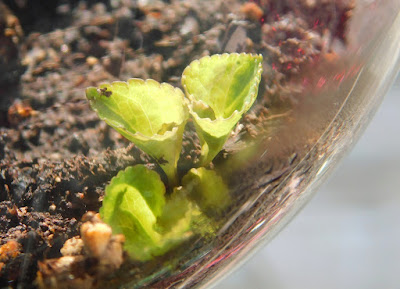
So last week, before the latest snow event occurred, I knew where to go in the backyard with my trowel to find a nice big violet rhizome to dig up. I planted it in some fancy potting soil at the bottom of a small fishbowl-shaped, bubble-ball glass vase.

I’m giving it plenty of water, and it gets oodles of sunshine in our front windows. On gray days, I stick it under an intense desk lamp.

And here’s what we’ve got so far. It’s making me happy!

And for the record, here’s where the idea came from: Leonard Hall’s A Journal of the Seasons on an Ozark Farm (Columbia: University of Missouri Press, 1980), 207.

Wednesday, October 24, 2012

October Twenty-Fourth

Greetings, everyone! Once again, I must apologize for my absences. As in the past, absence from blogging means that I've been preoccupied with something else. For the past month, in particular, Sue and I have been busy with one of our cats, Genji, who is struggling. Actually, he's doing pretty well, considering that his illness will eventually (and possibly soon) mean the end of him, but his relative comfort these days is due in large part to the efforts of Sue and me. We use a miniblender to liquify canned food, and we try to feed him just about whenever he's hungry. Then, we wipe his mouth, shirt front, and the kitchen floor. There is pain medicine twice a day. And well, you know . . . we're simply keeping an eye on him, and offering him a lap when he wants it, and trying to make sure he knows he's cared for, and that we love him.

When I get behind in my "journal-journal" (the real one, that's made of paper), I have traditionally used a technique I call "Newsflashes." It's a silly but effective way for me to cover as many subjects as possible, giving myself permission to treat each subject as a "headline." (I'm really not fitted for this Internet-Twitter-ADHD-cursory-shallow style of writing.) So maybe I ought to try that today. I'll omit the silly little lightning-bolt "icon" I would draw beside each statement, if I were writing in my actual journal. Here goes.

TODAY IT'S MY BIRTHDAY. Forty-seven! As Rose O'Neill remarked on her sixtieth, "How roguish!" Well, I'm just glad we have nice weather, that water flows out of the tap today, and that we're going out somewhere for dinner. I don't even know where yet! (I get to decide!)

GREAT NEWS ABOUT THE UNIVERSITY OF MISSOURI PRESS. All summer long, people have been outraged about the efforts by a few at the University of Missouri to hijack and dismantle Missouri's number-one book publisher, which happens to belong to the people of the State of Missouri. Fortunately, after months of receiving all kinds of public pressure, the administrators have--amazingly!--reversed their decision. But a great deal of damage was done. Press staff numbers are at an all-time low, and the disturbance in operations means that they're scrambling to rebuild their forthcoming list of titles.

I was looking to see if I had any pictures of the press or its staff to share with you. Most people don't know what "book publishing" looks like. Really, it's a bunch of people staring at computers. But to give you an idea of the change in the press in the past few years, here's a picture of the staff as of 2008, before nearly all the layoffs and downsizing began (copied from p. ix of University of Missouri Press: 50 Years of Excellence, 1958-2008). As far as I can tell, the total staff today numbers seven. Seven!!


But yes, the most recent news about the press has been particularly encouraging, so I'd like to encourage you to contribute to the press's future. Here's a link for making a tax-deductible donation. (Yes: My birthday wish is that you'd send a check to the University of Missouri Press!)

Also, browse their catalog and buy a book! Indeed, the books are available in print or electronic formats, and have been for years.

YARD WORK: MOVING THE IRIS. This has been my project the last few weekends. The catalyst was that my dad gave me a bushel of surprise lily bulbs: "If you can't find places for them, just throw them in a compost pile." (As if.) Back when Sue and I got our beloved privacy fence, we moved a bunch of iris to a less-than-optimal place under a tree, right on the corner. (I told you about our hardy heirloom irises.)


My plan was to remove the irises from under the tree and put the surprise lilies there. Those irises, then, could go into an expanded existing (more appropriate) iris bed. (It was expanded because of our new sidewalks and driveway--remember?) The iris, I think, will do well in their new location.


I also rescued some poor little iris bulbs from one of the local nonresident landlord's properties. They'd been mowed off regularly by his "lawn-scalper," but I think they should strengthen and revive. I look forward to seeing what color they are, once they're able to bloom again!

And you know how bulbs are--they always take up more space than you think they will. So I ended up digging up about a half of one of our backyard beds, too, and--sort of--reorganizing it, including some of the extra bulbs: Regular irises go "here," surprise lilies go "here," and Siberian (or are they Japanese?--oh, whatever!) irises go "here." And I made an attempt to segregate that variegated "bishop's weed" stuff (Aegopodium podagraria). We'll see how that goes!


THE NEW SIDEWALKS: UPDATE. Yep, they're lovely, all up and down Broadway. Despite the months of bare dirt due to the construction, heat, and drought, the grass they planted (once it started raining again) has taken off. It's looking really good! Compare the pictures below to the ones I posted earlier!


BREAKING NEWS: PHIDIPPUS AUDAX OBSERVED IN HOME OFFICE! Or, as they say in the guidebooks, a "bold jumping spider." I love the scientific name, though. Phidippus sounds like some Classical Greek playwright, and audax stands for "audacious." And these little characters are audacious! I get the idea they're as curious about us as we are about them. Naturally, I carefully trapped him with a cup and a piece of junkmail and escorted him outside. Below are a few pictures of a P. audax I took in 2008, while it perched on the hood of my car. Aren't the iridescent green chelicerae nifty? What a cool little fella!


If you're a regular reader, you know how I've grown to love spiders!

Well, that's enough "updating" for now--I have plenty more I want to write about, but I have a bunch of other stuff I want to do today!

Friday, November 11, 2011

Autumn Transitions

I’ve been thinking a lot about the progression of fall this year; I mean, I usually do, anyway, because it’s a dynamic season, intense and dramatic, manic-depressive. But with Teale’s Autumn across America fresh in my mind, I’m more thoughtful about it than usual.

Unlike in springtime, where there’s no clear-cut time when the growing season officially begins, in fall, the first hard frost and freeze slices a distinct boundary between animation and dormancy, juiciness and dryness—the vibrancy of “red autumn” and the dullness of “gray autumn.”

Here in Central Missouri, our average frost date is about the middle of October, which also happens to be our usual fall color peak. A hard freeze can zap the fall color pretty abruptly. Then, the abcission wind comes in late October or early November, often with rain and dreary skies, to knock the leaves off the trees and thus prepare the trees for snow and ice. (Remember the abcission wind? We talked about that last year!)

So much of autumn seems to be about preparation for the winter.

But although we had wind and rain this past week, we still haven’t had a freeze yet, or even a hard frost.

There are many pleasant things about this situation—for example, Sue and I were able to bring in our tropical plants at our leisure. We dug up the elephant ears and hibiscus a few weeks ago, and Sue brought in her bonsai that can’t survive the cold. The Fukien teas and what-all. Some years, we get caught by surprise; we put off bringing in the plants until the last minute, then suddenly they’re predicting a freeze, and we’re out there with our spades, sometimes in the dark or the rain. Which is not quite optimal!

And then there are the brugmansias, which have multiplied over the years like bunnies. Like hibiscus, they must be brought indoors during winter. We’ve found, however, they only really begin to bloom about the beginning of October, so they’re usually in full bloom when we tell them, like moms tell kids on summer evenings: Time to come in!

So we always have to trim back the bruggies so they are, say, not taller than ourselves, which usually means hacking off all the glorious, footlong flowers. And we cart them and their big pots indoors. Into the basement. It’s kind of sad.


This year, Sue couldn’t bear to chop all those blooming heads off, so she set them, pots and all, at an angle. We have sideways trees in our basement! They’re blooming right now, even as I type this on the third floor of our house, and I can smell them all the way up here.


And we swapped the screens for storm windows again. By the way, there were big numbers on the “cussometer” this year—but it’s long story I won’t go into. Here’s a picture from my parents’ collection of my Grandpa and Grandma dealing with the storm windows. It was the early sixties, and judging from their smiles, the storm windows fit better forty years ago!


I also, quite at my leisure, picked all my basil and made pesto the same day I picked it.

Another day, I picked all my cayenne peppers and dealt with them: The smallish green ones went into freezer zip bags—they will heat up my Indian curries this winter! The mature, red ones, I dried: Trimmed off the green calyx on top, sliced them once lengthwise, spread them on a huge cookie sheet, and let them enjoy the dry warmth of Grandma’s incredible oven, all night long. Next morning, I turned them into “dynamite dust.” Lookie!


I didn’t deseed them or remove the “membranes.” (Hey, want a more precise name for that pithy stuff? It’s the placenta, that middle part that the seeds grow on; and the part that connects it to the fruit wall is the septum).

Dynamite dust!
It’s just whole, ground cayenne. None of that sissy stuff for me! Good for what ails ya!

With all these preparations, though, there was no rush; we just found time here and there to get it all accomplished.

And yes, it’s rather pleasant to still have flowers around—chrysanthemums, and all that autumn-purple ageratum that grows around this yard for free. My herb garden’s still going at it; just today, I picked a handful of red-veined sorrel and some mint to go in a little salad at lunch.

. . . So when will it freeze?

Saturday, August 13, 2011

The Peach Fairy Was Here!

. . . I'm sure that's what the woodchucks, "Beth" and "Little Beth," think whenever we set the morning's pile of peach peelings out under the walnut tree.

I've told you about woodchucks before. We have a few on our block that apparently live in burrows around some of the vacant and semi-abandoned and marginally maintained "rental" housing nearby. (We used to be unqualified preservationists, but some of the houses on our block are beyond repair and are simply waiting in line to be torn down.)

It's not like we're "feeding" the woodchucks, particularly (we don't even set seed out for the squirrels, to keep them from the bird feeders, anymore)--we just feed the birds, and seed falls to the ground, and the woodchucks come to vacuum up the scraps. Sometimes the woodchuck sits there on the ground right next to the mourning doves, who are similarly interested in Hoovering up spilled millet, cracked corn, and what-all.

But on these mornings when I peel three or four peaches to have with our breakfast, we have a choice of where to toss the peels and pits. Should we scrape them into the garbage can (where they would soon get boozy and draw fruit flies)? Or put them into our backyard composter? (It's a plastic bin that is always full of weeds and seems rather creepy with spiders, picture-winged flies, mold, and more--it's kind of hard to face in the mornings; plus, peach peelings seem too sweet and precious for the composter.)

So instead, we put them in the yard, where a hungry and appreciative mammal can find them.


Ever since that lengthy, dry, hot spell we had (practically from June through July), we've been setting our cantaloupe rinds and fruit peelings under the walnut, where we know that Beth and Little Beth walk past, on their way to our bird feeders, and where (we know) the local opossum(s) and raccoon(s) amble past during the night shift.

The scraps always disappear within twelve hours. Although I haven't seen it, Sue says that once or twice, she's seen the woodchucks discover a fresh pile of peach peels.

She says they fall on it like prospectors on the mother lode.

To them, it must seem like manna from heaven, a supreme ambrosial treat--especially given this hot, dry summer of crackling, brown grass and a dearth of anything remotely resembling "succulence."

To them, it must seem like the "Peach Fairy" came and granted them a special boon! If woodchucks are capable of rejoicing (they always have such a deadpan expression), this would inspire it.

And as far as we're concerned--as long as the woodchucks refrain from burrowing under our house--they are quite free to enjoy the sweet peels that we don't want.


Sunday, May 22, 2011

Elephant Ears: The Springtime Drill

I’ve told you the story of Grandma’s prizewinning elephant ear plants before—but I didn’t give you pictures yet.

Here’s a brief recap; if you want to read the whole story, click here.

I’m not sure how long Grandma had these elephant ear plants, or how many she started with, but they seem to do very well in this backyard, and with annual regimen of care she gave them, which I continue. (Read that previous post for specifics on the care.)

Since they’re tropical plants, each October we have to dig up their huge, loglike rhizomes and take them inside for the winter. Then in may, once we’re past the danger of frosts, we plant them back outside in the ground.


We’re a bit behind this year—in part because it’s been rather cool and prone to frost, as well as rainy. (Who wants to work in mud?) Not to mention my ankle problems.

Anyway, since we cut grass yesterday and did lots of other stuff, and with rain threatening this afternoon, this morning was our big chance to get them in the ground.


I was still sore from yesterday’s exertions. (Until it happens to you, you don’t really appreciate how a single ankle injury can cause darned near every other joint in your body to ache! Which reminds me, I need to get us another big thing of ibuprofen . . .)

I think we counted fourteen large/original elephant ears, plus about half a dozen younger ones, which had arisen in previous years either as buds or from seed.

Last year, we learned about the importance of sunshine on the growth of elephant ears. Usually, we put them where Grandma usually had them, in a flower bed under a big yew tree—a rather shady location. But since we have “overflow,” last May we decided to put one baby elephant ear in a sunny, blank spot near our privacy fence. (Where Persephone is, now.)

Seriously, when we set it out a year ago, this thing was no bigger than about 2 inches in diameter. By August, it looked like this.


That’s a six-foot-high privacy fence behind it! The diameter at the base is about seven inches, now—plus it has two babies sprouting off the sides!

Sunshine + moisture + fertilizer = phenomenal growth!


The largest leaf blades were about a yard long!

Needless to say, this year, we planted a few new babies in that area, plus the one that had been there last year. I suspect they will all be enormous come August.


They’re not much to look at now (we didn’t even water them, since the weather forecasters sound very confident that we’ll have serious rain today)—and we haven’t put down the usual nice big layer of mulch (we didn’t think we had time, since the skies were getting gray and turbulent—but now it’s sunny again . . . Well, if it doesn’t rain, we’ll water them tonight).

Some of the other very small elephant ears have gone into big containers—well, at least until we decide where we might plant them elsewhere.


There is (quite literally) huge potential in these rhizomes; it’s always fun to see which ones develop the biggest leaves, which put their energy into flowers and fruits, and which decide to reproduce by growing new plants off to the side.


Oh, and did I tell you I was sorting through some old papers of Grandma’s a few weeks ago, and I discovered the actual blue ribbon the elephant ears had won? Lookie!


There’s no year on the label, but given the vintage of the various other papers this was shuffled with, I’d say she won it between about 1995 and 1999. Again, for more on the blue ribbon story, look here. It’s pretty funny.


I guess you could say the annual drill of planting these huge “logs” in the ground and then digging them up again five months later is kind of nutty—but if you had bona fide prizewinning plants, wouldn’t you feel compelled to keep them going, too?

Friday, May 13, 2011

Persephone Sees the Light of Day

After more than a year of living in the Underworld of our basement, and well past the Vernal Equinox, Persephone finally made it into our garden.


I told you about “Persephone,” the large concrete yard statue we bought in Rosebud, Missouri, a while back. We’ve been really slow in preparing her for exposure to the elements.

First, we had a bit of plastic surgery to do—grinding and sanding off the seams from where the two halves of her mold had fit imperfectly together, and adding a bit of concrete-patch to places where she wasn’t quite smooth enough. Then sanding again. Then patching again. (It’s Hades being a perfectionist!)

Then, it took us forever to decide on which shade of “whitish gray” looked enough like marble. Then, lordy, we had to paint it, making sure to work paint into all the little irregularities in the surface. Then paint it again. We don’t want her peeling!

So you get the picture.


We actually got her done before last fall, but we didn’t see any reason to stick her outside before the winter. She’s Persephone, after all.

But then her delivery to the Earth’s surface this spring was delayed by my broken ankle and her tremendous weight. We could put her on a two-wheeler dolly and pull her around, but there’s no way we could lift her, and pulling her up the hump of the driveway seemed iffy for me in a “moon boot.”

So last Friday, my dad was over, and my ankle was feeling pretty good, so we wrapped her up in a blanket, cushioned the hand-cart with cardboard, and wheeled her around the house on the sidewalk and up the hump of the driveway.

And now she graces our backyard with her goddesslike opulence. I’m glad we have a nice big privacy fence, and she’s not visible from the street. We think she’s close enough to a “real” statue that she adds an air of classic beauty to our backyard, like it’s a courtyard at a castle or something.

Or maybe she’s just a tacky concrete yard statue with a paint job.


But we certainly didn’t get her in order to make our yard look “normal.” So whatever anyone else thinks isn’t of great concern to us. We like her a lot!

Thursday, October 28, 2010

Tonight's the Night

. . . Of the first hard freeze--or so they say.

Of all the places in Central Missouri, our house and yard seem to be the least likely to experience predicted frost and freezes, because we're on a hill, and cold air doesn't settle in here like it does in the hollows. Plus we're in town and have lots of asphalt and concrete to warm the place up.

But do you really want to take chances where they're talking "freeze"? We have the blue-ribbon elephant ears to think about, and they might be older than I am. And then there are the hibiscus. And the big scheffleras, and the brugmansias, the philodendrons, aloes, orchids, begonias, dracaenas, and more.

God, we have too many plants. (Anyone want some? Free to a good home . . .)

Some years, we're smart about it, and we set aside a weekend, in early or middle October, to move the plants. That way, we're not out there the day right before the freeze-night, all in a rush.

One year, we didn't start digging up the elephant ears until after dark, when it was already starting to get quite cold, and the ground was wet. I'd already taken my lenses out and was wearing my hated glasses, which were steaming up and slipping down my face as I was sweating.

Wow, did that suck! It was definitely a "10" on the cussometer.

You would think we would have learned our lesson, right? I mean, for the love of God, please, let's get it done before we have to.

Well, today we "had to." And no, it was not convenient for us, not at all.

True, it wasn't raining (hooray!) or snowing (hooray!), and the ground wasn't soggy (hooray!)--but we both have head colds. Yep. We both started feeling crappy at about the same time yesterday afternoon, and we're still in that horrible "coming down with it" stage. All day today we've been sinking.

You know what it's like when you're just at the beginning of the cold. Stuffy, puffy, painful. That sense of "Oh, no." We've both had sinus headaches all day. I honestly feel like shit. But the show must go on, right? Save the plants!

Dad was our hero--I'm almost ashamed to admit it--he came over and did all the digging, and he helped us with the lifting, while we moved plants, carting them from the backyard to the garage, and scratched our heads and tried to figure out where everything was going to go. At least for tonight.

We seriously have too many plants.

Seriously: Want some?

So I was at it all day, pretty much--I took a "break" in midafternoon to buy cold remedies, orange juice, and tissues. It should have felt like a break, but instead it felt like a huge amount of work, even just to change temporarily out of my dirty gardening duds and into something presentable enough for K-Mart.

There is a good chance we'll wake up tomorrow and find absolutely no sign of frost or freeze--that has happened before--I'm not kidding about this yard having a relatively warm microclimate.

But as I explained in my previous post, I tend to err on the side of caution these days. Taking chances can lead to regret.

So by now it's all done--well, mostly. There are a few plants that we left outside--a little schefflera and a little philodendron that we're sick of moving in and out. Sorry, plants--nice knowin' ya.

And the "chatter" roses are blooming quite profusely now--I usually cut them so we can enjoy the clusters of flowers indoors, instead of them getting socked by the freeze. But eh: pretty as they are, I don't think I could smell them now, anyway.

Hibiscus Stories

This might seem a bit odd for a midwesterner, but I've been thinking about hibiscus the past few weeks. Like so much else, there is a recent trigger that has caused the past to flavor my current thoughts.

The trigger has been the luxurious blooms that our two hibiscus shrubs have begun to produce. (Yes, they're finally blooming, now that it's getting time to trim them back and bring them inside so they don't freeze.) (I don't think I've quite figured out how to make them happy enough to bloom all summer long.) (I'm still learning.)

One of the hibiscus is a peachy orange, single one, that we purchased, so there's not much of a story with it. The other one has more of a history.

It's pink, double, and bears large flowers. And it's only bloomed for us a few times. We are not its original owners. It used to belong to a friend of mine, whose mother gave it to her in about 1995, I think. (Or was it the late eighties?) It was blooming profusely at the time.

My friend knew how to take care of plants enough to keep them alive, but I don't think she was particularly good to them. This hibiscus never went outdoors, never drank sweet rainwater. She kept it on the floor next to the sliding door to her back patio, where it got lots of sun but nevertheless showed its need by pressing its leaves and branches against the glass. It was there for years.


She watered it, but I don't think she fertilized it. I don't think she ever repotted it, either. It never bloomed for her, that I know of.

We acquired it in about 2006, when my friend moved, and the first thing we did was repot it and set it outside, and it started blooming almost immediately. And I think that's the last time it bloomed for us.

Starting last year, we've been removing it and our other hibiscus from their pots and planting them directly into the soil in a flowerbed next to our house during the growing season. I think that's made a big difference. It's special ground, I think.

Here's where the past enters the story--as you know, this was my Grandma Schroeder's house since 1930, and she was a garden clubber, green-thumb kind of lady. Her yard was like a botanical garden. And she had hibiscus, too.


In fact, they outlived her. She had acquired her hibiscus in the 1950s, as I understand it. By the time Grandma died in 2000, she had two, and they were veritable little trees, with a trunk diameter of about one and a half or two inches.

One of them had been a gift to her from her neighbor Clara Renner, who happens to be my other grandma. This was before my parents had married--from what I know it was just a simple neighborly gift, the way gardeners share plants with each other.

Each spring, Grandma would plant her hibiscus in the soil, often right where we're planting our hibiscus today. How many summertime parties did we have in her backyard, with her red and yellow hibiscus glowing against the pure white stucco wall? Grandma would gush over them.

On special occasions--like when she was entertaining visitors even such as us--Grandma liked to pluck a hibiscus flower and stick it in her hair, or attach it to her blouse.

She also used them as a garnish on her fruit platters.

When I was young, Grandma Schroeder's hibiscus were a subject of chiding and lecturing twice a year by my parents and uncles and aunts. In spring these large pots had to go outside, and in fall, they had to come back in. Sometimes Grandma lugged them up to the third floor. And she'd often move them herself--hence the lectures from her children: "You did that by yourself? Why didn't you let us help you? What if you had fallen? They're too heavy!"

Grandma was obstinate back then--"Well, I just wanted to get them in, and I didn't want to bother you . . ."--but in later years, of course, she welcomed the help.

What happened to Grandma's hibiscus? I hate to tell you, because it's kind of sad. About five or six months after Grandma died, it was getting close to frost and freezing. Her yard and plants had been kept up by my dad and my uncle, and at that point I was seriously considering buying the house.

And of course, I remembered the hibiscus--but it was too late. It was already dark, and getting late, when I learned on the news that the first freeze was predicted for that evening. I called my dad, who has much more experience than I in interpreting the weather forecast and bringing in plants. We discussed it and decided that even though a freeze was predicted, the hibiscus should make it through the night.

Indeed--they were located against the house, and the house is located in town, surrounded by concrete, and usually we're the last ones in the region to experience frosts and freezes. When the weather forecast says "frost," we usually go, "yeah, sure."

But Grandma's hibiscus did freeze that night.

I wish that my foresight could be something just a little closer to 20/20.

I was sad to lose them. And it was more than losing another connection to my Grandma. It had to do with the death of mature, beautiful, living things that depended on us. I felt we had somehow betrayed them, considering all the care they had received for half a century. They were fine, and going strong, and they died just because I chose not to drive a half hour to Jefferson City at ten o'clock at night and drag them a few yards into shelter.

But there's no going back, of course; you live and learn. Sometimes those freeze warnings do indeed mean that it will freeze.

And anyway, we do have our own hibiscus, now, with their own stories and colors, to lug in and out each fall and spring, to delight us with their blossoms, no matter how profuse or rare, to take their nourishment in this charmed soil.

Friday, June 4, 2010

Virginia Creeper Sphinx Moth


Well, we were just heading out the door last night to get dinner someplace (I was too exhausted to cook—more on that in a second) when we noticed this groovy moth on the brickwork by our front steps.

We’re now in the habit of grabbing our cameras anytime we some something interesting, so instead of reaching for the field guides, we took pictures.

Indeed—later on, I didn’t identify it with a field guide at all (heresy for an editor of field guidebooks), but instead looked it up online at the wonderful and fun arthropod ID site “What’s That Bug.”

It was obviously some kind of sphinx moth or hawkmoth. The family is the Sphingidae (SFIN-jih-dee), which also includes the obnoxious tomato hornworm, the fairylike hummingbird moths, and this little fellow I showed you last year.

The larvae of the sphinx moths are typically (maybe all?) “hornworms”—the caterpillars have an “anal horn,” an elongated, sometimes thornlike projection arising from their butt like a tail.


So, this little fella is Darapsa myron, which, according to this informative Web site, is pronounced “dagh-RAP-suh MY-ron.” (I wonder what the “g” is for in that—how about “dah-RHAP-suh”? Whatever.)

It’s commonly called the Virginia Creeper Sphinx, a.k.a. Grapevine Sphinx, a.k.a. Hog Sphinx. The first two common names make a great deal of sense, because the larvae of this species munch on the foliage of Virginia creeper and grapes (in the genus Vitis), plus Amelopsis and Viburnum species (think of peppervine and raccoon grapes for the former, and blackhaws for the latter, here in Missouri).


I have no idea where the name “Hog Sphinx” came from. Combining the porcine with the Egyptian in a name for a moth seems completely bizarre.


Anyway, here’s more info for you. Once the larvae grow to full size on their Virginia creeper or grape vines, they descend to the leaf litter below to spin their cocoons and pupate. When they emerge as metamorphosed, winged adults, their diet switches to the sweet nectar of flowers.


Apparently you can often find them drinking from flowers, and they’re also attracted to sugar water.

I’m not sure if this is a boy or a girl, but I think it’s a boy—though its antennae aren’t massively feathery, some other pictures I saw online of this species seemed to have even smaller antennae, so I guess those were the females. (As with other moths, the female emits pheromones that males detect with their big feathery antennae.) [APPARENTLY A FEMALE; SEE COMMENTS BELOW.]


I think the curious little “crook” or bend in the antennae is interesting—apparently all Virginia Creeper Sphinxes have that. It almost gives them an “expression,” like a cocked eyebrow, I think.

Where do you find these moths? In the United States, they cover the entire eastern part of the country and extend as far west as the Dakotas, Nebraska, and New Mexico. (I’m kind of surprised they haven’t taken up residence in Northern California, what with all the vineyards there. Wouldn’t that climate support them? I suppose their introduction to that new territory is probably just a few accidental shipments away. None of what I read said they were a serious pest on vineyards, but I can’t imagine they’d be welcome by anyone wanting to grow grapes.)


Meanwhile, there are plenty of weedy wild grape vines and Virginia creepers around here for them to feed on, and they can be my guest! Indeed, it is ironic that we spotted this moth the same day I had spent part of the hot afternoon trimming, yanking, and wrestling various weedy vines from our poor lilac trees—Japanese honeysuckle, English ivy, and that horrible, immortal, exotic clematis. The effort was tough and disheartening—our poor lilacs!—and it had exhausted me. While I worked, I decided I “hate” every single vine in the universe.

But within a few hours, I was kneeling on our front steps, taking pictures of this lovely fuzzy olive-tan creature that depends on vines for its sustenance. So, okay. Maybe I don’t hate all vines . . . just that doggone invasive Japanese honeysuckle!


Insect life cycles always stir my imagination. These creatures begin life as juicy green, creeping worms, and then become these gloriously patterned, furrily scaled adults, that can fly! And yet other insects, the ants, go the opposite direction—once pupated from grub stage, queen ants begin adult life as creatures with the capacity of flight, but after mating they tear off their own wings, burrow into the earth, and live the rest of their lives in a hole in the dirt.

Both life cycles are equally impressive, in my view. Sometimes I think the best part of living on this Earth is getting to witness so many variations on the theme of life.

Monday, April 26, 2010

Johnny Iris


All our flowers have stories. I told you about our peonies last year. Well, now I’m going to tell you about the iris, which are blooming right now.

I really love it that the plants in our yard have histories, just like people do, and their stories intertwine with the stories of humans, the unfurling of history, the changing times.

I grew up overhearing but unfortunately not perfectly memorizing a lot of these stories. To get my facts straight, I recently asked my folks to reiterate the details about the irises in our yard. What I got was a discussion between the two of them as they tried to settle on which iris, and which stories, and who got what from whom.

The stories are already becoming fragmented and fuzzy. But here is what they told me about some of the various heirloom irises that came with our yard.

First, we have a small fleet of tall, light-blue irises in the flower bed over our retaining wall—near the peonies I told you about last year. There are also some of these next to the pillar rose (another million-year-old plant, with which we do battle every year). Right now, they are just starting to send up their tall inflorescences.

No joke, they are tall—the leaves grow to about 30 inches long, and the flower stalks reach 4 feet high.

Here’s what they’ll look like when they bloom.


These iris, my dad explained, had come from the old Bartlett house the next block down Elm Street, just as the peonies had.

Like the peonies, they had been rescued from the old yard before that house, at 318 W. Elm, had been razed. You know gardeners—they can’t let a perfectly good plant get mowed over.

And as I mentioned earlier, the Bartletts are connected to the Mauses, so who knows. Maybe these iris originally came from the old Union Hotel, at what is now the Jefferson Landing State Historic Site.

The other heirloom irises I’m talking about—our “Johnny Irises”— are more of a mystery. It seemed my folks couldn’t quite agree on their provenance.

To complicate matters, we’ve moved them from where Grandma Schroeder had had them during her long tenure in this house. Their “original” location (well, from my perspective) was in the side yard, by the driveway, behind where the old gazebo had once been (my family called it a “lusthaus”—and it stood on the spot where my paternal grandparents were married). (Long story.) We moved them from this location when we put up our privacy fence.


Grandma had also put some of these iris in her official iris bed along the foundation of the next-door house, which she rented out (the house is gone now, though the medley of iris remains).

These particular heirloom irises are early bloomers, solid, dark purple, and relatively short. The leaves only get about a foot high (and max out at about 20 inches), and the flower stalks average about 15 to 17 inches high, with about 20 inches the limit.


The flowers are relatively small, compared to larger, newer varieties, but they are solid dark purple, and plenty per stalk.


I wish I knew what variety they are, but I suspect they might actually be Iris germanica, a natural hybrid that is an old-fashioned standard. (But does that type come in a solid dark purple? Are any iris experts reading this?)


At any rate, they are cheery early bloomers, hardy and profuse, and apparently incredibly old. My dad says that according to his memory, his mom got them from their close neighbors, the Renners—my mom’s parents or grandparents. Somehow (I think because Grandma Schroeder said it!), the story has gotten passed down that they had come from Johnny Renner. Presumably, my mom’s dad. “From along the railroad.”

However, it might have been mom’s grandpa, who was also named John and lived at the same house. If Grandma Schroeder said she got them from “Johnny Renner,” it could have been from either the father or the son. . . . Though I’m not sure my great-grandfather ever went by “Johnny.”

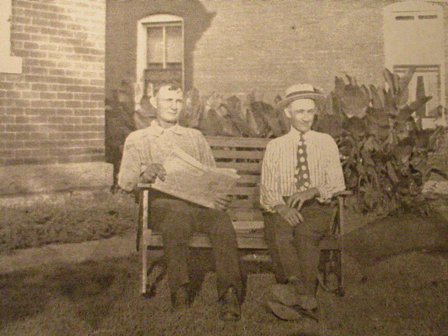
Here’s a picture of my great-grandfather John Christian Renner and my grandfather John Pollock Renner.


Now, while they were talking, my parents also pointed out to me that this swapping of iris rhizomes was probably not something done by the men of the family, but by the women. Hmmm.

Sue and I are still calling them our “Johnny iris.” Maybe I persist in this because iris are my favorite flower, and I want to associate my maternal grandfather with something elegant and beautiful, when I know he carried a lot of pain deep inside him.

. . . There’s another story, too. My mom explains that her family, there at 218 W. Elm, had had a bunch of iris along their back picket fence. These, she said, were bluish purple and not dark; she referred to them as “purple flags.” This color difference throws doubt on the idea that these are the same as our “Johnny iris.”

Anyway, those iris had a story, too. My mom told me that her grandpa, John C. Renner, had brought them home from work one day.

During the end of the 1800s and the first three decades of the 1900s, he worked with the Missouri Pacific Railroad. He had been a line foreman down at Cole Junction, west of town. One day, while he was working, he had seen a yard that had lovely iris. He told their owners, a couple of ladies, that he admired their iris. The women were flattered and shared with him starts of those flowers. And that’s where they came from—John Christian brought them home. So they, too, are a sort of “Johnny iris.”

Here’s a picture of my great-grandfather John C. Renner, working on the railroad. He looks like a nice enough guy, huh? Wouldn’t you share some iris rhizomes with him?


Back then, people relied greatly on their neighbors and friends for new irises and other perennials. It must have been fun to swap starts. They did stuff like that for fun, instead of surfing the Internet. Mom told me they had beautiful white Siberian irises along their sidewalk to the back of the property, and that they also had some early yellow iris that had come from her mom’s mom, Grandma Wilmesherr (who was another inveterate green-thumb type).

Mom also explained that there was a Mrs. Cowley here in Jeff City somewhere, who was a bona fide iris fancier, who had the biggest and best iris garden around. She was the one who got my Grandma Renner fired up about iris, and she undoubtedly shared rhizomes with her.

Here’s a picture of my Grandma and Grandpa Renner, upon their golden wedding anniversary:


And then, of course, good neighbors share plant starts with each other, too. It’s quite possible that my Grandma Schroeder got her stories mixed up and thought that her dark early-bloomers were the ones my Great-Grandpa Renner had carried home from the railroad that day, even though they apparently are not.


So you can see that the provenance of the iris in our yard is no longer ascertainable; the iris traders of the past, men and women, and John C. and John P., are gone, and so are the details of their stories. Still, though, the iris live on, occasionally relocated, but always appreciated, every spring.

Whenever I see hardy, heirloom irises blooming in older neighborhoods, I think of these stories and realize that each clump must have a similar history.

A line foreman in dungarees, doffing his hat politely and telling some ladies that their irises sure are pretty. Two neighbor ladies chat in the backyard and offer each other starts of their favorites. A young couple brings shovels and wheelbarrow to an in-law’s house to rescue plants before the house is town down. A Mrs. So-and-So’s fancy iris garden inspires a modest, Depression-weary housewife. A mother gives her daughter the latest yellow variety.

And they all have bloomed, every year.