Showing posts with label Charles Schwartz. Show all posts

Friday, August 31, 2012

Not-So-Opulent Armadillos


They still seem like newcomers, and why shouldn’t they? Here in Central Missouri, we never “see” them—unless you count their poor bodies lying lifeless—like overturned baskets—on the roadsides.

Poor critters . . . cars are so rude.


And to people north of the Missouri River, they truly are newcomers; the river serves as a serious barrier to their northward expansion. Each time a few of them manage to get across the river here and there, and begin new population centers, a hard winter eradicates them from the whole region. Or, that’s what people have thought.

Armadillos are insectivores, and they don’t hibernate. A hard winter that freezes the ground and prevents them from getting to delicious, hibernating insects wipes them out. It hits the “restart” button, and when that happens, Missouri has few, if any, armadillos until immigrants of that species, expanding from firm populations south of us, replenish the species in our state.

In 1959, when Charles and Elizabeth Schwartz published the first edition of The Wild Mammals of Missouri (a book I could not live without), armadillos were not known to live in our state. By the time they first revised the book, in 1981, the Schwartzes listed the armadillo as “possibly occurring.” By 2001, when Elizabeth Schwartz presented to our state the second revised edition—an endlessly fascinating guidebook, textbook, encyclopedia, and lavishly, perfectly illustrated volume—armadillos had definitely become established as “full residents,” “having been collected in 66 counties.”


So the armadillo is no longer just the “state bird of Texas”!

Dr. Lynn Robbins and his students at Missouri State University have for decades studied the range expansion of these curious critters, which so many of us still equate with the Longhorn State, and not the Show-Me State. Here’s a request for citizens to help with their studies; this appeared in the March 1993 issue of the Missouri Conservationist (the official monthly publication of the Missouri Department of Conservation):


So Why Am I Writing about Armadillos Today?

Well, Sue and I have been hiking recently at Painted Rock Conservation Area, south of Jefferson City along the Osage River where it bends (at Osage Bend), and we were astonished to see several armadillos abroad in daylight. It was midafternoon, and they were wandering around in the leaf litter, in the oak-hickory forest, foraging constantly.


What does a foraging armadillo look like? Nose-to-ground! Their conical heads poke through the leaf litter, snout-first, and the rest of the body follows. They plow through the fallen leaves in a random zigzag path, leaving a rounded tunnel behind. The leaves atop the “tunnel,” parted by the body, fall back together somewhat, but you can see through them to the ’dillo trail.


Armadillos specialize in eating insects (though they opportunistically eat other little critters, as well). They whiffle along the ground, snuffling for grubs, beetles, ants, and whatever else. They dig into the earth as far as six inches to locate a juicy insect their noses have detected.

It’s really interesting to watch them. They have terrible vision and next-to-terrible hearing, so they tend not to notice if they’re being observed. I think the constant crunching of dry leaves around their heads drowns out the sound of voices and footsteps.

Apparently, armadillos have been remarkably active this summer in general. One of my friends thinks it’s armadillos that have been rooting up her garden over at Osage Bluff.


They’re supposed to be mostly nocturnal during the summer—so why are they out in daylight?

It appears to be environmental: Remember last winter, when it never really got to be truly “winter”? Presumably a large number of armadillos survived Missouri’s winter last year. During our usual cold, freezing winters, many of them simply perish. Even in good years, they don’t put on much body fat to shiver away to stay alive—and any mammal that doesn’t hibernate has to “stoke the fires” of life in freezing weather by “eating hearty.” Frozen ground is not conducive to digging. So many ’dillos die.

But it was hardly even cold last winter, so we probably had record numbers of armadillos survive until springtime. Then we had a nice wet spring (remember?) and plenty of insects had survived the mild winter, too. Things were looking up for the armadillos at that point—but then the drought set in.


I suppose the drought is doing to the armadillos what winter failed to do—limit the populations. By the end of August, insects have become hard to find, and so has water. The armadillos are close to starving—and that’s why they’re out during the day, even, hunting relentlessly for bugs, grubs, beetles, weevils, pupae, lizards, darn near anything, to eat.


I recently contacted Dr. Robbins with my hypothesis, and responding in an e-mail of August 27, 2012, he said he thinks I’m on the right track. He mentioned, however, that many armadillos do seem to be surviving our midwestern winters—somehow, decent numbers of them manage to find shelter and food, so the idea of them all perishing with cold weather is not as strict as once supposed. That they’ve been continuously present in Nebraska for fifteen years, he says, “leads me to believe that even if a high percentage do not make it through a winter, they do find refuges where they can find enough food to make it.” They don’t seem to “fatten up” before winter, but they seem to survive anyway, by finding “large amounts of food under the leaf litter and by digging in unfrozen ground.”

Regarding what we saw at Painted Rock, and the drought, Dr. Robbins noted, “If the drought continues, I too will be concerned, and the conditions you observed are similar to the way they [the armadillos] looked after the [recent] big snow event, including their frantic behavior to catch up. I have been seeing increasing numbers of road kills north of the Missouri River this summer.” He continued, “if there is a reduction in food as a carryover from this drought, it could be a problem.”

(Thank you, Dr. Robbins, for helping me understand this interesting animal, and for your work in helping humanity to understand many kinds of mammals, too!)

So there you have it—although Sue and I were thrilled to see our first ever—living—armadillos, the situation wasn’t optimal for all parties. I hate the thought of anything suffering. Let’s hope the rain is bringing them some relief.


Bonus info! The scientific name for the nine-banded armadillo is Dasypus novemcinctus. Dasypus is the genus name for our armadillo and is used for six other closely related (living) armadillo species as well. (Dasypodidae is the name for the whole armadillo family, which comprises about 21 species, in various genera.) Dasypus means “rough-footed.” Since armadillos are diggers by trade, they have coarse, sturdy feet!

The only species of armadillo found in the United States is the nine-banded armadillo, Dasypus novemcinctus. The second half of the name means “nine-banded” (“novem-” for “nine,” and “-cinctus” for “belted”—as in “cincture,” an encircling belt, or to “cinch” up something).

SPECIAL THANK YOU to Susan Ferber, who took all the great photos in this post and has graciously allowed me to use them on my blog. Not only is she a talented and skilled photographer, but also: She is the best person in the world to go hiking with!

Thursday, September 2, 2010

Schwartz Exhibit: A Must-See

Mark your calendars for this if you appreciate any of the following: nature, the outdoors, biology, critters, conservation, fine art.

From September 10 through January 2011, original artwork by Missouri’s master wildlife artist Charles W. Schwartz will be on display for anyone to see. For free. It behooves you to jump on the early end of this exhibition. Details at the bottom of this post.

Of course, you can’t talk about the artwork without describing the artist and his lifelong interests.


Charles and Elizabeth Schwartz

If you grew up in America during the last sixty years or so, you have probably seen Charles Schwartz’s artwork. His sketches, drawings, and paintings appear in innumerable publications, including Aldo Leopold’s A Sand County Almanac (required reading for anyone even remotely interested in the environment), and a bazillion publications by conservation organizations. His art is copied all over the Web, too, sometimes without any credit. It’s just everywhere.

Charles Schwartz worked for the Missouri Department of Conservation for forty years, serving as biologist, author, wildlife photographer, and wildlife artist. His wife, Elizabeth (Libby), also worked for the MDC, as a biologist, author, and photography assistant. They worked for the MDC during its golden years, providing real wildlife education to the public, conducting groundbreaking research, and creating several award-winning nature films, over a dozen books, and numerous articles for both scientific and popular audiences. Schwartz’s art is still commonly used in MDC publications.


Perhaps the couple’s greatest achievement is The Wild Mammals of Missouri, which presents all the information you would want to know about each species of mammal in the state. It first came out in 1959, a copublishing arrangement with the “Missouri Conservation Commission” and the “University of Missouri.”

Every twenty years or so, it’s time for an update. The Schwartzes created an immensely popular revised edition that was published in 1981, and then Libby Schwartz—a widow by this time—prepared a second revised edition, copublished in 2001 by the descendant organizations of the originals: the University of Missouri Press, and the Missouri Department of Conservation.


The Wild Mammals of Missouri

If you live in Missouri, there’s a good chance that you or someone you know has a copy of one of the editions of this book; for decades it’s been a best-seller for the University of Missouri Press.

Since its debut in 1959, The Wild Mammals of Missouri has been required reading for anyone who wants to learn about the state’s mammals. Missourians purchased this book as a matter of course, just as they purchased their copies of Peterson’s guide to Eastern birds and their Denison wildflower guides.

As the authors said in the preface to the first edition: “The Missouri Conservation Commission has long recognized the need for such a reference as this, and it is because of the Commission’s interest that this book was written.” Much of the material was published first, in abstracted form, in the Missouri Conservationist magazine, the MDC’s broadest outreach publication.

The language is formal in an encyclopedic fashion, not chit-chatty, but it is not overly technical. Anyone with a high school or college education can understand it. With its wealth of interesting information, it is valuable to both professionals and “lay” people. But the illustrations! They make the volume truly stand out.


The Artwork

That is what this exhibition is about: Charles Schwartz’s artwork. I understand that much of the exhibition will be works Schwartz created for The Wild Mammals of Missouri. This original artwork is held in the collections of the State Historical Society, which is sponsoring this exhibit.

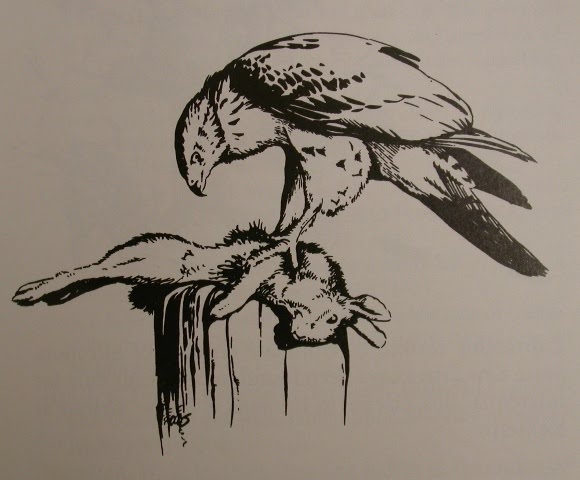
Foremost are the official portraits that Schwartz created for each species—in the book they are numbered as “plates”—these are fully rendered, incredibly detailed, full-body drawings of each mammal, in a natural setting. The eastern gray squirrel, for instance, is depicted on a tree limb—and boughs of a white oak tree form a backdrop. These painstakingly rendered, flawless portraits ought to be enough to draw you to this show.


Next, there are the more technical illustrations—easily skimmed over by the nonspecialist, but deserving of more than just a second glance. These are the closeups of forepaws and hind feet, teeth, skulls, jaws, track patterns, scats, and other details that help one to really identify a mammal. These detailed works prove that each of Schwartz’s illustrations are taxonomically and anatomically accurate.


Finally, there are numerous vignettes that show animals engaging in characteristic behaviors and other fascinating scenes. A hibernating ground squirrel, all curled up in its burrow. An owl flying off with a limp mouse. A rodent negotiating a power line. A hairless newborn eastern mole, even more blind than the adult. An opossum toting leaves in its tail. A fox with a deceased chicken in its mouth. Some of these vignettes will make you chuckle; others are sobering; all are truthful.


In these small scenes, Schwartz often betrays his personal feelings about the animals. A scene of a bobcat pawing playfully at an overturned tortoise shows us he identifies with the animal’s curiosity and thrill of discovery. A scene of a house mouse leaping from a drawer, and human hands frozen in a gesture of surprise, captures a startled fear we can all identify with. And when we see these same hands cradling a young cottontail or sleeping baby raccoon, we know he feels warmly toward these vulnerable innocents.


By taking the time to study and to render these scenes, the artist lets us know it’s okay for us to feel the same way. Not many science illustrators are able—or permitted—to venture that far today.

-------------------------------

In guidebooks, there are tradeoffs with using photos or illustrations. Many enthusiasts prefer photos, since photos provide literal views of the animal in question. And today, from the publisher’s viewpoint, photographs are much less expensive and easier to obtain than original artwork, keeping publication costs down.

But illustrations have definite strengths—the animal can be shown in a typical pose that also allows all the diagnostic characteristics to be visible, and clear. Nonessential characteristics can be downplayed, and key characteristics accentuated.

And then “artistry” can come into play. This is what makes the difference between a perfectly good, purely technical illustrator, and someone like Charles Schwartz. This is how a guidebook can transcend its role as an identification guide, and become a record, a testament, of the species.


Have you seen those awesome prints by Audubon, in his Birds of America? In them, Audubon captures more than the beauty, more than the plumage, physiques, anatomy, and colors—he captures each bird’s personality. His prints are so valuable today not because they are technically accurate—but because they are sheer treasures, emotionally moving works of art.

Schwartz’s artwork is in the same category—he captures the soul of his subjects; he makes them come alive. Most of the time, his animals are unaware of your presence and are acting out their natural behaviors—sometimes playfully, sometimes ruthlessly. On other occasions, they stare right into you. In either case, there is no candy coating. Each animal is true to its own wild self.


Go to this exhibit—before it all goes back in a drawer.


Here’s What You Need to Know

The exhibition opens on Friday, September 10, with a ticketed event, 3–8 p.m., at Columbia’s Bass Pro Sportsman’s Center. Proceeds benefit the State Historical Society of Missouri, which holds a collection of over 500 Schwartz drawings and studies, sculptures, and paintings. Tickets are a measly $10, and there’ll be guided tours by the people who know the most about Schwartz’s art, with wine and cheese to boot.

Then, Saturday and Sunday, September 11 and 12, the display remains at Bass Pro. There will be tours, landscape and wildlife art and photography seminars, and conservation educational activities. Bring the kids.

Then, the exhibit moves to the State Historical Society’s Main Gallery, located in the Ellis Library building on the University of Missouri–Columbia campus. It will remain on display through January 2011.

After that, it goes back into protective storage. So don’t miss this, okay?

For more information, contact Laura Wilson at the State Historical Society: 573-884-7904 (wilsonlo@umsystem.edu); and be sure to look at this official website:
http://shs.umsystem.edu/art/schwartz.html


CREDITS

All the pictures in this post are horrible, horrible photographs made from my copy of The Wild Mammals of Missouri, Second Revised Edition (Columbia: University of Missouri Press, with the Missouri Department of Conservation, 2001).

I’m including these pictures as samples—partly to illustrate my “review,” but mainly as an incentive for you to go see the real things at this exhibit. The original art, held at the State Historical Society of Missouri, is much, much better!


Saturday, February 6, 2010

I Told You They Have Opposable Big Toes!


We slept late. It’s been a hard week. This morning Sue looked out the back window at the snow in the yard and saw tracks. They seemed roughly triangular. Had a goose walked around in our yard this morning? Unheard of!

Realize: We were looking at them from the second floor.

Upon closer inspection, and double-checking on page 26 of the impressive cornucopia of mammal information that is The Wild Mammals of Missouri, 2d rev. ed., by Charles and Elizabeth Schwartz (whose text and illustrations are often lifted by many other authors and Internet sites), we realized it had been an opossum that wandered around our yard last night.

The Schwartzes write that female opossums are more likely to hunker down in frigid weather, so the chances are better that it was a male who visited.


The tracks are in pairs—left hand and left foot together, practically touching, then the right hand and right foot together, etc.


The hind feet leave quite unusual-looking prints on account of the big toe, which spreads out widely so that the left big toe is at about 4 or 5 o’clock, and the right one is positioned at about 7 or 8 o’clock—very distorted compared to how you might think they “should” be.

What a nice little gift from the critters last night. That Mr. Opossum snuffled around our yard last night makes me smile.


(For more about opossums and this blog, click here.)

Thursday, March 5, 2009

What's Op Op, Part 3

(More on the title of this blog.)

Opulent Opossum: It’s an attitude. Do you know much about opossums? Most people know them from seeing their poor broken bodies along the highways. Or, you’ll see them sniffing around your garbage cans at night.

Opossums are nocturnal omnivores. Often the size of grossly obese housecats, they have thinnish-looking gray fur, a white face with a long, pointy schnozzle, big beady brown eyes, and a slippery pink nose. Their legs seem too short. Their pink hands are nimble and delicate looking.

Surprised in a beam of light, opossums will just stare at you, like you’re invading their privacy (and well, you are). Harass them enough, and they roll on their backs and give a death hiss as if expiring their final breath. Yet as they waddle away in their getaway “flight,” you get the idea that deep down, though they’re cussing at you, they’re ultimately unflappable.

They’re amazing creatures. They’re common here in mid-Missouri, and they’re found all over the eastern United States and down into Mexico; also along the West Coast. They’re the only marsupial mammal in all of North America. (Compare that to about 120 different species of marsupials in Australia—think of it: The opossum’s relatives include critters like kangaroos, koalas, Tasmanian devils, bandicoots, and wombats.)

We all know about the special features of marsupials from watching the Discovery Channel, and possibly also from paying attention in biology class. Unlike placental mammals (such as us and mice and whales), marsupials don’t carry their young for long inside their uteruses; instead, they give birth to shockingly underdeveloped young that continue their development attached to teats within their mother’s pouch.

During a heat period, a female opossum (biologists call our species the Virginia opossum, Didelphis virginiana) commonly releases 22 eggs from her ovaries. Many of the young that develop and are born aren’t successful in the long, blind journey swimming through the mother’s fur from birth canal to pouch to nipple. There are only about a dozen teats in there, anyway.

Isn’t this fascinating? If you lived someplace that didn’t have any opossums, or any marsupials at all (such as all of Africa, all of Eurasia, and all of northern North America), wouldn’t our basic ol’ gray opossum seem like a nifty creature?

And cuddly looking. Once they get their fur, opossums are extremely cute. Really, it’s only when they’re hissing or trapped in the corner of your stupid junked-up shed that they look unwholesome. My Peterson’s Guide to mammals comments on their coats: “Fur salable, but of little value.” To which an opossum might reply, “So leave me alone, then, Jack!”

They’re expert climbers. Hey, don’t be too proud of your opposable thumbs, because our opossums have them too, as well as opposable big toes—the better to climb trees with. The prehensile tail also helps.

There are a lot more interesting facts I could tell you about opossums, but I’ll leave you with this: Even though they’re associated with the greasy dinner tables of hillbillies and other impoverished Southern types, of Elly May Clampett and her twangy grammar, even though opossums are not above clawing open your trash bag out on the curb and do kinda resemble enormous rats—

They’re pretty damn cool.

(Information in this post was gleaned from The Wild Mammals of Missouri, second revised edition, by Charles W. Schwartz and Elizabeth R. Schwartz, 2001. It is packed with cool information and illustrated with Charles’s incredible drawings.)