
All our flowers have stories. I told you about our
peonies last year. Well, now I’m going to tell you about the iris, which are blooming right now.
I really love it that the plants in our yard have histories, just like people do, and their stories intertwine with the stories of humans, the unfurling of history, the changing times.
I grew up overhearing but unfortunately not perfectly memorizing a lot of these stories. To get my facts straight, I recently asked my folks to reiterate the details about the irises in our yard. What I got was a discussion between the two of them as they tried to settle on
which iris, and
which stories, and who got what from whom.
The stories are already becoming fragmented and fuzzy. But here is what they told me about some of the various heirloom irises that came with our yard.
First, we have a small fleet of tall, light-blue irises in the flower bed over our retaining wall—near the peonies I told you about last year. There are also some of these next to the pillar rose (another million-year-old plant,
with which we do battle every year). Right now, they are just starting to send up their tall inflorescences.
No joke, they are tall—the leaves grow to about 30 inches long, and the flower stalks reach 4 feet high.
Here’s what they’ll look like when they bloom.

These iris, my dad explained, had come from the old Bartlett house the next block down Elm Street, just as the peonies had.
Like the peonies, they had been rescued from the old yard before that house, at 318 W. Elm, had been razed.
You know gardeners—they can’t let a perfectly good plant get mowed over.
And as I mentioned earlier, the Bartletts are connected to the Mauses, so who knows. Maybe these iris originally came from the old
Union Hotel, at what is now the
Jefferson Landing State Historic Site.The
other heirloom irises I’m talking about—our “Johnny Irises”— are more of a mystery. It seemed my folks couldn’t quite agree on their provenance.
To complicate matters, we’ve moved them from where Grandma Schroeder had had them during her long tenure in this house. Their “original” location (well, from my perspective) was in the side yard, by the driveway, behind where the old gazebo had once been (my family called it a “lusthaus”—and it stood on the spot where my paternal grandparents were married). (Long story.) We moved them from this location when we put up our privacy fence.

Grandma had also put some of these iris in her official iris bed along the foundation of the next-door house, which she rented out (the house is gone now, though the medley of iris remains).
These particular heirloom irises are early bloomers, solid, dark purple, and relatively short. The leaves only get about a foot high (and max out at about 20 inches), and the flower stalks average about 15 to 17 inches high, with about 20 inches the limit.

The flowers are relatively small, compared to larger, newer varieties, but they are solid dark purple, and plenty per stalk.

I wish I knew what variety they are, but I suspect they might actually be
Iris germanica, a natural hybrid that is an old-fashioned standard. (But does that type come in a solid dark purple? Are any iris experts reading this?)

At any rate, they are cheery early bloomers, hardy and profuse, and apparently incredibly old. My dad says that according to his memory, his mom got them from their close neighbors, the Renners—my mom’s parents or grandparents. Somehow (I think because Grandma Schroeder said it!), the story has gotten passed down that they had come from Johnny Renner. Presumably, my mom’s dad. “From along the railroad.”
However, it might have been mom’s
grandpa, who was also named John and lived at the same house. If Grandma Schroeder said she got them from “Johnny Renner,” it could have been from either the father or the son. . . . Though I’m not sure my great-grandfather ever went by “Johnny.”
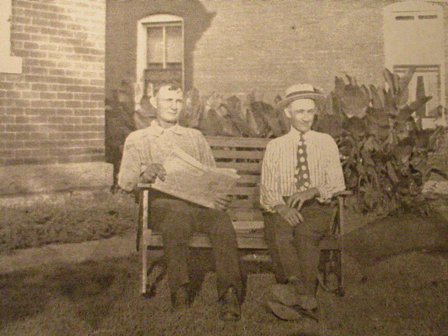
Here’s a picture of my great-grandfather John Christian Renner and my grandfather John Pollock Renner.

Now, while they were talking, my parents also pointed out to me that this swapping of iris rhizomes was probably not something done by the men of the family, but by the women. Hmmm.
Sue and I are still calling them our “Johnny iris.” Maybe I persist in this because iris are my favorite flower, and I want to associate my maternal grandfather with something elegant and beautiful, when I know he carried a lot of pain deep inside him.
. . . There’s another story, too. My mom explains that her family, there at 218 W. Elm, had had a bunch of iris along their back picket fence. These, she said, were bluish purple and not dark; she referred to them as “purple flags.” This color difference throws doubt on the idea that these are the same as our “Johnny iris.”
Anyway,
those iris had a story, too. My mom told me that her grandpa, John C. Renner, had brought them home from work one day.
During the end of the 1800s and the first three decades of the 1900s, he worked with the Missouri Pacific Railroad. He had been a line foreman down at Cole Junction, west of town. One day, while he was working, he had seen a yard that had lovely iris. He told their owners, a couple of ladies, that he admired their iris. The women were flattered and shared with him starts of those flowers. And that’s where they came from—John Christian brought them home. So they, too, are a sort of “Johnny iris.”
Here’s a picture of my great-grandfather John C. Renner, working on the railroad. He looks like a nice enough guy, huh? Wouldn’t you share some iris rhizomes with him?

Back then, people relied greatly on their neighbors and friends for new irises and other perennials. It must have been fun to swap starts. They did stuff like that for fun, instead of surfing the Internet. Mom told me they had beautiful white Siberian irises along their sidewalk to the back of the property, and that they also had some early yellow iris that had come from her mom’s mom, Grandma Wilmesherr (who was another inveterate green-thumb type).
Mom also explained that there was a Mrs. Cowley here in Jeff City somewhere, who was a bona fide iris fancier, who had the biggest and best iris garden around. She was the one who got my Grandma Renner fired up about iris, and she undoubtedly shared rhizomes with her.
Here’s a picture of my Grandma and Grandpa Renner, upon their golden wedding anniversary:

And then, of course, good neighbors share plant starts with each other, too. It’s quite possible that my Grandma Schroeder got her stories mixed up and thought that her dark early-bloomers were the ones my Great-Grandpa Renner had carried home from the railroad that day, even though they apparently are not.

So you can see that the provenance of the iris in our yard is no longer ascertainable; the iris traders of the past, men and women, and John C. and John P., are gone, and so are the details of their stories. Still, though, the iris live on, occasionally relocated, but always appreciated, every spring.
Whenever I see hardy, heirloom irises blooming in older neighborhoods, I think of these stories and realize that each clump must have a similar history.
A line foreman in dungarees, doffing his hat politely and telling some ladies that their irises sure are pretty. Two neighbor ladies chat in the backyard and offer each other starts of their favorites. A young couple brings shovels and wheelbarrow to an in-law’s house to rescue plants before the house is town down. A Mrs. So-and-So’s fancy iris garden inspires a modest, Depression-weary housewife. A mother gives her daughter the latest yellow variety.
And they all have bloomed, every year.




 Posts
Posts

