Showing posts with label pickles. Show all posts

Friday, September 16, 2022

Grilled Cheese Atrocity

Yaay! It’s time for another childhood culinary atrocity! This time, I’m sharing with you the special grilled cheese sandwich I “invented” in high school!

Well, what kinds of foods did you proudly “invent” when you were first making your own food?

I’ve been revisiting some of my formerly favorite foods that I used to make for myself when I was a youth. Before I had heard of health foods. Before I had ever eaten at a Chinese restaurant. Back when pizza and spaghetti were “ethnic” foods.

The Requisite Digression

Yeahhhhh . . . back when Taco Bell was a spicy new fast-food place for us midwesterners. Its menu board had pronunciation helps like “EN-CHI-REE-TOH” and “TAH-COH.” Remember when Taco Bell’s taco sauce came in small plastic tubs with a peel-off, foil lid? Remember when they added a second flavor of taco sauce, “Hot”? Then, they started to put the sauce into the kind of packets they’re using today, only without the silly catch-phrases? Back when the corporate colors were brown, red, orange, and yellow? Well, this "recipe" dates back to about that time. Yes, you young things, back when I was young, there were only two sauces at Taco Bell: Mild and Hot! And we liked it! This was way before “Fire,” “Wild,” “Diablo,” “Fire-Roasted,” and “Green.”

And while we’re reminiscing, I’d like to say a few words about “authenticity” and Taco Bell. I understand the urge to pillory Taco Bell for being an inauthentic non-Mexican ripoff of true Mexican cuisine. It’s not Mexican. I don’t think it claims to be authentic. It is essentially fast-food junk food with garbage cheese, but . . . for many of us in the Midwest, it was the first time we ever had food that was spicy, that burned our mouths. It taught us the words taco and burrito. It wasn’t great food or even really good, but it helped us discover the cuisine. It was like Kenny G to jazz, or Boone’s Farm to wine; it was our gateway drug.

I’d also like to point out that, unless you like to cook for yourself, if you live in a small town in the Midwest, Taco Bell may indeed offer the best "Mexican" food for miles. This was especially the case in the 1980s and before. Even today, many of the so-called Mexican restaurants are worse than Taco Bell. The Bell’s basic tacos still stand up pretty well against some of the stuff I’ve had in midwestern Mexican joints. Honestly, I think midwestern Mexican restaurateurs know that a majority of their customers prefer seas of cheesy beans and gloppy, fatty meats, with sweet, ketchup-like salsa. And Taco Bell can be better than that.

Also, among fast-food places, Taco Bell is about the only one that offers anything besides salads and French fries for vegetarians to eat. And "Mexican-inspired" fast food can be much tastier than the standard ol' burger and fries.

Which leads me back to my topic. My sandwich has very, very little to do with Mexican food. Nothing, in fact. But Taco Bell Hot sauce is a key ingredient.

So hang on to your stomach, here we go!

Taco-Bell-Hot-Sauce Grilled Cheese Atrocity

For one sandwich, you will need:

  • 2 slices of sandwich bread (the plain white stuff)
  • 2 packets of Taco Bell Hot taco sauce (not any other flavor)
  • About 4–5 hamburger dill pickle slices (Heinz preferred)
  • 2 slices of mild or medium cheddar cheese
  • Margarine or butter (for frying)

Spread the Taco Bell Hot taco sauce onto one of the slices of bread. Top with sliced cheese, then add the pickle slices. Cover with the other slice of bread.
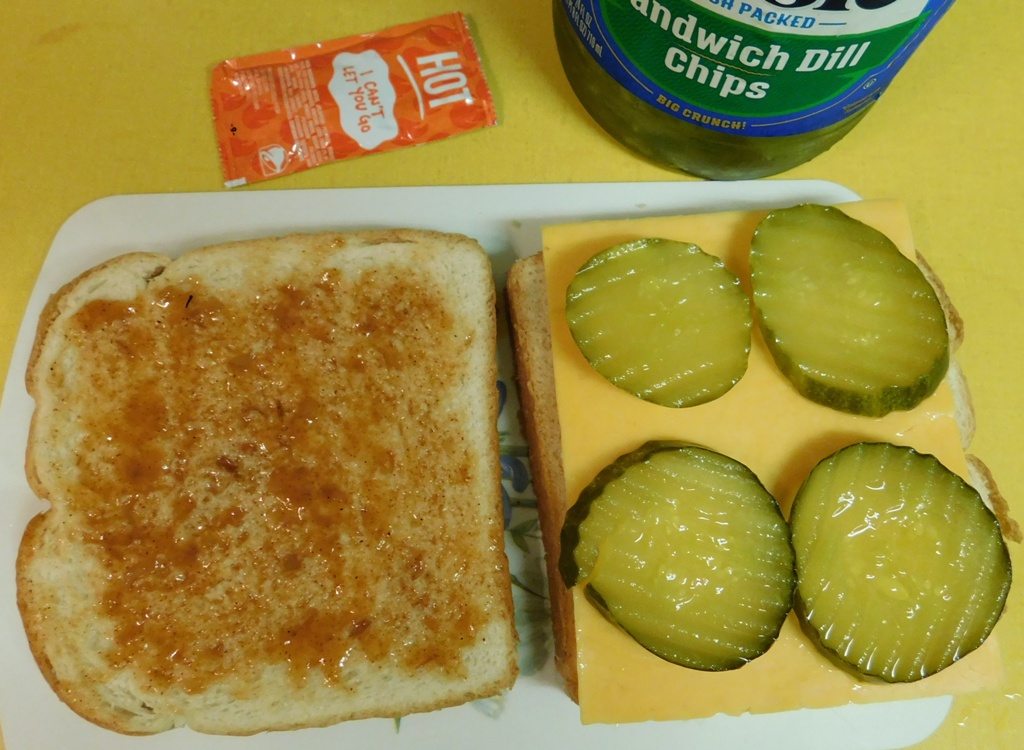
Heat a skillet, add a pat of margarine or butter into the skillet; when it’s melted, heat the sandwich on the buttery skillet. Flip. Cook until toasted. You can eat it now, or . . .

Bonus points: In high school, I used to make this in the evening, then pack it up in aluminum foil and carry it to school for lunch the next day. So try this: let the sandwich cool on the counter, then wrap it in foil or a sandwich bag. Refrigerate overnight. Eat cold, or at room temperature, as if it had to sit in your locker until lunchtime. It’s actually better this way, after it’s rested and solidified somewhat. I’m not sure why, but it’s the same principle as enjoying a cold slice of pizza or a piece of cold fried chicken. It might be because, being more solid, the sandwich seems more substantial. It’s also tidier to eat, now that it’s not gooey and drippy.

What is it that makes this work? On paper, it’s an atrocity: dill pickles and taco sauce. It must have something to do with the specific flavor of the Taco Bell Hot sauce. My guess is that the smooth, mild cheese melds whatever flavors the pickles and taco sauce have that can harmonize. The distinctive flavors of Taco Bell Hot sauce include plenty of cumin with onion and garlic powders, and I think those go especially well with something in the pickles. Maybe it’s the garlic, or maybe the vinegar . . . or maybe it’s just a salt festival. But try some other hot sauces, and you’ll see it just doesn’t work right.

Saturday, December 12, 2015

Easy and Reliable Kimchi

My kimchi is ready! It finished fermenting and I packed it into jars: Now I’m having a hard time keeping out of it! The recipe comes from my friend Bonnie, who calls it “bomb-proof”—but even more compelling than that is the addictive, fresh flavor of the finished product.


Before I pass along the recipe, I want to give you some sense of its provenance. Bonnie’s brother Jim, who lives in Washington, D.C., sent the recipe to her about a decade ago. He created the recipe from instructions he got from two people: An octogenarian named Mr. Woo, who owned a dry cleaning shop and convenience store in Dupont Circle, and a friend’s wife, Sue, who is Korean.

Bonnie suggests we call it “Jim Woo Sue’s Kimchi,” or perhaps “Woo Sue Jim’s Kimchi,” for a more chronological lineage. Or, I suppose, “Woo Sue Jim Bonnie’s Kimchi,” since I got it from her!

And I’m grateful to her for sharing it with me!

I’ve amended a few details, not very important ones (for example, I prefer smaller chunks, so I’ve given a range of chopping sizes).

See the notes below the recipe for additional ideas.


Easy and Reliable Kimchi

3 tbsp. plus 1 tsp. Kosher salt (divided)
6 c. water
1 lg. head (approx. 2 lbs.) Napa cabbage, cut in ½–2 inch squares
6 green onions, slivered lengthwise, then cut in 1–2 inch lengths
1–2 tbsp. minced fresh ginger (see note below)
2 T Korean ground dried hot red pepper (see note below)
3–4 minced garlic cloves (I use a garlic press)
1 tsp. sugar

1. Dissolve 3 tbsp. salt in water to make a brine. Put the cabbage in a large glass bowl and pour the brine over it. Weigh the cabbage down with a heavy plate or glass pie pan (or similar nonreactive object). Let it stand (at room temperature) for 12 hours.

2. Drain the cabbage, reserving the brine. Mix the cabbage with the remaining ingredients, including the remaining 1 tsp. salt. Pack the mixture into a 2-quart jar (or two 1-quart jars) (wide-mouth jars are a good idea). Pour enough reserved brine over the mix to cover it. Push a freezer bag into the mouth of the jar and pour remaining brine (or fresh water) into the bag to seal it. Set the jar(s) in a Pyrex baking dish (or similar nonreactive tray) to catch any brine that might bubble out. Let it ferment in a cool place (less than or equal to 68 degrees F) for 3 to 6 days, or until it’s as sour as you like.

3. Remove the brine bag and cap the jar(s) tightly. Store it in the fridge, where it will keep for months.


Notes


What do I eat it with?
Bonnie says this pairs well with foods that are spicy, smoky, or rich, such as barbecue, chili, smoked fish, canned tuna, and so on. Basically, think of this as another kind of pickle or relish to enjoy. Plus, of course it goes well with Korean foods!

Minced fresh ginger. Asian recipes got a whole lot easier for me when I started batch-processing fresh ginger ahead of time and freezing it flat in a thin layer in a freezer zip bag. I described the process when I told you about a cantaloupe sorbet recipe.

Dried hot red pepper.
The recipe calls for the Korean kind, but I used a combination of “regular” crushed red chili flakes and Indian ground red chilis. You must use your best judgment, based on your own heat preference and how hot your dried chilis are. (You can always add some chili and make it hotter, but it’s hard to do the reverse.)

Alternate veggies.
Bonnie says this recipe works with lots of different kinds of cole and root vegetables. I’ll bet thin-sliced bok choi, turnips, or cucumbers would be good variations.

On a grilled cheese sandwich. Bonnie loves to caramelize the kimchi and put it on a grilled cheese sandwich. She caramelizes it by chopping ¼ cup of the kimchi rather finely and mixing it with 1 tsp. brown sugar, 1 tsp. rice wine (I think mirin would do nicely), and 1 tsp. soy sauce. Then, she heats a little oil in a skillet and cooks the mixture until it bubbles.


Friday, December 4, 2015

Pickled Cabbage, Kimchi, First Steps

There are lots of reasons to enjoy food preparation. In addition to producing something that people can enjoy, the process itself can be pleasant and fun.

This is true whether the cooking is challenging or simple. When it’s challenging, the process can provide the satisfaction of mastering something hard. When it’s simple, then sometimes it’s about witnessing a miraculous, synergistic, seemingly alchemical process.

The latter is what I’m up to today.


Making kimchi is ridiculously simple: Basically, you just throw a bunch of stuff together in a bowl, and let it sit. But the results are bafflingly good, thanks to some biochemical “miracles.” In lactic acid fermentation, naturally occurring bacteria convert carbohydrates (sugars) in the cabbage into lactic acid, raising the acidity of the whole, which helps preserve the cabbage. The process of brining softens the cabbage and also helps preserve it. Both the fermentation and the brining make it tasty!

In addition to being a practical, cheap, no-cook method of preserving and flavoring foods, lactic acid fermentation—when you do it at home and don’t heat-sterilize the jars—provides so-called probiotics that assist and improve your digestion. It’s very similar to the process that creates yogurt, sourdough bread, Japanese miso, and many other dishes.

To our ancestors, to our grandparents, this method of pickling was a boon for surviving and enjoying winter. Fruits and vegetables had to be preserved, if you wanted them at all. In western Europe, fresh cabbage was turned into sauerkraut. In Korea, China, and other southeast Asian lands, kimchi and its variants were about the same thing, only flavored differently—with ginger, garlic, green onions, chilis, soy and/or fish sauce, and so on.


In Europe, the finished kraut can be served straight up, or it can be drained, rinsed, and drained again, then simmered with sautéed onions, tomatoes, and/or chicken stock, flavored with such things as juniper berries, caraway seeds, peppercorns, and bay leaves. Meat, such as pork chops or sausage, can be cooked in a bed of this kraut. Or you can make sauerkraut salads or other dishes out of it, using drained kraut as an ingredient and not an entire dish in itself.

I hear it’s pretty much the same way in Asia, where kimchi can be served right out of the crock, or it can be sautéed or otherwise further prepared, and used in other dishes.

I’ve often entertained fanciful ideas about the parallels of Germany and Korea—proud mainland nations divided into two by war, yet united in language, culture, and family ties; nations historically dominated by a hard-working peasant agriculture economy, now transformed into industrial powerhouses; nations whose most famous (or notorious!) dish is funky, fermented, pickled cabbage. Isn’t that interesting? Do you suppose there are other shared cultural characteristics, as well—a similar mind-set, similar outlooks and attitudes?


Anyway—my musings aside—a friend gave me her brother’s recipe for kimchi, and I’m finally trying it!

I’ve never made kimchi or sauerkraut before, and I’ve been wanting to try making both for a long time. Especially once I figured out that homemade krauts are much tastier than the “store-boughten” kind!

Last night, I chopped up a big head of Napa cabbage and set it to soak in a salt solution (brine) overnight. This morning, I combined the various ingredients, packed it in two quart-size wide-mouth jars, “sealed” them loosely with a plastic bag of water, so bubbles can escape . . . and now we wait.


If it turns out well, and if my friend says it’s okay with her, I’ll share her recipe with you!

More to come!


Friday, October 21, 2011

The Hearthstone’s Pickled Grapes: “Especially Nice for the Tea-Table”


Today I’m returning to a very old book we picked up at a used bookstore: The Hearthstone; or, Life at Home: A Household Manual [etc., etc.], by Laura C. Holloway (Philadelphia: Bradley, Garretson, 1883, yes, 1883).


Among the “Cookery Recipes” in this volume are several formulas for various types of pickles. Obviously, in the 1880s, if you wanted to have anything remotely resembling a fruit or vegetable in the wintertime (not counting potatoes, cabbage, and apples), you needed to preserve it before it went “south.”

I try to imagine what winter dinners were like before refrigeration, advanced greenhouses, and rapid transcontinental shipping: Meat ’n potatoes ’n cabbage. Potatoes ’n cabbage ’n meat. Cabbage ’n meat ’n potatoes . . .

So when Mom would have you go to the basement and fetch up a jar of pickled peaches, zesty gherkins, or zippy tomato catsup, it would turn the mundane into something you could, well, relish.

I encourage you to check out the recipes in this book. You can find digital copies of it online. Some of its pickle recipes today seem a tad unusual—including pickled nasturtiums, pickled damsons, cucumber catsup, and walnut catsup!

But the one we’re talking about today is on page 511: “Pickled grapes.” With my glorious abundance of Concords, I have plenty to experiment with. So I tried it this week!

No, it’s not as bad as you think—it’s not like dill or sour pickles. It’s more along the lines of “pickled peaches”—flavored with cloves and cinnamon, and brightened with apple cider vinegar—except with grapes, it acquires the texture of a sauce or jelly. It makes a great relish for any kind of dry meat that harmonizes with sweet flavors. It would be great on turkey, I think, or with pork chops or white-meat chicken.

Hey, maybe you could make this for Thanksgiving! The deep purple hue and the silky texture would be an interesting alternative to the usual ol’ cranberry-stuff you usually serve.

And it would be good on biscuits, and all of that kind of stuff, too. —Oatmeal? Why not!

And it’s good on crackers!


Here’s the recipe. I quartered it (those quantities and my notes appear after the official, full recipe).

Be careful not to overcook it; this recipe relies on the natural pectin in the grapes. If your grapes don’t quite “jelly,” don’t sweat it. It’s just fine when it’s on the runny side.

Here we go, verbatim from the book:

Pickled Grapes.—Seven pounds of ripe grapes, picked from the stems, and boiled until the skins will pass through a colander; three and a-half pounds of sugar, one-half pint of vinegar, one ounce each of whole cloves, cinnamon and allspice; all boiled together until it jellies. Put in glasses, and turn out in form. These pickles are especially nice for the tea-table.


But now, here’s how I did it: I processed the grapes in my usual way: I measured the cupfuls of grapes first; slipped off and reserved the skins; boiled the insides until soft and passed them through a food mill to deseed them. To ensure a fairly smooth texture, I chopped up the skins before reuniting them with the grape “guts.” Then I proceeded as the recipe says, cooking all ingredients together. I didn’t can (preserve) it; I’m just keeping it in the fridge. Depending on how much you cook it down, the quartered version will make no more than a few pints. Mine made about a pint and a half.

Here are the quantities for my quartered version:

3 cups Concord grapes (about 1.75 lbs.), processed as above to remove seeds
2 cups sugar
1/4 cup apple cider vinegar
1 tsp. cloves (I used powdered)
1 tsp. cinnamon
1 tsp. allspice


I wish I could give you some to try, because I think it's delicious. But maybe that's "just me." So when you try this recipe, make sure you write and tell me what you think!

Addendum: A few days after posting this, I found a similar recipe in another old cookbook, and it was recommended specifically as a relish for venison. Click here for my post on it.


Monday, January 4, 2010

In Northern Ohio, Shop at the Vermilion Farm Market


Well, I’ve reviewed restaurants, why not review some grocery stores, too? Like I told you, we spent Christmas with Sue’s family in northern Ohio. I’ve been visiting up there enough years to get a real feel and appreciation for the regional specialties. One thing that strikes me as unique—compared to here in Central Missouri—is the blend of the “Firelands” New England–types with a large population of Eastern Europeans.

There are several cultural commonalities between here and there, however, including many ethnic Germans and some relatively large Amish communities.

In the rural landscapes between Sandusky and Cleveland, where we spend most of our time, there are miles of country highways past colorful orchards and truck farms, vineyards and wineries, dairies, horse breeders, and plenty of cornfields. And compared to here, the farms are tidy. It looks like the landowners must spend a lot of time with weed-whackers and lawnmowers, and buckets of paint for touching up the barns and fences.


Because of the proximity to Lake Erie, there is a healthy freshwater fishery, providing good walleye, perch, and more, fresh to an appreciative population. This region is often called “America’s North Coast,” and for good reason. Summertime lake tourism is a major industry here.

So it comes as no surprise that there’s a kick-ass farm market in Vermilion, Ohio, which is right in the thick of all this good farmland and shoreline, and all these people who demand fresh, good products.

First, here’s the official Web site for the Vermilion Farm Market. They are located at 2901 Liberty Avenue, in the town of Vermilion, Ohio.

You know how I feel about locally owned, non-mega-chain places, and this is one. This store is unique and directly reflects the needs of its actual customers. Its owners and workers are friendly and knowledgeable. If they don’t have an answer for you, they’ll find one. If you have a store like this nearby, buy your stuff there. Help them stay in business.

The Vermilion Farm Market boasts of its “Gourmet specialties, extended wine selection, and full-service bakery,” but truly, that’s just the tip of the iceberg. A lot of stores can tout these things. But what sets this grocery apart is the ratio of interesting things to the square footage of the store. This ain’t no Walmart.


The place is packed with goods without being cramped, and all the displays are tidily arranged. And despite all the meat and fish they sell, it doesn’t smell bad in there at all; neither does it smell like disinfectant. It just smells like a market.

Practically everywhere you look, from the Amish cheeses to the Polish sausages, you see something that reflects the region, its specialties, the preferences of the local palates, and ethnic traditions.

Here’s a list of some of the things I noticed. Most of these products I just don’t see here in Central Missouri—so when I saw them in Vermilion, I knew I was in a real market, and not some dreadful mega-food-industry clone.


Pierogies (and not just the nationally marketed Mrs. T’s brand). Here, they carry Sophie’s Choice pierogies, which come in a joyous array of flavors: potato, cheddar, sauerkraut, cabbage, apple . . . prune . . . apricot. . . . I’m not kidding you! These puppies are good! No matter what your ethnic heritage, these ravioli-like packets will holler “mom-food” to you, and “home.”

Sauerkraut Balls. Another regional dish; I’d never heard of it until I went bowling with Sue’s family one year. These things are delicious! I’m sure they’re not perfectly good for you, but still, if you haven’t tried them, you really oughta. They’re in the frozen food section. Oh, they don’t have these at Walmart? Huh! Wonder why?

Meats and Smoked Fish. A full-service meat counter; they know what they’re doing here. Do you know what Kizka is? It’s an Eastern European beef blood sausage. Same with Hurka, I guess, though I’m not sure. They had both. There was also Baccala (salted cod—a traditional Italian Christmas Eve dish), as well as a fine selection of dry-smoked trout, carp, salmon, and other fish. No, they’re not much to look at, but neither is bacon, and you know how good bacon tastes.


Mrs. Miller’s Homemade Noodles. Amish-style egg noodles (plus no-yolk, veggie, and organic ones) produced by a small company in Fredericksburg, Ohio (which is in the Amish country south of the city of Wooster). Nice wide noodles, kluski, pot pie squares, etc. The same company also makes a full line of pasta sauces, jams and jellies, and other preserves.

Bell-View Specialty Foods. Another regional company, a fourth-generation family business based in northern Pittsburgh. They specialize in pickles, preserves, mustards, dressings, and so on. Sue’s brother-in-law pulled me aside and pointed at a big jar of hot pepper rings: “These are the best I’ve ever had. They retain a good crunchiness, have excellent heat, but pack a good flavor as well.” I declined to try to carry a big jar of peppers home with me on the plane, but after he gave me a sample the next evening, I’m regretting my decision now.


Ballreich’s Marcelled Potato Chips. I’ve told you about these before. These are the best chips in the universe, made by a family-run business in Tiffin, Ohio. I don’t know why they’re so good; you don't look a gift horse in the mouth. Ballreich's are available all over the region, but why not pick up a bag while you’re here?

The Bakery. Of course this is another section where ethnic colors shine brightly. I noticed Italian breads from Cleveland’s Orlando Bakery (which was founded by Italian immigrants) and “Charlie’s Kolachi,” which are festive nut rolls, another Eastern European specialty—apricot filling, walnut filling. And the market has its own in-store bakery, so the goods are fresh and delicious.


The Produce. Though the selection isn’t mind-blowing, it is ample, fresh, and well-tended. There are enough special items to keep it far from average, and I noted—or perhaps by now I was looking for it—a certain slant that said “ethnic tradition” to me. Plenty of turnips and beets, for instance. And packages—nice big packages!—of fresh dill. Someone’s making home cooking with these, and it’s like nothing you’d find at a Rubee Tewsdee’s.


Wines. Naturally, there’s a good selection of domestic and imported wines here, but even more exciting, you’ll enjoy exploring the great selection of local wines produced in northern Ohio and the Lake Erie islands—including Catawba Island (which is not really an island, but you might recognize the name anyway). Grapes have been grown in this region for generations, and you can find excellent Niagaras, Catawbas, Concords, Sauternes, Rieslings, Cabernets, and late harvest wines among their products.


Indeed, here are some of the wineries represented at the Vermilion Farm Market: Lonz, whose historic winery is located on Middle Bass Island; Mon Ami, on the mainland at Port Clinton; Pelee Island Winery (Pelee’s across the border and belongs to Canada, but on a good day you can see Pelee from North Bass); and Quarry Hill Winery, located in good ol’ Berlin Heights, my sweetie’s hometown.

Sigh. . . . I never quite know how to conclude these “reviews,” since by now it’s pretty clear that I’m telling you to go there if you can. I know it’s really a cheerleading session about local color, ethnic diversity, and small, family-run businesses.

As I explored the store on my vacation and photographed the aisles here and there, a fellow approached me and asked what I intended to “do” with my pictures. Well, I, uh . . .

Okay, I put them on my blog.

. . . I hope he doesn’t mind.

Vermilion Farm Market
2901 Liberty Ave.
Vermilion, OH 44089
(440) 967-9659

http://www.vermilionfarmmarket.com/

Hours:
Monday–Saturday: 8–7
Sunday: 10–6


Sunday, May 31, 2009

Walnut Catsup

Building on the subject of the last post, I wanted to talk again about the old tome The Hearthstone; or, Life at Home: A Household Manual, by Laura C. Holloway, published in 1883. Google has the entire book available online, here.

You might remember me making fun of this book’s “Toast and Water” recipe some weeks ago. Turns out some retro recipes deserve to recede into dim history!

But we were talking about ketchup, or catsup, as some would spell it. (Editor’s note: Webster’s 11th Collegiate has ketchup as the first spelling, followed by catchup and catsup in that order, so among U.S. editors, ketchup would almost always be the preferred spelling. Unless you have a good reason to prefer one of the alternate spellings . . . such as when you’re quoting from an 1880s cookbook that spells it catsup throughout and don’t want to annoy your reader by switching back and forth a lot . . .)

So, there are a lot of catsup recipes in Holloway’s book, beginning on page 508, in a section called “Pickles and Catsups.” Here’s a list of the recipes in that section:

--To Pickle Lemons with the Peel on.
--To Pickle Lemons without the Peel.
--Knickerbocker Pickle [“for beef, mutton and pork”; recipe makes one hundred pounds of pickled meat].
--To Pickle Green Tomatoes.
--To Pickle Red Tomatoes.
--Indian or Yellow Pickle (Mrs. Reynolds’ recipe).
--Mangoes. [Not what you think! It is muskmelons stuffed “with mustard-seed, allspice, horseradish, small onions, etc., and sewed up” and pickled.]
--Mushrooms.
--Onion and Cucumber Pickles.
--To Pickle Gherkins.
--Nasturtiums.
--Pickled Grapes.
--To Pickle Peaches [3 different recipes for these].
--Pickled Peppers.
--Pickled Onions.
--Spanish Onions—Pickled.
--Pickled Plums [2 versions].
--East India Pickle [What the hey? It’s cabbage, onions, horseradish, green peppers, vinegar, mace, cloves, allspice, cinnamon, alum, and salt.]
--English Pickles.
--To Pickle Eggs.
--Universal Pickle.
--A Tennessee Recipe for Tomato Catsup (1) [I think Holloway was from Tennessee; no wonder she lists it first].
--Tomato Catsup (2).
--Tomato Catsup (3) (Mrs. Reynolds’ recipe).
--Tomato Catsup (4) [Yes! Four different recipes for tomato catsup! Glory!].
--Cucumber Catsup.
--Walnut Catsup.
--To Make Curry Powder.

. . . So, are we scared yet, or intrigued? My home-canning skills are pretty minimal, so if I attempted to put up any of these, you should be very afraid. But I think it would nifty if a skilled home-canner explored some of these recipes and used modern (trustworthy) canning materials and techniques to produce some recipes from history.

For fun, and because I’ll be talking more along these lines shortly, here is Holloway’s recipe for Walnut Catsup, found on pages 515–14 of her book. No, there are no paragraph breaks. (Her book was going to be long enough as it was, huh?)

Walnut Catsup.—One hundred walnuts, one handful of salt, one quart of vinegar, one-quarter of an ounce of mace, one-quarter of an ounce of cloves, one-quarter of an ounce of ginger, one-quarter of an ounce of whole black pepper, a small piece of horseradish, twenty shallots, one-quarter of a pound of anchovies, one pint of port wine; procure the walnuts at a time when you can run a pin through them; slightly bruise, and put them into a jar with the salt and vinegar; let them stand eight days, stirring every day; then drain the liquor from them and boil it, with the above ingredients, for about half an hour; it may be strained or not, as preferred, and, if required, a little more vinegar or wine can be added, according to taste. When bottled well, seal the corks.

Poking a pin through the walnut is the way to tell if the nut inside is still soft enough to be pickled and eaten; if the pin can’t penetrate, then the shells have formed too hard inside. Which, truth be told, would be sometime in June for around these parts, if I gauge correctly.

Interesting how she says you can either strain it or leave them whole. Wild, huh?

Well, more on this subject later . . .

FOR MORE INFO, LOOK AT MY POST ON PICKLED WALNUTS.