Showing posts with label spring. Show all posts

Friday, March 21, 2025

Pansies for Edna Day

This is one of the big ways we celebrate the beginning of spring here on West Elm Street: The annual planting of the pansies. This little tradition goes back eighty years to when my dad was a kid. He’d buy a shoebox of pansies from old man Hugo Busch on Dunklin and Madison for his mom’s birthday—which almost exactly coincides with the first day of spring. She would put them in her front planters, for everyone to see. Dad has written about this on his own blog, so I won’t repeat it.

This is one of the first subjects I wrote about when I started the Op Op, too. Look here for that blast from the past.

So yesterday, two days before Grandma’s birthday, I put pansies once again into the front planters. After the drab winter, the pansies, and the flowerbeds full of daffodils, are incredibly cheerful. And we need it.

My little addition to the traditional is to use a little bit of mulch, and to place crystals and interesting rocks artistically around the pansies, which helps hold the soil in place during these sometimes severe spring storms.

Each year I arrange the rocks and stuff a little differently.

As spring always does, there are chilly days mixed with warm ones. Sometimes a chilly day, though, is sunny enough to warm up our front steps, and I can sit on the steps and bask a little after work and before I make dinner. And the pansies are there to make me smile a little bit.

Here's how I arranged them this year.

Sunday, April 10, 2022

Jar of Goodness 4.10.22: Prairie Dogtooth Violets

. . . The weekly virtual “gratitude jar.”

This week, I’m expressing thanks for prairie dogtooth violets. The official name is Erythronium mesochoreum.

Although prairies are in my genetics, I grew up spending much more time in wooded Ozark landscapes. So the dogtooth violets I adored were the woodland species called white dogtooth violet, Erythronium albidum.

The prairie dogtooth violet is a newer friend and companion, one that lives on prairies and glades. It’s not mottled like its woodsy cousin, and it has several other distinctions as well.

So today, we visited Friendly Prairie, south of Sedalia, where they’ve recently done a controlled burn. That got rid of all the built-up dry grassy thatch, so the shrimpy little early-spring wildflowers are peeping up out of the moonscape, getting all the pollinators to themselves.

Did you know there is at least one species of native andrenid bee that specializes in visiting dogtooth violets? Sheesh. If any of those visited that prairie today, they were in heaven. HEA-VAN.

Did you know that the presence of prairie dogtooth violet is a good indicator that the land, where they’re growing, might never have been plowed? Ever?

It was a windy, blustery day, and the gusts swept right over the prairie parcel. The hundreds, thousands of little bell-shaped lily flowers shook and waved. Somehow I kept expecting them to make a tinkling sound.

Anyway, it was a really special day. Palm Sunday—while others were waving palm leaves, I watched these humble lilies wiggle in the undying wind. It was The Day of the Prairie Dogtooth Violets, and one I’ll never forget.

If you want to learn more about prairie dogtooth violet (and there’s lots of cool information to learn), see this page, which I might have had something to do with.

Sunday, April 3, 2022

Jar of Goodness 4.3.22: The Violets of April

. . . The weekly virtual “gratitude jar.”

This week, I’m expressing thanks for April flowers, specifically violets.

Did you know that seventeen species of violets have been recorded in Missouri? In recent years (like, the past decade or so), I’ve been taking pictures of our different violets as I encounter them. I’ve posted photos of violets—mostly different variations of the common violet (Viola sororia) that grow in our yard—on my blog before.

In early April, it’s still kind of early for a lot of violets, but I know they’re coming, and I relish the opportunity to enjoy them again.

Here are some of my catches.

In 2017, I was really jazzed up to discover this violet, which is uncommon. It’s the plains violet or wayside violet, Viola viarum. There’s a population growing amid rock riprap in a small creek bed near the Katy Trail somewhere in this state. (I’m not saying where.) Most of the violets I’d seen until then had round or heart-shaped leaves, so the leaves of this violet kind of blew my mind.

Once my eyes were opened to that, I started looking more closely at violets. Only about a week later, I found that species’ doppelganger, cleft violet (Viola palmata). It was growing along a gravel roadway on my cousin’s property in Moniteau County. The leaves are really variable on both these species, but the main distinction is that cleft violet has hairy leaves, while plains violet is glabrous.

That same spring, while I was taking pictures of violets willy-nilly, I also took some pictures of Missouri violet (Viola missouriesis), which has distinctively elongated, heart-shaped leaves, whose outer third is not serrated like the rest of the leaf is. The flowers are said to be more of a lilac hue that the similar common violet, with a slightly darker ring around the pale throat.

While I’m on the subject of violets with weird leaves, here’s the only halfway decent picture I have (so far) of an arrow-leaved violet (Viola sagittata), taken on a prairie south of Sedalia in 2012. The flower of this species isn’t anything unusual, but the leaves are remarkable and, among our violets, unique.

In the woodsy-woods in springtime, you should always be on the lookout for yellow violets (Viola pubescens. This is possibly one of our most pleasing violets.

Then there’s pale violet, or cream violet (Viola striata). I don’t think I’ve ever seen this species in nature, but we have scads of it in our yard. I think Grandma or her parents must have introduced it and cultivated it.

Another violet that grows for free in our yard is field pansy, or Johnny-jump-up (Viola bicolor). Unlike the others I’m showing you, this is an annual, and kind of weedy. It volunteers and reseeds in our yard. I’ve seen it growing along the Katy Trail, too. It’s pretty cute, with pansy-like faces.

Well, I’m all enthused now about the possibility of taking some more pictures of violets. I’d like to improve on some of the pictures I’ve taken so far (such as bird’s-foot violet, the queen of eastern North American violets), and I’d like to locate some of the other violet species I haven’t seen yet. Some of that will require traveling to the eastern Ozarks. At least one is found on prairies.

Mainly, though, I’m just enthused about seeing violets, and other wildflowers, in general. Who knows what else I’ll find while I’m at it?

Thursday, March 17, 2022

Leprarians for St. Patrick’s Day!

This post was brought to you by the color green!

St. Patrick’s Day is well-timed, as we celebrate the color green on this very late winter day. On the calendar, it’s so very close to official spring, but on the ground, we’re still not fully convinced. So we look for and relish each glimpse of green: each resurgent patch of moss . . .

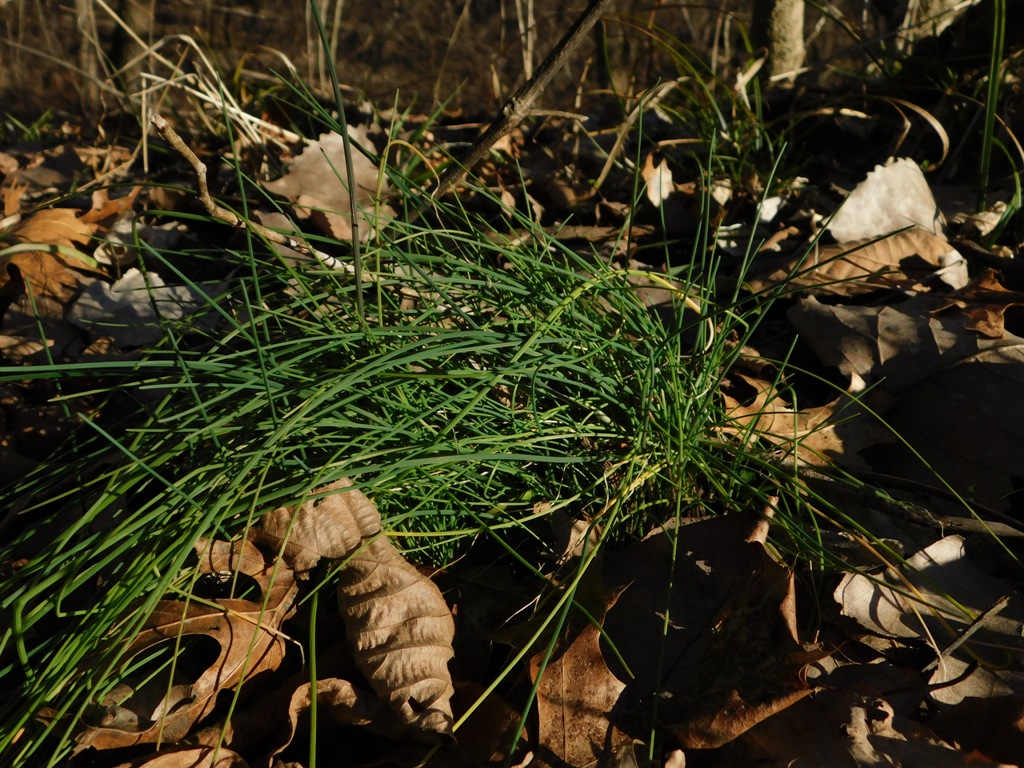
Each tuft of wild onion leaves waving around above the dry brown leaf litter . . .

Each green stink bug wandering around, warmed into activity by a persistent ray of sunshine.

This year, my favorite glimpse of green is a relatively new acquaintance: lichens in genus Lepraria, commonly called dust lichens. The leprarians I find myself spotting the most live in little sheltered nooks and crannies in cliff rocks, big boulders, or at the bases of trees. They tend to look like a minty green patch of dust, or cornmeal, clinging to the surface.

The dusty-looking granules are actually soredia—tiny ball-like packets of fungus and algae that readily break away to start new lichens elsewhere. (Remember that lichens are basically fungi that have algae living in their tissues—“fungi that have discovered agriculture.”) Missouri has something like six species of Lepraria lichens.

I like calling them leprarians, because it sounds something like “leprechauns.” And to me, they’re kind of like those small magical beings. They live in shaded, damp nooks in the woods, but they don’t live in every likely nook. There’s apparently no rhyme or reason to their occurrence. If you look for them, you’ll find one, eventually. But they’re not abundant around here, for sure. So when you see one, you go “Oho! There you are! I see you!”

Bonus fun: later in the year, once the insect world is back in full swing, you might see a small wad of lichen, less than about a quarter of an inch in diameter, wiggling and staggering around, trying to walk. It turns out there are lacewing larvae that decorate their backs with the soredia particles of lichens, and Lepraria species are one of their favorites for this purpose. It serves as camouflage for the larvae, which hunt and eat aphids. I don’t have a picture to show you, because the last time I saw one of these, I didn’t have my camera with me! But there are a number of fun videos online (such as this one) to see these curious little insects in motion.

Thursday, April 1, 2021

Opening Day: Yay!

Hallelujah! Baseball is back! It’s a wonderful thing.

A few years ago, I didn’t follow it much, but in recent years I’ve made a point to listen to the Cardinals. My parents are lifelong fans, so I grew up hearing Jack Buck and Mike Shannon call the games, it seems, every summer night of my youth. I go back to being a kid, up to my elbows in suds at the kitchen sink, washing the dishes after supper. The windows would be open. The air would be humid and heavy, but blessedly a bit cooler. The sound of the ballgame formed an auditory tapestry with the sounds of katydids, whip-poor-wills, crickets, frogs, nighthawks, distant traffic on Mexico Gravel Road or Route B.

I grew up hearing stories about the great Cardinals of the 1940s, because they were the heroes of my Mom and Dad. Mom used to say she was named after Dizzy Dean, since her middle name was Dean. I heard about Marty Marion, Enos Slaughter, Mort and Walker Cooper, and Stan Musial. Whenever Mom needed to tell someone how to pronounce the “oe” in our name, she’d tell them, “It’s like Red Schoendienst.”

By the time I was old enough to start paying attention to the radio while we were driving home from Jeff City, I heard Buck and Shannon call out names like Lou Brock, Bob Gibson, and Keith Hernandez.

When I was in junior and senior high, everyone was excited about Willie McGee, Vince Coleman, Darrell Porter, John Tudor, Bruce Sutter, Bob Forsch, Jose Oquendo, and, of course, Ozzie Smith, the super-athletic 13-time Gold Glove-winning shortstop who always did back flips as the team dashed out onto the field at the start of the game. Of course we watched all the playoff and World Series games.

But I didn’t really follow the Cardinals. Not like my parents and my brother did.

There was a time when I was a kid that I used my mom’s old first-baseman glove (a Snag-Em model), or borrowed my brother’s glove, and played lots of catch in the backyard, mostly with my brother. I never got into it; I was not very good at catching, since my depth perception suffers from my amblyopia and alternating vision. Also, there were no teams for girls, so not really a way to get involved enough to improve. And with my growing sense of feminism, I started realizing that sportsball, at all levels, is all about boys and men, which is incredibly unfair.

I used to wonder why practically a third of every newspaper and every news broadcast is traditionally devoted to coverage of sports. Why not science? Why not the arts? Why sports, especially so much on professional sports? Why not include it in the business section?

But I’ve altered my opinion in recent years—hence my purposeful attention to the game. It’s a way for me to connect with my parents. It’s a way to connect with my past, and my region. And it’s just fun. I like to listen while I’m fixing dinner or doing the dishes, or (with ear buds) even mowing the lawn. We haven’t had a TV in ages, and I don’t miss it. Radio baseball fits my lifestyle better.

We've even made a point of driving to St. Louis or Kansas City at least once a year to catch a game, except for last year.

Last year’s lack of baseball was revealing. There was a huge empty space in the summer evenings. It was as if the crickets had stopped chirping. It was so quiet. Also, we needed the diversion. With all that happened with the pandemic, and all that stress—we really needed it for its entertainment value. It didn’t matter who won or lost—we just needed the diversion. It was a blessing when it returned, even if just for a brief, weird season.

I just makes me appreciate baseball even more. It’s a challenging, complicated, unpredictable, and generally nonviolent game. Those players are like our friends. Their success is our success. Their struggles, frustrations, and losses are ours, but fleeting. It can be so symbolic and uplifting. It can reflect a lot of what’s great about the human spirit, including our sense of fairness and sportsmanship.

I’m so glad it’s back!

Go Cards!

Sunday, March 1, 2020

Spring Peepers, Coats Lane

Yesterday we went on a little excursion, just to get out of the house. We drove around at Eagle Bluffs Conservation Area, south of Columbia, just to see what we could see. Since it was kind of late in the day, we didn’t see much. What we did see, we didn’t see very well. Like this bald eagle’s nest. You can see it, can’t you?

Still, it was good to drive around and look out the windows.

We didn’t go straight home. Our meanderings, starting in McBaine, led from South Coats Lane north to Gillespie Bridge and then to I-70, which we then took to get around Columbia and back on our way to Jefferson City.

Below, I share a magical few moments of spring peepers chorusing from a farm lane off of Coats. The music exhilarated me and filled me with hope. You can’t yet tell by looking at the world, but the sound of these peepers is the jubilant sound of spring.

Wednesday, May 2, 2018

Violets Variation

Happy spring! For me, the preeminent flower of springtime is the violet: the ubiquitous "common violet" (Viola sororia) that grows in yards that are not poisoned by chemicals on a regular basis.

The taxonomy of these free and pretty little jewels has apparently given botanists fits. George Yatskievych, in Steyermark's Flora of Missouri vol. 3, summarizes "the tortuous nomenclatural history (and longest synonymy)" of this highly variable species. The species (as it's understood today, for now) differs in amount of hairiness, colors and color patterns on the petals, and lobing of leaves. Some apparently are not 100 percent wild; cultivated forms exist. I think that's what we have in our yard, mostly.

One reason, he says, for the variation and confusion might be because this species might hybridize with closely related violet species, but also that, because these violets also can create viable seeds from cleistogamous (non-opening, self-pollinating) flowers, an unusual specimen may easily reproduce its own weird genetic line in an area, filling the vicinity with its own non-sexually-reproduced offspring (basically clones of the parent plant).

I have kind of given up on trying to key out violets because of these differences. Every time I read technical and even nontechnical treatments of Missouri's violets, I get confused. It doesn't help that older references have them divided up into different species that newer references don't recognize.

But mostly, I simply hesitate to do the serious work in keying out the plants: picking and teasing and pulling apart the flowers, for instance. It pains me even to run the lawn mower over them. And they only last for a few months in the springtime.

So I will just enjoy them and let them be. They are a central reason I don't treat my lawn with weed killers.

Here's a little portfolio of the violets that grow in our yard. Enjoy!

First, some pictures of some "unusual" blue violets I transplanted them to Missouri from Sue's parents' yard in northern Ohio in May 2016, right after Mr. Ferber passed away. These rather pale violets are the most common type up there! Their yard is full of these violets. For all I know, they might be a different species. Anyway, the two little clumps I brought home have gotten pretty well established. I wonder if they're breeding with the other violets in our yard?


Next, the standard plain purple violets; most of the violets in our yard are these.


The next most common kind of violet in our yard are the "Confederate" violets, which Yatskievych calls Viola sororia f. priceana, "a form with grayish white corollas marked with violet or blue veins and sometimes also the lower petal spotted or mottled with purple." He says if you see any growing in a natural area, they are probably "plants that have escaped from cultivation rather than truly native occurrences."

Here is a typical purple and a Confederate together:


This year, I've noticed we seem to have a lot of variation in the "Confederate" violets. Yatskievych says, "Where such plants grow within natural populations of plants with bluish purple petals, individuals with intermediate corolla color patterns may also occur."

So here are some examples. First, some "regular" Confederates:


Then, there are some that look especially dark:


And here's one that seemed to have very pronounced dark veins:


On the other hand, here's one that's remarkably pale, but still with the "Confederate" patterning:


And I could only find a single pure white violet. Its stems and leaves are pure green, lacking the kind of reddish tinge the purple violets can have. And the petals are pure white. Sorry my photo's so lame. If it blooms again, I'll try to take a better picture. But you can get the idea even from this shitty out-of-focus photo.


(Really, I should be ashamed of myself for even posting this piece-of-crap photo...)

Finally, there is a different species of violet that occurs in our yard, and it's clearly separate. This one is Viola striata, the pale violet or cream violet. It has aerial stems (that have alternate leaves and flowers coming off of it) as opposed to having each leaf stem and each flower stem arising directly from the rhizome (like the other yard violets do). The flowers are narrower, and the stipules on the aerial stems are distinctly fringed with deep lobes or teeth (they look kind of comblike). The lower petal usually has dark purple veins (I guess that explains the species name, striata). Here are a couple views of it.




Monday, May 4, 2015

The Yellow Breeze

I used to rank springtime right up there with fall, as the very best time to be in Missouri, and possibly the best time to be alive, but I’m finally admitting it: Springtime has slipped to third place . . . behind winter.

Hang it all: I’m tired of fighting with the pollen. Until I was in graduate school, springtime never bothered me. Then, somehow (my mind still runs in circles, trying to figure out how it could have happened, as if there’s some kind of reason for it), I developed allergies to tree and grass pollen.


The first time it hit, I thought I had the world’s worst (and weirdest) head cold. In my effort to stop the nose running and the itching, I took so much Benadryl I became polka-dotted. I developed a rash. (I read the part in the instructions about “take every 4 to 6 hours,” but I neglected to pay attention to the part that says “don’t take more than X tablets in a 24-hour period.”) Fortunately, a doc with ASU student health center set me up with some Hismanal, and it was like clicking a switch: All better now.


And so each year my secret wish is that someday this might all “go away” just as mysteriously it came on. And if that wish doesn’t come true, then my second wish is that whatever allergy drug I took the previous year will still work this year. (And yeah . . . unfortunately, this year, Claritin’s nearing the end of its run. Geez, I’ve taken all the other ones. What’s next?)


I used to love to throw open the windows in spring, let the fresh cool air into the house. Taking down the storm windows and putting in the screens. Smelling the lilac blossoms from beneath the window. Awakening to birds singing in the backyard, because the windows are open. Or falling asleep to the sound of a gentle spring rain.

But no. This year, I entered allergy season on the heels of a head cold, and my throat, lungs, and sinuses are just . . . tired. So this year, when it started to get so bad that even Sue was suffering, we’ve decided to keep the windows closed, to keep the pollen out. It helps.

We also went and bought one of those true-HEPA air purifiers, and put it in the bedroom, so I can finally get some sleep.


It makes me sad to think that this time of year, when the weather is finally warm enough to let fresh air into the house, that a different reason has us shutting the windows. But then, ya gotta breathe, huh?

*Sigh.*