Showing posts with label trees. Show all posts

Sunday, October 23, 2022

Jar of Goodness 10.23.22: October Day at Painted Rock

. . . The weekly virtual “gratitude jar.”

This week, I’m expressing thanks for today’s trip to Painted Rock Conservation Area.

Yeah, mainly I’m talking about the fall color change. It’s simply amazing. Even though you know it’ll happen, you’ll still be speechless when you look out at a landscape that for months had been all the shades of green . . . and you suddenly realize it’s glowing yellow instead.

The whole world is yellow and orange. It’s glowing.

It doesn’t last long.

It’s that sweet transition time between “much too hot and humid; waaaay too many insects” and “freeze-your-ass-off, teeth-chattering cold; hardly anything living outside the window.” In October, you have some warm days and some cool days. Rainy and dry, windy and calm.

When you get a sunny, blue-sky day in the height of fall color, you grab it and get outside. Especially when it’s right near your birthday!

So we went hiking at Painted Rock Conservation Area, since it’ll be overcast and rainy tomorrow.

It’s one of our favorite hiking places nearby, and I’ve blogged about it before. It offers beautiful Ozark landscapes, both upland and lowland areas; a view of a serious river as well as several creeks and a few ponds.

We knew the popular, scenic Osage Bluff Scenic Trail would be busy, since it was such a gorgeous day, so we opted to hike the unnamed middle trail (that is, the other one, which is between it and the “Clubhouse Lake” trail).
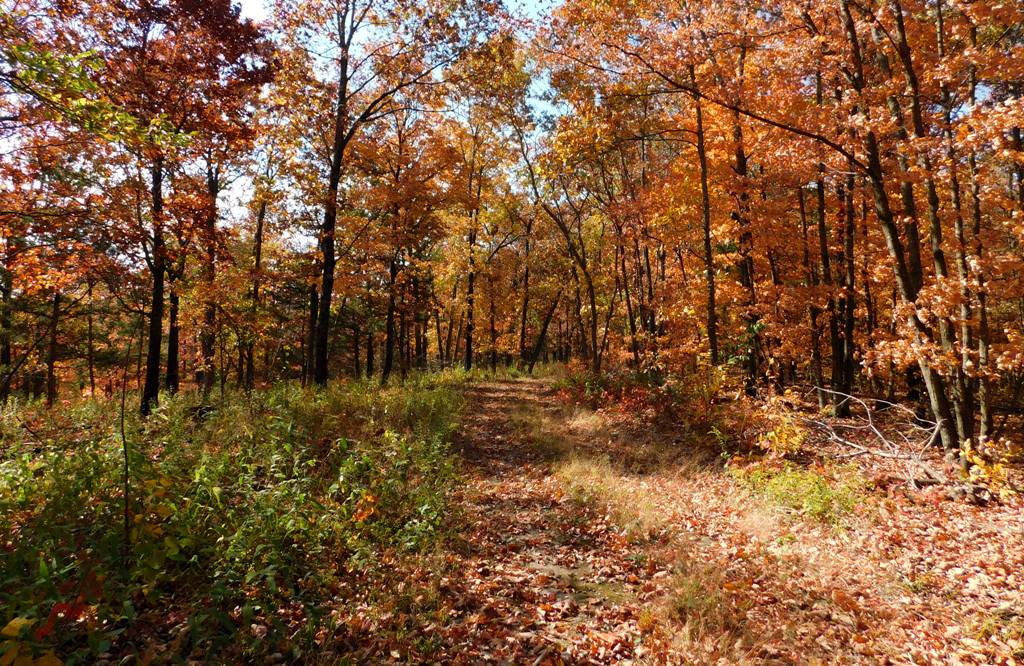
This trail has a couple of designated, completely undeveloped camping places near the parking area, at around 800 feet in elevation. Then the trail leads west along a ridge for a while before splitting into a Y: the left branch continues straight west to an upland wildlife food plot (a field of crops planted for wildlife) and apparently to nothing else. Meh. . . . But the fragrant sumac along this upland part of the trail was gorgeous.

All the understory shrubs and trees were being spectacular.

Meanwhile, the right branch of the Y veers northwest, working steadily down along the north side of the east-west ridge. No switchbacks. It’s an antique road that must have been used by the original Painted Rock Country Club, pre–World War II.

You can see hints of its former development—a culvert running below the road at one point; down lower, a concrete slab as a simple bridge over a creek; and more. It tickles me to picture Model A’s putt-putting down this little road, so the mayors and governors and fat ol’ senators could get close to the river.

Yes, the trail ends at the Osage River, around 530 feet in elevation . . . though if we’re being honest, the trail peters out before the river. The lowland brush and brambles, fallen branches, and what-not obscure where any official trail might be. And once you beat your way to the precipice, you’re on your own to figure out how to scramble down the steep riverbank. Sometimes you can use exposed tree roots like stairsteps.

Once you’re down the bank, though, there’s a nice wide, rocky gravel bar to explore.

With the river so low, we had a lot to explore! The gravel bar was covered with dried mud; the rocks were not clean-looking as they would have been if we’d had some decent rains this late summer, even as the river levels dropped. Oh well.
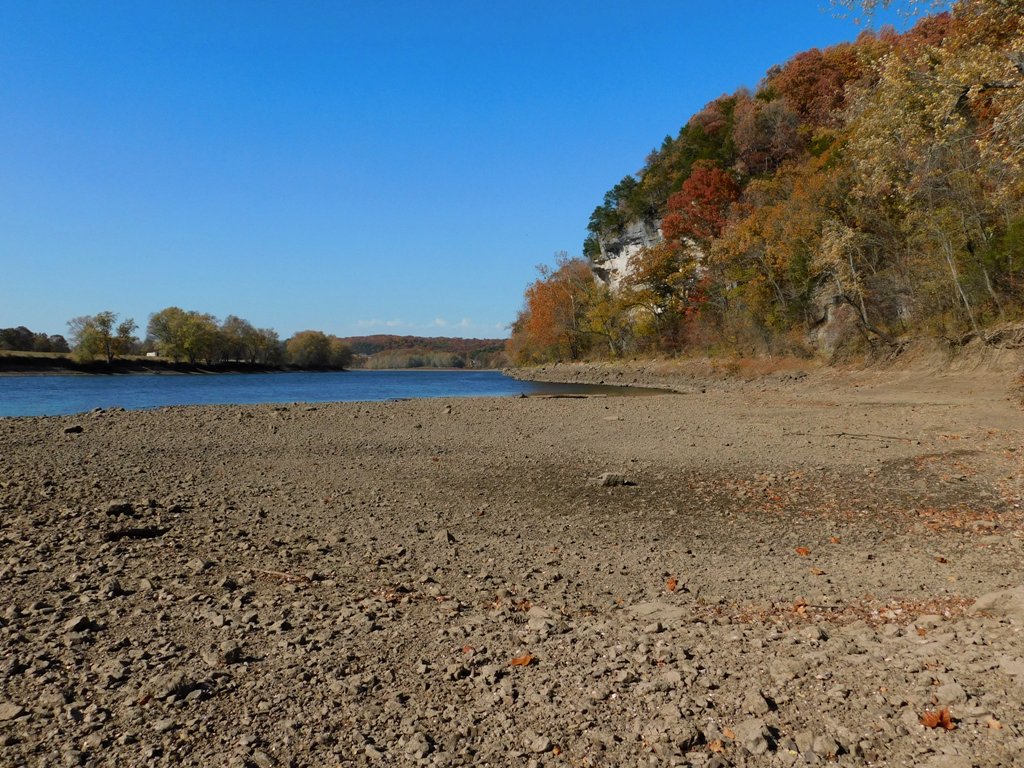
Sue loves Nicola White’s videos about mudlarking in the River Thames, in London. So she pokes around looking for seventeenth-century clay pipes, Tudor money boxes, and George III ha’pennies. Naturally, she finds none of these, but she finds fun objects anyway. Old bottles, pieces of broken plates and dishes, old bones (deer bones?), rusty objects.

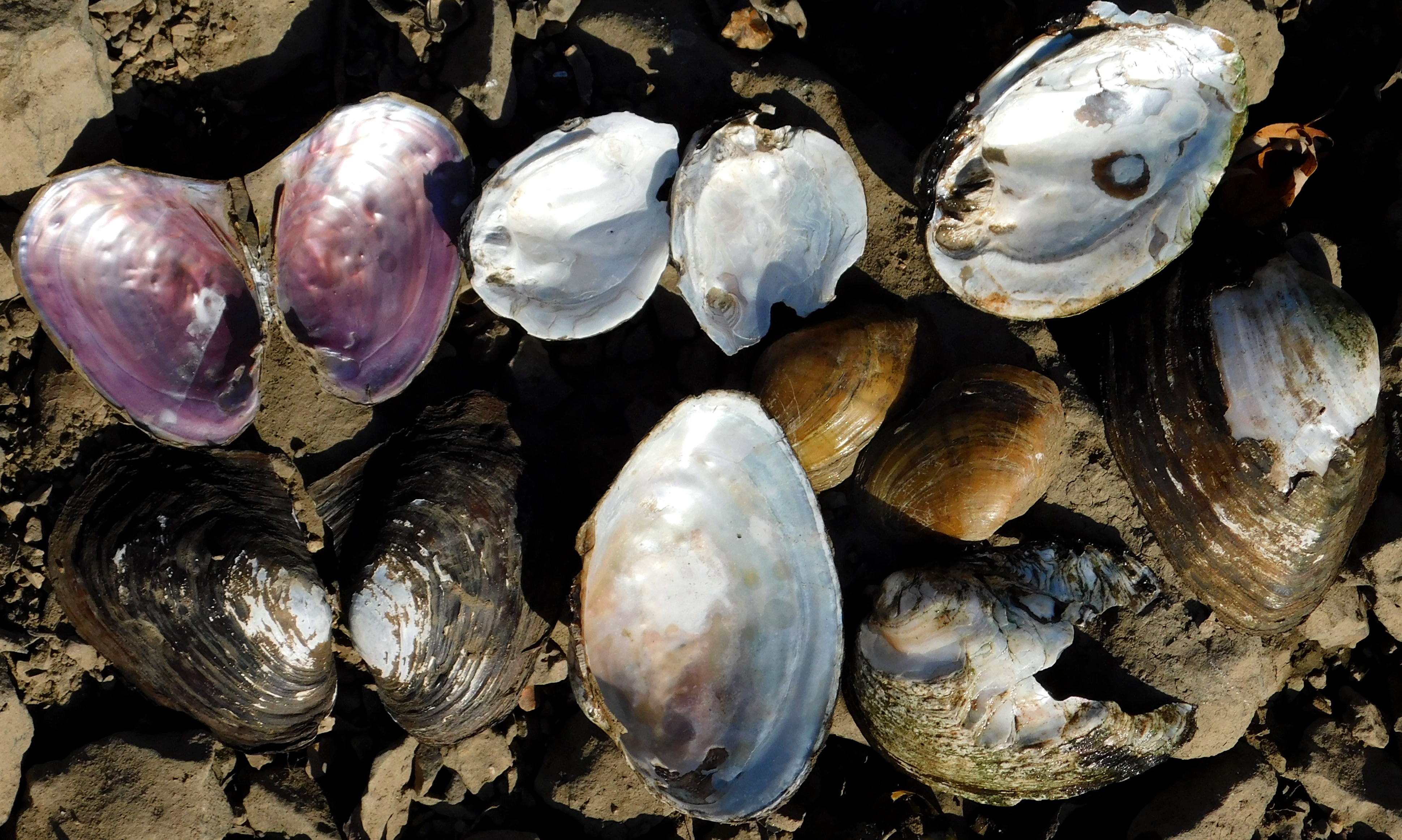
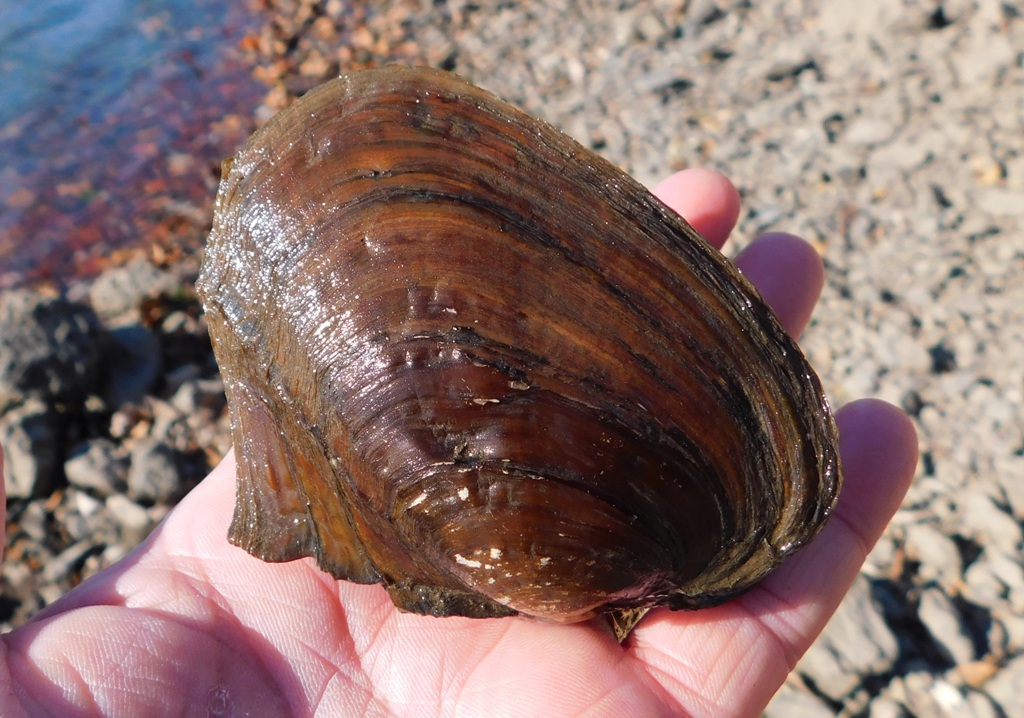
I find fun things, too. Where the bar was still muddy, hornets and some of the last butterflies of the season sought moisture. And did you know that Missouri is basically the global center of diversity for freshwater mussels, with about 70 species occurring within our borders? It’s thanks to our various, separated river systems. About 42 percent of our species are species of conservation concern, including several that are listed as threatened or endangered.
I also found a single Osage orange fruit lying partially embedded in the river mud—of the Osage River.

Who knows what curious things you’ll find when you look around.

I’m always interested in seeing the remains of the country club’s concrete steps leading down to what must have been a dock.

The old steps are gradually being erased by time and the river.

I’ll bet they had a structure here, like a fishing cottage, but I think their bona fide lodge was farther south, where their lake still exists and where you can still drive down a road to park near the river.

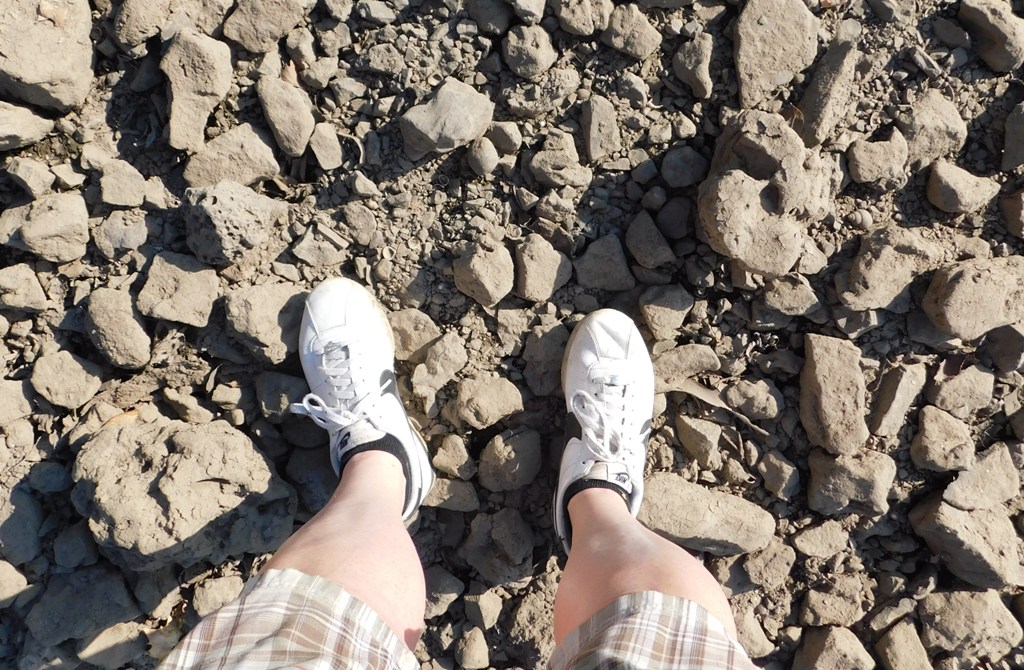
Anyway, I enjoyed taking pictures; breathing the fresh air, letting the gusty breezes flip my hair around. I even took a picture of my feet to show I was there.
It was a good day. Now it can rain for a few days, because we really need it.

I hope you’re enjoying this October, too!

Sunday, October 9, 2022

Jar of Goodness 10.9.22: Fall Color

. . . The weekly virtual “gratitude jar.”

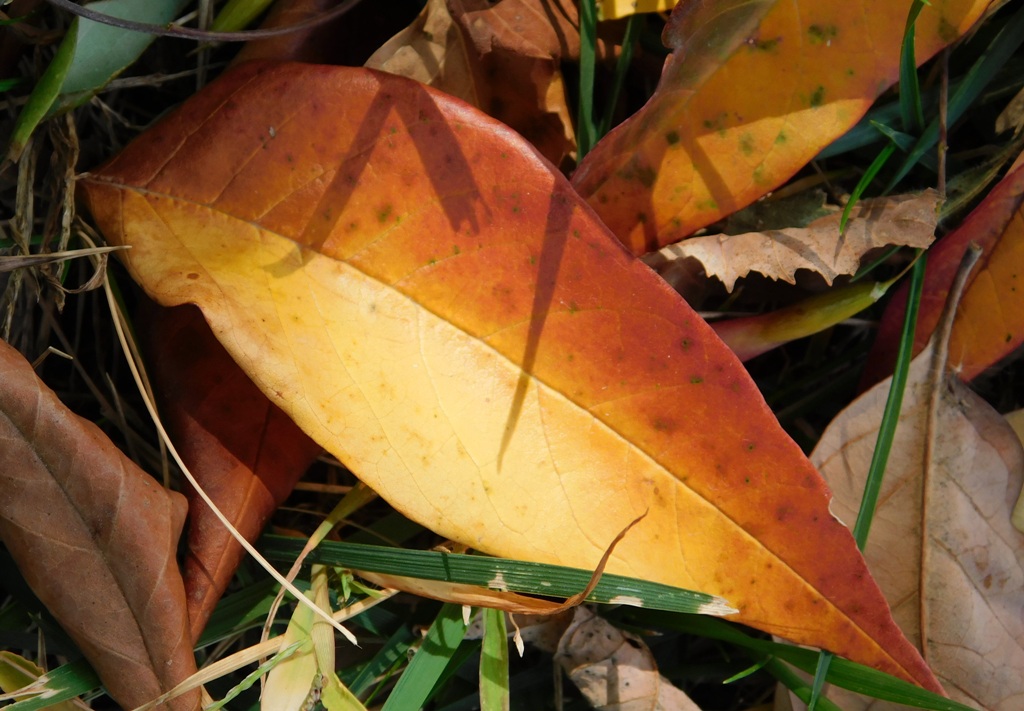
This week, I’m expressing thanks for fall color. For the beautiful leaves!

Leaf Day! Back in high school, one of my best friends and I would select a random day at the height of fall color season, and we would collect a bazillion lovely, bright-colored, fresh-fallen leaves, and then, in each of our various classes, arrive early and place a leaf onto each of our classmates’ desks. Plus the teacher’s. Everyone would be bewildered, but we’d simply reassure them: It’s Leaf Day! We’re celebrating! Aren’t they beautiful?

And our classmates would twirl their leaves and ponder nature during the rest of the class. (The janitors that evening were probably like, “what the hell—?”) Some of our classmates apparently enjoyed it, some thought it was stupid, but most, I think, really understood our point.

I think my friend and I had been inspired somehow to do this by listening to Leo Buscaglia talks on PBS, if that gives you a sense of the time period!

Wait, you haven’t heard of Leo Buscaglia? In the eighties, he was a big star on PBS. He gave lectures. He was a TED talk before there were such things. He was a great story teller, and all his stories made strong points. His favorite topic was love. Love was the title of his first bestselling novel.

We all oughta be reading and listening to Leo Buscaglia again. It would set us to rights again, maybe, for at least a little while. Here’s a video (in two parts) of perhaps his most famous lecture, “What Is Essential Is Invisible to the Eye.” The lecture, this time, was given at the University of Wisconsin–Eau Claire.

The lecture title was from The Little Prince (Le Petit Prince), by Antoine de Saint-ExupĂ©ry, and that was another book we devoured and got deep meaning from. Richard Bach’s Illlusions, another huge bestseller, and all this introspective, pop-psychological stuff set me going on a personal path that has given me a rich life. Not all of what followed was so great, but I’ve mostly managed to keep a balanced view. At any rate, it has helped.

Buscaglia’s lectures were full of humor, poignancy, and basic human wisdom. And emotional intelligence. We internalized tons of it. (And there was tons of it.) “People first, things second.” . . . “Life is God's gift to you; the way you live your life is your gift to God. Make it a fastastic one.”

My parents drove us to see Dr. Buscaglia speak at Kiel Opera House (now Stifel Theatre) in St. Louis. He was touring, and St. Louis’s KETC channel 9, the PBS station, was sponsoring him.

I don’t remember any direct connection our annual Leaf Day celebration had to Leo Buscaglia (his book The Fall of Freddy the Leaf wouldn’t come out until later) . . . but there’s a connection somewhere. (“The trees outside of your home are doing wondrous things; watch them step by step, it’s like magic.”)

But the connection is ultimately about love, and enjoying all the beauty all around us, perfect and imperfect. We don’t have forever; look around and see!

A reminder: to track the progress of fall color in Missouri, make sure you visit the Missouri Department of Conservation's Fall Color Reports page. It gets updated each week, on Thursday, by around 5 pm. Reports come from foresters in MDC's eight regions. And yeah, there's a little bit of me in there. But much better, when you read them, you can tell that the reporters, all professional foresters, really dig their subject.

Wednesday, May 18, 2022

The Black Walnut Tree

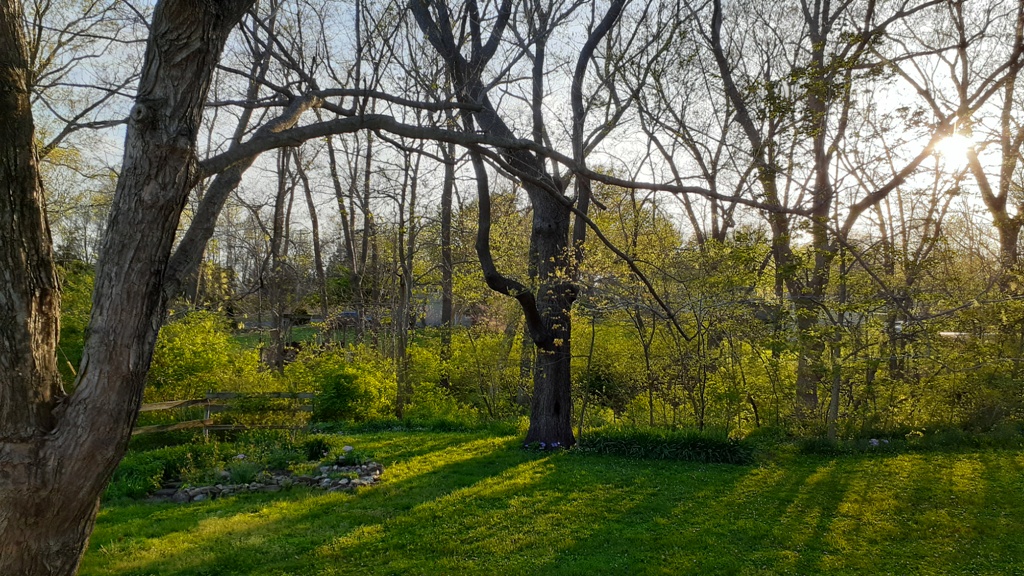
There’s a big old black walnut tree in my parents’ backyard. It’s right in the center, in the back, where the lawn meets the edge of the woods above the drainage ravine.

It was already a giant when they bought the house when I was on the way in sixty-five. All the branches are high out of reach.

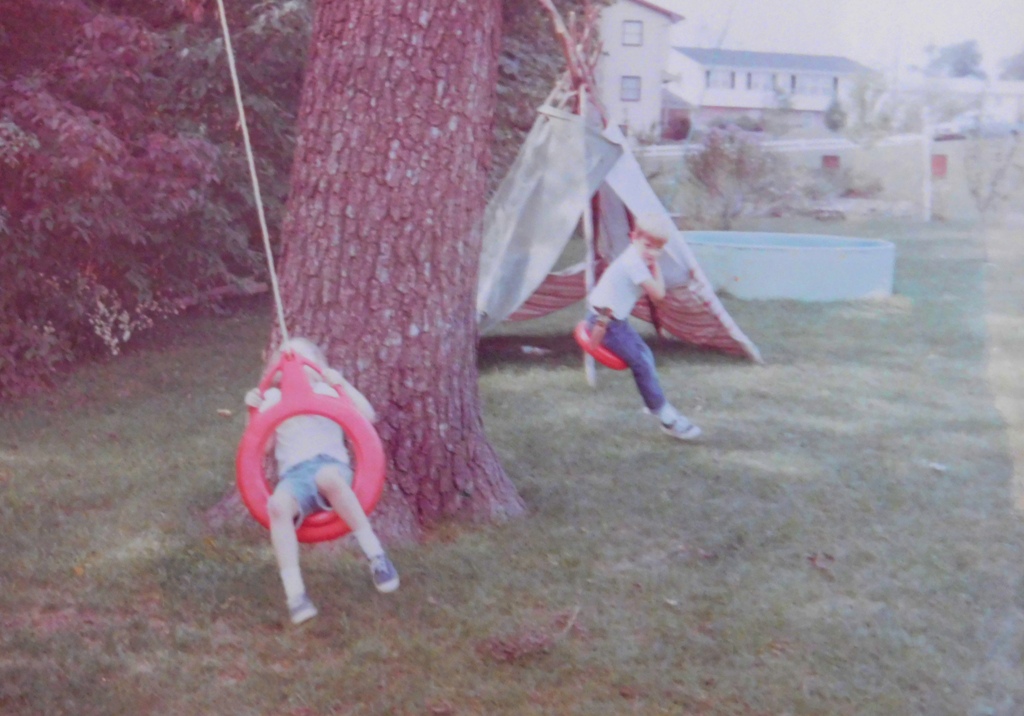
Dad hung swings for us from its huge lower limbs when I was a kid.

The night of Saturday, July 26, 1969, a severe storm blew the top out of the tree. A hard day’s work with saws cleared the debris from the lawn. Mom and Dad had plenty of help.

My brother and I didn't particularly help, but we sure had fun that day.

From that windfall and more, my folks used some of the fallen branches and some old blankets and pieces of canvas to build a tepee for us kids in the backyard. So that summer and following years, our yard was popular among the neighborhood kids.

Some of the large sections of walnut became woodworking projects. Mom squirreled away several nice thick pieces. To this day, I use one of the smaller chunks—which I carefully sanded and polished, as a preteen—as an incense burner. There's a public side and a private side.

Then in the late 1970s, Mom learned about juglenone when she tried to grow a tomato back near the tree. The tomato plant grew tall and spindly, and it begrudged us flowers and fruit. At the time, I didn’t care much, since I never cared much for raw tomatoes. (They’re still not a favorite.)

The nutmeats from the tree didn’t amount to much, as too many of them were dried and shriveled to make it worthwhile to crack them open. The squirrels found plenty of them to eat, however, and nested in its branches and ran around, like rollercoaster cars, on its wide, undulating, spreading limbs. Recently, my parents had a clan of gray squirrels with a lot of white patches in their fur, which was fun to see.

There has always been a vertical split in the trunk facing the house. It’s morphed over time into a more rounded hole. But the split was always a curious thing for me. Over the years, it became an entry way for the carpenter ants, bees, snakes, and other animals that have inhabited its hollow interior.

Paul and I used to pick up fallen walnuts and chuck them into the woods, practicing our pitches by aiming for random tree trunks. My fingers turned black from the juices, but I didn't care, since I wasn’t such a girly-girl. Chucking the nuts into the woods served a useful purpose, too, since it made mowing easier, and walking, too, for that matter.

I have so many memories of enjoying the backyard with that big tree providing us shade. It’s still standing, doing fine, its hollow space quite recently a home for a family of barred owls.

It’s truly a grandmother tree, and I thought I’d sing you this little song of praise.

Sunday, May 15, 2022

Jar of Goodness 5.15.22: The Black Walnut Tree

. . . The weekly virtual “gratitude jar.”

This week, I’m expressing thanks for the black walnut tree that grows in my parents’ backyard.

I’ll tell you more about it in a bit—I’m still cobbling together some pictures to share about it. But today let it suffice to say that it’s the day’s submission into the Jar of Goodness. I’m truly grateful to have grown up in the shadow of such a tree.

Tuesday, January 26, 2021

Walking Among the Ghosts and Lichens

Here’s a new idea for you. What have you been doing for exercise this winter—this socially distanced, pandemic winter, when half of what we need, really, is to just get out of the house?

Well, we’ve been taking walks out at Riverview Cemetery—one of Jefferson City’s big nondenominational cemeteries with rolling hills, lots of big, mature trees, and curvy, winding paved roads. It dates back to the 1910s.

We first started taking walks there in early December when we went to decorate my peoples’ graves—we realized how ideal it was as a walking location.

You want social distancing? There are very few people there—most folks don’t get out of their cars, and when they do, they stay close to whatever grave they’re visiting (decorating).

You want safety and solitude? Unlike walking on city streets, there’s no one brushing past you, and no traffic or noisy mufflers roaring by. You want fresh air? No stinky black exhaust fumes. Cemeteries are quiet places.

And we’re not superstitious. Neither of us is squeamish about being at the cemetery—we’re always intrigued and interested, reading the stones, noting the fresh graves (“ooh, do you think they died of COVID?”), straightening up dislodged decorations, etc. Indeed, we think of cemeteries as nice places. A place were mortality and eternity walk together in harmony.

Once, we came upon about a dozen deer walking around among the tombstones. When they noticed us, they all ran into the nearby woods. I’m pretty sure that was on Christmas Day. Yeah, indeed. We went walking there after Christmas dinner.

And the lichens! Championship flavoparmelias, bright orange xanthorias, sinewy ramalinas, ruffly parmotremas, etc., etc., etc., on the stones and the trees. Gorgeous, amazing organisms that make you glad to be stationed here on planet Earth for a time.

I guess cemetery trees get just the right amount of open sunshine, combined with lower air pollution and little mechanical disturbance, to grow nice, big perfect circles of lichens.

Sue and I probably look like weirdos out there, peering so closely at the trees and taking pictures. So far, no one has complained about us or asked us to leave.

Taking walks in cemeteries? We can recommend it!

Please enjoy some of the pictures I’ve taken on our walks.