Sunday, May 2, 2010

Kewpiesta and Bonniebrook: A Branson Excursion

Bonjour, mes amis! Or, as they say down in th’ hills and hollers of th’Ozarks, Howdy, y’all!

Today I report on last weekend’s daytrip to Branson, which is about three hours’ drive south of Jefferson City.

The impetus was that Kewpiesta was going on last week (April 21–25). It’s a five-day convention for the hardcore types, but we decided that a few hours of witnessing the Kewpie aficionados and their stuff would be plenty for us. And anyway, we didn’t want to pay the registration cost.

If you have no clue who Rose O’Neill was, or what Kewpies are, you need to look at my previous post. Here’s the link!

Kewpiesta is the annual convention of the International Rose O’Neill Club (IROC). You just know these are an interesting bunch! I think the largest number of IROC-ers are doll collectors, specifically Kewpie collectors—because Kewpies, in all their shapes and sizes, in print, on labels, on dishware and candlesticks and even Christmas lightbulb shapes, are eminently collectible!

And it is truly an international club—Kewpies were popular worldwide, were manufactured in Germany, and even today are quite popular in Japan. One year we went to Kewpiesta, and there was a large contingent of Japanese collectors there. Serious collectors. I recall they really had fun at the auction!

Other members of IROC are people interested in Rose O’Neill as a unique character, as a serious artist, as a female artist, and as a local celebrity. Most members of IROC have a sincere appreciation and understanding for the styles of the past, too. Not that they dress in turn-of-the-century garb or anything . . . but in a way, they are lay historians of popular cultural history.
You really should have a look at the Web site of the IROC and Kewpiesta.

They also provide scholarships for needy talented art students—which carries on O’Neill’s tradition of helping younger artists to get started.

It’s a three-hour drive from Jeff City down to Branson, so once we’d arrived and had lunch, the Kewpiesta, which had been going on since Wednesday, was wrapping up. Throughout the conference, in addition to the various speakers, auctions, discussions, luncheons, and so forth, the aficionados put up displays of their collections, and/or items for sale, in the windows of their motel rooms.

So all one has to do is stroll along the motel walkways, peering into windows. Most of the collectors are more than happy for you to come in and chat, and look at their items more closely.

There were tons of Kewpies to see, plus Kuddle Kewps, Ho-Hos (O’Neill’s Buddha figure, not the snack treat), Scootles dolls, and so on. Here are a few of the many, many items we saw.

The price tag on this item blew me away. It was only about two and a half inches long. I can see how pieces like this—made of china, I guess, with all those vulnerable, thin extremities—would not have survived well into the twenty-first century, so they’re probably very rare.


Here is “Farmer Kewpie,” another little china or bisque figure. There were several individual Kewpie characters identifiable by their various hats and other attributes. Again, check out the price tag!


Well, this next thing certainly caught my eye, since I’m an alumna of the Hickman High School Marching Kewpies trumpet line! This is a vintage Conn Victor cornet, probably from the 1920s (it has that weird extra linkage on the tube exiting the valve casing that could give you the option to turn it into an “A” cornet instead of B-flat—but I digress). It’s in about as beautiful a shape as you could expect a ninety-year-old horn to be.

But the kicker is that above the standard, old-fashioned, ornate bell engraving, THIS horn has been uniquely engraved with a Kewpie! Behind him is a little oceanscape, complete with distant lighthouse. Pretty neat, huh? I kept thinking how groovy this would have been in high school!


But what I find most compelling about this is that whoever owned this cornet must have been the one to have it engraved—paid to have it engraved nicely—and in the 1920s, that musician would have almost certainly been a man. Not just any man, but a trumpet-dude, a jazz dude (this wouldn’t have been in an orchestra, most likely). A studly macho trumpet dude—had a little naked Kewpie grinning on his bell, the bell of his sweet trumpet.

Which tells you about the popularity of the Kewpies, in their heyday.

Oh, and the price on this? I can’t recall the exact figure, but it was over $2,000. The original case and a Conn mouthpiece were with it, all in decent shape. The collector said he’d priced it so that it really wouldn’t sell. He didn’t want to sell it. Even though he didn’t know how to play a cornet. (Sigh!)

Here’s a picture of one of the early Kewpie dolls. The theme for this year’s Kewpiesta was “Rose’s Dolls,” so there you go. One of about a zillion, with so few left.


Below is another interesting thing to peer at: An original Kewpie Doll in an original box with (apparently) original packing material and everything. Can you imagine the thrill of a little kid opening up this box? It must have been mighty.


I mean, really—when you think of the “competition,” other dolls at the turn of the century were gorgeous, delicate, lifelike, yes . . . but they so often had a vacant stare. But the Kewpies had oodles of charm. Just look at them. Doesn’t it make you want to crack a Kewpish little smile, too?

-----------------------------------------------------------

After we’d completed our rounds of the Kewpie Konkourse (seriously, that’s what they call it), we drove back north out of Branson. (Ooh! The traffic of folks driving into town for the night’s shows!)

Thence to Bonniebrook. As I explained in my previous post, it’s a rebuilt Bonniebrook, but I suppose it looks quite a bit like the original home, which was destroyed by fire in 1947. (Something tells me that ol’ Rose would be touched and deeply amused that the home had been rebuilt.)

Bonniebrook is about nine miles north of Branson on the right/east side of Highway 65, at the bottom of a valley between two relatively steep grades. There’s a building with a gift shop and museum, and then there’s the house itself, with its yard and walkways, plus the O’Neill family cemetery.

The house must have seemed a mansion, or a castle, when it was first built. I read somewhere that Bonniebrook had the first indoor bathroom with running water in the whole area.


In the foreground of that picture, notice the sculpture, “The Fauness”—one of two O’Neill sculptures on the grounds. Keep scrollin’.

You can tour Bonniebrook. Since it was Kewpiesta Saturday, the home was open for free (which was really nice, since we got caught in a downpour while we were there!). Here is a view looking down the several staircases in the center of the home. At the bottom is a piano. The O’Neills loved to entertain, and the house was built specifically for it.


I told you it was raining. Here’s a view from the second-floor front porch, looking down at the swelling creek they called Bonniebrook, and a little footbridge. That’s vinca, by the way, down there on the ground. It’s all over the place on that land—but thankfully the wild sweet William, trillium, and other native wildflowers were able to poke out of it.


Here is another view of the interior of the rebuilt Bonniebrook. I tried to replicate the angle of a famous picture of O’Neill taken in this very same room. Well, the same room in the previous Bonniebrook, as this is sort of the holodeck version with twenty-first-century aliens lounging around in it.


In the old photograph of “this” room, taken around 1940 I guess, the room is chock full of Kewpies and Victorian pretties, including about seven busts sitting on the mantle of an ornate fireplace (the Gothic one O’Neill had moved to the house from Connecticut?), and the chairs are eighteenth-century carved-wing-armrest affairs. Rose is sitting with her brother Clink (Clarence, but who called him that?), her sister Callista, and Vance Randolph, the Ozark folklorist we’ve talked about before. Oh, and everyone seems to be looking at the same thing—a cat sitting right on the table, licking a paw. O’Neill loved cats.

In the house and in the museum are lots of photographs of O’Neill, and here is one of my favorites, taken when she was hanging out with her artist friends in Paris. Indeed, O’Neill’s “Sweet Monster” series of artworks had exhibitions in New York and in Paris. It wasn’t all “cartoons” for her.


Here’s a prime example of O’Neill’s more serious side. This sculpture is called “Embrace of the Tree,” and she originally had it at Carabas, her home in Westport, Connecticut. When she retired to the Ozarks, she had the sculpture brought to Bonniebrook. Rose said in her memoirs: “I think the hillmen . . . had a little fun when they put the Embrace of the Tree on the lawn, though they spoke of it respectfully as ‘That there monu-ment.’”


You really ought to read her autobiography—it’s a real hoot.

Here’s another view of Embrace of the Tree. Pretty, um, powerful, huh?


Honestly, I would sooooo love to have this sculpture in my backyard. Wouldn’t you?

I understand, by the way, that the caretakers of Bonniebrook are getting ready to have Embrace of the Tree moved indoors, since weather has been taking a toll on the two-ton sculpture (they seriously need to do this, indeed). So if you want to experience Embrace outdoors, as O’Neill had intended, you’d better get down to Bonniebrook soon.

Now, here is a closeup of The Fauness, one of O’Neill’s oddly transmogrified human-beasts. I think what’s odd and compelling about it is that despite the fact that it’s a monster—it’s attractive, organic, and benevolent. And beautiful. You can tell she studied classical sculpture from a very young age, assimilating into her aesthetic sensibility such strangely beautiful beings.


As you continue to stroll beyond the house and into the woods, a path follows the brook and leads to the O’Neill family cemetery. Rose was laid to rest here in 1944, beside her mother and her brother Jamie. Her sisters Callista and Lee, and her brother John Hugh, were also buried there.


Inside the museum, more treasures await. Naturally, there are Kewpies, Kewpies, and more Kewpies. Here’s a funny little Kuddle Kewpie that was seated in the back corner of a display case. Kuddle Kewps were invented so that little kids would have a soft Kewpie they could hug and cuddle with.


The museum also bears witness to the many commercial branches of Kewpieness. The Kewpies are famously associated with early ads for Jell-O. But here’s one I’d never heard of—Kewpie mixed vegetables!


(I wonder if the Kewpie on the label encouraged any more children to eat their canned veggies?)

O’Neill wrote books, as well. When I read one of these, I’ll tell you all about it. Here’s the front cover of one.


Various items were found in the ashes after the 1947 fire that destroyed Bonniebrook. Here’s a Buddha that O’Neill had owned. I find it intriguing, given that in her later years she developed the “Ho-Ho,” her version of a laughing Buddha—which, despite being a commercial failure, nevertheless lifted her own mood in light of her vanished fortune, indeed poverty, and the ongoing World War II, which threatened to crush her spirits during the last years of her life.


At some point relatively recently, an exploration was made of the Bonniebrook grounds to hunt for possible artifacts left over after the 1947 fire. And the stuff they found is pretty interesting. Here is one example of what had been buried under the soil, a fragment of a Kewpie face.


I try to imagine how it must have felt to unearth this little sprite after so many years of its being buried in that fertile Ozark bottomland soil—more than just a symbol of indomitable cheer, it’s a powerful proof of the ability of one artist to elevate a person’s mood, a legitimately real influence from beyond the grave, a true immortality for the Kewpish spirit of Rose O’Neill.


Wednesday, April 28, 2010

The Kewpies and Rose O’Neill


I want to tell you about our wonderful daytrip last Saturday, but first you need some back story. To “get it,” you have to know what Kewpies are, and who Rose O’Neill was.

O’Neill, 1874–1944, was an American-born artist with an unusual childhood—her parents were quite untraditional, and, in a nutshell, she was raised to be “artistic” instead of practical. And an artist she was—at age nineteen she moved by herself to New York. She lived in a convent and soon started getting work as a magazine illustrator.

She was the premier female illustrator of her day, which was the “Golden Age of Illustration.” Her peers included Charles Dana Gibson (you know—who created “the Gibson Girl”), Howard Pyle, James Montgomery Flagg, Arthur Rackham, and more. Working mostly in pen and ink, these commercial illustrators provided the tons of exquisite artwork used in popular magazines between 1880 and World War I.

Not only did she have constant work with Harper’s, Good Housekeeping, Cosmopolitan, Life, Collier’s, and many more, illustrating their stories and articles, but also she had steady gigs with the advertisers in those same magazines—including Jell-O, the Edison phonograph, and Kodak. She had a fabulous talent for human figures, and particularly facial expressions.

She also did cartoons for Puck, America’s version of the British Punch—which was grown-up satire. This was totally new territory for a woman artist.

So when she started drawing her Kewpies in 1911, she would have plenty of outlets for the illustrations. And the little cupid-like critters caught on like wildfire. A Kewpie, she explained, was “a benevolent elf who did good deeds in a funny way.”

Philanthropists need
A spice of wit
Or else they make
Dull work of it.

Any good deeds done
Too solemn-lee
Are hard on the Do-er
And the Do-ee.

But the Kewps’ idea
If understood,
Is to make you laugh
While they do you good.

They were cheerful and charming, but never saccharine. By 1912 the toy companies were hounding her to make a product that children could hold in their hands, and well, the rest is history. O’Neill made $1.4 million off the little things and all their spinoffs. They were like Mickey Mouse, Snoopy, Smurfs, Precious Moments . . . all that kind of stuff. But they were first. And they appealed to everyone—kids and adults. Kewpie consciousness went worldwide.

But Rose remained a serious artist at heart, and all along continued her illustrations, paintings, sculptures—she even wrote some novels and a book of poetry.

Her lifestyle was bohemian, and she was, as one semi-flattering biographer described her, “pathologically generous.” The things she paid for are legendary. At her home in Westport, Connecticut, she helped out her fellow artists, musicians, writers, and dancers. She let them live in the house with her—for months, sometimes years. Because she didn’t have the time to cook for them in her home, she simply had an “endowed table” at a nearby swanky restaurant, where anyone seated there received dinner for free.

(This photograph was on display at the Bonniebrook home and museum; it shows Rose O'Neill working in her third-floor studio at Bonniebrook.)


So it’s not surprising that she went through her fortune before she died. The Golden Age of Illustration had faded, the Kewpies had become passé, the Great Depression hit, and she ended up in her family’s home in the Ozarks, called Bonniebrook—a home she’d had built for her parents. It’s just a little north of Branson.

She loved the Ozarks, and in her memoirs, her admiration of the hill people is clear. She clearly found them amusing, too—but she acknowledges all along that they no doubt were amused by her as well! She also loved the wildness of the Ozark landscape, the vicissitudes of its weather, the tender spring wildflowers emerging in the hollows.

Rose O’Neill died in 1944 and was buried in a family cemetery just down a little trail from the house. Bonniebrook, her home, was destroyed by fire in 1947. The homesite then deteriorated for nearly three decades. In 1975, the Bonniebrook Historical Society was formed, and they rebuilt the O'Neill home, matching the original as closely as possible. Completed in 1993, the house is a tourist destination as well as a kind of shrine to those who appreciate the Kewpies and their remarkable creator.

So! That’s the back story. Tomorrow, I’ll tell you about our trip to Bonniebrook!

Sources, which I highly recommend:

Rose O’Neill, The Story of Rose O’Neill: An Autobiography, ed. Miriam Formanek-Brunell (Columbia: University of Missouri Press, 1997).

http://www.blogger.com/www.roseoneill.org (the official site of Rose O’Neill and the Bonniebrook Museum)

Munichburg Update: East Dunklin

Hi, folks! It’s been a few weeks since I last showed you how the Munichburg Corner project is coming along. For those of you just joining me, the Munichburg Corner is a sort of monument on the corner of Dunklin and Jefferson streets here in Jefferson City. This intersection was (and still is) the heart of the Munichburg business district.

“Munichburg” was the name given to the German-immigrant community that developed adjacent to Jefferson City, so it has its own historic “downtown” area. Now, of course, it’s all part of Jeff.

In the past year or so, Steve Rollins of Coleman Appliance, and Larry Kolb, a local developer (his signs are everywhere in this town), took on the project of renovating the south side of the 100 block of East Dunklin, where Milo Walz had his furniture store, where the Bassmann Apartments are, and several historic storefronts that used to house shoe stores, dry goods, restaurants, watering holes.

The storefronts are now ready for lease. Like I say, they have done a beautiful job of renovating them. The upper stories of two of the buildings have been completely renovated, too, and now feature very nice loft apartments. A huge, huge difference from the pathetic tenement-squalor that existed there before.

The transformation has been spectacular—far better than anyone who lives in this neighborhood could hope for. We’re now all hoping that this renovation will be a catalyst for more renovation.

Here are some photos of the renovations in progress. At this point, the focus seems to be on the sidewalk and street in front of the buildings.

----------------------------

Looking west, photo taken on May 12, 2009:


Here is the same basic area, photo taken on January 30, 2010:


Same basic view again, this time photographed on April 26, 2010:


Some of the poor old ironwork they exposed as they explored what what left of the original storefronts. This picture was taken May 12, 2009:


Here is what this storefront looks like now, after renovation (April 26, 2010):


The interior of one of the stores, view toward Dunklin (the front windows are boarded up); May 12, 2009:


The same store, photographed through the front window on April 26, 2010. Look how they stripped and finished the posts! Not to mention the entire gut-rehab . . .


I believe this is the front, main entrance to the Bassmann Apartments, taken on May 12, 2009. They had removed the roof structure at this point (they fixed it up and put it back on):


The same entrance, as of April 26, 2010


Here is the first of two sidewalk views, looking east toward the intersection of Dunklin and Madison. This is from May 12, 2009:


Here is the same basic thing, April 26, 2010. Look at the new sidewalks! And those nice new trees! I had almost gotten used to the ugly, stark stumps they'd let stand during the early parts of the renovation process!


Yes, some of the new trees they planted are dogwoods. Not a native Missouri kind, but dogwoods just the same, and a nice homage to our state floral emblem.


Finally, here are two views at the whole section, taken from across the street. This view is from November 27, 2009:


And this view is from April 26, 2010:


----------------------------

The Munichburg Corner, the monument, is a project of the Old Munichburg Association, the neighborhood association formed to honor and protect this historic area. The monument’s constructed out of stones that were salvaged from the old Nilges Grocery, which was razed this past year (for no reason other than that its owners claimed that the property was more salable without the old building on it). (No, I don’t think it’s sold yet.)

Here are a few photos I took recently to show more of what’s cookin’ at the Munichburg Corner. The stonework is pretty much the same as what I showed in my earlier post, but here are some shots that show the electrical box (the corner will be lit) and the fenceposts across the back.


Soon, they’ll be installing the personalized paving stones that people bought as memorials for loved ones, historic businesses and institutions, and to be recognized as donors. I’ll be getting you pictures of that when it happens.

Monday, April 26, 2010

Johnny Iris


All our flowers have stories. I told you about our peonies last year. Well, now I’m going to tell you about the iris, which are blooming right now.

I really love it that the plants in our yard have histories, just like people do, and their stories intertwine with the stories of humans, the unfurling of history, the changing times.

I grew up overhearing but unfortunately not perfectly memorizing a lot of these stories. To get my facts straight, I recently asked my folks to reiterate the details about the irises in our yard. What I got was a discussion between the two of them as they tried to settle on which iris, and which stories, and who got what from whom.

The stories are already becoming fragmented and fuzzy. But here is what they told me about some of the various heirloom irises that came with our yard.

First, we have a small fleet of tall, light-blue irises in the flower bed over our retaining wall—near the peonies I told you about last year. There are also some of these next to the pillar rose (another million-year-old plant, with which we do battle every year). Right now, they are just starting to send up their tall inflorescences.

No joke, they are tall—the leaves grow to about 30 inches long, and the flower stalks reach 4 feet high.

Here’s what they’ll look like when they bloom.


These iris, my dad explained, had come from the old Bartlett house the next block down Elm Street, just as the peonies had.

Like the peonies, they had been rescued from the old yard before that house, at 318 W. Elm, had been razed. You know gardeners—they can’t let a perfectly good plant get mowed over.

And as I mentioned earlier, the Bartletts are connected to the Mauses, so who knows. Maybe these iris originally came from the old Union Hotel, at what is now the Jefferson Landing State Historic Site.

The other heirloom irises I’m talking about—our “Johnny Irises”— are more of a mystery. It seemed my folks couldn’t quite agree on their provenance.

To complicate matters, we’ve moved them from where Grandma Schroeder had had them during her long tenure in this house. Their “original” location (well, from my perspective) was in the side yard, by the driveway, behind where the old gazebo had once been (my family called it a “lusthaus”—and it stood on the spot where my paternal grandparents were married). (Long story.) We moved them from this location when we put up our privacy fence.


Grandma had also put some of these iris in her official iris bed along the foundation of the next-door house, which she rented out (the house is gone now, though the medley of iris remains).

These particular heirloom irises are early bloomers, solid, dark purple, and relatively short. The leaves only get about a foot high (and max out at about 20 inches), and the flower stalks average about 15 to 17 inches high, with about 20 inches the limit.


The flowers are relatively small, compared to larger, newer varieties, but they are solid dark purple, and plenty per stalk.


I wish I knew what variety they are, but I suspect they might actually be Iris germanica, a natural hybrid that is an old-fashioned standard. (But does that type come in a solid dark purple? Are any iris experts reading this?)


At any rate, they are cheery early bloomers, hardy and profuse, and apparently incredibly old. My dad says that according to his memory, his mom got them from their close neighbors, the Renners—my mom’s parents or grandparents. Somehow (I think because Grandma Schroeder said it!), the story has gotten passed down that they had come from Johnny Renner. Presumably, my mom’s dad. “From along the railroad.”

However, it might have been mom’s grandpa, who was also named John and lived at the same house. If Grandma Schroeder said she got them from “Johnny Renner,” it could have been from either the father or the son. . . . Though I’m not sure my great-grandfather ever went by “Johnny.”

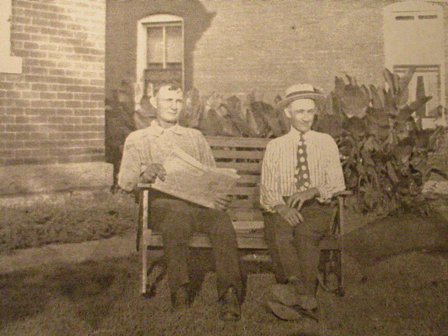
Here’s a picture of my great-grandfather John Christian Renner and my grandfather John Pollock Renner.


Now, while they were talking, my parents also pointed out to me that this swapping of iris rhizomes was probably not something done by the men of the family, but by the women. Hmmm.

Sue and I are still calling them our “Johnny iris.” Maybe I persist in this because iris are my favorite flower, and I want to associate my maternal grandfather with something elegant and beautiful, when I know he carried a lot of pain deep inside him.

. . . There’s another story, too. My mom explains that her family, there at 218 W. Elm, had had a bunch of iris along their back picket fence. These, she said, were bluish purple and not dark; she referred to them as “purple flags.” This color difference throws doubt on the idea that these are the same as our “Johnny iris.”

Anyway, those iris had a story, too. My mom told me that her grandpa, John C. Renner, had brought them home from work one day.

During the end of the 1800s and the first three decades of the 1900s, he worked with the Missouri Pacific Railroad. He had been a line foreman down at Cole Junction, west of town. One day, while he was working, he had seen a yard that had lovely iris. He told their owners, a couple of ladies, that he admired their iris. The women were flattered and shared with him starts of those flowers. And that’s where they came from—John Christian brought them home. So they, too, are a sort of “Johnny iris.”

Here’s a picture of my great-grandfather John C. Renner, working on the railroad. He looks like a nice enough guy, huh? Wouldn’t you share some iris rhizomes with him?


Back then, people relied greatly on their neighbors and friends for new irises and other perennials. It must have been fun to swap starts. They did stuff like that for fun, instead of surfing the Internet. Mom told me they had beautiful white Siberian irises along their sidewalk to the back of the property, and that they also had some early yellow iris that had come from her mom’s mom, Grandma Wilmesherr (who was another inveterate green-thumb type).

Mom also explained that there was a Mrs. Cowley here in Jeff City somewhere, who was a bona fide iris fancier, who had the biggest and best iris garden around. She was the one who got my Grandma Renner fired up about iris, and she undoubtedly shared rhizomes with her.

Here’s a picture of my Grandma and Grandpa Renner, upon their golden wedding anniversary:


And then, of course, good neighbors share plant starts with each other, too. It’s quite possible that my Grandma Schroeder got her stories mixed up and thought that her dark early-bloomers were the ones my Great-Grandpa Renner had carried home from the railroad that day, even though they apparently are not.


So you can see that the provenance of the iris in our yard is no longer ascertainable; the iris traders of the past, men and women, and John C. and John P., are gone, and so are the details of their stories. Still, though, the iris live on, occasionally relocated, but always appreciated, every spring.

Whenever I see hardy, heirloom irises blooming in older neighborhoods, I think of these stories and realize that each clump must have a similar history.

A line foreman in dungarees, doffing his hat politely and telling some ladies that their irises sure are pretty. Two neighbor ladies chat in the backyard and offer each other starts of their favorites. A young couple brings shovels and wheelbarrow to an in-law’s house to rescue plants before the house is town down. A Mrs. So-and-So’s fancy iris garden inspires a modest, Depression-weary housewife. A mother gives her daughter the latest yellow variety.

And they all have bloomed, every year.