Thursday, August 8, 2019

Vines on Broadway, Jefferson City

“Here’s That Place I Was Talking About”

That’s a quote from one of the early social-media reviews for Vines, and the more I think about it, the more it seems perfectly apt for this friendly, cozy, relaxing piece of heaven on Jefferson City’s Southside. The place is a huge success without doing a speck of advertising; people just bring their friends, who bring more friends, and so on. “It’s a great place! Let’s meet there Thursday after work!”


There’s so much I want to write about Vines. I really could go on and on, singing praises and hallelujahs about it, but I kind of have a deadline: tomorrow (Friday, August 9, 2019) is its one-year anniversary of being in business, and I want to have this posted for it.

I remember its first night in business, because I was there, poking around, taking pictures, enjoying a glass of the Malbec. The appearance of a new business just steps away from our house was exciting, especially since Vines on Broadway is an establishment that sells wine and appetizers. And no joke about its nearness to our house. It’s exactly one hundred steps from our basement door. I counted. (This might mean that I’m “livin’ the dream,” folks!)

So I’ve been a regular customer for a year, now, so I can reflect on the development of this business. Sorry if you’re looking for a tough-minded critique—I decided long ago that I don’t have time to “review” places I don’t like. I do, however, have time for cheerleading sessions, so that’s what you’ll get from me: here is why you should check out this place.

Basic information: As of this post, Vines on Broadway is open Thursdays, Fridays, and Saturdays, from 4 to 9 p.m. It’s at 510 Broadway Street, which is just south of the Highway 50/63 Expressway, about three blocks south of the Missouri capitol building. If you really want the “ins,” I suggest following Vines on Facebook, so you’ll know when they’re open for, say, Halloween night (which fell on a Wednesday), or New Year’s Eve (which was on a Monday). On social media, you’ll also be notified of any featured foods—because it changes—and other events, such as this summer’s new grilled goodies on the patio on Saturdays. Lorie, the owner, does not advertise . . . because she does not need to.


Vines, Like Real Vines, Likes to Grow and Develop

One thing that’s been a constant over the past year is growth and development—change—in an organic fashion. Think of how vines grow upward, into free spaces, toward light—that’s how this business has developed. Lorie Smith, the owner of Vines, has an artistic sensibility and approaches her business with a creative mindset. She tries new things. If something’s unpopular, she’s okay with letting it go. But if her customers like it, then she flies with the concept. Here are some of the things we’ve noticed in the past year:
  • The furniture changes. Lorie’s always discovering nifty old chairs, sofas, tables, and more, and she’s open to rearranging it, always looking for ways to make her customers more comfortable, in open conversational groups.
  • The decorations change with the seasons—she has collections of vintage holiday decorations, framed prints, colored lights, floral arrangements—and you can tell she has fun placing these around the parlors where customers sit. Even the decor in the bathroom is fun, even heartwarming (yeah, I know, in the john even!). Soon after Vines opened, she had a friend paint stylized grapevines all along the floor of her front porch. The decorations and furniture are eclectic. Most of it is vintage, which goes with the building. It’s like being in someone’s home. Lorie’s artistic tastes are apparent, with stained glass, chandeliers, nifty antique-mall and auction finds, and occasional quirky pieces, like a carved end table shaped like a hand. The table decorations change with the seasons. It’s all very attractive and creative.
  • The patio in back is a new development as of this spring. It had been about four parking spaces, but Lorie and her compatriots transformed it, enclosed it with a fence (a city requirement for serving alcohol), adding a variety of chairs, tables, string lights, patio umbrellas, and potted plants ranging from tropical elephant ears to tomato vines. When the temperatures got hot, she installed a fine-mist system that drops the temperature by at least 10 degrees. And now, she’s found friends who do outdoor grilling each Saturday night.
  • Special events happen; for a while, each Thursday was “Vegan, Vinyl, and Vino” night, featuring a bona fide record player and a bunch of LPs (think Bonnie Raitt, James Taylor, Jim Croce, Neil Diamond, and Rita Coolidge . . .). Now, Alexa typically churns out Van Morrison songs and similar. Then there was the Halloween Party, and the New Year’s Eve party, and the Fourth of July Party, and . . .
  • And the food has changed. In addition to the new Saturday-night offerings from the grill, there has been a lot of change and creativity in the past year. But the food should be its own category.


Tasty Nibbles

Vines has been described as a wine and beer bar with tapas. But calling it a “bar” seems wrong, because it doesn’t have a bar. It’s more like . . . a laid-back cocktail party in someone’s home. You’re sitting on real furniture, this is an actual coffee table, and that’s a genuine smile. And to me, “tapas” implies a distinct emphasis on Spanish tapas cuisine. But if you’re expecting oiled sardines, fresh squid and oysters, Spanish chorizo and butifarro, manchego cheese, and tortilla de patatas, you’ll be let down.

Actually, the menu at Vines started out much more eclectic than its traditional Spanish forebears. Changing the dishes makes it interesting, and it lets Lorie try different ideas, and have some fun in the process. It was also a way for Lorie to explore what her customers wanted. Over time, the menu has stabilized into two items that are available every night, plus two or three additional items that always change.


The “Vines Platter” is one of the two choices that are available every night. It’s a basic cheese and summer sausage plate, with sliced baguette, oil-cured olives, grapes, nuts, plus olive oil and seasoned grated parmesan for dipping. Usually, there’s a few squares of nice, healthy dark chocolate as well. (I've been lobbying for the possibility of a “Vines Plus Platter,” which would include some tastier, fancier, more adventuresome cheeses, and I am hopeful this will eventually happen.)

The other dish that’s available every night is the “Slap Yo Mama shrimp”: plump, juicy, shrimp sautéed in butter and garlic, served on crostini and dressed with a blend of Cajun spices. A customer favorite!

As for the other foods available on any given night, the choices have included
  • Sliders (like, roast beef and provolone with au jus, for example)
  • Wings (all sorts of sauces and glazes; now, especially nice on Saturdays, when they’re grilled)
  • Crostini (beef and herbed cheese; steak, caramelized onion, and gorgonzola; reuben—a favorite of mine; tomato, basil, and mozzarella . . . for example)
  • Spreads and dips (smoked salmon; homemade hummus; pizza hummus; spinach and artichoke dip . . .)
  • Soups (French country vegetable; Italian roasted sweet potato; Tuscan; creamy Italian sausage and tortellini . . . the soups were popular last fall and winter)
  • Miscellaneous appetizers (prosciutto-wrapped asparagus; goat-cheese-stuffed, bacon-wrapped dates; stuffed mushrooms; sweet potato taquitos; BLT lettuce wraps; pot pies; mini quiches)
  • Desserts (Oreo and cream cheese truffles; blackberry cobbler; pecan pie bread pudding; apple pie; salted caramel pecan cheesecake dip . . . and now, gelato and sorbetto from a locally owned food truck business)

When soups are served, Lorie and company are happy to divide the order into separate small bowls, which is an incredibly nice touch, so you and your friends don’t have to pass a bowl back and forth. They’re also fine with splitting orders on the bill, which is one reason Vines is popular with groups of friends: it’s a sharing menu, so they know that the food bill will be split between, say, four people.

Another wonderful thing is the kitchen’s flexibility and willingness to alter dishes for people with dietary restrictions, such as gluten-free foods. Indeed, Vines used to have weekly “gluten-free Fridays,” and although that idea got dropped for lack of enough interest, you can always request gluten-free options. If you have a special dietary need, you’ll find Lorie a sympathetic host. She’ll come out herself and ask about your preferences. She’ll work out something for you. Her hospitality is amazing.

And at some point, you’ll have to “ask about our balls.” One night last winter, Lorie and her friends were in the kitchen experimenting with making white-chocolate-dipped bonbons, and they produced a completely unique combination of creamy, tangy, sweet, rich, crunchy, chewy flavors and textures. She kept going around to her customers, asking them, “try one, and tell me what you think is in it.” Few people could guess, because the flavors blend so mysteriously and so well. I won’t tell you what’s in them, but it’s a very tasty, not-too-sweet, grown-up truffle—and “unique” does mean “there are absolutely no others like it.”


“Tonight’s Forecast: 99 Percent Chance of Wine”

Yes, Vines sells wine, by the bottle and by the glass. There’s a corkage fee if you bring your own, but why would you? Lorie and her distributor have curated for you a lovely selection that covers all the bases, and you can try samples, so you’re sure to find something you like.

The wines are subject to change, of course, but they are all great examples of their styles, including domestic and imported, dry, sweet, and everything in between. There is no “goof wine” (as Sue’s dad would call it) on the menu. Here’s a quick description of what you’ll find, from a recent list. (And hey, if you want to know the names of specific wineries/brands, then you’ll have to go there and find out.)
  • Whites: a Sonoma Chardonnay (CA); a Marlborough Sauvignon Blanc (New Zealand); a Veneto Pinot Grigio (Italy), and a Mosel Riesling (Germany).
  • Reds: a San Joaquin Valley Moscato (CA); a rich Spanish red blend called Berola (which is kind of the house favorite); a Sonoma Cabernet (CA), an Uco Valley Malbec (Argentina) (my favorite of the reds); and a Pinot Noir and Merlot, both organic from Mendocino (CA).
Also available are a French Rosé and an Italian Prosecco, plus a selection of beer, and truly delicious water supplied by EcoWater.

By the way, I keep lobbying for Vines to offer at least one Missouri wine—for example, Stone Hill’s Hellbender Red (a dry, complex Norton blend, which is also a fundraiser for efforts to restore an endangered species) . . . but so far no traction. (I’ll keep pushing, my friends.)

“Home of the 7-Ounce Pour”

You want to know about the cost, don’t you. A glass of wine ranges from six to nine dollars, depending on the wine. Bottles start at eighteen (the Pinot Grigio); the most expensive is the Berola, at twenty-seven. In case you are interested, Lorie (who is also an accomplished stained-glass artist) etched a tiny little dash onto each of her wine glasses to mark the correct level for a perfect (and consistent) 7 oz. pour. (The industry standard, FYI, is 5 oz.) They won’t short you.

As for the other prices, unless you require large amounts of food (I’ve seen the enormous portions served at some restaurants), you will probably be impressed at how reasonable the food prices are. These are small plates—appetizers—tasty bites—prepared in a small kitchen, to order, just for you, and served on interesting little plates. Other, swankier places would charge you double for less. Which leads me to my last subject: The ambience, the feel, the vibe.

“What a Great Place . . . Warm, Inviting, and Unique!”

Okay, so they serve an interesting parade of fun, tasty little snacky-snacks, and there’s a reliably satisfying selection of good wine . . . but then there’s another, even better thing about Vines that I’d like to share with you: It’s just fun to go there.

First, it has to do with the layout and the decor. I’ve already told you about the changes Lorie’s made over the course of a year, but the basic framework—a charming historic brick home built by German immigrants about a hundred years ago—gives the restaurant a feeling of history and lots of charm. Lorie has learned about the family that owned it, the Schlehers, who had a hardware store uptown, back in the twenties. A recent renovation brought the building into the twenty-first century with flying colors, and Lorie’s using the first floor for the Vines business, while she actually lives upstairs.

So here’s the basic layout. You park on the street or in a small lot off the alley, walk up steps to the front porch, and enter the front door. There’s a host stand at the bottom of a staircase, and beyond the stand is a hallway leading to the small kitchen and to the restroom. Your greeter will lead you to the left, where there are three rooms for seating.

The first room is a front parlor, with a cozy gas fireplace, a sofa, coffee table, and antique stuffed chairs.


The next room is a second parlor, with another sofa and coffee table, plus a few other café tables with chairs. (I bet most people think of it as The Purple Room.)


Behind it, the third room has a big dining table. It can be used for small conferences or meetings. Nifty wooden pocket doors allow you to close off this room for privacy. I find myself thinking, Don’t I belong to some group that could have its meeting here—?


The patio is truly pleasant; I described its development above. The crowning achievement for the patio thus far was the Independence Day party. The place was packed with all Lorie’s regulars. She had some musicians on the back porch strumming guitars and singing. And the views of the Jefferson City fireworks display were excellent—while other people were a few blocks north, gathering chiggers on the capitol lawn and dreading the traffic to come, we were all sitting in patio chairs, sipping our beverages, enjoying the cooling effects of the misters.


I’ve been searching for the right way to say this: Vines is attractive, and beautiful, without seeming snooty or untouchable. There’s a casual feeling that tempers the elegance into something genuinely approachable, like the difference between some wealthy person’s mansion and your own beautiful, comfortable living room. Or Architectural Digest versus Shabby Style. Which leads me to my final subject: the mood itself.

“One Visit and You Feel Right at Home”

Lorie told me that when she opened Vines, her goal was to create a space where people could get together, socialize, and relax, and she’s achieved that goal. Her success, in large part, is due to the host herself; she is outgoing, kind, shrewd, and has an easy laugh. She is genuinely welcoming; she makes it personal. This is a chemistry that all the chain restaurants in the world cannot touch.

It really does start with Lorie; I don’t think anyone can long remain a stranger to her. She greets her customers, sits down with them if they seem agreeable, and chats. It’s not uncommon for her to bring out samples of something she’s cooking up or experimenting with. Like the time she brought around a plate of bonbons made by mixing crushed whole Oreos with cream cheese, rolling it into balls, and dipping them in chocolate. “Hey, wanna try one of these? Check it out. I just made them.”

When she was thinking of opening Vines, she had friends tell her, “You have to be on High Street,” and she insisted: “No.” She found the place on Broadway and knew it was ideal for her. Okay, if you’re not from around here, you might not “get” this. Jefferson City’s High Street (which runs atop a high ridge parallel to the river) is the main business district of the town, frequented by bankers, lawyers, judges, legislators, and lobbyists. But when you cross south of the 50/63 Expressway (which occupies the low valley of a now-diverted creek), you ascend up more hills as you enter Old Munichburg, Jefferson City’s German-settled southside. Working-class people lived here; innumerable state workers—clerks, secretaries, and charwomen—lived here; and the funky ghosts of sauerkraut-odor linger in the woodwork of many of these sturdy brick homes. Lorie, a Tipton native, I think, picked up on this vibe immediately and recognized its cozyness.

And this is the real reason to celebrate the first year of Vines on Broadway: its society. Don’t go there if you want to be in a bad mood, or if you want to sit alone in dour silence. Vines is built for conversations and interconnections.

You’d think by now I’d get used to it, but it thrills me each time: As I’m sitting there, sipping and chatting with my companions, I almost always see two separate groups of people become one. It’ll start with someone overhearing some part of the conservation at a nearby table: “Sorry for butting in, but I couldn’t help hearing you mention _____, and . . .” And the response is usually an enthusiastic, “Oh, you’re not butting in at all, and that’s interesting what you said about _____.” Eventually, often, the parties end up repositioning their chairs in a big circle so they can all visit together.


A few weeks ago, one couple was staying at the nearby motel and kind of stumbled upon Vines; they were sitting on the patio; and another couple, nearby, were visiting Vines for the first time, too. The topic that linked them was “Isn’t this a great place? I wish we had something like this where we live!” Soon, the first couple just flat-out said to the other two, “Why don’t you just come over here and join us at our table?” So that’s what they did, and they spent the rest of the evening there, chatting and having a grand ol’ time.

“Because It’s Not Good to Keep Things Bottled Up”

Vines is a place for the Chardonnay moms to get together and deconstruct their week. It’s a perfect place for date night (or double-date night), where there are no TVs to distract you from the one person you want to focus on the most. It’s a place for the gals at the office to meet after work on a Thursday, to share a bottle of wine and snort about their jobs. It’s a place for certain Munichburgers (ahem) to meet and strategize about the organization. It’s a place for book clubs to meet. Middle-aged Harley bikers staying at the hotel have turned the patio into their own mini meet-and-greet party.

Then there was the night were some women showed up with a board game they’d just bought at Carrie’s Hallmark uptown, called “Chardonnay Go!” Everyone at Vines that night was drawn in to the game and had a great time.


And it has occurred to me, more than once, that Vines is on some level “feminine space”—in the same sense that a parlor with nice furniture is feminine. You are expected to use your manners here; this is not a sports bar with a concrete floor that can be bleached and hosed off. Keep your feet off the furniture; use your “indoors” voice. Buckets of beer are not available. There are no televisions, so there are no flickering images of sweating athletes, no corrupt politicians and “shouting guys,” and no shoot-em-up cop shows. No strobelike TV commercials to agitate your mind. No wonder it feels serene.

One of my favorite memories of last winter was the night of January 11, a Friday night, when we got an exceptionally heavy, wet snowfall starting in mid-afternoon. Lorie had mentioned that Fridays were her slowest night, and as the snow accumulated, and moving cars gone from the streets, I peered out my window to see if Vines was even open. Her light was on. So Sue and I walked our one hundred steps through the snow, opened the door, and stamped the snow off our boots: “Are you really open? We didn’t want you to not have any customers!” So the three of us sat together, enjoying wine and chatting . . . about the neighborhood, about art, about ideas; about people; telling our stories . . . as the snow accumulated and the blue sky turned to deep midnight snow-cloud gray. It was well after closing time when we walked back home. And we had had a terrific time.


Vines is a place to not take yourself too seriously. It’s a place to enjoy life, cherish your friends, and cultivate new ones.


Although some people seem to think wine is a beverage for snobs, and use it to pretend they are somehow upperclass, I’ve read recently that wine has a very long history of being viewed as a “civilizing” beverage, compared to beer and especially to hard liquor. Wine asks to be examined, swirled, tasted, contemplated . . . sipped again. It inspires conversation, creativity, ideas, and sociality. Indeed, apparently Thomas Jefferson himself—our city’s namesake—believed this was so. How appropriate for Vines on Broadway to offer its tasty, friendly, civilized, social atmosphere to our City of Jefferson.


Saturday, July 6, 2019

The Jefferson City Tornado

Hi, folks, an overdue post about the tornado that struck Jefferson City at about 11:30 p.m. on May 22. I wrote the following the day after the event, while I was still in a daze. It’s based on something I shared with my peeps on Facebook, but mainly, I think it served as a way to kind of deal with what I’d witnessed.

Merely witnessed; I had no direct damage, thank goodness, but it’s still a shock. We humans kinda base our everyday lives on certain things being solid, unchangeable. Like stone or brick buildings you see every day, and large trees. In about five or ten minutes, those were drastically changed.


It was especially—ironic? I’m scared to use that term anymore—because the afternoon of the tornado, just hours before it happened, Sue and I had met a friend at Sapphire’s restaurant, at the top of the Doubletree hotel (a place I rarely go). Unless you score a trip to the top of the Capitol, Sapphire’s is probably the best view you can get of downtown Jeff City. And so we had taken a few moments to walk from window to window, admiring the view, commenting on how Jeff has become more beautified in the past fifteen or twenty years. Yes, ironic is the term.


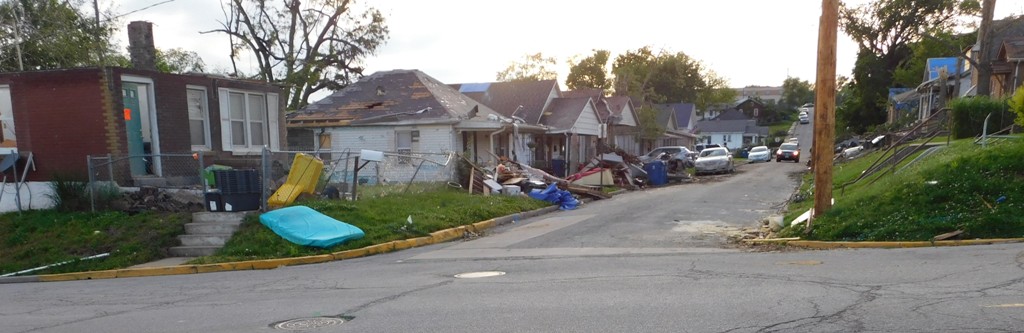
One more note: My photos are from May 26, when Sue and I finally drive around to gawk at the devastation. We waited until the streets were cleared of debris and officially open. By that time, most homes with major damage had had their windows boarded up and roofs covered with tarps—looking over the city, a patchwork of plastic blue tarps and twisted, shredded tree trunks dominated the stricken parts of the town.


At the end, I share a link to a news helicopter video that shows lots of the devastation. It starts with images of the Capitol covered with plastic—the plastic has been there for months, as they’re doing major renovation to the dome. The helicopter news team was from St. Louis, so they obviously didn't know the Capitol was find. So it doesn’t represent tornado damage, FYI. Thankfully, the Capitol escaped the tornado.

May 23, 2019

Thanks, everyone, for checking in with me. It’s just more than 12 hours after the tornado as I write this. I haven't spent much time on social media today. Whenever I look at Facebook, I’m overwhelmed by the photos and videos of destruction. And each time I go out in our yard, I see bits of soggy fiberglass insulation, crumpled siding, and other detritus that got sucked up from the areas that got blasted and then rained down on our street.

But Sue and I, and most of our immediate neighborhood, have come through the tornado just fine.

Oddly, last night we were mostly concerned about an apparent tornado that was moving across northern Boone County, and we were concerned for my parents.

When the sirens sounded, we headed downstairs out of a sense of duty. There, we watched TV weather coverage on my laptop. Oddly, as the big line of storms swept from west to east across the weather radar, we were mostly concerned about an apparent tornado that was moving across northern Boone County, and we were concerned for my parents, who live in northeast Columbia. But once that had passed well north of them, it seemed the worst was over. The “blobs” heading toward us, from the west and south, seemed not very intense, plus, they ALWAYS divide in two before they reach us: one blob always veers north, the other south. So we headed back upstairs. I actually got into bed. Then the sirens sounded again—this time, it was headed at us.

This time, we put Patches and Lois in their kitty carriers and took them into the basement, and we got Mac to follow us down there, too. We grabbed flashlights and set up chairs between the furnaces and the workbench. Again, we watched the local TV coverage, with increasing anxiety as we heard things like “Confirmed tornado at Brazito, heading toward the south side of Jefferson City along Highway 54”—Well, we live in the “Southside,” and Highway 54 was basically straight in our direction—indeed, straight at the heart of town, including the state capitol building.

The storm got gradually worse; we heard that the tornado was verified by sight by a trained spotter on the ground. The tornado was at 54 and 179. We looked out our basement door: it was pretty windy, but I’ve seen it worse (indeed, I think it was worse on Tuesday, when it blew one of our storm windows into a room and shattered it on the floor). But, you know . . . sheets of rain, strong winds, the crisp tinkling sound of small hail. (I think.) Then the lights went out at the height of the storm. And so our Internet went out, too.

From our perspective, it never seemed more than any other big storm, with strong winds and drenching sheets of rain. We sat there, between the furnaces and the workbench, listening to the kitties paw at their carriers, trying not to think how bad it could be—and then it was over. It seemed to stop rather abruptly, and we were left there with our flashlights on, thinking, "well—was that it?" How do you know when it’s over?

We learned, bit by bit, that the tornado had gone through the city south and east of us, missing the very center of town, with us included. We were very lucky. We crept back upstairs to free our kitties and try to sleep. It was clear that something had happened. Our electricity was out all night, but cars and emergency vehicles kept going by.

Sleep was next to impossible; we heard sirens pretty much all night on the 50/63 Expressway (which passes one block north of our house), and there were lots of cars and trucks zooming up and down Broadway. The air in the house was heavy and warm, but we didn't want to open the windows with the sporadic rain. With our electricity out, we didn't know the extent of the destruction elsewhere in the city. A friend texted me with some initial news about destruction. Simonson school "destroyed," Reilly Chevrolet "destroyed," police station, hospital without power. It was starting to feel Dada. I managed to get some sleep, probably starting around 2 a.m.


At around 4:45 a.m., the electricity came back on: Yay! I got up and turned off a bunch of lights that had been on when the power went off. Then, as I stepped back into the bedroom, the power went out again. It was confusing: wait, did the power just go off again? Really? . . . Or did I just dream it had come back on? What?

The power came back on for good at about 5:30, and starting about then, it was nonstop texts and phone calls from family and friends, and with the electricity back on, I could see the press announcements and the videos . . . and there seemed to be helicopters everywhere.


So it’s been a Dada day. Didn't get much sleep, so I feel achy and crusty, and it's mostly been overcast, so it could be 7 a.m. now or it could be noon or even 7 p.m. Considering our immediate area is pretty okay (look at it this way: we have some potted plants in our yard that ALWAYS fall over in ANY wind, and last night they never fell over)—still, this morning I noticed random soggy fragments of fiberglass insulation here and there on the ground, and shiny crumpled-up pieces of siding; I wondered, "Is that part of what used to be Riley Chevrolet? Or maybe it's part of Community Christian Church, or the Sonic, or Braun’s storage units, or maybe it came clear from Brazito . . ."


And life goes on, in its weird way. I went for coffee at Three Story on Dunklin and there were people there, texting like crazy and dazed but talking agitatedly about the mayhem on Jackson Street. Dunklin, just past the next intersection, was blocked off, with law enforcement officials there telling people not to go through.

And this morning the air conditioning guy came over for routine maintenance (because why not), and then suddenly our water stopped, and soon the water company was on the corner fooling with the hydrant, so now that's working again.

I kind of know how this goes—I was in Columbia for the 1998 Southridge tornado, and my workplace was on LeMone Boulevard, which was hit hard, and I had to go there and remove anything that I might possibly need for, like, who knows how long, since I’d have to work at home. I remember the blobs of soggy fiberglass on the sidewalk—they give me flashbacks—and the flapping roof and siding that had been peeled off the building like the lid of a sardine can, the quiet, disheveled dead sparrows in the parking lot, the fallen florescent light fixtures sagging into the hallway, dangling by their electrical conduits. I remember carrying my office plants into my car, thinking it weird how some stuff survives perfectly fine, and other stuff is utterly blasted away. It’s a damn convincing argument for Dumb Luck.

I'm feeling pretty sick for my friends and everyone else on Capitol Avenue and all the other places in town that have suffered staggering destruction. Those people have spent decades repairing and shining and polishing those fabulous, famous, beautiful homes, fighting tooth and nail to pull the rest of their avenue upward with them—and they formed a True Community in the process. All their heart and hard work . . . blasted. Someone wrote that Capital Avenue is Jefferson City's “front porch.” They are the heart and soul of our city’s movers and shakers. Many core people in the local historic preservation community have properties there. For the sake of our town, I hope they can repair those gems, because our CITY will be greatly diminished without them.


I also feel very sorry for the many, many people displaced from the modest and run-down homes—the homes they won't show on the news—many of them renters, without savings, whose entire fortune (such as it is) amounts to the possessions in their homes. Many of these people must certainly lack insurance and the savvy to figure out how to cope financially with what's happened to them, and their much simpler problem will be: Here we go again, back to square one, where we've basically always been.


And I feel sorry for everyone in between—aching arms, shoulders, backs, and hearts, tossing things into boxes, hoping some of it can be cleaned up and saved. People suddenly unable to get around town, now that their car is, like, totaled, or upside down. People tramping back and forth through carpet soggy with a friend's blood, moving their valuables to safety. You never think it's REALLY going to happen to your town . . .


Monday, May 27, 2019

Memorial Day 2019

. . . And decorating the graves. How many people still do this, nationally? It seems that a requirement be that someone’s still living someplace near the cemeteries. Someone who didn’t move to another state. Also, someone who—if they did move out of state—didn’t stay away so long as to have the tradition of decorating the graves leave their consciousness. Basically, someone like me—this is becoming my job.

Pretty much all my relatives are buried in Jefferson City cemeteries, and there’s been an unbroken tradition of decorating graves since each was filled. Christmas, and Memorial Day.


In Buddy’s Stories, Dad shared his memories of the whole family piling into his Aunt Minnie’s Lincoln Zephyr to decorate the graves, with water buckets on the floor between their feet filled with peonies, weigela, mock orange, and whatever else was blooming in the backyard. (You all have his latest book, right?)


Each year as the peonies, roses, and mock orange starts to bloom in our yard, I think, “Well, it’s getting close to Memorial Day, isn’t it.” I don’t really need a calendar for it, and I don’t need to see “Memorial Day Sale!” yelling at me in newspaper ads. These are the exacting same peonies, roses, and mock orange plants that once supplied Grandma with flowers for graves.

Dad and Mom, and Uncle Richard and Aunt Carole, have done these acts of devotion and memorial since Grandma and Aunt Minnie were no longer able to do so. Aunt Minnie died in 1980, and between her and Grandma, she was the one with the car, so Dad and Richard had been driving Grandma to decorate graves since at least that time. Until 2000, when Grandma took her place in the earth beside her husband.


Dad’s and Uncle Richard’s continuing attention to these rituals has always impressed me with its tenderness, its attention to detail, its steadfastness. Its obstinate refusal to go full-on plastic. And its privacy: because unless it’s part of a public ceremony involving the graves of military veterans, the decoration of graves is always a private ritual.

And it is a ritual. Setting the date for when we’re meeting out at Riverview. Driving slowly to the well-known locations that anyone else would have to hunt for, parking, opening the trunk or back door of the vehicle to create a little work station for fiddling with the flowers, ribbons, stakes, wire, wire cutters, and whatever else.

Often, the different tasks wind up certain people there. At Christmas, Uncle Richard will drive in the wooden stakes, while I cut the lengths of wire, while Dad arranges the greenery and ribbons. Or maybe I’ll do the arranging while Dad cuts the wire. I’ve taken to bringing a whisk broom with me to clean grass clippings off the stonework. We usually pick up any trash we see, too, wherever we see it.

After making the rounds of Riverview (rounds are literal, since the cemetery drives make big loops around the sections)—decorating the graves of Mom’s Aunt Lyddie and her family, Dad’s Aunt Minnie and her family, and, often, Marie Korsemeyer, who was basically an aunt to Dad, and one of Dad’s dear friends, and one of my dear friends.


Then, we drive on to Hawthorne and decorate the graves of my maternal grandparents. Then, often, we go to the old Lutheran cemetery overlooking Highway 54, and to Woodland to decorate Mom’s great-grandparents and grandparents.


For Memorial Day, Mom and Dad picked out a variety of imitation flowers (as you can see from my photos)—bright colors, natural-looking varieties that we connect with the ones whose graves we decorate. (Grandma Schroeder was in love with sunflowers, for example.)

At Christmas, we use cedar boughs that my cousin Phil gleans from his property northeast of Centertown; Uncle Richard and Aunt Carole bring them, while Dad brings the big, flocked, bright red ribbons. (And I keep forgetting to bring gloves!)


After the decorating is done at a site, or while one of us is putting the finishing touches on an arrangement, we often stand around and chat a little bit about the ones lying below us. It’s not maudlin talk. With Aunt Minnie, we often say, “Oh, she would like this arrangement—it’s so pretty!”


And Dad points to the stones nearby, naming the names, and talks about how a lot of Aunt Minnie’s best friends were buried in the same area.


For me, and I suppose overall for my family, Memorial Day is primarily a day for remembering those who now lie under the earth. It’s always kind of confused me that the rest of our nation seems to see it as a day for remembering only deceased military people—for waving flags and such. Because didn’t all our forbears struggle, deal with privation, make sacrifices, live their lives so that we may live? I don’t want to diminish the sacrifice made by people fighting wars, but by the same token, let’s not diminish the losses suffered—and the lives lived—by the ones who didn’t march off to war.


Tuesday, January 15, 2019

Middle of January Ramblings

I’m writing in 2019, but I’m not sure I’ve even digested the reality of 2018. I suspect I’m not the only one having vague recollections of life in the 1970s and 80s, and thinking that the 20-anythings seemed waaaaay far off. Seriously, is it really 2019 already?

This must mean I’m getting old, according to my projections made as a kid. As Rose O’Neill commented upon her sixtieth birthday, “How roguish.”

In case you’re wondering, 2019 has actually started off on a promising note. I am entirely grateful for many things that seem to be going well. Let’s use some bullet points, shall we? Taking stock:

Patches, our elderly kitty, had a pretty bad spell with her arthritic hips in early December (right when we were heading to Ohio for Sue’s niece’s wedding). But boy howdy, with a new supplement for her joints, she’s been doing real well. I get her to “walk around the block” (circle through the kitchen, dining room, living room, and front hall) each morning once or twice before serving her her beloved soft food (Royal Canin or Science Diet kidney chow). God love her, she’s deaf, and she puts the “cat” in “cataracts,” but she shows lots of affection for me, and she’s comfortable, and she makes sure to give Lois hell whenever she sees her. I’m grateful for this time with Patches. She’s a really sweet kitty.

Patches.

Church, which has been a topic of recent posts, has been going well. Our new congregation is growing, and the sense of freshness continues. Also (and I’m glad about this, too), my former congregation seems to be moving past the split, as well.

Christmas was good, though a bit strange for me—we didn’t put up the famous Weihnacthspyramide this year . . . we simply ran out of time. That, and we weren’t excited about giving Lois the opportunity to completely destroy it. Next year, Lois will be another year older, and maybe we’ll be able to trust her not to leap onto it and, like . . . destroy it. BUT! We did help my parents put up a Christmas tree, which was right in my Mom’s sight-line as she sits in her chair, and it was there for when my brother and one of my nephews came to visit at Christmastime.

And the visit with my brother was good, too. I’m grateful that my relationship with him is maturing, just as we both are. Sometimes, in the past, I haven’t clicked very well with him, but now . . . we see more eye-to-eye. Funny how, over the years, we meet each other in between our various flip-flops . . .

Also Christmas: once again, I made a bunch of different Christmas cookies. I’m starting to accept that this “gift” is as much for me as it is to my recipients. Of course I give most of them away to family and friends, but we do end up with some ourselves. And I’m doling them out. Tonight, I relished a few of the old-fashioned ones that no one else seems to make anymore: lebkuchen, springerle, billy goats. And I let the waves of memory wash over me, Christmases past . . . my childhood, my family, and I could feel we were still connected over space and time.

Financially: I was rather foolish in 2018. Generous with my time, but it bit too much into my professional life. I don’t regret volunteering so much with local organizations, but I see that I let it get out of balance. I need more “billable hours” in 2019, and I’m off to a good start. Feeling good about a renewed discipline regarding my freelancin’.

Looking out the windows: The Capitol looks really funny, all wrapped up in plastic (or whatever that is). The maintenance is long overdue. I'm glad its under way.

Sleeping: it wasn’t occurring to me, exactly, how much my sleep (or lack of) was messing up my life. I’ve come to the conclusion that the mushy foam mattress that I’d hoped would end my problems has actually been worse than what I had before. For one thing, it absorbs heat, and with my hot flashes (!!!), it gets intolerable. Tired (exhausted, actually) of getting out of bed, standing up, in the middle of the night, with back and hip pain and sweating. It’s not a good thing when you wake up for the umpteenth time thinking, “please kill me now.” So until I find something better, I’ve returned to a futon, and I’ve been waking up feeling . . . good.

And there you have it. A little update from here. Who knows what 2019 will bring.

Tuesday, November 13, 2018

Marideth Sisco: She Seems Like an Old Friend

Sometimes you find someone—a writer, or a musician, say—whose voice resonates in your spirit like a perfectly tuned guitar. I’ve gradually been realizing that 2018 needs to go down in my personal history as the year I made the acquaintance of such a person. Y’all, I’d like to introduce you to Marideth Sisco (in case you haven’t heard of her yet).


She’s built an admirable career for herself, one that I’m frankly jealous of. She’s a celebrated folk musician (who, good grief, has gained international fame for her contribution to the soundtrack to the critically acclaimed, award-winning film Winter’s Bone). She’s an accomplished journalist, writing the kind of pieces we all wish we could write—they’re like letters from a home you didn’t realize you’d wandered away from. She used to write a regular column in the West Plains Daily Quill on Ozark gardening (now collected into a book). Now, she’s been doing monthly radio essays in a series called “These Ozarks Hills” on Springfield, Missouri’s NPR station KSMU.

There are five books she’s written, and I counted six music CDs and two spoken-word CDs available on her website’s shopping page. (Look, I’m betting she’s been involved in a lot more recordings than what’s available through her website.) Her band is called Blackberry Winter, named for that occasional rude April or May cold snap that nips away the blossoms of blackberry canes (it’s springtime’s analogue to the better-known Indian summer of autumn).

Yep, and she’s also a blogger.

Where has she been all my life? And how did I finally learn about her? Funny you should ask, because now I have to make a plug for something else: the Big Muddy Folk Festival, which occurs each April in Boonville. We’ve been attending for several years, now, and enjoying the hell out of it each time. Every year, perched in my lovely balcony seat, soaking up beautiful live music, I think of all the friends and family I wish could be with me to enjoy it, too. You simply must check it out. Or, think about it this way: I’m personally not an avid folk music fan, but this is great, live entertainment, by accomplished musicians from all over the world.

Then, at the end of July, I got to drive an hour to Sedalia and hear her and Linda Stoffel perform at the Daum Museum of Contemporary Art. I had to go alone, because Sue had broken her ankle the week before and didn’t feel like doing any excursions at that point. (But after twenty-five years together, Sue really does “get” me, and she encouraged me to go.) This was my second exposure to what is, for me, basically an addictive substance.

But I first saw Marideth Sisco and her “Accomplices” playing at the Big Muddy in April 2018, and I was immediately intrigued. Here was this rather unassuming, slightly older woman, nothing flashy about her at all, calmly reading her prose, poems, and song lyrics off a digital tablet, surrounded by the members of her equally laid-back, extremely talented band, singing songs that were deceptively simple (you know the kind: when you breathe deeply and really listen, you discover the depth of emotion hiding in places like the held notes, and in the negative spaces between words and phrases).


I bought some of her CDs the next day, and I’ve been listening to them ever since. One of them, in particular, is like nectar to my soul. It’s almost uncanny, how much I love it. I’ve had a hard time figuring out why I’m drawn to it, but I think, after about a bazillion listens, I’ve finally figured it out.

The CD I’m talking about is her four-disc set of “These Ozarks Hills” readings. They’re little essays on her reflections of life in the Ozarks, and each CD focuses on a different season. Recurring themes include gardening, weather, nature, folklore, personal history, personal insights, her family and childhood memories, enduring values, and—only sometimes—politics, the economy, and current events, and those usually on the way to making a point about enduring Ozark values of tolerance, compassion, charity, thrift, and self-reliance.


These essays, like her musical delivery, are deceptively homespun. She speaks in her authentic Ozark dialect (some people have called this accent a “drawl”), after a little acoustic-guitar intro based on “Ozark Mountains,” a song on the Blackberry Winter CD Still Standing.

But boy, oh boy, her prose is tight. She’s a master writer, and she knows exactly what she’s doing. She has impeccable taste when it comes to her flights of fancy—she never gets full of herself; she “murders her darlings”—and she maintains a good sense of humor. She takes herself lightly. She stays on topic (I can never do that), and she crafts arresting beginnings and satisfying conclusions. (I’m an editor, and I really, I mean really, appreciate and admire such things.)

She’d probably read this and think, “Well, of course! I practice my art, and I’ve had plenty of time to get good at it. No big deal.”

Maybe this is part of why I’ve been enjoying her work: her voice is so natural, it almost seems like an extension of my own brain. And that’s the job of a writer, isn’t it: to speak inside your head in a voice authentic and natural enough that it almost sounds like your own self talking. And it expands who you are.


And here’s another confession: I’ve been listening to her spoken essays at night, when I have trouble falling asleep. This is not to say that I find them boring—far from it. My attention remains rapt, like a little kid listening to a favorite bedtime story. Sleep overtakes me because I’m simply exhausted and finally relaxed.

I find her voice soothing, familiar. It’s something about her accent, I think, that activates memories buried deep inside me, of the way a lot of people used to talk in central Missouri when I was a kid. Indeed, the region where you’re likely to hear an authentic Ozark accent seems to be contracting . . . and I hadn’t even realized it—until now.

As I write this, it occurs to me that my readers might not care about the different forms of southern or midwestern dialects, or where the two intersect, and all that. But to me, it’s of vital interest, and I realize I cherish this link to a part of my history, my heritage. I cling to it like a security blanket.


For the past few months, I’ve had the “Autumn” CD in my bedside player, and one of my favorites of her essays is on it. And there’s an aspect that makes it especially personal for me.

For a decade, now, I’ve been the behind-the-scenes compiler, editor, and poster of MDC’s annual Fall Color Reports. It’s a fun gig, a celebration of my favorite season. It also has given me an intimate knowledge of the patterns and nuances of autumn’s progress across Missouri, plus I’ve gotten to know several top-notch foresters from around the state. But . . . I’m actually losing that part of my job after this year, so this year’s surprising flash of amazingly bright fall color has been excruciatingly bittersweet. It’s gorgeous, but it fills me with grief.


But Marideth Sisco’s description of our glorious Ozark woods thrills me with its artistry. I share a bit of it with you here, but I encourage you to check out the whole thing, on her blog, or better yet, on the CD four-pack.

Sometimes I think autumn in the Missouri Ozarks is one of the most well-kept secrets left, and certainly the most little known anywhere. Granted, the scenery will not glow so incandescently as the blazing fire from acres of sugar maples, the major draw of New England autumns. Here, the colors of the Ozarks hills blend into more of a wonderfully colored tweed, with highlights that include the burnt orange of the Sassafras, the vermillion of the gum tree, the bright gold of the hickory, the butter yellow of Catalpa and the blood red of the sumac, all on a field of the caramel and cafe au lait of the oak forest. And underneath, the feathery goldenrod, the bittersweet berries and little clumps of fringed lavender where the fall asters grow.


I think the version on the CD is even better honed, but you get the idea. You can pretty much taste the fall color here.


And that’s the final “ping” that makes me enthusiastic about finding Marideth Sisco: It turns out that, although I never set out to become one, I’m a writer, too. (Hey, everyone, look at me! I have a blog!) Marideth Sisco’s kind of like the Opulent Opossum . . . only she’s waaaaaay better. Simply put, she’s what I aspire to be.

She’s doing it folks; she’s the real thing, and this here dilettante is simply awestruck. It’s worth doing: Celebrate Missouri’s glories; savor our Ozarks.

Check out Marideth Sisco.


Photos in this post were taken by me at various times and places in central Missouri this fall.

Friday, August 31, 2018

Capitol City Cork and Provisions

UPDATE: Capitol City Cork, and its owner, Jami Wade, celebrated Cork's last nights in business on Friday and Saturday, June 28 and 29, 2019. As of early July 2019, the business is for sale. Jami was ready to move on to something else; said the business had never taken a loss. Anyone want to take the reins of one of JC's premier hospitality businesses?

----------------------------------

This post is soooooo long overdue. Capitol City Cork has been in Jeff City for years, now, and it’s become an institution. And it’s a lot of things to a lot of people. In my opinion, it’s an oasis.


Located at 124 E. High Street, it’s almost exactly in the center of town, just a brief walk from the State Capitol, the Cole County Courthouse, and gaggles of law offices, lobbying groups, PR firms, and state office buildings. Being uptown, having an elegant ambiance, and serving beautiful food and beverages, it receives plenty of uptown customers. And you never know who you might see in there.


Disclaimer: As you might have gathered, my “restaurant reviews” are no longer critiques—instead they are cheerleading sessions about places I genuinely like, meditations on places that are great on levels deeper than the superficial. Places whose presence make our community better. Thus I describe my beloved Cork.

When I started this blog and named it the Opulent Opossum, I had in mind the juxtaposition of having big city tastes while living in a small town. How does one lead an opulent life in a place where the majority are thrilled with fast food and interstate chain restaurants and are suspicious of cuisines and foods none of us grew up with?

And how does one embrace the benefits of a small town—its neighborliness and warmth, its charm, its unabashed community spirit—without also caving in to the provincialism, self-satisfaction, and fear of change that’s the flip side of small communities?

How can we live in Jefferson City as Opulent Opossums?

Well, Cork exemplifies the best solution to this question: it strives for the best and highest tastes while being completely grounded in the warm and friendly neighborly hospitality people in big cities have nearly forgotten about. It’s elegant, but it’s a laid-back kind of elegant. A place to relax and celebrate this precise moment, in this exact place.

So, if you’re reading this, and if you’re wondering what kind of place Cork is, then let me describe it to you. In a word, it’s a bistro. It’s a long narrow room with a small bar in the back and a hallway beyond that leading to the back door. They make the most of what is actually a rather small space.


There are a variety of tables and seating options, including tables by the front window, so you and your friends can check out all the action on High Street (yes, that’s a small-town joke) . . . but there are more secluded tables farther in. (Think: date night.)


. . . Or you can sit at the bar, and no doubt make a new friend . . .


. . . Or you can enjoy the café tables out on the sidewalk.


You even have options getting in. In addition to the High Street entrance, there’s another entrance in the rear, along with opportunities for nearby parking in the lot behind the row of buildings. So you can usually park pretty close. (Big-city people, be jealous.)


The emphasis, as the name implies, is on wine. The list includes an array of tasty special offerings, but then the house wines are much better than average. The glasses are enormous, allowing you to properly swirl, sniff, and savor your beverage. (Some people have actually complained that their glasses aren’t filled enough—but they don’t take into account the large size of the glasses!)


And if you’re not into wine, there are good beers and other beverages as well. There’s a reason they call it Cork and Provisions!


And here’s a nice touch: They keep glass bottles of water chilling in the fridge and bring these to the tables, so guests can refill their own water glasses.

Their chow is called “new American,” but I think “fresh bistro fare” is a better label. If you find menus for Cork online, be skeptical—the menu has had several changes over the years, and it can change seasonally. Websites can’t keep up. Cork doesn’t use a food service, and sometimes something just looks really great at the farmer’s market, and suddenly that’s the day’s special.

So the menu can change, and that’s a good thing, my friends! Fairly recently, they’ve added burgers to the menu. Juicy, handmade burgers! And they do this thing with a bleu cheese cream sauce as a topping, and, well . . . you just have to try it. I did, and got perfectly prepared Brussels sprouts as a side.


When people criticize Cork, what do they say? The biggest complaint, I think, is about the hours, which would be easier to understand if they were more traditional or conventional. According to Cork’s Facebook page, they’re open Tuesday through Friday, 5:00 p.m. to 9:00 p.m., and closed Saturdays, Sundays, and Mondays. So: no lunches; no weekends at all; and no Mondays. Meanwhile, they may be closed (or open) certain nights for special events. And special events are pretty common, both at the restaurant and catering offsite. If you’re in doubt, call them (573) 632-2675 or message them (as on the Facebook page).

You’ve probably heard the old saw about “Do you want it fast, cheap, or good? Because you can’t have all three.” At Cork, the primary emphasis is on the last: quality and freshness is the priority. As international travelers know, not everyone in the world agrees that food should appear instantaneously, or that all diners are understood to be in a hurry. Cork has the sensibility of a café in, say, Paris, where dining is valued as a social occasion, for conversation, tasting, lingering, enjoying. Here in Jefferson City, this is high praise indeed.

One more thing about Cork: It is connected, philosophically, stylistically, and (by means of a small hallway in back) literally, to Capitol City Cinema, Jefferson City’s community-supported arthouse theater. This nonprofit single-screen cinema shows independent, foreign, and documentary films, and it partners with other nonprofit groups to improve the community. It, too, is an elegant space, with chandeliers and comfortable seating, and you can purchase gourmet appetizers, beer, and wine at next-door Cork to enjoy before and during the movie.


The two entities benefit one another: What could be more perfect than dinner and a movie? —Oh yeah! A lovely dinner and an awesome movie! It’s a brilliant strategy for helping the restaurant business, while also contributing to the cultural scene in this small town. Maybe you won’t want to see all the movies, but I’m sure there are some you’ll love.

And so here’s my call to action: Check out Cork and the cinema. Become a “regular”! “Like” ’em on social media so you know about upcoming movies and events at the cinema and can stay up-to-date on Cork’s specials and special events. The people who run these conjoined institutions are your neighbors, who love Jefferson City and are contributing to it, via their daily work, every single day. As with all locally owned businesses, you can “vote” for their continued presence with your meal and entertainment dollars. You won’t be let down.