Wednesday, September 29, 2010

Autumn’s Progress

I usually equivocate when asked to name my “favorite” of anything, but I can safely say my favorite season is autumn. At least, here in Missouri. (See, I just equivocated again, didn’t I.)

One of the big reasons to love autumn in Missouri is the fall color. I feel sorry for children who grow up in parts of the country where the local trees are just firs, pines, and aspens, so that “autumn” to them is only big patches of yellow interspersed with the ubiquitous, “ever” greens. Those children read books about “the seasons” and see pictures of deciduous trees in a riot of what we would call “fall colors”—and they must feel out-of-touch, if not outright deprived.

If you live in the Midwest, it can be easy, sometimes, to take our four true seasons for granted. But autumn usually makes itself hard to ignore.


As Pulitzer Prize–winning natural history writer Edwin Way Teale showed in the third volume of his American Seasons quartet, Autumn across America (1956), great pleasure can be gained from tracking autumn’s progress across the continent. It glides in a band southward, like a magically drifting rainbow, its spectrum enveloping the tired greens of late summer and leaving husky browns and tans in its wake.

Here in Missouri, autumn is delivered to us from Iowa and Nebraska, who got it from Minnesota and the Dakotas and ultimately, like all cold weather on our continent, from Canada.

In our state, fall color usually starts becoming visible in the northern counties in about mid-September and moves southward to finish completely in southern Missouri by the middle of November. The central counties (on a north–south gradient) are about one week later than the northern third, and the southern counties are about one week later than the central ones.

The peak of fall color usually occurs in the northern counties during the first third of October, in the central zone in the middle of October, and the southern counties in the last third of October. Again: generally speaking.


The timing can vary from the average, mainly due to vicissitudes of temperature—but the amount and types of color can vary drastically because of many additional factors, including timing and amounts of moisture during the summer and fall, whether drought was an issue, problems with any number of tree diseases and parasites, and more.

Each year, there are some trees, shrubs, and vines that are usually the first to change color—harbingers of autumn such as Virginia creeper and poison ivy, black walnuts, and dogwoods. And the trees that are the last to turn include the oak trees, for instance. In our state, like most of the eastern North America, fall color is said to reach its climax when the sugar maples are most colorful, with their fiery oranges, opulent golds, and glowing reds.


But even the sequencing can be thrown off by various factors. Also, most years there is at least one species of tree that fizzles out like a damp firecracker. This year, for instance, a lot of oaks are affected by a parasite called “jumping oak gall,” so we can’t expect to see much of their deep maroon this year—many oaks will be going straight from green to brown. Woolly oak leaf galls can have the same effect.

“Leaf peeping” is a big part of Missouri tourism; even when it’s not the sole point of the travel, fall color adds greatly to our enjoyment of our outings, whether we’re heading out on a weekend day trip to a church supper or an afternoon hike, or planning a more involved “staycation” down at Branson, or camping at Bennett Spring State Park, or bird-watching or hunting at Swan Lake National Wildlife Refuge.


When I was a teenager, back when I was under the influence of Leo Buscaglia, one of my sad attention-getting behaviors was to designate some random autumn day as “Leaf Day” and make my own little holiday out of it. I showed up at school with a bag of fresh, gorgeous fall leaves, arrived at all my classes early, and placed a leaf on each of my classmates’ desks. It often started conversations about the beauty of the season and the wonderful structure of leaves, and even the miracle of our ability of perceive—or construct—the idea of “beauty.” (Well, in my honors classes it did.)

At this point in life, my habit is not to “twirl buttercups,” waxing on the sheer loveliness of nature—but today’s an exception. My sole motivation is a hope that I’ve caused a few people to stop and be aware of whatever beauty may come.

Monday, September 27, 2010

“Trail Mix” Oat Bran Muffins

We’re just now getting a taste of autumn weather, and with the chill breezes from the north, the blue-sky sunny days, and the forests starting to show hints of warm yellows, golds, rusts, and reds, it’s a perfect time for hiking.

And one of the things you think of with hiking is “eats,” so naturally, trail mix comes to mind.


You know how much I’m into oat bran muffins! They’re low in fat and satisfyingly filling, they can help reduce cholesterol, and if you use them to replace the typical American breakfast, they can certainly help you lose a few pounds.

And the “trail mix” flavors might encourage you to get outside and hike! (See how incredibly healthy these are?)

Admittedly, this is kind of a “wing it” combination—but that’s how trail mix usually is. Enjoy!


“Trail Mix” Oat Bran Muffins

Preheat oven to 425 degrees F; line muffin tin with paper liners.
In a big bowl, mix together the dry ingredients:


2 1/4 cups oat bran cereal
2 tsp. baking powder
1/2 tsp. salt
1/4 tsp. cinnamon

Then add the following morsels, modifying or substituting to suit your tastes (use a small handful of each—about 1/4–1/2 cup):

—raisins
—coarsely chopped walnuts (or other nuts; if you don’t use crunchy peanut butter among the wet ingredients—see below—then add peanuts here)
—pumpkin or sunflower seeds
—sweetened carob chips (or chocolate chips, or M&Ms)
—diced, dried mango (or other dried fruit in small pieces)

In a separate bowl, mix together the wet ingredients:

3 egg whites (or equivalent quantity in egg substitute)
2 tbsp. vegetable oil
1/3 cup honey
1/3 cup crunchy peanut butter
3/4 cup evaporated skim milk (or low-fat yogurt, skim milk, etc.)

Add wet mixture to dry mixture. If too dry and sticky, add additional milk, yogurt, or other liquid. (Hmm: apple cider?) Consistency should be similar to corn muffin batter. Spoon batter into muffin cups and bake for 10–15 minutes, or until lightly golden on top and toothpick comes out moist, but not wet.

Turn out of muffin tin and let cool. Once muffins are completely cool, store in a plastic bag; refrigerate after about one or two days. Reheating makes them better, especially as more days go by.

Makes one dozen muffins.


Friday, September 24, 2010

Oktoberfest Preparations

Looks like it’s going to be a great festival this year! I know you all think I’m just being all chirpy and advertise-y because I’m with the group that’s sponsoring the festival, but really: This event has grown over the years and become big, fun shindig.

Honestly, those first few years—how it rained! There was one year we joked about changing our logo to an umbrella. I truly didn’t think we’d keep having Oktoberfest. But here it is, ten years already.

Yeah, there’s the vendors and the car show, the craft booths, the wiener dog derby, the kids’ area, and so on, but the heart of it all has always been the German dinner.

Central UCC lets the Old Munichburg Association use their kitchen and cafeteria for the dinner; and many of the women at Central Church volunteer to help with the food service. They also donate all kinds of nifty homemade German goodies for a bake sale.

Each year, the organizers try to offer something new, something different. Like the Hott & Asel sausage (from the original recipe used by a local butcher shop that closed in the sixties but which all the locals remember).

Or one year, we had authentic German beer, sent to us in kegs from our friends in partner city Muenchberg.

This year, one of the new things is a special sauce for your bratwurst—made using an authentic German recipe from Muenchberg.

I got to see it as it was being cooked today in big pots in the church kitchen: It’s got mustard in it. And some chicken broth. And bacon! (Plus other ingredients I won’t go into; some things ought to remain proprietary secrets, huh?)

I’ll be working at the OMA booth tomorrow, if you want to drop by and say hello. Though of course, I’ll have to sneak out for a few minutes to get me one of those saucy brats!

See you there!


Jefferson City/Old Munichburg Oktoberfest
Saturday, Sept. 25, 2010
Hours: 10–6
Old Munichburg district (Dunklin Street, between Broadway and Jefferson), Jefferson City

Thursday, September 23, 2010

Saturday Is Oktoberfest!


Get out your dirndls and lederhosen! Jeans and tee-shirts! Time to polka and have a beer! Saturday, September 25 is the annual Oktoberfest held in the Southside/Munichburg area, centered around the intersection of Dunklin and Washington Streets. (If you’re from out of town, this is the same basic area as the Ecco Lounge, Central Dairy, and the Schaefer House.)

Looks like the weather will be perfect! Click here for more festival schedule and more information.

I’ve told you about the Old Munichburg Oktoberfest before, and even shared a video with you. This festival is a fund-raiser for the Old Munichburg Association, which does all kinds of things to promote and uplift this historic “Germantown” neighborhood.

The festival goes from 10 to 6. Lots of food and vendors, authentic German dinners, two stages, vintage cars, a performance by a bona fide “strongman,” grape stomp, dachshund derby, and plenty of fun stuff for the kids—including the supremely cute “Hansel and Gretel Root Beer Garden.” And of course, a real beer garden for the grown-ups.

The Loehnig band from Hermann and the Rhineland Wurstjaegers will perform in the afternoon at the German stage; the beer garden stage will feature bluegrass and easy rock.

The official tee-shirt this year has a color reproduction of a nifty antique beer logo from C&L Wagner’s brewery, which used to stand right about where the festival is taking place.

And while you’re in the area, you can visit the newly dedicated Munichburg Corner, with its many commemorative bricks.


This year at the festival, there’s a renewed emphasis on authentic German artwork and crafts—artisans from the German Künstlerhaus (Artists House) in Hermann will be inside the Coca-Cola Community Building on Washington St. Here’s some of what you’ll see:

—Scherenschnitten, or scissors paper cutting, and you can buy intricately designed greeting cards, including Christmas cards.

—Schützenfest targets, shooting-match targets, which are elegantly painted targets to fire guns at—but you’ll want to hang these on the walls as art.

—The Friends of the Deutschheim State Historic Site will be selling imported German Christmas ornaments of fantastic design and quality—at good prices!

—There will be show of nifty antique memorabilia from Central Missouri’s historic breweries.

—Outside the Coke Building on Washington Street will be the Osage Bluff Blacksmith (look for the billowing smoke), making useful objects for sale. The blacksmiths at work will fascinate your kids!

—Next to them will be the Firehouse Woodcarvers at work carving delicate figures to delight all ages.

---------------------------

Obviously, you need to go to this festival. “Get your German on”!

—I’ll see you there!

Tuesday, September 21, 2010

Grape Crumble Cake

Here’s what I finally did with those grapes I processed. (Remember that earlier post?) I didn’t have enough grapes for a pie, so I decided to “wing it” and adapt a recipe from Dr. Oetker’s book of German baking. (See “Books . . .” at the bottom of this post.)


Dr. Oetker, the company, is the German equivalent of Betty Crocker or Duncan Hines—a manufacturer of packaged baking and pudding mixes, which you can easily find at international groceries. There was a real guy behind the name: Dr. August Oetker developed and sold baking powder in the late 1800s, and it kinda grew from there. His descendants still run the now-international company.

So there’s this cookbook, too—Dr. Oetker’s German Baking Today—whose recipes are all from scratch, with good descriptions and photos of technique. Which I for one need.

The following is adapted from Dr. Oetker’s “Cherry Crumble Cake,” on pages 88–90 of the book. Don’t be put off by all my text—it’s not a difficult recipe. I don’t know how much of a professional baker you are, but I’m intimidated by “pastry” and always appreciate such explanation.


Grape Crumble Cake

You will need a springform pan for this.

First, process about 2 cups of Concord grapes (see my earlier post for pictures): Pluck and measure grapes, slip skin from each grape, reserving skins and putting grape-innards into a small saucepan. Simmer the innards until the tissues start breaking down and seeds start coming loose. The use a food mill or sieve to strain seeds out of the pulp. Recombine the innards with the skins in the saucepan; throw away the seeds.

Next, make the dough for the crust; it will need to chill in the fridge for half an hour, giving you more time to mess with your grapes and the crumble topping.

To make the dough for crust, start with:

1 1/3 c. flour
1 pinch baking powder

Sift together the above into a mixing bowl; then add the following:

1/2 cup sugar
1/2 tsp. vanilla dissolved in a tablespoon of sugar
1 pinch salt
1 egg
3/4 stick butter, somewhat softened

Combine with a pastry cutter until a dough is formed; shape into a ball, wrap in plastic wrap, and put into the fridge for half an hour.

While the crust dough chills, preheat the oven to 400 degrees.

Finish preparing the grapes. To the processed grapes in the saucepan, add the following:

2/3 c. sugar
3 tablespoons cornstarch (dissolved in a little grape juice or water first)
dash salt
dash nutmeg
1 tablespoon of lemon juice

Heat slowly to boiling, then simmer a few minutes until thickened. Turn off heat; set aside.

Prepare crumb crust from the following:

1 1/3 c. flour (sifted as above)
1/2 c. sugar
1 tsp. vanilla dissolved in 1 tablespoon of sugar
3/4 stick of butter, slightly softened.

Mix together with a pastry cutter until desired crumb texture is achieved. Set aside or better yet in the fridge.

Assembly:

Grease the springform pan and take it apart. Take the dough-for-the-crust out of the fridge and roll out like a pie crust. Then, using the bottom platform of the springform pan as a stencil, cut out a circle of dough to fit it. Place that dough circle onto the bottom of the greased springform pan, and then put the springform pan back together. Press the edge of the dough so that it lightly seals around the edge. Lightly prick all over with a fork.

Bake just this bottom part for about 10 minutes or until it’s just cooked; remove from the oven, place on a wire rack, and let it cool down some.

Once it’s cooled a bit, roll/shape the rest of the crust dough into a “snake” (or snake segments), and press it lightly against the sides of the springform pan to form an edge, sealing it against the bottom crust. It should go about 3/4 inch up the sides of the pan.

Pour/scrape the grape mixture onto the pastry base and spread evenly. Top with the crumble topping, and place the whole shebang into the oven. Bake for about 20–30 minutes or until done and attractively golden on top.

Let the cake sit in its pan on a wire rack for about 15 minutes. Then run a knife or thin spatula carefully along the edge to unstick it, and carefully remove the ring. Next, run the knife or thin spatula carefully underneath the cake to free it from the springform base, but don’t take it off the base. Finish cooling on a wire rack.

Then, you have to think of something special to have for dinner, to go with this awesome dessert. I leave that part to you—but make it light, fish or salad or something—because this cake is full of buttery goodness!

(If “grape pie” sounds familiar, you might recall another recipe for grape pie I gave you last year; here’s a link to it!)


Books Admired in This Post

Dr. Oetker, German Baking Today (English edition) (Bielefeld, Germany: Dr. Oetker Verlag, 2003).

Sunday, September 19, 2010

Dixon Cow Days, September 18, 2010

Well, that was fun!

Yesterday, my folks, Sue, and I drove down to Dixon, Missouri, to see the twenty-seventh annual Cow Days festival. This was a new one for us, and Dixon is a little far south to be on our beaten path. You can tell from all the English surnames and place-names that you’re getting away from the German-occupied Weinstrasse region along the Missouri River.

It was warm yesterday, and even more than that, it was humid. But at least it didn’t rain on the parade.

What was the scene like? Well, first of all, you have to imagine Dixon without a festival—a small town without much going on. You could easily drive right through it. It’s that kind of town. No offense to its Chamber of Commerce, but it doesn’t exactly “bustle.”

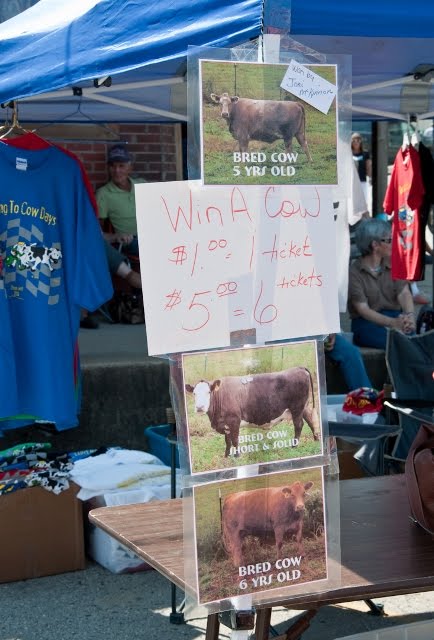
Cow Days is actually a renewal of a series of festivals that Dixon merchants sponsored during the Great Depression, as a way to get folks to visit the town and spend money. The draw? A cow was given away to some lucky festival-goer. Yee-haw!

And that’s still the draw today—now, what other festival can you go to where you could potentially win a cow?? That’s basically what drew me there—what a thrill! (What the hell was I gonna do if I won it?)

(Probably take the $600 instead.) But still—“Win a cow!”

The festival covered about two blocks of downtown—vendors, craft booths, political booths. One whole section of food vendors—meat smoke, powdered sugar, and hot grease!

The parade was fun—very small-town; makes the Macy’s parade look like something from Alpha Centauri. Here are some photos.

There were lots of classic cars, of course, and vintage tractors, Farmalls and John Deeres.


There was patriotic everything, and lots of plugs for state and local candidates. This pickup went a little overboard, I thought, but it was fun to see its “windshield wipers” flippin’ away.


Of course, the fire trucks were all there, honking their horns, and everyone was handing out or pitching candy.


The different classes of the local high school had a competition for best float. This year’s theme was “Racing to Cow Days,” so there were a lot of checkered flags and NASCAR references. Combined with cattle and other barnyard imagery.


Yeah, go figure. But it gave everyone something to do and to be proud of.

And there were scads of queens and princesses. Here’s the Pulaski County Miss Outstanding Teen, handing out candy. If the look in one’s eyes and kind mannerisms count for anything, this teen queen looked to be a sincerely nice young woman.


I told you everyone was handing out candy. About three-quarters of the way through the parade, I noticed that much of the candy being tossed at the audience was just “bouncing off” people in the front row.

The best parts of the parade, as usual, were the bands. There was the Dixon combined middle and high school band, and the Lebanon High School Yellowjackets. They all played very well, and their horn carriage and other marching skills were admirable. Good job, kids!


I have to confess I can be a real turkey when high school marching bands go by—sometimes I can’t resist calling out some uber-popular name for kids in that age group: “ASHLEY!!” or “TYLER!!” Just to see if anyone looks up. I think it’s hilarious, but it makes Sue want to creep away and pretend she doesn’t know me.

The car show is always fun. Every time I see classic cars from the fifties and sixties, I find myself saying, yes, out loud: “Why did they ever stop putting vent windows on cars? They were so nice!” . . . Oh well.


What else do you do at Cow Days? Well, you visit the food vendors and look for new combinations of sugar, flour, and fat that you’ve never heard of before, and try them.


This year we had to try a “Kow Patty: The Redneck Funnel Kake,” advertised on the side of one of the food wagons. As far as I could tell, everything this particular food wagon sold was deep-fried—bloomin’ onions, deep-fried pickles, fried “twinkes” [sic], fried Oreo cookies, and “ribbon tater’s.” (Again, sic.)


Three bucks. I waited in line, got up to the window, waved my three bucks at the lady, and said, “I want a Kow Patty!”

She asked me, “Do you know what that is?

I replied, “Nope! That’s why I’m ordering it!”

She described it: It’s a honey-bun that’s been dipped in batter, deep-fat fried, and topped with powdered sugar. “When we’re done with it, it looks a lot like a cow patty. . . . You still want it?”

I told her, “Sure! We have our cameras ready.”

Here you go.


Yes, it was sticky, greasy, molten inside, strangely delicious, and, as Anthony Bourdain said about deep-fried Twinkies: “wrong on so many levels.”

Finally, there’s the cow raffle. We did buy some tickets—Well? You can’t win if you don’t play. So far, to our knowledge, neither we nor any of our friends or family have been contacted, so I guess none of our tickets won. It was fun filling out the names and numbers. But if you’re reading this, and you get a call from the Dixon Cow Days people saying you “won a cow,” don’t put them off. You might actually have won it!


Friday, September 17, 2010

Peach Lassi

Today was Clara Day—my maternal grandmother was born September 17, 1897. I usually try to commemorate my grandmas’ birthdays somehow—in some kind of small, but privately meaningful way.

Last year, we had a dinner of some of Grandma Renner’s favorite foods.

This year, I spent most of the day cooking (which was rather commemorative in itself, given the amount of cooking she did in her life). I made several batches of pesto, cleaning out some of the herb garden. And I fussed over a grape tart (more on that soon). And more; a terrific dessert calls for a special dinner. This activity wasn’t consciously part of Clara Day, but in retrospect, it does kind of fit.

But I did find time to make a couple big glasses of peach lassi, and Sue and I tipped them in honor of Clara—who was so fond of peaches.

Granted, the lassi was kind of a stretch—it’s like a Punjabi milkshake made with yogurt and pureed fruit—but I think Grandma would have enjoyed trying it. Peaches are great in almost anything. And Grandma loved peaches.

Here’s the formula I used. Quick and easy.


Peach Lassi

Take 2 nice big juicy ripe peaches, peel and stone them, and puree them, with a small pinch of ground cloves, in a blender or food processor.

Add about 16 oz. of vanilla yogurt. (This is about half of a 32-oz. tub of Dannon. I didn’t have any plain around. It’s what I had on hand. And this way, I didn’t need to add much sugar. And the Dannon isn’t very thick, so I didn’t need to add milk or water.) Blend and blend.

Okay, taste some: sweet enough? I added about 1/8 cup sugar, and a small pinch of salt, blended again.

Take two pint glasses and half-fill with crushed ice. Pour in the lassi and stir well.

Garnish with ground unsalted pistachios.