Showing posts with label church ladies. Show all posts

Monday, December 30, 2024

Happy New Year, 1950-1951

I’ve recently found some non-recipes among my grandma’s recipe collections.

To distract myself in the evenings when I have trouble getting to sleep, I’ve been sifting through the cigar boxes, looseleaf cookbooks, and other places Grandma stored her recipes. I’ve been trying to organize them, transcribing them, too.

One of these sources is Grandma Schroeder’s copy of My Own Recipes: Loose Leaf Cook Book. It must date to the 1920s or 30s. The pages are exceedingly brittle (especially considering it’s a looseleaf binding), and the binder itself fell apart. Grandma fixed it together with strapping tape. That, by now, is not able to hold it together, either.

The printed pages of this volume are brittle and falling out of the two rings. So fragile.

This notebook, however, is chock full of handwritten recipes, written on index cards, note paper, the backs of envelopes, you name it. Grandma added to this collection her whole life (though later recipes mostly wound up in the aforementioned cigar boxes).

But at the very back of her copy of My Own Recipes: Loose Leaf Cook Book, I found a cute little handmade Christmas/New Year’s card made by my uncle Tom in late 1950, perhaps as a school art project, or perhaps in Sunday school. I think it’s obviously a gift for his parents.

It’s a winter scene, with a church, a night sky, snow, and a full moon. The snow effect was created by spattering white paint using a toothbrush, I’ll bet. The moon in the sky is rather fanciful, since it’s usually not visible when snow is falling, with the sky thus cloudy. In the upper left corner is a miniature, commercially printed calendar for 1951, sewn together in actual pages.

There’s evidence that this little artwork was tacked up onto a bulletin board, or something. Maybe the tack was only used for the creation of the piece, since there’s no white-snow-spatter where the thumbtack had been.

Uncle Tom, born in 1944, would have been six when he made this. And it’s clearly his, with his name written on the front and the back. (It’s hard to write your name in pencil on a piece of black construction paper.)

So even after 1951 came and went, and the little calendar was out of date, Grandma kept this little artwork all these years, tucked into the very back of her looseleaf cookbook.

So, being curious, I had to look up some things. First, the moon amused me. It’s so small. Generally speaking, I think I expected it to be about the diameter of a bottlecap, but instead, it’s not even half an inch wide.

Then I remembered what it was like to try to cut a perfect circle out of a piece of construction paper, using kindergarten scissors, and having no plan for how to cut a circle. My circles got smaller and smaller, as I rotated the paper and trimmed off all the offending pokey-out bits. If I’d traced a circle first, it would’ve been easier.

But it’s clearly intended to be a full moon in Uncle Tom’s artwork. I doubt anyone would have intended it to be, say, a gibbous moon.

And this got me wondering. Was there a full moon at the end of 1950, when these children were all making their little nighttime scenes of the church, snow, and the moon?

With the Internet, you can get this kind of information pretty quickly. And sure enough! The last full moon in December 1950 was on Christmas Eve: December 24, at 10:24 a.m. UTC, or around 4:24 a.m. here in Missouri.

So . . . this was an actual scene from Christmas 1950. How about that.

I’m also tickled at all this line of thinking, because for several years at Christmas, Uncle Tom has mailed us Moon Over Me Magnetic Moon Calendar, Almanac Card, and MoonMaggy Fridge Magnets. The fridge magnet shows all the phases of the moon for the calendar year.

The chart itself, in its geometric form, has an aesthetic beauty to it. And it’s good to know what the moon is up to, even if you don’t believe in astrology. When is the night darkest? When is it brightest? When do you get to see those beautiful “fingernail” new moons hanging over the western sky in the evenings, with the earthshine on the dark portion, revealing its true spherical shape? When will the lunar eclipses be happening?

And that’s really about all on this subject. It was just fun to discover, among all those recipes for cinnamon coffee cake, chow-chow, oatmeal cookies, and Christmas fruitcake.

I’ve found some other interesting non-recipe items, too. Maybe I’ll find time to blog about them, as well.

Friday, December 2, 2022

Notes on Grandma Renner's Billie Goat Cookies

I’ve written about Billie Goats, also spelled Billy Goat Cookies, before. But it’s time for a more nuanced version of the instructions. Look, no matter how you make them, they’ll be delicious. But I’ve been taking notes every year, so I can get the shape and texture just right. Until now, it’s been hit-or-miss. But I think I’ve got the techniques figured out, now. (As Chef John says, “Never let the food win.”) By golly.

So yes, there's a recipe at the end of this post.

A true, enduring gift from my grandma Clara Renner, these cookies take the strong, separately distinctive flavors of brown sugar, cinnamon, black walnuts, and dates and combine them into a new flavor I can only call “Billie Goat.” It’s a genuine meld; the combination is much greater than the sum of its parts. If you don’t like one of the ingredients, don’t rule out these cookies, because each flavor is tempered and transformed by the others. This is one of the best cookies anyone can make, in my opinion.

And for us, it’s a must-have for the Christmas cookie tray.

I have used this combination of brown sugar, cinnamon, dates, and black walnuts in other recipes, and I’ve found they have the same profound, synergistic effect, where they meld into a new, milder, but very unique flavor. I think of it as “Billie Goat seasoning.” I use this combination in my bran muffins, for example. You could also apply it to a bowl of oatmeal, or use it in pancake batter or a quick bread.

Grandma Renner said these are called “Billie Goats” because they are lumpy and have little points that stuck out, like a goat. (This is why the shape and the texture of the dates is important; read on.) I don’t know why Grandma spelled it “Billie” instead of “Billy.” Grandma Renner, her sister, Lydia Meyer, and their friends apparently all started making Billie Goats about the same time.

Billie Goats/Billy Goats are in a family of similar drop cookies that were really popular among mothers in the 1930s and 40s. This was a generation of moms who were keenly conscious of their role as household managers. In school, their “domestic science” classes taught them to be faithful guardians of their family’s health and good stewards of the family food budget. Vitamins were a new discovery with their generation. These women wanted to pack maximum nutrition into the foods they made, including their children’s after-school snacks—while being very economical (first, because of the Great Depression; next, rationing during World War II).

So, instead of sugar cookies or candies, they made these proto-health-food snacks, using nuts, plus raisins, dates, and/or currants, and sweetening with surprisingly small amounts of brown sugar (some recipes call for a combination of brown and white). Other cookies in this group include “hermits” and “rocks”; oatmeal-raisin cookies are also close relatives. Look for all these recipes in old cookbooks and church ladies’ cookbooks. The names “billy goats” and “rocks” both apparently refer to the chunky, knobby look of these cookies. I don’t know how “hermits” got named.

Some notes about texture and form, since I’ve had some time to figure these out. They’ll taste great no matter what you do, but the goal is to have a chewy, cakelike inside, and a lumpy, chunky shape. So here’s a discussion of challenges, and my “pro tips.”

For generations, most American cooks could only get Dromedary brand dates, which were apparently Deglet Noor dates. They were packed tightly in cellophane (this was before plastic), stuffed into cardboard boxes, and, after languishing in a warehouse or on grocery shelves, they were as tough as shoe leather. Clipping them with kitchen shears, as Grandma’s recipe instructs, would literally hurt your scissors hand. (Grandma’s kitchen shears were stainless steel, dull old things; you know the type—the ones with the rounded “claws” for opening bottles at the base of the red-painted, hard metal handles. The base of my thumb still hurts, just thinking of them. This was way before “Fiskars” scissors were available!)

So billy goat cookies, being a midcentury recipe, were developed using the ingredients that, at that time, were available to most people: dried-up dates. The cooking softened them, but not to the point where they lost a distinctive, chewy, chunky presence.

Today, the Dromedary brand seems to have gone out of business, and you just cannot buy dry, hard dates like them; instead, they are all moist and tender, either packed in plastic or shipped absolutely fresh. This is actually a good thing, but it presents a problem for replicating this cookie’s texture, since moist dates tend to dissolve into gooey molasses during baking, producing a flat, uniformly chewy cookie, instead of distinct, chunky, jagged lumps of chewy dates and nuts in a cakey, rounded matrix of dough.

I’ve learned to replicate the type of dates Grandma had by purchasing them (Deglet Noors) a few weeks ahead of baking, clipping them in the prescribed herringbone pattern while they’re still soft (which is a much easier task, now), spreading these out on cookie sheets, and letting them sit (under wax paper) in a quiet place while they dry. The house isn’t at all humid in November. Or, you can put them in the oven warmed only by the pilot light. Or you can try a dehydrator. An alternative might be to try to find one of the so-called bread dates (varieties such as Thoories that are sold rather dry, dry enough you can carry them in your pocket)—but those might lack sweetness. Also, I think it’s cheaper and easier to use regular Dole (or whatever) brand Deglet Noors, cut them, and let them dry. That seems the best way to replicate the texture and flavor of old-fashioned Dromedary dates.

Another point about texture: These cookies have caused me more vexation than any others, except perhaps when I was first figuring out springerles. If you only make a cookie once a year, it’s hard to fine-tune the recipe! My Billie Goats recipe card is full of penciled-in notes: “try doing _____ next time.” You don’t want the cookies to be so soft they spread out, but you don’t want them crunchy or hard. How to get that cakey, chewy texture, and chunky look? Here are some key tips:

  • Use a 50/50 combination of margarine and butter-flavored Crisco. Real butter does make them taste better, but it complicates the texture; the cookies turn out drier, less moist. Save your butter for some other recipe.
  • Pack the flour; forget the rule about spooning fluffed-up flour into your measuring cup and leveling it off with a knife. It turns out Grandma R used her measuring cups as scoops: swipe the cup through the flour, like you’re using a dip net to fish something out of water. You can level it off if you want, or just kind of shake off the excess, but you need to pretty much pack the flour into the cups.
  • Let the dough sit overnight in the refrigerator or on an unheated sunporch. The flour will absorb the liquids and be easier to work.
  • . . . But the dough will still be sticky and hard to handle. Put on some happy music. Use parchment-lined cookie sheets. Try dabbing the dough into little rounds with two spoons, or (if you haven’t much patience for the spoon method) use your fingertips to pinch off bits of dough (put some water on your hands so it doesn’t stick so bad; even then, you’ll have to clean your hands and start again several times).
  • I tend to make smallish cookies, because I figure twenty-first-century people would rather select six different morsels from the tray than settle on just two huge cookies. Big cookies are a joy, but variety is the spice of life. Also, with smaller cookies, a single batch of dough goes farther. A 1¼-inch blob of dough, slightly flattened before cooking, produces about a 1½-inch diameter cookie. Back in the day, Mom and Grandma’s cookies tended to end up about 2 to 2½ inches in diameter. Different sizes account for the difference in cooking time; smaller cookies cook faster.
  • Do a single tray of cookies first and see how they turn out. These shouldn’t flatten very much. If they spread out flat, you may have to add a bit more flour to the dough, or you might need to adjust the size of the cookies.
  • Finally, don’t overcook these, or they will be too hard. Mom says this was a principal criticism Grandma R had about her sister, Lydia’s billy goats: “she bakes them too long, and they get too hard.” (I’ve heard this criticism plenty, too.)
  • But if they come out kind of hard, don’t panic. Seal them in a tin, with the layers of cookies divided by wax paper, and take half of a tart apple, wrap it loosely in wax paper, and nestle it in the tin with the cookies. After a week or so, you’ll discover the cookies have softened and developed a je ne sais quoi in terms of flavor.

. . . Does all this sound too hard? Please don’t be put off by these tips; it’s all stuff I’ve learned the hard way, and I’m sharing it here, so you have a super-duper head start!

Finally, again, you can’t really ruin these. They’ll taste great regardless of the texture and shape.

Billie Goats/Billy Goat Cookies

1½ c. brown sugar
1 c. butter [Pat S. uses margarine, sometimes butter-flavor Crisco; I use half margarine and half butter-flavor Crisco; real butter tastes good, but then the texture will be off]
-----------Cream together butter and sugar.

3 eggs: beat whites [till light; use a hand mixer or whisk] and [then] add [whisk in] yolks

1 level tsp. baking soda dissolved in
¼ c. lukewarm-to-hot water

1 Tbs. cinnamon
1 tsp. vanilla
1 c. black walnuts [chopped]
1 lb. clipped dates [using a scissors, clip whole, pitted dates in an alternating herringbone pattern; the idea is to have them big enough to kind of “poke out” of the cookies; if you buy pre-chopped dates, it’s okay, but the pieces are too small to achieve the characteristic lumpy look.]
2½ c. flour [basically pack it]

Make the cookie dough [let it sit overnight in the fridge] and drop it onto [parchment-lined] cookie sheets by small spoonfuls. Bake in a moderate (ca. 350-degree) oven like you would other cookies, about 8–11 minutes. [Don’t overcook; they should be rather chewy and cakey inside.]

Makes about 100 cookies.

Thursday, November 24, 2022

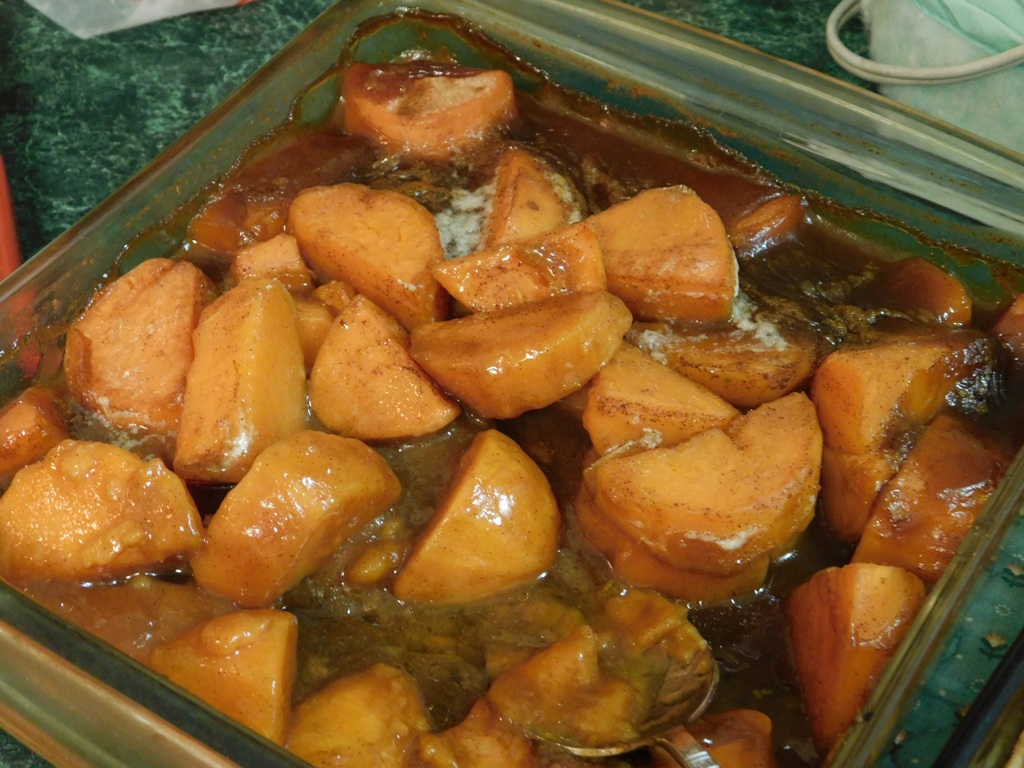
Florence Biffle’s Sweet Potato Bake

Happy Thanksgiving!

This fantastic yet simple recipe, titled “Sweet Potato Bake,” is from Mrs. Florence M. Biffle (1914–2006), who was a member of Faith Lutheran Church in Jefferson City. I recently found her obituary online. I’ll bet my Great Aunt Lydia Meyer knew her well, since she was a longtime member of the same church and was also a quilter. Also, I’ll bet my Grandma Schroeder and Great Aunt Minnie Bartlett new Mrs. Biffle, too, since they were all longtime members of Jefferson City’s Hawthorn Garden Club.

I never knew Mrs. Biffle, but I feel I could easily have known her. There’s a good chance I was in the same room with her at some point, and just never knew it. Anyway, I’m grateful to her for this recipe, and for these small connections between our worlds.

I noticed she was buried out at Hawthorn Memorial Gardens cemetery, so in a few weeks when I'm out decorating Grandma and Grandpa Renner's grave, I'll see if I can find Mr. and Mrs. Biffle.

This recipe was on p. 49 of Cooking with Faith: Favorite Recipes of Faith Lutheran Church Women, Jefferson City, Missouri, by the Faith Lutheran Ladies Guild, Jefferson City, Missouri [ca. 1975].

This is an interesting, fruity-glazed alternative to the standard (and I think tiresome) sweet potato casseroles made with brown sugar, pecans, and marshmallows, so common at the Thanksgiving table. I think you’ll really like this for a change of pace.

I’ll offer my tips and suggestions after the recipe.

Sweet Potato Bake

Cook 4 to 6 sweet potatoes until almost tender. Skin and cut to desired size (chunks). Place in a casserole dish.

Combine and bring to a boil:

1 c. apricot nectar
2 T. orange juice concentrate (not diluted)
½ c. brown sugar
1½ T. cornstarch
1 t. salt
½ t. cinnamon
2 T. butter
½ c. water

Pour over the potatoes and bake 30 to 40 minutes at 350°F.

Julie’s notes:

You can peel the sweet potatoes and cut them into chunks, then cook them in gently boiling water if you don’t want to bake them. I have also steamed them, and that works, too. But don’t overcook the potatoes; remember they will be cooking for another half hour in the oven.

I use a 9 x 9 Pyrex baking dish. You will cook it uncovered, so what begins as a liquid dressing reduces to a gooey glaze over the potatoes. Pull them out of the oven when the sauce is gooey enough for your taste.

The dressing mixes up most easily if you first combine all the dry ingredients together before adding them to the liquid.

Kern’s Apricot Nectar, which is no doubt what Mrs. Biffle had in mind, used to be available at all the grocery stores around here, but I haven’t seen it in years. I think the company’s out of business. There’s another brand called Jumex, but I’ve never seen it except online. I’ll bet it’s something to look for at an international store. Both seem to contain high fructose corn syrup and other less-than-desirable ingredients. But it’s no problem if you can’t find apricot nectar. Just take some canned apricots and some of their juice and puree it in a food processor or bullet blender, so it gets to the consistency of a thick “nectar” type juice. You only need a cup. A bonus of doing it this way is that you can decide how much corn syrup to include (since you are selecting your can of apricots—in heavy syrup, light syrup, or whatever). You can even puree the apricot pieces with just water, if you want.

There's no reason you couldn't use dried apricots, simmered in water until they're perfectly soft, then process those in a bullet blender or run them through a food mill, to make them into a liquid puree. I suppose that would be healthier. But I think using canned apricots with their corn syrup is more authentic to the midcentury church ladies cooking style.

Do-ahead tip: You can put the peeled, precooked potato chunks and the uncooked sauce into the casserole dish, dotting the butter on top, covered with plastic wrap, and refrigerate overnight. Or out on your unheated sunporch, if it’s cool enough. Finish it in the oven the next day.

Monday, July 6, 2015

Red, White, and Blueberry Jell-O Salad, alias "Blueberry Salad"

Trust me, this looked excellent before we demolished it.


And the fact that we demolished it implies (correctly) that it tasted really good, too!

It’s the perfect Jell-O salad for a Fourth of July meal. Like all Jell-O salads, its cool fruitiness is a great complement to barbecue, hamburgers, hotdogs, or whatever. And it’s refreshing on a hot day (like it always is here, in July). And face it, most Jell-O salads are more like dessert than a health food, and it’s a holiday, so hey, rock on!

But you gotta be fast if you want to take a picture of it.

File this one under “retro recipes.” I found it in the 125 Year Anniversary Commemorative Cookbook from Trinity Lutheran Church, published in 1995 or 1996. The original recipe, according to that collection, was in “the Kitchen Klatter Cookbook, published in 1982.” (Does that mean the magazine? I can’t find evidence that a Kitchen-Klatter cookbook was published in 1982; only in 1977. Hmm.)

Or it could have come from Country Woman magazine, July/August 2000, p. 42, where apparently it was called “Red, White, and Blueberry Salad”? Online, it’s frequently called “4th of July Party Jello.” (Sic.) (We all know how it’s officially spelled and capitalized: Jell-O.)

Anyway . . . there aren’t many pictures of this particular Jell-O concoction because, no doubt, it gets eaten up before anyone gets a chance to take a picture of it!


I amended the recipe just a tad: It was apparently created before Jell-O had come out with its blueberry flavor/color, so the original called for the blue layer to be created with raspberry Jell-O plus the fruit and juice from a can of blueberries. But shoot! Why not use blueberry, now that it’s available here in the modern age? Real or artificial, flavor-wise, blueberries and raspberries are great friends!

I interpreted the “coffee cream” it called for as “half-and-half,” and I substituted Neufchâtel cheese for the cream cheese in the recipe—it’s got less fat, but darned if I can tell much difference between the two.

Here’s how to make it. Be sure to allow time for each layer to get hard before adding the next—I suggest making it a day ahead. (Which is to say, July 3!)

The recipe suggests using an 8 x 8 or 9 x 11 inch dish. (I used an 8 x 8.)

1. First layer (red):

1 box raspberry Jell-O (regular size box; not the big one)
1 cup boiling water
1 cup cold water

Make the raspberry Jell-O per the usual directions on the box. Pour it into the dish and chill until firm.

2. Second layer (white):

1 envelope plain (Knox) gelatin
1/2 cup cold water
1 cup half-and-half (or milk)
1/2 cup sugar
1 (8-oz.) package of cream cheese (I use the lighter Neufchâtel cheese), softened a bit
1 tsp. vanilla
1/2 cup pecan pieces

In a little bowl, stir the gelatin into the water and let soften. In a saucepan, heat the half-and-half with the sugar until hot but not boiling. Add the gelatin, mix, and let cool. When it’s no longer hot, in a blender or food processor, mix the gelatin mixture with the cream cheese, vanilla, and pecans.

Pour this white layer over the red layer and chill until firm.

3. Third layer (blue):


1 package blueberry Jell-O (again, regular size box)
1 cup boiling water
1 (approx. 15-oz.) can blueberries with juice (such as Oregon brand)

Dissolve the Jell-O in the boiling water. Stir in blueberries, with their juice. Let it cool so that it’s not hot (you don’t want it to melt the gelatin you’re pouring it on), then pour this blue layer over the white layer and chill until it’s firm.

----------------------------

This is really delicious. If you’re like me, the slightly tangy, creamy white layer, with its pecans, will really transport you back to childhood potlucks from the sixties and seventies. Back then, I would have had no idea what was in that white “mystery” layer—but I sure would have given it my approval!


Saturday, November 13, 2010

Christkindelfest: Mark Your Calendars!

Kristkindlfest, Kristkindelfest, Christkindelfest—no matter how you spell it, you’ll want to be there. Music, cookies, coffee, food, fellowship, fun, and a beautiful, German-flavored worship service to get you in the Christmas spirit. Mark your calendars now.

First, I have some music to share with you! You can watch and listen to music from Christkindelfest 2008 while you read the rest of my post.

First, here’s the Central UCC Choir singing “Lo, How a Rose E’re Blooming.” That’s a good German Christmas hymn!


Central United Church of Christ—which is Jefferson City’s historic German Central Evangelical Church—sets aside a Saturday in early December to offer a German-style Christmas worship service to the community. And lots more. Do you like church suppers? Do you like cookies? I thought you did!

The date is Saturday December 4, 2010. Here’s the schedule.

9:30 to 11:00—Kaffeeklatsch and bake sale in the church gymnasium. The bake sale features German-recipe cookies, kuchen, tea rings, and stollen, along with other yummy things. The idea is: Buy some goodies to take home with you, plus a little extra to eat right now, while you sip coffee, visit, and make new friends.

(By the way, they usually have cookbooks to sell, too. In case you’re like me and can’t get enough of church-ladies cookbooks.)


11:00—German-style worship service, in the church’s sanctuary. First, if you’re not a member of Central UCC, relax!—you’re welcome to participate. If you’re a Catholic, Baptist, Lutheran, or anything else, don’t worry: The United Church of Christ welcomes you as a fellow Christian! (That’s one of the reasons this denomination is called the United Church of Christ: The idea is that despite the denominations, we are all united under God.) (Hmm: that sounds kind of familiar, somehow . . .)

And even if you’re not a Christian at all, it’s okay. This service is light on the preachin’ and heavy on the music. I think we can all agree that the Christmas sentiments of peace, joy, and love are powerful and are worth celebrating, whether you think the stories are literally true or not.


This year, the choir is preparing music from a German-language mass written by Franz Gruber (who wrote the music for “Silent Night”) that features an Alpine horn (well, it will be performed on a French horn)—and it should sound very “Tyrolean.” As far as I’ve been able to tell, this mass is rarely if ever played in America; it was brought over by Central UCC’s former choir director, Carl E. Burkel, who wrote the arrangement.

There will also be a “children's time” and plenty of good Christmas songs for everyone to sing. I understand, too, that the Christkindelfest offering always goes to local charities. Please don’t hesitate to attend this—it will get you in the Christmas spirit for sure.

Here is another video for you to watch—this is also from the 2008 Christkindelfest, and the singer is Esther Seidel, a lifelong resident of the greater Jefferson City area, who learned “Silent Night” in the original German as a little girl, and has known it by heart ever since.


By the way, I was there when she sang that year, and I couldn’t help but think of my Grandma Schroeder, who is about her same vintage, and how little it took to get her to start singing, and how she remembered the German lyrics to all her old songs.

I can’t tell you how moving it was to hear Mrs. Seidel sing this song. The video gives you only a small taste of this beautiful lady’s sweet singing.

And! I’ve heard that Mrs. Seidel will perform again this year! Yes! She’s planning to sing the beloved German Christmas hymn “Vom Himmel Hoch” (“From Heaven Above to Earth I Come,” or “From Heaven High I Come to You”). It’s one of Martin Luther’s hymns!

And then . . .


12:00 (or thereabouts--after the service) to about 1:30—Lunch in the gym. They’re serving delicious Burger’s ham from Moniteau County, plus—I’m sure—a bounty of yummy church-lady-style side dishes.


1:00—Reverend Stephen H. Buchholz, pastor of Central UCC, will lead a tour of the church. He’ll describe the congregation’s 150-year history and focus on the lovely artwork, stained glass, carvings, and their symbolism in the sanctuary of this historic church.


One more YouTube link for you: It’s the Central UCC choir (under the direction of Dr. Ruth Robertson) performing the traditional German carol “Never Do Bells Ring More Sweetly.”


So: put it on your calendar right now, so you don’t forget it!

—And see you there!


Special thanks to Rene Miserez of Central United Church of Christ, who has posted several Central Church videos on YouTube. She made it possible for me to share these with you. A big exuberant Munichburg “Danke Schön” to you, Rene!

Monday, February 1, 2010

Miss Ann Kielman


Tonight I’m sharing with you a photograph of Miss Ann Kielman, whose delicious Cucumber Mold recipe I presented to you in my previous post.

Mom stopped by the other day with a copy of the 1972 Pictorial Directory of Jefferson City’s Faith Lutheran Church, which had belonged to Mom’s Aunt Lydia Meyer, who, as I also mentioned in my previous post, had been Ann Kielman’s best-friend-forever (BFF).

That 1972 church directory! I couldn’t help hooting and pointing at some of the hairdos. There were some real doozies—beehives, wing-to-one-sides, swooping Kon-Tiki Hawaiian do’s. One lady looked like she had a Drip-O-Lator coffeepot on her head. And the men weren’t immune, either: Comb-overs and slicked-down hair galore. And everyone was wearing polyester and looked, well, permanently pressed.


I could indeed share some of the more entertaining pictures with you; other bloggers would jump on the chance to provide such hilarious pictures to which they could add witty put-downs, but you know what? I’m too classy to do that. These were and are real people, with feelings; sincere Lutherans just trying to look nice for their church directory portrait.

Face it, the fashions reached their lowest point ever in the history of humankind in the seventies, and these folks, like all the rest of us, were victims of the trends. Unlike James Lileks et al., I just don’t feel like “poking fun at the defenseless past” this time.

Back to Miss Kielman for a second. Remember, it’s pronounced “kilmun,” not “keel-man.” I remember Aunt Lyd talking about her and pronouncing it “kilmun.” And no, I don’t know why the directory spells it “Anne” while the cookbooks spells it “Ann.” I don’t know about you, but my money’s on the cookbook spelling. (If you’re reading this and you can correct me, please leave a comment!)

She’s dead. Why does any of this matter? It just does. I didn’t know her (though I’m sure I met her; she had to have been at cousin Dennis’s wedding and funeral, and at many other occasions) . . . but like Mildred Sippel, the thread of her life has interconnected with mine, and the fact that she left behind no progeny, no one to leave flowers on her grave or point at her picture in an album compels me to put her name and picture on the Internet, for people maybe even a world away to see and sort of know, a memorial of sorts, even if we’re recognizing her for her cucumber Jell-O mold and for the fact that she and my great aunt were dear, dear friends.

It has to count for something.

Thursday, January 28, 2010

Retro Jell-O Recipes Nos. 62,500 and 62,501: Lime Jell-O with Cucumbers, Onions, and Vinegar


Hey, folks! I’m almost getting serious about these retro Jell-O recipes! Today I present to you two variations on a theme, and these are both definitely “salad” Jell-Os and not dessert ones.

Both involve lime Jell-O, cucumbers, vinegar, and a small amount of onion.

The first recipe was published in the official Jell-O cookbook from 1930 and was the first “salad” recipe listed, on page 16. I should mention that this cookbook announced a brand new Jell-O flavor: “The new, wonderfully refreshing Lime!” (“You will want to buy Jell-O in all six flavors, six packages at a time. Then there will always be the ‘makings’ of a lovely dish on hand.”) Yes, junior, there was indeed a time before green Jell-O.

Just in case you missed the fantastic news, there’s a “note” just before you launch into the recipes:


Above this particular recipe is a lovely illustration of some pret-ty high-class folks. One lady is our heroine; she’s slicing into her monumental jewel-like creation. Another lady behind her has her pretty little nose in the air. Bleeding off the edge of the illustration are two figures in black suits, and another high-class lady’s shoulder. There’s a magnificent coffee urn on the table (puffing out his stainless chest, with arms akimbo), attended by some fabulous coffee cups and saucers. What a fine, gay luncheon this shall be! (I think the message here is: “With Jell-O, you can forget all about the Great Depression.”)


Here’s the recipe, transcribed with great care. My comments follow.


Sea Dream Salad

1 package Lime Jell-O
1 cup boiling water
1 cup grated cucumber
1 tablespoon vinegar
1 teaspoon onion juice
Dash of Cayenne
1/2 teaspoon salt

Dissolve Jell-O in boiling water. Add cucumber, vinegar, onion juice, Cayenne, and salt. Force through sieve. Turn into mold. Chill until firm. Cut in squares and serve on crisp lettuce. Garnish with Hellmann’s Mayonnaise. Serves 6.


. . . Now, is there any law that says you have to cut it in squares? Pffft. I molded mine in little cups!

I have to say, this is a Jell-O technique you don’t see very often in your standard church-ladies cookbook, this idea of infusing your hot liquid Jell-O with other flavors, keeping the Jell-O crystal clear. You add the grated cuke and stuff to hot Jell-O, then strain out the solids. It’s like making cucumber–onion–Jell-O “tea.”

Hmm. I think that most church ladies would see this as a waste of perfectly good cucumber. I think most church ladies would just as soon keep the cuke in the salad.

Aha! Hence the next recipe, which comes from my beloved copy of Cooking with Faith: 1950 to 1975, published in Jefferson City by the Faith Lutheran Ladies Guild.


It’s a contribution from “Miss Ann Kielman,” and appears, amid a wiggly, jiggly bounty of other fine Jell-O recipes, on page 30.


Again, I transcribe it for you, with a few comments afterward.


Cucumber Mold

1 pkg. lime jello [sic]
1 c. hot water
1 tsp. salt
2 Tbsp. vinegar

Mix together and let cool until almost set, then add:

1 c. sour cream
1/4 c. or 2 Tbsp. mayonnaise
1 c. chopped cucumbers
1/2 tsp. grated onion


As usual with these sketchy types of recipes, you’re left to wonder about how finely chopped the cucumbers should be, or how finely grated the onion. But I bet I know what Miss Ann Kielman would say: “Well, as fine as you want them.” . . . I chose a small dice.

So! How Do They Taste?

My curiosity about this very question is what made me make these two recipes. They sound so counterintuitive to us in 2010; I suspect many of you are thinking, “Ugh! Nasty! Jell-O ’n cucumbers ’n onions ’n vinegar!”

Yet these recipes were appreciated enough to appear in these publications. Someone paid good money to print these on paper. The first must have ranked extremely high on General Foods’ taste tests, since it appeared at the top of the salad section where they kick off the new Jell-O flavor—two whole pages before the spectacularly famous “Under-the-Sea Salad.”

And Miss Kielman must have had plenty of folks compliment her on her delicious Cucumber Mold, since she tendered it among her other contributions to her church’s cookbook. (Well, unless maybe it was dishes like this that “kept” her unmarried?)

So here’s the verdict. First, you have to let go of your ingrained notion that Jell-O is for sweet stuff. In fact, you need to let go of the common American idea that fruit flavors aren’t used in savory dishes. But try thinking along the lines of a mango chutney or pineapple salsa, where “savories” like onions and garlic walk down the aisle hand-in-hand with delicious sweet fruits.

Both tasted really good! Sue, in particular, liked them—but you have to realize that Sue is a nut for Jell-O. Always has been. She said it was a bit of a leap to get used to “salty Jell-O”—an exaggeration, I think, though it does kind of describe the effect. The flavors of the two are surprisingly similar.

We both agreed that if you were to pick one of these to serve to company, Ann Kielman’s is much better. First, the milkiness prepares you for something “different”—you know just by looking at it that it’s been modified somehow. The Jell-O cookbook version, by contrast, looks for all the world like “normal” green Jell-O. (Until you inspect it closely and see the cayenne flecks in there.) Unless you’re fully aware of the fact that the sparkling green blob before you is a salad, you might be really, um, surprised.

Another point in the Ann Kielman recipe’s favor: The chopped cucumbers do add a pleasant and welcome texture; their presence helps balance the whackiness of the overall concept.


Meanwhile, I found myself unable to finish my portion of Jell-O’s Sea Dream Salad, mainly on account of the mayonnaise, the garnish. I have to admit that I’m not a fan of mayo, anyway, and this is probably my least-favorite way of having it, ever. Bleah. More like Sea-Nightmare Salad. My sea doesn't have mayo in it.

Tomorrow when we have more of this (hey, it’s just the two of us, so there’s leftovers), I’ll try mashing an avocado and putting that to the side instead of mayo. I’ll bet that would be lots better. Or maybe sour cream. So many options.

I guess this is why there are a hundred thousand different Jell-O recipes, huh!


Bonus Fun Information, Just for You!

Maybe you’re wondering about this “Miss Ann Kielman” who submitted such a delightful recipe to the Faith Lutheran cookbook! Well, she was my Great Aunt Lyd’s BFF. They were both about the same age, so Miss Kielman was probably born around 1905 or so.

Oh! And it’s pronounced “Killmun,” not “Keelman.”

If you’re from around Jeff City and keep your ears pricked up for history, that surname might ring a bell: Kielman’s Pool Hall was opened in 1897 and by the 1930s was run by Ann’s father. It was located just south (uphill) of the ECCO Lounge—actually, the two buildings are attached. There’s a consignment shop there now.

My mom remembers going to Kielman’s with her dad when she was little; they’d sit at the bar together. He’d have a beer, and she’d drink a Dr. Pepper and eat a package of Planter’s Peanuts.

Ann’s mother, mom says, drove a car (which is remarkable for a woman of that vintage, and that’s why I’m relating it), and she was a good friend of my mom’s Great Aunt Maggie (Margaret Renner Burkel Jordan), who lived up on East Ashley. She also drove her own car!

The Kielmans were a longstanding Munichburg family, and Ann—who never married—lived in her parents’ house and continued to live there after they passed away.

So Aunt Lyd and Ann Kielman were lifelong best friends; they worked together for years at the Missouri Public Service Commission, and they both were members—charter members, I think—of Jeff City’s Faith Lutheran Church.

After Lyd got married, and before she and Adolf started having kids, they would take Ann with them on trips. Once (my mom says) they even went together on a trip to Colorado! You have to give Adolf some real credit here for being a nice hubby: How many other young married men would want to go on a lengthy motor trip with their wife and wife’s best friend?

Anyway. I never new Ann Kielman myself, but I sure heard her name a lot when we would visit Aunt Lyd. It’s nice to put these whacky pieces together, and to enjoy her tasty Jell-O salad!


Sunday, November 8, 2009

Jefferson City Braunschweiger Report #3: A Log for Your Next Shindig

Oh my goodness.

What can I say? This sounded kinda good, and kinda gross at the same time.


. . . So I had to make it. Yeah, it’s from a church ladies cookbook, the 1975 one from Faith Lutheran Church here in Jeff City. I told you about it before.

Braunschweiger Log

1 lb. Braunschweiger
2 Tbsp. chili sauce
2 Tbsp. mayonnaise or salad dressing
1/2 tsp. sweet basil
4 strips bacon, cooked and crumbled, or 2 oz. (1/2 c.) crushed or slivered nuts

Combine Braunschweiger, chili sauce, basil, and mayonnaise. Form mixture into loaf shape. Roll in crumbled bacon or crushed or slivered nuts. Add decoration to top for occasion. (For example: Christmas holly—leaves cut from a green pepper and berries made from pimiento pieces.) Serve with assorted crackers.

Mrs. Linda Sporleder

From Cooking with Faith, 1950 to 1975 (Jefferson City, Mo.: Faith Lutheran Ladies Guild, ca. 1975), 7.


“How . . . was it?” you might ask, thinking to yourself, “Ewwwww . . .”

Well? It tasted . . . braunschweigery. But better than plain braunschweiger: Beating it up with the other ingredients turns it into a nice, easy little pâté, perfect for dipping, with that retro flavor that no one “does” anymore. It’s reasonably pretty when decorated (as I did) with sliced almonds as well as the recommended colorful bell-pepper artwork.

I truly don’t advise rolling it in crumbled bacon, or your heart valves might start clapping shut like storm doors on a windy day. And trust me, no one’s that keen on defibrillation.

I used Yeo’s Hot Chilli Sauce (product of Singapore) instead of the mild, home-canned, 1950s-era chili sauce that I’m sure Mrs. Sporleder used, and I’m glad I did, because it added a nice little kick. Okay, and I reduced the amount of braunschweiger and added plenty more chili sauce and basil than recommended, too. The heat really added a nice dimension. Yum!

It makes enough for a party. Please serve it with raw veggies in addition to crackers.

You might consider this as a potential potluck item the coming holidays. . . . Because you know nothing will “wow” them like a genuine church-ladies-style braunschweiger log.

(Wow.)

Thursday, October 29, 2009

Celebrate German Heritage Recipe #5.2: Lydia Wegener’s German Potato Salad

It’s a cornucopia of GPS recipes! Remember versions 5(.0) and 5.1? This is the last of my Oktober, er, October, celebrating-German-heritage recipes. I will of course keep sharing recipes with you, so don’t worry.


Here is another recipe from my mom’s collection. The recipe is from Lydia Wegener, who was a crony of my Grandma Renner’s, a Lutheran, who was in Grandma’s circle. As in, church ladies’ circle. (I think “circles” were what people had before there was Facebook.)

Being good friends, Grandma and Lydia Wegner apparently swapped various recipes. Years later, Dorothy Schaefer (Lydia’s daughter and next-door neighbor to my Grandma) (I mentioned Dorothy and her husband, Ralph, earlier) shared some of her homemade chili sauce with Grandma.

Grandma tried it, and remarked, “Why, that tastes quite a bit like my chili sauce!” Dorothy showed her her recipe, explaining it had been her mother’s recipe, and Grandma looked at it and said, “Well, that’s my recipe!” Turns out she’d shared it with Lydia years and years before.

. . . But we’ll get to retro chili sauce recipes some other day.


Anyway, like I said in my first GPS post, the techniques and dressings for German potato salad really do vary from one recipe to another. Here’s one where the dressing is made with an egg.

I found this to be a very sweet version of German potato salad, and surprisingly light. The abundance of celery and green bell pepper helps lighten it quite a bit.

As usual, I’m presenting the recipe just like I acquired it, keeping my editorial comments to a minimum; I’m adding them in square brackets. And be sure to read my comments at the end.

German Potato Salad, from Lydia Wegener

[Put the first five ingredients into a big bowl:]

12 sm. potatoes [cooked and cut up]
3 lg. blades celery [chopped]
1/4 green pepper [chopped]
salt and pepper to taste
1 small onion [chopped]
4 slices bacon

Cut up and fry bacon and pour over the potatoes. Add the following dressing:

For dressing, bring to a boil:

1 egg
1/2 c. sugar
1/2 c. vinegar [apple cider vinegar, of course]


Note: As you can see from the photos, I’ve made this salad, and I have to say I don’t understand the dressing at all. Maybe I didn’t make it correctly, but I couldn’t see that the three dressing ingredients should go in the pot together—it seemed that the vinegar would cook the egg--but maybe I should have cooked them together anyway.

As it turned out, I cooked the sugar and vinegar together, first, then added the egg, which, I should have predicted, immediately cooked into solid swirls; it basically became “egg-drop soup.” I put this “dressing” into the food processor to make it into something smoother, and it worked (sort of). If anyone has any better idea about how to make a “dressing” out of egg, vinegar, and sugar, please let me know!

Another comment: I used big red potatoes instead of small ones, and I overcooked them a bit. It tastes good, anyway!

Thursday, October 1, 2009

The Trinity . . .

Hi! And welcome to October, the best month of the year! Because we think a lot about German heritage this month--what with all the Oktoberfest celebrations going on--I'm going to make an effort to focus on German-heritage recipes this month. Yeah--as in, more than usual!

I've often explained to people that German festival food is like the "holy trinity." There are three things you need:


Brats.


Kraut.


. . . And German potato salad.


Okay, there are a few other things that are great to have, too:


Cooked apples.


. . . And--of course--beer.


(Photos in this post are from the German supper at this year's Old Munichburg Oktoberfest, held on September 26 in Jefferson City. As in previous years, the dinner was served in the gymnasium of Central United Church of Christ. And the women of the church did a great job of preparing and serving all that food! Oh, and the last photo is from the beer garden. Of course.)