Showing posts with label exhibitions. Show all posts

Thursday, January 17, 2013

Ascent from Deep River: Paintings and Drawings by the Late Tim Williams

I’m sharing this with my Op Op friends because I’m pretty sure we like the same kinds of things: Home; art; nature; heritage; creativity; things that make you think. Finding the glory in imperfect things. Glorying in things that are well done. Doing things with heart and with love. Treasures of people and places.


You would have liked Tim Williams, and you will love his art.

A native Columbian, Tim Williams painted in Central Missouri for decades, but he always seems to have shied away from putting his work in shows and galleries. He was a creator, pure and simple. As a result, though he was prolific, not many people have seen his works.


But Tim was a friend of mine (“is”—? Well, I have never stopped liking and loving him, so how does someone word such a thing, anyway?)—and because of this, I’ve been lucky for the past fifteen years or so to get to see his art; sometimes as it was in progress, but mostly as samples of it hanging in his and Jane’s home, and in Jane’s office, which was a revolving mini-gallery of his work. (You see, Jane was my managing editor, and Tim’s colorful and evocative paintings in her office provided a surefire mind-thrill during every Monday morning staff meeting. I sipped coffee those mornings, but with his art on her walls, I didn’t need to!)


I could try to describe Tim’s beautiful, brilliant personality, and his intriguing, beguiling art, but it wouldn’t work. It would come out wrong; as Laurie Anderson said, “Writing about music is like dancing about architecture.” Instead, I recommend you go see his art, which is currently on exhibit (free!) at Orr Street Studios in downtown Columbia (106 Orr St., north of Walnut, east of 10th St.).

For a taste treat, check out his enduring Web presence at his Flickr photostream and his StumbleUpon page. The Flickr photostream is a trove of his art, with each work often paired with a poem, each pairing guaranteed to make you feel more human and alive. There are landscapes, portraits, self-portraits, paintings on Zen subjects, architectural paintings, and more. (The Flickr site is where I have copied the images in this post from. See below for a statement on my copying of his art.) The StumbleUpon site shows the breadth and depth of his curiosity and the wide range of things that tickled him.

Tim’s Web presence gained him a large and loving international online following, and their appreciation was based only on digitized art glowing on a computer screen. Now you get to see the works up close, in real life. This is a huge opportunity!

------------------------------------

Orr Street Studios (106 Orr St., downtown Columbia, Mo.):
Ascent from Deep River: A Collection of Work by the Late Tim Williams, Boonville, Mo.
Exhibition runs through February 10.
Gallery hours 12–3, Thursday–Sunday (or by chance).
Reception is Friday, Jan. 18, 6–9 pm.
“Remembering Tim” discussion is Tuesday, Feb. 5, 6–8 pm.


Here is what Orr Street Studios is saying about Tim and his work:

In 1990, Tim married longtime friend Jane Lago. As a practicing Buddhist, Tim annually went to Japan to meditate with other Buddhists. One day a Zen master asked him to illustrate a book of poems he had written. Tim’s response was, “but I’m not an Artist!” and the Master said, “oh but you are!”

So in the early 90’s Tim decided to go back to school to pursue an art degree, which he completed in 1996 from MU. His mentor, as he was for so many others, was Frank Stack [professor of art at MU]. Tim would travel to surrounding river towns with Frank, and sometimes with other plein air painters—Jane Mudd, Byron Smith, and Chris Teeter—to name a few.

He communed with fellow artists and nature, and he quickly gained an understanding of painting from life. He had a natural, raw talent that amazed and inspired all who knew him. Tim was also influenced by MU professors Jennifer Wiggs and Jo Stealey.

He was passionate about art history and collected many art books. He and Jane eventually decided to buy a house in Boonville with a majestic river view.

In recent years, Tim’s desire for making art intensified. He investigated form and idea with an even greater urgency, setting a goal to do a portrait a day. Tim was a tireless seeker, a fearless innovator and an extremely sensitive artist. He died suddenly Dec. 19, 2011, at 58 years old.

This collection is only a part of a vast body of work by Tim’s in his last 20 years. In addition to attending the Jan. 18th opening reception, please join the discussion “Remembering Tim” at the Feb. 5th “Seeing Visions” Orr Street Studio event, 6 to 8 p.m.


A note on the images in this post: They are all under copyright, and I've admittedly copied-wrong by pinching them from Tim's Shitao Flickr photostream. My intentions are purely to help promote the exhibition at Orr Street, and to encourage you to look at Tim's work online, too. The pictures I've selected may not be in the exhibit. Finally, depending on Jane's wishes, I may be taking them off this post when the exhibition's done (or sooner). But the links to Tim's online collections will remain.

Thursday, September 2, 2010

Schwartz Exhibit: A Must-See

Mark your calendars for this if you appreciate any of the following: nature, the outdoors, biology, critters, conservation, fine art.

From September 10 through January 2011, original artwork by Missouri’s master wildlife artist Charles W. Schwartz will be on display for anyone to see. For free. It behooves you to jump on the early end of this exhibition. Details at the bottom of this post.

Of course, you can’t talk about the artwork without describing the artist and his lifelong interests.


Charles and Elizabeth Schwartz

If you grew up in America during the last sixty years or so, you have probably seen Charles Schwartz’s artwork. His sketches, drawings, and paintings appear in innumerable publications, including Aldo Leopold’s A Sand County Almanac (required reading for anyone even remotely interested in the environment), and a bazillion publications by conservation organizations. His art is copied all over the Web, too, sometimes without any credit. It’s just everywhere.

Charles Schwartz worked for the Missouri Department of Conservation for forty years, serving as biologist, author, wildlife photographer, and wildlife artist. His wife, Elizabeth (Libby), also worked for the MDC, as a biologist, author, and photography assistant. They worked for the MDC during its golden years, providing real wildlife education to the public, conducting groundbreaking research, and creating several award-winning nature films, over a dozen books, and numerous articles for both scientific and popular audiences. Schwartz’s art is still commonly used in MDC publications.


Perhaps the couple’s greatest achievement is The Wild Mammals of Missouri, which presents all the information you would want to know about each species of mammal in the state. It first came out in 1959, a copublishing arrangement with the “Missouri Conservation Commission” and the “University of Missouri.”

Every twenty years or so, it’s time for an update. The Schwartzes created an immensely popular revised edition that was published in 1981, and then Libby Schwartz—a widow by this time—prepared a second revised edition, copublished in 2001 by the descendant organizations of the originals: the University of Missouri Press, and the Missouri Department of Conservation.


The Wild Mammals of Missouri

If you live in Missouri, there’s a good chance that you or someone you know has a copy of one of the editions of this book; for decades it’s been a best-seller for the University of Missouri Press.

Since its debut in 1959, The Wild Mammals of Missouri has been required reading for anyone who wants to learn about the state’s mammals. Missourians purchased this book as a matter of course, just as they purchased their copies of Peterson’s guide to Eastern birds and their Denison wildflower guides.

As the authors said in the preface to the first edition: “The Missouri Conservation Commission has long recognized the need for such a reference as this, and it is because of the Commission’s interest that this book was written.” Much of the material was published first, in abstracted form, in the Missouri Conservationist magazine, the MDC’s broadest outreach publication.

The language is formal in an encyclopedic fashion, not chit-chatty, but it is not overly technical. Anyone with a high school or college education can understand it. With its wealth of interesting information, it is valuable to both professionals and “lay” people. But the illustrations! They make the volume truly stand out.


The Artwork

That is what this exhibition is about: Charles Schwartz’s artwork. I understand that much of the exhibition will be works Schwartz created for The Wild Mammals of Missouri. This original artwork is held in the collections of the State Historical Society, which is sponsoring this exhibit.

Foremost are the official portraits that Schwartz created for each species—in the book they are numbered as “plates”—these are fully rendered, incredibly detailed, full-body drawings of each mammal, in a natural setting. The eastern gray squirrel, for instance, is depicted on a tree limb—and boughs of a white oak tree form a backdrop. These painstakingly rendered, flawless portraits ought to be enough to draw you to this show.


Next, there are the more technical illustrations—easily skimmed over by the nonspecialist, but deserving of more than just a second glance. These are the closeups of forepaws and hind feet, teeth, skulls, jaws, track patterns, scats, and other details that help one to really identify a mammal. These detailed works prove that each of Schwartz’s illustrations are taxonomically and anatomically accurate.


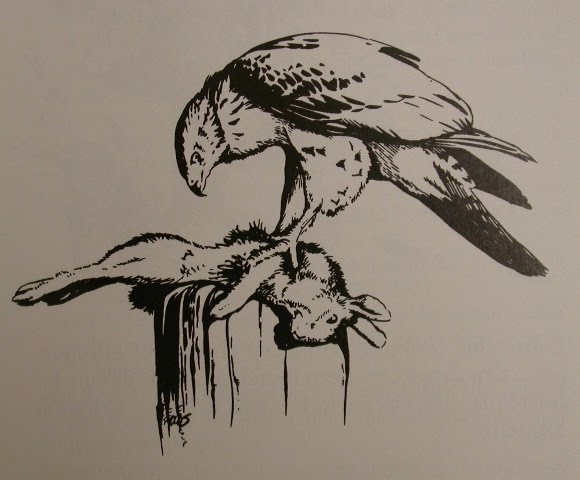
Finally, there are numerous vignettes that show animals engaging in characteristic behaviors and other fascinating scenes. A hibernating ground squirrel, all curled up in its burrow. An owl flying off with a limp mouse. A rodent negotiating a power line. A hairless newborn eastern mole, even more blind than the adult. An opossum toting leaves in its tail. A fox with a deceased chicken in its mouth. Some of these vignettes will make you chuckle; others are sobering; all are truthful.


In these small scenes, Schwartz often betrays his personal feelings about the animals. A scene of a bobcat pawing playfully at an overturned tortoise shows us he identifies with the animal’s curiosity and thrill of discovery. A scene of a house mouse leaping from a drawer, and human hands frozen in a gesture of surprise, captures a startled fear we can all identify with. And when we see these same hands cradling a young cottontail or sleeping baby raccoon, we know he feels warmly toward these vulnerable innocents.


By taking the time to study and to render these scenes, the artist lets us know it’s okay for us to feel the same way. Not many science illustrators are able—or permitted—to venture that far today.

-------------------------------

In guidebooks, there are tradeoffs with using photos or illustrations. Many enthusiasts prefer photos, since photos provide literal views of the animal in question. And today, from the publisher’s viewpoint, photographs are much less expensive and easier to obtain than original artwork, keeping publication costs down.

But illustrations have definite strengths—the animal can be shown in a typical pose that also allows all the diagnostic characteristics to be visible, and clear. Nonessential characteristics can be downplayed, and key characteristics accentuated.

And then “artistry” can come into play. This is what makes the difference between a perfectly good, purely technical illustrator, and someone like Charles Schwartz. This is how a guidebook can transcend its role as an identification guide, and become a record, a testament, of the species.


Have you seen those awesome prints by Audubon, in his Birds of America? In them, Audubon captures more than the beauty, more than the plumage, physiques, anatomy, and colors—he captures each bird’s personality. His prints are so valuable today not because they are technically accurate—but because they are sheer treasures, emotionally moving works of art.

Schwartz’s artwork is in the same category—he captures the soul of his subjects; he makes them come alive. Most of the time, his animals are unaware of your presence and are acting out their natural behaviors—sometimes playfully, sometimes ruthlessly. On other occasions, they stare right into you. In either case, there is no candy coating. Each animal is true to its own wild self.


Go to this exhibit—before it all goes back in a drawer.


Here’s What You Need to Know

The exhibition opens on Friday, September 10, with a ticketed event, 3–8 p.m., at Columbia’s Bass Pro Sportsman’s Center. Proceeds benefit the State Historical Society of Missouri, which holds a collection of over 500 Schwartz drawings and studies, sculptures, and paintings. Tickets are a measly $10, and there’ll be guided tours by the people who know the most about Schwartz’s art, with wine and cheese to boot.

Then, Saturday and Sunday, September 11 and 12, the display remains at Bass Pro. There will be tours, landscape and wildlife art and photography seminars, and conservation educational activities. Bring the kids.

Then, the exhibit moves to the State Historical Society’s Main Gallery, located in the Ellis Library building on the University of Missouri–Columbia campus. It will remain on display through January 2011.

After that, it goes back into protective storage. So don’t miss this, okay?

For more information, contact Laura Wilson at the State Historical Society: 573-884-7904 (wilsonlo@umsystem.edu); and be sure to look at this official website:
http://shs.umsystem.edu/art/schwartz.html


CREDITS

All the pictures in this post are horrible, horrible photographs made from my copy of The Wild Mammals of Missouri, Second Revised Edition (Columbia: University of Missouri Press, with the Missouri Department of Conservation, 2001).

I’m including these pictures as samples—partly to illustrate my “review,” but mainly as an incentive for you to go see the real things at this exhibit. The original art, held at the State Historical Society of Missouri, is much, much better!


Saturday, August 21, 2010

Golden Treasures in Columbia


Pay attention, folks: You have until September 26 to see an exhibition of exquisitely crafted golden treasures currently on display at the University of Missouri Museum of Art and Archaeology. Yes, this exhibition’s been there since early June, but if you’re just now getting back to town, or if you’re simply looking for neat things to do here in Central Missouri, may I humbly suggest this exhibition: The Voyage of a Contemporary Italian Goldsmith in the Classical World: Golden Treasures by Akelo.


Don’t get me wrong—I’m not a “jewelry gal.” But that’s my point: I’m genuinely impressed by this show, and by the artist-goldsmith who has created the works. The artistry and craftsmanship make this exhibition transcend, by far, any routine look in a jewelry store’s windows.


The goldsmith’s name is Andrea Cagnetti, whose “artistic name” (like a nom de plume) is Akelo. He’s Italian and grew up constantly exposed to Greek, Roman, and Etruscan classic artworks. From an early age, he admired the gold jewelry of the ancient Etruscans.

However, the goldsmithing techniques of the Etruscans had been lost to time. But Akelo’s dogged studies of science and art led him to research metallurgy, and he delved into the ancient texts of alchemy to look for hints for how his ancient forebears did what they did. In those medieval books, recipes for gold were combined with recipes for the purification of the soul, and Akelo’s life was, in a strange, anachronistic fashion, transformed into that of a medieval monk.


I guarantee that you will be impressed by his delicate application of filagree, his selection of precious and semiprecious stones, and the powerful symbolism of his designs and ornaments. But perhaps the most remarkable thing you’ll see in the exhibit is a technique called granulation.

I’d never heard of granulation before—basically, it’s a way of creating a texture on the surface of a gold object by affixing a layer of tiny gold balls (granules) to it. These balls can be as large as a millimeter and as small as .07 mm. (That’s seven hundredths of the width of a dime!)


The goldsmith has to create these spheres and weld them (somehow) onto the surface, usually in some sort of pattern.

This technique—in the perfected form the Etruscans had developed—had been lost to time. Indeed, it was being lost about the time the Romans took over. Akelo, however, has figured out how to do it, and the spectacular results can be seen at this exhibition.

Akelo also has his own proprietary formula for mixing gold, so the color of his gold is different—warmer, I’d say, but also more vibrant—from what you’ve seen before.

Everything in this show is made by this one man—starting with the melting and mixing of the gold, to the shaping and decorating of the pieces, to the creation of his own thin gold wires, and even to the crafting of each tiny, identical link in every single chain. All made by him.

He must have an incredible amount of patience!


Again—I’m not a girl to go nuts over jewelry—but I am impressed by the time and care Akelo has put into his art. His designs, which feature elements such as amphoras, pinecones, acorns, dolphins, and crosses, pay homage to the classical and medieval past but also contain a contemporary flair—as a result, the pieces are timeless.

It’s no surprise that Akelo’s work has been getting lots of attention, and that major art museums have begun purchasing his works for their permanent collections.

So catch a rising star—go see the Golden Treasures by Akelo. I promise that you will be impressed.


Finally, a word about the Museum of Art and Archaeology: If you have never seen it, make sure you build in plenty of time to visit the whole museum. No, it’s not the Nelson, and no, it’s not the Saint Louis Art Museum, but for its size, its collection—of antiquities, classic works, and more contemporary pieces—is remarkable, significant, full of artistic gems.

Time spent in an art museum is never, ever wasted. It elevates you, it broadens your mind. The role of the artist is to remind you that everything around us is a miracle. —Oh, and did I mention this museum is free? Free! So you have no excuse not to go.

There’s all kinds of stuff going on there. Look at their website for more information.

Museum of Art and Archaeology
1 Pickard Hall
University of Missouri–Columbia
573-882-3591

Hours:
Tuesday through Friday, 9 a.m. to 4 p.m.
Saturday and Sunday, noon to 4 p.m.
(closed on holidays)

http://maa.missouri.edu/