Showing posts with label biology. Show all posts

Friday, May 10, 2024

Cicadas: What’s Up With Their Eyes?

It’s just uncanny how insects seem to be looking right at you. No matter how you turn them, and from no matter what angle you look at them, they always seem to be looking right at you.

Right

at

you!

So, what’s up with their eyes? I mean, we “know” they’re compound eyes and that they are quite different from our own. Our eyes are basically a clear-jelly-filled ball, with sensors (retina) at the back, a lens-covered, expandable aperture (pupil) in the front, and muscles that rotate it (so we don’t always have to turn our head in order to look around).

But their eyes are quite different. They are fixed; they don’t rotate. So why does that dark spot on their big, buggy eyes seem to follow around, so it’s always looking at the viewer?

Wet or dry . . . they always are looking at you.

Even while they’re molting!

How does this work? It’s caused by the structure of their compound eyes. It’s essentially a result of tubes, shadows, and mirrors. To understand this, imagine a model: Think of their globe-shaped compound eyes as a cluster of narrow tubes, all pointing outward from a center point, and imagine these tubes are coated, on the inside surfaces, with silver. Closest to you, the tubes are pointed directly at you, and you can see into the whole long (dark) tunnel (you’re not seeing much of the silver), while the tubes increasingly angled away from you appear light-colored, reflecting the light.

That’s basically it: you are looking at a spherical cluster of tubes.

And it’s not just with cicadas; many insects have compound eyes that have this property.

Like this common meadow katydid.

Like this little baby, gray short-horned grasshopper. So cute, sitting on a leaf in his prairie.

And like this pretty green planthopper.

The next question is, why does this seem so freaky to us?

We humans—with our social nature, our interdependence, our allies and enemies, our capacities for trust and for deceit—have evolved to be masters at evaluating each other. We look carefully at one another’s eyes. You can tell so much about someone by their eyes! Yes, “the eyes have it.”

This is why those professional poker players so often wear mirrored sunglasses—they want to conceal their thoughts and feelings. (Why shouldn’t that be considered cheating?)

It’s why people who have eye-alignment problems have a real social disadvantage, because crossed eyes or other misalignments are stereotyped as a sign of severe developmental disability, or head injury, of being dazed or semiconscious.

It’s why silent movie actors wore such heavy eye makeup.

And so we, in our anthropomorphization of insects, can’t help but look into their eyes, too, and try to read their expressions. And what we get back is an unblinking stare, perpetually fixed upon us. Does it freak us out?

Maybe it should. Insects depend on us to not ruin the world for them. They need elbow room. They depend on the existence of their many native food plants; they depend on the habitats—prairies, woodlands, glades, wetlands—that support their various food plants. They need plenty of plants and habitat, because the usual existence strategy for insects is to create a bazillion eggs and offspring, most of which won’t make it to adulthood. On some scale, they need room, like cicadas, to have a bloom, a heyday, and then have a majority eaten by countless predators, and then return to the soil.

So yes, they depend on us.

If you feel stared at, it’s not surprising.

Do things to preserve and increase native habitats.

And vote for the environment.

The above text explaining the dark dot in insect compound eyes is loosely edited from a page I wrote for MDC’s online field guide, Mantids (Mantises). Mantises, of course, are one of the many insects with compound eyes that exhibit this phenomenon.

Sunday, September 14, 2014

My Other Life

For those of you who are my friends and family, you may be interested in the links I'm providing in this post. I keep my work life separate from my blog, and from everything else personal, but for those of you who have missed me (and may miss my posts again, the next time I get all busy with work), if you want to see more of what I've been "up to," then check out the online field guide of the Missouri Department of Conservation.


When I started working on this project, the MDC folks asked me if I wanted to be identified publicly as a "field guide maven," and I said no. I'm an editor, right? I'm not a "writer"!! (Okay, I guess I am, now, aren't I.) And I certainly don't want my sad-looking mugshot next to anything on this online field guide. It's all about the plants and animals! But my friends, and family--if you ever want to know what I'm "up to," look at this site.


(Muskrat photo by Susan Ferber.)

It's basically 10 field guides in one: aquatic invertebrates, insects, butterflies and moths, fishes, amphibians and reptiles, birds, mammals, mushrooms, wildflowers and nonwoody plants, and trees/shrubs/woody vines. You can search on it via an alphabetical browse menu, or you can do an "advanced search" that allows you to narrow search results using key identifying characteristics (such as color, habitat, etc.).

This summer, I've been particularly busy fulfilling entries on the wildflowers and other nonwoody plants. (It's still going to be a while before I post a bunch of grasses and ferns--surely you can see why those present special problems for writing a guide for nonscientific readers.) Here's a link to the "browse" page for the wildflowers. It's an alphabetical listing; just scroll down, then click on the next page, etc. There's close to 300 species entries for this group, with more a-comin'.

Also, in the browse menus, when a plant or animal strikes your fancy, click on that image to see the complete entry for that species. Here, for example, is a recent entry I did, for Giant Ragweed. You know this plant; you've seen it a million times. But have you really seen it? Part of the satisfaction of creating this field guide is in thinking, really thinking, about some of the most minute aspects of these organisms. What sets it apart from others of its kind? Why should anyone care about it? Why does it possess its unique characteristics?


I love it when I can include information that is particular to Missouri, the Ozarks, the tallgrass prairie. I guess because of my own local pride. Like how the word "cooter" came from Africa and then became a verb in Ozark dialect. And every time I write about a prairie wildflower, I think of how they must have cheered settlers as they headed west into such strange, treeless terrain.

It's especially been fascinating to include "human connections" and "ecosystem connections" for each species. What has amazed me is how nearly every single species in the state, whether it's a weird mushroom, or a nondescript rodent, a ubiquitous roadside wildflower, or even a minnow, a wicked-looking insect that hides under rocks in a stream, or a type of insect that's so damn common you don't give a second thought to it, has an interest on a human level and on the level of its relationship to nature. That's just incredibly cool, I think.


Honestly--sometimes the hardest thing about this project is to keep from writing too much. There's no end to the fascination in the natural world.


Anyway--enough of "tooting my own horn." But I did want to let y'all know that I haven't exactly been absent from the Internets--just from my blog. If you ever miss me (you know who you are!), check out the MDC field guide, where you'll find out what I've been doing in "my other life."

Monday, July 18, 2011

Two New Friends I’d Like You to Meet

Hi there! Sorry for the absence, but you know how it is—summer—gotta live it up while you can. We recently took a trip to Ohio, and before that was preparation, and after that was dealing with all the stuff that had piled up. You know.

Meanwhile, I’ve been working on another lengthy post. (BAD blogger! BAD! I should know by now that “no one reads long posts” and that I’m just wasting my time. At the very least, I should break it down into smaller chunks. Right? Because everyone’s got ADD these days. Right?)

Well, anyway. Sometimes you do things just for yourself.

Today, I have a few new friends to introduce to you. I suspect both fall into the category of “I’ve seen them, but we’ve never been formally introduced.”

New Friend Number 1

First, I’d like you to meet a little fly (a dipteran—a two-winged insect) that has been unusually prevalent in our yard this year.

The name is “picture-winged fly”; it’s called that because of the little black, orange, and white triangles and dots that appear on the wings. Delphinia picta is the proper name. My photos are only so-so; you can see better ones here at BugGuide.

Viewed from above, they’re rather triangular. They have a habit of moving their wings in a circular motion while they’re walking around—like they’re rowing a boat.


If you’ve seen them before, you probably haven’t paid much attention to them, because they don’t bite or sting, they don’t fly in your face, they don’t enter your house.


The m.o. of the picture-winged fly, as far as I can tell, is that they love compost and other decaying things. As larvae, that’s their home and their food. (They’re kind of like fruit flies, in this respect.) I think that’s why we’ve been seeing them a lot this year: They’re especially prevalent around our compost bin!

Well, they can have that rotting ol’ leaf stuff: “Knock yourselves out, little dudes.”


By the way, I think that’s a gas mask they’re wearing!


New Friend Number 2


This one has a rather strange story. First of all, rest assured that this little insect (no more than 3/4 of an inch long) is indeed a moth. A moth with narrow wings that fold straight down its back.


Unlike a lot of moths, this one has pretty colors and is active during the daytime.

The name is ailanthus webworm moth, or Atteva aurea. (In this case, the scientific name is easier to learn and say than the common name!) Here it is at BugGuide.

Does the name “ailanthus” ring a bell? Well, Ailanthus is the genus name of the tree-of-heaven, an oft-planted (and oftener-escaped) tree originally from China. Like geraniums, begonias, and forsythias, ailanthus’s genus name has become its common name as well.

So Ailanthus altissima, the so-called tree of heaven, is as hardy as all get-out. Tough as nails! (One reason they were planted in urban areas is that they can survive in rough neighborhoods! One of their common names is “ghetto palm”; another is “tree from hell”!) They’re an invasive exotic pest tree that easily out-competes our native trees—they’re bad news, and in North America they deserve extermination much, much more than, say, rattlesnakes and copperheads, who belong here.

The ailanthus webworm moth uses ailanthus as a host tree—lays its eggs on it, and the larvae (little silk-spinning caterpillars) gobble up the leaves.


So now you’re wondering if the ailanthus moth didn’t also come from China—perhaps as an experiment in biological control. But no! They are a native North American moth whose original favorite host trees are the tropical paradise trees (genus Simarouba).

Ailanthus webworm moths are originally native to the tropical Americas, where paradise trees grow, but now that they’ve found ailanthus trees to be delicious, too, they migrate north each spring—even into Canada—to take advantage of all the free food. (Unfortunately, they don’t seem to do much harm to the evil, invasive ailanthus trees. Poo!)

Apparently the ailanthus webworm moths cannot survive freezing winters, so you have to wonder what the point is to them breeding and laying eggs on ailanthus trees this far out of their survival range. It sounds like any eggs, larvae, pupae, or adults caught here in December would expire the way an orange tree would.

Hmm. Maybe the moth’s lifestyle is just as messed up by the presence of the invasive tree as all the trees and other interconnected, native organisms being displaced by it.

So the next time you see one of these pretty little ailanthus moths, think of its unknowing sacrifice up here in the cold northlands, and thank it for doing its best to help cramp the style of those invasive trees.


Monday, October 4, 2010

Ha Ha Tonka State Park

October, the pinnacle of autumn, is probably the best month of the year to go outside and poke around in nature: The weather is great, the landscape breathtaking. A close runner-up for the award might be April, but for hiking October edges ahead because of the drier weather and superior trail conditions.


On September 26, our excursion was to Ha Ha Tonka State Park, arguably the crown jewel of the state park system. It “has it all,” and in an oversized way: Interesting human history ranging from aboriginal up to modern times; natural communities and a host of remarkable organisms; broad, wondrous views; hidden alcoves; and a range of options for accessibility and strenuousness.

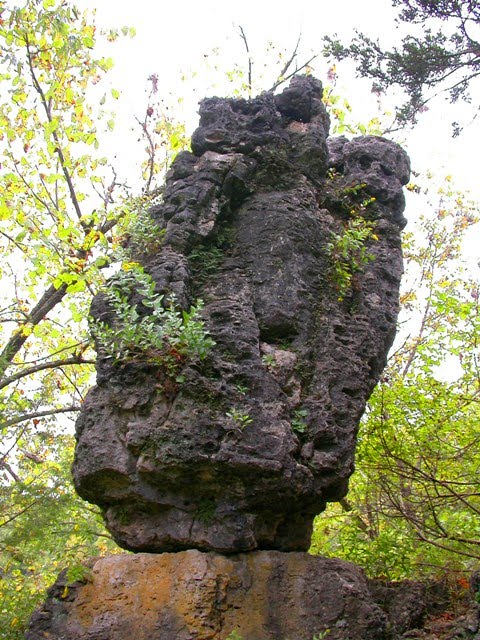
Underlying its skin of soil and vegetation, this land offers a living encyclopedia of geologic wonders, a textbook of karst topography. A few miles of hiking can show you at least one example of just about every single type of karst feature: Caves (nineteen have been found so far within its borders), sinkholes, dramatic 250-foot bluffs, a chasm, a tremendous natural bridge, a pirated stream, fins and pinnacles, a balanced rock, and the state’s twelfth largest spring (48 million gallons a day), flowing into a gorgeous turquoise pool.

Formerly, there was a pleasant forty-acre fishing lake downstream of the spring, with rental cabins, boating, and bathing, but in 1931 the newly impounded Lake of the Ozarks swallowed it up.


The entire landscape is shaped by the partial collapse of an enormous cave system; all—including the original cave itself—sculpted over eons by the slow, steady rotting or dissolution of sedimentary, carbonate rock by mildly acidic groundwater seeping through its fissures. This is karst.

By now, you’ve probably guessed—correctly—that this is a large tract of land. The state park includes 3,709 acres; 953 acres of it has been designated as Ha Ha Tonka Oak Woodland Natural Area, which showcases and preserves a remarkable blend of prairie and forest—an open woodland—with gnarled oaks scattered over wild grasses and prairie forbs such as coneflowers, asters, sunflowers, milkweeds, and blazing star. (Formerly called a “savanna” landscape, apparently now it’s called “woodland”—I suppose to distinguish it from the savannas of Africa. I hope someone will let me know if I’m wrong on this point.)

Another natural community type is maintained at Ha Ha Tonka: dolomite glade. Glades in Missouri are like a little touch of the desert Southwest. Sunbaked, rocky outcrops on the tops of bluffs and ridges, thin soils, with few trees—inhabited by prickly pears, lizards, tarantulas, and other xeric specialists.


Ha Ha Tonka’s human history is rich, beginning with the Native peoples who settled here, hunted, and used the then free-flowing Osage River and its tributaries as transportation routes.

White Americans came to the area and were understandably impressed; these included Nathan Boone and his dad, Daniel, Meriwether Lewis (apparently), and James B. Wilkinson of the Pike Expedition, as well as less famous, even notorious individuals—outlaws and counterfeiters—who utilized the area’s many hidey-holes for their covert operations.

In the first quarter of the twentieth century, there was tremendous interest in this part of the Ozarks as a vacation retreat. At that time, the go-getters in the cities were discovering they needed solitude, quiet land, and clean air. At least on the weekends. To stay sane.

At about the same time, state parks were being established throughout the nation. In Missouri, Ha Ha Tonka was at the top of just about everyone’s list. Governor Hadley recommended it to the legislature in 1909 as the first Missouri state park; the bill passed in the Senate, but it failed by a single vote in the House. But it remained at the top of the state’s “beauty spots.”


Meanwhile, a developer showed up. A wealthy businessman in Kansas City, Robert M. Snyder, discovered the land and in 1903 bought up more than five thousand acres. The following year, construction began on this clubman’s massive private retreat: A three-story, twenty-eight-room mansion built of stone in the style of an English-Renaissance castle, perched high on a bluff overlooking Ha Ha Tonka Spring. To support his retreat, Snyder also built an eight-hundred-foot water tower made of stone, and a carriage house, greenhouses, stables, and homes for his various servants. Plus roadways for all this, of course.


To build the castle, twenty stonemasons were “imported” from Scotland. The rock was quarried on the property; today, one of the trails provides views of some of the quarries.

Only about three years into his project—and no doubt relishing his prospects for hiking, fishing, hunting, and hobhobbing with his political, banker, and gas company cronies (and his sons, too), in the upper-class hunting-lodge fashion—Snyder was killed in an automobile accident in 1906. (In 1906, there were hardly any cars then. It was one of the state’s first automobile accidents.)


Construction was halted. But by 1922, the mansion had been completed through the efforts of Snyder’s sons. The Snyder family apparently didn’t spend a lot of time at Ha Ha Tonka, however, and by the forties or so, it had become a resort hotel. In 1942, the stone mansion burned.

It wasn’t supposed to burn, but it did. And after that, the ruins just stood there.


Over the years, the Snyders had made a number of attempts to sell the property to the state, but the price was always too high for the legislators. The land was purchased by others, who then tried to resell it, and vandalism took a toll on the structures. Eventually, though, the state was finally able to acquire the land in 1978. Thus it was seventy years before what “should” have been Missouri’s first state park to actually become one.

The Missouri Department of Natural Resources, which administrates the land, has worked hard and successfully to restore and maintain the delicate natural communities at Ha Ha Tonka, as well as curate the stark stone remnants of the mansion. Those intriguing walls, arches, and gables would certainly have tumbled down by now if not for the cleverly camouflaged reinforcing of the stones, and blending of new mortar with old.


The ruins are nifty-cool. Make sure you bring a camera.


The most popular trails have been converted in large part to wooden “boardwalks,” improving accessibility while also keeping the herds of visitors from trampling the vegetation.


Probably the most popular hike is the one that leads from the “castle” past the water tower, then around “Whispering Dell” (an enormous sinkhole), then down three hundred steps to get to the spring. (The sign says 316, but sixteen steps go upward as the boardwalk negotiates a stone outcropping. Yes, I counted.)


Though the spring is gushing at a staggering rate, the overall look is tranquil. You just can’t beat the color of springwater.


From there, the boardwalk follows the flow of the water toward its connection with the Niangua Branch of the Lake of the Ozarks. Accessibility note: There is one place where the boardwalk ends and the visitor must walk through a cleft in a huge boulder; for about two feet, the path narrows to a chute less than a foot wide. But it’s level. You just have to go single-file and watch where you step.


This trail connects with the short loop trail that traces the island (yes, there’s an island), and that’s where you can see the balanced rock.


I could go on and on about Ha Ha Tonka, but I’d better lay off, so we all can get back to the work of the day. So we can finish earlier. So we can have more time for hiking.

It’s October, you know.


Buy This Book

If you liked the kind of information in this post, I encourage you to purchase a copy of this book, which tells the story of each of Missouri’s State Parks and Historic Sites. The text is superb, and the photography magnificent. It looks like a coffee-table book, but it reads like the best history professor you ever had. Great for planning your next outing!

Exploring Missouri’s Legacy: State Parks and Historic Sites, ed. Susan Flader. Columbia: University of Missouri Press, 1992.


And . . . there’s more to the story: In my next post, I examine the etymology of the name Ha Ha Tonka. Click here.

Monday, May 3, 2010

House Wrens and the Imbuers

Each morning these days I am awakened by the twittering exuberance of our local house wren. It sounds like this little fellow is right outside the window; we’ve got the windows open again this glorious spring. Though I struggle with the pollen, we enjoy the scents of green and blooming things, and even the smell of the rain, and appreciate the lower energy bills.

The wrens came back last month. The males precede the females on the trip north and divvy up their territories first. Then the females arrive, and each male’s song turns from a wary and fairly routine “this is my space” to an urgent, vigorous love-call, full of lusty promises to the female, as he shows her his “properties.”

That’s how Sue described it Friday morning when she noticed that Mr. Wren had as his audience a female, whose attention he was clearly directing to our three wren boxes (which we cleaned out and rehung as soon as we started hearing wren music this spring).

We bought a new box for them this year, and we hung it from the rock peach tree, where the popular but ill-fated house had hung last year.

Mr. Wren seemed very optimistic about his prospects—but despite his high hopes, he never slacks in his work of self-promotion: Female wrens are notoriously picky.

Whenever birds or other creatures start seeming to me like biological subjects, soulless Cartesian automatons of meat and bone, I return to my library of old nature books. Even the ones written by scientists, for popular audiences, anthropomorphize like crazy, compared to how naturalists write today. And I think we’ve lost something in the process: Maybe, on some primal level related to our human propensity for myth and personal immediacy, we need to endow animals with human traits—first—in order to make the leap toward an objective and fair understanding. Yes—gripping emotional interest first, intellectual rigor second. Well, it’s just an idea I have.

One of my cherished books is Birds of America, edited by T. Gilbert Pearson, first published in 1917, though my copy is from 1936. The book is out-of-date—taxonomies have been revised, species have been extirpated and extinguished, and others have been introduced or have moved into new areas. The house finch, for instance, was a completely western species when this book was written, extending only as far as the western edge of the Great Plains. What a difference a hundred years makes!

In many other ways, however, this volume is timeless. The physical descriptions are thorough and precise, written back in the day when bird-fanciers were quite likely to be identifying a bird “in the hand” as opposed to tracking it through binoculars as it flits through leaves and branches at the crack of dawn.

Each species has a technical description followed by a short essay describing character, habits, and other topics; these essays can be quite fanciful by today’s ironclad objective standards. For example, this volume offers that the “Jenny wren” is, “in truth, . . . a good deal of a shrew, and a chronic scold on general principles. By the same token, Johnny is likely to present a pretty good imitation of a henpecked husband, for from the moment he promises to love, cherish, and obey Jenny, he hardly dares say his soul is his own. However, he doesn’t appear to be in the least depressed by this state of affairs, for his bubbling song is one of the merriest and most spontaneous of bird utterances” (Pearson, 3:193).

Describing the wren as “a tiny fidgety body with an up-turned tail” does give you a pretty good impression of this creature, even though the fidgetiness is an outright anthropomorphism, a human judgment-call, when the truth of the situation is that the wren is simply a fast, efficient avian predator of insects; its movements, if quick, are calculated. If we all hunted insects for a living, quick, jerky movements would be the standard of normalcy.

Natural history educators today, more than they ever have in the past, are scrupulously careful not to bestow human attributes onto animals when interpreting nature to the public, and even to children. But maybe that’s not a good idea. Maybe it is a failing experiment. It’s bad enough that fewer and fewer Americans ever “get outside”; the current obsession with dehumanizing our nonhuman companions on this spinning planet simply widens the gap, makes us care less.


------------------------------------------

Another of my favorite books in the “birds” section of my natural history library is Joseph Kastner’s A World of Watchers, which is an incredibly entertaining guided tour of bird watching in America. Kastner devotes an entire chapter to “The Imbuers,” the countless ladies who, in the early half of the last century, enthusiastically ushered youngsters into the marvelous world of bird-watching:

A reader going through the annals of birddom, the little small-print stories in the old birding journals, comes across a fine old-fashioned word: “imbue.” It almost always referred to somebody whose name was prefixed by “Miss” and who was, often, a teacher. Miss Mary Agnes Tillisch imbued the children of St. Paul with a love of birds. Miss Fannie Stebbins imbued the children of Springfield, Massachusetts, with an understanding of nature. . . .

There were thousands like them who worked through the Junior Audubon clubs, using their ten-cent pamphlets as texts. Their teaching could be sentimental and superficial and their bird walks just an excuse for an outing. Still, they opened the children’s eyes to nature and, in the end, helped produce multiplying generations of bird watchers. Except for little pats of appreciation in Bird-Lore or in the school columns of local newspapers, these imbuers have been forgotten. (Kastner, 156)


Kastner relates that one of these “imbuers,” Miss Blanche Hornbeck of Jamestown, New York, struggled to “tame an unruly seventh-grader named Roger Peterson, got him looking at birds and sent him on to become the world’s best-known birder.” I suspect that a great many of today’s biologists got their start because someone took their hands at a young age and made nature come alive for them, in a personalized, immediate way: Touch the feather. Call the colorful male a “dandy.” Memorize a goofy lyric to learn by heart the birdsong.

For an example of the anthropomorphism these women employed, Kastner describes one typical “imbuer” as being “shameless about endowing birds with human traits. Woodpeckers are ‘phlegmatic,’ waxwings ‘gentle, courteous, elegant,’ the cardinal ‘a shining example of self-conscious superiority.’ . . . The catbird with its ‘glorious song . . . hateful catcalls and squawks’ is ‘the “Dr. Jekyll and Mr. Hyde” of birds,’ while the mockingbird was the ‘angel that . . . the catbird was before he fell from grace’” (Kastner, 167).

I think my Grandma Schroeder fit this “imbuer” category. As a young mother, she volunteered as a leader with the Missouri Conservation Commission’s “Nature Knights” program, which was a nature-enrichment club for youngsters. Participants received rewards such as patches and medals and went on nature outings, learning about birds and plants as well as the latest conservation issues.

Yes, my grandma was an “imbuer.”


------------------------------------------

I started this post mentioning that I had been awakened by our local house wren, because the first thought I had upon waking was that this tiny, noisy creature was my “natural alarm clock.” This idea isn’t mine, however; it comes from my Grandma.

Living here in her house occasionally offers us fascinating new insights into her personality and life, and the life of my dad’s whole family. Our most recent discovery was a folder of typed papers, clippings, and a small stack of magazines. The papers are yellowed, and the typing was manual. I suppose my dad was the one who typed these for her. Back in the fifties, I guess. There are some corrections penciled in, and certain words are underlined: Grandma must have used these as speeches.

Maybe these were presentations she gave to the garden club, or perhaps to her circle at church. I don’t know for sure. Two have captivated my interest the most: “Adventure with Herbs,” which I’ll talk about sometime in the future, and an untitled typescript on her “feathered friends.”

I’m sure I don’t need to tell you how marvelous it was to discover these short texts. Grandma wasn’t much of a writer—she was definitely more of a talker! But finding these little essays—well, she’s been gone ten years now, and of course you would just figure there is nothing new for her to “say.” You just figure she’s silenced forever. You just figure you’ve heard her voice for the last time on this earth.

In her speech on birds, she lists and comments on the birds that frequented her yard—now our yard. Some, like the purple martins she and her father adored so much, who for nearly a century were as loyal to them as they were to the martins, no longer come around. It’s the same with purple finches—Grandma wrote that they “invade our lawns and trees in March and April,” but I haven’t seen a purple finch in decades. Meanwhile, although she seems to have listed every bird that passed through her yard, she said nothing about mourning doves, which are now so common.

I’d like to share with you, from her writing on birds, her comments about the house wren. As you read it, imagine how excited I was to discover this, right when the wrens were returning to our backyard. Imagine that the wrens scoping out our birdhouses might be descendants of the same twittering Johnny and Jenny Wrens that thrilled my grandma. For my part, I imagine my grandma’s voice saying these words, in that exuberant way of hers. That's why I've italicized the words she had underlined.

The liveliest singer in our back yard is the House Wren. Early some morning in April, there will go off under our window that most delightful of all alarm clocks—the friendly House Wren, just returned from a long visit south. Like some little mountain spring that, having been imprisoned by winter ice, now bubbles up from the spring sunshine and goes rippling along over the pebbles, tumbling over itself—so this little Wren’s song bubbles, ripples, cascades in a miniature torrent of ecstasy. After the Wren’s happy discovery of a place to live in, his song will go off in a series of musical explosions all day long, now from the roof, now from the clothesposts, the fence, or lawnchair. There never was a more tireless, spirited, brilliant singer.

Year after year, Wrens return to the same nesting places. The nest is kept scrupulously clean. The house cleaning, like the house building and renovating, being accompanied by the cheeriest of songs, that makes the bird fairly tremble by its intensity. But however angelic the voice of the House Wren, its temper can put to flight even the English Sparrow. [Grandma would comment later in her speech: “Like the poor, the Sparrows are always with us.”]

The male begins to carry twigs into the house before he finds a mate. The day she arrives on the scene, how he does sing. Dashing off for more twigs and stopping to sing to her every other minute, he helps furnish the cottage quickly, and he overdoes it and then pulls them out again. Jenny is a bustling housewife and will not tolerate vermin or dirt within her well-kept home. What rent do they pay? No man is clever enough to estimate the vast number of insects on your place that they destroy. They eat nothing else, which is the chief reason why they are so lively and excitable. Unable to soar after flying insects because of their short, round wings, they keep as a rule rather close to the ground, which their finely barred brown feathers so closely match. Whether hunting for grubs in the woodpile, scrambling over the brush heap after spiders, searching in trees, or creeping like feathered mice, they are always busy in your interest which is also theirs. It certainly pays, in every sense, to encourage Wrens.


------------------------------------------


Books Adored in This Post

Joseph Kastner, A World of Watchers: An Informal History of the American Passion for Birds (San Francisco: Sierra Club Books, 1986).

T. Gilbert Pearson, ed., Birds of America. With original paintings by Louis Agassiz Fuertes (1917; reprint, New York: Doubleday, 1936).

Friday, January 8, 2010

Baby, It’s Cold Outside

Yes, the snow makes it all pretty and stuff, but it’s punishingly cold out there. The high today was supposed to be around 5; wind chills tonight might get as low as 25 below. This isn’t funny.

I’m still suffering from a cold and/or a sinus infection that I’ve had since the first of the year, and still suffering from laryngitis (which means I haven’t really “spoken” since “last year”). I’m basically hating 2010 so far.

But at least I’m here in my house, which is a pleasure palace of warmth compared to what the world outside is experiencing. Drafty windows? Is it a little chilly in here? Who am I kidding. Look at those birds out there.

The birdfeeder is insanely popular today, and for good reason: Those birds and squirrels are stoking their metabolic rates so that, with the magic of insulation, they can shiver all night long and survive until morning.

That cardinal has no more mass as that can of beer on the sunporch that we had to bring inside, lest it freeze and blow up. Why doesn’t the little birdie turn into a block of ice, like the brewski would?

Humans are in the same boat, only we are smart enough to have figured out how to burn something outside our bodies to keep from freezing solid.

Critters and plants don’t have that option, however. So they have to do other things to survive:

1. Move to warmer climes; migrate.

2. Go dormant or hibernate.

3. Just keep a-goin’; thermoregulate.

4. Don’t survive; die and leave behind dormant offspring so they can carry on life whenever it warms up.


1.

We have examples of each category right in our backyard. In the first category, we most obviously have bird species who have gone bye-bye for the winter, returning to their homes in the tropics or even just the southern U.S., since they only came here to breed, anyway: Orioles, wrens, hummingbirds, catbirds, warblers, tanagers . . . And monarch butterflies migrate south, too.

I think we can also count all our tropical houseplants in this category, as they spend their summers enjoying the sunshine and rain in our backyard, but each winter migrate (with a good deal of assistance from us!) into the warmer climate of our household.

2.

Then there are the hibernators, whose bodies decline to fight hard against the cold. Instead of trying to stay warm and active during the winter, these organisms enter dormancy of various kinds. Our woodchucks grow slothful as the temperatures drop in early winter; they’ve spent the summer building up fat. They eventually creep into their burrows one day to go to sleep and not reawaken until the warmth of spring.

During hibernation, a mammal’s body temperature falls in response to cold, and metabolic processes drop with it. Oxygen consumption plummets, heart rate is greatly reduced, and there can be long periods of suspended respiration. But when temperatures drop below freezing, almost all hibernating mammals have to thermoregulate somehow (that "warm-bloodedness" kicking into gear), or else they would become a block of ice. Thus the fat layer they've built up that can be burned; thus the importance of good insulation from fur, fat, soil, and even snow. All of this is because there’s not enough food available in winter to supply the tons of calories these critters would need to keep warm and normally active. In winter, they simply check out of the system.

Reptiles and amphibians enter dormancy, too, of a different kind. They don't thermoregulate internally like mammals and birds do. Most of them, from toads to box turtles to garter snakes, instinctively burrow someplace low as the temperatures grow colder in the fall. I’m pretty sure I know where the garter snakes like to overwinter on our property; one hole is on our front terrace by the ash tree, another’s in our backyard, where some remains of an old house still moulder beneath ground level. I’m sure there are crannies among that buried rubble where the snakes take shelter, in a group. I think they also have hidey-holes against our stone foundation, especially in the front, which faces south.

Box turtles seem more haphazard about their burrows; as winter closes in, they push headfirst into leaf litter, swimming persistently with their forelegs into the earth; if they’re lucky, they do this in a place where the soil is soft enough to be workable, and the turtle can get a decent amount of cover up over its shell before all this horrible cold sets in.

Although recent studies have shown that box turtles (and some frogs, and numerous other creatures) can have a kind of “antifreeze” in their blood to prevent them from freezing solid and sustaining tissue damage, no doubt many box turtles do lose their lives on these bitter cold nights, dying as they sleep, to become food for the soil, the earthworms, and the hungry scavenger-carnivores once their bodies start to thaw.

But the most obvious dormancies are all around us: The trees, which stand quietly, accepting everything that befalls them; their defense is to drain liquids belowground, below frostline if possible, and then to be flexible enough to bend under the weight of snow and ice, or strong enough to withstand it. Deciduous trees drop their leaves before the snows start, reducing the amount of snow that might collect otherwise. Years where the snow comes freakishly early, before leaf fall, can wreak havoc with broken limbs. Conifers, evergreens, tend to grab lots of snow—but they make up for it in their ability to bend without snapping under the weight.

Some trees, such as ashes, have branches configured in softened Vs that make it easier for precipitation to drip or slide from them toward the strong trunk and onto the ground, reducing the amount of weight to be borne by the branches in the first place.

Less obvious vegetative dormancies occur underground: the daffodils, the tulips, the dandelions and parsley, irises, dame’s rocket, peonies, grasses of all kinds, coneflowers, mayapples, and the myriad of other herbaceous perennials that die clear down to the ground, leaving only dry, withered husks to sink beneath the accumulating snow. Perhaps because these plants disappear so thoroughly from view during the winter, their reappearance in spring can thrill us beyond words.

3.

Into the third category fall ourselves and all the birds that visit our feeders: Those that thermoregulate and stay completely active, burning food, burning fat, or (like us) burning wood, coal, and natural gas to stay warm. We are textbook cases of endotherms; unlike snakes that must warm themselves by sitting in the sun on a warm rock, we maintain our preferred body temperature with our own metabolisms.

Endotherms are like little cottages with a woodstove inside to generate heat, and good insulation to keep the heat in. It takes a lot of wood to make it through a cold winter, but it’s a workable proposition.

We counter the plummeting ambient temperature by respiring, digesting, which produces heat. We burn cookies for heat! And there are other strategies; for instance, we humans, birds, squirrels, rabbits, and others who are awake to see the snow can actively insulate ourselves with nests, and we can increase our collective body mass by huddling together.

Our feathers or hairs fluff out as we shiver, creating a larger pocket of warm air against our bodies—the same as fluffing a comforter. And shivering itself causes warmth, as the rapid contraction of muscles, kinetic energy, produces heat.

True mammalian hibernation is a subset of enderthermy, where the animal burns stored fat to stay alive during its long winter's sleep, but not enough to be active.

There is also a strategy called “regional heterothermy,” where an animal’s body permits its extremities to be colder than the core. To understand the problem, look, for example, at the Arctic hare, which is shaped like a ball, while an Arizona jackrabbit has long legs and ears. In this case, the jackrabbit’s body does a better job of casting off excess heat, while the hare conserves it.

But, in cold weather, heat loss in the extremities can be a serious drain on the body’s “core,” and there are more physiological mechanisms that combat this, allowing the extremities to be a different temperature, but within reasonable limits. One of these mechanisms is called the “rete mirabile” (miraculous net), which provides for a counter-current heat exchange. Generally speaking, in this arrangement, a big artery carrying nice warm blood from the core of the animal passes down the middle of the appendage; surrounding that artery are a network of veins returning the cooler blood back from the extremity. So the blood loses warmth while in the appendage but is warmed before being returned to the body.

In addition to the legs of terrestrial mammals (think especially of hooved animals like deer and horses), this circulatory arrangement is found in the flippers of marine mammals, as well as in the long legs of herons and other wading birds (which helps explain how they can walk around in ice-cold water, without screaming and dancing around in agony).

Wading birds are often seen standing on one leg in the cold water, with the other one tucked up against the body, so only one leg is getting cold. Then you also see birds tucking their bills under their wings, because inhaling cold, raw air can lose them more heat; it’s their equivalent of you wearing a nice wool scarf over your face.

4.

Finally, there are the organisms that simply pass away as summer closes. My beloved argiope spiders (and most other spiders and insects as well) slow down as the temperatures decrease. They can’t feed as quickly, and chances are, their prey items begin to dwindle, too. Being slow and clumsy increases the chance of being chomped by something else. (I think I told you that a big Chinese praying mantis is what did in our argiope by our front door.) (The mantis itself died shortly after, the top of its food pyramid.)

On the bright side for the late Mrs. Argiope, she had left behind some nice egg cases, whose hundreds and hundreds of spiderlings will emerge in spring, like pretty, delicate flowers, to bloom and grow into the next season.

Indeed, insects and many little flowers have a lot in common in wintertime; when conditions aren’t right anymore, when temperatures make them clumsy and rob them of food, when photosynthesis can’t obtain enough light, when their delicate tissues can’t withstand freezing—they simply wither. They die. It’s their seed, their eggs, or sometimes their pupae, that survive the winter in a state of suspended animation. These awaken like sci-fi astronauts into a new time, the “future,” with a fresh new world to explore, where they will experience the entire, wild adventure of life.

----------------------------

But man . . . it’s seriously cold out there.

Feed your birds.

And pray for the rest of ’em.

(And it should go without saying: don't you dare leave your pets outside in this stuff.)

Saturday, May 16, 2009

Lettered Sphinx Moth

This moth was standing on the screen of the bathroom window on Monday morning, the eleventh.

Because I’m not very good about identifying the basic brown moths (all I knew was that this was some kind of sphinx), I made a point of looking it up. “What’s That Bug” to the rescue! Here is their page for sphinx moths.

Another Web site that was helpful is this one.

So what we have here is a lettered sphinx moth, Deidamia inscriptum.

Other well-known members of the sphinx moth family (the Sphingidae) include hummingbird and clearwing moths (which look like a cross between a hummingbird and a bumble bee), tomato hornworms (most sphinx moth larvae have a horn on their tails), and many others. They are often remarkably large, and many have glorious colors, eyespots on their hind wings, and so on. Some of the darker species look like B-2 bombers when they’re at rest. Really cool.

Anyway, this little feller is one of the more drab types, though this species does have the distinction of being one of the earliest sphinx moths to emerge in springtime.

Adults like to feed from lilac and phlox flowers, apparently, and the larvae like to chew up leaves of grape and Virginia creeper, as well as members of the genus Ampelopsis (more vines: possum grape, porcelain berry, peppervine, etc.; some of these plants are invasive exotics).

Lettered sphinx moths are found in the eastern half of our country, more or less.

From the same Web site cited above: “Females call at night, and males fly into the wind to pick up and track the pheromone plume. The species is also active during the day.”

Males, such as this one, commonly rest with the abdomen strongly curved. Probably showing off their “junk,” huh?

Or . . . just happy to be alive—in between the severe thunderstorms, we’ve been having some really nice weather this spring.


Monday, May 4, 2009

For Hercules the Turtle

I want to tip my hat to all the biology teachers and the animals and plants they introduce to their students.

This spring I have been thinking about my seventh grade life sciences teacher, Mrs. Hessenbruch, who had a nifty little fishbowl in the back of the class with leaf litter and planarians in it. I used to sit back there and peer into the water occasionally and watch those oddly cross-eyed critters glide smoothly across the soft brown leaves.

Mrs. H gave us a wonderful assignment in the spring. We had to choose one deciduous tree and one conifer—the trees had to be available to us daily—and we had to use colored pencils, or markers, or crayons, or some other medium to draw detailed pictures of the emergence of new leaves. I think it was daily chore, or maybe every other day. We also had to take a sample of the bud and emerging leaves each time, to show what we were illustrating, press it, and include it alongside the illustration in our final project.

Doing this forced us to really see what was happening as the scales stretched open and the tender leaves emerged, reached out, pumped full of life and sap, changed colors, finally matured. The differences were striking even with the conifers.

I will never forget that observational exercise and how it forced me to see that transformation in all its magical detail. Forever afterward, I felt like I somehow knew my chosen oak tree and juniper, like I somehow understood them. I felt an affinity and affection for them, and then, by extension, I had a similar feeling for all the other trees of the world.

Well, I just found out from a friend, who is a high school biology teacher, that her class pet, Hercules the tortoise, had died suddenly and unexpectedly last weekend. And she had to break the news to her students, most of whom had adored little Hercules.

And I want to thank all the science teachers who go to the trouble, and indeed undergo the grief, that comes with having living creatures in the classroom. On top of all the other stuff educators do, it’s not easy to clean the cages, to monitor the feedings, and to have to explain to the class it’s time to focus on their upcoming finals when tragedy has struck and everyone’s mourning.

Because here’s the deal: Biologists study life; we all love life, but biologists love it so much they make it their career. And it just hurts to lose a thing you love.

Meanwhile, I think it’s all worth it. If I can remember those planarians, the oak buds, that juniper, then Hercules will be remembered, too, with affinity and affection, and perspectives and lives have been forever changed.

Rest in peace, little Hercules.