Showing posts with label backyard. Show all posts

Sunday, March 23, 2025

Jar of Goodness 3.23.25: Blue Lights, Firepit Nights

. . . The weekly virtual “gratitude jar.”

This week, I’m expressing thanks for our blue lights, firepit nights.

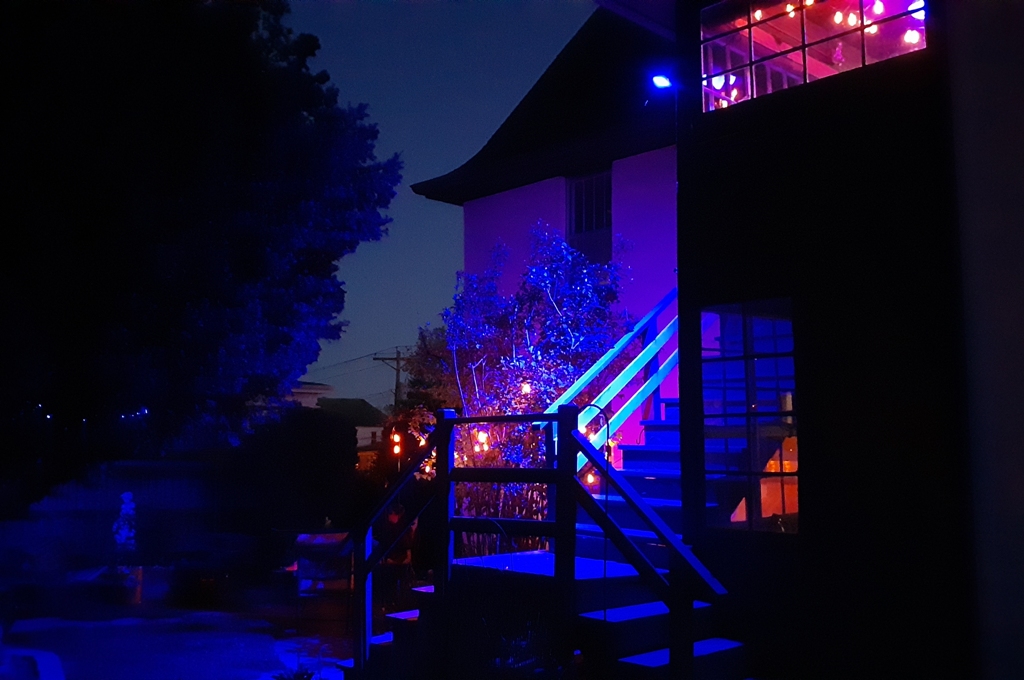
One of the fun things Sue and I have been doing in recent years is flat-out enjoying the backyard in the evenings. In 2018, I bought a bunch of decorative lights: cobalt-blue stringlights and spotlights, and retro-incandescent-bulb-looking stringlights (which look golden-orange when blended with the blue), and hung them around our backyard and sunporch. I do say, they add a nice festive touch, cool and warm. I've tinkered with, added to, repaired or replaced, and improved the lights since then.

And we have a very cheap, old firepit we’ve been using for years. It’s a rusting, shallow saucer on a just-strong-enough stand, with a rusty, decrepit screen that we really don’t use much anymore. This “firepit” is lightweight and tucks away easily when not in use. We always have a pile of miscellaneous sticks that we need to get rid of, and it’s excellent tinder and kindling. We also manage to accumulate a variety of small logs (mostly branches that fall out of trees in our yard, or Mom and Dad’s), which we saw into ridiculously short eighteen-inch sections that fit in our little fire pit. Our firepit is basically a surreptitious way of disposing of woody yard waste.

But it’s also an opportunity to have fun. We have a bottle of wine. We listen to relaxing music on my little bitty Bluetooth speaker. We roast some weenies and have some potato salad. We look up at the sky. We visit with the backyard Wild Things cats. Sometimes an opossum or raccoon ambles through the yard.

Our opportunities for enjoying these blue lights, firepit nights are not great during the winter, since we don’t bother to cover the wood and we won’t try to burn it wet. Plus, we don’t want to have to hover over the fire to even be outside.

But when the weather starts to improve, and the sticks and little logs dry enough to burn cleanly, and we get an early spring day without winds and red-flag warnings, it’s a perfect time to sit and enjoy our backyard, and each other’s company.

. . . Also known as the simple pleasures of life.

Wherever you are, and whenever you’re reading this, I hope you’re finding ways to enjoy your life, too.

Monday, April 22, 2024

Totem Pole Is Up!

Ta-dahhhhh--! The totem pole is now standing in our backyard! This is its third location, and after more than forty years in Columbia, it’s back in Jeff City!

I told you about it in my previous post—how my cousin Phil made it, how it was in Aunt Minnie’s backyard, then got moved to my parents’ home in Columbia. It fell over last year, Dad gave it to me, and I’ve been rehabbing it.

The last thing to do was patch some missing broken wood on the wing, and let that dry, and dab it with some paint to make the wood filler look better, and wait for it to dry again.

On Saturday, Sue and I carried it out of the garage and up the steps to the backyard, where the two support posts and concrete platform were waiting. Sue held the totem pole against the posts while I wrapped wire around and around it, hopefully unobtrusively.

Later that day, we bought some solar-powered lights (for fun), including a solar-powered spotlight that is now pointed up at the totem pole. So I can look out the window and see it at night!

Earlier in the day, I mowed the lawn (first time this year!), so the whole yard is seeming really pretty right now. Despite the pollen, and the cold, gusty winds we had over the weekend.

Saturday, April 13, 2024

Totem Pole

It’s a project! With a history! Oh, boy! I’ve been going around showing pictures on my phone to anyone who’ll look at them! It’s a totem pole, and my work is almost finished. About the only thing left is to stand it up in the yard.

First, the history. My cousin Phil made this in the late 1970s, I think as part of a Boy Scout project. Or maybe it was just for fun. Did Uncle Richard help him or at least inspire him? Probably, at least as a scoutmaster.

It was made out of a utility pole. The wings, bill, nose, and ears were nailed on. The features were chiseled in. The paint was Rust-Oleum, in the standard colors available in the seventies. Phil’s initials are carved into the back of the wings.

When first created, it was installed in the backyard of Aunt Minnie’s, out on Forest Hill. She had it in the far southwest (left) corner. It added a really unusual touch to her otherwise quite proper, upscale landscaping. She loved her family and appreciated everyone’s unique characters, so it probably didn’t faze her at all to have a totem pole in her yard.

It also has strong connections to scouting’s early, and sincerely held admiration of Native American spirituality and philosophy. Today, we call it cultural appropriation and know that it isn’t the innocent thing we used to think it was. We see that white people’s “take” on Indigenous people’s culture was indeed just that: a gleaning, from people who had had nearly everything taken from them: their land, their property, their rights, their language, their culture. But I contend that we should also recognize that early scouting’s admiration was sincere, even if flawed in hindsight, and that their idealized understanding of Native American perspectives and life-ways helped produce better people. It represented a bend toward nature and ecological wisdom, toward harmony, toward quietude and humility, toward simplicity. These are good things, considering the overall trajectory of US culture in the twentieth century: commercialization, natural illiteracy, discord, selfishness, materialism.

Anyway, I recognize that the totem pole could be viewed as problematic, but I appreciate it for what it has meant to my family. For me, it’s a totem of a time when scouting unselfconsciously admired and emulated Native American culture, and it produced some generations of people who were better humans for it.

So after Aunt Minnie passed away, by 1982 the totem pole was moved to my parents’ house in Columbia. There, it stood in the southwest (right) corner of their backyard. I was about sixteen, then, so the totem pole doesn’t figure into my childhood memories. But I sure mowed around it, lived with it, and it has long been a fixture in my parents’ backyard.

Here it is in April 2008.

Well, last year, it finally pitched over. (It was a rough year all around, I guess.) The base had rotted to the point that it fell over.

Dad picked up the pieces that broke off (the bill, the nose, the ears, a bit of the wing) and moved it all under his screened-in porch. And there it lay for months. He was wondering what to do with it. Last fall, he asked me if I had any ideas. Did I want it? Should we just chuck it down the ravine on top of fifty years’ of yard waste? So I took it, and all the pieces. It actually fit in my Civic, if I folded down the seats.

And so it ended up in our garage for the winter. The last few months, I started on its renovation. I decided, first, that I wanted it to remain looking elderly. I wanted to embrace its weathered look, its impermanence. Wabi-sabi. I would mix the paint with thinner so it would not look too dressed-up.

Here's a picture of it laying in my backyard, in early March. It had been rained on, so it looks dark. Remnants of the original paint are more visible, looking like flecks of white.

The wings were hanging on by only one screw, its nails having rusted and broken clean through, so it needed to be secured. That was pretty easy.

The bill, fortunately, was still in pretty good shape. A light sanding, and some thinned-out yellow Rust-Oleum, and it was ready to reattach.

The original nose had split in half, so it needed replacing. I’ve replaced it with a section of sweet gum from a limb that fell out of my parents’ front-yard tree. It is pretty sound wood, and I left the bark (with lichen!) on it. I think it gives a nice woodsy, organic look.

The ears, however, were a problem. Only one of the originals survived, and it’s pretty rotten. I’m no woodcarver, so I couldn’t fabricate new ones on the original pattern—even if I thought brand-new wooden parts would look good.

But I wanted to do something different, also woodsy, so we found some cedars that had been culled at a local conservation area. (MDC had cut them down in order to improve the native woodland habitat. Did you know that before white settlement, the only places cedars lived in Missouri was on cliff faces? Pretty much!) With loppers, I extracted some good-looking branching portions and brought those home.

After a bit of reflection, cocking my head to one side and the other, some careful trimming, and holding different branches in place against the totem pole, I selected my two new antlers. It’s a different look, but I like it.

I’m surprised I got them to balance as well as they do. I’m not convinced I’ve attached them very securely, but I think we’ll get at least a season out of the current construction. Reevaluate next spring.

Before I got too far with any repainting, I wanted to find some old photos. I kept looking through my parents’ old photo albums and striking out.

A lot of the photos I found were generic views of the backyard, and the totem pole was so blurry, I couldn’t tell much. But we sure had some pretty fall color! And my parents have a beautiful backyard.

The day before Uncle Richard’s memorial a few weeks ago, I finally found a photo of it from 1982, which turned out to be the year it was put in my parents’ yard (apparently). I was surprised at how much color had been on it—it had faded so much over the years!

I changed some of the color patterns, though I kept the same “palette” of 1970s Rust-Oleum paints: royal blue, sunburst yellow, regal red, gloss black, gloss white. I think it’s looking pretty good!

The only thing left to do is figure out how to repair a chunk of wood missing from the top edge of the wing. I glued a broken portion back on, but there is still a hole where (I think) a knot had been. Should I cut out a square-edged hole and replace it with a squarish piece of wood that fits in it? Or cut an old piece of wood to “kind of” fit and fill with wood putty? Or maybe leave it as is? Maybe I can think of a clever workaround. Beads or feathers. A big scallop shell?

After that fix, it’s time for the ceremonial placement in our backyard. It will be in the north corner, next to The Door. It will stand on a small circular concrete platform (so the rotten bottom won’t sit in water or stay moist), and it will lean against two stout metal fence posts, to which it will be wired. I could instead sink it into the ground, but with it already rotting and shorter, and the depth it would need to be sunk, I think it would end up shorter than me. And we can’t have that.

Because I think you’re supposed to look up at totem poles.

So, we’re in the home stretch with this project. More news soon.

Sunday, May 15, 2022

Jar of Goodness 5.15.22: The Black Walnut Tree

. . . The weekly virtual “gratitude jar.”

This week, I’m expressing thanks for the black walnut tree that grows in my parents’ backyard.

I’ll tell you more about it in a bit—I’m still cobbling together some pictures to share about it. But today let it suffice to say that it’s the day’s submission into the Jar of Goodness. I’m truly grateful to have grown up in the shadow of such a tree.

Monday, September 6, 2021

Our House of Blue Lights

Gosh, we’ve had a hot summer, with plenty of bugs. Odgen Nash, as usual, hit the nail right on the head: “In this fairly temperate clime / Summertime is itchy time. . . . Beneath the orange August moon / Overfed mosquitoes croon. / After sun-up, flies and midges / Raise on people bumps and ridges.”

But as the weather seems to be getting cooler, I’m hoping we’ll also have breezes enough to push aside some of the insects while also making it more pleasant to be outdoors in general. So we’ll be spending more time on our patio. (Such as it is.)

I’ve mentioned our little oasis in Central Missouri before (like when I wrote about playing the zither or our guitars out there), but today I’m frankly just crowing about our outdoor lighting, which I’m so proud of.

Sue and I were recently sitting out there, playing our guitars, and Sue mentioned that we have “The House of Blue Lights.” She hummed a few bars, and I was like, “What song is this?” She said, “Don’t you know that song?” So we had to Google it, and I learned a new song. And I got a title for this blog post! . . . Here.

I started the lighting project in 2018. I basically copied an idea from Kansas City’s Cafe Trio (yeah, one of my happy places). (And yeah, you should really go there and check it out.) That restaurant has a deck/patio with an attractive view overlooking the iconic Nichols Memorial Fountain and looking beyond toward the KC Plaza. I was fortunately able to be there alone one night and noticed the lighting.

They had gobs of those bright, cold LED Christmas lights overhead—enough to cast a cool, cobalt-blue glow over the entire patio. So that people could see (and read the menu and stuff)—but also to create a compelling visual contrast—they also had regular warm-colored patio lights overhead, too. The warm and cool lights combined to produce interesting reddish or even purplish hues where they intersected.

Then—and here they were really inspired—they had a number of rotating LED projecting spotlights (you know, the kind that people use to beam rotating snowflakes onto their homes at Christmas) mounted overhead, too, facing down onto the bar, the chairs, the floor, everything. Because it beamed down from above, it wasn’t in anyone’s eyes. And it wasn’t snowflakes, though—it was just blue revolving and rotating splotches of color. The lights overlapped a bit, so there was no discernible pattern. The overall effect was like being underwater.

I took note of the idea.

I started with the screened-in part of our sunporch. While Sue was out of town for a while, I did it all unilaterally. I put a super-blue LED light bulb into our overhead fixture, and it emits enough glow for that small portion of the porch. Then, I copied Cafe Trio’s method, stringing plain patio lights overhead and rigging our rotating LED projector so it would beam down onto the table and the rest of the room. We don’t use it for Christmas decorations anymore! And it has a little remote control, so I can change the colors a bit: blue, red, green, or combinations of the three. (It looks best when it’s set on all-blue.)

I was so pleased with the effect, I extended it to the backyard patio area. I found a LED blue spotlight for above the steps (you can still see to get up and down them, but it’s blue now). I purchased a bunch of plastic blue LED stringlights and hung them in the lower portion of the canopy of our big yew tree that overlooks part of our patio area.

Next, I strung regular patio lights from our downstairs back door along the walkway to the patio area. I was proud of myself for using some plant hooks for those. . . . And we already had our tiki torches, and the firepit.

We still really miss Vines, but even when it was still open, there were many nights when we had opted to stay in our own little private oasis in our backyard. Hopefully, now that the weather’s starting to get nice again (with, I pray, a corresponding decrease in itchy bugs), we’ll be out there again.

Monday, August 26, 2019

The Moths of 2019

Going through my pictures from La Plata, I fell in love again with an insect we saw there, a dogbane beetle. It was resting on a shaded, north-facing window, but it was shining beautifully in rich rainbow colors. And I realized, “Hey, I’ve met a lot of new insects this year.” Maybe you’d like to meet them too?

Although I’ve taken loads of “bug pictures” this year (I'm still taking plenty more), I’m only going to do the highlights. But because there are so many, I’ll present them in five separate posts: moths, beetles, true bugs, and a collection of flies, mantids, and others as a sort of “miscellaneous insects” category. I’ll finish with spiders and other noninsects. Ready? Let’s go!


This here is a boxwood leaftier (Galasa nigrinodis)—a type of pyralid moth—that was perched on the bathroom wall one morning in mid-April. It seemed very early in the year to be seeing a moth; Bugguide says they usually fly June through September. I’m pretty sure it must’ve come indoors as a pupa on a potted plant we brought inside for the winter. We have a box bush in the backyard, which must have provided its food last year before it pupated accidentally in some plant we ended up bringing inside. Isn’t it fascinating how they stand, like they’re doing a pushup? I was impressed by the beauty of its maroon and orange iridescence.

-------------------

The next two are geometrid moths—the name means “earth measurer” and it refers to the caterpillars, which most people would call “inchworms.” As adults, they’re distinctive moths, typically posing with wings open and flattened out to the sides. The colors and patterns on fore wings and hind wings usually run seamlessly onto one another. If you’re thinking of learning more about moths, geometrids are a good place to start—because many of them are so pretty.


The first day of June, this geometrid, called the bent-line carpet (Costaconvexa centrostrigaria), was perched on our front doorsteps. Wow! It pays to look closely at insects, doesn’t it! It’s called a “carpet,” apparently, because the ornate patterns make it look like an oriental rug. As a caterpillar, this moth eats various species of knotweeds and smartweeds. I predict this species will be extra common in our area, given the flooding this year—we have a bumper crop of smartweeds locally, about everywhere the floodwaters had been a few months ago.


A few nights later (June 3), a juniper-twig geometer (Patalene olyzonaria) came to our front porch light. As the name suggests, the caterpillars of this species eat juniper foliage. The caterpillar, true to the typical geometrid pattern, looks JUST like a juniper twig—tan, with a series of little X markings—and when it stiffens and stands still at an angle to the twig it’s resting on, you’d have little luck seeing it. I truly admire how the adult moth looks like a dead leaf, right down to the kind of wavy texture to the wings. I'm grateful this insect let me photograph it.

-------------------


I know you’ve seen plume moths before—probably on a screen window or the side of your house in the morning. You’ve probably wondered what they are. They always hold their wings folded tight and out to the side, so they look like a T. It’s easy to recognize them as plume moths (family), but narrowing them to species is much more tricky.

I’m confident that this species is the morning-glory plume moth (Emmelina monodactyla). First, it’s a common and widespread plume moth species. Second, its caterpillars eat plants in the morning glory family, including field bindweed, a plant we struggle with in (so far, only in) one sector of our yard. Also, it superficially matches the pictures in Bugguide. (Bugguide, my guide!)

-------------------


On August 3, we enjoyed a few hours hanging out at Hermann’s Stone Hill Winery. We were getting ready to leave, and we saw this moth flying around; it finally lit in an oak tree near the parking lot. It’s not a great picture, because I was holding the camera way up above my head and zooming . . . and hoping for something decent. This is an imperial moth (Eacles imperialis), one of the lovely, majestic giant silkworm (or royal) moths. Others in the same group are luna moths, Polyphemus and cecropia moths, royal walnut moth, rosy maple moth, etc. Big, furry, gorgeous animals.

-------------------


Working on field guide entries about moths and insects recently has taught me a lot about creatures almost no one would give a second thought to. And guess what: learning just a little about them makes them incredibly fascinating. This species is in the crambid snout moth family (used to be grouped with the pyralids, like the boxwood leaftier above). Both have mouthparts that tend to be pointed forward, making it look like they have snouts.

Most crambids are tiny and not colorful. Many curl their wings around the body, so they look like little sticks. Sod webworms are a classic example. Even though they’re not colorful, you still have to look at wing patterns to identify them. This species, the elegant grass-veneer (Microcrambus elegans) has a pattern that looks like a frowny Halloween mask! So it’s rather easy to ID, even from a distance. This moth has has a wingspan of only about ½ inch. The larvae feed on grasses. You almost certainly have some of these trapped in your lamp covers, inside or out. (One of my insect superheroes, Eric Eaton, addressed indoor bug safaris in a recent wintertime blog post. I love it!!!!)

Hashtag "I love insects." Hashtag "I wish other people could see how beautiful and interesting they are."

Next, I'll share some nifty beetles!

Wednesday, May 2, 2018

Violets Variation

Happy spring! For me, the preeminent flower of springtime is the violet: the ubiquitous "common violet" (Viola sororia) that grows in yards that are not poisoned by chemicals on a regular basis.

The taxonomy of these free and pretty little jewels has apparently given botanists fits. George Yatskievych, in Steyermark's Flora of Missouri vol. 3, summarizes "the tortuous nomenclatural history (and longest synonymy)" of this highly variable species. The species (as it's understood today, for now) differs in amount of hairiness, colors and color patterns on the petals, and lobing of leaves. Some apparently are not 100 percent wild; cultivated forms exist. I think that's what we have in our yard, mostly.

One reason, he says, for the variation and confusion might be because this species might hybridize with closely related violet species, but also that, because these violets also can create viable seeds from cleistogamous (non-opening, self-pollinating) flowers, an unusual specimen may easily reproduce its own weird genetic line in an area, filling the vicinity with its own non-sexually-reproduced offspring (basically clones of the parent plant).

I have kind of given up on trying to key out violets because of these differences. Every time I read technical and even nontechnical treatments of Missouri's violets, I get confused. It doesn't help that older references have them divided up into different species that newer references don't recognize.

But mostly, I simply hesitate to do the serious work in keying out the plants: picking and teasing and pulling apart the flowers, for instance. It pains me even to run the lawn mower over them. And they only last for a few months in the springtime.

So I will just enjoy them and let them be. They are a central reason I don't treat my lawn with weed killers.

Here's a little portfolio of the violets that grow in our yard. Enjoy!

First, some pictures of some "unusual" blue violets I transplanted them to Missouri from Sue's parents' yard in northern Ohio in May 2016, right after Mr. Ferber passed away. These rather pale violets are the most common type up there! Their yard is full of these violets. For all I know, they might be a different species. Anyway, the two little clumps I brought home have gotten pretty well established. I wonder if they're breeding with the other violets in our yard?


Next, the standard plain purple violets; most of the violets in our yard are these.


The next most common kind of violet in our yard are the "Confederate" violets, which Yatskievych calls Viola sororia f. priceana, "a form with grayish white corollas marked with violet or blue veins and sometimes also the lower petal spotted or mottled with purple." He says if you see any growing in a natural area, they are probably "plants that have escaped from cultivation rather than truly native occurrences."

Here is a typical purple and a Confederate together:


This year, I've noticed we seem to have a lot of variation in the "Confederate" violets. Yatskievych says, "Where such plants grow within natural populations of plants with bluish purple petals, individuals with intermediate corolla color patterns may also occur."

So here are some examples. First, some "regular" Confederates:


Then, there are some that look especially dark:


And here's one that seemed to have very pronounced dark veins:


On the other hand, here's one that's remarkably pale, but still with the "Confederate" patterning:


And I could only find a single pure white violet. Its stems and leaves are pure green, lacking the kind of reddish tinge the purple violets can have. And the petals are pure white. Sorry my photo's so lame. If it blooms again, I'll try to take a better picture. But you can get the idea even from this shitty out-of-focus photo.


(Really, I should be ashamed of myself for even posting this piece-of-crap photo...)

Finally, there is a different species of violet that occurs in our yard, and it's clearly separate. This one is Viola striata, the pale violet or cream violet. It has aerial stems (that have alternate leaves and flowers coming off of it) as opposed to having each leaf stem and each flower stem arising directly from the rhizome (like the other yard violets do). The flowers are narrower, and the stipules on the aerial stems are distinctly fringed with deep lobes or teeth (they look kind of comblike). The lower petal usually has dark purple veins (I guess that explains the species name, striata). Here are a couple views of it.