Showing posts with label caves. Show all posts

Wednesday, July 21, 2010

Jacob’s Cave, Versailles, Missouri

Face it, Missouri’s summers are damn near unbearable, and most of us can’t imagine trying to live here without air conditioning.

When I describe this situation to outsiders, to people who lack a truly cold winter or truly hot summer, I tell them that when you have four full seasons like we do, we have two seasons—spring and fall—that are incredibly pleasant and richly beautiful, where it’s a punishment to stay indoors.

But then, we have two seasons where you would rather remain indoors, because the weather is so uncomfortable: winter and summer. Summer’s a lot like winter—you venture outside because you have to mow the lawn, which is analogous to shoveling snow in the winter. By the time you’re done, you’re so glad to get back inside—sipping cocoa in winter, gulping iced tea in summer.

You might remember this past winter when I recommended visiting Missouri’s caves when the weather is, well, horrible. On those endlessly gray and freezing days, visiting a cave, which is humid and comparatively warm inside, is a treat, and it gets you out of the house. Plus, all that darkness makes the sky seem so much brighter when you emerge.

Most people don’t think of visiting caves in the winter; they think of it as a summertime activity, and that attitude is warranted, too!
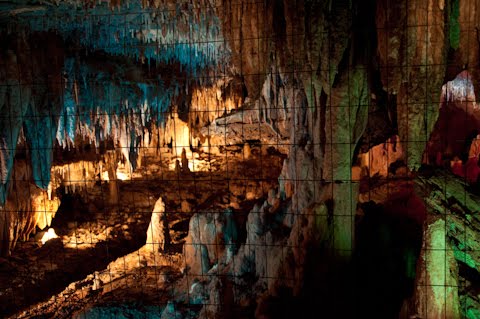


In summer, caves offer relief from the smothering heat and humidity. (No wonder show caves were such popular tourist attractions in the days before a/c!) The darkness is also a wonderful, calming respite from the brilliant sunlight (which becomes positively glaring on the most humid days).

So back in January, I reminded you about Bridal Cave, near Camdenton; and soon after that, I gave you some background information about Missouri’s caves. Today, I’m going to tell you about Jacob’s Cave, near Versailles, Missouri. (Yes, folks, that’s pronounced “vur-SAY-ullz”—get it right!)


Jacob’s Cave

Jacob’s Cave is one of Missouri’s historic commercial show caves (a “show cave,” you might recall, is a cave that is run, basically, as a tourist attraction): It opened for tours in 1932. Before that, the cave had been used, for instance, as cold storage for apples (there was a large orchard located in Versailles in those days), and it had been prospected for mineral wealth.

The cave had been discovered by a lead and tiff miner named Jacob Craycraft, who signed his name in pencil inside the cave on August 9, 1875. (Yes, it’s horrible graffiti, but at this point, it’s also historic. His inscription, which is by now coated with a glaze of new cave material, is now part of the cave tour.)

Craycraft did try to mine lead in the cave, but he met with little monetary success. He did, however, begin leading crude, lantern-light cave tours, charging twenty-five cents for admission.


In the 1930s and 1940s, when the Lake of the Ozarks was developed, nearby Gravois Mills became one of the Lake’s popular communities, and Jacob’s Cave was developed more seriously as a show cave; in 1950, it opened for visitors with electric lighting, widened passageways, and level walkways, and it became extremely popular. Remember, Missouri summers are hot, and caves are cool. Jacob’s Cave remains 52 degrees year-round (compare that to tomorrow’s predicted high: 95 degrees, with a heat index of 105).

Jacob’s Cave has the distinction of being the only show cave in the state that’s completely wheelchair accessible. There is a rock and gift shop adjoining the entrance of the cave, and ample parking. Owner Frank Hurley and his family have been running the cave for over forty years.

What Is It Like?

Well, you drive there, you park, you go inside, and you buy your tickets. Since it was a sweltery day when we were there, we arrived in shorts and tee-shirts, and the women who sold us the tickets reminded us of the cool damp environment of the cave, and recommended we wear jackets. Then—amazingly enough—they produced some nylon jackets, big flannel shirts, and other alternatives that we could borrow for the tour. They guessed our sizes pretty accurately, too. What a pleasant touch! And as it turned out, we were grateful for the extra clothing.

Yes, it’s coooooool in there. Ahhhhh. Hallelujah!


Because this is the peak of the season, the cave tour was pretty structured—this time of year, cave operators don’t spend a lot of time lollygagging, and the groups can be fairly large. There were about twelve people in our group, on a rainy Sunday afternoon. If we’d gone in the off-season, we would have monopolized the tour guide more. But that’s okay—this is the time of year cave operators try to make ends meet, and sure enough there was another group of folks waiting to start the next tour by the time we returned.


I have already mentioned that these commercially run show caves are often, sadly, devoid of life; they were opened to the public before people had much awareness of the delicate ecosystems that exist in subterranean chambers, or the damage that can be caused by the oils from people’s hands, or the algal growth because of lights. But while this is sad, it also means that you don’t have to feel too worried about visiting these caves; the damage has been done, and the cave owners today do what they can to prevent further damage.

One example of past damage is the thin layer of green algae that formed on several walls and formations, wherever spotlights had shined on their surfaces. It’s regrettable, and our tour guide explained that the cave’s owner had attempted to try to remove some of this disfiguring material—but he had found that a thin, clear layer of cave rock had already formed on top of it, sealing it in forever. Nowadays, as with other caves you can tour, the guide turns on only the lights for the room you are currently viewing, and switches off each chamber’s lights as you exit.


But the cave isn’t completely sterile, no-sirree. Our tour guide, right at the beginning of the tour, found a little cave salamander to show us, which was a real treat. Apparently there are also nifty black toads, and some bats that occur, but we didn’t see any. Also, larval forms of the cave salamander are apparently also found in the waters of the cave—but though we looked, we weren’t lucky enough to see any. Oh, well; there was plenty more to enjoy.

The cave is continuing to grow, as well; there are numerous places on the concrete pathway where lumps—baby stalagmites—are forming, caused by incessant steady drips from above. And that’s pretty cool to see!

Other interesting things on the tour are some places on the wall where you can see claw scratches by prehistoric cave bears; evidence of previous glaciations; numerous large columns that were fractured and offset by historic earthquakes (three in this cave’s history, the most recent being the New Madrid quake); and more.


An enormous geode is basically a small chamber all in itself; they bill it as the “world’s largest geode,” but I suspect that the “crystal cave” at Heineman’s Winery in Ohio is larger. (They call theirs the “world’s largest geode,” too.)


There are a lot of nice “soda straws” and delicate helectite formations, flowstones, and more. Our tour guide pointed out some places near the ceiling where the former “floor” of a cave passage had been undercut long ago by water, which removed the silt beneath, leaving behind a suspended, flattened, hardened rock shelf connected to the ceiling by its stalactites and stalagmites.


There are some interesting reflections in pools, which create convincing optical illusions of depth, and of nonexistent new chambers—I think those are worth the price of admission alone. (Photographs don’t do it justice, either.)


At the beginning of the tour, you get to see a case full of ice age bones of bison, Mammoth, and so on, that were found in the cave; at the end of the tour is a display of rocks and minerals that you can see under regular lighting as well as fluorescing under a black light—if you’ve never seen anything like that before, you’ll find it an eye-opening experience.


The Retro-Kitsch Factor

The next thing I’m going to tell you may or may not make this cave seem appealing to you: It is touristy in an old-school way. Though they have pulled back a bit from what I’m sure had been a whole lot of fanciful, silly, amusing stuff, there was still enough to remind me of the old days, when cave guides led tours to see a historic “iron spring” (which turned out to have come off an old jalopy) or, in this case, a “bulb garden,” which our guide led us past, but tactfully said nothing about. We took a picture, however:


A bulb garden! Yes, those are flash bulbs of various makes and shapes. (Remember flash bulbs? Goodness.) (They could probably sell these to collectors on eBay!)

So maybe you will sniff and see this as a horrible marring of the cave, and of the experience, but I enjoyed it for what it was—genuine tourist kitsch, the real thing, the kind of whimsy that would have tickled us all back in the fifties, sixties, and early seventies.

Some of the lights illuminating the cave were multicolored; I mean, what the heck; you purists, just relax. It did add to the niftiness. Here is a multicolor light-spinner from a Christmas tree:


And our tour guide incorporated a lot of fanciful ideas into her spiel—especially in describing what particular formations “looked like.” One formation, for instance, looked like a “whale’s tail” from one side, and an “angel’s wing” from the other.


It’s like hunting for recognizable shapes in the random patterns of clouds—anyone can do it. And you have to admit, if there had been kids along on this tour, it would have really drawn them in.

One room, for example, was called the “Cave Garden,” where one can supposedly see shapes of cabbage, beans, and a variety of other common vegetables among the formations. Another spot was called the “Children’s Zoo”; here, one views a representation of Snow White and her seven dwarves (eight humplike stalagmites, one of them large), plus other subjects that would appeal to kids. Another area was called the “Cactus Room”—and yeah, I could kinda see that one—stalagmites can sort of look like columnar cactus. After a while, you do start “seeing things.”


My favorite of these was at a chamber where there were hundreds of delicate soda straws and helectite formations stuck to the ceiling; here, the guide pointed out the odd shapes they had taken and said in rapid-fire: “People see all sorts of things in this room—Dum-dums, turkey legs, popcorn, pickles, corndogs . . .” She must have rattled off about ten things, and the overwhelming quantity (not to mention the food theme) made me laugh. I could definitely make out the little Dum-dums, stuck on the ceiling; they were the right size and everything. I’ll be doggoned.

If I could make one change to the entire experience, I would wish that I didn’t smell cigarette smoke so heavily in the gift shop. Maybe it was just a fluke that particular day, with people standing right outside the door to smoke, but the place kind of reeked. But who wants to spend a lot of time in the gift shop anyway? You can always wait for your tour outside.

Jacob’s Cave: Heartily recommended, provided you are the type to enjoy the occasional remnant of genuine tourist cave kitsch, and not bristle at it. It is an educational tour, it’s a whole lot of fun, and keep in mind: It’s a great thing to do here when the weather is so dang hot.


Here’s the info:

Admission is $12 for adults, $6 for kids age 4–12. Group rates are available.

The cave is handicap-accessible; in fact, wheelchairs, as well as baby strollers, are available for those who need them.

Hours are seasonal: From Memorial Day through Labor Day, they’re open 9–5. During the off-season, the hours are 9–4.

Though I think they are open every day, except for major holidays, I recommend calling ahead to make sure they are open on whatever day you intend to go.

An easy day trip for Central Missourians, this cave is located between the towns of Versailles and Gravois Mills, not far off of Highway 5, on Route TT. There are signs for it, and their website has a map.

Contact info:

Jacob's Cave LLC
Frank J. Hurley, CEO
23114 Highway TT
Versailles, MO 65084

Phone: 573-378-4374
E-mail: jacobscave@earthlink.net
Web: http://www.jacobscave.com/

Tuesday, January 26, 2010

H. Dwight Weaver, and "Missouri Caves in History and Legend"


If you are interested in the history and lore of caving in Missouri--and you should be--I'd like to recommend the book Missouri Caves in History and Legend, by H. Dwight Weaver. It would be hard to find a more qualified person to tell the story of Missouri's caves, for they have been Mr. Weaver's lifelong passion.

Missouri's caves have provided saltpeter, guano, onyx, housing for farm animals, shelter for Civil War guerillas and for outlaws, misplaced hope for treasure hunters, locations for parties, beer storage, springhouses, and tourism income. And more. This book tells all these fascinating stories, and much, much more. For such a compact volume, it provides a huge amount of information.

To whet your appetite, below is a link you should look at. Mr. Weaver gave an hour-long presentation based on this book at the Missouri State Archives, here in Jefferson City. His talk was videotaped and is available online in its entirety at the Secretary of State's "Missouri Digital Heritage" site. (Alternatively, at the same Web site, you can read the entire transcript--in case you can't download the hour-long video.)

I recently watched the video of this presentation, which was recorded on September 18, 2008, and I found it as entertaining as it was educational. I encourage you to enjoy it as well!

To watch the presentation, click on this link:
Missouri State Archives Presentation:
Missouri Caves in History and Legend, by H. Dwight Weaver

Missouri Caves: The Backstory

Missouri has been called “the Cave State” for years, and for good reason. We have plenty of that neat-o karst topography of sinkholes, springs, and caves, where water seeps into the earth, penetrates the limestone rock layers, then follows along cracks and fissures. Because the water carries with it chemicals from organic sources (think of the leaf litter that water passes through), it becomes mildly acidic (think of it as weak tea), and over time, the water eats away at the rock as it flows through, seeking someplace lower, seeking the water table.

The first stage is basically an underground river. This river is called a spring when it exits the ground. Picture a spring at the foot of a hill, where its water feeds into a creek or river. Then, think of what will happen after an overall, regional uplift: Bluffs are created as streams cut downward through rock; as the Ozark region was raised, many spring openings were lifted so high they were no longer at the water table. And those opened up into air-filled caverns. The former mouth of the spring is now the entrance to a cave.

Of course, water still drips in from above, etching the rocks above it, and redepositing minerals where it drips—thus the stalactites and stalagmites and other beloved cave formations. These features actually represent the later stages of a cave, where rock is gradually refilling the cavity.

When you think of the process—the initial fissure, the water table, the widening channel of the spring, the uplift, the cavern, then the (re)formation of geological features within it, you begin to realize this is much, much older than, say, the Grand Canyon. You begin to wonder: Well, when precisely do you say a cave “began to form”?

This process began tens of millions of years ago. What’s more amazing still is that some of the oldest caves are still down there, gaping full of water, hundreds of feet below the mouths of the big Ozark springs where they discharge.

Sunday, January 24, 2010

Bridal Cave

Post-Christmas, but still winter. The warmth of the holiday lights is long gone, and all we’re left with are our workdays, brown lawns, and grit-sided cars.

And here recently the weather’s been rainy and cold. “Cold” becomes bone-chilling when it’s humid, and in these evenings we’ve been getting fog plus rain, plus cold. The gray days tend to make one feel gray, and yesterday morning I decided I’d had enough. No, I didn’t hop on a plane to Arizona.

Instead, I played reverse psychology on myself. How can you make an overcast day seem brighter? Well, try spending an afternoon two hundred feet below the earth’s surface!


First: I don’t recommend doing spelunking this time of year in wild caves, unless you absolutely know what you are doing—as in, you are a professional caver—since bats hibernate this time of year, and awakening them can cause them to die. (Which sucks, so don’t do it.)

So we went to one of Missouri’s premiere commercially run show caves—these are gorgeous caves that are accessible to the public via tours. Sadly, many of these have been so touched and trampled that they don’t harbor much of an ecosystem anymore. However, since the damage has already been done decades ago, your presence there has a minimal effect on the underground environment. Meanwhile, it is good to learn about and appreciate these amazing chasms, so easy to put out of mind otherwise.


Bridal Cave

The cheery yellow signs with the retro logo are everywhere! If you live in Missouri, you learn to ignore them, but they act on you subliminally, anyway, and sooner or later, you really ought to succumb: Visit Bridal Cave.

The entrance to Bridal Cave—originally only a few feet across—used to be high on a rocky bluff, overlooking the Big Niangua, the Ozark stream that had carved the deep valley below it. That valley is no longer apparent, because the Lake of the Ozarks, created in the 1930s, flooded the chasm, and the water level rose to within easy reach of the cave mouth.


Though it had been explored much earlier, in the 1800s, Bridal Cave was opened as a “show cave”—a tourist attraction—in 1948. Tourist attractions opened up all over the Lake; and by then Missouri was already well-known as a place for caves.


Bridal Cave’s particular schtick was that its front chamber (the “Wedding Chapel”) became a popular spot for weddings. There’s a large, tall formation on one wall that sort of resembles an elaborate pipe organ, plus a central stalagmite that you could say resembles an altar, and I guess that was the inspiration. Well, also, there’s a crusty old local legend about an Indian wedding that took place there in the early 1800s. (True? Who knows.) Anyway, to date, they’ve had over 2,128 weddings in there. And they’re still doing them.


(No, they haven’t done any same-sex commitment ceremonies yet; I asked. Anyone want to go first? To have a wedding there, with their wedding package, they require a valid Missouri marriage license; but then they have also allowed other religious ceremonies on the site, so perhaps there’s some wiggle room for gay folks and their ministers, friends, and families to have commitment ceremonies, which, though not recognized by this state, are certainly not illegal by any means.) (But I digress.)


Though there’s something kitschy about it, they take the wedding thing seriously; the first thing you see when you enter the visitors center/gift shop is a large shelf bearing three-ring binders of 8 x 10 wedding photos. These photos used to be framed and displayed on the walls of the old visitor center. Today, only a select few are framed on the wall: The first wedding, of Mr. and Mrs. Basil Cole, took place June 1, 1949, for instance. Also pictured are the 700th, 1,000th, and 2,000th couples, as well as the “Couple from Farthest Distance,” Mr. and Mrs. Hui-Shong-Cha, from Taipai, who had themselves a June wedding in 1968.

Now, if it were just based on the “bridal” aspect of Bridal Cave, I honestly wouldn’t be very eager to go there. But here’s the kicker: It’s simply a lovely cave.


Indeed! Our tour guide verified this, saying that Bridal Cave is consistently ranked among the top 10 caves in the nation in terms of beauty, accessibility, and the diversity of formations. And that’s saying something, I think.


It’s not a huge cave—this isn’t one where you go back for miles and miles, or ride in jeeps, or access via long flights of stairs. But you do get a lot of bang for your buck. (Prices, times, directions are at the bottom of this post.)

The onyx formations are indeed breathtaking, in milky whites tinted with rusts and yellows; there is an incredibly long wall of uninterrupted drapery formations.


There are, of course, plenty of stalactites and stalagmites to ooh and ahh at, as well as many delicate soda straws hanging from the ceilings, many visible at close range. Plus many other features I’m not smart enough to identify.


There was one thing that really surprised me, and if you’re like me and are already familiar with this cave, this might surprise you, too: They opened up a whole new section!

This project brought access to new rooms behind the ones that had been accessible since the 1940s; indeed, they nearly doubled the cave tour distance!

The last time I toured Bridal Cave was in the mid-1980s, and this project took place in 1988–1990; I was living out-of-state and had no idea this had happened. They call it the “Thompson Expansion,” named for Steve Thompson, who was the general manager of the cave at that time. They had to remove 500 tons of rock in order to carve a tunnel through to the next chambers.


In addition to lengthening the tour overall, the expansion provides two new things: First, today’s visitors are able to see parts of the cave that aren’t so worn out by feet and fingers, and experience a deeper section of the cave. At about 200 feet below the surface, the humidity and the temperature seemed to increase dramatically in the back section.

Second, a whole new treasure is now visible at the farthest extent of the tour: “Mystery Lake.” Yeah, I love how they came up with such a marketing-savvy name, but there is a real mystery to it: They discovered an old ladder and some other stuff in the lake, and they have no idea how it got in there so far, or who brought it.

Visitors can view the lake, from an overlook with a railing. This mineral water is a breathtakingly pure turquoise blue, as you view it through a nearby rock fissure. What a nifty sight!


Well, if you’ve read this far (and yeah, I know this is long), here’s my final point: I especially encourage you to visit Bridal Cave—or any of our other fascinating show caves—during these winter doldrums.


Yeah, I know that we usually think about visiting caves in the summer—tourist season, plus the coolness of the cave is really attractive in Missouri’s heat. But consider this: The cave’s constant 60 degrees feels warm in comparison to the winter outdoors. The humidity feels great, too! And when you emerge from the cave, that overcast, gray daylight suddenly seems bright!


Here’s another reason, possibly the best one of all: Winter is the “off” season for show caves, so when you go there, you practically have the tour guide all to yourself. Our guide at Bridal Cave said that in summertime, they regularly reach their maximum group size of fifty people—to which I say: ugh!


But on our tour, on a cold, rainy Saturday afternoon in January, we had only six, and we all got to ask questions and wander around in each chamber, inspecting formations as the guide spoke. There wasn’t a rush to keep moving. It truly felt like a personalized tour, just for us.


So if you’re looking for something to do on these boring, cold, gray days instead of laundry, Fiddle-Faddle, and DVDs, I suggest you take a tour of one of our state's amazing show caves. I warmly recommend Bridal Cave.


Here’s the info:

Admission is fifteen dollars for adults, and seven for kids ages 5–13. Group rates are available.

They’re open every day except for major holidays and on days when they close school for snow days. If you have any doubts, you can always call ahead to ensure they’re open.

Hours are seasonal: winter, 9–4; spring and fall, 9–5; summer, 9–6.

This cave can be reached by car or by boat! Cars get there by taking Business Highway 5 for 2 miles north of Camdenton; boats can find Bridal Cave at the 10½ mile marker of the Big Niangua arm of the Lake of the Ozarks.

Contact info:

Phone: 573-346-2676
E-mail: info@bridalcave.com
Web: http://www.bridalcave.com/