Showing posts with label black walnuts. Show all posts

Friday, December 2, 2022

Notes on Grandma Renner's Billie Goat Cookies

I’ve written about Billie Goats, also spelled Billy Goat Cookies, before. But it’s time for a more nuanced version of the instructions. Look, no matter how you make them, they’ll be delicious. But I’ve been taking notes every year, so I can get the shape and texture just right. Until now, it’s been hit-or-miss. But I think I’ve got the techniques figured out, now. (As Chef John says, “Never let the food win.”) By golly.

So yes, there's a recipe at the end of this post.

A true, enduring gift from my grandma Clara Renner, these cookies take the strong, separately distinctive flavors of brown sugar, cinnamon, black walnuts, and dates and combine them into a new flavor I can only call “Billie Goat.” It’s a genuine meld; the combination is much greater than the sum of its parts. If you don’t like one of the ingredients, don’t rule out these cookies, because each flavor is tempered and transformed by the others. This is one of the best cookies anyone can make, in my opinion.

And for us, it’s a must-have for the Christmas cookie tray.

I have used this combination of brown sugar, cinnamon, dates, and black walnuts in other recipes, and I’ve found they have the same profound, synergistic effect, where they meld into a new, milder, but very unique flavor. I think of it as “Billie Goat seasoning.” I use this combination in my bran muffins, for example. You could also apply it to a bowl of oatmeal, or use it in pancake batter or a quick bread.

Grandma Renner said these are called “Billie Goats” because they are lumpy and have little points that stuck out, like a goat. (This is why the shape and the texture of the dates is important; read on.) I don’t know why Grandma spelled it “Billie” instead of “Billy.” Grandma Renner, her sister, Lydia Meyer, and their friends apparently all started making Billie Goats about the same time.

Billie Goats/Billy Goats are in a family of similar drop cookies that were really popular among mothers in the 1930s and 40s. This was a generation of moms who were keenly conscious of their role as household managers. In school, their “domestic science” classes taught them to be faithful guardians of their family’s health and good stewards of the family food budget. Vitamins were a new discovery with their generation. These women wanted to pack maximum nutrition into the foods they made, including their children’s after-school snacks—while being very economical (first, because of the Great Depression; next, rationing during World War II).

So, instead of sugar cookies or candies, they made these proto-health-food snacks, using nuts, plus raisins, dates, and/or currants, and sweetening with surprisingly small amounts of brown sugar (some recipes call for a combination of brown and white). Other cookies in this group include “hermits” and “rocks”; oatmeal-raisin cookies are also close relatives. Look for all these recipes in old cookbooks and church ladies’ cookbooks. The names “billy goats” and “rocks” both apparently refer to the chunky, knobby look of these cookies. I don’t know how “hermits” got named.

Some notes about texture and form, since I’ve had some time to figure these out. They’ll taste great no matter what you do, but the goal is to have a chewy, cakelike inside, and a lumpy, chunky shape. So here’s a discussion of challenges, and my “pro tips.”

For generations, most American cooks could only get Dromedary brand dates, which were apparently Deglet Noor dates. They were packed tightly in cellophane (this was before plastic), stuffed into cardboard boxes, and, after languishing in a warehouse or on grocery shelves, they were as tough as shoe leather. Clipping them with kitchen shears, as Grandma’s recipe instructs, would literally hurt your scissors hand. (Grandma’s kitchen shears were stainless steel, dull old things; you know the type—the ones with the rounded “claws” for opening bottles at the base of the red-painted, hard metal handles. The base of my thumb still hurts, just thinking of them. This was way before “Fiskars” scissors were available!)

So billy goat cookies, being a midcentury recipe, were developed using the ingredients that, at that time, were available to most people: dried-up dates. The cooking softened them, but not to the point where they lost a distinctive, chewy, chunky presence.

Today, the Dromedary brand seems to have gone out of business, and you just cannot buy dry, hard dates like them; instead, they are all moist and tender, either packed in plastic or shipped absolutely fresh. This is actually a good thing, but it presents a problem for replicating this cookie’s texture, since moist dates tend to dissolve into gooey molasses during baking, producing a flat, uniformly chewy cookie, instead of distinct, chunky, jagged lumps of chewy dates and nuts in a cakey, rounded matrix of dough.

I’ve learned to replicate the type of dates Grandma had by purchasing them (Deglet Noors) a few weeks ahead of baking, clipping them in the prescribed herringbone pattern while they’re still soft (which is a much easier task, now), spreading these out on cookie sheets, and letting them sit (under wax paper) in a quiet place while they dry. The house isn’t at all humid in November. Or, you can put them in the oven warmed only by the pilot light. Or you can try a dehydrator. An alternative might be to try to find one of the so-called bread dates (varieties such as Thoories that are sold rather dry, dry enough you can carry them in your pocket)—but those might lack sweetness. Also, I think it’s cheaper and easier to use regular Dole (or whatever) brand Deglet Noors, cut them, and let them dry. That seems the best way to replicate the texture and flavor of old-fashioned Dromedary dates.

Another point about texture: These cookies have caused me more vexation than any others, except perhaps when I was first figuring out springerles. If you only make a cookie once a year, it’s hard to fine-tune the recipe! My Billie Goats recipe card is full of penciled-in notes: “try doing _____ next time.” You don’t want the cookies to be so soft they spread out, but you don’t want them crunchy or hard. How to get that cakey, chewy texture, and chunky look? Here are some key tips:

  • Use a 50/50 combination of margarine and butter-flavored Crisco. Real butter does make them taste better, but it complicates the texture; the cookies turn out drier, less moist. Save your butter for some other recipe.
  • Pack the flour; forget the rule about spooning fluffed-up flour into your measuring cup and leveling it off with a knife. It turns out Grandma R used her measuring cups as scoops: swipe the cup through the flour, like you’re using a dip net to fish something out of water. You can level it off if you want, or just kind of shake off the excess, but you need to pretty much pack the flour into the cups.
  • Let the dough sit overnight in the refrigerator or on an unheated sunporch. The flour will absorb the liquids and be easier to work.
  • . . . But the dough will still be sticky and hard to handle. Put on some happy music. Use parchment-lined cookie sheets. Try dabbing the dough into little rounds with two spoons, or (if you haven’t much patience for the spoon method) use your fingertips to pinch off bits of dough (put some water on your hands so it doesn’t stick so bad; even then, you’ll have to clean your hands and start again several times).
  • I tend to make smallish cookies, because I figure twenty-first-century people would rather select six different morsels from the tray than settle on just two huge cookies. Big cookies are a joy, but variety is the spice of life. Also, with smaller cookies, a single batch of dough goes farther. A 1¼-inch blob of dough, slightly flattened before cooking, produces about a 1½-inch diameter cookie. Back in the day, Mom and Grandma’s cookies tended to end up about 2 to 2½ inches in diameter. Different sizes account for the difference in cooking time; smaller cookies cook faster.
  • Do a single tray of cookies first and see how they turn out. These shouldn’t flatten very much. If they spread out flat, you may have to add a bit more flour to the dough, or you might need to adjust the size of the cookies.
  • Finally, don’t overcook these, or they will be too hard. Mom says this was a principal criticism Grandma R had about her sister, Lydia’s billy goats: “she bakes them too long, and they get too hard.” (I’ve heard this criticism plenty, too.)
  • But if they come out kind of hard, don’t panic. Seal them in a tin, with the layers of cookies divided by wax paper, and take half of a tart apple, wrap it loosely in wax paper, and nestle it in the tin with the cookies. After a week or so, you’ll discover the cookies have softened and developed a je ne sais quoi in terms of flavor.

. . . Does all this sound too hard? Please don’t be put off by these tips; it’s all stuff I’ve learned the hard way, and I’m sharing it here, so you have a super-duper head start!

Finally, again, you can’t really ruin these. They’ll taste great regardless of the texture and shape.

Billie Goats/Billy Goat Cookies

1½ c. brown sugar
1 c. butter [Pat S. uses margarine, sometimes butter-flavor Crisco; I use half margarine and half butter-flavor Crisco; real butter tastes good, but then the texture will be off]
-----------Cream together butter and sugar.

3 eggs: beat whites [till light; use a hand mixer or whisk] and [then] add [whisk in] yolks

1 level tsp. baking soda dissolved in
¼ c. lukewarm-to-hot water

1 Tbs. cinnamon
1 tsp. vanilla
1 c. black walnuts [chopped]
1 lb. clipped dates [using a scissors, clip whole, pitted dates in an alternating herringbone pattern; the idea is to have them big enough to kind of “poke out” of the cookies; if you buy pre-chopped dates, it’s okay, but the pieces are too small to achieve the characteristic lumpy look.]
2½ c. flour [basically pack it]

Make the cookie dough [let it sit overnight in the fridge] and drop it onto [parchment-lined] cookie sheets by small spoonfuls. Bake in a moderate (ca. 350-degree) oven like you would other cookies, about 8–11 minutes. [Don’t overcook; they should be rather chewy and cakey inside.]

Makes about 100 cookies.

Wednesday, May 18, 2022

The Black Walnut Tree

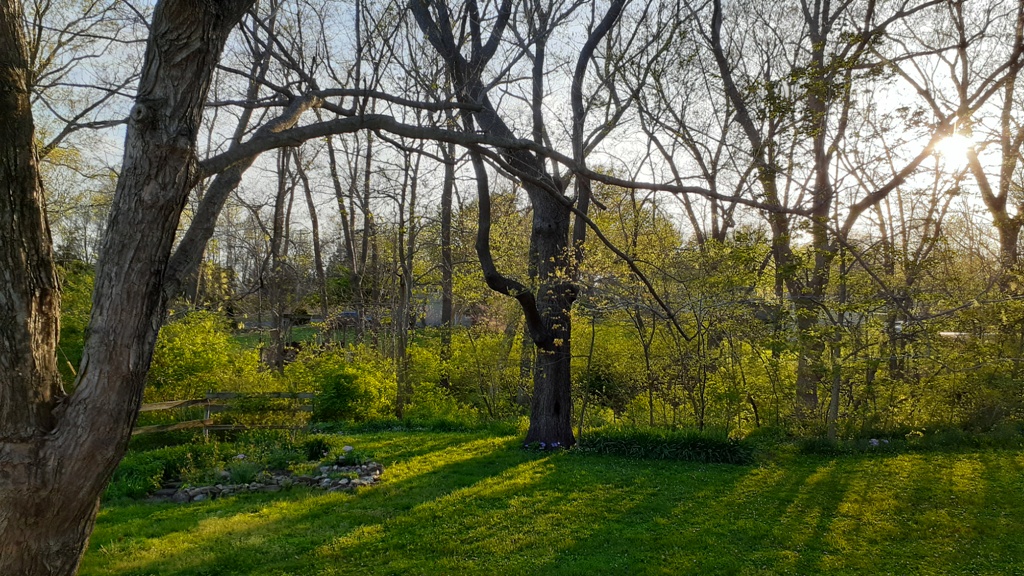
There’s a big old black walnut tree in my parents’ backyard. It’s right in the center, in the back, where the lawn meets the edge of the woods above the drainage ravine.

It was already a giant when they bought the house when I was on the way in sixty-five. All the branches are high out of reach.

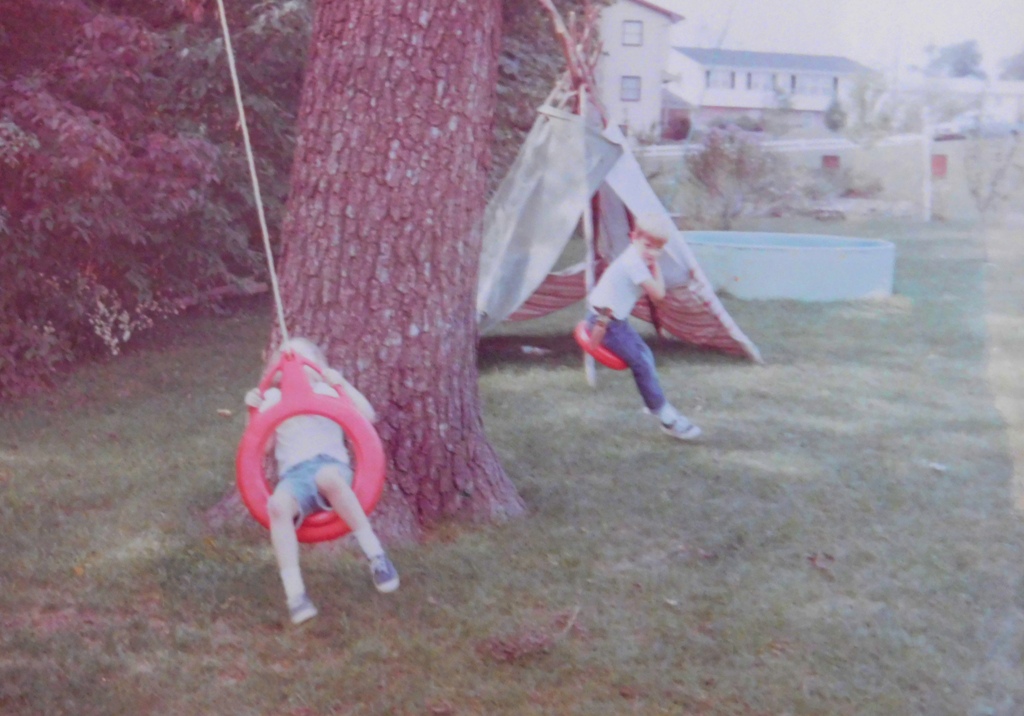
Dad hung swings for us from its huge lower limbs when I was a kid.

The night of Saturday, July 26, 1969, a severe storm blew the top out of the tree. A hard day’s work with saws cleared the debris from the lawn. Mom and Dad had plenty of help.

My brother and I didn't particularly help, but we sure had fun that day.

From that windfall and more, my folks used some of the fallen branches and some old blankets and pieces of canvas to build a tepee for us kids in the backyard. So that summer and following years, our yard was popular among the neighborhood kids.

Some of the large sections of walnut became woodworking projects. Mom squirreled away several nice thick pieces. To this day, I use one of the smaller chunks—which I carefully sanded and polished, as a preteen—as an incense burner. There's a public side and a private side.

Then in the late 1970s, Mom learned about juglenone when she tried to grow a tomato back near the tree. The tomato plant grew tall and spindly, and it begrudged us flowers and fruit. At the time, I didn’t care much, since I never cared much for raw tomatoes. (They’re still not a favorite.)

The nutmeats from the tree didn’t amount to much, as too many of them were dried and shriveled to make it worthwhile to crack them open. The squirrels found plenty of them to eat, however, and nested in its branches and ran around, like rollercoaster cars, on its wide, undulating, spreading limbs. Recently, my parents had a clan of gray squirrels with a lot of white patches in their fur, which was fun to see.

There has always been a vertical split in the trunk facing the house. It’s morphed over time into a more rounded hole. But the split was always a curious thing for me. Over the years, it became an entry way for the carpenter ants, bees, snakes, and other animals that have inhabited its hollow interior.

Paul and I used to pick up fallen walnuts and chuck them into the woods, practicing our pitches by aiming for random tree trunks. My fingers turned black from the juices, but I didn't care, since I wasn’t such a girly-girl. Chucking the nuts into the woods served a useful purpose, too, since it made mowing easier, and walking, too, for that matter.

I have so many memories of enjoying the backyard with that big tree providing us shade. It’s still standing, doing fine, its hollow space quite recently a home for a family of barred owls.

It’s truly a grandmother tree, and I thought I’d sing you this little song of praise.

Sunday, May 15, 2022

Jar of Goodness 5.15.22: The Black Walnut Tree

. . . The weekly virtual “gratitude jar.”

This week, I’m expressing thanks for the black walnut tree that grows in my parents’ backyard.

I’ll tell you more about it in a bit—I’m still cobbling together some pictures to share about it. But today let it suffice to say that it’s the day’s submission into the Jar of Goodness. I’m truly grateful to have grown up in the shadow of such a tree.

Tuesday, September 16, 2014

Black Walnut Wheat by Piney River Brewing Company

Piney River Brewing Company, based in Bucyrus, Missouri, has invented a beer that I especially admire: their Black Walnut Wheat. It’s delicious!


Since there’s nothing not to like about it, let’s go directly to why we love it!

Because we love black walnuts! It’s Missouri’s official state tree nut. Our state is the top producer of black walnuts in the world, and we like them, and we’re proud of them.

I’ve blogged about black walnuts before—shown their progress as they mature; told you about the delicious pickled black walnuts produced by Barnacle Farms in Mary’s Home, Missouri; even shown you pictures of a variety of critters drinking the late-January sap of the walnut tree in our backyard.

I think everyone should have a big black walnut tree in their backyard!

And we can’t have our lebkuchen or our billy goat Christmas cookies without black walnuts!

Since I’m so proud of Missouri’s black walnuts, when I first saw this beer on tap at my favorite neighborhood restaurant, I had to give it a try: Black walnut beer, really?


And there’s something to that local pride, isn’t there. It’s September, and it’s that time of year when the Hammons company, based in Stockton, Missouri, establishes black walnut hulling stations around the state. This is a distinctly Missouri thing, which the Piney River beer celebrates on its label.

The deal is, black walnuts are harvested by hand, by anyone. Whether you’re collecting them for yourself or selling them to Hammons, the company makes it easy for you. It’s a messy, involved process to hull them (that is, remove the sloppy, black-staining green or black outer part), which is the first step in getting to the nutmeats.

So people bring buckets, bags, and pickup trucks full of black walnuts to these processing stations, where Hammons hulls them using really cool-looking machines. (It’s great fun to watch!) At the time of processing, you can either sell your bounty to Hammons, or if you want to take your walnuts home and try to bust them open and pick out the nutmeats yourself, you just pay them for the processing.


If you’re interested in harvesting and cracking your own nuts, read Hammons’s webpage about how to do it. Once you’ve tried it yourself, you’ll understand why black walnuts cost so much at the store.


Anyway—the limited seasonality, the gathering of people it causes, the promise of all those good Christmas cookies, and the idea of genuine riches growing on the trees without any help from you, besides picking it up after it’s fallen, plus the crispness and blue skies of early fall, all makes black walnut harvest seem like a celebration.

And that’s what I get from the fact that this beer exists: Someone else feels this same way. Right on, Piney River Brewing Company!


Sunday, January 29, 2012

Nature’s Kool-Aid

If this were Vermont, we’d be saying, “It’s sugarin’ time!” We’ve been having those fluctuating temperatures—freezing nights, warm and sunny days—that make the trees start pumping sap.

Sap is like natural Kool-Aid for critters. Maples, of course, but other trees, too. Including our black walnut. The first thing we saw was a wet spot on the bark, about chest-high.


Closer inspection revealed a horizontal row of about fifteen small round holes, each about two inches from the next. Most were dripping sap.


If you taste it, it’s pretty much like water. This is sweet?


But you’re not the one drilling the holes, and neither are you the one to be attracted to it.

It was not a mystery to us what bird had drilled the holes. But it had been years since I’d actually seen a yellow-bellied sapsucker (Sphyrapicus varius).

This year, we saw him! (Look carefully!)


I’d forgotten how well sapsuckers blend in with their background, which is almost inevitably the patch of bark that they have darkened by the moisture caused by the dripping. It’s pretty neat how they blend in. And they’re fast workers!


Yellow-bellied sapsuckers do this: They tap holes into trees from which sap drips. They drink the sweet fluid, using their brushlike tongues. Which is pretty much like drinking Kool-Aid, nutritionally speaking.

But wait! They get some protein out of the deal, too! The sap is also a lure for ants. Even at this time of year, ants, on warm days, send out scouts to make sure that potential food sources aren’t going unexploited.

And because ants are everywhere, they certainly find the patch of sugary water seeping down the bark, and immediately send out workers to drink it and carry it back to the nest.


Thus, with the ants milling around the sap wells, the sapsucker has the opportunity to grab ants that are bloated with sap. Or, I’ll bet Mr. Sapsucker can simply grab ants and smear them around in the tree-juice, like sopping biscuits and gravy. (Don’t you think?) Anyway, that’s protein and sugar! Dee-liss-yuss!

While the party is swinging, others come to enjoy the punchbowl, too. Other woodpeckers, I understand, are attracted to the sugar water and (no doubt) to the baited ants as well. I’ve read that sapsuckers vigorously guard their sap wells, but ours leaves for hours at a time. Look at this!


It was pretty cute to see this little fella clinging to the side of the tree, upside-down, right-side-up, and sideways.

Are we afraid of damage to the tree? Nah. Sapsuckers have zapped our walnut before, and they’ve riddled our big yew tree, too (and gave it worse).


It’s not like in those pictures where the holes are so close you can’t see the bark anymore. I think this bird has several trees that it’s tapping. And the walnut, for instance, has thick ridges of bark that prevent the sapsucker from drilling holes one after the other, so that protects the tree from being completely girdled.


And anyway, sapsuckers are highly migratory, and this fellow is probably just passing through, on his way north to claim his breeding territory. Somewhere up in Canada, in a few months, he’ll be banging on a hollow tree or on somebody’s gutter, and working to make Kool-Aid-loving progeny.


Thursday, April 15, 2010

Things You Can Pretty Much Count On

Tax day. You never completely know, until the final calculations are done, whether you’ll get a refund or will owe.

And you can’t count on much with the weather around here, or a lot of other things.

It’s good, then, to look around and see some things that are more or less reliable.

This, for instance, will smell heavenly:


This will make me sneeze and my eyes itch:


This, in our yard, will make a “rock peach.” (Gotta love it.)


This will attract hummingbirds:


This will beget black walnuts:


And this will draw ants, and then bloom pretty white right around Memorial Day.


Thursday, December 24, 2009

Leppies (Lebkuchen or Lepkuchen)


Around here—and perhaps all around the world, including Germany—this is the number one German Christmas cookie of all time. Really: The official cookie of Christmas. Authoritative. Can’t have Christmas without lebkuchen—not if you’ve got “sauerkraut in the blood” like we do.

If you have German heritage like us, you probably know what I’m talking about. This is just as Christmassy as the Tannenbaum and “Stille Nacht”—lebkuchen. Sometimes you see it spelled “lepkuchen.” We call ’em “leppies” for fun. We’re German Americans, after all, so whatever’s authentic in Germany might be a little foreign to us.


Indeed—official German forms of this recipe nearly always use honey as the sweetener. According to Erin McCawley Renn, in her important book A Midwest German Christmas: Breads, Cakes, Cookies, Sweets, and Special Foods: Weihnachtsgebäck, -konfekt, und –speisen, Nuremberg, Germany, “became the center of the Lebkuchen industry because . . . [it] was on the direct route north from the Republic of Venice, where the spice ships unloaded anise, cinnamon, cloves, cardamom, nutmeg, ginger, and black pepper, and Nuremberg was famous as the center of the finest honey-producing region in Germany.”

But, as Renn points out, Germans who immigrated to America tended to modify their recipes to utilize molasses instead of honey—molasses being cheaper and generally more available. Therefore, among us ethnic Germans here in the Midwest, the “traditional” lebkuchen recipes that came down to us from our immigrant grandmas usually feature sorghum or some other sweetener or combination of sweeteners. Sometimes I use blackstrap molasses!


In my experiments, I’ve found that sorghum is mild and is indeed a pretty good substitute for honey. Blackstrap molasses is delicious, too, with that dark, smoky, almost bitter flavor—and it makes for some truly distinctive cookies.


There’s also such at thing as “white lebkuchen,” which uses white sugar as the sweetener. My recipe for white leppies came from my Grandma S’s collection, and it calls for “cardamom to taste.” (Oooh, don’t throw me into the briar patch!)

The recipes vary considerably, but they almost all have a few things in common. First, they use a wonderful variety of spices, types that are traditionally considered almost medicinal, as digestive aids. These spices make me think of Indian cuisine: Cinnamon, cloves, nutmeg, ginger, pepper, cardamom. Remember the comment about the spice trade? Here you go. When they first appeared in Europe, these were special, precious flavors. So special you reserve them for Christmas.

Another thing most leppies share is candied fruit. Candied lemon peel, candied citron, and candied orange peel pop up a lot. Some newer recipes use “candied mixed fruit,” with that pineapple . . . and whatever those little green things are.


In my family, you can’t have leppies without nuts, and the nuts are usually black walnuts. White leppies tend to include almonds instead. I guess some people use English walnuts and pecans for their lebkuchen, but whatever. With my people, leppies are the number one reason to procure black walnuts every fall. We compete with the squirrels for them.

As Renn also points out, nearly all lebkuchen recipes call for the completed dough to rest for some days before rolling and baking, in order for the flavors to meld.


Many recipes involve large amounts of ingredients and make a huge supply of cookies. Stored in a sealed container in a cool place, leppies can last for months—without any preservatives.

These are apparently pretty healthy cookies, as cookies go, having relatively few calories and being low in fat and cholesterol.


My uncle, a retired Conservation Agent, used to bring a coffee can of leppies and a Thermos of coffee with him on his frozen, late-night stakeouts, waiting in his darkened patrol car for poachers during deer season. His mother’s lebkuchen forever have a special place in his heart.

Lebkuchen recipes are passed down through the generations, sometimes modified, sometimes adhered to with stereotypical Germanic strictness.


In my case, I have the same recipe from both of my grandmas, since one grandma’s mother provided the recipe to both women—they lived on the same street, so Wilhelmine Thomas’s recipe is “grandma’s leppies” for me on both sides of my family. And each modified the recipe slightly to her own preferences.

After all this discussion, I’m not going to give you the precise formula. I will tell you, however, that Great-Grandma Thomas’s recipe calls for a half gallon of molasses, “10 cents citron peel” and “10 cents lemon peel,” “1/2 box of raisins,” “1/2 box of currants.” There’s a certain amount of interpretation required.

Her recipe also calls for “3 or 4 cups cold black coffee.”


Sometimes lebkuchen turn out kind of stiff and hard—but they are all precious in my sight. The stiffer ones are good for dunking. Or you can seal them up along with an apple, which mellows the texture after some weeks.

Yep, I made a ton of leppies this year, and the house smells absolutely marvelous.


Referenced in this post:

Erin McCawley Renn, A Midwest German Christmas: Breads, Cakes, Cookies, Sweets, and Special Foods: Weihnachtsgebäck, -konfekt, und –speisen. Hermann, Mo.: Deutschheim Association, 1999.

How do you get a copy of this book? Its copyright page gives a phone number for the publisher, the Deutschheim Association: 573-486-2200. Here is the association's website. Here is the Missouri DNR's website for the Deutschheim State Historic Site. Finally, the Gasconade County Historical Society sells the book on their website; click here to view that page.

Sunday, December 20, 2009

Billy Goats

A recipe from my Grandma Renner. These are Christmas cookies, a kind that you can’t have Christmas without. They’re not tremendously sweet in the ordinary, sugary sense. They’re rich and sweet with dates and have that smoky flavor of black walnuts.

And yes, you must use real black walnuts (not the English kind or any other kind of nut). They’re a key flavor ingredient. (We’ve talked about black walnuts before on this blog.)

(We have also talked about billy goat cookies before, as an example of what I mean by "Opulent Opossum.")


When I was a little kid, I often got fooled by these cookies, because they look something like chocolate chip. But they aren’t. They taste very different.

So here we go. My notes are in brackets.

Billy Goats

Cream together: 1 1/2 c. brown sugar + 1 c. butter.
3 eggs: beat whites, then add yolks.
1 level tsp. baking soda dissolved in 1/4 c. lukewarm to hot water.
1 tbsp. cinnamon
1 tsp. vanilla
1 c. black walnuts [gotta be black walnuts, not any other kind, I mean it]
1 lb. clipped dates [see note below]
2 1/2 c. flour

Make the cookie dough and drop it onto cookie sheets by small spoonfuls. Bake in a moderate (ca. 350-degree) oven like you would other cookies.

Clipped dates: Start with whole (pitted) dates. Using a scissors, starting at one end of the date, snip off alternating diagonals in a sort of herringbone pattern, so you get rhomboidal shapes.

These cookies are called “billy goats,” Grandma told us, because they have little bumps poking out of them. No, I don’t quite understand that, either, but the “point” is that the dates have to be big enough to protrude a bit after you bake the cookies. If you cut them too fine, then I guess you have “nanny goats” instead!

Tuesday, November 17, 2009

Black Gold

This is real, true, black gold, black-walnut gold, exquisite, painstakingly shelled and picked, the ultimate nut, dark, rich, and smoky. Black walnut shells are incredibly hard; it’s a mystery to me how anyone can extract nutmeats that are larger than a crumb or a smear.


A sixteen-ounce bag of these fancy babies costs ten dollars (well, $9.99) from Hammons Products.

But my mom knows a fellow in Jeff City who has a contraption that makes the cracking and picking easier, and he produces shelled black walnuts for family and friends. This year my mom bought from him four quart-sized freezer zip-bags, stuffed full. You know what he charged her? Five bucks a bag. Seriously. (Though she insisted on giving him a more than that—you know—just because.)

Mom gets her black walnuts from this gentleman every year, and these nuts go into her fantastic lebkuchen, her billy goat cookies, and lots of other incredible holiday treats. She also shares her black-walnut bounty with her sister in Michigan and (hooray!) with us.

Mom says she’s never, ever, found a piece of shell in this man’s black walnuts.

So am I bragging? No. I’m just saying: This is really, really wonderful, you guys. I rejoice each time I think about these beautiful, tasty, fresh nutmeats, more special than candy.

Thursday, September 24, 2009

Black Walnut Update: Harvest Time

Time for another update on the walnuts' progress! I feel like I skipped a few weeks, but there was "no change" for the longest time, it seemed--and now they're all ripe and falling off the tree. At this point, the tree is almost bare of walnuts, and the branches that were drooping so low (one even onto the ground), have rebounded now that the weight is off.

The leaflets are falling, too, turning yellow and brown. They sprinkle and flutter down with each breeze, or when rains fall.

The trio of walnuts I've been showing you have already fallen and gotten mixed up with all the rest. So here's a different trio.

As the nuts mature, the hull (just under the leathery green part) changes drastically, from dense and nearly woody (something like an extremely unripe pear) to fibrous and squishy.

And black! See?


I think the thing that makes them fall--not counting harassment from the squirrels (we'll get to them in a minute)--is that the hull gets so loose and soft, the weight of the entire fruit detaches it from the stem.


There's supposed to be a Boy Scout from Moniteau County coming to collect them this year, as a way to help fund his trip to Philmont Scout Ranch in New Mexico. But he hasn't shown up yet. (Maybe it's been too rainy and damp; you should really collect walnuts on a dry day!)


So we've been pitching the nuts into a casual pile at the base of the tree they came from. Which is mighty convenient for the squirrels, who have built a nest in the same tree. Talk about the life of Riley!


It's rainy today again, but each time the rain stops, the squirrels creep around the branches of the walnut, causing the leaves to rustle and the boughs to toss. They remind me of monkeys at the zoo.

Here are links to my previous posts about the progress of our nuts this year:

August 22

July 16

June 23

June 6 (which includes photos of pickled walnuts, too)

May 21

May 8 (when they were just flowers)