Showing posts with label fruits. Show all posts

Wednesday, September 30, 2026

Simple Cooked Apples and Aunt Annie

Here’s another recipe that’s really more about family. As I and my cousins and classmates have slowly become the elder generation, I’ve been sifting through, transcribing, and annotating recipes written on cards, in notebooks, on scraps of paper tucked into church-ladies’ cookbooks, on the backs of old envelopes. These are mom recipes, grandma recipes, aunt recipes, great-aunt recipes.

It’s been hard to complete this project, because I keep acquiring more of these recipes. I open up another one of their old cookbooks, and another little recipe falls out.

Then there are “recipes” that no one bothered writing down, because they were so standard, so simple, or so memorized they didn’t require it. But as I think back to how we used to eat, and compare it to how we eat today, I find I want to include these dishes.

This post is more about a person than it is about a recipe, and it’s only marginally a recipe, anyway.

This time, we’re featuring Aunt Annie—my great aunt Anna (Eggert) Wilmesherr (1904–1981), who married Emil Wilmesherr (1899–1990) in 1922. Emil was my grandma Clara (Wilmesherr) Renner’s younger brother.

Emil and Annie lived in Washington, Missouri, where his and Clara’s parents, William August and Pauline (Wehmeyer) Wilmesherr, had moved their young family from Kansas in about 1901.

Grandma Renner, though she didn’t have a car and couldn’t drive, still got to see her kin in Washington pretty often, with it only about an hour away on Highway 50. Emil and Annie had nice cars.

Fun fact: Aunt Annie’s sister Ida Eggert (1902–1956) married Clara and Emil’s older brother, Andrew Wilmesherr (1899–1990); they lived in New Haven. Two sisters married two brothers!

With Franklin County a center of the extended Wilmesherr-Wehmeyer-Brinkmeyer-Busekrus family, Emil and Annie often hosted the annual summertime family reunions. Sometimes it was at their house, but later it was held in the basement of the Leslie [now-Zion-no-longer-United] Methodist Church. (That congregation must have split from the mainstream denomination in 2023, but whatever.)

Uncle Emil often made homemade ice cream for the reunions, and when he got too old to make it, he ensured there was plenty of vanilla ice cream from the supermarket (or dairy).

I can picture him, sitting next to the big cylindrical tub of ice cream, professional-quality ice cream scoop in hand, dipping out perfect spheres of ice cream into everyone’s bowls. Between servings, he’d plunge the scoop into a container of hot water, to make the scooping easier. You only had to hold out your bowl to him, and he would fill it, or refill it, smiling, his eyes twinkling. So, so, good.

These reunions were potlucks, of course, so before the ice cream was served, we enjoyed a selection of all kinds of hot dishes, cold dishes, fried chicken, sliced ripe tomatoes, cold cuts and sandwich fixings, Jell-O salads, pies, cookies, and cakes.

While the adults visited, trying to figure out how they were related, and how many cousin-times removed they were, and learning about recent marriages and babies born, we kids visited and revisited the food tables. It was always really hot.

When the family’s formal meeting started, we went outside to play, or carefully explored the church sanctuary above. Being a young pianist, I was amazed with their 1908 pipe organ.

Emil and Annie had fruit trees in their yard, so they often provided bowls, or pies, of fresh peaches and apples.

And here is the “recipe”: one year, I remember that Aunt Annie had served a big bowl full of cooked, cold apples. They were fresh apples (probably Jonathans) from their trees, peeled, cored, and quartered, cooked until perfectly tender, sweetened with a bit of white sugar, chilled, and served in their own juices. Was there a hint of cinnamon? I can’t recall. They were tender, with only enough body to hold their shape just long enough to collapse when you closed your mouth on them.

I recall going back again and again to get more of those icy cold, delicious apples, on that hot day, in that musky church basement. These simple apples blew my mind. Yes, I was pretty young, but I was at an age where I was starting to notice and think about such things.

They weren’t apple pie, apple dumplings, applesauce, or baked apples. I asked Mom about them. “What do you call these?” She said she was pretty sure Aunt Annie had brought them. “Ask her.” So I did.

Aunt Annie kind of laughed her bubbly laugh and shook her head, with its snow-white hair, and told me, “Why, they’re just plain cooked apples, honey! How do you make them? Well, you just cook your apples, like you’re making applesauce, but you don’t mash them up!”

I must’ve expressed to her that I thought they were the best things on the whole potluck. She was flattered, but had to chuckle. She was always kind to us kids. And she had the sweetest smile.

Today I understand her bemusement, since at that point, for all I knew, applesauce was something everyone bought in a can. Only old-fashioned country people, it seemed, made homemade applesauce. But in Aunt Annie’s world, every female probably knew how to make applesauce from scratch by the age of eight. The simplest thing on earth.

I’ve been making them for myself for as long as I’ve had a kitchen. I use a steamer. I don’t turn them into applesauce—you can buy applesauce, right?

But each time I make them, I think of Aunt Annie, and her smile.

Sunday, February 16, 2025

Jar of Goodness 2.16.25: Papaya and Lime

. . . The weekly virtual “gratitude jar.”

This week, I’m expressing thanks for papaya and lime.

Because we’re getting more snow, and it’s gonna be impressively cold this week. Super cold. Frigid, freezing, frickin’ fuh-fuh-fuh-fuh-fuh COLD.

And tropical fruits are a lovely antidote. And yes, we recently had The Cold that’s been going around. We’re recovering nicely. And again, tropical fruits help.

If you’re not used to enjoying papaya, get you some, and try it. Wait until the rind is getting yellow and a little spotted. Cut it up like you would a cantaloupe. Discard the seeds.

And don’t forget to anoint it with fresh lime juice; it makes all the difference.

So delicious. Yum!

Friday, December 30, 2022

24-Hour Salad (Overnight Fruit Salad)

This recipe is from Alvina Crawford. She and her husband, Fred, were my parents’ dear neighbors across the street on Isherwood. For many years, she would make overnight salads for friends and family at Christmastime. She’d make so many, over so many days, she’d freeze them so she could deliver them all on the same day.

So this is a holiday recipe for me.

I can replay the scene in my memory: our doorbell would ring, we’d go down the stairs to the front door, open it, and there’d be Mrs. Crawford, holding a big container full of salad. It would be a reused plastic ice cream tub, or a disposable aluminum foil casserole container. Her warm, mild voice, with its notes of rural North Dakota and Scandinavian ancestry. Her Christmas greetings—you could hear the smile in her voice. . . . We’d give her and Mr. Crawford a big platter of our homemade Christmas cookies, covered with foil, decorated with a Christmas bow.

There are lots of versions of this dish online; it’s a classic 1950s salad that doubles as a dessert. In this way, it is a lot like a Jell-O dish: “Is it a salad, or a dessert?” How can you tell? If it’s a salad, you serve it on a lettuce leaf—that makes it a salad instead of a dessert. As a dessert, served in a pretty bowl, it’s great with cookies. After a hearty Christmas meal, you might not want a heavy piece of pie or pudding. A fluffy fruit dessert like this is just the ticket! It’s perfect with Christmas cookies!

Grandma Renner made overnight salad, too. I’m not sure if anyone has her recipe. To the best of our memory, she used large, round, juicy red grapes instead of canned sweet cherries. In those days, you couldn’t get seedless red grapes, so each grape needed to be sliced in half, and the seeds picked out with the knife tip. Tedious; a labor of love. If you use seedless grapes (and why not?), slice them in half in memory of the labors of the past.

Other recipes, by the way, use things like drained canned mandarin orange slices, or real orange or tangerine slices, chopped bananas, and nuts. (Though if you’re making it for me, please don’t add nuts.) This recipe is a lot like an ambrosia salad, which has shredded, sweetened coconut, citrus, and pineapple.

My tips and comments are at the end.

24-Hour Salad (Overnight Salad)

Recipe adapted from Alvina Crawford

Dressing ingredients:

1 c. half and half
4 egg yolks, well-beaten
1 T. butter
1/4 t. salt
1/2 cup sugar
2 cups (1 pint) heavy/whipping cream

Make the dressing first (see notes at end, however). Use a double boiler, or use a heavy saucepan and heat gently. Heat the half and half first. Then add the next ingredients (except for the whipping cream), adding the eggs slowly and carefully so they don’t curdle. Cook, stirring, until definitely thickened. Then, set it aside to cool. This is a good time to prepare the fruit ingredients.

Fruit ingredients:

2 cans (20 oz.) sliced pineapple, drained and sliced (see notes below)
1 can (17 oz.) sweet cherries, drained and halved (or further chopped) [or whole]
[optional: large red grapes, halved and seeded if necessary]
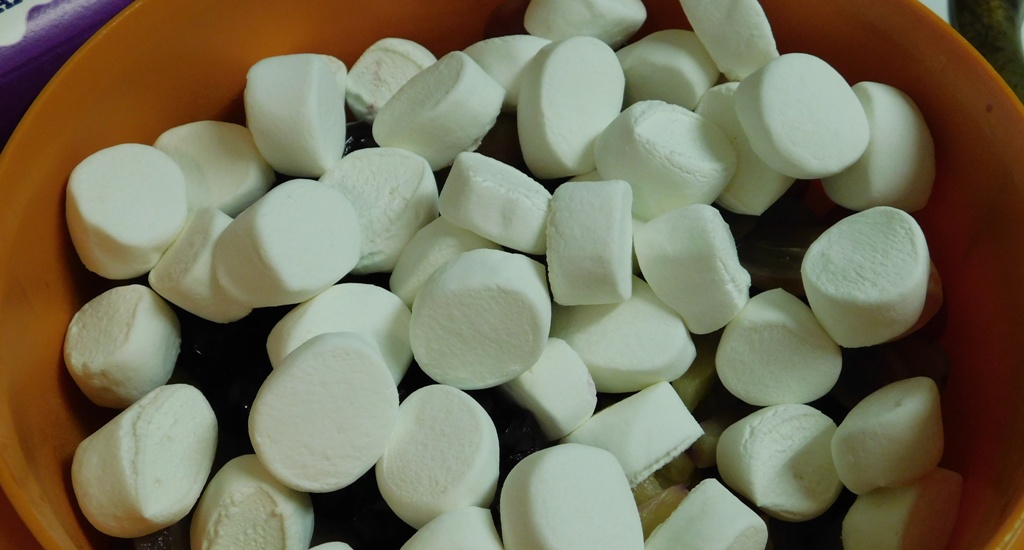
1/2 lb. (24 count) regular-size marshmallows, quartered (or halved)
juice of half a lemon (fold in with the rest)

When fruit ingredients are ready, and collected into a big bowl, and when dressing custard is cooled, whip the heavy/whipping cream until well-whipped. Add the custard/dressing to the fruits, then fold in the whipping cream. Let it stand in the refrigerator for 24 hours (this is an important step).

Serve on lettuce, as a salad, or in dessert dishes as a dessert.

Yield: about 2½ quarts.

Julie’s notes:

Mrs. Crawford noted that, in order to divide the labor, she sometimes would cut up the fruit the day before, then make the custard and whipped cream the second day. “It doesn’t seem like such a long process when divided up.”

Why do you need to buy canned sliced pineapple, and then cut it into smaller pieces? Why not just buy pineapple tidbits? . . . Well, do what you want, but you get prettier pieces, and fewer little blobs of pineapple fragments, if you cut them yourself with a nice sharp knife. (Your knives are sharp, right?)

Also, as I mentioned above, you can freeze this and give it to people frozen; they can decide when to thaw it and enjoy it.

This recipe dates back to the days before they made "mini marshmallows." So you have to buy "regular" marshmallows and cut them! Okay, use mini marshmallows if you want, but quartered or halved "regular" marshmallows are much more fun to eat.

How do you know when the custard is thickened? . . . You will know; it may take a while, but when it thickens, it will happen quickly, and you'll know.

Finally, regarding the canned fruits: in the 1950s, all the canned fruits were in heavy syrup, so that’s the kind I suggest. But use what you want. Although not overly sweet, this isn’t a low-calorie dessert, so avoiding heavy-syrup in the pineapple probably won’t make a big difference.

And what can you do with the syrup you’ve drained off? Here’s an idea: put it in a saucepan, add sugar, maybe also a cinnamon stick, and simmer to reduce it to a bona fide syrup. With the syrup/juice from the canned sweet cherries, the syrup will be pretty purple. You can use this syrup for pancakes! Or, you can add brandy to the syrup and put other canned fruits in it: brandied fruits; great on ice cream!

Friday, December 24, 2021

World's Best Fruitcake!

Maybe you’re thinking, “Ew, I hate fruitcake.” Too bad for you! Because with an attitude like that, you’ll miss out on something spectacular.

Today I’m celebrating a genuinely superlative fruitcake. The kind to swoon over. The kind to completely hide from people who “don’t like” fruitcake (pearls before swine) . . . and the kind to hide from people who like fruitcakes, too (’cuz no, it’s mine, all mine!). The kind you hide from everybody, because you want every crumb for yourself.

. . . To savor.

We are so happy to have an annual cross-continent gift exchange with our dear friends Steve and Sherri, who live in Seattle. We send them an assortment of my homemade cookies, and they send us one of Sherri’s homemade, made-from-scratch fruitcakes.

It’s totally not a fair exchange. What Sherri sends us is far, far beyond my feeble cookie gifts. (Sherri? Me dilettante, you master.)

I remember the few winters we spent together as neighbors in Montana. Steve and Sherri lived next door to us in an elderly duplex in Helena, midway between downtown and the capitol complex, the last house on South Raleigh as it ascended Sugarloaf Hill. I’ve never had such fun neighbors. One winter, after endless bitter cold, it finally, albeit prematurely, got up above freezing. At almost the same moment, Steve and I both emerged from our respective front doors, glanced at each other, and laughed at each others’ shorts. Look, it’s a heat wave! Steve grinned and purred, “Ahh, another balmy day in beautiful Helena, Montana!”

They are epicures, and they don’t take life too heavily. Steve mountain-biked all over town as well as in the nearby mountains. Sherri created lovely, elaborate dishes, apparently with complete ease, and the four of us had many meals together—often in our shared backyard, or on the front porch, with its gorgeous view of the sunsets behind Mount Helena.

Well, one winter, Sherri decided to put her formal culinary training (yes!) to use in making fruitcake from scratch.

Do you have any idea what that means? It was days in the making, because she candied her own fruit! Orange and lemon peel, apricots, pineapple, pears, cherries, you name it. Their apartment smelled like magic after Sherri spent whole days simmering fruits in sugar syrup. And Sherri used perfect, fresh, whole nuts—hazelnuts, almonds, walnuts, you name it. And luscious prunes, figs, and dates. All this was in preparation for the actual construction and baking of the cakes.

These are works of art. There’s just enough cake batter to hold the gorgeous, colorful, translucent fruits and nuts together. If you slice it thinly enough, it looks like a stained glass window.

It really does.

And the flavor. Mercy!

I’ve been meaning to write again about fruits at Christmas, and how our parents and grandparents, and everyone before them, considered fruits at Christmas a real treat. It wasn’t that long ago that you couldn’t get all kinds of fresh produce in midwinter. Winter was for cabbage, meat, and potatoes, over and over again. So dried fruits at Christmas were a treasure. They were expensive. Apricots, pears, apples, plums, cherries, grapes, strawberries. And fruitcakes celebrate that.

And so I celebrate fruitcake, specifically Sherri’s fruitcake, which we’ve been enjoying annually for several years now. Sherri, you’ve perfected it. In our humble opinion, you could serve this to the queen. You could sell this for about a million dollars. Nobody does it better. You rock.

So on December 25, once again, breakfast will be a slice of Sherri’s beautiful, precious fruitcake and coffee. Maybe the coffee will be elevated by a little Bailey’s Irish Cream, or Kahlua, Grand Marnier, or some such. It’ll have to be good to pair with the fruitcake.

Merry Christmas!

P.S. This year Sherri also sent us some homemade plum chutney! Her modest little comment on the card noted that the chutney was from their plum tree and that it is “pretty good with some blue cheese on a cracker.” . . . “Pretty good,” she says. When Julia Child or Jacques Pépin says something is “pretty good,” it’s time to sit up and take notice, because to us mere mortals, it means, “Try this, it’ll knock your socks off!” I can’t wait!

Thursday, December 23, 2021

Fruitcake Bars

I haven’t been posting much because my evenings have been filled with elvish baking projects! Like I’ve been doing for years now, I made a bunch of Christmas cookies and gave them as gifts this year. Many of my recipes, especially the oldtime family favorites, make dozens and dozens of cookies (even when I quarter the recipe!). But here’s one that makes a smaller amount.

On the “up” side, they are completely delicious, AND they ship well. I love these.

This is not one of my traditional family favorites, passed down through the ages. It’s one I’ve acquired and added to my annual list because “I make these for me.”

They are fruitcake bars. I begged the recipe from Marilynn Keil, who at that time was the longtime executive staff assistant at the University of Missouri Press. (She was the kind of executive staff assistant who truly ran the whole operation. You know the type: soft-spoken, but she knew more about everything than everyone else put together. These days, we call them “unicorns” because they are often believed not to exist in real life.) Anyway, she had brought in a batch to share with us at the press. (Yes! “And she brought cookies!” . . . Can a single human being be any more awesome?) She had gotten the recipe from her mother, Marge Ball.

After a bit of internet searching, I found that her mom must have adapted the recipe from the venerable Maida Heatter, who included a nearly identical recipe in her famous Maida Heatter’s Cookies, now a classic cookbook. I’ll bet her mom owned a copy.

Apparently, Maida Heatter’s original, published version is different, as it apparently suggests, for the candied fruit, a mixture of red or green candied cherries, candied pineapple, and/or the mixed candied-fruit blend you can get at the store. BUT because Marilynn’s mom suggests dried, not candied fruits, specifically pineapple and apricots, it really changes the flavor. I think it must be for the better.

Hold on—I can hear you saying, “EW! Fruitcake!!! Blechh!!!” But no—seriously—these are excellent. Addictive. I have to slap my own hand to keep from gobbling these up and having to make a second batch for gifts.

If you follow Mrs. Ball’s version, you’ll use dried, not candied fruit, which is what so many people object to. Many people strongly dislike the commercially available candied fruits made for home baking. (I also urge you to reflect on what it is about “candied fruit” you dislike. Chances are, you’ve only had the preservative-laden, garishly colored stuff from the grocery store. But if you make your own candied fruit, or buy from a boutique maker, or purchase—ooh-la-la—what les français call “les fruits confits,” you’ll realize that candying fruit is a fine art, an ancient art, and one well worth pursuing.) Here in America, plain dried pineapple and apricots are readily available and high quality. So like Mrs. Ball, let’s use those.

I’d also like to add that I’ve been making these for years, now, and I’ve heard no complaints.

These are easy, rather healthy, and an excellent “fix” if you’re longing for some fruitcake but don’t want to commit to making an entire loaf. They also look pretty on a cookie tray, especially dusted (or as I do, drenched) in powdered sugar.

I’ve edited it slightly.

Thanks, Marilynn. I hope you’re having a lovely Christmas season! I miss you.

Fruitcake Bars

  • 1½ cups walnuts, broken into pieces
  • 1 cup raisins (I use a combination of golden and dark —JS)
  • 1 cup pitted dates (in large pieces)
  • 1 cup candied or dried fruit (a combination of dried pineapple and dried apricots is good) (— YES! —JS)
  • 1 cup flour, divided (¼ cup + ¾ cup)
  • 4 eggs
  • ½ tsp. salt
  • 1 cup packed brown sugar
  • 1 tsp. vanilla
  • finely grated peel of one large orange (I use a microplane zester; you only want the orange part, not the pith —JS) confectioner’s sugar (optional)

Preheat oven to 325 degrees F. Combine all fruit and nuts in a large bowl, sprinkle with ¼ cup flour, and toss till coated; set aside. In a smaller bowl, beat the eggs just until blended; add salt, brown sugar, and vanilla; and stir in the remaining ¾ cup flour until blended (use wire whip). Stir in the orange peel. (The batter will be thin.) Pour the batter over the fruit/nut mixture and blend well. Spread in a greased ca. 10 x 15 x 1 inch (jelly-roll) pan; bake in 325-degree oven for 30–35 minutes or until golden brown on top. Halfway through baking, swap it end-for-end to ensure even baking. Cool in pan. With a small knife, loosen the edge, cut into small bars or squares. Can dust with confectioner’s sugar, before cutting, if desired. Or you can roll/coat individual cut bars in confectioner’s sugar. Store in an airtight container. These ship well.

Sunday, August 15, 2021

Grandma Schroeder’s Peach Kuchen Recipe

Here is the venerable kuchen recipe from my grandma Edna Schroeder. It’s a family favorite; every time I make it, all the Schroeder-clan people ooh and ahh. I grew up understanding that a kuchen was a special, special thing.

From my youngest age, I remember our family going to visit Grandma in Jeff City, and if she’d made a kuchen, there’d be excitement (which Grandma herself helped to generate): “Look what I made for dessert!” “Ooh, a kuchen! What kind is it?” “Peach!” “Oooh, a peach kuchen, I can’t wait!” . . . If it was a larger family get-together, each group to arrive would go through the same ritual, so I often heard it numerous times in a day, as my uncle and aunt and cousins arrived, as Marie arrived, as anyone else came. “Look, Mom made a kuchen!” “What kind?” “Peach!” “Oh, boy!”

Apparently Grandma never wrote down the recipe, but fortunately my Aunt Carole made notes one day as Grandma was making it. I’m not much of a baker, but I’ve been plugging away trying to master this recipe for a few decades (hard to master when I don’t make it very often). But even when I’m not personally satisfied with the texture, it has always tasted incredibly good.

First, let us review our German. In German, Kuchen means “cake” or “something baked,” so the word applies to a huge variety of Germanic baked goodies. Think of how we use the word “cake” for a wide range of dishes—pancakes, birthday cake, cheesecake, crabcakes, sponge cake, coffee cake, angel food cake, pound cake, fruit cake . . . This explains why your German grandma’s kuchen is nothing like my German grandma’s kuchen.

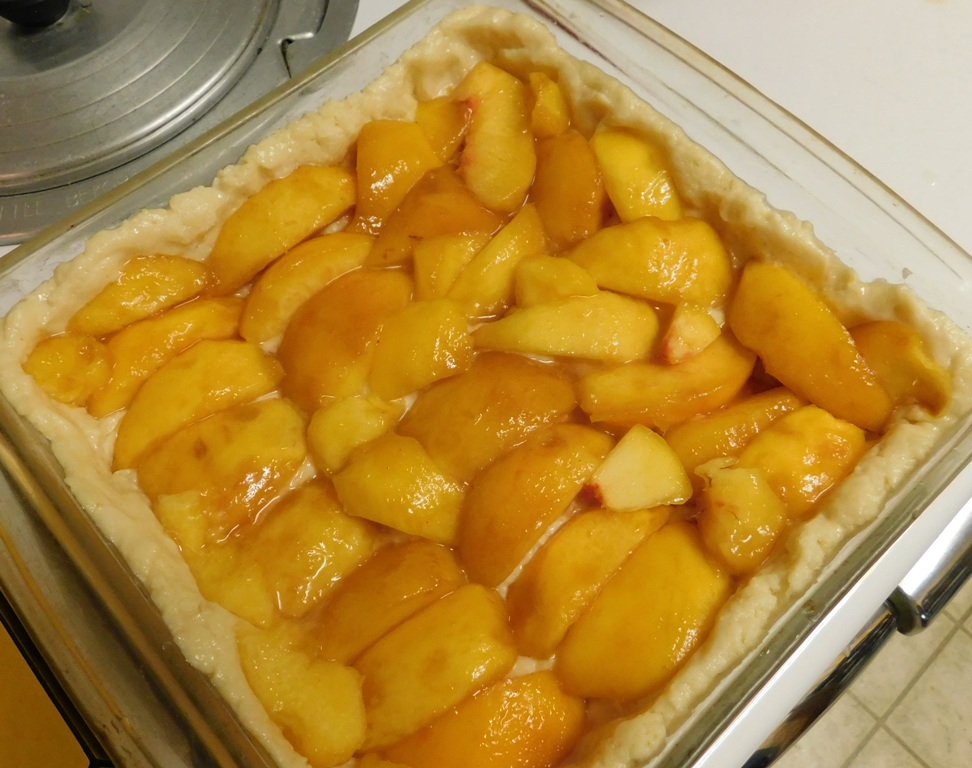
Well, Grandma Schroeder’s kuchen is like this: it has a shortbread-cookie-like “crust,” which is topped with fresh fruit lubricated with a gooey custard matrix and baked; when that is fairly set, it is topped with meringue and browned. (The meringue topping explains why the type of fruit is always a mystery; you can’t tell what kind of fruit was used just by looking at it.)

This is a wonderful way to celebrate whatever kind of fruit is in season. Right now, the peaches are perfect. Lovely, sweet, divine peaches. So we’re making a peach kuchen in this post.

A typical serving of this dessert (or coffee cake) is a 3 x 3 inch square (so, 9 servings in a 9 x 9 inch baking dish). I often stretch this out, using more fruit and meringue, to a 9 x 13 inch size, for groups.

The biggest challenge I usually have with this recipe is getting the center of the fruit/custard portion to bake firm enough to have meringue spread over it, without also overcooking the crust. This recipe can (and should) use a variety of seasonal fruits, so the juiciness can vary a lot. Therefore, I advise reducing the amount of custard for juicy fruits like peaches—just drizzle it on, but don’t force yourself to pour it all on, if it will make a pool of “soup” in the middle. I have the best results with sliced apples (apple kuchen)—where the fruits are somewhat dry.

The final result should have, at the base, about ½ to ¾ inch crust/cake; then about ¾ to 1 inch of fruit, within a gooey matrix of custard; then, on top, about ¾ to 1 inch of meringue. The corner pieces will have the most cake; the center pieces will be the gooiest.

Grandma made all kinds of kuchens, depending on what was fresh—Concord grapes, plums, blueberries, peaches, and combinations of these. Dad says Grandma never deseeded her Concords; she just put them in whole and let people chew on the seeds(!) My own variations have included a banana kuchen with peanut butter in the crust (recipe is here), and a kuchen with sliced tart apples plus big golden raisins that I’d soaked overnight in vanilla–infused cognac. (Grandma would’ve loved that one!)

I have seen what are apparently very “authentic” German recipes for plum kuchens that skip the meringue and are much flatter and more spread out. These are made in 9 x 13 baking dishes or cookie sheets. The plums are washed, halved, pitted, and placed on the crust in a decorative, overlapping pattern. Some type of glaze (sometimes heated-up jam) is drizzled or brushed over the top, then it’s baked, and that’s that. You can find several recipes for this plum kuchen (Pflaumenkuchen) online. You can certainly do that with this recipe, simply omitting the meringue and making a wider, flatter dish.

The base of the kuchen, in many recipes, is made with a sweet yeast dough (similar to that used for cinnamon rolls), but that’s not the way my grandma made it.

By the way, we always assumed that Grandma’s kuchen was a recipe she learned from her mother, who immigrated from Germany, but I found a very similar recipe in a cookbook that my Grandma used in her high school Domestic Science (home ec) class. Indeed: that particular page of her book (p. 412) is firmly adhered to the facing page by hundred-year-old, dried-up cooking goo. (I didn’t dare try to peel the pages apart; instead, I found a scanned version of the book online.) Some of the many kuchen dough recipes and variations in that book are very similar, too. So perhaps Grandma learned this recipe from her high school cooking text, The Settlement Cook Book, 11th ed., 1921. (Digitized versions of several editions of this book are online at the Hathi Trust; here’s a link to the 1921 edition.)

So here you go, another family secret unveiled . . .

Grandma Schroeder’s Peach Kuchen Recipe

Overall ingredients list:

  • 2 + ¼ cups flour (divided)
  • 2 tsp. baking powder
  • pinch salt
  • ½ + ½ + ½ cup sugar (divided)
  • ¾ stick butter
  • 4 eggs (divided: 1 beaten; the other 3 separated)
  • ½ + ⅓ cup milk (divided)
  • 2–3 cups fresh peaches, sliced (or other fruit)
  • ½ tsp. vanilla (optional)
  • ¼ tsp. cream of tartar

1. Make the dough. Combine the following:

  • 2 c. flour
  • 2 tsp. baking powder
  • pinch salt
  • ½ cup sugar
  • ¾ stick butter (it helps to use a pastry cutter and rather softened butter)

. . . then, add 1 beaten egg and enough milk (about ½ cup) to make it the consistency of cookie dough (e.g., rather stiff and sticky).

Spread the dough in the bottom and slightly up the sides of a 9 x 9 inch baking dish (Pyrex is good); with the dough so sticky, I spread it with moistened hands.

2. Make the custard. Separate the 3 eggs (reserving whites for meringue); beat together the 3 yolks, add ⅓ cup milk, ½ cup sugar, and about ¼ cup flour. This is for the custard matrix for fruit: depending on the juiciness of the fruit, consider making less, or using less milk, or including a whole egg instead of a couple of the yolks. (I usually make the full amount of custard; then whatever isn’t drizzled over the fruit in the kuchen I pour over additional/extra fruit in a couple of single-serving ramekins and cook in a bain-marie as a fruit custard.)

3. Fill the kuchen. Spread approx. 2–3 cups fresh fruit (sliced peaches, or whatever) evenly over the dough. It helps to gently press the fruit down into the kuchen; the crumb will raise and puff up, and the fruit will add moisture to the crumb. Drizzle custard on top of fruit. (See previous comment about not using too much custard—you don’t want it too full of liquid in the center.)

4. Bake at 350F for about 20–30 minutes. Watch it, because ovens vary; it’s done when the dough is cooked (browns) and the custard is relatively firm. Sometimes it never quite firms up due to the juices; it usually firms nicely with apples but rarely with grapes, blueberries, or peaches.

5. Make the meringue. This is a standard meringue recipe, as I don’t have any indication about how Grandma made her meringue. Beat the 3 room-temperature egg whites on medium with ½ tsp. vanilla (if using) and ¼ tsp. cream of tartar for about a minute (until soft peaks form); then switch to high speed and gradually add up to about ½ cup sugar; beat for about 4 minutes, or until shiny and stiff peaks form. If making meringue seems like kind of a pain, remember that Grandma used a manual rotary eggbeater.

6. Finish the kuchen. You’re in the home stretch, now. Spread the meringue carefully on top; dabbing it into artistic shapes, and return it to the oven to brown the top. Let it cool gradually. Store it in the refrigerator.

If it falls apart when you cut it, who cares? It's delicious! And I'm sure you'll love it.

. . . My people do.

Thursday, September 17, 2015

Head to 4M Vineyards—It’s Concord Time!

Oh, joy! The concord grapes are ready at 4M Vineyards! You can buy 3-lb. boxes, 20-lb. half bushels, and 40-lb. whole bushels of them at excellent prices through about the end of October. (The grape season usually starts in early to mid August and extends into October.)


Most people make jelly or juice from concords, but I like to make them into grape pies, tarts, and kuchens, and “pickled grapes” (which is really a spiced grape jam, akin to pickled peaches). The latter is a favorite of Dad’s.


Right now, I’m giving you links to 4M’s website and Facebook page—look at those for official info and updates on what’s currently available.

During grape harvest season, they’re open 7 days a week, 9 a.m. to 6 p.m. When it gets to be late October and the grape crop is finishing, to make sure to call ahead to make sure they’re open: 573-265-3340.

Once there’s a hard frost, that’s the end of the grapes: 4M typically has them available for about a week after the frost, but then that’s it. So call ahead if it’s late October.


4M Vineyards and Farms is located at 20670 State Route KK, which is 4 miles east of St. James, Missouri. Where they’re at, Route KK, actually old Route 66, runs along the south side of I-44 like an outer road, and 4M and some of its vineyards are plainly visible from the interstate.


If you’re on I-44, get off at the Highway 68/St. James exit, go south, and turn left (east) at the first stoplight (James Blvd., which becomes Route KK). (Often, people actually park on the shoulder of the interstate and walk up the grassy slope and across Route KK, but that’s not recommended!)

This, by the way, is the Ozark Highlands/St. James/Rosati grape-growing region of Missouri, a distinct American Viticultural Area (appellation) designated by the U.S. government (TTB). For more about that, visit the St. James Winery on the north side of the interstate.


Okay: Of all the places to purchase grapes in Missouri, why am I telling you about 4M Vineyards?

Because they’re the real thing, they’re local, they’re friendly, and their products, though unpretentiously presented, are deserving of the highest praise. It’s been a family business since 1984. My blog has always been about things like that.

One look at 4M’s annual letter and price list says it all. (Seriously, click on the link, and you’ll find an informational, entertaining announcement about 4M Vineyards’ progress and offerings this year. You’ll especially enjoy the story of the grapevine-chomping deer, the air cannon . . . and the neighbors!)


I love 4M Vineyards, and I deeply admire Mike and Jody Rippelmeyer, who own it. There are incredibly good reasons why their vineyards are expanding, why their preserves and baked goods are so delicious, and why a visit to their market is so pleasant.

We always make an annual trip to 4M! It’s worth it. I need my nice big box of concords!

I process (deseed) grapes in 3-cup batches, put them in quart-size freezer zip bags, and freeze them—each is enough for a pie or a kuchen, or a pint or so of pickled grapes.


But at 4M, we can also start our Christmas shopping: They sell a glorious variety of homemade jellies, jams, and other preserves that you can’t purchase just anywhere. Think how much your impoverished friends who live in big cities will love these goodies!


I mean, seriously! Here is a PARTIAL list (partial, because I ran out of room on my notepad!):

  • Apple butter; amaretto apple butter
  • Blackberry jelly
  • Cantaloupe marmalade
  • Catawba grape jam and jelly
  • Concord grape jam, jelly, and juice
  • Corn cob jelly
  • Cucumber pickles (various kinds)
  • Elderberry jelly and jam
  • Green tomato chutney
  • Jalapeno jelly (several kinds)
  • Niagara grape jam and jelly
  • Pear jelly; pear honey
  • Pineapple jelly
  • Pumpkin butter; pumpkin pie jelly
  • Relishes of various kinds
  • Salsas of various kinds
  • Tomato jam and jelly
  • Wild plum jelly and jam
  • Wine jelly (this is incredibly delicious!)
  • Zucchini pickles (various kinds)

—Wowsa! Doesn’t that sound tempting? Their shelves and shelves of preserves make me feel proud, and I didn’t lift a finger. And yes, they have samples for you to try.


And they make these goodies themselves—this isn’t just shipped in from Pennsylvania or someplace.


They also sell homemade banana bread, zucchini bread, pumpkin bread, and apple chip bread. (Just typing this, my mouth is watering.)

And they also make and sell grape pie—which is my favorite kind of pie. Not many people in Missouri make grape pie, but it’s well worth the extra effort. It is not only exquisitely delicious, but also a joy to behold, being a glorious, deep, royal purple.

Local honey and low-priced, top-notch fresh fruits and vegetables round out the edible bounty.

There’s also a fun selection of antiques and collectables, with an emphasis on cooking supplies. (Christmas is coming; and you know you could always use another cookie sheet, baking pan, or casserole dish!)


And although they don’t make and sell wine themselves, they sell wine-making supplies, including a selection of yeasts and (of course) bulk grapes! You can buy grape plants, too.


This is the best time of year to be in Missouri, and while you’re driving around enjoying the crisp air and scenery, stop at 4M and get some concords, while they last!

4M Vineyards and Farms
21000 State Route KK
St. James, MO 65559
573-265-3340

  • Farm stand is typically open Aug. 7 to Nov. 1
  • Opening depends on ripening; closing depends on how long the crop holds.
  • Call ahead in early August or late October, to ensure they are open.
  • Open daily, 7 days a week, 9 a.m. to 6 p.m.