Showing posts with label early spring. Show all posts

Friday, March 21, 2025

Pansies for Edna Day

This is one of the big ways we celebrate the beginning of spring here on West Elm Street: The annual planting of the pansies. This little tradition goes back eighty years to when my dad was a kid. He’d buy a shoebox of pansies from old man Hugo Busch on Dunklin and Madison for his mom’s birthday—which almost exactly coincides with the first day of spring. She would put them in her front planters, for everyone to see. Dad has written about this on his own blog, so I won’t repeat it.

This is one of the first subjects I wrote about when I started the Op Op, too. Look here for that blast from the past.

So yesterday, two days before Grandma’s birthday, I put pansies once again into the front planters. After the drab winter, the pansies, and the flowerbeds full of daffodils, are incredibly cheerful. And we need it.

My little addition to the traditional is to use a little bit of mulch, and to place crystals and interesting rocks artistically around the pansies, which helps hold the soil in place during these sometimes severe spring storms.

Each year I arrange the rocks and stuff a little differently.

As spring always does, there are chilly days mixed with warm ones. Sometimes a chilly day, though, is sunny enough to warm up our front steps, and I can sit on the steps and bask a little after work and before I make dinner. And the pansies are there to make me smile a little bit.

Here's how I arranged them this year.

Thursday, March 17, 2022

Leprarians for St. Patrick’s Day!

This post was brought to you by the color green!

St. Patrick’s Day is well-timed, as we celebrate the color green on this very late winter day. On the calendar, it’s so very close to official spring, but on the ground, we’re still not fully convinced. So we look for and relish each glimpse of green: each resurgent patch of moss . . .

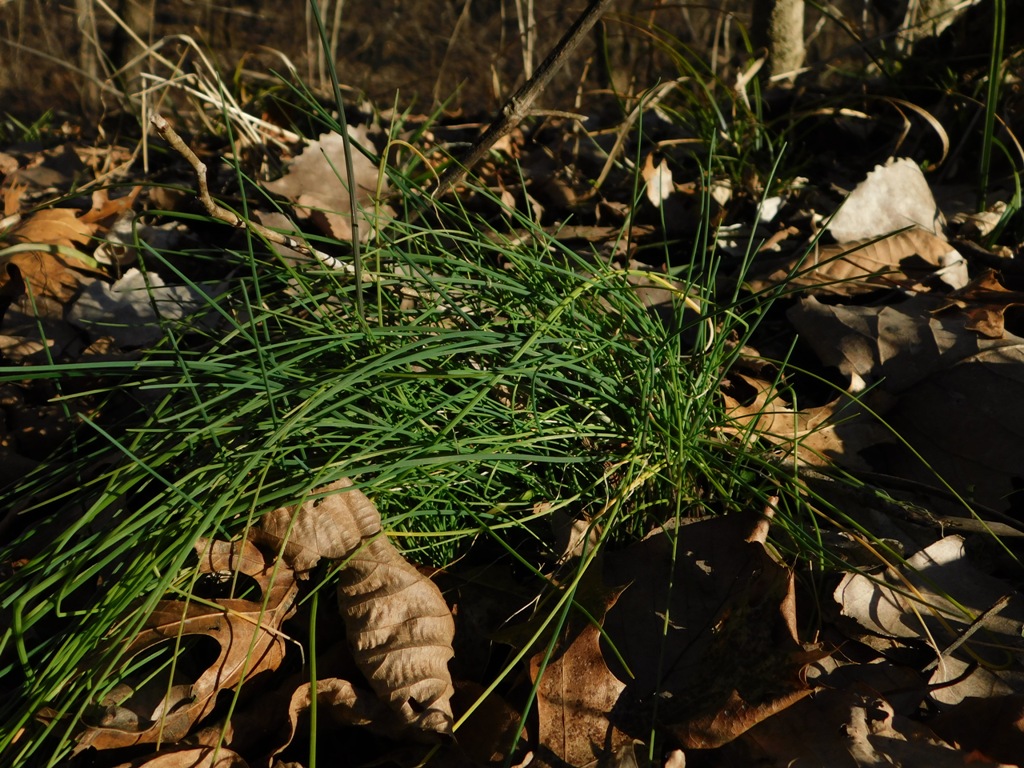
Each tuft of wild onion leaves waving around above the dry brown leaf litter . . .

Each green stink bug wandering around, warmed into activity by a persistent ray of sunshine.

This year, my favorite glimpse of green is a relatively new acquaintance: lichens in genus Lepraria, commonly called dust lichens. The leprarians I find myself spotting the most live in little sheltered nooks and crannies in cliff rocks, big boulders, or at the bases of trees. They tend to look like a minty green patch of dust, or cornmeal, clinging to the surface.

The dusty-looking granules are actually soredia—tiny ball-like packets of fungus and algae that readily break away to start new lichens elsewhere. (Remember that lichens are basically fungi that have algae living in their tissues—“fungi that have discovered agriculture.”) Missouri has something like six species of Lepraria lichens.

I like calling them leprarians, because it sounds something like “leprechauns.” And to me, they’re kind of like those small magical beings. They live in shaded, damp nooks in the woods, but they don’t live in every likely nook. There’s apparently no rhyme or reason to their occurrence. If you look for them, you’ll find one, eventually. But they’re not abundant around here, for sure. So when you see one, you go “Oho! There you are! I see you!”

Bonus fun: later in the year, once the insect world is back in full swing, you might see a small wad of lichen, less than about a quarter of an inch in diameter, wiggling and staggering around, trying to walk. It turns out there are lacewing larvae that decorate their backs with the soredia particles of lichens, and Lepraria species are one of their favorites for this purpose. It serves as camouflage for the larvae, which hunt and eat aphids. I don’t have a picture to show you, because the last time I saw one of these, I didn’t have my camera with me! But there are a number of fun videos online (such as this one) to see these curious little insects in motion.

Saturday, February 19, 2022

Forcing Violets

Are you ready for spring yet? I am.

Back in November and December, this winter was really slow to start, but now that we’ve finally started getting frozen precipitation, we can’t seem to shake it off. We finally got a big snow dump in the middle of January. Then it mostly melted, and then we got more on the first of February. Then that was mostly gone, and now we had snow again on the seventeenth. It wasn’t a lot of snow, but around here it is underlain by about three-fourths of an inch of grainy, icy sleet, which has formed a stubborn, un-shovelable layer on the sidewalks. Geez.

Each time we have gotten snow, people have dutifully cleared roads and parking lots, and we’ve shoveled our sidewalks and driveway and steps (yeah, we have lots of sidewalks, since we live on a corner). In the process, we’ve all created little hills of snow, which last forever, especially where it’s shady.

So, since the first big snow in January, we’ve never really completely gotten rid of the snow before the next dump. This has become kind of unusual for us, especially this late in the year. In fact, in recent years, the middle of February is when I start removing dead plant material from our flower beds, so the daffodils and such can come up in the clear. Because by mid-February, our daffodils are coming; indeed, the ones in front by the house are already at least four inches tall. The front of our house faces due southwest, so it’s sunbaked and amazingly warm, especially as the light and heat are reflected of the front of the house, so those daffodils are practically in a greenhouse, essentially “forced” to develop and bloom ahead of their compatriots elsewhere.

And that’s what I’m getting to: forcing flowers in springtime. It’s really popular to “force” into bloom various bulbs such as narcissus (those extremely fragrant “paperwhites,” for example), other daffodils, and hyacinths. Professionals force them in greenhouses for the trade. Go to your local grocery store floral department and you’ll see examples.

But it’s possible to force plants you find in nature, or in your backyard.

NOTE THAT I AM NOT SUGGESTING YOU DIG WILD PLANTS FROM PUBLIC LANDS OR FROM PROPERTY THAT ISN’T YOURS. . . . Please behave!

But you know . . . our backyard is the opposite of a golf course. And it’s not natural, either. Yards like ours have been called “freedom lawns,” since they’re free of pesticides, herbicides, and unnatural monocultures of high-maintenance turfgrasses. Admittedly, along with our smattering of various lawn grasses, we also have invasive star-of-Bethlehem and a variety of nuisance nonnatives and natives, such as Indian strawberry, creeping Charlie/ground ivy, field pansy, plantains, and common violets of various colors.

It’s the last one that I’m “forcing” this winter. The common violets that grow all over in our backyard develop rather coarse rhizomes at least about an inch long. As a kid digging in the soil of my parents’ backyard, I fancied these were like tiny iris bulbs, and I treasured them.

And I still treasure them; I have a hard time treating them like weeds, so when I’m working in a flower bed, such as my herb garden, I tend to pull out the violet rhizomes and transplant them elsewhere. Can’t bear to toss them into the composter. I really love violets.

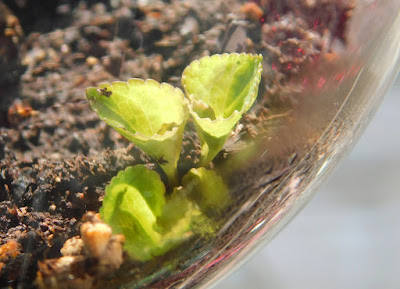
So last week, before the latest snow event occurred, I knew where to go in the backyard with my trowel to find a nice big violet rhizome to dig up. I planted it in some fancy potting soil at the bottom of a small fishbowl-shaped, bubble-ball glass vase.

I’m giving it plenty of water, and it gets oodles of sunshine in our front windows. On gray days, I stick it under an intense desk lamp.

And here’s what we’ve got so far. It’s making me happy!

And for the record, here’s where the idea came from: Leonard Hall’s A Journal of the Seasons on an Ozark Farm (Columbia: University of Missouri Press, 1980), 207.

Sunday, March 1, 2020

Spring Peepers, Coats Lane

Yesterday we went on a little excursion, just to get out of the house. We drove around at Eagle Bluffs Conservation Area, south of Columbia, just to see what we could see. Since it was kind of late in the day, we didn’t see much. What we did see, we didn’t see very well. Like this bald eagle’s nest. You can see it, can’t you?

Still, it was good to drive around and look out the windows.

We didn’t go straight home. Our meanderings, starting in McBaine, led from South Coats Lane north to Gillespie Bridge and then to I-70, which we then took to get around Columbia and back on our way to Jefferson City.

Below, I share a magical few moments of spring peepers chorusing from a farm lane off of Coats. The music exhilarated me and filled me with hope. You can’t yet tell by looking at the world, but the sound of these peepers is the jubilant sound of spring.

Thursday, March 9, 2017

Squaw Creek National Wildlife Refuge, Now Loess Bluffs National Wildlife Refuge

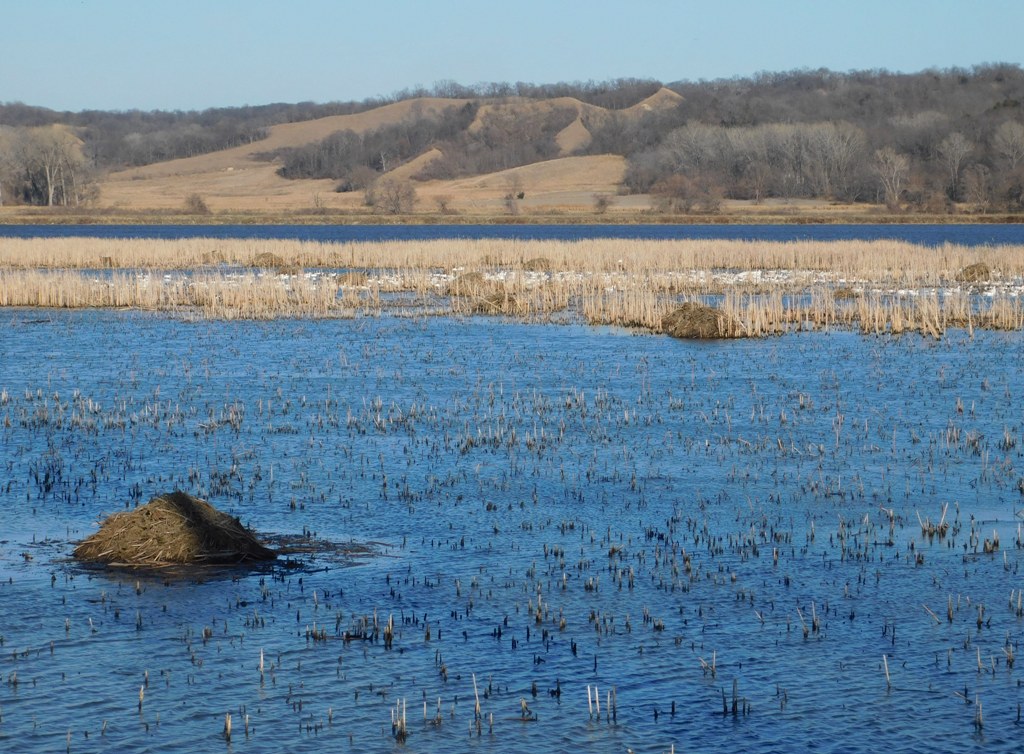
In January, the US Fish and Wildlife Service finally changed the name of Squaw Creek National Wildlife Refuge to Loess Bluffs National Wildlife Refuge. This NWR, near St. Joseph, Missouri, is now aptly named for the spectacular hills lining the refuge on the east, which are made not of rock but of loess, a kind of compacted soil made of dusty, yellowish silt that was blown into great rolling dunes after the last glacial period.


Nearby Mound City is named for the large loess hills in the area.

I hope that people aren’t bent out of shape about the name change. Sure, there’s a Squaw Creek that runs through the area, and that name hasn’t changed, but the NWR’s name isn’t exactly historic, as it goes back only to 1935, when the NWR was created.

Back in 1935, almost every American understood the term squaw to be sort of a Native American equivalent of the German frau, the Spanish señora or mujer, or the French madame or femme. Obviously, no one meant it as a derogative term because they had no idea it had such connotations. People probably thought they were honoring Native American women by naming the creek and later the refuge after them. I hope that in the future, people don’t look back and think that people who used the word squaw were being disgusting, insensitive, insulting. They simply didn’t know about the original meaning of the term. In fact, through their longstanding, benign use of the word, you can argue that they gave it a new, non-insulting meaning.

But finally, Native Americans made it clear to us other Americans (immigrants and children of immigrants, all of us), that squaw was for them a deeply offensive term, used for part of a woman’s private anatomy, so ever since then, place-names of lakes, mountains, trails, and so on, that had long used the word, have been changing.

And it’s a good thing! Some people might grouch and moan about “political correctness,” but I’m convinced it’s simply about being gracious and respectful of others’ feelings. Why continue using a word, a name that essentially insults someone, when we can use a new name that is better, anyway?

So now it’s the Loess Bluffs National Wildlife Refuge. And who knows how to pronounce it? Ha-hahh! Hopefully the people in northwest Missouri have already picked out a pronunciation they can live with, whether it’s “luss,” “less,” or (definitely the weirdest choice) “low-ess.” These are Americanized pronunciations, however, of a German word with a vowel sound we don’t make in English, the German “umlaut o” (spelled ö or oe).

It’s a mix of the vowels “ee” (or “eh”) and “ohh.” In a nutshell, you say “ee” (or “eh”) with your tongue, inside of your mouth, and you say “ooh” with your lips. Try saying “oh” with your lips, rounding them, but position your tongue as if to say “ee” (or “eh”). (Here’s a fun explanation of German umlaut sounds.)

French coeur, German Goethe, and my own surname use the ö/oe sound.

So after listening to these examples, you might start saying it more like “lurse” or “loorse” (light on the r’s, in both cases). I have been trying to pronounce “loess” correctly for about as long as I’ve been able to talk, since my dad is a physical geographer who specializes in Missouri landscapes, and he always taught his students (and my brother and me) how to say loess the original German way. Loess! Loess! Loess!

So! On Saturday, we drove up to the northwest corner of the state not to see the Loess Bluffs National Wildlife Refuge, particularly, but to see the birds taking refuge on it! And what a treat it was!

The big show, of course, was the snow geese, which were so numerous as to look like, yes, large areas of snow. Like, 28,000 of them. (In previous weeks, there’d been as many as 283,000 of them!) White and blue forms. I’ll bet there were some Ross’s geese among them, but picking them out would have distracted me from the main attraction: their multitudes.


Occasionally vast numbers of them would rise and fly off northward, an overwhelming chorus of their thousands of high voices. They were getting a nice brisk tailwind from the south!


They vanished into the whiteness of the northern sky. But there were still thousands left in the wetlands.


We saw lots of other birds, too, of course. There were plenty of Canada geese around; they seemed to love standing on top of the many muskrat homes that poked up out of the water. This one was all “honked off” at something—looking at it through our binoculars, we could see it hissing at something below it, then turning around and complaining the other direction.


Other birds that we saw (in the afternoon) included several trumpeter swans, American white pelicans, mallards, northern shovelers, blue-winged teal, gadwall, American coots, killdeer, common grackles and red-winged blackbirds (but unfortunately we didn’t see any yellow-headed blackbirds, but I certainly looked), and my favorite sight of the day, a female belted kingfisher that was hunting for fish. (Yes, in Squaw Creek itself, so see? It pays to take your eyes away from the vast wetlands and look all around.) Sorry, no pictures of her.

Sue, of course, was the one who first spied the kingfisher. As we watched, the kingfisher flew down to the water and captured a fish. (Judging by the shape, I’m betting it was a green sunfish or something similar.) She flew with it to a nearby wood duck nest box, perched atop the box, and started the process of swallowing it. True to form, she smacked it on the box a few times to subdue it, then got it flipped around so it would go down headfirst (the smooth way).

This was the weekend of Columbia’s True/False film festival, (or as some of my friends who work at restaurants and bars call it, “Hipster Christmas,” “Hipster Homecoming,” or the “Bunning Man” festival). Why would anyone want to be cooped up in a dark movie theater when they could be out watching these miracles of nature? Oh well. Maybe people don’t know you can see these amazing sights for free. Or maybe, because it’s free, they don’t value it as much as something you have to buy a ticket for?


Anyway, during one particularly large and raucous liftoff of zillions of snow geese, we noticed that a few non–snow geese were caught up in the excitement of the crowd. Amid the multitudes of basic sameness were a few different shapes, different wing-flapping patterns: One was a blue heron, and the other an adult bald eagle.

Well! That made our day! Can you pick out the eagle in this photo? (Remember you can click on these pictures to make them bigger.)


It was also great fun to watch some of the muskrats.


One sat on a completely muddy area amid dried cattails near a muskrat home and groomed itself for several minutes. I kept thinking, Dang, with all this mud, it must be a never-ending chore for them to try to keep clean!

As with so many other rodents, you can’t help thinking it’s really pretty cute-looking. Look at the little fist this one made with its left hand while it worked to clean its right arm.


Yeah, pretty cute, huh?

Well, it was a very memorable day. We need to keep going out and seeing these sights. What a beautiful and fantastic world we live in!


Saturday, March 12, 2016

Springtime Crayfish Happiness

Okay, here’s a real “Opulent Opossum” subject for you: the glory of crayfishes in early spring! Plus, the Missouri Department of Conservation has just published a new booklet to help you learn to identify our state’s 36 crayfish species!


Chris Riggert, the Volunteer Water Quality Monitoring Coordinator for the Conservation Department’s Stream Team program, headed up the project. The new booklet is an excellent introduction for identifying the state’s crayfishes—a good “jumping in” place to get you started in learning about (and thus appreciating) our beloved crawdads.


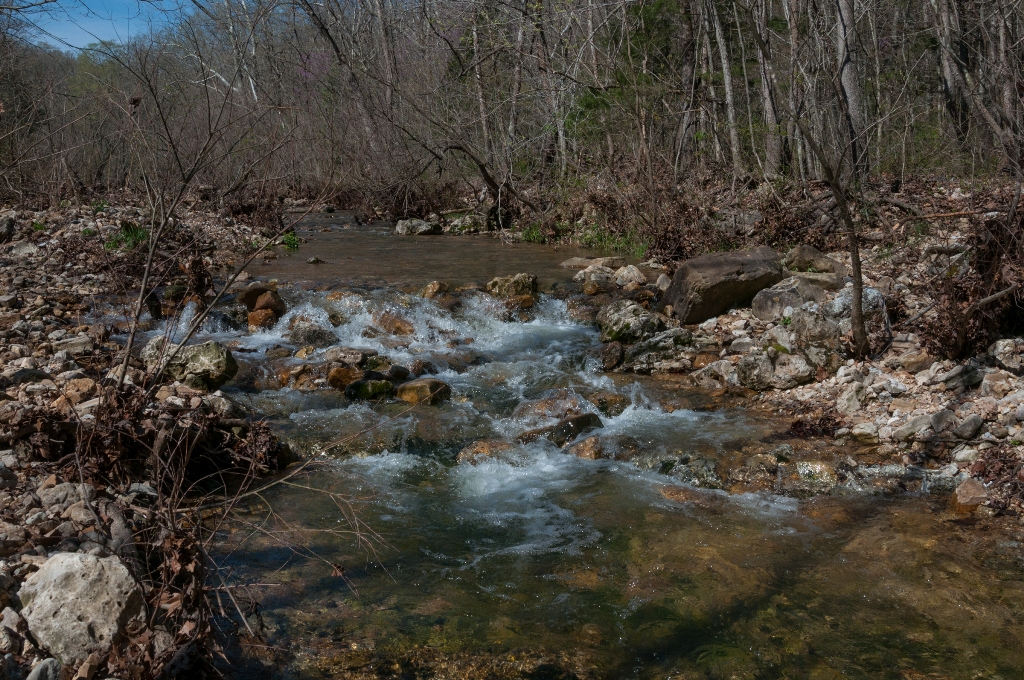
I love to see rocky creeks come alive in early spring.


In early spring, with the leaves still off the trees, light penetrates through the bare branches of the forest canopy and shines on the creekbeds. This light creates a short-lived “bloom,” first, of a matlike brown algae (I think it’s a diatom), and then of a wispy filamentous green algae—like flowing green tresses, wafting in the current. That algae is to creeks what bloodroot, trilliums, and spring beauties are to the springtime forest floor.


And though the water’s pretty cold, it’s no longer frozen, so the animals start getting active. I have spent hours and hours by streams, watching the snails crawl around on the rocks, minnows glide and dart hither and thither, and crayfish explore the miniature aquatic caves and canyons.


It’s our midcontinent version of tidepooling, and it’s a fun as all get-out.


Last weekend, when we had some really nice weather, Sue and I visited Clifty Creek Conservation Area (which is fast becoming my favorite hikin’ place; click here for the MDC web page on it).


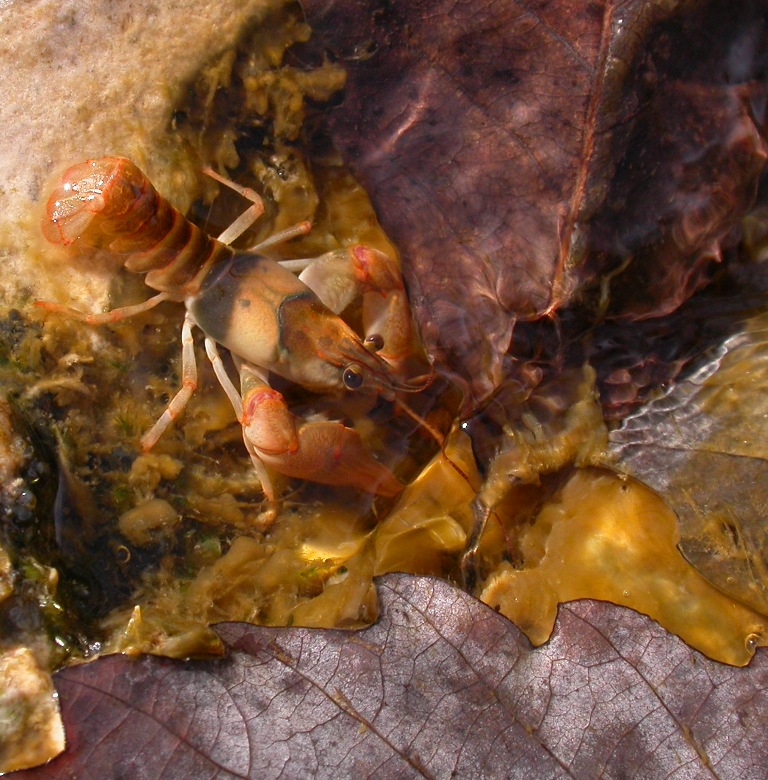
When we were there, we saw lots of golden crayfish (Orconectes luteus) scooting around in that crystal clear water. They were nearly all about one and a half inches long.

See?


One of the things that the new MDC brochure (and their other printed crayfish publications, and the online Missouri field guide) emphasize is that crayfish identification involves more than just colors, spots or stripes, and body shape. First, you narrow your search by habitat and geographic range.

Although a handful of our crayfishes are found nearly everywhere, most are restricted to certain parts of the state, and certain watersheds within those regions.

Some crayfish species occur only in the glaciated and unglaciated plains of north and northwest Missouri, where they live in streams that are rather sluggish and turbid, or where they tunnel clear down to the water table in prairies. Others occur only in the Ozarks, where the streams tend to be clear, brisk, cool, and rocky. And others are found (in our state) only in the Bootheel, where swamps and ditches prevail.

And within those broad ranges and habitat types, many crayfish species are confined to certain particular river drainages. An example is the Neosho midget crayfish, which occurs only in the Spring River and Elk River systems, so in our state, you probably won’t find it anyplace besides our far southwestern corner.

So if you want to identify a crayfish, first, identify the region, habitat, and watershed, and then start looking at the color, the spots or stripes, and peculiarities of pincer shape and so on. The new brochure organizes our crayfishes by location: Ozarks, Prairie, Lowland (Bootheel), and Statewide, and each entry has a distribution map showing watersheds, which helps you immediately narrow down your search.

This, by the way, is the same situation when you’re trying to identify fish, particularly minnows and darters, which are also numerous and diverse—unless you know where they’re from, they can be kind of a pill to identify to species.

I love being able to identify plants and animals. It’s not so much that knowing the name has some kind of magic (though it helps me remember)—it’s that the process of identifying forces me to look, really look, at the organism, and see things I might not notice before. That’s the value; that’s the fun.

For example, did you know that one of the keys to identifying crayfish can be the shape of the rostrum? Crayfish bodies are quite different from ours, so you have to learn a little “Crayfish Anatomy 101.” The rostrum is the triangular little beaklike structure between the eyes. It’s shaped differently in different species of crayfish—pointier or less pointy, long or stubby, ridged or furrowed (or furrowed with a little ridge within), with or without spines flanking the tip . . . Isn’t that fascinating? Now, you can really see it!

Anyway . . . these and many other thoughts pass through my mind as I peer into a creek like Clifty, watching the crayfish explore like little armored vehicles among the rocks and crannies. Crayfish happiness!

It’s my happiness, too.

Do you want a copy of this nifty booklet? It’s hot off the presses, so it hasn’t been promoted much yet. Send an e-mail to pubstaff@mdc.mo.gov, and ask for “A Guide to Missouri’s Crayfishes FIS011.”


Tuesday, February 17, 2015

Arizona Dreamin'

I'm still thinking about the weather. It's grim out there tonight. Sharon Ray (my Sharon Ray!) is predicting wind chills near -1 by 2:00 a.m., and -5 to -10 tomorrow morning. Winds gusting to 25 mph. And then there will probably be a fresh round of "wintry mix" right before the weekend. Brrr!!!

So I will take this opportunity to show you a picture of what Sue and I saw only last week. On Saturday, February 7, we were in Tucson, Arizona, where it was in the low 80s, sunny, and pretty near perfect. Blue skies. Things were blooming. Springtime in the desert!

It was that kind of dry warmth that makes the Sonoran desert so perfect in February. You can wear long sleeves or short, or slacks or shorts, and still be comfortable. You'll want a little jacket at night, just because it cools down so nicely after dark.

So, here's a picture of Saguaro National Monument. Just to let you know: If we ever pull up stakes and disappear without warning, this is probably where we'll be.


(Yes, Sue took the picture. Thanks, Sue, for sharing it! Y'all, you can see it bigger, and see more detail, if you click on it.)

Thursday, March 6, 2014

Journeys Around the Sun: Leonard Hall

In my previous posts, I talked about natural history books that have an almanac structure: Edwin Way Teale’s A Walk Through the Year, Hal Borland’s Twelve Moons of the Year, and Aldo Leopold’s A Sand County Almanac. Today, I’m continuing in the same vein, with a book of special interest to Missourians. You probably haven’t heard of this author.


Leonard Hall’s A Journal of the Seasons on an Ozark Farm (1956; reprint, Columbia: University of Missouri Press, 1980), like the other books, is arranged chronologically, with a handful of short essays for each month. Hall wrote a regular column about life on his “Possum Trot Farm” (south of Potosi, Missouri) for the St. Louis Post-Dispatch and Globe Democrat from 1946 to 1980.


Hall embraces the conservation ethic that Aldo Leopold so eloquently laid out, and his stories of life on a working Ozark cattle farm show a sustainable land ethic in practice. The changing seasons frame the story of a year’s worth of activities and observations, including migrating geese, cattle auctions, hunting and fishing, gardening, hiking, gathering elderberries, pawpaws, and hickory nuts, and butchering hogs.

If you’re not familiar with Leonard Hall, check out his books. I particularly recommend his Stars Upstream: Life Along an Ozark River, about the Current and Jack’s Fork rivers. It’s a classic every Missourian ought to read.


Since I was inspired to write about these books by my late-winter longing for spring, and being on constant watch for signs that springtime is coming, I’ll quote a few sections from Hall’s Journal of the Seasons on an Ozark Farm.


“This is a time of year we could do without. There are gloomy days when I have a profound sympathy for those furbearers which hibernate or for the birds that fly south in autumn. But then comes a snowy morning when the earth might have just been born and the chickadee sings as if it were summer, or a mild evening when the sunset paints the western sky in vivid colors and the young calves chase each other across the pasture with tails high in the air. Then I decide that one way or another, we’ll somehow ‘make it through to grass.’” (“January: The Sun Starts North,” p. 190.)


One of my favorite signs of spring is the sound of spring peepers, tiny peeping frogs that, in full chorus, sound to my ear like thousands of little jingle bells, though they symbolize anything but Christmastime. Here’s Hall’s description:

“When the worst blizzard of winter struck the western states this week, our thermometer at Possum Trot dropped sharply and a hard wind out of the northwest rattled the shutters, sifted in through the storm sash, and set the phone wires to singing. We hurried out in the morning to have a look at the baby calves, but found them galloping about the pasture with tails high in the air as if it were summer. Then on Sunday afternoon the wind dropped to a whisper and the mercury climbed into the fifties again. After supper, when I went to make sure the biddies were safely shut up in the hen house, I heard the first spring peepers singing, down in the pond in the woods.” (“February: Spring Edges Closer,” p. 205.)


And that’s how you always hear the first spring peepers of the season. It will be some supremely welcome warmish day, and you will be walking outside in a light jacket some evening after supper. And suddenly you hear them, jingling away, in some seemingly insignificant little pond in the woods.


Of course, there’s still an excellent chance it may snow and freeze again, but I agree with Hall: “There is something optimistic about the note of the first spring peepers that braces us against the occasional spell of cold weather which may still lie ahead” (p. 206).


Here’s to the birds who are remembering their songs
and the young birds who are tuning up for the first songs of their lives;
the geese honking, winging north on the heels
of warming weather,
and stopping overnight in marshes in gabbling flocks;
and tiny frogs awakening,
slipping out of cold mud,
and perching at the water’s edge
to peep their riot of love songs.

And here’s to the reawakening of the entire green world.


Monday, March 3, 2014

Journeys Around the Sun: Hal Borland

In my previous post, I talked about a favorite “essay-a-day” natural history book, Edwin Way Teale’s A Walk Through the Year. Today, I’m continuing on the topic of almanac-format nature books.

A similar book, in a similar vintage, is Hal Borland’s Twelve Moons of the Year (New York: Knopf, 1979).


Borland wrote a weekly natural history or “outdoors” editorial in the Sunday edition of the New York Times for 35 years. This book, which he was finishing when he died, is a collection of those brief editorials—so well written . . . so well written.

I’ve been dipping into this book especially, since he writes so eloquently of our desire in late winter to look for signs of impending spring. Wasps waking and flying groggily about on a prematurely warm day. The courtship of owls and squirrels. The lengthening days. Rising sap. The hope encapsulated in the buds of trees. And the first tentative, brief bird songs.

“There are things to be heard if one is at all attentive. At noontime on a sunny day the dooryard sparrows begin to test a few phrases of remembered song. The chickadees, which will lisp a greeting any winter day, now extend their songs, simple though they are. The nuthatches still say nothing but yank, but they say it more often and with a new intonation. From the woodland the male cardinal whistles as though he really means it.

“. . . Spring is not yet at hand, but there is change, and there are subtle stirrings here and there, if we forget the calendar and listen.” (“Subtle Signs of Spring,” February 15, pp. 46-47.)


He notes a softening of the blue jay’s raucous voice:

“But when February comes and daylight begins to linger, the jays begin to feel, perhaps down in their hollow bones, that life is good and soon will be even better. They whisper this, at first, to themselves. Then they say it aloud, but softly. It is a wholly new note, actually a two-note salute to the season. It is almost musical. It really is the blue jay’s prelude to a love song, a sentimental secret the secretive jay can no longer keep to himself.” (“The Secret,” February 8, p. 41.)


It’s not going to make spring come any sooner, but reading this helps me remember that I’m not alone in looking for “signs,” and that people have always yearned for spring this way.