Showing posts with label grandma. Show all posts

Wednesday, September 30, 2026

Simple Cooked Apples and Aunt Annie

Here’s another recipe that’s really more about family. As I and my cousins and classmates have slowly become the elder generation, I’ve been sifting through, transcribing, and annotating recipes written on cards, in notebooks, on scraps of paper tucked into church-ladies’ cookbooks, on the backs of old envelopes. These are mom recipes, grandma recipes, aunt recipes, great-aunt recipes.

It’s been hard to complete this project, because I keep acquiring more of these recipes. I open up another one of their old cookbooks, and another little recipe falls out.

Then there are “recipes” that no one bothered writing down, because they were so standard, so simple, or so memorized they didn’t require it. But as I think back to how we used to eat, and compare it to how we eat today, I find I want to include these dishes.

This post is more about a person than it is about a recipe, and it’s only marginally a recipe, anyway.

This time, we’re featuring Aunt Annie—my great aunt Anna (Eggert) Wilmesherr (1904–1981), who married Emil Wilmesherr (1899–1990) in 1922. Emil was my grandma Clara (Wilmesherr) Renner’s younger brother.

Emil and Annie lived in Washington, Missouri, where his and Clara’s parents, William August and Pauline (Wehmeyer) Wilmesherr, had moved their young family from Kansas in about 1901.

Grandma Renner, though she didn’t have a car and couldn’t drive, still got to see her kin in Washington pretty often, with it only about an hour away on Highway 50. Emil and Annie had nice cars.

Fun fact: Aunt Annie’s sister Ida Eggert (1902–1956) married Clara and Emil’s older brother, Andrew Wilmesherr (1899–1990); they lived in New Haven. Two sisters married two brothers!

With Franklin County a center of the extended Wilmesherr-Wehmeyer-Brinkmeyer-Busekrus family, Emil and Annie often hosted the annual summertime family reunions. Sometimes it was at their house, but later it was held in the basement of the Leslie [now-Zion-no-longer-United] Methodist Church. (That congregation must have split from the mainstream denomination in 2023, but whatever.)

Uncle Emil often made homemade ice cream for the reunions, and when he got too old to make it, he ensured there was plenty of vanilla ice cream from the supermarket (or dairy).

I can picture him, sitting next to the big cylindrical tub of ice cream, professional-quality ice cream scoop in hand, dipping out perfect spheres of ice cream into everyone’s bowls. Between servings, he’d plunge the scoop into a container of hot water, to make the scooping easier. You only had to hold out your bowl to him, and he would fill it, or refill it, smiling, his eyes twinkling. So, so, good.

These reunions were potlucks, of course, so before the ice cream was served, we enjoyed a selection of all kinds of hot dishes, cold dishes, fried chicken, sliced ripe tomatoes, cold cuts and sandwich fixings, Jell-O salads, pies, cookies, and cakes.

While the adults visited, trying to figure out how they were related, and how many cousin-times removed they were, and learning about recent marriages and babies born, we kids visited and revisited the food tables. It was always really hot.

When the family’s formal meeting started, we went outside to play, or carefully explored the church sanctuary above. Being a young pianist, I was amazed with their 1908 pipe organ.

Emil and Annie had fruit trees in their yard, so they often provided bowls, or pies, of fresh peaches and apples.

And here is the “recipe”: one year, I remember that Aunt Annie had served a big bowl full of cooked, cold apples. They were fresh apples (probably Jonathans) from their trees, peeled, cored, and quartered, cooked until perfectly tender, sweetened with a bit of white sugar, chilled, and served in their own juices. Was there a hint of cinnamon? I can’t recall. They were tender, with only enough body to hold their shape just long enough to collapse when you closed your mouth on them.

I recall going back again and again to get more of those icy cold, delicious apples, on that hot day, in that musky church basement. These simple apples blew my mind. Yes, I was pretty young, but I was at an age where I was starting to notice and think about such things.

They weren’t apple pie, apple dumplings, applesauce, or baked apples. I asked Mom about them. “What do you call these?” She said she was pretty sure Aunt Annie had brought them. “Ask her.” So I did.

Aunt Annie kind of laughed her bubbly laugh and shook her head, with its snow-white hair, and told me, “Why, they’re just plain cooked apples, honey! How do you make them? Well, you just cook your apples, like you’re making applesauce, but you don’t mash them up!”

I must’ve expressed to her that I thought they were the best things on the whole potluck. She was flattered, but had to chuckle. She was always kind to us kids. And she had the sweetest smile.

Today I understand her bemusement, since at that point, for all I knew, applesauce was something everyone bought in a can. Only old-fashioned country people, it seemed, made homemade applesauce. But in Aunt Annie’s world, every female probably knew how to make applesauce from scratch by the age of eight. The simplest thing on earth.

I’ve been making them for myself for as long as I’ve had a kitchen. I use a steamer. I don’t turn them into applesauce—you can buy applesauce, right?

But each time I make them, I think of Aunt Annie, and her smile.

Friday, March 21, 2025

Pansies for Edna Day

This is one of the big ways we celebrate the beginning of spring here on West Elm Street: The annual planting of the pansies. This little tradition goes back eighty years to when my dad was a kid. He’d buy a shoebox of pansies from old man Hugo Busch on Dunklin and Madison for his mom’s birthday—which almost exactly coincides with the first day of spring. She would put them in her front planters, for everyone to see. Dad has written about this on his own blog, so I won’t repeat it.

This is one of the first subjects I wrote about when I started the Op Op, too. Look here for that blast from the past.

So yesterday, two days before Grandma’s birthday, I put pansies once again into the front planters. After the drab winter, the pansies, and the flowerbeds full of daffodils, are incredibly cheerful. And we need it.

My little addition to the traditional is to use a little bit of mulch, and to place crystals and interesting rocks artistically around the pansies, which helps hold the soil in place during these sometimes severe spring storms.

Each year I arrange the rocks and stuff a little differently.

As spring always does, there are chilly days mixed with warm ones. Sometimes a chilly day, though, is sunny enough to warm up our front steps, and I can sit on the steps and bask a little after work and before I make dinner. And the pansies are there to make me smile a little bit.

Here's how I arranged them this year.

Monday, December 30, 2024

Happy New Year, 1950-1951

I’ve recently found some non-recipes among my grandma’s recipe collections.

To distract myself in the evenings when I have trouble getting to sleep, I’ve been sifting through the cigar boxes, looseleaf cookbooks, and other places Grandma stored her recipes. I’ve been trying to organize them, transcribing them, too.

One of these sources is Grandma Schroeder’s copy of My Own Recipes: Loose Leaf Cook Book. It must date to the 1920s or 30s. The pages are exceedingly brittle (especially considering it’s a looseleaf binding), and the binder itself fell apart. Grandma fixed it together with strapping tape. That, by now, is not able to hold it together, either.

The printed pages of this volume are brittle and falling out of the two rings. So fragile.

This notebook, however, is chock full of handwritten recipes, written on index cards, note paper, the backs of envelopes, you name it. Grandma added to this collection her whole life (though later recipes mostly wound up in the aforementioned cigar boxes).

But at the very back of her copy of My Own Recipes: Loose Leaf Cook Book, I found a cute little handmade Christmas/New Year’s card made by my uncle Tom in late 1950, perhaps as a school art project, or perhaps in Sunday school. I think it’s obviously a gift for his parents.

It’s a winter scene, with a church, a night sky, snow, and a full moon. The snow effect was created by spattering white paint using a toothbrush, I’ll bet. The moon in the sky is rather fanciful, since it’s usually not visible when snow is falling, with the sky thus cloudy. In the upper left corner is a miniature, commercially printed calendar for 1951, sewn together in actual pages.

There’s evidence that this little artwork was tacked up onto a bulletin board, or something. Maybe the tack was only used for the creation of the piece, since there’s no white-snow-spatter where the thumbtack had been.

Uncle Tom, born in 1944, would have been six when he made this. And it’s clearly his, with his name written on the front and the back. (It’s hard to write your name in pencil on a piece of black construction paper.)

So even after 1951 came and went, and the little calendar was out of date, Grandma kept this little artwork all these years, tucked into the very back of her looseleaf cookbook.

So, being curious, I had to look up some things. First, the moon amused me. It’s so small. Generally speaking, I think I expected it to be about the diameter of a bottlecap, but instead, it’s not even half an inch wide.

Then I remembered what it was like to try to cut a perfect circle out of a piece of construction paper, using kindergarten scissors, and having no plan for how to cut a circle. My circles got smaller and smaller, as I rotated the paper and trimmed off all the offending pokey-out bits. If I’d traced a circle first, it would’ve been easier.

But it’s clearly intended to be a full moon in Uncle Tom’s artwork. I doubt anyone would have intended it to be, say, a gibbous moon.

And this got me wondering. Was there a full moon at the end of 1950, when these children were all making their little nighttime scenes of the church, snow, and the moon?

With the Internet, you can get this kind of information pretty quickly. And sure enough! The last full moon in December 1950 was on Christmas Eve: December 24, at 10:24 a.m. UTC, or around 4:24 a.m. here in Missouri.

So . . . this was an actual scene from Christmas 1950. How about that.

I’m also tickled at all this line of thinking, because for several years at Christmas, Uncle Tom has mailed us Moon Over Me Magnetic Moon Calendar, Almanac Card, and MoonMaggy Fridge Magnets. The fridge magnet shows all the phases of the moon for the calendar year.

The chart itself, in its geometric form, has an aesthetic beauty to it. And it’s good to know what the moon is up to, even if you don’t believe in astrology. When is the night darkest? When is it brightest? When do you get to see those beautiful “fingernail” new moons hanging over the western sky in the evenings, with the earthshine on the dark portion, revealing its true spherical shape? When will the lunar eclipses be happening?

And that’s really about all on this subject. It was just fun to discover, among all those recipes for cinnamon coffee cake, chow-chow, oatmeal cookies, and Christmas fruitcake.

I’ve found some other interesting non-recipe items, too. Maybe I’ll find time to blog about them, as well.

Thursday, November 16, 2023

Grandma Renner’s Apple and Raisin Stuffing

Only a week before Thanksgiving! Have you decided on all your recipes yet? I’d like to recommend my Grandma Renner’s Apple and Raisin Stuffing!

This may be Germanic, or it may not. It is, however, THE BEST DRESSING for Thanksgiving turkey. Everyone in the Renner family agrees!

Seriously, it’s an old-fashioned favorite, and not just with my family, either. I’ve got nothing against Stove Top stuffing (though it often “tastes of box.”) But it can’t hold a candle to homemade. And the sweet-savory combination of apples, onions, raisins, and celery is just what poultry wants, in the fall.

I’m actually providing you with four slightly different renditions of it. Because it’s a stuffing, it’s not rocket science. Each family member who has made it has altered it slightly, and I find that intensely interesting. I doubt that even Grandma made it the same way all the time.

So here is what I present below:

  1. The recipe that I’ve transcribed from a handwritten copy by my grandma, Clara Renner.
  2. The same recipe as Grandma’s, but with comments and suggestions by me, and presented in a more standard recipe format (I suggest you use this one, but of course I’m biased).
  3. A version of the recipe apparently handwritten by Grandma, that had been tucked into one of her sister’s cookbooks.

  4. My mom’s version of the recipe, from Mom’s recipe cards.
  5. My Aunt Sally’s handwritten version of the recipe—which my cousin David uses.

It’s interesting to note that Grandma Renner didn’t care very much for turkey, so she much preferred to have chicken at Thanksgiving instead. And yeah, we often had chicken at Thanksgiving. This stuffing is great with both!

“Dressing for Turkey”: Clara Renner’s Stuffing

1 loaf bread cut into cubes and toasted in oven [...] then put in large mixing bowl or pan. Cut up about 4 stalks celery, 1 large onion, 3 apples sliced as for pies, 1 cup raisins, cover with enough water so as not to burn and cook this until almost tender, sprinkle with black pepper and a little poultry seasoning about the same amount as pepper and add about 1 tablespoon salt, pour this over the bread crumbs and add 2 unbeaten eggs and mix well, do not pack dressing in fowl too tight. Put some of the dressing [...] top of chicken. If you have any of the dressing left over, spoon or ladle some of the juice out of the bottom of the baking pan when the poultry is about done and stir this juice with the left over dressing and bake in one of your Pyrex baking dishes with lid on, take the lid off when about done to brown the top a bit.

_____

When baking any kind of fowl sprinkle the inside and outside with salt, pepper and poultry seasoning then put in baking pan and add a cup of water in bottom of pan to help to keep it moist. It is best to bake a hen at 325 for about 2½ hrs, then uncover and bake to brown on all sides until tender.

Edited Version of the Above (Julie Schroeder, presumptuous editor)

1 loaf bread [e.g., country white] cut into [½ to ¾ inch] cubes and toasted in oven [yes, until they turn golden brown]
4 stalks celery, chopped [I’d use the tender inside parts, with leaves]
1 large onion, chopped [white or yellow]
3 apples [peeled and] sliced as for pies [Jonathan was Grandma Renner’s go-to apple for pies; I think Granny Smith or other firm, tart, flavorful baking apple would work well, too]
1 cup raisins
water [or chicken or turkey stock, or liquid from cooking giblets; or milk, per Sally Renner’s version]
black pepper
poultry seasoning [such as McCormick’s, which is a blend of thyme, sage, marjoram, rosemary, black pepper, and nutmeg]
1 tablespoon salt
2 unbeaten eggs [lightly beaten, no doubt; apparently can be omitted, per Pat Schroeder’s version]

[You can make all of the stuffing/dressing in a baking dish, instead of stuffing it into the fowl. To my recollection, no one actually stuffed the turkey or chicken from the 1970s and on. People were concerned about it not getting cooked through and being a health hazard.]

Spread toasted bread cubes into large baking dish [such as a 9 x 13 inch baking pan] [and set aside].

In a saucepan or skillet, mix together celery, onion, apples, and raisins; cover with [or just “add”?] enough water [or stock] to keep from burning, and cook until almost tender. [OR: I suggest using a stick of margarine or butter, in a frying pan, to sauté the celery, onion, raisins, and apples; see other versions of this recipe.] Add black pepper, poultry seasoning, and salt. [Use plenty of seasonings, but take into account the saltiness of the water, stock, or other liquid you will use.]

Combine vegetable mixture and eggs [if using]; pour onto bread cubes in baking dish, and mix well. Adjust moisture with [stock or] poultry juices [or milk or whatever]. Bake at 350, covered, until about done, then remove lid to allow top to brown.

“Clara’s Apple and Raisin Dressing”

This version was on a piece of note paper stuck in Great Aunt Lyd’s copy of Cooking with Faith (the ca. 1970 cookbook of Faith Lutheran Church, Jefferson City). I think it’s in Grandma Renner’s handwriting. Aunt Lyd was Grandma’s younger sister. Notice that this version doesn’t use eggs.

Cut up a large loaf of bread into squares and toast, put in big container. Peel and slice 4 jonathan apples, 4 big stems of celery, 1 large or 2 medium size onions, then add a heaping cup of raisins. Put into skillet 1 whole stick margarine then add these 4 things and cook a little until about tender, then pour into that 2 cans Campbell’s chicken broth, sprinkle a little salt and pepper over this and a little poultry seasoning and stir, then pour over the toasted bread crumbs, if it isn’t moist enough to dampen all the bread add a little water.

“Mom’s Dressing”

From Pat Schroeder, so “Mom” is Clara Renner. So this is another version of Clara Renner’s apple and raisin poultry stuffing. As Grandma grew older, Pat took on more of the Thanksgiving cooking duties, and she often prepped the dressing at home in Columbia, the day before Thanksgiving, or on Thanksgiving morning. Then she brought it to Grandma’s house to finish cooking. Pat’s quantity adjustments are in brackets.

Cube and toast 1 loaf of bread.
Peel and cut up 5 [3] apples
Peel and cut up 2 [1] large onions
Cut up 4 to 6 sticks of celery
1 cup raisins

In fry pan, 1 stick margarine. Sauté onion, apple, celery, and raisins until tender. Add 2 cans undiluted chicken broth. Add salt and pepper—let it cool a little. Then pour over and mix with bread crumbs.

[This would be put into a 9 x 13 inch baking dish (or spread around the turkey in the pan and the rest placed in a smaller baking dish), and cooked, covered, in a medium oven, until heated through; then the cover would be removed and the mixture allowed to brown and dry a bit. If using aluminum foil as a cover, I suggest spraying its bottom side lightly with PAM so it won’t stick to the top of the dressing.]

[Note that this version does not include eggs. In my opinion, the recipe is fine without eggs. Nor does it include poultry seasoning, though presumably poultry seasoning would be used on the fowl. —JS]

German Apple Dressing

This version of Clara Renner’s poultry stuffing/dressing is from Sally Renner, her daughter-in-law who lived in Wyoming. As her note at the end of the recipe says, it was her husband, Elwood’s favorite. So this is the version that my cousin David uses, since his mom gave him this recipe. If anyone loves this stuffing more than me, it might be David. He makes it every year. He usually cooks it inside the turkey, too.

Note that Sally recommends using milk for moisture, or a combination of milk and giblet-cooking water.

She also does not specify sautéing or otherwise cooking the celery, onions, apples, and raisins before combining them with the bread. In fact, you add the vegetable components to the dry bread mixture the night before; they cook as they’re in the bird. Or the dish.

Also, the recipe makes a smaller quantity of stuffing than the previous two, using a small loaf of bread, medium (not large) onion, only 2 apples, only ½ cup raisins, etc.

My comments in the recipe are in square brackets —JS.

1 small loaf of bread, toasted on a baking sheet until dry and lightly browned [sliced, then toasted in the oven; David uses a toaster to toast the bread slices].

1 med. sized onion, chopped
½ cup chopped celery and leaves
2 med. sized Jonathan or Winesap apples, pared and cored to make 3 cups chopped
½ cup raisins

Cut the toasted bread into cubes and salt and pepper to taste.

I then put this in the refrigerator to season overnight. [So: the seasoned, toasted bread cubes, chopped onion, celery, and apples, and raisins, all get mixed together and sit overnight.]

In the morning, take out and add:
2 eggs, lightly beaten,
2 cups milk [see below regarding combination of milk and giblet-cooking water]
½ cup melted oleo or butter

If you have boiled the giblets to put in gravy, the liquid from them may also be used instead of 2 cups milk, [so, for example,] use 1 cup milk and 1 cup liquid from giblets. You want the bread mixture to be soft, as too dry [of a] mixture will make the stuffing hard and dry after being baked. Pack loosely into turkey or chicken.

This is the recipe from Mom Renner, and was Elwood’s favorite. If you like you can add:
1/4 tsp. ground sage
1/4 tsp. poultry seasoning

Friday, December 2, 2022

Notes on Grandma Renner's Billie Goat Cookies

I’ve written about Billie Goats, also spelled Billy Goat Cookies, before. But it’s time for a more nuanced version of the instructions. Look, no matter how you make them, they’ll be delicious. But I’ve been taking notes every year, so I can get the shape and texture just right. Until now, it’s been hit-or-miss. But I think I’ve got the techniques figured out, now. (As Chef John says, “Never let the food win.”) By golly.

So yes, there's a recipe at the end of this post.

A true, enduring gift from my grandma Clara Renner, these cookies take the strong, separately distinctive flavors of brown sugar, cinnamon, black walnuts, and dates and combine them into a new flavor I can only call “Billie Goat.” It’s a genuine meld; the combination is much greater than the sum of its parts. If you don’t like one of the ingredients, don’t rule out these cookies, because each flavor is tempered and transformed by the others. This is one of the best cookies anyone can make, in my opinion.

And for us, it’s a must-have for the Christmas cookie tray.

I have used this combination of brown sugar, cinnamon, dates, and black walnuts in other recipes, and I’ve found they have the same profound, synergistic effect, where they meld into a new, milder, but very unique flavor. I think of it as “Billie Goat seasoning.” I use this combination in my bran muffins, for example. You could also apply it to a bowl of oatmeal, or use it in pancake batter or a quick bread.

Grandma Renner said these are called “Billie Goats” because they are lumpy and have little points that stuck out, like a goat. (This is why the shape and the texture of the dates is important; read on.) I don’t know why Grandma spelled it “Billie” instead of “Billy.” Grandma Renner, her sister, Lydia Meyer, and their friends apparently all started making Billie Goats about the same time.

Billie Goats/Billy Goats are in a family of similar drop cookies that were really popular among mothers in the 1930s and 40s. This was a generation of moms who were keenly conscious of their role as household managers. In school, their “domestic science” classes taught them to be faithful guardians of their family’s health and good stewards of the family food budget. Vitamins were a new discovery with their generation. These women wanted to pack maximum nutrition into the foods they made, including their children’s after-school snacks—while being very economical (first, because of the Great Depression; next, rationing during World War II).

So, instead of sugar cookies or candies, they made these proto-health-food snacks, using nuts, plus raisins, dates, and/or currants, and sweetening with surprisingly small amounts of brown sugar (some recipes call for a combination of brown and white). Other cookies in this group include “hermits” and “rocks”; oatmeal-raisin cookies are also close relatives. Look for all these recipes in old cookbooks and church ladies’ cookbooks. The names “billy goats” and “rocks” both apparently refer to the chunky, knobby look of these cookies. I don’t know how “hermits” got named.

Some notes about texture and form, since I’ve had some time to figure these out. They’ll taste great no matter what you do, but the goal is to have a chewy, cakelike inside, and a lumpy, chunky shape. So here’s a discussion of challenges, and my “pro tips.”

For generations, most American cooks could only get Dromedary brand dates, which were apparently Deglet Noor dates. They were packed tightly in cellophane (this was before plastic), stuffed into cardboard boxes, and, after languishing in a warehouse or on grocery shelves, they were as tough as shoe leather. Clipping them with kitchen shears, as Grandma’s recipe instructs, would literally hurt your scissors hand. (Grandma’s kitchen shears were stainless steel, dull old things; you know the type—the ones with the rounded “claws” for opening bottles at the base of the red-painted, hard metal handles. The base of my thumb still hurts, just thinking of them. This was way before “Fiskars” scissors were available!)

So billy goat cookies, being a midcentury recipe, were developed using the ingredients that, at that time, were available to most people: dried-up dates. The cooking softened them, but not to the point where they lost a distinctive, chewy, chunky presence.

Today, the Dromedary brand seems to have gone out of business, and you just cannot buy dry, hard dates like them; instead, they are all moist and tender, either packed in plastic or shipped absolutely fresh. This is actually a good thing, but it presents a problem for replicating this cookie’s texture, since moist dates tend to dissolve into gooey molasses during baking, producing a flat, uniformly chewy cookie, instead of distinct, chunky, jagged lumps of chewy dates and nuts in a cakey, rounded matrix of dough.

I’ve learned to replicate the type of dates Grandma had by purchasing them (Deglet Noors) a few weeks ahead of baking, clipping them in the prescribed herringbone pattern while they’re still soft (which is a much easier task, now), spreading these out on cookie sheets, and letting them sit (under wax paper) in a quiet place while they dry. The house isn’t at all humid in November. Or, you can put them in the oven warmed only by the pilot light. Or you can try a dehydrator. An alternative might be to try to find one of the so-called bread dates (varieties such as Thoories that are sold rather dry, dry enough you can carry them in your pocket)—but those might lack sweetness. Also, I think it’s cheaper and easier to use regular Dole (or whatever) brand Deglet Noors, cut them, and let them dry. That seems the best way to replicate the texture and flavor of old-fashioned Dromedary dates.

Another point about texture: These cookies have caused me more vexation than any others, except perhaps when I was first figuring out springerles. If you only make a cookie once a year, it’s hard to fine-tune the recipe! My Billie Goats recipe card is full of penciled-in notes: “try doing _____ next time.” You don’t want the cookies to be so soft they spread out, but you don’t want them crunchy or hard. How to get that cakey, chewy texture, and chunky look? Here are some key tips:

  • Use a 50/50 combination of margarine and butter-flavored Crisco. Real butter does make them taste better, but it complicates the texture; the cookies turn out drier, less moist. Save your butter for some other recipe.
  • Pack the flour; forget the rule about spooning fluffed-up flour into your measuring cup and leveling it off with a knife. It turns out Grandma R used her measuring cups as scoops: swipe the cup through the flour, like you’re using a dip net to fish something out of water. You can level it off if you want, or just kind of shake off the excess, but you need to pretty much pack the flour into the cups.
  • Let the dough sit overnight in the refrigerator or on an unheated sunporch. The flour will absorb the liquids and be easier to work.
  • . . . But the dough will still be sticky and hard to handle. Put on some happy music. Use parchment-lined cookie sheets. Try dabbing the dough into little rounds with two spoons, or (if you haven’t much patience for the spoon method) use your fingertips to pinch off bits of dough (put some water on your hands so it doesn’t stick so bad; even then, you’ll have to clean your hands and start again several times).
  • I tend to make smallish cookies, because I figure twenty-first-century people would rather select six different morsels from the tray than settle on just two huge cookies. Big cookies are a joy, but variety is the spice of life. Also, with smaller cookies, a single batch of dough goes farther. A 1¼-inch blob of dough, slightly flattened before cooking, produces about a 1½-inch diameter cookie. Back in the day, Mom and Grandma’s cookies tended to end up about 2 to 2½ inches in diameter. Different sizes account for the difference in cooking time; smaller cookies cook faster.
  • Do a single tray of cookies first and see how they turn out. These shouldn’t flatten very much. If they spread out flat, you may have to add a bit more flour to the dough, or you might need to adjust the size of the cookies.
  • Finally, don’t overcook these, or they will be too hard. Mom says this was a principal criticism Grandma R had about her sister, Lydia’s billy goats: “she bakes them too long, and they get too hard.” (I’ve heard this criticism plenty, too.)
  • But if they come out kind of hard, don’t panic. Seal them in a tin, with the layers of cookies divided by wax paper, and take half of a tart apple, wrap it loosely in wax paper, and nestle it in the tin with the cookies. After a week or so, you’ll discover the cookies have softened and developed a je ne sais quoi in terms of flavor.

. . . Does all this sound too hard? Please don’t be put off by these tips; it’s all stuff I’ve learned the hard way, and I’m sharing it here, so you have a super-duper head start!

Finally, again, you can’t really ruin these. They’ll taste great regardless of the texture and shape.

Billie Goats/Billy Goat Cookies

1½ c. brown sugar
1 c. butter [Pat S. uses margarine, sometimes butter-flavor Crisco; I use half margarine and half butter-flavor Crisco; real butter tastes good, but then the texture will be off]
-----------Cream together butter and sugar.

3 eggs: beat whites [till light; use a hand mixer or whisk] and [then] add [whisk in] yolks

1 level tsp. baking soda dissolved in
¼ c. lukewarm-to-hot water

1 Tbs. cinnamon
1 tsp. vanilla
1 c. black walnuts [chopped]
1 lb. clipped dates [using a scissors, clip whole, pitted dates in an alternating herringbone pattern; the idea is to have them big enough to kind of “poke out” of the cookies; if you buy pre-chopped dates, it’s okay, but the pieces are too small to achieve the characteristic lumpy look.]
2½ c. flour [basically pack it]

Make the cookie dough [let it sit overnight in the fridge] and drop it onto [parchment-lined] cookie sheets by small spoonfuls. Bake in a moderate (ca. 350-degree) oven like you would other cookies, about 8–11 minutes. [Don’t overcook; they should be rather chewy and cakey inside.]

Makes about 100 cookies.

Sunday, August 15, 2021

Grandma Schroeder’s Peach Kuchen Recipe

Here is the venerable kuchen recipe from my grandma Edna Schroeder. It’s a family favorite; every time I make it, all the Schroeder-clan people ooh and ahh. I grew up understanding that a kuchen was a special, special thing.

From my youngest age, I remember our family going to visit Grandma in Jeff City, and if she’d made a kuchen, there’d be excitement (which Grandma herself helped to generate): “Look what I made for dessert!” “Ooh, a kuchen! What kind is it?” “Peach!” “Oooh, a peach kuchen, I can’t wait!” . . . If it was a larger family get-together, each group to arrive would go through the same ritual, so I often heard it numerous times in a day, as my uncle and aunt and cousins arrived, as Marie arrived, as anyone else came. “Look, Mom made a kuchen!” “What kind?” “Peach!” “Oh, boy!”

Apparently Grandma never wrote down the recipe, but fortunately my Aunt Carole made notes one day as Grandma was making it. I’m not much of a baker, but I’ve been plugging away trying to master this recipe for a few decades (hard to master when I don’t make it very often). But even when I’m not personally satisfied with the texture, it has always tasted incredibly good.

First, let us review our German. In German, Kuchen means “cake” or “something baked,” so the word applies to a huge variety of Germanic baked goodies. Think of how we use the word “cake” for a wide range of dishes—pancakes, birthday cake, cheesecake, crabcakes, sponge cake, coffee cake, angel food cake, pound cake, fruit cake . . . This explains why your German grandma’s kuchen is nothing like my German grandma’s kuchen.

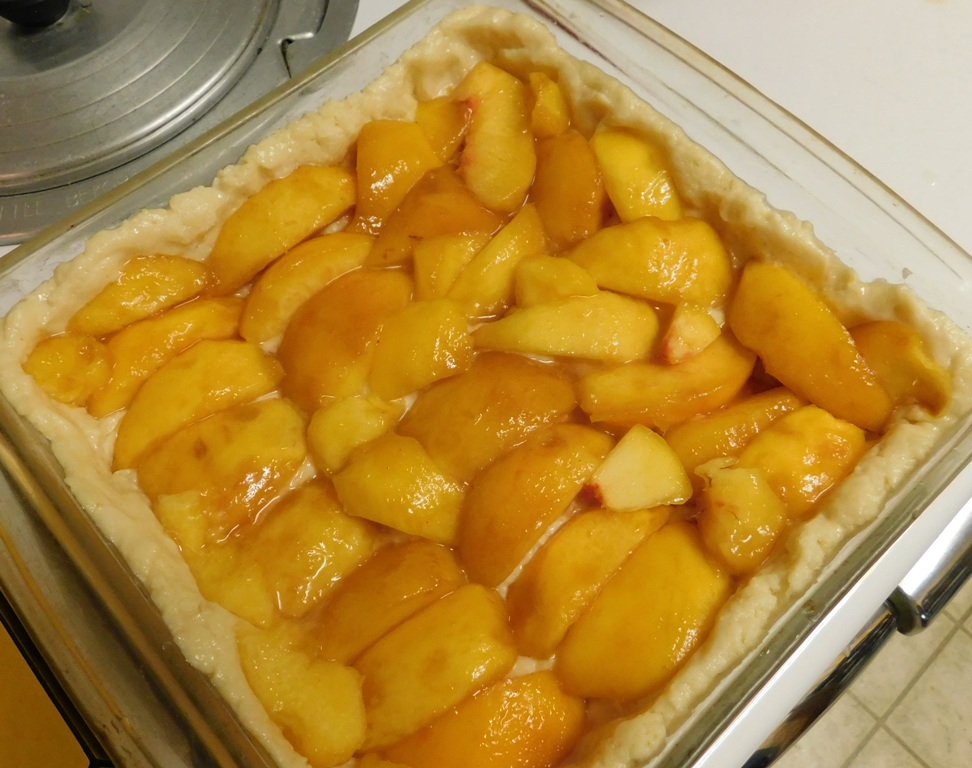
Well, Grandma Schroeder’s kuchen is like this: it has a shortbread-cookie-like “crust,” which is topped with fresh fruit lubricated with a gooey custard matrix and baked; when that is fairly set, it is topped with meringue and browned. (The meringue topping explains why the type of fruit is always a mystery; you can’t tell what kind of fruit was used just by looking at it.)

This is a wonderful way to celebrate whatever kind of fruit is in season. Right now, the peaches are perfect. Lovely, sweet, divine peaches. So we’re making a peach kuchen in this post.

A typical serving of this dessert (or coffee cake) is a 3 x 3 inch square (so, 9 servings in a 9 x 9 inch baking dish). I often stretch this out, using more fruit and meringue, to a 9 x 13 inch size, for groups.

The biggest challenge I usually have with this recipe is getting the center of the fruit/custard portion to bake firm enough to have meringue spread over it, without also overcooking the crust. This recipe can (and should) use a variety of seasonal fruits, so the juiciness can vary a lot. Therefore, I advise reducing the amount of custard for juicy fruits like peaches—just drizzle it on, but don’t force yourself to pour it all on, if it will make a pool of “soup” in the middle. I have the best results with sliced apples (apple kuchen)—where the fruits are somewhat dry.

The final result should have, at the base, about ½ to ¾ inch crust/cake; then about ¾ to 1 inch of fruit, within a gooey matrix of custard; then, on top, about ¾ to 1 inch of meringue. The corner pieces will have the most cake; the center pieces will be the gooiest.

Grandma made all kinds of kuchens, depending on what was fresh—Concord grapes, plums, blueberries, peaches, and combinations of these. Dad says Grandma never deseeded her Concords; she just put them in whole and let people chew on the seeds(!) My own variations have included a banana kuchen with peanut butter in the crust (recipe is here), and a kuchen with sliced tart apples plus big golden raisins that I’d soaked overnight in vanilla–infused cognac. (Grandma would’ve loved that one!)

I have seen what are apparently very “authentic” German recipes for plum kuchens that skip the meringue and are much flatter and more spread out. These are made in 9 x 13 baking dishes or cookie sheets. The plums are washed, halved, pitted, and placed on the crust in a decorative, overlapping pattern. Some type of glaze (sometimes heated-up jam) is drizzled or brushed over the top, then it’s baked, and that’s that. You can find several recipes for this plum kuchen (Pflaumenkuchen) online. You can certainly do that with this recipe, simply omitting the meringue and making a wider, flatter dish.

The base of the kuchen, in many recipes, is made with a sweet yeast dough (similar to that used for cinnamon rolls), but that’s not the way my grandma made it.

By the way, we always assumed that Grandma’s kuchen was a recipe she learned from her mother, who immigrated from Germany, but I found a very similar recipe in a cookbook that my Grandma used in her high school Domestic Science (home ec) class. Indeed: that particular page of her book (p. 412) is firmly adhered to the facing page by hundred-year-old, dried-up cooking goo. (I didn’t dare try to peel the pages apart; instead, I found a scanned version of the book online.) Some of the many kuchen dough recipes and variations in that book are very similar, too. So perhaps Grandma learned this recipe from her high school cooking text, The Settlement Cook Book, 11th ed., 1921. (Digitized versions of several editions of this book are online at the Hathi Trust; here’s a link to the 1921 edition.)

So here you go, another family secret unveiled . . .

Grandma Schroeder’s Peach Kuchen Recipe

Overall ingredients list:

  • 2 + ¼ cups flour (divided)
  • 2 tsp. baking powder
  • pinch salt
  • ½ + ½ + ½ cup sugar (divided)
  • ¾ stick butter
  • 4 eggs (divided: 1 beaten; the other 3 separated)
  • ½ + ⅓ cup milk (divided)
  • 2–3 cups fresh peaches, sliced (or other fruit)
  • ½ tsp. vanilla (optional)
  • ¼ tsp. cream of tartar

1. Make the dough. Combine the following:

  • 2 c. flour
  • 2 tsp. baking powder
  • pinch salt
  • ½ cup sugar
  • ¾ stick butter (it helps to use a pastry cutter and rather softened butter)

. . . then, add 1 beaten egg and enough milk (about ½ cup) to make it the consistency of cookie dough (e.g., rather stiff and sticky).

Spread the dough in the bottom and slightly up the sides of a 9 x 9 inch baking dish (Pyrex is good); with the dough so sticky, I spread it with moistened hands.

2. Make the custard. Separate the 3 eggs (reserving whites for meringue); beat together the 3 yolks, add ⅓ cup milk, ½ cup sugar, and about ¼ cup flour. This is for the custard matrix for fruit: depending on the juiciness of the fruit, consider making less, or using less milk, or including a whole egg instead of a couple of the yolks. (I usually make the full amount of custard; then whatever isn’t drizzled over the fruit in the kuchen I pour over additional/extra fruit in a couple of single-serving ramekins and cook in a bain-marie as a fruit custard.)

3. Fill the kuchen. Spread approx. 2–3 cups fresh fruit (sliced peaches, or whatever) evenly over the dough. It helps to gently press the fruit down into the kuchen; the crumb will raise and puff up, and the fruit will add moisture to the crumb. Drizzle custard on top of fruit. (See previous comment about not using too much custard—you don’t want it too full of liquid in the center.)

4. Bake at 350F for about 20–30 minutes. Watch it, because ovens vary; it’s done when the dough is cooked (browns) and the custard is relatively firm. Sometimes it never quite firms up due to the juices; it usually firms nicely with apples but rarely with grapes, blueberries, or peaches.

5. Make the meringue. This is a standard meringue recipe, as I don’t have any indication about how Grandma made her meringue. Beat the 3 room-temperature egg whites on medium with ½ tsp. vanilla (if using) and ¼ tsp. cream of tartar for about a minute (until soft peaks form); then switch to high speed and gradually add up to about ½ cup sugar; beat for about 4 minutes, or until shiny and stiff peaks form. If making meringue seems like kind of a pain, remember that Grandma used a manual rotary eggbeater.

6. Finish the kuchen. You’re in the home stretch, now. Spread the meringue carefully on top; dabbing it into artistic shapes, and return it to the oven to brown the top. Let it cool gradually. Store it in the refrigerator.

If it falls apart when you cut it, who cares? It's delicious! And I'm sure you'll love it.

. . . My people do.

Thursday, October 1, 2020

More About Great-Grandma Wilmesherr

. . . and her zither. So don’t you want to hear more about my great-grandma? Pauline Wehmeyer (1875–1950) was born and raised in Kansas. She married my great-grandpa William August Wilmesherr (1872–1936) and lived with him on her family’s farm in Kincaid, Kansas. They had their first three children, including my grandma, Clara (who was born September 17, 1897), while they were farming there. She used to help her husband with the farm work while her mother babysat the kids. William Wilmesherr wasn’t a big sturdy guy; he was “slightly built,” and a childhood bout of what may have been typhoid might have diminished his constitution.

At the end of the 1800s, falling farm prices helped convince the couple to relocate to Washington, Missouri, about 1900. So they moved all their possessions, including a couple of horses, from eastern Kansas to Washington, Missouri, by boxcar. William rode in the boxcar with the horses, to take care of them.

In Washington, they bought an old house on Henry Street, south of a city ballfield in a neighborhood then called “Goosetown” (east of MO 47 and north of MO 100). In addition to a thriving economy, they had plenty of relatives in the city. William worked as a teamster, hauling brick to locations where houses were being built. The brickyard guys would throw a stack of four bricks to my great-grandpa, and he’d catch them and load them onto his horse-drawn wagon. (So much for being “slightly built,” huh?)

I never could have known them, but I can’t visit Washington without thinking of my great-grandparents, and remembering all the many relatives who lived there.

The German community in Washington was very musical, and the various members of the extended Wehmeyer and Wilmesherr families were involved with the pipe factory band, the Elks band, and the Washington Civic Orchestra. Some of them were very involved with music.

The zither dates to about 1900, so we’re not sure if Pauline bought it before or after moving to Missouri. We think she must’ve bought it soon after moving to Washington, though it’s possible she got it in Kansas. No one knows. My mom suspects she might’ve gotten it via a Sears catalog. There was a famous zither manufacturer in Washington, but I bet those instruments were much more expensive.

In addition to the zither, my great-grandma also had a parlor organ, which she taught herself how to play. Mom says she liked to play “lively hymns” like “Heavenly Sunshine.” Before marriage, she must’ve been a Presbyterian or maybe a Methodist, but her husband was German Lutheran, and that’s what she became after they were married. Apparently, she never much liked the dour, serious hymns of the Lutherans, and that was the one thing she really didn’t care for about her new denomination.

Really, everyone likes to have a fun time. Grandma Renner described how her parents would have get-togethers in their home. The Wilmesherrs would have the Fillas, or the Noelkers over. Or the Dennlers, Lohmeiers, Kampschmidts, Schmidts, Kampschroeders, Huxels, or the Stumpes. They’d serve “dishpans” full of popcorn to their guests, and they’d play cards, or people would bring instruments over and play and sing with Pauline’s parlor organ. Homemade wine might be brought out for the guests, too, and everyone would sip the precious, sweet liquid from little wine glasses.

Great-Grandma Wilmesherr must’ve been a remarkable woman. No nonsense, practical, a capable mother and farmwife, yet musical, curious, and creative. She was famous for her ability to make anything green grow, including vegetables and flowers. She had coldframes and sold flowers and bedding plants to people who stopped by. She had a goldfish pond. My grandma, her daughter, followed in these footsteps and had the same talents and pastimes. Even a goldfish pond.

In winter, Great-Grandma Wilmesherr read “Westerns.” Why not? She had known the plains of windswept Kansas in the late 1800s, and the West was a real thing for her. It might have been the closest thing to actual travel she could have. I think she had an independent streak. I grew up hearing stories about how, as a widow, she’d drive, solo, on curvy, hilly Highway 50 from Washington to Jefferson City, peering at the road through the space between the top of her steering wheel and the dashboard.

When I got married, my mom gave me Pauline Wilmesherr’s wedding ring to use in our ceremony. (She also gave me my great-grandma Renner's wedding band, as well, and that's what Sue used.) It’s the most beautiful wedding ring I could’ve imagined, invented, or asked for, and I see no reason to replace it with anything else—it’s such an honor just to have received it.

Sometimes when I practice my trumpet, I play in my office, where the zither rests in an honored position. With its open strings, it sounds with resonance when I play notes in accordance with its tuning—concert Cs, Gs, Fs, and all their overtones. I play the notes . . . and it breathes again.

Thursday, September 24, 2020

The Story of the Zither, Part 2

So what’s the story with the zither? I don’t know a lot about it, but we’re pretty sure it was my great-grandma Pauline Wilmesherr’s. She died fifteen years before I was born. My mom remembers the zither being in the attic of her mom and dad’s house (218 W. Elm in Jefferson City) when she was growing up. Mom doesn’t remember anyone ever playing it. (For reasons mentioned in my previous post, I can see why it fell by the wayside. Also, at some point, it got out of tune and started losing strings, so . . .) I suspect that one of Mom’s three elder siblings might have had something to do with the missing strings, but who knows; maybe the damage occurred in the previous generation. We were all kids once.

I discovered the zither in an old trunk in my parent’s garage when I was about ten. I don’t know how it came to be in my parents’ basement, except that Mom must’ve acquired it when her parents moved into their new house on Jefferson Street in the 1950s. All that stuff in the Elm Street house had to be gone through. They must have found it in the attic and wondered what to do with it, and Mom must have said, “Oh, I’ll take that; I don’t know what I’ll do with it, but we shouldn’t throw it out.”

I don’t remember how I found it, or why I was snooping around in that old trunk, but there you go. From then on, I was curious about it. With Mom and Dad’s permission, I took it up into my room. Several strings were missing, and it was dreadfully out of tune. Bing! Bong! Thud. Buzz! Twannnng! (So fascinating!)

Not long after this discovery, I carried it with me on one of our many trips to Jefferson City to visit my grandmas. Perhaps this was about the time my Grandpa Renner was in his final illness. Anyway, this memory stands out not only because of what happened with the zither, but also because it was a rare occasion when I was visiting with Grandma Schroeder by myself. If my brother was there, he might’ve been inside reading a book or something. Anyway, my parents weren’t there, so I was alone with Grandma, and with her BFF, Marie Korsemeyer. (Everyone loved Marie.)

And it was nice outside, and we were sitting on the backyard patio enjoying the early evening. We must have had a meal and then remained out there, sitting and chatting as the light left the sky. Like Sue and I do today, in the exact same place.

I don’t remember if they told me to go get the zither or if I did it on my own, but I ended up playing it for them. And those two old ladies sat there and graciously clapped and cackled and encouraged me as I strummed and pounded and plucked that poor old, out-of-tune zither. I played one “song” after another. It didn’t sound like anything. At best, it might’ve sounded like avant-garde music. At best, it was primitive. At best, it was, um, rhythmic. At best, it was emotional. They encouraged me, and they seemed to be having as much of a good time as I was.

. . . I suspect that the more they drank, the better I sounded!

Anyway, I will never forget that evening, and my thoughts often drift to that memory when I sit out in the backyard on pleasant nights.

I rarely (if ever) got Grandma all to myself. As time went on, in my young adult life, the memory of that one evening brought moments of crushing embarrassment, tumbling upon me, once I was old enough to realize how horrid it must have sounded. But today my cringing is tempered by a deep appreciation for their graciousness and their willingness to play along with my childish game.

At some point in my childhood, I tried to tune it, using a pliers—a horrible idea, since it chewed up the tuning pins. And the pins, and the tuning didn’t hold, and several strings were still missing, anyway . . . And so it sat for years, until I moved back to Missouri in the late 1990s, and my parents gave the zither back to me.

And that’s when I was finally in a position to do right by it. In the fall of 1998, Sue and I took it to Music Folk in Webster Groves, Missouri, and I asked them if they could do anything to fix it.

The guy examined it and said it could probably be fixed, but, he reasoned, for the price of fixing it, I could simply buy another zither that was already fixed up, so, um, why bother—? Just hang it on a wall. But I explained that it isn’t just some old curiosity I’d bought at a garage sale—it had been my great-grandma’s. And I wanted to hear its voice.

So I left it with them and returned the next week to pick it up. They did a brilliant job with it! And it ended up not being too expensive, in my opinion. The labor charge of $100 was the biggest single component of the cost; then, the all-new strings cost nearly $50, plus new tuning pins and some miscellaneous expenses for glue and such, since they removed old glue and nails and reglued the pin blocks, glued the side seams, seated some loose pins . . . the total ticket came to $172.46. Do you think that was an outrageous expense? I don’t. To me, it’s like buying art: Follow your heart.

About this time, Mom had a reunion with her Trinity Lutheran 8th-grade graduating class. There, she had chatted about the zither with one of her classmates. And that fellow, Jimmy Sommerer, owned one of the original books of music that had been made for these types of instruments. He gave her photocopies of the book. (Samples are in my previous post.) What a neat coincidence!

No, I don’t play much on the zither these days. I’m not very good at it. (The strings all look alike!) That night in Grandma’s backyard might have been my high point! Seriously, I do play it occasionally in the living room or the backyard, but as I’ve said, it’s only good for straightforward tunes. I can do a pretty decent rendition of “Silent Night” and “O Tannenbaum.” (At least they’re rather slow.)

Another thing I’ve liked about it is that when I play my trumpet in the same room as the zither, it rings in sympathetic vibrations with the trumpet. (Musicians have taken advantage of this effect with brass instruments and pianos, where the piano’s sustaining pedal is kept pressed down while a trumpeter or trombonist points her bell into the piano’s raised lid and plays. The effect is eerie and rich—it’s the same principle as with an Indian sitar.) When I play a loud note, especially pointing toward the zither, every string capable of harmonizing with the overtones in the trumpet note vibrates lightly, and with so many strings sounding, the zither exhales a cloud-chord in answer to the trumpet, like an echo. I have always loved that. An echo—in so many ways.