Showing posts with label church cookbooks. Show all posts

Thursday, November 24, 2022

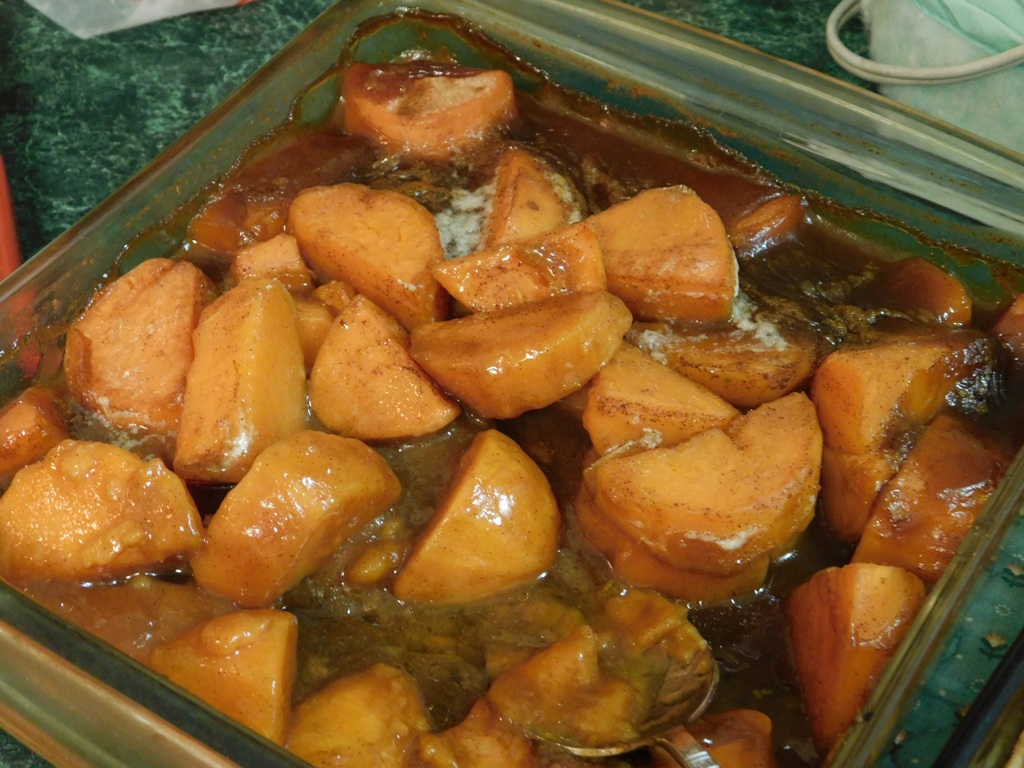
Florence Biffle’s Sweet Potato Bake

Happy Thanksgiving!

This fantastic yet simple recipe, titled “Sweet Potato Bake,” is from Mrs. Florence M. Biffle (1914–2006), who was a member of Faith Lutheran Church in Jefferson City. I recently found her obituary online. I’ll bet my Great Aunt Lydia Meyer knew her well, since she was a longtime member of the same church and was also a quilter. Also, I’ll bet my Grandma Schroeder and Great Aunt Minnie Bartlett new Mrs. Biffle, too, since they were all longtime members of Jefferson City’s Hawthorn Garden Club.

I never knew Mrs. Biffle, but I feel I could easily have known her. There’s a good chance I was in the same room with her at some point, and just never knew it. Anyway, I’m grateful to her for this recipe, and for these small connections between our worlds.

I noticed she was buried out at Hawthorn Memorial Gardens cemetery, so in a few weeks when I'm out decorating Grandma and Grandpa Renner's grave, I'll see if I can find Mr. and Mrs. Biffle.

This recipe was on p. 49 of Cooking with Faith: Favorite Recipes of Faith Lutheran Church Women, Jefferson City, Missouri, by the Faith Lutheran Ladies Guild, Jefferson City, Missouri [ca. 1975].

This is an interesting, fruity-glazed alternative to the standard (and I think tiresome) sweet potato casseroles made with brown sugar, pecans, and marshmallows, so common at the Thanksgiving table. I think you’ll really like this for a change of pace.

I’ll offer my tips and suggestions after the recipe.

Sweet Potato Bake

Cook 4 to 6 sweet potatoes until almost tender. Skin and cut to desired size (chunks). Place in a casserole dish.

Combine and bring to a boil:

1 c. apricot nectar
2 T. orange juice concentrate (not diluted)
½ c. brown sugar
1½ T. cornstarch
1 t. salt
½ t. cinnamon
2 T. butter
½ c. water

Pour over the potatoes and bake 30 to 40 minutes at 350°F.

Julie’s notes:

You can peel the sweet potatoes and cut them into chunks, then cook them in gently boiling water if you don’t want to bake them. I have also steamed them, and that works, too. But don’t overcook the potatoes; remember they will be cooking for another half hour in the oven.

I use a 9 x 9 Pyrex baking dish. You will cook it uncovered, so what begins as a liquid dressing reduces to a gooey glaze over the potatoes. Pull them out of the oven when the sauce is gooey enough for your taste.

The dressing mixes up most easily if you first combine all the dry ingredients together before adding them to the liquid.

Kern’s Apricot Nectar, which is no doubt what Mrs. Biffle had in mind, used to be available at all the grocery stores around here, but I haven’t seen it in years. I think the company’s out of business. There’s another brand called Jumex, but I’ve never seen it except online. I’ll bet it’s something to look for at an international store. Both seem to contain high fructose corn syrup and other less-than-desirable ingredients. But it’s no problem if you can’t find apricot nectar. Just take some canned apricots and some of their juice and puree it in a food processor or bullet blender, so it gets to the consistency of a thick “nectar” type juice. You only need a cup. A bonus of doing it this way is that you can decide how much corn syrup to include (since you are selecting your can of apricots—in heavy syrup, light syrup, or whatever). You can even puree the apricot pieces with just water, if you want.

There's no reason you couldn't use dried apricots, simmered in water until they're perfectly soft, then process those in a bullet blender or run them through a food mill, to make them into a liquid puree. I suppose that would be healthier. But I think using canned apricots with their corn syrup is more authentic to the midcentury church ladies cooking style.

Do-ahead tip: You can put the peeled, precooked potato chunks and the uncooked sauce into the casserole dish, dotting the butter on top, covered with plastic wrap, and refrigerate overnight. Or out on your unheated sunporch, if it’s cool enough. Finish it in the oven the next day.

Monday, July 6, 2015

Red, White, and Blueberry Jell-O Salad, alias "Blueberry Salad"

Trust me, this looked excellent before we demolished it.


And the fact that we demolished it implies (correctly) that it tasted really good, too!

It’s the perfect Jell-O salad for a Fourth of July meal. Like all Jell-O salads, its cool fruitiness is a great complement to barbecue, hamburgers, hotdogs, or whatever. And it’s refreshing on a hot day (like it always is here, in July). And face it, most Jell-O salads are more like dessert than a health food, and it’s a holiday, so hey, rock on!

But you gotta be fast if you want to take a picture of it.

File this one under “retro recipes.” I found it in the 125 Year Anniversary Commemorative Cookbook from Trinity Lutheran Church, published in 1995 or 1996. The original recipe, according to that collection, was in “the Kitchen Klatter Cookbook, published in 1982.” (Does that mean the magazine? I can’t find evidence that a Kitchen-Klatter cookbook was published in 1982; only in 1977. Hmm.)

Or it could have come from Country Woman magazine, July/August 2000, p. 42, where apparently it was called “Red, White, and Blueberry Salad”? Online, it’s frequently called “4th of July Party Jello.” (Sic.) (We all know how it’s officially spelled and capitalized: Jell-O.)

Anyway . . . there aren’t many pictures of this particular Jell-O concoction because, no doubt, it gets eaten up before anyone gets a chance to take a picture of it!


I amended the recipe just a tad: It was apparently created before Jell-O had come out with its blueberry flavor/color, so the original called for the blue layer to be created with raspberry Jell-O plus the fruit and juice from a can of blueberries. But shoot! Why not use blueberry, now that it’s available here in the modern age? Real or artificial, flavor-wise, blueberries and raspberries are great friends!

I interpreted the “coffee cream” it called for as “half-and-half,” and I substituted Neufchâtel cheese for the cream cheese in the recipe—it’s got less fat, but darned if I can tell much difference between the two.

Here’s how to make it. Be sure to allow time for each layer to get hard before adding the next—I suggest making it a day ahead. (Which is to say, July 3!)

The recipe suggests using an 8 x 8 or 9 x 11 inch dish. (I used an 8 x 8.)

1. First layer (red):

1 box raspberry Jell-O (regular size box; not the big one)
1 cup boiling water
1 cup cold water

Make the raspberry Jell-O per the usual directions on the box. Pour it into the dish and chill until firm.

2. Second layer (white):

1 envelope plain (Knox) gelatin
1/2 cup cold water
1 cup half-and-half (or milk)
1/2 cup sugar
1 (8-oz.) package of cream cheese (I use the lighter Neufchâtel cheese), softened a bit
1 tsp. vanilla
1/2 cup pecan pieces

In a little bowl, stir the gelatin into the water and let soften. In a saucepan, heat the half-and-half with the sugar until hot but not boiling. Add the gelatin, mix, and let cool. When it’s no longer hot, in a blender or food processor, mix the gelatin mixture with the cream cheese, vanilla, and pecans.

Pour this white layer over the red layer and chill until firm.

3. Third layer (blue):


1 package blueberry Jell-O (again, regular size box)
1 cup boiling water
1 (approx. 15-oz.) can blueberries with juice (such as Oregon brand)

Dissolve the Jell-O in the boiling water. Stir in blueberries, with their juice. Let it cool so that it’s not hot (you don’t want it to melt the gelatin you’re pouring it on), then pour this blue layer over the white layer and chill until it’s firm.

----------------------------

This is really delicious. If you’re like me, the slightly tangy, creamy white layer, with its pecans, will really transport you back to childhood potlucks from the sixties and seventies. Back then, I would have had no idea what was in that white “mystery” layer—but I sure would have given it my approval!


Monday, February 1, 2010

Miss Ann Kielman


Tonight I’m sharing with you a photograph of Miss Ann Kielman, whose delicious Cucumber Mold recipe I presented to you in my previous post.

Mom stopped by the other day with a copy of the 1972 Pictorial Directory of Jefferson City’s Faith Lutheran Church, which had belonged to Mom’s Aunt Lydia Meyer, who, as I also mentioned in my previous post, had been Ann Kielman’s best-friend-forever (BFF).

That 1972 church directory! I couldn’t help hooting and pointing at some of the hairdos. There were some real doozies—beehives, wing-to-one-sides, swooping Kon-Tiki Hawaiian do’s. One lady looked like she had a Drip-O-Lator coffeepot on her head. And the men weren’t immune, either: Comb-overs and slicked-down hair galore. And everyone was wearing polyester and looked, well, permanently pressed.


I could indeed share some of the more entertaining pictures with you; other bloggers would jump on the chance to provide such hilarious pictures to which they could add witty put-downs, but you know what? I’m too classy to do that. These were and are real people, with feelings; sincere Lutherans just trying to look nice for their church directory portrait.

Face it, the fashions reached their lowest point ever in the history of humankind in the seventies, and these folks, like all the rest of us, were victims of the trends. Unlike James Lileks et al., I just don’t feel like “poking fun at the defenseless past” this time.

Back to Miss Kielman for a second. Remember, it’s pronounced “kilmun,” not “keel-man.” I remember Aunt Lyd talking about her and pronouncing it “kilmun.” And no, I don’t know why the directory spells it “Anne” while the cookbooks spells it “Ann.” I don’t know about you, but my money’s on the cookbook spelling. (If you’re reading this and you can correct me, please leave a comment!)

She’s dead. Why does any of this matter? It just does. I didn’t know her (though I’m sure I met her; she had to have been at cousin Dennis’s wedding and funeral, and at many other occasions) . . . but like Mildred Sippel, the thread of her life has interconnected with mine, and the fact that she left behind no progeny, no one to leave flowers on her grave or point at her picture in an album compels me to put her name and picture on the Internet, for people maybe even a world away to see and sort of know, a memorial of sorts, even if we’re recognizing her for her cucumber Jell-O mold and for the fact that she and my great aunt were dear, dear friends.

It has to count for something.

Thursday, January 28, 2010

Retro Jell-O Recipes Nos. 62,500 and 62,501: Lime Jell-O with Cucumbers, Onions, and Vinegar


Hey, folks! I’m almost getting serious about these retro Jell-O recipes! Today I present to you two variations on a theme, and these are both definitely “salad” Jell-Os and not dessert ones.

Both involve lime Jell-O, cucumbers, vinegar, and a small amount of onion.

The first recipe was published in the official Jell-O cookbook from 1930 and was the first “salad” recipe listed, on page 16. I should mention that this cookbook announced a brand new Jell-O flavor: “The new, wonderfully refreshing Lime!” (“You will want to buy Jell-O in all six flavors, six packages at a time. Then there will always be the ‘makings’ of a lovely dish on hand.”) Yes, junior, there was indeed a time before green Jell-O.

Just in case you missed the fantastic news, there’s a “note” just before you launch into the recipes:


Above this particular recipe is a lovely illustration of some pret-ty high-class folks. One lady is our heroine; she’s slicing into her monumental jewel-like creation. Another lady behind her has her pretty little nose in the air. Bleeding off the edge of the illustration are two figures in black suits, and another high-class lady’s shoulder. There’s a magnificent coffee urn on the table (puffing out his stainless chest, with arms akimbo), attended by some fabulous coffee cups and saucers. What a fine, gay luncheon this shall be! (I think the message here is: “With Jell-O, you can forget all about the Great Depression.”)


Here’s the recipe, transcribed with great care. My comments follow.


Sea Dream Salad

1 package Lime Jell-O
1 cup boiling water
1 cup grated cucumber
1 tablespoon vinegar
1 teaspoon onion juice
Dash of Cayenne
1/2 teaspoon salt

Dissolve Jell-O in boiling water. Add cucumber, vinegar, onion juice, Cayenne, and salt. Force through sieve. Turn into mold. Chill until firm. Cut in squares and serve on crisp lettuce. Garnish with Hellmann’s Mayonnaise. Serves 6.


. . . Now, is there any law that says you have to cut it in squares? Pffft. I molded mine in little cups!

I have to say, this is a Jell-O technique you don’t see very often in your standard church-ladies cookbook, this idea of infusing your hot liquid Jell-O with other flavors, keeping the Jell-O crystal clear. You add the grated cuke and stuff to hot Jell-O, then strain out the solids. It’s like making cucumber–onion–Jell-O “tea.”

Hmm. I think that most church ladies would see this as a waste of perfectly good cucumber. I think most church ladies would just as soon keep the cuke in the salad.

Aha! Hence the next recipe, which comes from my beloved copy of Cooking with Faith: 1950 to 1975, published in Jefferson City by the Faith Lutheran Ladies Guild.


It’s a contribution from “Miss Ann Kielman,” and appears, amid a wiggly, jiggly bounty of other fine Jell-O recipes, on page 30.


Again, I transcribe it for you, with a few comments afterward.


Cucumber Mold

1 pkg. lime jello [sic]
1 c. hot water
1 tsp. salt
2 Tbsp. vinegar

Mix together and let cool until almost set, then add:

1 c. sour cream
1/4 c. or 2 Tbsp. mayonnaise
1 c. chopped cucumbers
1/2 tsp. grated onion


As usual with these sketchy types of recipes, you’re left to wonder about how finely chopped the cucumbers should be, or how finely grated the onion. But I bet I know what Miss Ann Kielman would say: “Well, as fine as you want them.” . . . I chose a small dice.

So! How Do They Taste?

My curiosity about this very question is what made me make these two recipes. They sound so counterintuitive to us in 2010; I suspect many of you are thinking, “Ugh! Nasty! Jell-O ’n cucumbers ’n onions ’n vinegar!”

Yet these recipes were appreciated enough to appear in these publications. Someone paid good money to print these on paper. The first must have ranked extremely high on General Foods’ taste tests, since it appeared at the top of the salad section where they kick off the new Jell-O flavor—two whole pages before the spectacularly famous “Under-the-Sea Salad.”

And Miss Kielman must have had plenty of folks compliment her on her delicious Cucumber Mold, since she tendered it among her other contributions to her church’s cookbook. (Well, unless maybe it was dishes like this that “kept” her unmarried?)

So here’s the verdict. First, you have to let go of your ingrained notion that Jell-O is for sweet stuff. In fact, you need to let go of the common American idea that fruit flavors aren’t used in savory dishes. But try thinking along the lines of a mango chutney or pineapple salsa, where “savories” like onions and garlic walk down the aisle hand-in-hand with delicious sweet fruits.

Both tasted really good! Sue, in particular, liked them—but you have to realize that Sue is a nut for Jell-O. Always has been. She said it was a bit of a leap to get used to “salty Jell-O”—an exaggeration, I think, though it does kind of describe the effect. The flavors of the two are surprisingly similar.

We both agreed that if you were to pick one of these to serve to company, Ann Kielman’s is much better. First, the milkiness prepares you for something “different”—you know just by looking at it that it’s been modified somehow. The Jell-O cookbook version, by contrast, looks for all the world like “normal” green Jell-O. (Until you inspect it closely and see the cayenne flecks in there.) Unless you’re fully aware of the fact that the sparkling green blob before you is a salad, you might be really, um, surprised.

Another point in the Ann Kielman recipe’s favor: The chopped cucumbers do add a pleasant and welcome texture; their presence helps balance the whackiness of the overall concept.


Meanwhile, I found myself unable to finish my portion of Jell-O’s Sea Dream Salad, mainly on account of the mayonnaise, the garnish. I have to admit that I’m not a fan of mayo, anyway, and this is probably my least-favorite way of having it, ever. Bleah. More like Sea-Nightmare Salad. My sea doesn't have mayo in it.

Tomorrow when we have more of this (hey, it’s just the two of us, so there’s leftovers), I’ll try mashing an avocado and putting that to the side instead of mayo. I’ll bet that would be lots better. Or maybe sour cream. So many options.

I guess this is why there are a hundred thousand different Jell-O recipes, huh!


Bonus Fun Information, Just for You!

Maybe you’re wondering about this “Miss Ann Kielman” who submitted such a delightful recipe to the Faith Lutheran cookbook! Well, she was my Great Aunt Lyd’s BFF. They were both about the same age, so Miss Kielman was probably born around 1905 or so.

Oh! And it’s pronounced “Killmun,” not “Keelman.”

If you’re from around Jeff City and keep your ears pricked up for history, that surname might ring a bell: Kielman’s Pool Hall was opened in 1897 and by the 1930s was run by Ann’s father. It was located just south (uphill) of the ECCO Lounge—actually, the two buildings are attached. There’s a consignment shop there now.

My mom remembers going to Kielman’s with her dad when she was little; they’d sit at the bar together. He’d have a beer, and she’d drink a Dr. Pepper and eat a package of Planter’s Peanuts.

Ann’s mother, mom says, drove a car (which is remarkable for a woman of that vintage, and that’s why I’m relating it), and she was a good friend of my mom’s Great Aunt Maggie (Margaret Renner Burkel Jordan), who lived up on East Ashley. She also drove her own car!

The Kielmans were a longstanding Munichburg family, and Ann—who never married—lived in her parents’ house and continued to live there after they passed away.

So Aunt Lyd and Ann Kielman were lifelong best friends; they worked together for years at the Missouri Public Service Commission, and they both were members—charter members, I think—of Jeff City’s Faith Lutheran Church.

After Lyd got married, and before she and Adolf started having kids, they would take Ann with them on trips. Once (my mom says) they even went together on a trip to Colorado! You have to give Adolf some real credit here for being a nice hubby: How many other young married men would want to go on a lengthy motor trip with their wife and wife’s best friend?

Anyway. I never new Ann Kielman myself, but I sure heard her name a lot when we would visit Aunt Lyd. It’s nice to put these whacky pieces together, and to enjoy her tasty Jell-O salad!


Sunday, November 8, 2009

Jefferson City Braunschweiger Report #3: A Log for Your Next Shindig

Oh my goodness.

What can I say? This sounded kinda good, and kinda gross at the same time.


. . . So I had to make it. Yeah, it’s from a church ladies cookbook, the 1975 one from Faith Lutheran Church here in Jeff City. I told you about it before.

Braunschweiger Log

1 lb. Braunschweiger
2 Tbsp. chili sauce
2 Tbsp. mayonnaise or salad dressing
1/2 tsp. sweet basil
4 strips bacon, cooked and crumbled, or 2 oz. (1/2 c.) crushed or slivered nuts

Combine Braunschweiger, chili sauce, basil, and mayonnaise. Form mixture into loaf shape. Roll in crumbled bacon or crushed or slivered nuts. Add decoration to top for occasion. (For example: Christmas holly—leaves cut from a green pepper and berries made from pimiento pieces.) Serve with assorted crackers.

Mrs. Linda Sporleder

From Cooking with Faith, 1950 to 1975 (Jefferson City, Mo.: Faith Lutheran Ladies Guild, ca. 1975), 7.


“How . . . was it?” you might ask, thinking to yourself, “Ewwwww . . .”

Well? It tasted . . . braunschweigery. But better than plain braunschweiger: Beating it up with the other ingredients turns it into a nice, easy little pâté, perfect for dipping, with that retro flavor that no one “does” anymore. It’s reasonably pretty when decorated (as I did) with sliced almonds as well as the recommended colorful bell-pepper artwork.

I truly don’t advise rolling it in crumbled bacon, or your heart valves might start clapping shut like storm doors on a windy day. And trust me, no one’s that keen on defibrillation.

I used Yeo’s Hot Chilli Sauce (product of Singapore) instead of the mild, home-canned, 1950s-era chili sauce that I’m sure Mrs. Sporleder used, and I’m glad I did, because it added a nice little kick. Okay, and I reduced the amount of braunschweiger and added plenty more chili sauce and basil than recommended, too. The heat really added a nice dimension. Yum!

It makes enough for a party. Please serve it with raw veggies in addition to crackers.

You might consider this as a potential potluck item the coming holidays. . . . Because you know nothing will “wow” them like a genuine church-ladies-style braunschweiger log.

(Wow.)

Monday, July 13, 2009

Retro Jell-O Recipe No. 62,498

Here’s another recipe that’s just right for when summer temperatures soar, and it comes from my very own Great Aunt Lyd. It was published in her church ladies’ cookbook, Cooking with Faith, 1950 to 1975 (Jefferson City: Faith Lutheran Ladies Guild, 1975), p. 34. (Yes, I’ve mentioned this cookbook before.)

For me personally, it’s a “food of childhood,” something that links me to my great aunt (who was a real sweetheart; she passed away in 1999 at the age of 93) . . . but I encourage you to try this recipe if you find yourself “bringing a dish” to a potluck this summer.

Everyone will be tickled by the sweet creaminess of it; and the tartness of the pink lemonade and the crunch of the pecans keep it from wobbling over the edge into diabetic-coma territory.

And of course, the color is out of this world.


Here it is, in all its glory. Long live the church-lady Jell-O salad!

(Comments in brackets are mine.)


Red Raspberry Mold

1 (10 oz.) pkg. frozen red raspberries, thawed
2 (3 oz.) pkg. red raspberry Jell-O
2 c. boiling water
1 pt. vanilla ice cream
1 (6-oz.) can frozen pink lemonade, thawed
1/4 c. chopped pecans

Drain raspberries, reserving juice. Dissolve Jell-O in boiling water; add ice cream by spoonfuls, stirring until melted. Stir in pink lemonade and reserved juice. Chill until partially set. Add raspberries and nuts. Turn into [ca. 6-cup] mold. [Or casserole dish.] Chill until firm. Serves 10.

Mrs. Adolph Meyer (Lydia)

Sunday, June 28, 2009

Bertha. Bertha Was Her Name.

Mom remembered the first Mrs. Sippel’s first name: it was Bertha.

And she also found another recipe from the Cooking with Faith cookbook, and this recipe is credited to this Mrs. Sippel. The first Mrs. Sippel. So the cookbook has recipes from both Mrs. Sippels in it. How about that.

Here you go. By the way, I think some instructions are missing, such as how to create a “marbled” effect using the two different colors of batter . . . but then I guess you can figure out how to do that: dollop and swirl with a knife or skewer.


“Family” Marble Cake

1 c. butter
1 c. milk
2 c. sugar
3 c. flour
6 egg whites
3 tsp. baking powder

Blend butter and sugar. Combine baking powder and flour. Blend into first mixture alternately with milk. Beat egg whites until stiff, but not dry, and slowly blend into mixture. Remove 4 tablespoons mixture into a small bowl. Add:

4 Tbsp. cocoa
1 tsp. cloves
1 tsp. allspice
1/2 tsp. nutmeg
1/2 tsp. cinnamon

Bake at 350 degrees about 40 minutes. Does very well in tube pan.

Mrs. Wm. Sippel (Bertha), First President of Faith Guild


From p. 130 of Cooking with Faith: Favorite Recipes of Faith Lutheran Church Women, Jefferson City, Missouri, by the Faith Lutheran Ladies Guild, Jefferson City, Missouri [1975].

Saturday, June 27, 2009

The Dinner Mr. Sippel Never Had


I don’t mean to make fun of anyone, but it was kind of funny to think this yesterday when I plated the first Mrs. Sippel’s meatloaf alongside the second Mrs. Sippel’s cooked red cabbage.

I followed the directions, even though I was pretty sure the red cabbage wouldn’t cook well with vinegar in the water. Sue was a little let down by the texture and the flavor. Yeah, my recipe really is better. (I’ll share it one of these days.) But Mrs. Sippel’s wasn’t bad; it was just really plain. And crunchy.

Someday I’ll have to tell you a family story—well, more of a legend—about my Great-grandma Thomas and red cabbage. It speaks of the love she had for beautiful red cabbages, and the love her husband had for her.


. . . Okay, and the meatloaf—well! I was a little let down that it didn’t remind me a whole lot of my mom’s. Partly because I didn’t cook it as long as I remember my mom cooking it; she didn’t want us to get worms, or E. coli, so her meatloaf tended to be a little firmer than mine. I was actually going to leave it in the oven longer, but Sue noticed the sides had pulled away from the loaf pan, and the inside was cooked, so she probably saved me from overcooking it.


And another little detail that occurred to me: the ketchup on top. Mom always used to very carefully pour it out of the glass bottle in little dabs (note that the recipe says “dot with catsup”) . . . and here I am, in 2009, with a handy plastic squeeze bottle of Heinz that doesn’t deliver the ketchup in “dabs” or dots. Oh well.

It tasted really good. I have to admit that I used a little more onion than the recipe called for . . . and I cut up the bacon into little pieces instead of laying big strips down the middle (this way it’s easier to cut slices later on).

Today, we’ll have cold meatloaf sandwiches for a late lunch. It will taste really good with some watermelon and potato chips. Summer is definitely here, folks.

Mississippel

This post builds on the previous one, about the women of the Greatest Generation.

I’ve learned that someone connected to me, a member of this generation, passed away recently: Mildred Sippel. She was born in 1916, got married in 1954 (yes!), and was the organist for her church for many years. This information is from her obituary, here.

I copied this picture from the newspaper’s obituary, and ten bucks says that it, in turn, was copied from her church’s directory.

Here’s how she’s connected to me: My mom’s aunt’s husband was Mildred’s brother. Which is to say, she was the sister of my Great Uncle Adolf. No, I didn’t know her, but my mom did. And I’m sure we’ve attended some of the same weddings and funerals.

So. Mildred Sippel passed away, and I had to go look in my copy of Cooking with Faith, 1950 to 1975, also known as “Favorite Recipes of Faith Lutheran Church Women, Jefferson City, Missouri, 1970.” Because she was a longtime member of Faith Lutheran.

(No, it’s not very clear what the official cookbook title is—the thing on the cover, or the thing on the first page. And you can’t tell what the publication year is, either. Church ladies’ cookbooks can’t be bothered with such details—it’s more important to copy all those precious recipes accurately.)

And behold! I found one of Mildred’s recipes—in fact, I remember looking at this recipe before, because when I was first teaching myself how to cook red cabbage, I studied her instructions with curiosity. (How much red cabbage to use, then? Apparently this must not make very much. Maybe she was just thinking about cooking for two, huh. And do you think the spelling should have been “Bierich,” or what? Hmm. I’ll bet she was one of those gifted “cook by feel” people. . . . Or maybe that’s the pun in the book’s title—you have to have “faith” that it will turn out!)

Anyway, here ya go, verbatim from the bottom of p. 46 of Cooking with Faith. Read my note right after it, however. Very important.


Beirich Kraut

Place finely cut red cabbage in pan with slightly salted boiling water. (Water should barely cover the cabbage.) Add 1 teaspoon vinegar to water, cover pan and cook cabbage until tender, adding water if needed. When finished, add a little sugar or sweetener to taste.
Mrs. William Sippel (Mildred)

Note: I don’t know how long Mildred had to cook this after she’d added her vinegar, in order for it to get tender, but my advice is to cook the cabbage in water alone, first, until it’s completely done, before adding any vinegar. It can only be a small amount of water, too; it basically steams. As a general rule, if you add vinegar before the vegetable is soft, it will stay crunchy. . . . Hmm. Well, maybe Mrs. Sippel liked it crunchy.

Oh, and of course: Use apple cider vinegar. Of course.

Someday I’ll post my own recipe for red cabbage. Which is better; everyone loves it. But this is Mildred Sippel’s memorial post, and I don’t want to brag . . .

---------------

And now here’s a bonus recipe for you! From my mom’s handwritten collection! This recipe is known as “Mrs. Sippel’s Meatloaf,” but my Mom pointed out to me that it’s not from Mildred Sippel . . . and it’s not from Mildred’s mother-in-law, either. Nope. It’s from Mildred’s predecessor, the first Mrs. Sippel, who passed away—hence William Sippel’s remarriage in 1954, to Mildred, who was the second Mrs. Sippel.

So yeah . . . I’m feeling warm about this dish. This is the exact same meatloaf recipe my mom used all while I was growing up. This here is real home cookin’, I’ll tell you what!

Note: Making these kinds of connections are one of the best things about living in your extended family’s home turf.
Mrs. Sippel’s Meatloaf

1 1/2 lb. hamburger
1 egg
2 tbsp. chopped onion
1 cup cracker crumbs
1 cup milk
salt and pepper (to taste)

For Topping:

bacon (2 strips)
catsup

Mix together meatloaf ingredients and place in baking dish. Put 2 strips of bacon on top and dot with catsup. Bake 1 hour at 350°.


(For more on these recipes, with pictures, click here!)