Showing posts with label birds. Show all posts

Monday, July 24, 2017

Bluebird versus Honda Mirror

This is a new thing for me: a male bluebird attacking the mirror of a car. I've seen other birds (especially male cardinals!) engaging in this territorial behavior, but not a bluebird. So this is a first.

(A quick internet search revealed that American robins often attack their reflections in mirrors and windows, too, and bluebirds and robins are pretty closely related--they're both thrushes, look at their body shapes, legs, and bills--so it shouldn't be a surprise that both do it.)

Look! Mr. Bluebird was so obsessed with fighting his perceived interloper (who absolutely refused to leave and was always there in the mirror each time he looked), he let me get close enough for some pictures:


Oh, it was so hot last week! Maybe the bird was feeling extra peevish, nervous, and out-of-sorts. I didn't notice the bluebird doing this yesterday, when it was cooler. But on Thursday, when I took these pictures, it got up into the high nineties by midday, and at midmorning he was panting from his exertions.

Here's a fun quiz: "How can you tell when a bird's been attacking your car's mirrors?" Two pictures provide the answer:


. . . And how do you keep the birds away from your mirrors (if not to protect the mirrors, then at least to prevent the bird from hurting his bill or from getting heatstroke)? In the past, my parents have slipped a big old sock over their mirrors: easy on, easy off.

My solution was to tie a ubiquitous white plastic grocery bag around each mirror. It looks ridiculous, and it's a bit of a pain to untie them in order to drive somewhere . . . but at least it saves the bird from wasting his precious energy attacking a mirage.


Silly thing. There's a reason why calling someone a "birdbrain" is an insult.

Of course, after I put bags over my mirrors, he moved on to our neighbor's car.

And one final thought: Wowsa! We have bluebirds in our neighborhood!

We have not had a great number of, well, interesting songbirds in our neighborhood recently (of course; see post on cats below). We have the usual: bluejays, grackles, cardinals, sparrows, chickadees, catbirds, Carolina wrens, and occasional flocks of waxwings that come through. There are also plenty of chimney swifts and mourning doves, and a few Eurasian collared doves, as well.

But this summer we have seen at least three bluebirds (the male plus a female plus a female or immature male), which clearly are living somewhere in the area; I love their songs, those mellow little comments. And last night at sunset, we watched a kingbird repeatedly fly out from the top of the pine trees across the street.

It's been a real treat. I hope they all stick around!

Thursday, March 9, 2017

Squaw Creek National Wildlife Refuge, Now Loess Bluffs National Wildlife Refuge

In January, the US Fish and Wildlife Service finally changed the name of Squaw Creek National Wildlife Refuge to Loess Bluffs National Wildlife Refuge. This NWR, near St. Joseph, Missouri, is now aptly named for the spectacular hills lining the refuge on the east, which are made not of rock but of loess, a kind of compacted soil made of dusty, yellowish silt that was blown into great rolling dunes after the last glacial period.


Nearby Mound City is named for the large loess hills in the area.

I hope that people aren’t bent out of shape about the name change. Sure, there’s a Squaw Creek that runs through the area, and that name hasn’t changed, but the NWR’s name isn’t exactly historic, as it goes back only to 1935, when the NWR was created.

Back in 1935, almost every American understood the term squaw to be sort of a Native American equivalent of the German frau, the Spanish señora or mujer, or the French madame or femme. Obviously, no one meant it as a derogative term because they had no idea it had such connotations. People probably thought they were honoring Native American women by naming the creek and later the refuge after them. I hope that in the future, people don’t look back and think that people who used the word squaw were being disgusting, insensitive, insulting. They simply didn’t know about the original meaning of the term. In fact, through their longstanding, benign use of the word, you can argue that they gave it a new, non-insulting meaning.

But finally, Native Americans made it clear to us other Americans (immigrants and children of immigrants, all of us), that squaw was for them a deeply offensive term, used for part of a woman’s private anatomy, so ever since then, place-names of lakes, mountains, trails, and so on, that had long used the word, have been changing.

And it’s a good thing! Some people might grouch and moan about “political correctness,” but I’m convinced it’s simply about being gracious and respectful of others’ feelings. Why continue using a word, a name that essentially insults someone, when we can use a new name that is better, anyway?

So now it’s the Loess Bluffs National Wildlife Refuge. And who knows how to pronounce it? Ha-hahh! Hopefully the people in northwest Missouri have already picked out a pronunciation they can live with, whether it’s “luss,” “less,” or (definitely the weirdest choice) “low-ess.” These are Americanized pronunciations, however, of a German word with a vowel sound we don’t make in English, the German “umlaut o” (spelled ö or oe).

It’s a mix of the vowels “ee” (or “eh”) and “ohh.” In a nutshell, you say “ee” (or “eh”) with your tongue, inside of your mouth, and you say “ooh” with your lips. Try saying “oh” with your lips, rounding them, but position your tongue as if to say “ee” (or “eh”). (Here’s a fun explanation of German umlaut sounds.)

French coeur, German Goethe, and my own surname use the ö/oe sound.

So after listening to these examples, you might start saying it more like “lurse” or “loorse” (light on the r’s, in both cases). I have been trying to pronounce “loess” correctly for about as long as I’ve been able to talk, since my dad is a physical geographer who specializes in Missouri landscapes, and he always taught his students (and my brother and me) how to say loess the original German way. Loess! Loess! Loess!

So! On Saturday, we drove up to the northwest corner of the state not to see the Loess Bluffs National Wildlife Refuge, particularly, but to see the birds taking refuge on it! And what a treat it was!

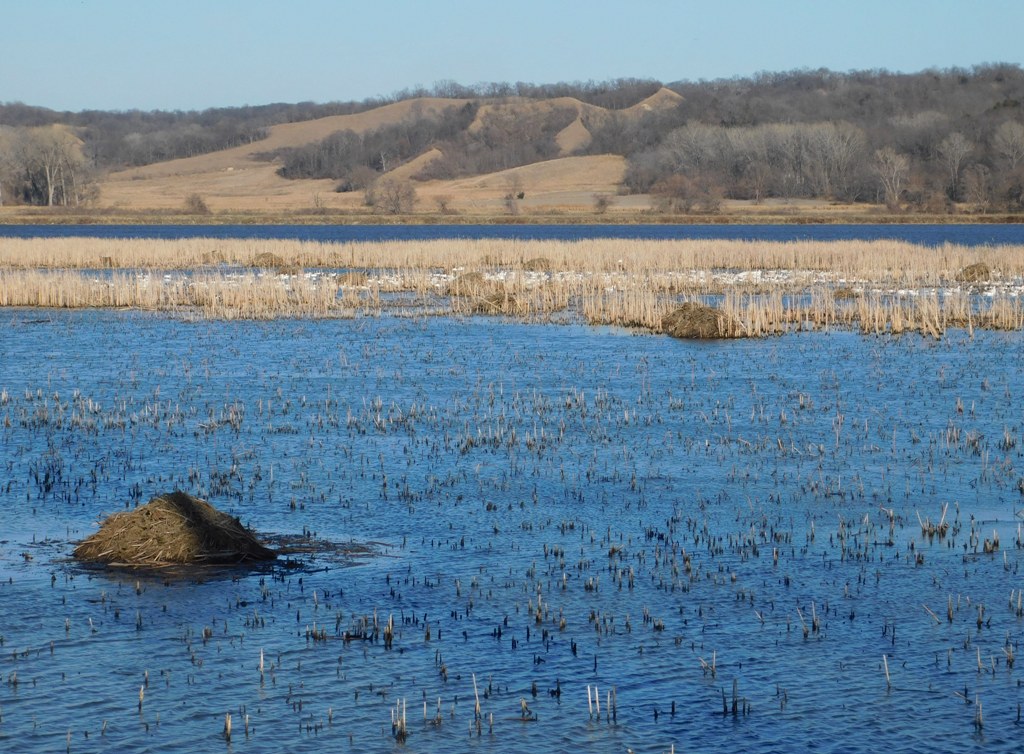
The big show, of course, was the snow geese, which were so numerous as to look like, yes, large areas of snow. Like, 28,000 of them. (In previous weeks, there’d been as many as 283,000 of them!) White and blue forms. I’ll bet there were some Ross’s geese among them, but picking them out would have distracted me from the main attraction: their multitudes.


Occasionally vast numbers of them would rise and fly off northward, an overwhelming chorus of their thousands of high voices. They were getting a nice brisk tailwind from the south!


They vanished into the whiteness of the northern sky. But there were still thousands left in the wetlands.


We saw lots of other birds, too, of course. There were plenty of Canada geese around; they seemed to love standing on top of the many muskrat homes that poked up out of the water. This one was all “honked off” at something—looking at it through our binoculars, we could see it hissing at something below it, then turning around and complaining the other direction.


Other birds that we saw (in the afternoon) included several trumpeter swans, American white pelicans, mallards, northern shovelers, blue-winged teal, gadwall, American coots, killdeer, common grackles and red-winged blackbirds (but unfortunately we didn’t see any yellow-headed blackbirds, but I certainly looked), and my favorite sight of the day, a female belted kingfisher that was hunting for fish. (Yes, in Squaw Creek itself, so see? It pays to take your eyes away from the vast wetlands and look all around.) Sorry, no pictures of her.

Sue, of course, was the one who first spied the kingfisher. As we watched, the kingfisher flew down to the water and captured a fish. (Judging by the shape, I’m betting it was a green sunfish or something similar.) She flew with it to a nearby wood duck nest box, perched atop the box, and started the process of swallowing it. True to form, she smacked it on the box a few times to subdue it, then got it flipped around so it would go down headfirst (the smooth way).

This was the weekend of Columbia’s True/False film festival, (or as some of my friends who work at restaurants and bars call it, “Hipster Christmas,” “Hipster Homecoming,” or the “Bunning Man” festival). Why would anyone want to be cooped up in a dark movie theater when they could be out watching these miracles of nature? Oh well. Maybe people don’t know you can see these amazing sights for free. Or maybe, because it’s free, they don’t value it as much as something you have to buy a ticket for?


Anyway, during one particularly large and raucous liftoff of zillions of snow geese, we noticed that a few non–snow geese were caught up in the excitement of the crowd. Amid the multitudes of basic sameness were a few different shapes, different wing-flapping patterns: One was a blue heron, and the other an adult bald eagle.

Well! That made our day! Can you pick out the eagle in this photo? (Remember you can click on these pictures to make them bigger.)


It was also great fun to watch some of the muskrats.


One sat on a completely muddy area amid dried cattails near a muskrat home and groomed itself for several minutes. I kept thinking, Dang, with all this mud, it must be a never-ending chore for them to try to keep clean!

As with so many other rodents, you can’t help thinking it’s really pretty cute-looking. Look at the little fist this one made with its left hand while it worked to clean its right arm.


Yeah, pretty cute, huh?

Well, it was a very memorable day. We need to keep going out and seeing these sights. What a beautiful and fantastic world we live in!


Friday, September 11, 2015

Audubon’s Paper Menageries: Birds and Quadrupeds

Places to go! Things to do!

If you love art, and you love nature, here’s something you don’t want to miss: An exhibition, at the State Historical Society of Missouri, of several of John James Audubon’s famous, hand-colored engravings and lithographs depicting American birds and mammals.


The State Historical Society (SHS) owns lots of wonderful art pertaining to Missouri the state, and Missouri the territory (that is, the western U.S.). I’ve told you about their collection of Charles W. Schwartz’s artwork before.

They also possess several of the engravings and lithographs that constitute Audubon’s incredible, huge books Birds of America (printed between 1827 and 1838), and The Viviparous Quadrupeds of North America (printed 1845–1848). (Viviparous quadrupeds means “live-bearing four-footed creatures,” that is, the mammals.) (Such as the opossum!)


If you don’t know who Audubon was, or if you want to learn more about him, click here.

Sue and I were pleased to attend the “Curator’s Walk-Through” of the exhibit, led by Dr. Joan Stack, curator of art collections, on August 29. Her presentations are always first-rate, exemplifying the best of the cultural opportunities that college-town life offers.


Her talk, like the exhibit itself, started with Audubon’s image of the eastern bluebird, which is the official bird of Missouri. She pointed out something I have always sensed, but never fully understood, about Audubon’s bird images: Many times, birds are shown offering food to each other, and these poses have a famous artistic predecessor.

For example, in the case of the eastern bluebird, a female is offering a caterpillar to her fledgling.


Stack pointed out that this image recalls Michelangelo’s famous Creation of Adam fresco painting in the Sistine Chapel. One wonders if Audubon had this image in mind as he created his art. . . . Or if Michelangelo had contemplated birds feeding their young as he composed his fresco.

Anyway, those are the kinds of connections that a good lecture inspires, and I love it. During the talk, there were many more interesting, and compelling observations.

Details were pointed out.


History was discussed.


And technical matters were explained.


We’ve all seen Audubon’s prints reproduced in books, but it’s not common to get to see some of the actual prints themselves. Take this opportunity to stand in front of these enormous (life-size, in many cases), incredibly detailed artworks. Plus some major artworks by George Caleb Bingham and Thomas Hart Benton.

Did I mention it’s free to go there and enjoy all this great art?

(Of course, if you’re inclined to do so, however, memberships to the State Historical Society of Missouri are only $30 and include all sorts of perks, including the highly respected quarterly Missouri Historical Review as well as the Missouri Times, not to mention the good feeling you have for supporting the SHS and its vast collections of genealogical resources, photos, city and county histories, manuscripts, and newspapers.)

The Audubon exhibit runs until November 28.

The State Historical Society Gallery in Columbia is located on the University of Missouri campus, on the ground floor of Ellis Library, Hitt Street at Lowry Mall. Detailed directions and parking suggestions are available here.

By the way, the State Historical Society of Missouri is planning a major expansion, and relocation, in the coming few years. This move is long overdue for an organization that has enriched Missouri for more than a century, and it will include a larger gallery for its many valuable paintings, illustrations, maps, and other graphic treasures.

. . . Including artwork of opossums.


Note: Except for two images of opossums, and the photo of Dr. Stack, all the pictures in this post were recklessly, unconscionably photographed from my copy of a modern-printed, downsized reproduction of Audubon’s Birds of America. These are only lame representations of some of the same plates that are on display in the exhibit. The artwork you’ll see at the SHS looks much, much better!!!


Tuesday, March 4, 2014

Journeys Around the Sun: Aldo Leopold

In my previous posts, I talked about natural history books that have an almanac structure: Edwin Way Teale’s A Walk Through the Year, and Hal Borland’s Twelve Moons of the Year. Today, I’m continuing with another classic natural history author.


Today, it’s one of the most famous written celebrations of the annual cycle of nature, by that giant oak of the conservation movement, Aldo Leopold: A Sand County Almanac (New York: Oxford University Press, 1949). It’s not a day-by-day approach; its chronology is monthly. The location is Wisconsin, but the application is global.

If you haven’t read it yet, you can get it for just the cost of shipping; there are over 2 million copies in print; just do it. It is a great classic of natural history writing, full of heart and soul, unflinching truthfulness, a celebration of all that is wild. A bonus thrill is that (in the original edition) the illustrations are by Missouri’s own Charles W. Schwartz.


In keeping with the theme of longing for spring, I’m sharing a sample from this book, also about birds and the coming of springtime, from a section titled “The Geese Return”:


“One swallow does not make a summer, but one skein of geese, cleaving the murk of a March thaw, is the spring.

“A cardinal, whistling spring to a thaw but later finding himself mistaken, can retrieve his error by resuming his winter silence. A chipmunk, emerging for a sunbath but finding a blizzard, has only to go back to bed. But a migrating goose, staking two hundred miles of black night on the chance of finding a hole in the lake, has no easy chance for retreat. His arrival carries the conviction of a prophet who has burned his bridges.” (“March,” p. 18.)


“. . . When it has become warm enough to sit outdoors, we love to listen to the proceedings of the convention in the marsh. There are long periods of silence when one hears only the winnowing of snipe, the hoot of a distant owl, or the nasal clucking of some amorous coot. Then, of a sudden, a strident honk resounds, and in an instant pandemonium echoes. There is a beating of pinions on water, a rushing of dark prows propelled by churning paddles, and a general shouting by the onlookers of a vehement controversy. Finally some deep honker has his last word, and the noise subsides to that half-audible small-talk that seldom ceases among geese.” (Ibid., p. 22.)


Monday, March 3, 2014

Journeys Around the Sun: Hal Borland

In my previous post, I talked about a favorite “essay-a-day” natural history book, Edwin Way Teale’s A Walk Through the Year. Today, I’m continuing on the topic of almanac-format nature books.

A similar book, in a similar vintage, is Hal Borland’s Twelve Moons of the Year (New York: Knopf, 1979).


Borland wrote a weekly natural history or “outdoors” editorial in the Sunday edition of the New York Times for 35 years. This book, which he was finishing when he died, is a collection of those brief editorials—so well written . . . so well written.

I’ve been dipping into this book especially, since he writes so eloquently of our desire in late winter to look for signs of impending spring. Wasps waking and flying groggily about on a prematurely warm day. The courtship of owls and squirrels. The lengthening days. Rising sap. The hope encapsulated in the buds of trees. And the first tentative, brief bird songs.

“There are things to be heard if one is at all attentive. At noontime on a sunny day the dooryard sparrows begin to test a few phrases of remembered song. The chickadees, which will lisp a greeting any winter day, now extend their songs, simple though they are. The nuthatches still say nothing but yank, but they say it more often and with a new intonation. From the woodland the male cardinal whistles as though he really means it.

“. . . Spring is not yet at hand, but there is change, and there are subtle stirrings here and there, if we forget the calendar and listen.” (“Subtle Signs of Spring,” February 15, pp. 46-47.)


He notes a softening of the blue jay’s raucous voice:

“But when February comes and daylight begins to linger, the jays begin to feel, perhaps down in their hollow bones, that life is good and soon will be even better. They whisper this, at first, to themselves. Then they say it aloud, but softly. It is a wholly new note, actually a two-note salute to the season. It is almost musical. It really is the blue jay’s prelude to a love song, a sentimental secret the secretive jay can no longer keep to himself.” (“The Secret,” February 8, p. 41.)


It’s not going to make spring come any sooner, but reading this helps me remember that I’m not alone in looking for “signs,” and that people have always yearned for spring this way.

Sunday, March 2, 2014

Journeys Around the Sun: Edwin Way Teale

It’s still early enough in the year to be thinking of the passage of time, as I do at every new year—jeez, it’s hard to believe it’s the year 2014! I suppose part of my pondering might also have something to do with this year’s lengthy onslaught of snow and bitter cold—I can’t help looking for signs the spring is coming.

And it is. Even if we’re getting yet another dump of ice and snow this weekend!


My evidence? Well, haven’t you been hearing cardinals singing outside your windows in the mornings? I have. And it’s a damn good song they’re singing!

I’ve been dipping into some of my favorite books that celebrate the annual cycle. A recent comment on my blog suggested to me a book by the great natural history writer Donald Culross Peattie, An Almanac for Moderns. (Thanks, Tina, I’m going to check it out!) Peattie’s books describing America’s trees are exquisite blends of science, poetics, and philosophy. Peattie educated his reader while ensouling his subjects.

Of course, the famous quartet of books by Edwin Way Teale is a monument to the changing American seasons, and I’ve written about them before.

But Teale’s more compact, and personal celebration of the changing seasons is A Walk Through the Year (New York: Dodd, Mead, 1978). In it, he writes a brief essay for each day of the year, describing some natural event that happened on his farm in Connecticut. He intended it as a companion to A Naturalist Buys an Old Farm, which tells about the property he purchased later in life, Trail Wood, which he treasured as a natural area.


A Walk Through the Year is pure Teale. In it, one of his later books, he shares his reflections on his and his wife, Nelly’s observations of nature at Trail Wood. It’s a gentle and pleasant conversation, as if you and the aging Teales were chatting in their living room, sitting around their cozy fireplace on some evening after a blizzard. “Guess what we saw at one of our bird feeders yesterday!” And “I was walking on the lane to the road and saw a red fox—guess what it was doing!”

To show you why I’ve been dipping into this book, and to celebrate the springtime we’re all hungry for, here’s an excerpt from A Walk Through the Year. Because the Teales were nuts about birds, I’ve chosen one about birds—specifically, red-winged blackbirds:


“February 28. This is the sound we longed for, dreamed about, looked forward to in the darkest days of winter. Rising and subsiding, becoming a storm of mingled voices, then ebbing away, it comes from the treetops along the brook. It is an excited sound, a festive, holiday sound. Like the torrents of spring, it is a rushing, liquid sound that here antedates the spring. It is the great chorus of the first of the homecoming flocks of the redwings.

“Bare only yesterday, the treetops along the brook today are clothed with blackbirds. A hundred and fifty or more swirled down to alight among the leafless branches before dawn today. All are males. The females will arrive later. We watch the birds, in the richness of their breeding plumage, flying from tree to tree, each alighting with its scarlet epaulets exposed. Their surging energy is contagious. We feel a sense of elation, a wave of optimism. The stolid endurance of the deepest winter drops away.

“We listen to the overlapping chorus of ‘okaleees’ or ‘bob-y-leees’ swell and fade and begin again. The interplay of sounds merges into a rolling, trilling clamor. Standing listening, we catch little dropped notes spilling through the chorus. The ‘okaleeeing’ is replaced by sharp metallic calls as all the birds take off in a cloud of black to sweep in curves, to turn and turn again, and then swirl down once more to the tops of the brookside trees.

“It is usually near the end of this shortest month of the year or in the earliest days of March that the redwings come back to Trail Wood. The intermingled tumult that comes down from the treetops seems compounded of relief at the end of a long journey, of ecstasy in reaching an age-old breeding ground, of health at a peak, and life lived intensely. We are swept along by the excitement pulsing through these hundred and more bodies. This wild musical clamor of the first of the returning redwings reechoes in our minds long after it is left behind. For the birds, the farflung journeys of migration now are a thing of the past. For us, the winter—all but a few short weeks—has run its course.”

------------------------------------

And yes: While visiting my parents two weeks ago in Columbia, Sue and I heard our first raucous, cacophonous red-winged blackbird chorus of the spring, and we almost jumped for joy!

Is winter over? Of course not. Look at all this frickin’ ice!

But hey—keep your hopes up! The cardinals are singing, and the redwings have appeared.


Wednesday, February 5, 2014

Today, There Are Only Hungry Birds

Boy, we’re having a genuine winter this year, aren’t we. Sue and I just got in from shoveling our six or so inches of snow, which, thankfully, was fluffy stuff and easy to toss away from our sidewalks with my trusty lightweight aluminum coal shovel (which came with the house).

While the sun was out, and while we were getting our workout, it actually didn’t feel that cold. But now that we’re inside with damp hair, and not moving anymore, now that the sun has gone behind a cloud, it’s starting to feel like that zero-degree weather we’re supposed to be having.

A look out our bathroom window, and I noticed more and more starlings perching on the small length of horizontal drain pipe connecting one section of gutter to another, in a place that’s sheltered by the eaves and out of the wind.

At one point, I counted fifteen of them, huddling together.

Now: I’m far from being in love with European starlings—they are exotic, invasive, noxious weeds of the bird world—but when it’s this cold, this bitter, this deadly, things are different. I’m on the side of life.


It reminded me of something my hero Edwin Way Teale wrote in his book A Walk Through the Year (New York: Dodd, Mead, 1978), for his entry for “January 4” (p. 326):

When we put out bird food these winter days we are as impartial as nature. The varied species compete, as they compete in the wild, for seeds scattered on the stone wall under the hickories and along the lane, for suet hanging in mesh bags from the apple tree, for food filling our different feeders. Bluejays share the sunflower seeds with chickadees and evening grosbeaks. Cowbirds feed among the tree sparrows. In these bitter winds of January, there are no “good” or “bad,” “beneficial” or “harmful” birds for us. There are only hungry birds.

Aside from the gray squirrels that we see coming in from the woods, bounding across the glitter of the ice crust, the birds, in their varied shapes and colors, are the most evident form of warm-blooded life today. And they will remain so all during the rest of the weeks of cold. The “dead of winter”—how much more dead it would be each year without the birds!

Birds can survive winter, provided they have enough food to stoke the fires of their metabolism. When there’s snow on the ground, birds can’t find food very easily. If you haven’t done so yet, go get yourself a bird feeder and some seed.

Because today, there are only hungry birds.


Sunday, January 29, 2012

Nature’s Kool-Aid

If this were Vermont, we’d be saying, “It’s sugarin’ time!” We’ve been having those fluctuating temperatures—freezing nights, warm and sunny days—that make the trees start pumping sap.

Sap is like natural Kool-Aid for critters. Maples, of course, but other trees, too. Including our black walnut. The first thing we saw was a wet spot on the bark, about chest-high.


Closer inspection revealed a horizontal row of about fifteen small round holes, each about two inches from the next. Most were dripping sap.


If you taste it, it’s pretty much like water. This is sweet?


But you’re not the one drilling the holes, and neither are you the one to be attracted to it.

It was not a mystery to us what bird had drilled the holes. But it had been years since I’d actually seen a yellow-bellied sapsucker (Sphyrapicus varius).

This year, we saw him! (Look carefully!)


I’d forgotten how well sapsuckers blend in with their background, which is almost inevitably the patch of bark that they have darkened by the moisture caused by the dripping. It’s pretty neat how they blend in. And they’re fast workers!


Yellow-bellied sapsuckers do this: They tap holes into trees from which sap drips. They drink the sweet fluid, using their brushlike tongues. Which is pretty much like drinking Kool-Aid, nutritionally speaking.

But wait! They get some protein out of the deal, too! The sap is also a lure for ants. Even at this time of year, ants, on warm days, send out scouts to make sure that potential food sources aren’t going unexploited.

And because ants are everywhere, they certainly find the patch of sugary water seeping down the bark, and immediately send out workers to drink it and carry it back to the nest.


Thus, with the ants milling around the sap wells, the sapsucker has the opportunity to grab ants that are bloated with sap. Or, I’ll bet Mr. Sapsucker can simply grab ants and smear them around in the tree-juice, like sopping biscuits and gravy. (Don’t you think?) Anyway, that’s protein and sugar! Dee-liss-yuss!

While the party is swinging, others come to enjoy the punchbowl, too. Other woodpeckers, I understand, are attracted to the sugar water and (no doubt) to the baited ants as well. I’ve read that sapsuckers vigorously guard their sap wells, but ours leaves for hours at a time. Look at this!


It was pretty cute to see this little fella clinging to the side of the tree, upside-down, right-side-up, and sideways.

Are we afraid of damage to the tree? Nah. Sapsuckers have zapped our walnut before, and they’ve riddled our big yew tree, too (and gave it worse).


It’s not like in those pictures where the holes are so close you can’t see the bark anymore. I think this bird has several trees that it’s tapping. And the walnut, for instance, has thick ridges of bark that prevent the sapsucker from drilling holes one after the other, so that protects the tree from being completely girdled.


And anyway, sapsuckers are highly migratory, and this fellow is probably just passing through, on his way north to claim his breeding territory. Somewhere up in Canada, in a few months, he’ll be banging on a hollow tree or on somebody’s gutter, and working to make Kool-Aid-loving progeny.


Wednesday, April 13, 2011

Good Eggs!


One sign of spring is farm-fresh eggs! I don’t think that many Americans realize that eggs are a seasonal item. Their appearance in spring is one reason why we think about eggs at Easter.

If you stop to think about it, most birds don’t lay eggs in wintertime, and so neither do chickens—according to nature, anyway. The reason we have hens’ eggs in our grocery stores year-round is because big commercial egg farmers manipulate the photoperiod using artificial light to trick the chickens into not having any idea what day, month, or season it is! There are no calendars in commercial chicken houses.


Before farmers figured out how to fool the chickens with electric lights, and before refrigeration was available, it was a real game for people to figure out how to preserve eggs during the months when hens weren’t laying. To give you an idea of this chore, here’s a quote from The Hearthstone; or, Life at Home: A Household Manual, written by Laura C. Holloway, published in 1883:

To keep Eggs Fresh.—One of the best means of preserving eggs is the following: Select good fresh eggs and pack endwise in a mixture of equal parts of fine dry charcoal and salt (cold). Keep in a cool, dry place until required for use. A thin coating of gum or a trace of oil will prevent loss of moisture through the shell. The best time for preserving eggs is from July to September.


So anyway, there are still some chickens in this land, our land, that do natural things, like scratch in the dirt, flap their stubby wings and go clumsily airborne (as chickens do), peck at corn, strut around and cluck, nibble on grasses, capture beetles, and listen to robins singing on these fine spring mornings. And they do know what season it is: It’s the season to lay eggs!

My friend Rhoda lives in Columbia and has chickens, and now that her hens are producing again, she let it be known (Facebook to the rescue!) that she was ready for buyers again. (Note: if you are reading this and are wanting to contact her, let me know, and I’ll put you in touch. Realize—she’s not a commercial chicken farmer, so she doesn’t have a bazillion to sell.)

For my Central Missouri friends who are wondering, hers is not one of the backyard-chicken-coops that have recently become lawful in the city of Columbia (last year the city council passed an ordinance permitting it—cool, huh?)—she’s actually zoned “Agricultural.”

Anyway—what a great thing! Happy chickens, awesome eggs.

I love it that they’re all different colors, shapes, and patterns. Sometimes you want a smaller egg; sometimes you want a great big one. And the variety reminds me of the fact that each of her chickens are individuals—I don’t know if she has names for them, but they are certainly far from being anonymous, confused birds in little boxes.

Having awesome eggs makes me want to do something special with them.

Stay tuned!

Saturday, July 3, 2010

Better Catbird

I think Sue felt sorry for me on my last post, since I wasn't able to share with you any decent picture(s) of a gray catbird (Dumetella carolinensis).

Or maybe she felt challenged, and if she did, she certainly rose to it.


She went outside the other morning and took real pictures, actually decent ones--and she agreed to let me post some of them. So here you go.


. . . Of course, left to my own devices, this is about what I would have come up with, if my Uncle Richard hadn't already come up with it long ago.