Showing posts with label seasons. Show all posts

Sunday, October 9, 2022

Jar of Goodness 10.9.22: Fall Color

. . . The weekly virtual “gratitude jar.”

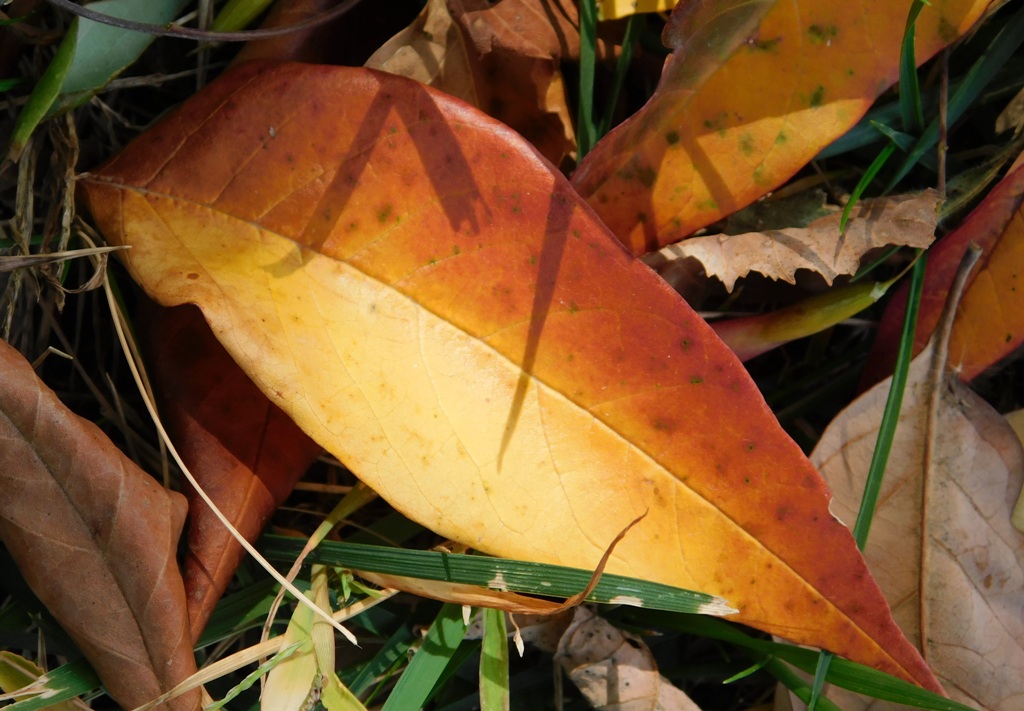
This week, I’m expressing thanks for fall color. For the beautiful leaves!

Leaf Day! Back in high school, one of my best friends and I would select a random day at the height of fall color season, and we would collect a bazillion lovely, bright-colored, fresh-fallen leaves, and then, in each of our various classes, arrive early and place a leaf onto each of our classmates’ desks. Plus the teacher’s. Everyone would be bewildered, but we’d simply reassure them: It’s Leaf Day! We’re celebrating! Aren’t they beautiful?

And our classmates would twirl their leaves and ponder nature during the rest of the class. (The janitors that evening were probably like, “what the hell—?”) Some of our classmates apparently enjoyed it, some thought it was stupid, but most, I think, really understood our point.

I think my friend and I had been inspired somehow to do this by listening to Leo Buscaglia talks on PBS, if that gives you a sense of the time period!

Wait, you haven’t heard of Leo Buscaglia? In the eighties, he was a big star on PBS. He gave lectures. He was a TED talk before there were such things. He was a great story teller, and all his stories made strong points. His favorite topic was love. Love was the title of his first bestselling novel.

We all oughta be reading and listening to Leo Buscaglia again. It would set us to rights again, maybe, for at least a little while. Here’s a video (in two parts) of perhaps his most famous lecture, “What Is Essential Is Invisible to the Eye.” The lecture, this time, was given at the University of Wisconsin–Eau Claire.

The lecture title was from The Little Prince (Le Petit Prince), by Antoine de Saint-ExupĂ©ry, and that was another book we devoured and got deep meaning from. Richard Bach’s Illlusions, another huge bestseller, and all this introspective, pop-psychological stuff set me going on a personal path that has given me a rich life. Not all of what followed was so great, but I’ve mostly managed to keep a balanced view. At any rate, it has helped.

Buscaglia’s lectures were full of humor, poignancy, and basic human wisdom. And emotional intelligence. We internalized tons of it. (And there was tons of it.) “People first, things second.” . . . “Life is God's gift to you; the way you live your life is your gift to God. Make it a fastastic one.”

My parents drove us to see Dr. Buscaglia speak at Kiel Opera House (now Stifel Theatre) in St. Louis. He was touring, and St. Louis’s KETC channel 9, the PBS station, was sponsoring him.

I don’t remember any direct connection our annual Leaf Day celebration had to Leo Buscaglia (his book The Fall of Freddy the Leaf wouldn’t come out until later) . . . but there’s a connection somewhere. (“The trees outside of your home are doing wondrous things; watch them step by step, it’s like magic.”)

But the connection is ultimately about love, and enjoying all the beauty all around us, perfect and imperfect. We don’t have forever; look around and see!

A reminder: to track the progress of fall color in Missouri, make sure you visit the Missouri Department of Conservation's Fall Color Reports page. It gets updated each week, on Thursday, by around 5 pm. Reports come from foresters in MDC's eight regions. And yeah, there's a little bit of me in there. But much better, when you read them, you can tell that the reporters, all professional foresters, really dig their subject.

Sunday, July 24, 2022

Jar of Goodness 7.24.22: Menus for the Seasons

. . . The weekly virtual “gratitude jar.”

This week, I’m expressing thanks for my Uncle Richard.

He’s my godfather, he’s my woodsy uncle, my alternate daddy. He’s a retired conservation agent. He’s recently hit a rough patch, health-wise, and I feel like sharing one of his (((many, excellent))) writings. This is one of my favorites, because he didn’t work hard on it; you know it just flowed from his mind naturally, in a single, beautiful concept.

It’s also a testament to the women in his life, especially his mother (my Grandma Schroeder) and his wife (Aunt Carole), who always knew how to make the dishes of the seasons, which he clearly loved to the point of idealization.

Yeah, there’s longing in this list, the way we long for snow in July, warm sunshine and green things in January, rain during a drought.

Anyone from rural Missouri will understand at least some of this list. Understanding some of it means you get the rest of it, too, by extension.

To me, it’s poetry . . .

Feel better soon, Uncle Richard.

Menus for the Seasons

Winter
Stewed Rabbit
Dumplings
Cooked Carrots
Waldorf Salad with Black Walnuts

Spring
Baked Wild Turkey with Dressing
Morel Mushrooms
Asparagus
Mennonite Biscuits with Molasses or Honey

Early Summer
Creek Perch Fried
New Potatoes
Peas
Polk Greens
Raspberries and Ice Cream

Midsummer
Fried Catfish
Fried Potatoes with Onions
Coleslaw
Sweet Corn
Blackberry Pie

Late Summer
Frog Legs
Green Beans
Tomatoes
Cucumbers
Blueberry Muffins
Homemade Ice Cream

Early Fall
Baked Doves
Baked Squash and Apples

Mid-Fall
Fried Squirrel
Biscuits and Gravy
Blackeye Peas
Sliced Tomatoes
Pecan Pie

Late Fall
B*B*Q Deer Ribs
Baked Potato
Cooked Turnips
Cornbread and Honey
Persimmon Pie

Early Winter
Baked Goose
Sweet Potato
Homemade Bread

Thursday, March 6, 2014

Journeys Around the Sun: Leonard Hall

In my previous posts, I talked about natural history books that have an almanac structure: Edwin Way Teale’s A Walk Through the Year, Hal Borland’s Twelve Moons of the Year, and Aldo Leopold’s A Sand County Almanac. Today, I’m continuing in the same vein, with a book of special interest to Missourians. You probably haven’t heard of this author.


Leonard Hall’s A Journal of the Seasons on an Ozark Farm (1956; reprint, Columbia: University of Missouri Press, 1980), like the other books, is arranged chronologically, with a handful of short essays for each month. Hall wrote a regular column about life on his “Possum Trot Farm” (south of Potosi, Missouri) for the St. Louis Post-Dispatch and Globe Democrat from 1946 to 1980.


Hall embraces the conservation ethic that Aldo Leopold so eloquently laid out, and his stories of life on a working Ozark cattle farm show a sustainable land ethic in practice. The changing seasons frame the story of a year’s worth of activities and observations, including migrating geese, cattle auctions, hunting and fishing, gardening, hiking, gathering elderberries, pawpaws, and hickory nuts, and butchering hogs.

If you’re not familiar with Leonard Hall, check out his books. I particularly recommend his Stars Upstream: Life Along an Ozark River, about the Current and Jack’s Fork rivers. It’s a classic every Missourian ought to read.


Since I was inspired to write about these books by my late-winter longing for spring, and being on constant watch for signs that springtime is coming, I’ll quote a few sections from Hall’s Journal of the Seasons on an Ozark Farm.


“This is a time of year we could do without. There are gloomy days when I have a profound sympathy for those furbearers which hibernate or for the birds that fly south in autumn. But then comes a snowy morning when the earth might have just been born and the chickadee sings as if it were summer, or a mild evening when the sunset paints the western sky in vivid colors and the young calves chase each other across the pasture with tails high in the air. Then I decide that one way or another, we’ll somehow ‘make it through to grass.’” (“January: The Sun Starts North,” p. 190.)


One of my favorite signs of spring is the sound of spring peepers, tiny peeping frogs that, in full chorus, sound to my ear like thousands of little jingle bells, though they symbolize anything but Christmastime. Here’s Hall’s description:

“When the worst blizzard of winter struck the western states this week, our thermometer at Possum Trot dropped sharply and a hard wind out of the northwest rattled the shutters, sifted in through the storm sash, and set the phone wires to singing. We hurried out in the morning to have a look at the baby calves, but found them galloping about the pasture with tails high in the air as if it were summer. Then on Sunday afternoon the wind dropped to a whisper and the mercury climbed into the fifties again. After supper, when I went to make sure the biddies were safely shut up in the hen house, I heard the first spring peepers singing, down in the pond in the woods.” (“February: Spring Edges Closer,” p. 205.)


And that’s how you always hear the first spring peepers of the season. It will be some supremely welcome warmish day, and you will be walking outside in a light jacket some evening after supper. And suddenly you hear them, jingling away, in some seemingly insignificant little pond in the woods.


Of course, there’s still an excellent chance it may snow and freeze again, but I agree with Hall: “There is something optimistic about the note of the first spring peepers that braces us against the occasional spell of cold weather which may still lie ahead” (p. 206).


Here’s to the birds who are remembering their songs
and the young birds who are tuning up for the first songs of their lives;
the geese honking, winging north on the heels
of warming weather,
and stopping overnight in marshes in gabbling flocks;
and tiny frogs awakening,
slipping out of cold mud,
and perching at the water’s edge
to peep their riot of love songs.

And here’s to the reawakening of the entire green world.


Tuesday, March 4, 2014

Journeys Around the Sun: Aldo Leopold

In my previous posts, I talked about natural history books that have an almanac structure: Edwin Way Teale’s A Walk Through the Year, and Hal Borland’s Twelve Moons of the Year. Today, I’m continuing with another classic natural history author.


Today, it’s one of the most famous written celebrations of the annual cycle of nature, by that giant oak of the conservation movement, Aldo Leopold: A Sand County Almanac (New York: Oxford University Press, 1949). It’s not a day-by-day approach; its chronology is monthly. The location is Wisconsin, but the application is global.

If you haven’t read it yet, you can get it for just the cost of shipping; there are over 2 million copies in print; just do it. It is a great classic of natural history writing, full of heart and soul, unflinching truthfulness, a celebration of all that is wild. A bonus thrill is that (in the original edition) the illustrations are by Missouri’s own Charles W. Schwartz.


In keeping with the theme of longing for spring, I’m sharing a sample from this book, also about birds and the coming of springtime, from a section titled “The Geese Return”:


“One swallow does not make a summer, but one skein of geese, cleaving the murk of a March thaw, is the spring.

“A cardinal, whistling spring to a thaw but later finding himself mistaken, can retrieve his error by resuming his winter silence. A chipmunk, emerging for a sunbath but finding a blizzard, has only to go back to bed. But a migrating goose, staking two hundred miles of black night on the chance of finding a hole in the lake, has no easy chance for retreat. His arrival carries the conviction of a prophet who has burned his bridges.” (“March,” p. 18.)


“. . . When it has become warm enough to sit outdoors, we love to listen to the proceedings of the convention in the marsh. There are long periods of silence when one hears only the winnowing of snipe, the hoot of a distant owl, or the nasal clucking of some amorous coot. Then, of a sudden, a strident honk resounds, and in an instant pandemonium echoes. There is a beating of pinions on water, a rushing of dark prows propelled by churning paddles, and a general shouting by the onlookers of a vehement controversy. Finally some deep honker has his last word, and the noise subsides to that half-audible small-talk that seldom ceases among geese.” (Ibid., p. 22.)


Monday, March 3, 2014

Journeys Around the Sun: Hal Borland

In my previous post, I talked about a favorite “essay-a-day” natural history book, Edwin Way Teale’s A Walk Through the Year. Today, I’m continuing on the topic of almanac-format nature books.

A similar book, in a similar vintage, is Hal Borland’s Twelve Moons of the Year (New York: Knopf, 1979).


Borland wrote a weekly natural history or “outdoors” editorial in the Sunday edition of the New York Times for 35 years. This book, which he was finishing when he died, is a collection of those brief editorials—so well written . . . so well written.

I’ve been dipping into this book especially, since he writes so eloquently of our desire in late winter to look for signs of impending spring. Wasps waking and flying groggily about on a prematurely warm day. The courtship of owls and squirrels. The lengthening days. Rising sap. The hope encapsulated in the buds of trees. And the first tentative, brief bird songs.

“There are things to be heard if one is at all attentive. At noontime on a sunny day the dooryard sparrows begin to test a few phrases of remembered song. The chickadees, which will lisp a greeting any winter day, now extend their songs, simple though they are. The nuthatches still say nothing but yank, but they say it more often and with a new intonation. From the woodland the male cardinal whistles as though he really means it.

“. . . Spring is not yet at hand, but there is change, and there are subtle stirrings here and there, if we forget the calendar and listen.” (“Subtle Signs of Spring,” February 15, pp. 46-47.)


He notes a softening of the blue jay’s raucous voice:

“But when February comes and daylight begins to linger, the jays begin to feel, perhaps down in their hollow bones, that life is good and soon will be even better. They whisper this, at first, to themselves. Then they say it aloud, but softly. It is a wholly new note, actually a two-note salute to the season. It is almost musical. It really is the blue jay’s prelude to a love song, a sentimental secret the secretive jay can no longer keep to himself.” (“The Secret,” February 8, p. 41.)


It’s not going to make spring come any sooner, but reading this helps me remember that I’m not alone in looking for “signs,” and that people have always yearned for spring this way.

Sunday, March 2, 2014

Journeys Around the Sun: Edwin Way Teale

It’s still early enough in the year to be thinking of the passage of time, as I do at every new year—jeez, it’s hard to believe it’s the year 2014! I suppose part of my pondering might also have something to do with this year’s lengthy onslaught of snow and bitter cold—I can’t help looking for signs the spring is coming.

And it is. Even if we’re getting yet another dump of ice and snow this weekend!


My evidence? Well, haven’t you been hearing cardinals singing outside your windows in the mornings? I have. And it’s a damn good song they’re singing!

I’ve been dipping into some of my favorite books that celebrate the annual cycle. A recent comment on my blog suggested to me a book by the great natural history writer Donald Culross Peattie, An Almanac for Moderns. (Thanks, Tina, I’m going to check it out!) Peattie’s books describing America’s trees are exquisite blends of science, poetics, and philosophy. Peattie educated his reader while ensouling his subjects.

Of course, the famous quartet of books by Edwin Way Teale is a monument to the changing American seasons, and I’ve written about them before.

But Teale’s more compact, and personal celebration of the changing seasons is A Walk Through the Year (New York: Dodd, Mead, 1978). In it, he writes a brief essay for each day of the year, describing some natural event that happened on his farm in Connecticut. He intended it as a companion to A Naturalist Buys an Old Farm, which tells about the property he purchased later in life, Trail Wood, which he treasured as a natural area.


A Walk Through the Year is pure Teale. In it, one of his later books, he shares his reflections on his and his wife, Nelly’s observations of nature at Trail Wood. It’s a gentle and pleasant conversation, as if you and the aging Teales were chatting in their living room, sitting around their cozy fireplace on some evening after a blizzard. “Guess what we saw at one of our bird feeders yesterday!” And “I was walking on the lane to the road and saw a red fox—guess what it was doing!”

To show you why I’ve been dipping into this book, and to celebrate the springtime we’re all hungry for, here’s an excerpt from A Walk Through the Year. Because the Teales were nuts about birds, I’ve chosen one about birds—specifically, red-winged blackbirds:


“February 28. This is the sound we longed for, dreamed about, looked forward to in the darkest days of winter. Rising and subsiding, becoming a storm of mingled voices, then ebbing away, it comes from the treetops along the brook. It is an excited sound, a festive, holiday sound. Like the torrents of spring, it is a rushing, liquid sound that here antedates the spring. It is the great chorus of the first of the homecoming flocks of the redwings.

“Bare only yesterday, the treetops along the brook today are clothed with blackbirds. A hundred and fifty or more swirled down to alight among the leafless branches before dawn today. All are males. The females will arrive later. We watch the birds, in the richness of their breeding plumage, flying from tree to tree, each alighting with its scarlet epaulets exposed. Their surging energy is contagious. We feel a sense of elation, a wave of optimism. The stolid endurance of the deepest winter drops away.

“We listen to the overlapping chorus of ‘okaleees’ or ‘bob-y-leees’ swell and fade and begin again. The interplay of sounds merges into a rolling, trilling clamor. Standing listening, we catch little dropped notes spilling through the chorus. The ‘okaleeeing’ is replaced by sharp metallic calls as all the birds take off in a cloud of black to sweep in curves, to turn and turn again, and then swirl down once more to the tops of the brookside trees.

“It is usually near the end of this shortest month of the year or in the earliest days of March that the redwings come back to Trail Wood. The intermingled tumult that comes down from the treetops seems compounded of relief at the end of a long journey, of ecstasy in reaching an age-old breeding ground, of health at a peak, and life lived intensely. We are swept along by the excitement pulsing through these hundred and more bodies. This wild musical clamor of the first of the returning redwings reechoes in our minds long after it is left behind. For the birds, the farflung journeys of migration now are a thing of the past. For us, the winter—all but a few short weeks—has run its course.”

------------------------------------

And yes: While visiting my parents two weeks ago in Columbia, Sue and I heard our first raucous, cacophonous red-winged blackbird chorus of the spring, and we almost jumped for joy!

Is winter over? Of course not. Look at all this frickin’ ice!

But hey—keep your hopes up! The cardinals are singing, and the redwings have appeared.


Saturday, November 5, 2011

Edwin Way Teale’s Autumn across America

Today we’re celebrating another classic work by the famous midcentury natural history writer Edwin Way Teale: Autumn across America: A Naturalist’s Record of a 20,000-Mile Journey through the North American Autumn (New York: Dodd, Mead, 1956).


This is my third “book report” on Edwin Way Teale this year: I decided that in 2011, I would reread all four of Teale’s “American Seasons” books, in their appropriate seasons! To catch up with me, click here for my post on Teale’s North with the Spring (and an introduction to this remarkable quartet of books), and click here for my post on Teale’s Journey into Summer (including a discussion of the timing of the trips and the publication of the books).

The American Seasons Series: Spring and Summer

Each of the four American Seasons volumes chronicles the automobile travels of Edwin Way Teale and his wife, Nellie, as they traverse the continent for months, following the progress of a season in as many places and aspects they can.

In the spring volume (published in 1951 based on travels made in 1947), they rode the wave of the season from the southern tip of Florida all the way up to Maine: one big, long extended springtime of migrating birds and opening wildflowers—and lots more that you never would have noticed—all the way up the coast, ending as spring does with the summer solstice.

The summer book was published in 1960, based on their travels during the summer of 1957. For that project, they started at the summer solstice in New Hampshire, traced the northern edge of the United States clear to Montana, then wandered south through the Great Plains and explored Colorado and its Rockies. Thus they experienced “the summer of the shore, the summer of the forest, the summer of the Great Plains, the summer of the mountains . . . in vacation spots—along lake shores, on the mountain heights, in the cool north woods . . . [as well as] on salt flats and in corn country, amid swamps and in areas where falling rain would be sucked up by the thirsty atmosphere before it reached the ground.”


The Autumn Project

The autumn travels, and publication of the autumn book, actually occurred between the spring and summer projects. Autumn across America was published in 1956, based on travels that occurred in 1952. Their trip began in late August, looking east across the waves of the Atlantic on Cape Cod. Why in August? Teale explains at the beginning of chapter 3:

The season of summer extends to about September 21 but the summer season ends with Labor Day. Then the newspapers begin referring to summer in the past tense. Vacations are over. Schools commence. To the popular mind, September belongs to autumn as December belongs to winter. (p. 19)


Their autumn trip starts out rather like the summer one, for they travel west from New England taking a somewhat northern route, through Ohio, Michigan, Illinois, Minnesota, and the Dakotas. But here they continue west all the way to the Pacific, visiting Wyoming, Montana (and Yellowstone), Idaho, Utah, Oregon, and Washington.


Then they proceed southward into California, seeing the sequoias, Monterey, the migrating monarchs at Pacific Grove, and Yosemite. They end up on a very windy Point Reyes, north of San Francisco, facing westward across the Pacific, at sunset on the shortest day of the year.

Some Major Themes

Teale was an incredibly organized writer. Each book of the quartet offers about the same blend of topics. In each, there’s a chapter or two spotlighting individuals who make their living from the land, and he marvels at expansive agricultural endeavors, and their picturesque qualities.

And although he’s mostly interested in animals and plants, with chapters spotlighting particular species, he always includes a few chapters focusing on geological matters, on landscapes, on astronomy, and on notable environmental tragedies, or on disasters averted.

But in this volume, more than the others, there are certain subjects Teale weaves through the whole book:

Bird Migration. The Teales were avid birders! It’s no accident that their autumn trip took them across all four major flyways for migration, and Teale writes enthusiastically about the flocks they see. The map in the front endpapers has the four major North American flyways marked on it. Along the Atlantic Coast Flyway, there are “swallow clouds” at Cape May, where bazillions of migrating birds concentrate before crossing the Delaware Bay. The Teales trace the Mississippi Flyway in five states, and see the Central Flyway as they travel through the Dakotas, Wyoming, and Montana.


At some point, if you’re not really into birding, you either get weary of reading about the birds, or you begin to chuckle affectionately at Teale’s enthusiasm. At the Bear River delta on the Great Salt Lake, they experience their “Million-Duck Day,” where Teale, well, positively gushes at the thousands and thousands and thousands of birds they saw.

He keeps returning to his writerly style but always ends up helplessly gushing once again about the huge flocks: “For us who, among the depleted, overgunned ponds of the populous east, were accustomed to counting our flocks of migrant ducks in dozens and scores, the wonder never diminished in these thousands and tens of thousands and hundreds of thousands of waterfowl” (p. 194). (Remember, Teale was writing at a time when conservation laws were still rather new.)

And then later, they visit the Sacramento National Wildlife Refuge (on the Pacific Flyway) and see more zillions of birds: “Wherever we went the roar of waterfowl wings preceded us as mallard and pintail and baldpate and green-winged teal—perhaps some of the very birds we saw at Bear River—shot into the air from behind the curtain of the tule rushes” (p. 316). But the big deal there, that day, for the Teales, was the swarms of blackbirds! (But I’ll let you read about that yourself.)


Tracing the Paths of Explorers. Their route took them west, but they do more than just intersect with the paths of some famous explorers: They trace them. They first join the trail of Lewis and Clark at the juncture of the Knife and Missouri rivers, where, at Fort Mandan, the explorers had met Charbonneau and “his amazing squaw, Sacajawea” (p. 127).

Wait a minute—a note on that loaded term: The word squaw was not a loaded term in standard American English in midcentury. Americans didn’t know it was a deeply offensive term in the Native American language from which it was adopted. As far as any of us knew, it was a Native word for “wife” or for “woman”—same as you might refer to a young French woman as a “mademoiselle,” or a Spanish man as a “señor.” The Russian king was a “czar” and a Muslim sovereign was a “sultan.” I’m pretty sure that nearly all Americans who were not First Nation peoples had no idea that squaw was an offensive term, and Teale was simply using the pleasantly widened vocabulary of an educated man.

So let’s cut him a break, and acknowledge that the word came to have a different meaning in American English than it had in its original language. And, yes, now that we know how offensive it is, let’s please quit using it.

At any rate, it is clear that Teale admired Sacajawea, for he speaks directly about the importance of her contribution to the expedition. He mentions her often and notes places where she has been memorialized in place-names.

And so their path leads them along the Missouri, through the Rockies, all the way to where the Columbia joins the Pacific. Teale quotes from the Lewis and Clark journals, and he notes several plants and animals named for the explorers. He keeps the famous expedition in the reader’s mind as well as his own.

~~~~~~~~~~~~~~~~~~~~~~~~~

(By the way, this is not the "Lewis and Clark" we've been talking about! --Just a bit of humor to see if you're still paying attention!)


~~~~~~~~~~~~~~~~~~~~~~~~~

Another explorer whose path the Teales keep intersecting is less well-known, except among biologists: Thomas Nuttall, and his assistant John K. Townsend, traveled the interior of America in the early 1800s not long after Lewis and Clark, botanizing and collecting biological specimens. Nuttall was the curator of the Harvard Botanic Garden, and as a result of his travels, he added “more new species to the lists of science than any other man in America” (p. 28). The Teales follow Nuttall’s path, off and on, from Cape May on the East Coast all the way to Vancouver and to Monterey. And yes, the parts about Nuttall are more fascinating than those about Lewis and Clark.


Autumn Color. Well, of course, Teale had to write about this subject. But perhaps the most surprising thing about Autumn across America is that the Teales, who lived in New York at the time, began their fall trip by promptly leaving New England! Remarkable, since New England is the official place to see a glorious riot of autumn foliage, picturesque white-painted churches, and so on. But the Teales have big plans—they’ve got to get across the continent, and through Rocky Mountain passes, while it’s still “fall.”

Teale gets around this problem by relating the splendor of New England’s fall color from memory! Then, he proceeds to witness and describe all the different colors of autumn, all across America. Autumn looks different in the Dakotas, in the treeless plains, in the Rockies, in the Pacific Northwest, in Northern California, than it does in the entire eastern half of the country.


One chapter focuses on “dusty autumn”—this is the dustiest time of year. (The early fifties, I understand, were drought years throughout much of America.) Though it is the bane of anyone trying to keep a place tidy, atmospheric dust, Teale points out, is what gives us our brilliant sunrises and sunsets, and it is what forms the nuclei of every single raindrop and snowflake: No dust, no clouds, no rain.


In his ruminations about fall color, Teale provides an especially insightful paragraph about the way we “feel” about autumn—how the lower humidity, the crisp air, the generally clear skies, and, especially, the riots of color in the landscape serve to exhilarate and uplift us:

In the forest, fall is the season of light. The aureate leaves, the golden carpet of fallen foliage reflecting rays upward from the ground, these fill the deciduous woodlands with a luminous radiance unknown at other seasons of the year. Henri Amiel noted in his Journal Intime: “The scarlet autumn stands for vigorous activity; the gray autumn for meditative feeling.” Later in the season there would come slaty skies, brown leaves, gray autumn. But now we wandered in the multicolored early days of fall, the time of vigor and elation. (109–10)


I truly appreciate that distinction between “red autumn” and “gray autumn,” for it helps me to conceptualize this Janus-faced season, so intensely colorful at one end and depressingly drab at the other. It’s almost hard to “picture” autumn for this reason. Thanksgiving usually looks very little like Columbus Day! (The dividing line, of course, is usually the Abscission Wind!)


The Pacific Coast.
Of the quartet of books, this is the only one that explores Northern California, Oregon, and Washington, and it’s clear the Teales glory in these travels. About a third of the book focuses on this leg of the trip. (Here's a photo from the book--the Teales are seeing a group of sea otters, which were then just beginning to come back along the Pacific Coast.)


They’re easterners, writing for an audience that viewed the West Coast as a spectacular vacation destination. So if you like places like Yosemite and the Sierra Nevada, Monterey Bay, the Redwoods, Mount Ranier, the Olympic Peninsula, tidepooling and skirting the coast all down the length of Oregon . . . you will love where this book goes.

End of the Trip

Teale really wraps it up nicely; their autumn travels began in late August, with them standing on Cape Cod, staring eastward across the Atlantic, watching the tide rise to its fullest point and then start to go out—and they complete their journey facing west across the Pacific, on a windy crag at Point Reyes, watching the tide ebb on Winter’s Eve, the shortest day of the year. (Here is a photo from the book, of the lighthouse at Point Reyes, taken that day.)


They return the next day to watch the hands move on Teale’s wristwatch as the minutes slip away from autumn: “The sun, shining from farthest south in the heavens, ‘stood still’ before beginning its long, slow climb to the zenith of June. One instant it was autumn, the next it was winter. In this moment in the sunshine, between breaths, fall had slipped away” (p. 363).

I have to admit, I got a little choked up as I read aloud the final passages of the book. At some point, you just feel like you’re traveling along with Edwin and Nellie, and when their epic adventure—their incredible, once-in-a-lifetime autumn trip across America—draws to a close, you can’t help but feel a pang.

I don’t know if I mentioned it, but Sue and I have been reading these books together, aloud, in the evenings, or when we have some driving to do. We react to it, comment on it, discuss it. It’s very pleasant to share a book this way, and I heartily recommend it.


So now there’s just one more of Teale’s American Seasons books: Wandering through Winter, based on travels that took place during the winter of 1961–1962, and published in 1965. (That’s the year I was born—how about that! This is also the book where Teale visits Jefferson City!) Wandering through Winter was the book that earned Teale the Pulitzer Prize, when Teale was sixty-six and had some thirty books to his credit.

Well, it’s been a long time since I’ve read Wandering through Winter, so stay tuned for the final installment—I’ll probably be blogging about it about three months from now!

Saturday, March 26, 2011

Teale’s North with the Spring: A Natural History Classic

At some point when I was in college, my inveterate book collecting transitioned from “literature” to “natural history literature,” and it was about that time I discovered the prolific Edwin Way Teale (1899–1980). (Follow this link to see the Wikipedia entry about him.) His manuscripts and papers are archived at the Thomas J. Dodd Research Center at the University of Connecticut.


Here is a photo of Teale that appeared in his book North with the Spring.


It bugs me that he seems so little-read today; in the middle twentieth century, his writings and photographs were everywhere: In bookstores and libraries, in magazines like Natural History and Popular Science, and in the glowing reviews of his books in the New York Times, the Atlantic, and Scientific American. He was the author or editor of more than thirty books.

He won the John Burroughs Medal for distinguished nature writing in 1943 for one of his early books, Near Horizons, “the story of an insect garden.” Some other authors who have won the Burroughs medal are David Quammen, John Alcock (who also wrote of his own insect garden, in Tempe, Arizona), John McPhee, David Rains Wallace, Peter Matthiessen, Barry Lopez, Aldo Leopold, Ann Zwinger, Hal Borland, Loren Eiseley, Joseph Wood Krutch, Rachel Carson, Roger Tory Peterson, Ernest Thompson Seton, and William Beebe. And these are distinguished authors indeed.

Teale also won the Pulitzer Prize for nonfiction, which puts him into a category of even more famous authors. His book that won the Pulitzer, Wandering through Winter (1965), was an offshoot of the book I’m focusing on today.


North with the Spring

Teale was an established nature writer when he began the North with the Spring project; it’s not clear to me that it even started out as a book. Instead, it began with the simple human desire to escape winter. But during the years of planning, his desire to remove himself to a warmer place intensified: Teale and his wife, Nellie, lost their only son, David, in action during World War II. I think at that point the Teales just wanted to get away, to go driving. But it had started with a late-winter yearning for an extended road trip, one that would give them a grand tour of the North American spring:

Bare trees imprinted the black lace of their twigs on a gray and somber sky. Dingy with soot, snowdrifts had melted into slush and were freezing again. Behind us, as we drove south, city pallor was increasing. Tempers were growing short in the dead air of underventilated offices. . . . February, at once the shortest and the longest month of the twelve, had outstayed its welcome. The year seemed stuck on the ridge of winter.

At such a time, when you look with dread upon the winter weeks that lie before you, have you ever dreamed—in office or kitchen or school—of leaving winter behind, of meeting spring under far-southern skies, of following its triumphal pilgrimage up the map with flowers all the way, with singing birds and soft air, green grass and trees new-clothed, of coming north with the spring? That is a dream of the winter-weary. And, for nearly a decade, it was, for Nellie and me, both a dream and a plan. (1)

They had been contemplating a springtime-long trip for years, but had put it off. “And while we waited, the world changed and our lives changed with it. The spring trip was something we looked forward to during the terrible years of World War II, during the strain and grief of losing David, our only son, in battle.” The book (plus the three other “seasons” books that followed) is dedicated to David, “who traveled with us in our hearts.”

It was on Valentine’s Day in 1947 that the Teales loaded up their Buick with maps, binoculars, field guides, notebooks, and camera equipment, and departed from their New York home for the southern tip of Florida, where “spring” is more of a concept than an observable event.


Starting in the Everglades, the Teales drove a widely zigzagging route all the way to Maine. From February to the summer solstice in June, they “witnessed the defeat of winter” in twenty-three states, and put 17,000 miles on their Buick.


Here is the map printed on the endpapers of North with the Spring; a similar map appears in each book of the quartet. Once Wandering through Winter was done, it and each reprint of the others included a map showing all four routes together. There are only a few states that get short shrift.


And they took excellent notes; they met fascinating people, both famous and unknown. They visited a gracious Marjorie Kinnan Rawlings (author of The Yearling) at her Florida home (now a historic state park)—the visit Teale documents, it turns out, was only six years before Rawlings died; she treated them to a lovely picnic lunch out in the Florida scrub at a cool sinkhole that had inspired a location in her most popular novel.

Teale documents equally well a day spent with a Mrs. Toy Miller, a snuff-using backwoods herbwoman in Kite Hollow, North Carolina. She showed the Teales how she collects medicinal plants for the Greer Drug Company, which at that time was a wholesaler of pollen, ginseng, goldenseal, and all manner of other wildcrafted botanicals (today, the company has become Greer Laboratories; look here).

Each chapter is a snapshot of a time and a place, all revolving around nature and the way human lives were interacting with it at midcentury. The book is a travelogue by an insightful and knowledgeable pair of travelers. Reading the book in 2011, sixty years after the publication of North with the Spring, fills me with curiosity about “the rest of the story.”

Teale tells of viewing a lone whooping crane at the zoo in Audubon Park, New Orleans, likening his experience to what people must have felt upon viewing the last living passenger pigeon at a zoo in 1914. As of 1941, there were probably only about twenty-one whooping cranes in the whole world. But, Teale writes, not long after he saw this individual crane, it was used in a captive-breeding program and became the mother of the first whooping crane hatched in captivity. In the sixty years since Teale saw this bird (named Jo), the cranes have rebounded somewhat; today there are some four hundred in the wild. It is still one of the most endangered birds in America, but it’s much better off than when Teale visited the zoo that day in 1947.

Teale mentions details that make me nostalgic for the Americana that was disappearing when I was a little girl—they spend the night in “tourist courts”; they purchase gas at service stations, where attendants pump gas into their car for them and offer up friendly, colorful comments. It was America before interstate highways, when driving faster than fifty was “careening.”


Here is a photo of Nellie Teale (and their nifty 1961 Oldsmobile) that appeared in Wandering through Winter. The caption notes that she is identifying a desert plant.


So much has changed since Teale wrote. In some ways, his “seasons” books are sadly “out of date.” But by now, we can read them knowing full well that science has marched on and refuted some of the knowledge that had been gained at midcentury; meanwhile, we can appreciate the America of the past, despite its faults and naivety. Reading North with the Spring aloud to Sue, I kind of choked when I came to this passage, describing scenes they witnessed in South Carolina: “With green, freshly cut bamboo poles, Negroes were out for the spring fishing, angling for ‘stump-knockers’ in brimming roadside ditches” (136). I don’t find the diction as thought-provoking as I do the scene of people fishing with the crudest of implements in flooded roadside ditches. There are clues to the past in these books that I’m not sure Teale quite intended to provide.


Teale’s Quartet of Seasons


North with the Spring
was the first book in a quartet that took twenty years to complete; after its publication in 1951, the Teales completed three more trips, each carefully planned to maximize their experience of seasonal progress across the United States. In 1952, the couple traveled from Cape Cod to Point Reyes (north of San Francisco) to experience Autumn across America (published in 1956). Their Journey into Summer took place in 1957, and the book came out in 1960; the Teales’ summer travels covered the entire eastern three-quarters of the United States, beginning in the White Mountains of New Hampshire and ending at the top of Pike’s Peak in Colorado. Wandering through Winter, the final book of the quartet and the volume that won the Pulitzer Prize, was published in 1965, based on their 1961–1962 trip that stretched from the Silver Strand, south of San Diego, to the northeastern corner of Maine.

By the time they were done with their travels for the four books, including return trips to some places to check facts or obtain additional information, Teale states in his acknowledgments in Wandering through Winter that they had logged “well over 100,000 miles by automobile, airplane, ferry, mudboat, snow Weasel, scout car, Jeep, cog railway, canoe, on foot and on showshoes.” (If you don’t know what a snow Weasel is, you have to look at the winter volume!) (By the way, using the current IRS mileage reimbursement rate for business-related travel, that amount of traveling would count for $51,000 in 2011!)

These books represent America as it was, and America as it is (for much in the natural world changes little, even though human fashions change); the Teales are like gentle, reflective, knowledgeable grandparents. Sometimes, perhaps, Teale waxes a little too much about the birds they see (one reviewer on Amazon complained wearily: “He points out every single bird he sees!”)—but mostly, the reason I think Teale is not so popular today is that he simply takes his time. He reflects on the things they witness; he reflects on humanity. The Teales poke along on America’s back roads. Teale explains things well; he occasionally goes off on tangents. But all his tangents are interesting!


When I read these books, I feel as if Teale is speaking to me. There are occasional moments when Teale, in addition to addressing his contemporary audience, also nods to the posterity who would hear his voice in their minds long after his death. Here is one such passage from North with the Spring:


Later . . . we stopped by the wooden bridge once more. . . . The limpkins were snail hunting among the eelgrass of the shallow borders. The river rang with the wildness of their calls. Theirs was a voice that spoke for an older time, a long-ago time. . . . It was the voice of the dark, the swamp, the vast wilderness of ancient times. It links us—as it will link men and women of an even more urbanized, regimented, crowded tomorrow—with days of a lost wilderness. (93)

Reading this makes me want to hear limpkins, too, and not just on Cornell’s ornithology website.


Teale understood that he was placing himself at a distinct moment in time, that he was writing for the future, in addition to his many contemporary readers. This is most evident on pages 346–47, at the end of Wandering through Winter, the volume that finishes the quartet:

And so we came home at last. We came home rich in memories. We drove down the long lane to the 160-year-old white cottage under the hickory trees. We unlocked the door in spring that we had locked in autumn. We found calendars of another year hanging on the wall....

Another spring is coming in as these words are written. The white magic of another winter is gone. Another night is falling over our woods and fields and pond. I switch on the lamp above my study desk. Its soft light falls on typed sheets of fieldnotes, on marked maps, on odds and ends, mementos of our winter travels. I am nearly at the end of that self-imposed task that for more than two decades has been my work and my relaxation, my livelihood and my diversion. While I have been wandering across the country and writing of what I have seen . . . two new states, Alaska and Hawaii, have been added to the Union, the population of the United States has grown by 50,000,000 and the earth has traveled through space 10,000,000,000 miles.

I set down these final words in the dusk of an early spring day. You are reading them when, where, under what conditions? Now the light—my light here, your light wherever you are—falls on the last page of the last book of the last season. We have traveled far together. We have watched the successive seasons flow and merge and intermingle. We have seen the beauty of the land through the whole cycle of the year. To those of you who have journeyed so long, who have traversed the four seasons in our company, to all farewell.
For here ends the story of our travels
through the spring and summer
and autumn and winter of
The American Year.


This is the year, I think, that I will reread all four of these books during their respective seasons. What a rich, pleasant exercise! I think the only thing that could be better than this would be to grab our binoculars, field guides, laptops, pack our bags, get in the Honda with Sue and her photography equipment, and disappear for some months, retracing one of the Teales’ seasonal paths, looking to see what’s become of the places and people his books today memorialize. . . . And finding all new adventures along the way.