Showing posts with label vegetarian. Show all posts

Monday, August 3, 2026

Julie's Granola

Yes, it’s precious to announce this as my own recipe, since I openly adapt it from Carol Gelles, 1,000 Vegetarian Recipes. I think it’s an unspoken truism that any granola recipe is intended to be altered to fit what you have on hand, and what the saveur du jour happens to be. But I’ve tweaked it enough that it’s pretty much my own. But thank you, Ms. Gelles (or Carol, if I may).


A few ingredients notes: I like to use genuine sweetened carob chips. These days you have to hunt for them, because last time I looked, I couldn’t even get it at our local health foods store. Whaaaaaat—? Yes. But I seriously like carob chips in my granola, muffins, granola snack bars, and so on. I’m not going to try to make “chocolate” frosting, cake, or brownies out of it. But as a flavorful ingredient used like raisins or blueberries, they’re really quite nice. Be sure to used sweetened carob chips.

Cashew pieces: I’ve been buying raw cashew halves and pieces in a bag at the international store. Look for Swad brand, in the India aisle. Since childhood, I disliked cashews, but those were always Planter’s roasted and salted cashews. But when you them raw, you can toast them yourself, and season or not. Much more delicious.

And substitute stuff as you like. Just keep the overall quantities about the same: you need enough liquid-stuff to moisten enough for everything to get a little coated with the oat bran, wheat germ, brown sugar stuff. Also, the original recipe called for raisins. You could swap craisins or other dried fruits, nuts, etc. See notes after the recipe for more tips.

  • 3 T butter
  • ⅓ cup brown sugar (packed)
  • 1½ to 2 T juice (apple, orange)
  • 2 c. plain, rolled oats
  • ⅓ c. sunflower seeds (or pumpkin seeds)
  • ½ cup wheat germ (I use Kretschmar’s toasted wheat germ)
  • ½ cup oat bran
  • ⅓ cup raw cashew halves and pieces (or other nuts)
  • powdered cinnamon (to taste)
  • ⅓ cup sweetened carob chips (or chocolate chips)

Preheat oven to 350°F. (If your oven runs hot, set it at 325.)

Spray a 9-x-13-inch baking pan with Pam (Pyrex casserole dish is good). In a microwave, melt the butter, then stir in the brown sugar and juice until dissolved.

In a big mixing bowl, combine all the rest of the ingredients (except for the carob or chocolate chips, or raisins or any other dried fruit you might use). Pour the liquid ingredients over the mixture in the bowl and toss to get everything moistened. (Texture: you don’t want it soggy; if it seems too dry, you can add a little honey.)

Spread the granola mixture into the prepared baking pan and spread evenly. Bake, stirring and checking often, until dryish. The edges will brown first. Don’t let it burn.

Take it out; while it’s still hot, sprinkle cinnamon and the carob (or chocolate) chips over the top. The chips should melt a little bit, which is good. When it cools further, stir in any dried fruits you’re using.

Let it cool completely before storing in an airtight container.

Tips:

  • I suggest adding raisins or dried fruits after baking to avoid them burning. Burnt raisins are evil. I like chopped dried apricots, chopped dried, sweetened pineapple chunks, dates, craisins, etc.
  • Any kind of nuts or seeds are a great addition; the original recipe calls for 3 T. sesame seeds, but I usually don’t keep those on hand, and they go rancid quickly. But I keep sunflower seeds and pumpkins seeds in the freezer; they’re right next to the sweetened carob chips!
  • Granola: you know what to do. Sprinkle on yogurt with fresh fruits. Eat some out of hand as a snack. Eat it with milk as a dry cereal, or mix it in with other dry cereals. Sprinkle some on ice cream. This would be a nice garnish of a cold fruit soup or a fruit smoothie. And so on.

Friday, July 31, 2026

Healthy, Frugal, Simple, Kind

Yes, we need to exercise more, but a big component has been the food. Sue and I need to be eating more healthfully and more frugally, thanks to a confluence of stimuli. We’re both overweight. My A1C and cholesterol have been heading in the wrong direction. And “frugal”? That reflects national trends and my current personal situation.


There have been other stimuli that are more “carrot” than “stick.” First, the death—no, the memory—of Columbia, Missouri’s shining light of vegetarianism, Leigh Lockhart, founder, owner, and high priestess of Main Squeeze café, has led me to re-re-re-reconsider my attitude toward organic, sustainable, healthy, whole-grain vegetarian cooking. She was filled with joy about a sustainable, organic, healthy vegetarian lifestyle. Her slogan was “Goodness for all.” And she meant it!

Since her memorial gathering on June 27, I’ve been poring over Main Squeeze brochures I’ve kept in my recipe scrapbooks. Juices, smoothies, sandwiches, wraps, bowls, breakfasts, soups, hot dishes . . . the only real reason I stopped going to her café was because it was always incredibly busy at lunchtime. We’re talking lines out the door. And I didn’t work anywhere near downtown. Then, we moved out of town and were never even in Columbia for breakfast or lunch.


Also, I’ve been making my way through a new (to me) book, Johnathan Kauffman, Hippie Food: How Back-to-the-Landers, Longhairs, and Revolutionaries Changed the Way We Eat. It describes the historical and cultural ingredients, and movements, that created the cuisine we’d call “health food” in the 1960s, 70s, and 80s. This was the culture and the foods I encountered in Columbia at the food coop and with lots of college friends who made dishes such as “tofu and sprouts.” This was long before Whole Foods commodified health foods, added lots of fancy-schmantzy techniques and top-dollar ingredients, and quadrupled or sextupled the price. (Which is why suddenly it’s become a questionably unquestioned “truism” that “only the rich can afford to eat healthy food.” Hmm.)


Did you know that in college and grad school, I often ate a macrobiotic diet? Brown rice and beans with steamed vegetables. I always kept sea vegetables—hijiki and wakame—on hand! I was quite vegetarian. This was before I got really interested in cooking. And yet I was never strict about anything; I could always turn around, visit a restaurant, and enjoy kung pao pork, chicken mole, or yes, the occasional Quarter Pounder® with Cheese. But at home, I was quite frugal. Brown rice, beans, and veggies matched my checking account, for one thing, and it never, um, disagreed with me.

And I liked avoiding “factory food.” I grew up in a house where margarine was favored because, first, it was low in cholesterol, thus healthier, and second, it was a lot less expensive than real butter. But things changed, and by about 2000, I was switching to butter or olive oil for cooking, and relegating “I Can’t Believe” to a role as a basic bread or pancake spread. I quickly grew skeptical of Hamburger Helper and so on. A close friend in college turned me on to simple steaming and stir-frying vegetables, with only a small bit of lean meat.

So that was the diet I ate for several years.

Eating vegetarian food is also a positive for me because it has always made me feel MUCH less guilty whenever I had to see one of those awful livestock semis on the highway. Don’t tell me it doesn’t bother you, too, when you glimpse the eyes, faces, legs, and tails, or see a snout protruding from the holes, amid the excrement seeping around the bottom of the trailer. Don’t tell me it doesn’t make you feel uncomfortable to think about those living, breathing, intensely worried animals, trying to keep standing, breathing nasty diesel fumes at seventy miles per hour as they endure their one-way route to extermination. I’ve seen too many movies about the holocaust, when humans were treated that way, and I’ve never lost my innate empathy toward animals. I didn’t grow up on a farm and have that kindness and sensitivity crushed entirely out of me. Where does our innate empathy toward animals come from, do you suppose? I think we have more in common than we have differences.

The recent national and statewide cyclosporiasis outbreaks also give me pause. I suppose most stupid Americans will take that as an excuse to eat fewer “green things” and more beef and bacon. Look at how the spate of E. coli cases linked to fast-food restaurants’ handling of alfalfa sprouts led to alfalfa sprouts almost completely disappearing from all restaurants and grocery stores. The answer wasn’t to ensure that employees would simply wash their hands after wiping themselves in the bathroom. It was to remove the ingredient that couldn’t be cooked above 160°F.

It seems one of the best ways to avoid cyclosporiasis is to eat produce that comes from our local farmers markets. It’s not that I ever fully trusted that prerinsed, pretrimmed, prebagged, “where-did-this-some-from” greenery from the big groceries. I’m guessing those giant-ass nationwide produce companies rely on hardworking migrants who are given few potty breaks and nowhere to go when they are. And yes, I have trusted, even admired the produce department of my local Schnuck’s grocery. . . . But beyond that, our local farmers markets are happy places for me. For sheer shopping fun, I’d rather go there than, say, to any mall. Yeah, give me a little more of a push to go to the farmers market!

I’m sensing a new direction. I’ve learned a lot more about cooking since the first time I plunged into healthy eating. I know how to deploy a wide range of spices and how to make masalas, how to cook without scorching stuff, how to make crêpes and sauces and omelets, how to adjust baking times and temperatures to my old, idiosyncratic oven. I know how to make my own sprouts, which will of course be completely free of cyclospora and E. coli. The only thing that can’t really be shortened is prep time, but it appears I might have some extra time on my hands. Healthy, high-fiber food is filling. So be it. Time to lose some weight, anyway.

Monday, February 17, 2025

Aloo Palak Tacos

Rejoice! Today, I present to you: the Aloo Palak Taco!

It’s a tasty, hearty, Indian-inspired vegetarian sandwich.

In the process, I’m also giving you a straight-up recipe for making aloo palak, a north Indian/Punjabi “dry curry” vegetable dish (sabji) of potatoes and spinach, which you can have on its own as part of an Indian-inspired meal, with, say, rice (chawal) plus a sauced/wet curry dish (ones with a lot of sauce or gravy, such as butter chicken or anything-korma), or with a dal (bean/legume dish).

(Here, I serve my aloo palak taco along with a basic masoor dal and white rice. Delicious!)

Not counting the sections for appetizers, salads, and breads/rice, my recipe file of Indian dishes has separate sections for dals (the bean dishes, which are typically a little soupy); “wet curries” (whether with meat or vegetables, these have a kind of “gravy”); and “dry curries” (sabji/sabzi, “dry vegetables”).

Dry curries, or sabji, are vegetable dishes lacking a gravy, though they are usually spiced up really thoroughly. You typically make a masala (say, with oil, onions, ginger, garlic, plus your spices), then add your main ingredient, and cook (carefully, usually at a relatively lower temperature), sprinkling water in the pan only to keep the ingredients from sticking, but not so much as to make the dish “wet.” The masala flavors permeate the main ingredient. You might be familiar with aloo jeera (cumin-flavored potatoes), bhindi masala (okra fried with onions and spices), aloo gobi (potatoes and cauliflower), or bund gobi and mater (cabbage with peas).

If you are not interested in learning how to make your own Indian food, you can simply order a dry curry/sabji from your local Indian restaurant, and use the leftovers from that.

Well, I like to play around with these vegetable dishes, since recipes usually make plenty for leftovers, and they’re already nicely flavored. They make delicious vegetarian sandwiches, burritos, and tacos. They’re good in omelets, too. For big burritos, you can add some leftover rice. For burritos and tacos, I usually add some neutral-flavored cheese, such as mozzarella, Monterey jack, or provolone (sliced or shredded). Having a layer of melty cheese against the burrito or taco tortilla helps give it some structural integrity. Which is so important for hand-held foods.

Which brings us to aloo palak tacos.

Making the tacos is straightforward, if you know how to treat flour tortillas nicely. Whether for burritos or tacos, you need to heat your flour tortillas so they will bend and not break. I use a big, heavy skillet. You might have a griddle or tava. You might need to very lightly oil the surface to make sure the tortilla doesn’t stick. Heat on one side, turn it over, add a layer of cheese, let it get warmed up. Don’t heat the tortilla until crispy, only until pliable. Then add your filling—in this case, a few spoonfuls of reheated leftover aloo palak. Bonus points for garnishing with some chopped fresh tomatoes. Ta-da!

And now, here’s my recipe for aloo palak (potatoes and spinach). It’s based on a recipe I received from Aman and Gurcharan Aulakh, a mother-daughter duo who, in March 2009, taught a series of “Punjabi Home Cooking” classes at the Missouri Botanical Garden. The ingredients are the same, but I’ve tweaked the method a bit from what they told us. (The biggest difference is that they precook the potatoes in a casserole dish in the oven, covered with sliced lemons to prevent browning, while I simply steam the potatoes.)

Aloo Palak

Prepare the two main ingredients:

  • 4 c. peeled and diced potatoes (approx. 1-inch-long rectangles): steam until just done, not mushy, but completely done, and set aside
  • 2 c. frozen chopped spinach: thaw and squeeze out moisture (I thaw in water, then squeeze out in a wire sieve); set aside

Make the masala; note that at any time the ingredients start to stick, sprinkle some water, but not so much water that you make a sauce:

  • 3 T. vegetable oil
  • 1 medium onion, chopped
  • 2 t. minced garlic
  • 1 T. minced ginger

In a wide, heavy-bottom skillet, cook the above until the onions are translucent. Then add the masala spices all at once; lower the heat to prevent burning; sprinkle water as necessary:

  • 1 t. turmeric
  • 1 t. cumin seeds
  • 1 t. black pepper
  • ½ to 1 t. red chili powder (ground) (I use Kashmiri red chili powder, but use whatever ground red chilis you want, or none at all; it’s to your taste)
  • 1⅓ T. ground coriander seed (yes, it’s a lot, but you’ll be glad because this is really good)
  • 1½ t. salt (or to taste; I usually use 1 t., then taste at the end)

After the masala has cooked enough (about five minutes) (you’ll know when, because the oil kind of starts separating out, and it looks and smells like the spices, oils, and onion are all melded), stir in the spinach. Again, you’ll need to sprinkle water to keep it moist. Then add the potatoes and stir gently. Again, sprinkle water if necessary. The potatoes should absorb the flavors of the masala.

Finally, add:

  • 1 T. kasoori methi (dried fenugreek leaves, which you can buy at an international store) (I rub the dried leaves in my hands to break them up a little)

Stir and heat through. Taste for salt.

Thursday, November 24, 2022

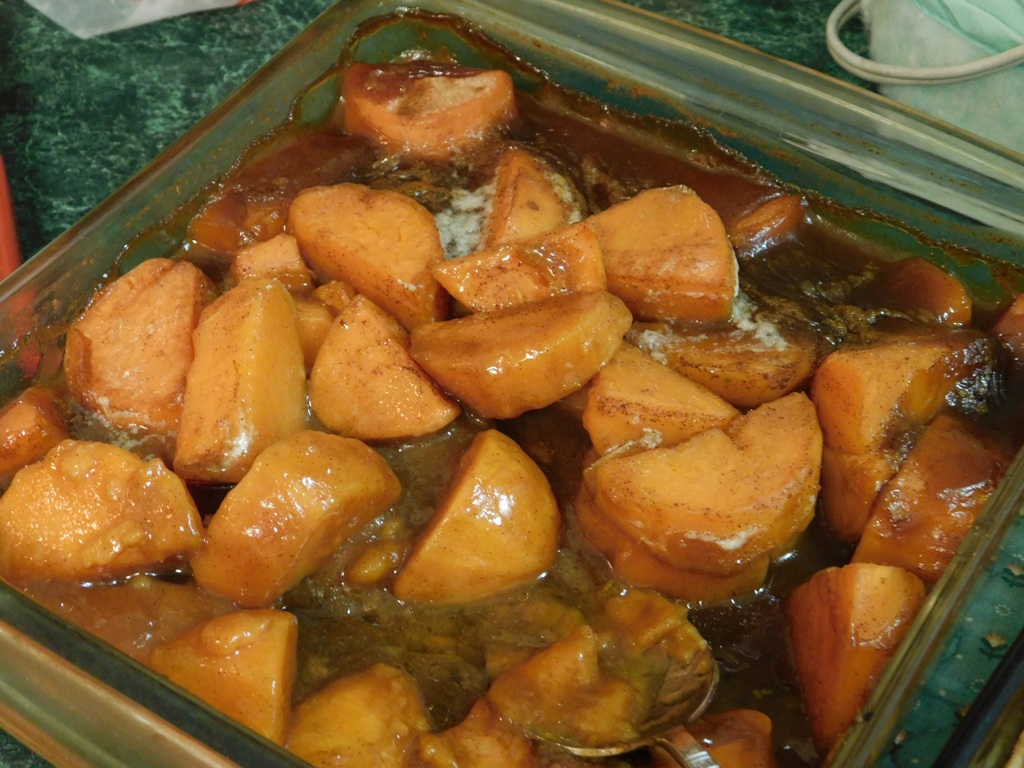
Florence Biffle’s Sweet Potato Bake

Happy Thanksgiving!

This fantastic yet simple recipe, titled “Sweet Potato Bake,” is from Mrs. Florence M. Biffle (1914–2006), who was a member of Faith Lutheran Church in Jefferson City. I recently found her obituary online. I’ll bet my Great Aunt Lydia Meyer knew her well, since she was a longtime member of the same church and was also a quilter. Also, I’ll bet my Grandma Schroeder and Great Aunt Minnie Bartlett new Mrs. Biffle, too, since they were all longtime members of Jefferson City’s Hawthorn Garden Club.

I never knew Mrs. Biffle, but I feel I could easily have known her. There’s a good chance I was in the same room with her at some point, and just never knew it. Anyway, I’m grateful to her for this recipe, and for these small connections between our worlds.

I noticed she was buried out at Hawthorn Memorial Gardens cemetery, so in a few weeks when I'm out decorating Grandma and Grandpa Renner's grave, I'll see if I can find Mr. and Mrs. Biffle.

This recipe was on p. 49 of Cooking with Faith: Favorite Recipes of Faith Lutheran Church Women, Jefferson City, Missouri, by the Faith Lutheran Ladies Guild, Jefferson City, Missouri [ca. 1975].

This is an interesting, fruity-glazed alternative to the standard (and I think tiresome) sweet potato casseroles made with brown sugar, pecans, and marshmallows, so common at the Thanksgiving table. I think you’ll really like this for a change of pace.

I’ll offer my tips and suggestions after the recipe.

Sweet Potato Bake

Cook 4 to 6 sweet potatoes until almost tender. Skin and cut to desired size (chunks). Place in a casserole dish.

Combine and bring to a boil:

1 c. apricot nectar
2 T. orange juice concentrate (not diluted)
½ c. brown sugar
1½ T. cornstarch
1 t. salt
½ t. cinnamon
2 T. butter
½ c. water

Pour over the potatoes and bake 30 to 40 minutes at 350°F.

Julie’s notes:

You can peel the sweet potatoes and cut them into chunks, then cook them in gently boiling water if you don’t want to bake them. I have also steamed them, and that works, too. But don’t overcook the potatoes; remember they will be cooking for another half hour in the oven.

I use a 9 x 9 Pyrex baking dish. You will cook it uncovered, so what begins as a liquid dressing reduces to a gooey glaze over the potatoes. Pull them out of the oven when the sauce is gooey enough for your taste.

The dressing mixes up most easily if you first combine all the dry ingredients together before adding them to the liquid.

Kern’s Apricot Nectar, which is no doubt what Mrs. Biffle had in mind, used to be available at all the grocery stores around here, but I haven’t seen it in years. I think the company’s out of business. There’s another brand called Jumex, but I’ve never seen it except online. I’ll bet it’s something to look for at an international store. Both seem to contain high fructose corn syrup and other less-than-desirable ingredients. But it’s no problem if you can’t find apricot nectar. Just take some canned apricots and some of their juice and puree it in a food processor or bullet blender, so it gets to the consistency of a thick “nectar” type juice. You only need a cup. A bonus of doing it this way is that you can decide how much corn syrup to include (since you are selecting your can of apricots—in heavy syrup, light syrup, or whatever). You can even puree the apricot pieces with just water, if you want.

There's no reason you couldn't use dried apricots, simmered in water until they're perfectly soft, then process those in a bullet blender or run them through a food mill, to make them into a liquid puree. I suppose that would be healthier. But I think using canned apricots with their corn syrup is more authentic to the midcentury church ladies cooking style.

Do-ahead tip: You can put the peeled, precooked potato chunks and the uncooked sauce into the casserole dish, dotting the butter on top, covered with plastic wrap, and refrigerate overnight. Or out on your unheated sunporch, if it’s cool enough. Finish it in the oven the next day.

Tuesday, June 14, 2022

Alfalfa Sprouts in 2022

We used to eat alfalfa sprouts all the time back in the day. We used to be able to buy them at the store, at regular grocery stores. Back in the 1980s, all the salad bars had sprouts. (Remember Roseanne Barr’s Pizza Hut commercial where she talked about “grazing on a delightful array of sprouts and garbayennnzo beans”?) (Well, hey, remember salad bars?)

And all the health food groceries had deli cases with freshly made sandwiches full of alfalfa sprouts. And on the other end of the spectrum, until quite recently (at least) the sandwich chain Jimmy John’s had a sandwich or two that featured alfalfa sprouts . . . though it seems they’ve dropped the sprouts entirely, though.

You used to be able to buy a variety of sprouts, even: onion sprouts, broccoli sprouts, "spicy" sprouts (a blend with radish sprouts, which taste peppery), and clover sprouts. What happened?

Now it seems that sprouts are impossible to get, unless you grow your own. Jimmy John’s had a problem with its sprouts by the name of E. coli; maybe that made people scared of sprouts. (Though that’s silly, because there’ve been plenty of E.coli incidents with pre-packaged lettuce, and people keep buying that. . . . And the problem has more to do with worker hygiene and proper rinsing of the produce than it does with the produce itself.)

Or maybe people decided that sprouts symbolized something that’s uncool today: All that not-indulgent, low-fat food from previous decades’ health food movements. And honestly, I’m guilty of referring to that era’s health foods as “tofu-and-sprouts” cuisine. But it’s one thing to laugh at them as a symbol, but another to actually dislike them.

Or maybe people today have no concept of how to care for their sprouts, once purchased. Unlike grocery store strawberries, they’re not immortal. And you can’t think of a more tender produce item.

. . . Or maybe grocery stores’ produce suppliers can’t provide the right kind of schedule to keep the stores’ stock fresh. And proper care extends to the stores, too: there are times I’ve seen a produce department’s automatic sprayers dripping water into the sprouts’ plastic containers, flooding them, turning them into a mossy brown little swamp.

And yeah, it does seem like the most recent times I’ve seen alfalfa sprouts at the store, they’re old and brownish and wilty, also known as “no good.” No one wants them when they’re bad, but if no one buys them quickly enough, they go south and you can’t sell ’em. Pretty soon, the store has a reputation as “not a place to buy sprouts.”

But guess what? Alfalfa sprouts are ridiculously easy and cheap to grow on your own. They are tasty and nutty. They are a great way to add crunch and nutrients to your sandwiches. And! They contribute to a sandwich’s or burrito’s structural integrity, because they behave like a sponge with sauces, tomatoes, or other slippery ingredients, holding them in place (lettuce, on the other hand, is incredibly slippery and causes your sandwich ingredients to slide right out of the bread). (I hate that so much, I often chop lettuce before putting it on a sandwich, to make it more like sprouts.)

I love to have alfalfa sprouts on three of my favorite health-food sandwiches: tofu salad, brick-a-broc, and ye olde samurai sandwich. But they’re also great on just about any other kind of sandwich. They’re great on peanut-butter-and-jelly sandwiches, even. Yes!

You can also use sprouts on salads, of course, or use them as a garnish on just about anything, because they’re pretty. The original “microgreens.”

Have you ever grown sprouts before? It’s incredibly easy.

Here’s the deal: Go to your local health food store (or go online) and get what you need. There are alternatives, but I use a simple plastic mesh lid—a sprouting lid—created for growing sprouts. The kind I have fits on a wide-mouth one-quart canning jar.

And yeah, you’ll need the jar. And you’ll need the seeds for the sprouts (again, get it at the health food store, where they might just have them in bulk). (Fresher is better.) (And yeah, they make a lot of sprouting seed mixes—it’s not just alfalfa sprouts; you can have fun trying different sprouts.) Oh, and you’ll need a towel and a dish drainer.

If you follow the directions (see my well-used copy, above), a mere tablespoon and a half of alfalfa seeds will become a quart-jar full of sprouts, in about a week. Yes, you will need to tend to them, three times a day. Don’t worry; you don’t even have to open the jar until they’re all done. Three times a day, run some fresh water in through the mesh lid of the jar, swirl it a little to rinse the seeds/sprouts, then turn the jar on its side, at an angle, and let the water drain out. Keep the jar wrapped with a towel (or some other way in the dark) and tilt it at an angle while they’re growing.

I do all this in the dish drainer of my kitchen sink. Because I visit the kitchen sink many times a day, the thrice-daily tending is no problem. I certainly can’t forget them, because there they are.

They really grow rapidly. It's fun to see.

On the last day, give them some light (not too much; you don’t want to cook them via the greenhouse effect), and their tiny little leaves will turn green.

At the end, you’ll want to remove the the brown seed coats that have separated from the sprouts. I use a stock pot: put the sprouts into the pot and run fresh cool water over them. Swish them around a little. The seed coats will float on top while the sprouts swim around below. You can skim away the seed coats, or just pour or flick them off the top. Then, fish out the sprouts (I use my hand) or use a colander, and set them in the colander or on paper towels for a few minutes. Then, transfer them into a plastic bag, and you’re done. If you have extra cold spots in your refrigerator, make sure the sprouts don’t freeze. And use them while they’re fresh.

You’ll be amazed at how delicious they are, and so fresh.

Thursday, April 28, 2022

The Dandy Lion Cafe, Ashland, Missouri

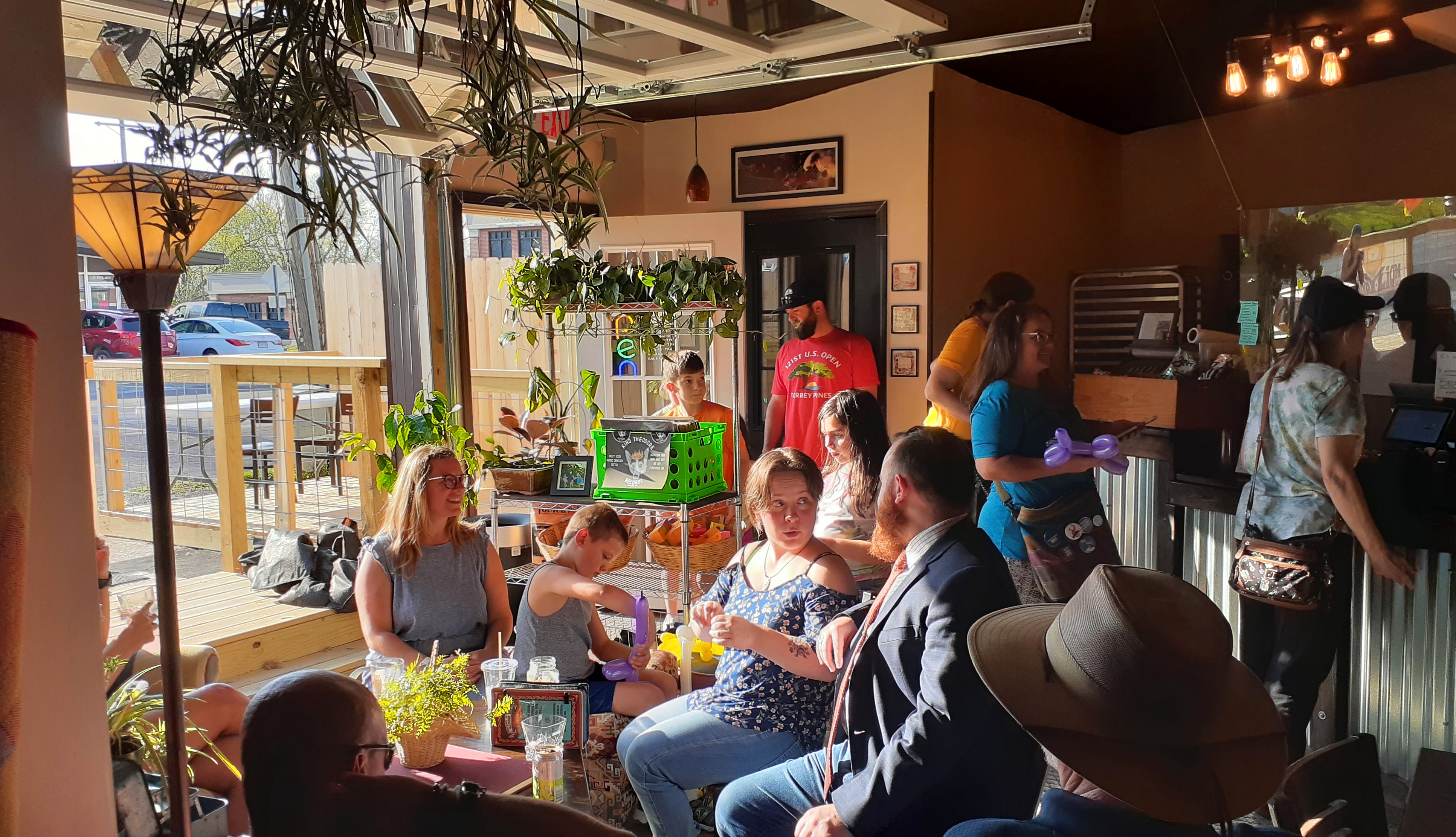
Also known as The Dandy Lion on Main, this is the new cafe in Ashland, Missouri. They just had their ribbon-cutting ceremony with the Southern Boone County Chamber of Commerce on Friday, April 22, with a packed house enjoying the wide-open doors, blue sky, and sunshine, which seemed very, well, Dandy-Liony. I’ve been there a few times, now, starting with the ribbon-cutting day. (My pictures are from that day.)

So what is this place, you ask? Well, it’s a new cafe on the southeast corner of Ashland’s Broadway and Main, nestled between Century Tattoo and a carwash in what clearly used to be a garage attached to the back of the tattoo parlor. To spiff up such a hole-in-the-wall place—to add a picnic patio, to replace the routine garage door with a glass one that admits sunshine, to decorate the space with living plants and colorful, boopfy furniture, to decorate the walls with fanciful art, to fill the air with the sound of laughter and the scents of coffee and freshly baked, legendary cinnamon rolls, to have the gall to fly rainbow, transgender, and BLM flags outside for all to see—well, that’s very much like the stubborn glory of a dandelion.

Indeed, Dandy Lionness is very much like Opulent Opossumness, and they have my high approbation.

(By golly, we both even seem to have a "Jar of Goodness"/gratitude thing going on!)

Here’s their official description: “Serving: specialty espresso drinks and cocktails; local beers and coffees; delicious sandwiches and soup; legendary cinnamon rolls; good vibes.” Here’s another statement from them: “A space for creation, connection, and caffienation in Ashland, MO.” And their hours? “Dandy Hours: W–F: 7 to 7; S/S: 8 to 3.” I suggest checking their Facebook or Instagram pages, or calling or texting ahead, if the weather’s dicey or if you want to make sure their hours haven’t changed. (I suspect they may be adjusting for a while.)

A core mission of Dandy Lion is to create a welcoming space open to everyone (hence the flags that fly outside their doors), and they’ve had at least one drag queen story hour (yes, a kid-friendly event), right there in downtown Ashland. (If you’re not from Missouri, you might not know what this means, but trust me, this is big, almost as big as the fact that Ashland how has a few traffic roundabouts, which in some circles is practically countercultural in itself.) They also had a drag Bingo & Brunch, with performances and bingo for adults and kids hosted by queens Amanda Lay, Karma Cassidy, and Faye King.

Another focus is on sustainability, by sourcing foods from local farmers, and on sheer deliciousness. The sandwiches are grilled in a panini press, making them hot and simultaneously gooey and crispy. Examples include the Fluffer Nutter (which is just fun to say, already), with peanut butter, marshmallow fluff, banana, and honey; the Classic Grilled Cheese (with your choice of two cheeses, plus hot pepper jelly); the Caprese Grilled Cheese (with pesto, sun-dried tomato mayo, mozzarella, and balsamic vinegar); and the Chicken Bacon Pesto (with the obvious ingredients plus the sun-dried tomato mayo, cream cheese spread, and greens). There are soups, the afore-mentioned legendary cinnamon rolls (“we were told they should come with a warning and a cigarette for afterwards”), yogurt parfaits (also highly lauded), and various brunch/breakfast dishes (such as egg, bacon, sausage, cheese combo sandwiches).

The beverages are just as much of a feature as the food, and someone there is very serious about making sure you have plenty of delicious beverage choices while you sit and talk. The coffee is from Columbia’s Fretboard Coffee and Z Best Coffee in Rocheport, and they offer a variety of lattes, espressos, and teas, plus lemonade and orange juice and a variety of milks and milk alternatives. We’ve also spied local favorite Central Dairy ice cream. And then there’s the adult beverages.

On the current menu, the alcoholic beverages are summed up with “Full Bar Available! (Let us impress you with our limited experience.)” Which I think means that, in addition to beer (Logboat and 4 Hands cans) and a basic decent selection of wines, “we’ll mix drinks for you to the best of our ability and with whatever liquors we have on hand.” Since they’re open for breakfast and brunch, they offer mimosas and bloody Marys, for sure.

There’s such an eagerness to be a part of the community. This would be a great place for your reading group, or your deconstruct-after-the-workday coven. Stop by on your commute between Jeffy C and Como. Get a bunch of cinnamon rolls, bring ’em to work, and be a hero. You get the idea. If you're not sure you agree with all the politics of this place, I hope you'll give it a try. One of the BEST things about small towns is that we're small enough to know you and know that you're a good-hearted, decent person, even if we might disagree about some things.

I think Dandy Lion on Main is very much a work in progress, but I find it infinitely more fun and interesting than a corporate behemoth with an astronomical budget, billboards on the interstate, a sleepwalking marketing department, a zillionaire CEO who only wants your money. You know, those kind of places introduced by the indefinite article (such as an Olive Garden or a McDonald’s).

No, this here is THE Dandy Lion Cafe. It’s the only one . . . and Missouri’s lucky to have it.

Sunday, April 24, 2022

Jar of Goodness 4.24.22: Natural Foods Stores

. . . The weekly virtual “gratitude jar.”

This week, I’m expressing thanks for the natural foods movement in America, and the organic, health-food stores and restaurants that helped us all to eat better (better for us, and better for the Earth).

I’ve timed this post for Earth Day, because our food and the environment are so closely intertwined. How we treat the earth, how we till it, what we plant on it, which and whether we are applying chemicals, affects the soil and its natural communities, including all the organisms, from native plants, pollinators, birds, and yeah, us.

The natural foods movement has been pointing this out for more a century, a century that corresponds with our civilization’s increasing capacity for industrialized agriculture.

It goes back to religious groups in the late 1800s who practiced vegetarianism and temperance for physical and mental health. It goes back to Rudolf Steiner in the 1920s, with his spiritualized view of agriculture called anthroposophy. It goes back to J. I. Rodale’s emphasis on organics, starting in the 1950s and continuing into day with its institute. (Alas, the publishing branch of the company went the way of lots of other natural foods companies, being bought up and sold and merged into oblivion.)

Southern California and the Hollywood set made their contributions to health foods, too, undoubtedly spurred by their desire to remain youthful and desirable. Their fad diets included juices, sprouts, avocados, lots of dietary supplements, and so on.

In the 1960s, macrobiotics came on the scene, founded by George Ohsawa and promoted by Michio and Aveline Kushi. It was basically Japanese peasant food: brown rice and beans (adzuki and soy were big favorites), miso soup, seaweed, some fish. It was bland, because when you balance yin and yang in your food, you avoid anything strongly sweet and light or strongly savory and meaty. So, a flame-broiled cheeseburger followed by a milkshake are no-nos. Turns out the brown rice, which peasants ate because they couldn’t afford white (processed) rice, is healthier for its fiber and whole-grain nutrients. Macrobiotics was still going strong when I started paying attention in the 1980s.

And hooray for the hippies! All those ideals! We are indebted to them. They’d read about the dangers of America’s increasingly synthetic agricultural practices. They’d read Rachel Carson and knew that we have to be vigilant about pesticides and herbicides. Many of them remembered growing up on family farms and were concerned about what they were seeing, and reading about. (It was just the tip of the iceberg compared to how it is today. Geez, there are no fencerows and thickets anymore! They even mow the field edges like grass lawns. Farm fields used to be so much smaller. Weeds and wildflowers, birds and butterflies, used to abound in those thickets and other scruffy places. Now, huge farms have Roundup-Ready crops which they blast with herbicides, removing all non-crop plants from acres and acres and acres . . .)

But I digress. The hippies! Their communes, their experiments. I’ve read that their first experiments in organic and whole foods cooking were pretty awful. I’ve experienced some of it. I’ve actually had dishes like “tofu and Spike” and “tofu and sprouts” at potlucks (back in the day). Notoriously tasteless. And we were all catechized: Vegetarianism is moral. What kind of vegetarian are you? There were three kinds (at that point): ovo-lacto, lacto, and what we’d call today “vegan.” Was it okay to have honey? Were beekeepers enslaving bees and stealing their honey, so is that wrong? Brown rice syrup, or natural sorghum, seemed like a better choice.

Sometime in the 1970s there was a turning point. The cream was rising to the top. Each commune was finding individuals who excelled at making the food taste delicious. Think of Edward Espe Brown, cheffing at Tassajara Zen Center and writing his groundbreaking Tassajara Cooking . . . or Ruth Reichl, who started out working at the collectively owned Swallow Restaurant in Berkeley and rose to become the restaurant critic for the Los Angeles Times and then for the New York Times, then editor in chief of Gourmet Magazine. Influencing people’s thinking about food and sustainability the whole time. Think of Mollie Katzen and her Moosewood Cookbook and Enchanted Broccoli Forest; everybody had at least one of her books. And who else remembers The Vegetarian Epicure, with its whimsical line drawing on the cover, which promised to “bring vegetarian cooking to new gastronomic heights”? All that hand-lettering. These books were true labors of love.

These promised much, much tastier foods. The whole-grain bakery coops and health-food restaurants were turning out delicious foods, genuine treats. In addition to the brown rice and other whole grains, the soy products and other beans, the steamed vegetables, the overreliance on onion and garlic, they were looking around the world for spices, sauces, and recipes.

This is about when I got on board, when I was in late high school and college. Columbia had a cooperative health food store on the southeast corner of Hitt and Locust. Next to it was the Catalpa Tree Cafe, a vegetarian restaurant. On Business Loop 70, in that little business strip squeezed between the Loop and little North Blvd., east of Coats Street, there was Columbia Specialty Foods, which in the 1990s became Clover's, which is still going strong. By the mid-1980s, too, grocery stores were starting to pay attention. The Gerbes on Broadway had a large natural foods section.

At all these groceries, there were bulk foods in bins, which you scooped out for yourself. Carob, rice, beans, spices, brewer’s yeast, teas, and so on. (Gosh, remember kukicha twig tea?) There were also increasing amounts of prepared or packaged organic foods from national companies. Many of them still exist today (though now, after corporate acquisitions and mergers, often in much different forms). Santa Cruz Organics, Blue Sky and Hansen’s sodas, Arrowhead Mills, Eden Organics, Food for Life (Ezekial 4.9 bread is still available, though the flour is not, and I miss it); Yogi Tea (their line of products is quite changed these days, and I miss their carob-flavored tea); Celestial Seasonings (which you can buy nearly everywhere, though I’ve found their good ol’ flavors, such as Red Zinger and Morning Thunder, are hard to find in big mainstream groceries).

By the late 1980s, the corporate acquisitions and mergers had begun. There was money to be made! And in the 1990s, many of the idealistic cooperatives (community-owned food coops) were starting to fold. They couldn’t compete with places like Trader Joe’s, which sold what were apparently a full line of healthy or organic foods, but also gourmet treats made with white flower and white sugar, plus meat (sustainably produced), and alcohol.

My beloved Gentle Strength Cooperative in Tempe, Arizona, folded, thanks in large part to competition from the for-profit Trader Joe’s. The Gentle Strength board of directors was conflicted about the choice between sticking to the core mission of healthy, whole foods, versus moving forward with a business-minded savvy, selling the items, such as meat alcohol, that people wanted. By the time they went through their lengthy, contentious, consensus-building process and decided to move forward and be competitive, they had already lost. (There’s an enormous apartment building now, where Gentle Strength once stood; nearby is a slick, new, for-profit, Amazon-owned Whole Foods Market.)

Somewhere along the way, now, the natural foods movement has been watered down, appropriated, lost sight of its core mission. In addition to the white sugar, refined flour, meat, and alcohol, even the juices and other canned products have departed from the high road, using evaporated cane juice, or concentrated apple or grape juices as sweeteners, which are not much different from white sugar . . . they just sound better. A far cry from the natural brown rice syrup.

And the corporate buyouts are regrettable, too. Whole Foods is owned by one of our biggest twenty-first-century lords and masters, corporate behemoth Amazon; it went and tried to engulf-and-devour Wild Oats (which had itself engulfed-and-devoured Alfala’s Markets), but the FTC got after them, and someone else bought Wild Oats, and now Wild Oats is partnered with—brace yourself—Walmart.

As the acquisitions and mergers proceeded in the 1990s and early 2000s, the federal government decided it should create national standards for claims like “organic.” Naturally (no pun intended), big agriculture and food processing companies got involved and watered down the official definitions, so now we have to have a variety of confusing labels on our foods.

I saw an article awhile back in which a nutrition scientist at a large, public midwestern university did research into the nutritive quality and healthfulness of “processed foods.” She started by defining “processing” as anything that happens to a food item before it reaches the supermarket, such as picking an apple off a tree and rinsing it, or trimming bunches of grapes and portioning them into bags; or it could mean heating, cooling, or fermentation; or it could be mixing two or more kinds of foods together. With that definition of processing, her study inevitably ended up with “processed foods aren’t necessarily bad; many of them are quite healthy! My research shows that processed foods are not necessarily bad!” Her study, of course, can be pointed to by any number of corporate factory foodmakers, ultra-processors, food technologists, who will cite her out of context and proclaim that the businesses, providing cheap chips and cheese-doodles to the masses, are healthful.

And the health-food crowd seems to have decided that GMOs are the new devil, when in actuality, big corporations, their ownership of nearly all broad-casting media, their enormous advertising budgets, and their grip on government regulations, are much bigger threats to environmental health and human well-being.

So . . . with all this history, I have to proclaim that the locally owned, idealistic, crunch-granola, vegetarian places are complete treasures, so you should patronize them. Savor the fact that they exist. The vegetarian cafes, the cooperative food buying clubs, the health-food stores.

You’ll know you’ve arrived when you step in the door and inhale. I guess it’s the combined scents of the bulk foods and teas and spices, the carob powder, the fresh, organic roasted coffee, the nontoxic, lavender-scented bulk cleaning supplies, the essential oils (including the patchouli that cute babe of a shelf-stocker is wearing), the olive-oil bath soaps and candles, the hand-built wooden shelving units . . . and the produce section, with all its colorful fruits and veggies. If you’re in an especially older health-food store, you might also pick up a clean, musky scent of sweat, from the generations of hippies who donated their labor to the cause.

Tuesday, February 20, 2018

Sunshine Inn Menu

Greetings, friends! It’s so dreary today, I decided to share a little “sunshine” with you—in this case, an old to-go menu from the Sunshine Inn, a wonderful vegetarian (well, mostly vegetarian) restaurant that used to be one of the best reasons in the world to visit St. Louis’s Central West End. It opened in 1972 and quickly became a landmark. Plants in the windows. And rather plain, but somehow quite elegant decor. Cloth napkins.

Ahhhh . . . the Garden of Eden Salad; the house Creamy Sesame dressing. The quiches. The Great Harvest dinner rolls. Cream Cheese on Date Nut Bread. I used to like their egg salad sandwich, served open-faced, with cheese. Let’s not forget “RZOJ,” iced Red Zinger (Celestial Seasonings’ hibiscus blend tea) with orange juice, and the Viennese coffee (they were serving that waaaay before there was a Starbuck’s on every corner). And, joy of joys, the Golden Lion—the Sunshine Inn’s signature vegetarian burger.

It closed in 1998, and ever since then, the earth has always been a little off-kilter. Losing restaurants like this are a prime reason I needed to learn how to cook.

This to-go menu was printed on both sides of a single sheet of paper, and I’m pretty sure it dates to the late 1990s—I wish I had one from the late eighties, which was when I went there the most. (Alas.)

I’m posting this because I know there are other people out there who pine for the Sunshine Inn perhaps more than I do. Of course, I mean no copyright infringement. I’m keeping the files kind of big so you can hopefully read the type better. (Remember: you can click on the images to see them larger.)

I see value in old menus like this—what were the main ingredients of a dish you liked so much. What things went well with other things. Ideas for reconstruction and inspiration for new construction. I’ll bet there are restaurants you miss like crazy, too.

If you’re someone who misses the Sunshine Inn, I hope you’ll leave a comment and tell me which menu items you loved the most.

Enjoy.