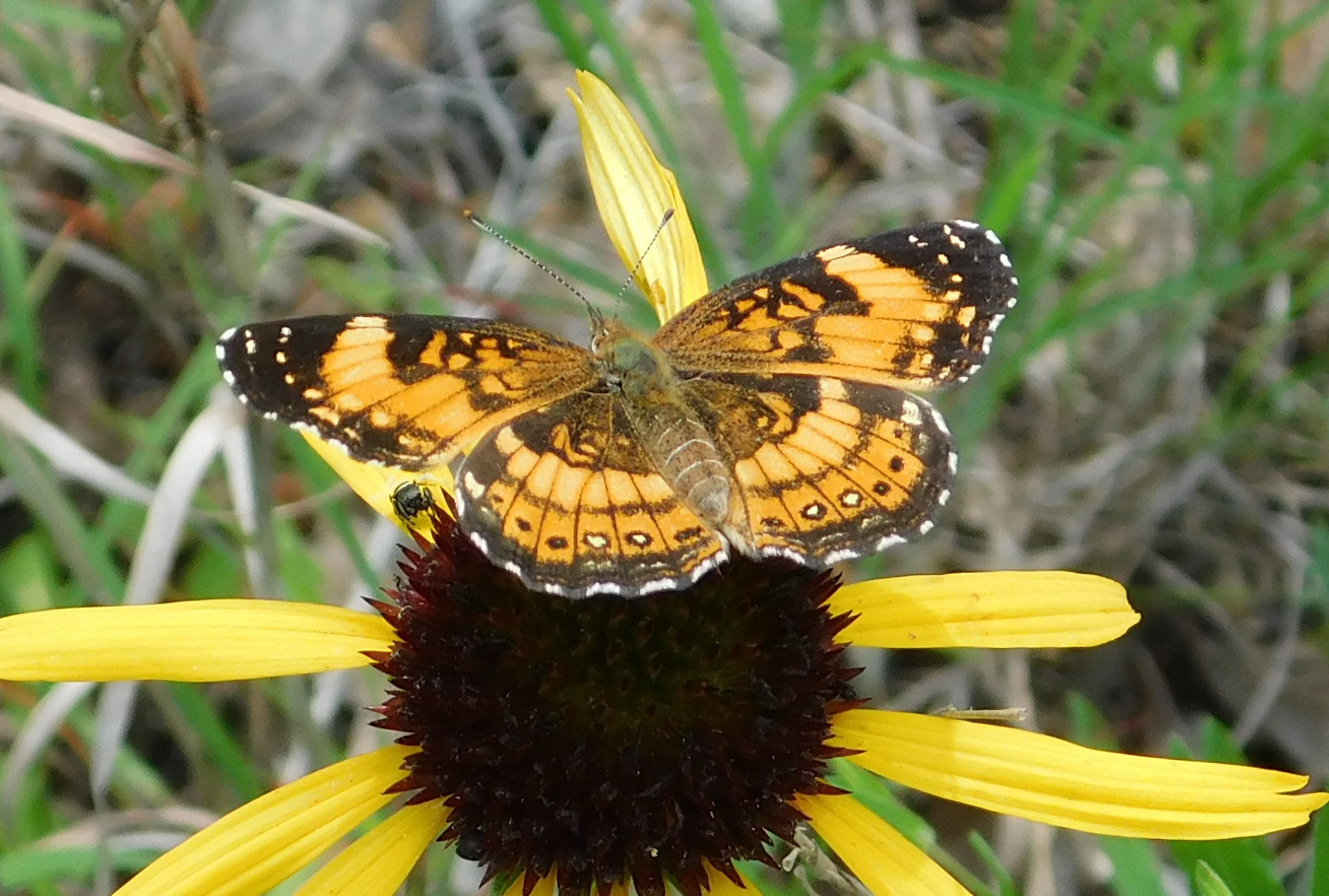
Showing posts with label insects. Show all posts

Saturday, September 26, 2026

Another Kind of Air Show

Two Sundays ago, on the thirteenth, Sue and I did something unusual for us: we left the house, and not only did we leave the house, we did something that was strictly for fun! We weren’t procuring food or dry goods, or running errands, or driving anyone to an appointment. We just drove north of town, across the river, to see the weekend’s air show more closely.


We’d been hearing and seeing the planes pretty well from our yard; we’re only about three blocks from the Capitol, and thus the river, and the airfield is just north of the river. Some of the planes even flew over our house. As they do.

We didn’t want to pay or anything, and we didn’t need to see any patriotic signage or whatever. We just parked in a gravel lot between US 54 and the airstrip and looked up.

It was okay.


Sue always waves when she sees a small plane flying fairly low. It’s leftover from her childhood, flying on Island Airline’s Ford Trimotor to visit her grandma Bower on North Bass Island in Lake Erie.

When the air show seemed to be winding down, we took a brief, leisurely walk on the Katy Trail nearby.

The Katy Trail is a fun way to be out in nature, sort of. Most of the plants are what you’d call weeds. Many are nonnative. I mean, look, they’re growing along some old traintracks. And in many places, the trail goes by agricultural fields (perpetual soil disturbance), and the whole shebang is in bottomlands: moisture.

But although the vegetation is weedy, the growth is rank, and there are many nonnative and invasive plants, it is fun to see the insects that are drawn to all the jungley vegetation.

Here are a few little “friends” I saw along the trail, putting on their own brilliant air show.


First, a dolichopodid, or longlegged fly. I have no idea of the genus, much less the species. But it was so pretty, like a tiny jewel-bird, perched on a leaf. On close inspection, I could see it was dining daintily on a gnat.

I usually take a whole bunch of pictures, hoping that at least one turns out okay. In the process, I accidentally jostled the leaf, causing the fly to launch upward a few inches, but then it lit again near where it had been. It hopped a few times before it settled more comfortably. But for a few seconds, it looked like it was performing some kind of interpretive dance, its long legs hopping and landing, hopping and landing.

So that’s the first little air show.

The second was a surprise for me: I’m usually not fooled by flies that mimic wasps, but boy, this was a good one! This was a fly, but as it crept around on several big clusters of goldenrod, I thought surely it was a yellowjacket.


Now, yellowjackets are very common this time of year—they’re drawn to juicy, rotting fallen fruits, to whatever sweet things are in outdoor trash containers, and to untended, open soda cans. Be careful when you sip!

But, yeah, no! This lovely insect is a type of syrphid, or flower fly. Just like the longlegged fly, it is a true fly (family Diptera); it is no more harmful than a housefly. Bees, ants, and wasps are in a completely different family.

This species is the eastern hornet fly, Spilomyia longicornis. It’s simply fantastic, even compared to other syrphids.


The mimicry is brilliant. Look at the crisp black and yellow bands, and even the smooth surface sheen of the body. The swirly, mottled eyes disrupt their huge size that would otherwise help us see this as a true fly. Also, notice how the middle and hind pairs of legs are yellow, while the forelegs are black—at a glance, they give the impression of a wasp’s long, busy antennae, downplaying the little V of tiny antennae characteristic of flies. Finally, the fly’s two wings are two-toned, giving the impression of a wasp's four slightly overlapping wings.

For that matter, the timing is brilliant: this is the peak time for yellowjacket activity and numbers, and here are these flies, making the most of their resemblance.

As I ponder this, what really gets me is that this mimicry evolved and functions to fool animals incapable of logic. And this camouflage will certainly fool most people, whether they’ve taken any biology or not.

You’d think that black and yellow bands, and “buzz-buzz,” should be enough, but the mimicry of this insect goes above and beyond. It disrupts many of the anatomical hallmarks of a true fly: the two wings, the short antennae, the enormous eyes, as well as the body shape and color pattern. These are the kind of characters you’d learn in “Zool. 350: Invertebrate Zool.”

I actually did not see this insect fly; it was so addicted to the goldenrod’s nectar and pollen, it just crept from flowerhead to flowerhead, pigging out. But this spiffy flier was certainly a highlight of my own personal air show that day.


And yeah, this is a great time of year to look for cool insects on goldenrods. Bring your camera.

Friday, May 10, 2024

Cicadas: What’s Up With Their Eyes?

It’s just uncanny how insects seem to be looking right at you. No matter how you turn them, and from no matter what angle you look at them, they always seem to be looking right at you.

Right

at

you!

So, what’s up with their eyes? I mean, we “know” they’re compound eyes and that they are quite different from our own. Our eyes are basically a clear-jelly-filled ball, with sensors (retina) at the back, a lens-covered, expandable aperture (pupil) in the front, and muscles that rotate it (so we don’t always have to turn our head in order to look around).

But their eyes are quite different. They are fixed; they don’t rotate. So why does that dark spot on their big, buggy eyes seem to follow around, so it’s always looking at the viewer?

Wet or dry . . . they always are looking at you.

Even while they’re molting!

How does this work? It’s caused by the structure of their compound eyes. It’s essentially a result of tubes, shadows, and mirrors. To understand this, imagine a model: Think of their globe-shaped compound eyes as a cluster of narrow tubes, all pointing outward from a center point, and imagine these tubes are coated, on the inside surfaces, with silver. Closest to you, the tubes are pointed directly at you, and you can see into the whole long (dark) tunnel (you’re not seeing much of the silver), while the tubes increasingly angled away from you appear light-colored, reflecting the light.

That’s basically it: you are looking at a spherical cluster of tubes.

And it’s not just with cicadas; many insects have compound eyes that have this property.

Like this common meadow katydid.

Like this little baby, gray short-horned grasshopper. So cute, sitting on a leaf in his prairie.

And like this pretty green planthopper.

The next question is, why does this seem so freaky to us?

We humans—with our social nature, our interdependence, our allies and enemies, our capacities for trust and for deceit—have evolved to be masters at evaluating each other. We look carefully at one another’s eyes. You can tell so much about someone by their eyes! Yes, “the eyes have it.”

This is why those professional poker players so often wear mirrored sunglasses—they want to conceal their thoughts and feelings. (Why shouldn’t that be considered cheating?)

It’s why people who have eye-alignment problems have a real social disadvantage, because crossed eyes or other misalignments are stereotyped as a sign of severe developmental disability, or head injury, of being dazed or semiconscious.

It’s why silent movie actors wore such heavy eye makeup.

And so we, in our anthropomorphization of insects, can’t help but look into their eyes, too, and try to read their expressions. And what we get back is an unblinking stare, perpetually fixed upon us. Does it freak us out?

Maybe it should. Insects depend on us to not ruin the world for them. They need elbow room. They depend on the existence of their many native food plants; they depend on the habitats—prairies, woodlands, glades, wetlands—that support their various food plants. They need plenty of plants and habitat, because the usual existence strategy for insects is to create a bazillion eggs and offspring, most of which won’t make it to adulthood. On some scale, they need room, like cicadas, to have a bloom, a heyday, and then have a majority eaten by countless predators, and then return to the soil.

So yes, they depend on us.

If you feel stared at, it’s not surprising.

Do things to preserve and increase native habitats.

And vote for the environment.

The above text explaining the dark dot in insect compound eyes is loosely edited from a page I wrote for MDC’s online field guide, Mantids (Mantises). Mantises, of course, are one of the many insects with compound eyes that exhibit this phenomenon.

Sunday, August 28, 2022

Jar of Goodness 8.28.22: Native Prairies

. . . The weekly virtual “gratitude jar.”

This week, I’m expressing thanks for Missouri’s native tallgrass prairies.

We visited Friendly Prairie and Paintbrush Prairie today (they’re both south of Sedalia). It’s always good to see the flowers.

From a distance, the staggering variety of plants just doesn’t register. You have to wade in there in order to start really seeing things. Each time I go to Friendly Prairie, I see some new plant I didn’t know before. Maybe it should be renamed “Making New Friends Prairie.”

Today’s new friend is slickseed wild bean, Strophostyles leiosperma. I think. There are a few other species in that genus that occur in Missouri, and my pictures don’t show all the characters definitively, but that’s what my money’s on.

I was wading through the grasses, and I just looked down and saw its delicate little tendrils and soft, hairy trifoliate leaves, with oval leaflets, and I thought, What is this new little pea plant? The pods of this demure little legume were only slightly longer than an inch.

Here’s a picture of the prairie taken straight ahead, at eye level. My eyes are well over 5 feet above the ground. The tall stalks are big bluestem (good ol’ Andropogon gerardii), the prime tall grass of the tallgrass prairie. Its flower stalks can reach 8 feet high. Sue’s dad, having read many accounts of pioneers and settlers, used to talk about how crazy it was just to think of American grasses so high. A native of Ohio, he had not ever really seen the tallgrass prairie. So I took lots of pictures like this for him. See? See how high they are? So I still take these pictures.

At Paintbrush Prairie, I noticed an American bluehearts plant abloom. I’ve seen it at Friendly, but not at Paintbrush. Bluehearts is one of those MUAH! *chef’s kiss* wildflowers that pretty much only grow on high-quality native prairie. It’s also a semiparasitic plant, attaching to other plants (usually trees and other woody plants) via the roots and swiping nutrients. Unlike a lot of other parasitic plants, bluehearts does have green chlorophyll and can live okay without a host. And here’s another thing, per MDC’s Field Guide page, “Prairies, by definition, have very few trees. But historically, Missouri’s prairies, glades, savannas, and open woodlands formed a patchwork of open, grassy habitats that were kept open by occasional fires.” You can bet American bluehearts used to take advantage of that patchwork.

American bluehearts is one of the several caterpillar host plants for buckeye butterflies. Yay! And indeed, I saw a common buckeye not long after I spied the bluehearts! Yay! It was on top of a pretty curlytop ironweed plant. Yay! . . . But, hey, it wasn’t moving . . .

Turns out a crab spider was having a happy hunting day! I’m thinking this is a whitebanded crab spider (Misumenoides formosipes) but don’t quote me on that. . . . But yeah, I know. Sad day for the butterfly. But I did notice the butterfly was pretty beat up. Let’s hope it got to mate and create the next generation before its final stroke of luck.

On the subject of insects, there were a lot of grasshoppers flicking around. I managed to capture a picture of this one. No, I don’t know what it is. It’s a juvenile something-something. My first guess is two-striped grasshopper, Melanoplus bivittatus, but seriously, hell’s out for recess on this ID.

Finally, the picture at the top of this post is of wholeleaf rosinweed. It’s sort of become my favorite rosinweed because, well, it don’t get no respect. Unlike compass plant (look at those huge, flat, deeply lobed basal leaves!) . . . and carpenter weed (look at those square stems and opposite, perfoliate leaves!) . . . and prairie dock (look at those gigantic, smooth flower stalks, and those enormous basal leaves!) . . . wholeleaf rosinweed apparently gets written off as “some kind of” sunflower. Its leaves are, well, leaf-shaped.

So that’s the report for today. It’s mainly pictures. If I get behind in posting, it might be that when I’m not working, I’m just out trying to have fun, seeing what I can see. I'm sure you understand.

Sunday, June 5, 2022

Jar of Goodness 6.5.22: Butterflies of June

. . . The weekly virtual “gratitude jar.”

This week, I’m expressing thanks for the butterflies of June.

Really, anyplace flowers are blooming, this time of year, you’ll see butterflies. But today we saw them at Painted Rock Conservation Area; along the drive to the main parking lot, there’s a glade vegetation planting with lots of coneflowers, butterfly weed, and more.

So here are some pictures of a silvery checkerspot and great spangled fritillary. There were many, both butterflies and flowers.

And it just felt magical.

Sunday, January 16, 2022

Jar of Goodness 1.16.22: The Eggplant Leafrollers

This is my second installment of this, my online, blog-based, virtual “gratitude jar,” inspired by the tradition my brother and his family have been enjoying for years. A simple, weekly recording of something you’re grateful for. A.k.a., a “jar of goodness.” (They even seem to have a little theme song for it.)

So here’s this week’s thing I’m grateful for:

Our visitation this winter by eggplant leafrollers (Lineodes integra). What nifty insects! What a strange little appearance of nature, in the dead of winter.

(Explanation below the picture.)

This was on December 31. I only saw one at first—it was perched in our first-floor bathroom window. I was sure (well, pretty sure) it was a moth, but I couldn’t get it narrowed down to family, much less genus or species. I suspected it was in one of the crambid or pyralid groups, which are both huge families with hundreds of species. I didn’t have the time to march through all the genera on Bugguide, and I’m annoyed by the idea of photo-based digital ID apps, but fortunately someone on an regional insect group got it to genus for me. Hooray!

As caterpillars, eggplant leafrollers eat the leaves of tomato, eggplant, and other members of the nightshade family (yeah, toxic leaves). They roll the leaves, creating a little shelter for themselves while they chew. Aha!

Sue’s reaction was, “NOW I know what’s been eating the Jerusalem cherry plant!” (We have a big, nice potted Solanum pseudocapsicum plant that Sue got as a start from her parents way back when. It has beautifully dark blue-green leaves, bright orange, cherry-size fruits, and a lush, shrubby habit. It comes inside every winter to survive.)

As adults, eggplant leafrollers have a really snazzy pattern on their wings, with a big, uninterrupted brown swoosh running along the forewing. I keep thinking it looks like a brocade or a paisley. They perch at a 45-degree angle to whatever they’re standing on, like they’re doing a pushup, hold their narrow wings out in a V shape, and have the habit of curling their abdomen up into a C shape. The abdomen tip sometimes almost touches the head, making them look like a ring.

So it started with the one eggplant leafroller bopping around in our bathroom, perching on the window, the walls, the towels. Then, in the following week or so, I realized there were about five others on the first floor, in the room with the Jerusalem cherry. Perching on the walls, looking out the windows, standing on the drapes.

For the past few weeks, I’ve had compassion for them, since they’re screwed by Missouri weather and our bringing them indoors. Instead of hibernating, they pupated and emerged, their bodies expecting balmy weather, and now they have nowhere to go. Our house in winter is dreadfully dry. Showering, I would shut the door so steam would build up on the walls; maybe the moth in the bathroom, at least, would get some moisture that way. It always fluttered off when I tried putting water on whatever it was sitting on. Silly thing.

I haven’t seen any of them for a while now, so I guess they’re all kaput, dried up, lying crumpled in the corners of the room, waiting for the vacuum to erase them from all recognizable existence.

Now that they're gone, I kind of miss them.

Anyway, I’m grateful to get to learn about these little fellow earthlings, and the opportunity to show them some charity in the form of moisture and appreciation. I’ll have to look for their compatriots out in the wild next summer.

Saturday, September 28, 2019

Noninsects of 2019

If you don’t like arthropods (insects and spiders and such), get ready to rejoice, because once this post is done, I’ll turn to other subjects. Meanwhile, this is the one that’ll give you the heebie-jeebies for sure. After several posts highlighting the various insects I photographed in 2019, I’m doing a post on non-insect arthropods.

As you might remember, one of the key identifying features of insects is their number of legs: six. So if you see something that looks like an insect and it doesn’t have six legs, then it’s probably not an insect. A millipede is a prime example, because it has not just six legs, but a million.

Just kidding. It’s not really a million legs; it’s usually more like 80 to 100 or so. Interesting fact: they have two pairs of legs for each body segment, not counting the head and tail (which have no legs), and the first three body segments (which have only one pair of legs per segment). As the millipede grows and molts, it adds new body segments. These humble arthropods eat humble fare: lichens, maybe, and decaying vegetation. At least some types of millipedes (usually the ones with bright warning colors) can secrete toxic substances (including cyanide) if they feel threatened. But unless you’re planning on eating one (not recommended), why would anyone threaten a millipede?

Anyway, we found this cute little millipede walking around on our front porch steps in the late afternoon sunshine on March 13; it was a fairly warm evening. It was only about 1¼ inches long. The warming temperatures must have roused it out of its winter torpor.

The next two are spiders. The first is an oddball called a featherlegged orbweaver.

We get these around our yard each year, and I took this photo on June 5. Why do I call it an oddball? Well, first, it just looks odd. The forelegs are typically held straight out in front of the body, though sometimes they hold their forelegs foreword in a Y shape. Either way, they look rather peculiar.

By the way, in the photo above, she is facing downward, her forelegs stretched out straight in front of her, and above her abdomen is one of her egg cases, which is shaped something like a whelk shell. These spiders create a line of these spindle-shaped egg cases, which look a lot like their abdomens, then pose along the line, blending in.

But there’s more. Although they’re an orbweaver (a weaver of orb-shaped webs), they’re not true orbweavers (a member of the Araneidae or typical orbweavers, the family of spiders that build orb webs). Featherlegged orbweavers instead belong to a family of spiders called cribellates, or cribillate orbweavers (Uloboridae), because they possess an unusual sieve-like (perforated) plate called a cribellum, which is positioned at the place where silk exits the spider’s body. This cribellum causes the silk to become hackled—to have woolly fuzzy extensions along its length, instead of being a smooth-sided silky strand. Because the silk is so cottony, it easily snags the legs and other pointy, jagged body parts of insects. They stick to it the way rough dry fingertips snag on polyester fabric.

In fact, this cribellate silk is so good at snagging insects, it replaces the sticky goo that other spiders have on their webs. Also, cribellate spiders have such success with their hackled threads that they do not even have venom; they don’t need it. Not having any venom is a true oddity for a spider. Instead of injecting venom into the prey, they regurgitate digestive juices onto the bound prey, then lap up the liquefying meaty juices. It’s sort of how flies burp up digestive fluids onto their foods, then sop up the goodies.

The other spider I photographed (above) was a longjawed orbweaver, genus Tetragnatha, in family Tetragnathidae. These are also called “stretch spiders,” for the way they rest. Holding the two pairs of forelegs straight forward, and the two pairs of hind legs straight backward, they—with their elongated, narrow bodies—look like little twigs. The “longjawed” part of their name refers to their huge chelicerae. Best not to imagine yourself as a mayfly when you contemplate the hunting of longjawed orbweavers.

They are fascinating spiders that are associated with boat docks and the vegetation around lakes and streams. This longjawed orbweaver built its web among the big tropical plants we keep along the retaining wall of our driveway.

Finally, the other noninsects I photographed were these water springtails (above). Long considered insects, because they have six legs, springtails as a group are now classified separately from insects. They may have six legs, but they aren’t related to insects. I photographed these floating on a pond on a relatively warm day at MDC headquarters, March 23.

Springtails are fascinating! There are all kinds of interesting facts about them, including why they are not considered insects. Here’s another cool fact: water springtails (this species), for instance, can see polarized light—an adaptation for living near water! Do look at my writeup on water springtails on the MDC field guide.

Saturday, September 21, 2019

More Insects of 2019

I’m continuing my little series on insects I photographed this year. Although in previous posts I grouped them by order, in this post, it’s kind of a grab-bag of miscellaneous types of insects.

Several teeny-tiny baby mantids were hanging around the backyard on May 30. I'm pretty sure these were the ubiquitous, nonnative Chinese mantises. They must have just hatched, which explains why they were still so near each other. Ravenous little buggers, they have to disperse quickly, or they’ll try to prey on each other. When people say it’s a “dog-eat-dog world,” they really mean it’s a “mantis-eat-mantis world.”

On June 6, a mayfly subimago (or “dun,” if you’re into flyfishing) was resting on our screen door. Mayflies are the only insects that molt once more after gaining wings. You can tell it’s a subimago (subadult) because its wings are whitish or cloudy looking.

I was on a roll in June! Here’s a crane fly that was resting on our aluminum front storm doors. See those weird little dealy-bobbers extending out from the body behind where the wings are attached? Those are called halteres, and they are a feature of true flies. True flies have only one pair of wings, right? Well, the second pair was modified into these halteres. Apparently, they function like little gyroscopes and help the fly to navigate. This would be especially useful if you’re, say, a house fly, zipping around at a million miles per hour.

You might also notice a little point at the abdomen tip. Fear not—this is only an ovipositor, not a stinger. This harmless, harmless, harmless female crane fly uses it as an egg depositor. Adult crane flies don’t have mouthparts that function, so they can’t bite.

In late June, I saw a handful of scenes like these on the undersides of some of the leaves on our black oak tree. Tiny blue-black spheres, many with holes in them, with several itty-bitty wasps scampering around nearby. This one had me confused, and I’m still not sure what’s going on. But here’s what I think:

The spheres are eggs from some kind of insect species. Maybe a hemipteran? And the “flies” are little parasitic wasps, Telenomus-somethings, perhaps the parents guarding the parasitized eggs, or (I think more likely) perhaps they are newly hatched adult Telenomus fresh from emerging from the eggs of their host species. They had long, fast-moving antennae—something I associate with parasitic insects, since they’re constantly trying to find suitable hosts as the clock is ticking on their own lifespans.

Above is another insect we saw at the end of June, at La Plata. It’s a moth fly, probably Clogmia albipunctata. It’s indeed an actual fly, a true fly, in the same order as houseflies, mosquitoes, horse flies, crane flies, and so on. But this nifty little fuzzy fly has scales on its wings, which makes it look a lot like a moth. So, “moth fly.” They are, alas, associated with kinda skanky wet areas, since their wormlike larvae are famous for growing up in dirty sink traps and other wet places with lots of decaying organic material. This is why you often see moth flies hanging around near sinks and bathtubs. But you have to admire these furry little fuzz muffins of flight.

Finally, a couple of mantises. These are representatives of Missouri’s two most common species. The one on top is native, the Carolina mantis, and the one below it is the Chinese mantis, a nonnative/exotic/introduced species (technically, it’s invasive, though hey, it’s had about a century of concerted, purposeful introduction as a so-called agricultural pest-control species, so it’s pretty late to be trying to put this genie back in the bottle).