Showing posts with label television. Show all posts

Sunday, May 29, 2022

Jar of Goodness 5.29.22: Missouri Wines

. . . The weekly virtual “gratitude jar.”

This week, I’m expressing thanks for Missouri wines.

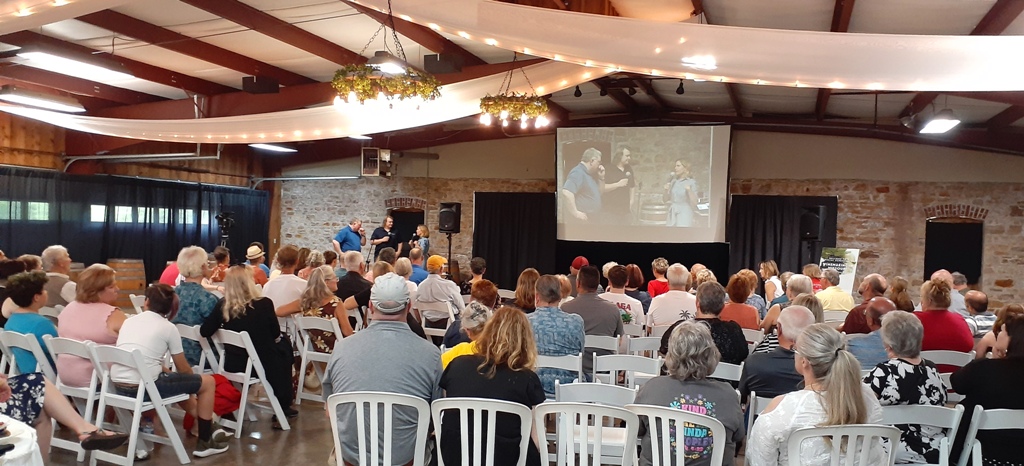
This afternoon we went to Stone Hill for a screening of a new documentary about the history of wine in Missouri, including a big dose of Stone Hill history in Hermann. It’s called Winemaking in Missouri: A Well-Cultivated History, and apparently it will be coming to a PBS station near you soon (starting in St. Louis, eventually being distributed nationally by American Public television).

Seriously, keep an eye out for it. It's well made, well-researched, and well worth watching.

Directed by Cat Neville as part of her tasteMAKERS series, it covers a long, interesting history: How German immigrants brought wine culture with them, how it was a challenge to try to grow European grapes in Missouri, how an invasive root pest introduced to Europe nearly destroyed the wine industry there, but Missourians figured out that North American grape rootstocks were naturally resistant and European grapes could be grafted onto them, saving them from utter destruction. And then, when Missouri wineries were producing the most wine in the country, then came Prohibition. So Missouri wines themselves had to come back from utter destruction.

One of my favorite points made in the movie is that here in Missouri, we don’t grow Zinfandel, Merlot, Cabernet, Chardonnay, Sauvignon Blanc. Our climate and soils aren’t right for those. BUT! We have the Norton, and we have a number of interesting hybrids of those European grapes with native varieties. So yeah, Missouri wines are not the same as the others. If you drink them expecting them to taste just like the wines made in California or Europe, you’ll be disappointed. . . . But why would you hold such an expectation? And why would you want them to be the same? . . . Variety is the spice of life! Travel broadens the mind! And wine is never about having that same exact delicious flavor again and again and again. That’s for fast-food connoisseurs. No! Wine is about trying and sampling new things. It’s about the journey; making discoveries.

We were a little late, so we missed most of the hors d’oeuvres before the showing, but we got to see the film. Afterward, as people milled about and sifted away, we sat at one of the outdoor picnic tables to enjoy a bottle of Norton.

Even though there had been a formal Q&A session before the film, the Held family and other Stone Hill people were still busy afterward speaking with tons of guests. (You could have figured that people would want to stand around and talk more after viewing the film!) The servers were removing the demolished trays of food, the leftover napkins, the plates. As the place emptied, we waved and did the hip-hip-hooray sign at Betty Held, the honored matriarch of Stone Hill, as she rode away with friends in a van. A little later, Jon and Nathan Held walked by and chatted with us for a while, so we had a really nice conservation with them after all. Truly the highlight of the evening.

John Thorne, my favorite food writer, said that good wines are always worth trying, because you can usually see why some people really like them. They’re interesting. Even if it’s not to your personal taste, you can at least appreciate them for what they are: different. Somebody’s beloved local flavor. “Malbec, for instance,” he says, “is a varietal that tastes rather like ink; a highly rated one tastes like delicious ink.”

Variety is the spice of life. . . . Variety is the spice of life.

Saturday, January 23, 2021

COVID Entertainments

Something about January makes me rather reflective. I guess it’s that the holiday busy-ness is over, and it’s usually always cold or grim enough outside that I don’t want to be outdoors, and that there’s not much yard work to do, anyway.

But before we got cooped up inside, watching TV and what passes for TV these days, we spent lots of time outside. Starting in March and continuing through October, we spend a lot of time in the backyard, enjoying each other's company.

When COVID appeared in the United States in March, it immediately affected big cities on the coasts. But while people in those areas quite reasonably freaked out and began to adapt to being stuck inside their high-priced urban apartments and missing contact with the zillions of big-city people they otherwise would see every day on their work commutes, at that time COVID wasn’t yet affecting us here in Missouri much at all. Naturally—just like cultural trends and fashion, the middle of the continent lags behind. Which proved deceptive—around here, most of us started taking measures in mid-March, but there was not much sign of the disease in our area. It really hadn’t gotten here yet. Hospitals kept up with cases. Only a few people had died. This probably fed the opinions of people who thought it was a hoax.

Our midwestern numbers started their steep climb in the summer and fall. I’m still amazed at how many supposedly practical, hard-headed, no-nonsense midwesterners didn’t watch and learn from the people on the coasts. I mean, looking over at someone else’s test is only illegal when you’re in school. But in everyday life, looking over your shoulder at others just common sense. Even though we had low numbers for so long, it made good sense for midwesterners to take precautionary measures: With so many people not following guidelines for one reason or another (or, despite all reason), it wouldn’t have taken much for an infected person to hop on a plane or drive into Missouri and start infecting people willy-nilly.

So, Sue and I have basically stayed away from folks since March. We wear masks when in public. We do go out for groceries and other needed purchases. We also get groceries and supplies for my folks and deliver them. (And we wear masks when we visit my parents.) We go to doctor and dentist appointments. We go to haircuts—though there have been some postponements, as our salon has had times when it could not be open. We initially made a point to spend money at our favorite local restaurants a few nights a week, getting carryout, to help them economically. For example, we bought wine from Vines on a carry-out basis.

But our restaurant patronage, even with carry-out purchases, has dwindled as the local government has never placed restrictions on restaurants or even bars, and there are plenty of people in this city, swallowing rightwing propaganda, who think COVID is somehow a hoax. With so many of them around and going to restaurants and bars unmasked, we opt to just stay away. Apparently the leaders in this city think that the best way to keep restaurants and shops in business is to have no restrictions at all; instead, it’s “do what y’all are comfortable with,” and then businesses just close temporarily whenever they find out someone in there had the ’rona. (“Oopsie.”) I guess that’s a plan, of sorts.

But it really just means that people like us, who really do not want to get sick, or to carry and spread the disease to others, are uncomfortable going into most places in town, even for the five to fifteen minutes we may have to wait when our pick-up order isn't ready on time. Some groceries, for example, insist on masks; others don’t and thus attract more than their fair share of anti-maskers, potential virus spreaders. You have to look carefully at the signs on the doors, to gauge the degree of danger within a business.

So we’ve decided we can’t feel responsible for the success of local businesses. Apparently, they are getting plenty of customers without us. I would feel better about shopping and dining out and getting carry-out—and I’d be more likely to do so—if most people around here took the virus seriously. Or if a local ordinance made it so that everyone was required to wear masks, meaning that business owners could shrug and say, “Well, we all have to do it, so please wear a mask.” But whatever. The lackadaisical people might finally have to change their attitudes and behaviors once the new, more easily-transmissible variant becomes widespread this spring.

I keep thinking the same grim notion: that people around here, and in other small-town, hinterland areas, simply will not take the disease seriously until someone they know dies from it, or until the dead are stacked like cordwood in the streets. The bad math of the anti-maskers often goes like this: “99 percent of people who get COVID don’t die from it, so what’s the problem?” I say: Bad math, because in a town the size of Jefferson City, 1 percent of the population is 430 souls. In the United States, 1 percent is some 3,282,395 people, dead. And the notion of “surviving” COVID is problematic, as many people who don’t die from it nevertheless suffer long-term, possibly permanent health effects and disability as a result: strokes, lung conditions, migraines, etc. And you know that if the insurance companies have their way, they would like to return to the days when they could zap you for preexisting conditions—oh, they’d be happy to sell you insurance, but at a higher rate, or a policy that won’t cover the very things you need—and having had COVID would be a reason to dock you.

So, our lifestyle has changed. With us eating out less, I’m cooking much more. Spring, summer, and fall, we enjoyed grilling and eating in the backyard. Many evenings, with the firepit. It was fun.

And I’ve perfected my pizza-from-scratch making—booyah! We’ve been saving a lot of money on food, since we’re mostly eating from scratch. We also save a lot on beverages, since restaurants have such a tremendous markup on those. We’ve both lost some weight—it turns out my cooking must be fairly healthy, or else we eat smaller portions than we would at restaurants. It’s certainly not because of more exercise.

Indeed, reviewing the past year, I realized we’ve watched more TV than usual. Which is to say, we watched TV. Ordinarily, from spring until fall, I listen to Cardinals baseball radio broadcasts whenever it’s convenient. It’s the soundtrack for summer evenings. Like, while doing the dishes. Or working the crossword and Cryptoquip. This year, I really missed the baseball broadcasts. Summer just wasn’t the same without it. Then, when we did finally get a baseball season, it was weird. That fake crowd noise! But at least we had some kind of season. I have a new appreciation for the ability of professional sports to deliver us from the tedium or pain of our daily lives.

So what did we do? We don’t get cable, so everything we watched was online: YouTube, Facebook videos, Netflix, or whatever. So here’s some of what has entertained us.

First on the list was the Metropolitan Opera! With its live performances closed because of the pandemic, the Met has been offering nightly broadcasts of its years of archived HD performances. These are beyond cool! The first one we watched was La Fille du Régiment, on March 20, starring the energetic coloratura Natalie Dessay in a hilarious comedic role, and Juan Diego Flórez as her love interest, a charming Swiss villager capable of singing multiple high Cs. The live performance was in 2008, but we didn’t see it then, so it was all new to us! They’re still showing these encore performances—a different opera each night, and each one is available for viewing for 24 hours. Check it out on the Met’s website.

Another source of entertainment was a variety of our favorite musicians who have been posting regular or occasional house concerts on Facebook. These are fun and sometimes . . . interesting. We’re so used to hearing pop musicians via professionally engineered recordings, or in concerts with full bands where professional sound technicians work to perfect what booms out of the speakers. But here were these musicians, in their living rooms or music rooms, sitting alone with their guitars, sometimes reading off of music, telling stories, and occasionally squinting at their devices and responding to live comments . . . suddenly looking like real people negotiating their video devices, instead of being completely polished, shining icons. It’s refreshing. Some of these we’ve watched were Melissa Etheridge, the Indigo Girls, and Cris Williamson. I think it really takes a lot of guts to offer such casual performances, often from their own homes.

Of these, perhaps my favorite has been Lucie Blue Tremblay, a French-Canadian singer-songwriter who’s a legend in the women’s music genre. Bonjour, Lucie Blue! She has become a US citizen and, per her website, “In the summers you can find Lucie and Pat managing their new guest house ‘The Princess & The Sea Nova Scotia’ as they live life deeply and gently in a wonderful fishing community on the Bay of Fundy.”

Their live Facebook events have been really fun. In the first of these that we saw, in midsummer, Lucie and Pat were simply walking around the pandemic-empty tourist town of Annapolis Royal, Nova Scotia, stopping in shops and showing us the sights, playing a song or two, say, in a mostly empty ice cream parlor or in a local park. Keeping people’s spirits up—including ours.

On the flip side of these casual, and I’m sure they would all admit, less-than-professionally-engineered performances, we’ve also seen some very slick, well-rehearsed and well-engineered performances by Sue’s favorite performer these days, Brandi Carlile. In case you didn’t know, Brandi and her family, and the three men who are in her group, and their immediate (and interconnected) families, all live more or less in a compound in the Seattle area. Thus, they basically have a bubble in which they’re all able to interact with each other with few restrictions.

To raise funds for charitable causes, and to provide money for their idle road crew, who would otherwise have plenty of paying work traveling to all their concerts, Brandi and co. have had a series of live pay-per-view concerts. They basically play one of her albums as a single concert. I think we’ve seen all of them. There was even a live “Still Home for the Holidays” Christmas concert broadcast from her living room. As I understand it, in their compound, they have a bona fide recording studio that easily doubles as a stage for these programs. Nice lighting, videography, and sound. The music is polished and rich; they can be together as needed to rehearse. But since it’s live and informal, there’s a fun sense of spontaneity. We’ve enjoyed these a lot. We’ve even watched a few twice!

Other entertainments we’ve enjoyed have been on Netflix, which we finally broke down and subscribed to. We tried hard not to binge-watch The Crown, once its new season was finally released. We watched a lot of old movies—Sue’s a big fan of Joan Crawford. Sue subscribed to Criterion, so we have a plethora of nifty old classic movies to watch. And on Netflix, we watched several old Star Trek shows; for instance, we looked at the (generally humorous) Lwaxana Troi episodes of Next Gen and DS9; then we watched all the Vic Fontaine episodes from DS9. All quite fun and diverting; we didn’t watch any of the episodes about dysfunctional, evil, orange-colored authoritarian aliens hell-bent on destroying the universe.

Then, of course, we enjoyed a lot of miscellaneous Christmas programming on Netflix. I’d kind of forgotten how fun TV can be.

Any videos watched on a device can be watched on a laptop, and anything can be plugged into a screen, so we watched a lot of non-programming programming together, too. Chief among these were the offerings of Virtual Railfan on YouTube. Our default is the live webcam from the Amtrak station at La Plata, Missouri. VR keeps adding new webcams, so there’s always something to enjoy. Fort Madison, Iowa, was new this year, for example, and it shows not only the train tracks but also boats, barges, and bald eagles on the Mississippi, and the turning bridge over the river. Plus, every few days, VR posts “grab bag” videos that compile the most unusual and interesting moments from all the cameras: bears crossing the road late at night in Revelstoke, British Columbia; cars that crept too far forward at intersections getting “knighted” by railroad crossing gates in La Grange, Kentucky; and a bewildering variety of executive, heritage, and anniversary locomotives, “meets,” “races,” “power moves,” “slugs,” unusual cargoes, rusty old boxcars bearing logos of “fallen flags,” railroad employees waving at the cameras and giving horn salutes, and more. The chat is well-moderated, cordial, and informative. Thousands of people tune in to VR to watch trains, chat while waiting for trains, and forget our troubles for a while.

Well, wherever you are, I hope you’re well and staying entertained. Stay safe, my friends!

Wednesday, December 14, 2011

Gift Idea: TV B Gone


Okay: Let’s say you’ve decided to go out for dinner someplace. Maybe you’ve been driving all day and you want to relax and get a bite to eat. Or maybe you’ve got someone you want to visit with. Like, an out-of-town friend you rarely get to see, but hooray, she’s visiting, and you get to have dinner together. Or maybe you’re lunching alone and are relishing the chance to collect your thoughts for the afternoon’s work. Or maybe you’re having an important conversation with someone, like a client.

And there’s this ignorant television hanging up in the corner of this otherwise quite nice restaurant, flickering and flashing, showing some godawful sad, sensationalistic trash, or some talking-head politics guy whose every word gives you a sour feeling in your stomach.

You know, television programs and the advertising they exist to serve are designed to grab your attention—the change of camera angle every five seconds or less; the rate of flashing; the emphasis on “big” (never subtle) emotions; the pacing of dialogue, the tone of voice. It plays with your monkey mind in ways you’re scarcely aware of—all you know is, it’s hard to get your eyes off the screen.

I’m not joking—and I do encourage us all to educate ourselves about television and how it manipulates our attention, feeds our thoughts, and (I believe) pollutes our culture and damages our democracy. To everyone, I recommend this book: Four Arguments for the Elimination of Television, by Jerry Mander. It’s not a new book at all, but what is says is just as relevant today as when it was written. If you don’t believe me, read the Amazon reviews.

-----------------------------

THAT was my prologue. The gift idea mentioned in the title of this post, now, should need no explanation, beyond this: It is a handy, keychain-sized universal remote control that only does one thing: It works as a power button on all different types of televisions. It is an “off” switch! Of your very own.

They’re about twenty bucks, batteries are included, and you can get them online here: Cornfield Electronics.

Look, how many times do I tell you to “buy” stuff? Never. But here I am, telling you: You will love having the power to turn off those offensive TVs wherever they may be: The doctor’s office. An otherwise decent restaurant. The waiting room at the service department at your car dealer’s. At the laundromat. Maybe even in the gate area at the airport!

Oh, joy!


I got mine and tried it out at Ruby Thursday’s! I was kind of worried a riot might break out, with people deprived of their TV teats, but no one even noticed the TV had gone black.

And yes, these would make great stocking stuffers!

-----------------

Special thanks and an Op Op Hurray! to Jane Phillips, who told me about this lovely product and reports great success with it in places ranging from restaurants to the DMV!

Friday, June 25, 2010

"My Sara": How Sara Moulton Is Carrying Julia Child's TV-Chef Torch


I like to think of her as “My Sara” because, well, she’s just so doggone cute, and if I hadn’t met the true love of my life, I might indeed be off driving in a skeezy van, traveling the nation, chasing after Sara Moulton.

Noooo, I’m not a stalker or anything. That’s a joke, okay? I might be a little woo-woo with her, but it’s not like I’m anywhere near the level of “screaming-teenage-Beatles-fan”!


Okay, maybe just a tiny bit. But seriously, my not-so-secret adoration of Sara Moulton emerges from a completely innocent appreciation of her down-to-earth style, her approachableness, and her sincerity. She doesn’t act like a “celebrity chef”; she always seems like a normal person, like me and you.

Let me draw a comparison between her and another blonde TV personality famous for helping us all to cook better. You know who I’m talking about—Martha Stewart! Martha (like as if I actually knew her!) comes off as formal, maybe even chilly, and perfectionistic in the extreme—or at least, that’s what she’s come to symbolize.


There’s something to be said, of course, for perfectionism, but that’s not Sara Moulton’s thrust. Like her former boss and longtime friend and mentor, Julia Child, Sara’s philosophy is about trying new things, sometimes making mistakes, learning, improvising, having fun, steadily improving, and being “real.” (La cuisine bourgeoise, as Julia would call it—the food of regular people, done well.)

Let’s engage in fantasy for a minute: Say you’re cooking something in Martha’s kitchen, and you screw up somehow. Something’s burning, or the mayonnaise separated, or the meringue collapsed. Lumpy gravy! Or whatever. What’s your first impulse? Well with Martha, I think it would be, Quick! Hide the evidence! Fast! Before she sees it! (Aaaahhhh! Here she comes! Run like hell!)


But with Sara, you know she’d treat it as “just another routine kitchen disaster,” no biggie. You’d probably just laugh at it together, say “Aw, heck,” and then start over again—or rescue the project by sending it in a new direction. I like this scenario with Sara a lot better, don’t you?

I used to watch Food Network a lot in its early days, when Sara had her Cooking Live shows, which were truly live, and where “anything” could happen. It was fun, informative, and on several occasions she showed viewers how to doctor up dishes when things go wrong.

(I remember the notorious Chinese fortune cookie episode! That Sara had such a big “brain fart” live on TV made me feel soooo much better about my own mistakes. Recently I cooked a big pot of beans and totally forgot to add the ham hocks until the beans were completely done. But I didn’t sweat it—I figured out what to do, and nobody had a clue.)

To this day, I really don’t care much for any of the other “celebrity chefs” out there on TV; from them I have learned tips and tricks and have been entertained, but it was Sara who became a model for me, a chef to emulate.


Anyway, I was able to finally meet “My Sara” in Kansas City a few weekends ago. How exciting! She was travelin’ across America promoting her new book, Sara Moulton’s Everyday Family Dinners (New York: Simon and Schuster, 2010). Her book tour was sponsored by the German cookware company Chantal, so she was promoting Chantal pots and pans, as well. (And yeah, it’s nice stuff.)

I’d never been to one of these celebrity-chef-book-promotion cooking classes, so I wasn’t quite sure what to expect, apart from having an opportunity to get an autographed book. The event was titled “Master Class with Chef Sara Moulton.”

The venue was the Culinary Center of Kansas City, which is in downtown Overland Park, Kansas. They’ve got a demonstration kitchen with the angled mirror above so you can see what’s happening on the cutting board and in the sauté pan. The people in the class were all seated at tables in the center of the room.

If you haven’t been to the CCKC, I encourage you to check them out and support them. (Pryde’s in Westport was another sponsor—and surely you know how fun it is to visit them!)


Above is my only halfway decent picture from the class. I’m sorry that I don’t have a whole bunch of gorgeous photos to share with you, but I was busy paying attention, and my camera doesn’t do well in indoor light—and I didn’t want to use the flash because I didn’t want to distract her (taking pictures, I felt, was obnoxious enough). (Oh, sure, I got a great picture of her with a squinty “Gilbert Gottfried” expression . . . but I like her too much to post it.)

After the introductions and applause, Sara got right to work. She prepared four dishes from her new book: Ground Turkey and Mint Lettuce Wraps; Mu Shu Vegetables with Pancakes (actually, crêpes); Soba Noodles with Asian Clam Sauce; and Fruit Pot Stickers. Chefs from the CCKC also prepared the dishes so participants could sample them while she cooked.

I was intrigued by the selection—they all had an Asian theme, and thus were all potentially a “stretch” for a midwestern audience. But the entire book is about expanding one’s repertoire for the family meal, adding new culinary tricks (“How many of you have never made crêpes before? Why?”); new sauces and ingredients; and new techniques that can all be mix-and-matched by anyone with some basic cooking know-how.


Indeed, there’s a section at the front of the book called “Head Starts” that’s all about making some recipes ahead of time that can be frozen or refrigerated for later use. Things like flavored butters, garlic dressing (both “rich” and “slim” versions), broccoli pesto, a basic pizza dough, and so on. These well-described, versatile recipes alone might be worth the price of the book.

The goal with the book is to add to the family cook’s “bag of tricks,” so that one’s weeknight dinners can be more varied and interesting. And healthier—throughout, Sara has tended toward more veggies and whole grains, smaller portions of meat, and only moderate amounts of fat, salt, etc. She has also steered in the direction of sustainable foods, home economy, and healthy cooking methods.

In keeping with the aim of providing relatively fast recipes for weeknight dinners, Sara’s reinvented the way recipes appear. She knows that most people don’t prepare their mise all at once (that is, chop and measure out all ingredients ahead of time)—they chop the tomato, say, after tucking something else into the oven. So her recipes list ingredients like “6 medium celery stalks” and “1 ounce Parmigiano-Reggiano”; later, while something else is cooling, the instructions say, “Meanwhile, . . . slice the celery . . . and shave the cheese.”

I wonder what her editor had to say about this—editors tend to be conservative (“why change it from the traditional way that everyone’s already comfortable with?”)—but Sara explains: “This book incorporates several new ideas about how to cook smarter, faster, and cleaner. . . . Why not take advantage of the time required to cook an onion—about five minutes—to slice your red pepper?” And though it makes for more verbiage within each recipe, she certainly has a point.

Regarding the food, unless you travel a lot or live in some big metro area like New York, you might find many recipes and foods in this book that are new to you. You might look at a dish such as “Chicken Saltimbocca with Artichoke Sauce” and think “what the hell is a Saltimbocca?” and just skip over it. But fortunately, Sara has provided a paragraph or two of description before each recipe. And you know what? Chicken Saltimbocca with Artichoke Sauce is completely “doable.”

And what she says about preparing the chicken breasts in that recipe is an example of her wonderful way of blending practical information with a spin that is both enthusiastic and humorous:

The only time-consuming part of this recipe is the pounding of the chicken breasts. But if you sprinkle the breasts with a little water before bashing away at them with a rolling pin, they won’t stick to the plastic bag and shred. In any case, I tend to find the bashing part of the preparation strangely soothing, especially after a bad day at the office or a squabble with the kidlets.


Hmm, does that paragraph remind you of anyone—?


If you are a fan of Julia Child (and who wouldn’t be, after that book and that movie), you should pay attention to Sara Moulton.

As she cooked in the demo, she reminisced a little about Julia Child, smiling and calling her a “wild woman” and telling an anecdote about how the latter nearly wiped out an entire table of food that Sara and a colleague had prepped for filming when she suddenly tossed a “Dreadful!” loaf of Wonder Bread over her shoulder.

You know, there’s no question that Julia Child invented this cooking-on-TV scene; she defined it. As an educator, she hit upon the ingredients that cooking-show audiences crave:
  • A sense of “I can do it!”
  • Security; knowing that “screwing up” is no big deal
  • Clear demonstration of technique
  • Genuine enthusiasm for ingredients and tools as well as the final product
  • Education (learning how stuff works is fun!)
  • A teacher with a friendly, companionable personality and a sense of humor

. . . Although there will only be but one Julia Child, Sara Moulton is obviously carrying Julia’s torch—she’s running with it, and lifting it high.

(Go, Sara, go!)


Note: only three pictures on this post are actually mine, the one taken at the class, the picture of the book in our front yard with peaches, and the picture of my own first crêpe; the rest were copied indiscriminately and probably illegally from other posts on the Internet. Okay, the one of the "Kitchen Destroyed by Hurricane Katrina" was lifted from here. No harm intended. If you're the copyright holder, I'll be glad to remove the image or provide credit. Thanks!


Wednesday, July 15, 2009

End of the Tube

It happened suddenly last week, just out of the blue (. . . and the pink and the green). It was just fine, but one day we turned on the television and discovered that it’s become a lava lamp. Time to play taps. Time to play sad violin music for it.


Okay . . . this ol’ JVC has served me well; I got it in Phoenix in 1989, so twenty years of absolutely-no-problems-whatsoever isn’t bad.

What’s bad is the cost of the new TVs. I feel like I’m supposed to get an HDTV, or a flat-screen something-or-other, or move to something slightly bigger than a twenty-inch screen, now that twenty years have passed since graduate school and theoretically I’ve got more of an income. But Ouch! Those flatscreen things are frickin’ expensive!

I’ve got half a mind to just ditch it altogether: Ditch the TV. Ditch the cable. It’s all far too expensive anyway, for what you get out of it, which is basically time-wasting nonsense. Or, as the comedian Gallagher put it, “Doncha wish televisions came with an intelligence knob, so you could turn it up? —Yeah, there’s a ‘brightness’ knob, but that don’t work!

As I said before, the squirrels in our backyard are more brilliant than most of the stuff on TV, and letting them have some of our birdseed is much less expensive than the monthly TV bills.

I would entirely miss Sharon Ray, Jeff Huffman, and the other members of the local Stormtrack 24/7 weather team. But at this point, their radar maps are next to useless, since the color coding is a rainbow swirl of distortion. (It surely is pretty . . . but not very helpful.) Yeah, I can catch the weather online, but it’s not the same at 3 a.m. when the weather is wild; much easier to click on the TV than to boot up the computer, navigate to the Web page, wait for it to load . . .

Hmmm. Meanwhile, we’re kinda just living with our groovy hallucinogenic kaleido-television, where a man can have a green face, blue arms, and pink hands.


Sunday, June 21, 2009

Funny Thought

Ha ha—I just sent an e-mail to the Food Network telling them about my big idea. And then my imagination took over—wouldn’t it be funny if they contacted me, now, and asked me to bring myself and my dishpan hands over to New York to discuss the fine points of my proposal?

Then I could start to regain my big-city edge!

Ha ha ha.

I’m sure my letter will get the same response as that time I sent an e-mail to Pizza Hut suggesting to them my brilliant idea for their next sensational pizza breakthrough: Fried-chicken-crust pizza! (Two great tastes in one! It would go over really well here in the Midwest!) Hee hee hee.

. . . No, I never heard back from Pizza Hut. And apparently, they haven’t used my idea yet. (Maybe they’re still experimenting in their test kitchens, eh?)

Of course, maybe the Food Network will look at my blog, show this post to Paula Deen, and she can develop the fried-chicken-crust pizza!

And frankly, she can take all the credit for it!

Saturday, May 30, 2009

The Here and Now

I’ve kept a journal since about 1980, which is why I find it pretty easy to write in this blog fairly often. One rule of thumb that has kept me going is that I don’t tell myself I “have” to write “every day.” But if I go a week or so without it, I begin to miss it, to feel like I’m getting “behind,” and that keeps me doing it. This plan has worked for me for almost thirty years.

Every once it a while I get behind and write a list of things I would like to write about but don’t have time to. Oh well.

Another thing I’ve learned from my years of journaling (which is so similar to this blogging, yet so different) is that often my best entries begin with this simple statement: Here is where I am right now.

And then I describe the scene around me, and my position in it. Such recordings rarely say anything profound or make much of a “point,” but they do serve as time-and-space capsules, and that is something. The day, the doings, the scene, the feeling, the sounds, the flavors, my random thoughts, the way my body feels.

When I take my journal on vacations, it serves as a satisfying complement to, say, the photographic record that Sue creates. The images record on one level, the writing on another.

So here is where I am right now. I am sitting on the old sofa on the sunporch, my legs stretched out comfortably, my bare feet cooled by the breezes wafting in the bank of windows facing Broadway. Grandma’s old windchime—the brittle-sounding one made of translucent disks of shells—clatters musically every so often.

The sun is setting; it’s been a long day, even though we slept kinda late. Today’s job was to fix up one of the last flower beds: the one on the corner of our property, just inside the sidewalk. It’s a tricky bed to plant because it’s generally shaded by a respectable-sized ash tree but then it’s also hot and dry there. Not your typical shade garden. First, I needed to do a little light weeding.

The plan with that bed is generally to use it as a place where the tropical houseplants spend the summer. Dracaenas, airplane plants, aloes, Swedish ivy, some arrowhead plants (Syngonium podophyllum) that I got from a friend who was going to throw it all out . . . The houseplants look exotic and jungly once they get established.

I even put a small schefflera in there this year.

The houseplants have been sitting in pots in the driveway getting used to the outdoors, and today was the day they got to put their roots into real soil again. It will be a few weeks before they get comfortable, but they’ll grow like crazy once that happens.

Then I mulched the whole bed, which gives it that lovely finished look (and helps with the dryness problem). Another flower bed put into shape. Check.

It was breezy, even windy at times today, and my allergies were going nuts. I was sneezing and rubbing my eyes throughout the day. It was in the eighties. The mosquitoes are out, and I suspect the chiggers are coming along.

In other words, it’s getting to be the time of year when being outside isn’t so peachy. Missouri’s heat, humidity, and itchy bugs turn summers into winters for me: a second season to spend indoors. On the bright side, once the grasses are finished with their big June pollination cycle, I can start backing off the allergy medication.

So back to where I am right now: I’m relaxing on the sofa after a rather uncomfortable yard-work day, my muscles aching, my nose and eyes itching, though I’m finally clean and showered.

Robins in the backyard are beginning their evening vespers, and the baby grackles are squawking for their evening meals. Chimney swifts chitter high in the skies. The occasional bad-muffler hot rod zooms down the expressway. Mourning doves call from somewhere.

The baby gray squirrels—I think there are three of them—have been extremely entertaining as they try to figure out how to exploit the bird seed in the feeders and the “rock peaches” I mentioned a few days ago. One tried repeatedly to shinny straight up the skinny wire pole of a bird feeder hook, always ran out of steam a foot from the top, and slid slowly back down. Very funny to watch. They earn their bird seed, and entertain us in the process.

Every time I get a Mediacom bill for our cable TV, I keep thinking it’s too high and that we ought to pull the plug on it. Watching the squirrels and the birds—and occasional woodchucks and even a fox that lopes through, sniffing at things, every once in a while—I realize I have virtually free entertainment (just the cost of the seed and suet) that tops anything on the boob tube.

Also, compared to TV, this entertainment is much more intelligent. Especially the squirrels. They are brilliant, plus persistent; it’s a good thing they don’t have opposable thumbs, or we humans would be in trouble.

I know there are all kinds of bird feeders out there designed to exclude squirrels—but wouldn’t it be neat to devise a little obstacle course that would turn the squirrel’s foraging persistence into circuslike entertainment? Give them a little trapeze they must swing on, a bridge to cross, a wheel to spin, a tightrope to walk, before they can access the seed? My sides would hurt from laughing.

. . . Well, anyway, I’m enjoying a glass of cold iced tea—Constant Comment, the old summertime standby. It is any wonder I am feeling relaxed tonight, with a sense of well-being?