Showing posts with label prairie. Show all posts

Sunday, August 28, 2022

Jar of Goodness 8.28.22: Native Prairies

. . . The weekly virtual “gratitude jar.”

This week, I’m expressing thanks for Missouri’s native tallgrass prairies.

We visited Friendly Prairie and Paintbrush Prairie today (they’re both south of Sedalia). It’s always good to see the flowers.

From a distance, the staggering variety of plants just doesn’t register. You have to wade in there in order to start really seeing things. Each time I go to Friendly Prairie, I see some new plant I didn’t know before. Maybe it should be renamed “Making New Friends Prairie.”

Today’s new friend is slickseed wild bean, Strophostyles leiosperma. I think. There are a few other species in that genus that occur in Missouri, and my pictures don’t show all the characters definitively, but that’s what my money’s on.

I was wading through the grasses, and I just looked down and saw its delicate little tendrils and soft, hairy trifoliate leaves, with oval leaflets, and I thought, What is this new little pea plant? The pods of this demure little legume were only slightly longer than an inch.

Here’s a picture of the prairie taken straight ahead, at eye level. My eyes are well over 5 feet above the ground. The tall stalks are big bluestem (good ol’ Andropogon gerardii), the prime tall grass of the tallgrass prairie. Its flower stalks can reach 8 feet high. Sue’s dad, having read many accounts of pioneers and settlers, used to talk about how crazy it was just to think of American grasses so high. A native of Ohio, he had not ever really seen the tallgrass prairie. So I took lots of pictures like this for him. See? See how high they are? So I still take these pictures.

At Paintbrush Prairie, I noticed an American bluehearts plant abloom. I’ve seen it at Friendly, but not at Paintbrush. Bluehearts is one of those MUAH! *chef’s kiss* wildflowers that pretty much only grow on high-quality native prairie. It’s also a semiparasitic plant, attaching to other plants (usually trees and other woody plants) via the roots and swiping nutrients. Unlike a lot of other parasitic plants, bluehearts does have green chlorophyll and can live okay without a host. And here’s another thing, per MDC’s Field Guide page, “Prairies, by definition, have very few trees. But historically, Missouri’s prairies, glades, savannas, and open woodlands formed a patchwork of open, grassy habitats that were kept open by occasional fires.” You can bet American bluehearts used to take advantage of that patchwork.

American bluehearts is one of the several caterpillar host plants for buckeye butterflies. Yay! And indeed, I saw a common buckeye not long after I spied the bluehearts! Yay! It was on top of a pretty curlytop ironweed plant. Yay! . . . But, hey, it wasn’t moving . . .

Turns out a crab spider was having a happy hunting day! I’m thinking this is a whitebanded crab spider (Misumenoides formosipes) but don’t quote me on that. . . . But yeah, I know. Sad day for the butterfly. But I did notice the butterfly was pretty beat up. Let’s hope it got to mate and create the next generation before its final stroke of luck.

On the subject of insects, there were a lot of grasshoppers flicking around. I managed to capture a picture of this one. No, I don’t know what it is. It’s a juvenile something-something. My first guess is two-striped grasshopper, Melanoplus bivittatus, but seriously, hell’s out for recess on this ID.

Finally, the picture at the top of this post is of wholeleaf rosinweed. It’s sort of become my favorite rosinweed because, well, it don’t get no respect. Unlike compass plant (look at those huge, flat, deeply lobed basal leaves!) . . . and carpenter weed (look at those square stems and opposite, perfoliate leaves!) . . . and prairie dock (look at those gigantic, smooth flower stalks, and those enormous basal leaves!) . . . wholeleaf rosinweed apparently gets written off as “some kind of” sunflower. Its leaves are, well, leaf-shaped.

So that’s the report for today. It’s mainly pictures. If I get behind in posting, it might be that when I’m not working, I’m just out trying to have fun, seeing what I can see. I'm sure you understand.

Sunday, April 10, 2022

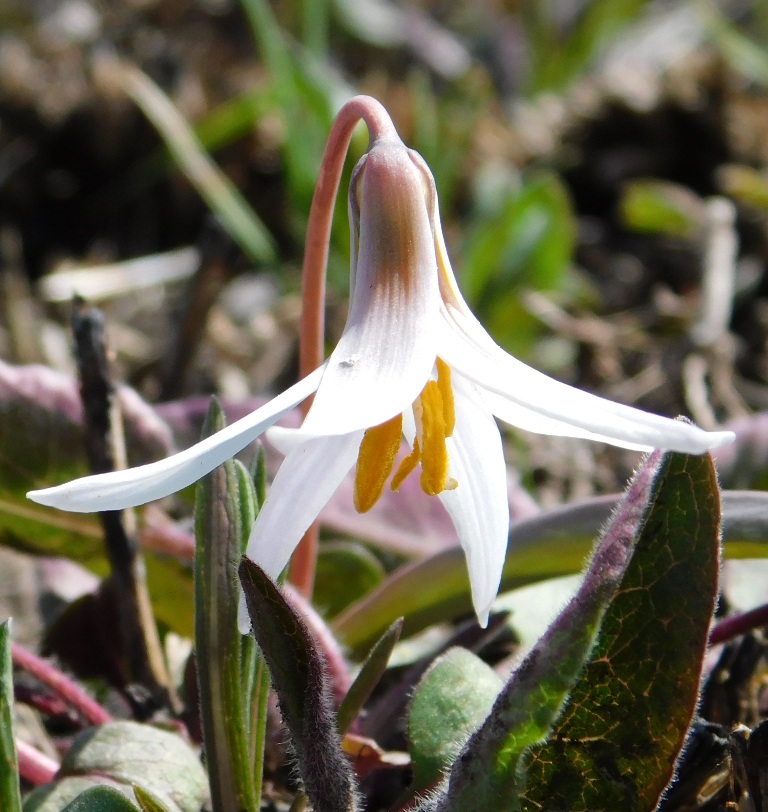
Jar of Goodness 4.10.22: Prairie Dogtooth Violets

. . . The weekly virtual “gratitude jar.”

This week, I’m expressing thanks for prairie dogtooth violets. The official name is Erythronium mesochoreum.

Although prairies are in my genetics, I grew up spending much more time in wooded Ozark landscapes. So the dogtooth violets I adored were the woodland species called white dogtooth violet, Erythronium albidum.

The prairie dogtooth violet is a newer friend and companion, one that lives on prairies and glades. It’s not mottled like its woodsy cousin, and it has several other distinctions as well.

So today, we visited Friendly Prairie, south of Sedalia, where they’ve recently done a controlled burn. That got rid of all the built-up dry grassy thatch, so the shrimpy little early-spring wildflowers are peeping up out of the moonscape, getting all the pollinators to themselves.

Did you know there is at least one species of native andrenid bee that specializes in visiting dogtooth violets? Sheesh. If any of those visited that prairie today, they were in heaven. HEA-VAN.

Did you know that the presence of prairie dogtooth violet is a good indicator that the land, where they’re growing, might never have been plowed? Ever?

It was a windy, blustery day, and the gusts swept right over the prairie parcel. The hundreds, thousands of little bell-shaped lily flowers shook and waved. Somehow I kept expecting them to make a tinkling sound.

Anyway, it was a really special day. Palm Sunday—while others were waving palm leaves, I watched these humble lilies wiggle in the undying wind. It was The Day of the Prairie Dogtooth Violets, and one I’ll never forget.

If you want to learn more about prairie dogtooth violet (and there’s lots of cool information to learn), see this page, which I might have had something to do with.

Thursday, October 14, 2021

Nature and Culture Intertwined

Prairies, ideally, are expansive places, where the land spreads out unobstructed on all sides except by miles upon miles of sunlit wildflowers and grasses. When you’re out on the prairie, the only aspect greater than the land is the unfathomable sky above.

So to me it makes perfect sense that the Missouri Prairie Foundation has been encouraging us to look at prairies not just as places full of grasses, flowers, bugs, and birds, but as places significant to human culture—to our history, our settlement patterns, our agriculture, our artworks, our spirituality.

At the same time, the Missouri Humanities Council has been turning its attention to the “outdoors,” also known as the natural world. Like their 2020 Water Symposium and “Growing Up with the River” video series. To me, this makes sense, since you can’t have human history without nature, without our environment.

Maybe I need to backtrack for a second: it is remarkable that the MPF has been featuring programs beyond the biological and ecological, and that MHC has been featuring programs beyond the strictly humanistic, given the standard myopia of twenty-first-century public outreach. It’s generally considered best practice to stick to a single subject and reiterate a few chosen angles to that subject. “We need to stay in our lane.” That’s the general strategy for today’s media.

Don’t get me wrong: I love nature. When I think of prairies, I think of a lot of my favorite native plants and animals. And you know that I appreciate Missouri’s humanities, too, such as the German-immigrant history and culture, and our Missouri musicians and musical organizations.

So it’s a nice surprise that these two organizations are daring to connect, because I don’t much care for the standard myopic mores of our sophomoric century. I’m attracted to what the people of Phi Beta Kappa call “breadth and depth.” Notice how the Missouri Humanities Council has been using lovely, rich photos of Missouri landscapes instead of the “collages depicting a variety of Missourians” that you might otherwise expect, for an organization with “human” in its title. Something’s going on here beyond just eye candy—there’s a crossover shift between culture and nature, and I’m liking it.

So last night I helped my Dad with his first-ever Zoom presentation. Since he was one of three co-presenters, and the representatives of the Missouri Prairie Foundation and Missouri Humanities Council took charge of organizing the presentation, Dad (and I) didn’t have a steep learning curve. My job as helper was mainly to sit beside dad (off camera) and provide a sense of technological security, which he really didn’t need.

The presentation (whose recorded version you can watch on YouTube here) was about the intersection of Missouri prairies with Missouri’s human history and culture. Though I admit to being biased, I think it was really good. I think you’ll like it, too.

But wait, there’s more: MPF will be having another expansive webinar this next week! This time, the topic is “Contemporary Art and the Prairie,” “an exciting panel discussion that brings together the communities of MPF and the Kansas City Art Institute in a shared passion for the landscapes within which we reside. This conversation, moderated by MPF Executive Director, Carol Davit, features three Midwest artists, Julie Farstad (Kansas City, MO), Erin Weirsma (Manhattan, KS), and Keli Mashburn (Fairfax, OK), whose creative practices focus upon the rich and nuanced significance the prairie has in our understanding of time, self, and place.”

“Keli Mashburn is a photographer and filmmaker living and working at the edge of the Tallgrass Prairie on the Osage Reservation of northeastern Oklahoma. Julie Farstad is an artist, Professor and Co-chair of the Painting Department at the Kansas City Art Institute, who explores the role of plants and the idea of cultivation in mixed media studio artwork and community based painting projects. Erin Weisma Wiersma is an artist and professor at Kansas State University. Wiersma’s new and ongoing works draw from the Konza Prairie, becoming both the medium and subject matter.”

I’ll bet you’ll enjoy it. It’ll be live on Wednesday, October 20, at 4 p.m., and it’ll be recorded so you can see it later. Here’s where you go for more information and to sign up.

Monday, August 30, 2021

A Conversation with Walter Schroeder, Mapper of Missouri's Presettlement Prairies

This is a short post. I'm just sharing a video with you. I hope you enjoy it.

I sure did.

For those of you who don't know, while I was in elementary school and junior high, my dad spent a decade meticulously researching the original handwritten descriptions of Missouri's landscapes made by the original land surveyors, who worked before Missouri was opened up to settlers, who plowed up the prairies, cut down the woods, suppressed natural fires, introduced cattle, etc.

From the surveyors' notes, he created a map (in the days before computers) of what parts of Missouri had been prairie (grassland) and which were wooded. The map was published by the Missouri Department of Conservation in 1981 and is still incredibly useful for conservationists and others who want an idea of how a piece of land was vegetated before settlers came in and altered it.

My dad's had a long career in both physical geography (landforms) and historical geography (especially settlement patterns). Many people in Jefferson City know him only from his popular books about the capital city and its German immigrant community—books he's written in retirement.

In this video, he touches on a lot of these subjects. A longer video, incorporating more parts of the interviews, is in the works, so stay tuned.

Also, be sure to check out the Missouri Prairie Foundation at moprairie.org.

I'm really pleased that the nice folks at MPF saw fit to do these interviews with my dad. I'm biased—I know he's a big deal—but it's nice to see others honor him, too.

Fun fact: my Grandma Schroeder was a charter member of the MPF. She and the other Garden Club ladies viewed native prairie conservation as integrally related to their gardening and landscaping interests. It seems that Grandma always spoke gushingly about the beauty of the prairies. She always pronounced it puh-HRARE-ie.

Thursday, August 8, 2013

Remembering Clair Kucera, His Grasses, His Gayfeathers


Sue and I drove to Tucker Prairie, just west of the Kingdom City exit off I-70 on Sunday, July 28, and spent the afternoon wandering around in that plot of never-broken prairie soil, examining plants, watching insects, and enjoying the abrupt, intense flights of an eastern kingbird. At one point, a covey of northern bobwhites erupted before us and flew away. Prairie cicadas droned . . .


I always find myself filled with wonder on a prairie. From a distance, it looks scruffy, and up close, you see that it’s a dizzying variety of plants that gives it that texture. The insects, birds, and other wildlife are similarly diverse.


Hardly any of it lives in forests, or subdivisions, or weedy roadsides. As you wade into the grasses, every few steps there is something to peer at, some new marvel.


I felt a different kind of wonder a few days later, when I learned that Dr. Clair Kucera, the ecologist credited for saving this spot of virgin prairie, had passed away the day before our visit. I felt sorrow of course, for I count him as a friend . . . but I felt wonder, too.


I heard Clair Kucera’s name a lot when I was growing up. Because I was young, I didn’t know who he was—someone my dad knew. He was a colleague of my dad’s at the University of Missouri, and they both were doing research on prairies; they were also both active in the Missouri Prairie Foundation. My dad, as I said in an earlier post, is a professional geographer who, using thousands of historical survey records as data points, mapped the presettlement prairie of Missouri.

Among Clair’s trailblazing contributions are his studies on the role of fire in maintaining prairie as prairie. He was an ecologist at a time when ecology was flowering as a discipline, and the ideas of biological succession and climax communities are core ecological concepts.

A vexing question about prairies was, What keeps them from being colonized by trees, and eventually turning into forest? We know that forests—oak-hickory being the predominant type around here—are the climax community, not tallgrass prairie.

As we know today, it was fire—started by random lightning strikes, or started by Native Americans—that kept the trees from taking over, maintaining the prairie as prairie.


Clair did much of his research at Tucker Prairie, using controlled burns, to figure out what frequencies of burning, in what times of year, are best for the prairie. How often, and when, should prairies burn, in order to keep out trees and shrubs, or kill off invasive plants like fescue, or invigorate the tallgrasses, or enhance the diversity of wildflowers and other forbs? As you can guess, these questions are critical for wise management of what few prairies remain in North America.

I don’t need to go into his life story or professional accomplishments. The Columbia Missourian did a nice job of describing those things in his obituary.

But I wanted to share a little about how I think about him. In 1995, I was living in Montana and looking for a new publishing job. When I learned of an opening here in my home state, at the University of Missouri Press, I applied for a number of reasons, but I wasn’t sure it would be a good “fit”—looking at their catalog, I noted that they published a lot of political philosophy and postmodern lit crit, which I didn’t think would interest me much. As an editor, I specialize in biology and natural history. During a phone interview, I asked if the press ever published much of that kind of stuff.


When the managing editor, who was speaking with me, mentioned that Clair Kucera’s manual The Grasses of Missouri would be coming out in a revised edition in the next few years, and I might get to work on it, my opinion of the job prospect improved tremendously. The first edition had been published in 1961, and this would be not only a chance to work in my preferred area, but also an opportunity to work with someone I had long admired.

And it was a pleasure and an honor to work with him. Even after the book came out, he sometimes called me just to chat. One time, he brought me some Liatris pycnostachya corms—surplus gayfeathers from his farm—to plant at the apartment where I lived then. So naturally, whenever I see blazing stars, I think of him.


And, of course, I think of him whenever I see prairie grasses, too. He wrote the book on them.


One more thing. Next time you’re on I-70 heading east out of Columbia, not long before the Kingdom City exit, turn your head and look at the scrubby-looking green grassland to the south. There’s a sign that says “Tucker Prairie,” in case you’re not sure.


The humble green building there is the Clair Kucera Research Station. Since the last time I wrote about Tucker Prairie, it’s been repainted and the windows repaired. It may not look like much, but for ecologists, for lovers of the prairie, and for friends of Clair Kucera, this research station, and this 160 acres, is cherished ground.

Saturday, August 25, 2012

The Green, Green Grasses of This Horrible Drought Year

I'd like you to notice something about our native prairies: All summer long, despite this awful drought, they've stayed green, green, green!

Unlike our pastures and old fields, which are filled with cool-season grasses, our native prairies have grasses whose favorite growing season is the hottest part of summer. Really, instead of calling them "warm-season" grasses, we should call them "hot-season" grasses. Because that's what they truly are. Not only is this their peak growing season, but also, they have super-deep roots that allow them to survive horrible droughts. (Like this one.)

For proof, here are some pictures I took at Tucker Prairie on July 29. All the pastures we drove through to get there had turned golden and dry. But the prairie--though not having a fabulous year--was getting along okay.


Tucker Prairie, in case you didn't know, is owned by the University of Missouri and is used as an ecological research area. This is 146 acres of true, virgin prairie, folks. You can see it as you drive along I-70: It's just west of Kingdom City. Apparently somebody knocked the sign down that used to be visible from the interstate, but you can easily recognize the native prairie by its greenness and the uniquely textured look of its vegetation. (By the way, the little research station building has attracted a great deal of vandalism, too. Which is very sad to see!)

You might have noticed that I-70 has a prominent curve between Tucker Prairie and Kingdom City, and this is no coincidence. When the government was planning the new superhighway, conservationists had to fight to keep it from plowing through and destroying this tiny remnant of original, untouched, native landscape.

Among the green grasses and sedges are hundreds of "forbs," which are herbaceous plants that aren't grasslike--in other words, broad-leaved nonwoody plants. There are something like 260 species of plants living on this small, precious patch of earth.

Below is one of my favorite prairie plants: Rattlesnake master! It looks a lot like a spiny ol' yucca plant, but Eryngium yuccifolium is actually in the celery, carrot, or parsley family. It's more closely related to "harbinger of spring" and "Queen Anne's lace" than it is to "Spanish bayonet"!


This is one of six species of sunflowers that occur at Tucker Prairie (I think it's ashy sunflower, Helianthus mollis, but I didn't photograph enough of the vegetative parts for this amateur botanist to be certain). There are 48 members of the sunflower family on this one small prairie (statewide, there are about 400 different taxa in the sunflower family).


Below is one of my favorite pictures from our visit--it's an insect you don't want to play with, though it's awfully interesting to watch one. This is a female robber fly (Promachus vertebratis) depositing her eggs into the flowerhead of an ironweed (Vernonia missurica, I believe).


Yeah, she was big and made an ominous buzz when she flew--she looked and sounded "stingy"! Robber flies are insect "wolves" that often prey on creatures much bigger than themselves. And they have a venomous bite that every account says hurts very bad.

Like all other wild creatures during this drought, she seemed pretty frantic, trying to do what she needed to do before water, and life, ran out on her. The 100-degree temperature itself must have cranked her metabolism up about as high as it ought to go. The wild critters of Growing Season 2012 deserve medals of valor! These will be awarded in spring of 2013, upon the hatching of their progeny.

One more thing. Every Missourian should know about the Missouri Prairie Foundation. They have some upcoming events of interest:

Thurs. Aug. 30: Doug Tallamy, author of Bringing Nature Home: How You Can Sustain Wildlife with Native Plants, will speak at Lincoln University's Scruggs University Center. There will be a whole bunch of native plant stuff going on, too, with food, tours of Lincoln's Native Plant Outdoor Laboratory, and so on.

Sat. Sept. 8: Workshop on Prairie Planting from Seed, with Jon Wingo and Frank Oberle. Learn how to convert lawn or fescue fields to drought-tolerant, beautiful native prairie plants that provide habitat for pollinators and other wildlife. Morning presentations, lunch, and tours of Prairie Star Restoration Farm (between Belle and Bland, Mo.). You have to RSVP for this. Click on the link at the bottom of this post.

Sat. Sept. 15: Prairie Day at Shaw Nature Reserve, Gray Summit, Mo. This is fun event for the whole family!

Sat. Sept. 22: "In Touch with Nature Field Day," at the Alan Busby Farm on US 54 west out of Jefferson City. Exhibits, hands-on demos, tours; more family fun!

Sat. Sept. 29: Prairie Jubilee at Prairie State Park, near Nevada, Mo. Celebrate Prairie State Park's 30th anniversary! Another family-friendly event.

FOR MORE INFORMATION ON THESE MISSOURI PRAIRIE FOUNDATION EVENTS, CLICK ON THE MPF'S "EVENTS" PAGE, HERE.

Wednesday, April 4, 2012

Springtime in Missouri

But is it April now, or May?

You have to admit, it was pretty much a nonwinter, and spring started in February. We’re a month ahead! I started planting lettuce and radishes the second week in February, and those plants that I haven’t picked yet are starting to bolt.

I’ve been busy, yes, yes, and you don’t want to read about that. But part of my busy-ness has been in hiking. Sue and I have made a point of “getting away” on weekends, or whenever we can claim a few hours, to enjoy the spring.

I’ve been photographing wildflowers, which has been fun. I do not consider myself any kind of “photographer” much less an “artist,” but I’m kind of proud of some of my pics. I’ve been visiting woodlands and prairies, witnessing the progression from early spring (February instead of March this year) into mid-spring (March instead of April this year).

So I hope you won’t mind if I share some of these pictures with you. I hope it’s not overkill. My camera does a pretty good job with closeups, and I honestly adore every single one of these plants.

I’m arranging roughly in order of blooming time, with the earliest of bloomers first. Several of these are long gone already, not to be seen again until next year!

Here are some flowers from Missouri woodlands.


Bloodroot.


Dutchman’s breeches.


Spring beauty.


Dogtooth violet (which is not a violet at all, but a lily).


Rue anemone.


Blue-eyed Mary.


Bluebells.


Wake robin; but I prefer the genus name, Trillium.


Here’s a trillium with fascinating genetics: It has parts in fours instead of in threes. Should we call this a quadrillium?


Yellow violet. Crazy-sounding, but true.


Wild sweet William, a.k.a. blue phlox.


Mayapple.


Wild ginger (not at all related to true ginger).


Wild geranium (yes, this is actually a type of geranium).


Jack-in-the-pulpit (in the same family as elephant ears).


Here are some flowers from glades.


Bird’s-foot violet, the two-toned form.


Shooting star.


Rose verbena.


And here are some from the prairies.


False garlic.


Yellow star grass.


Wild strawberry.


Hoary puccoon.


Wood betony.


Indian paintbrush.


And here is a bat!

It was on a shady trail one morning at Gans Creek. I’m pretty sure it’s a silver-haired bat, Lasionycteris noctivagans. I don’t know if it was ill, but it promptly flew away when I prodded it with a stick. (Gently. And yes, I’m extremely careful with bats.) Maybe it had just eaten a bug; they are known to eat off of surfaces in addition to catching bugs on the wing.


There’s some extremely bad news about bats, by the way. Please, please read this. Since silver-haired bats apparently don’t roost in caves, but sleep days in shagbark hickory crannies, hollow trees, and old birds’ nests, maybe they won’t be in trouble with that evil White Nose Syndrome.


Its face reminds me of a little dog’s. Incredibly cute. Silver-haired bats are migratory and spend nights fluttering up and down creek bottoms, hunting the zillions of pesky insects that fly in those areas.

Wouldn’t it be neat if everyone started hounding their governmental representatives about needing to find a cure for White Nose Syndrome? If not out of affection and respect for the bats, then out of hatred of mosquitoes—?