Showing posts with label Leonard Hall. Show all posts

Saturday, February 19, 2022

Forcing Violets

Are you ready for spring yet? I am.
Back in November and December, this winter was really slow to start, but now that we’ve finally started getting frozen precipitation, we can’t seem to shake it off. We finally got a big snow dump in the middle of January. Then it mostly melted, and then we got more on the first of February. Then that was mostly gone, and now we had snow again on the seventeenth. It wasn’t a lot of snow, but around here it is underlain by about three-fourths of an inch of grainy, icy sleet, which has formed a stubborn, un-shovelable layer on the sidewalks. Geez.

Each time we have gotten snow, people have dutifully cleared roads and parking lots, and we’ve shoveled our sidewalks and driveway and steps (yeah, we have lots of sidewalks, since we live on a corner). In the process, we’ve all created little hills of snow, which last forever, especially where it’s shady.

So, since the first big snow in January, we’ve never really completely gotten rid of the snow before the next dump. This has become kind of unusual for us, especially this late in the year. In fact, in recent years, the middle of February is when I start removing dead plant material from our flower beds, so the daffodils and such can come up in the clear. Because by mid-February, our daffodils are coming; indeed, the ones in front by the house are already at least four inches tall. The front of our house faces due southwest, so it’s sunbaked and amazingly warm, especially as the light and heat are reflected of the front of the house, so those daffodils are practically in a greenhouse, essentially “forced” to develop and bloom ahead of their compatriots elsewhere.

And that’s what I’m getting to: forcing flowers in springtime. It’s really popular to “force” into bloom various bulbs such as narcissus (those extremely fragrant “paperwhites,” for example), other daffodils, and hyacinths. Professionals force them in greenhouses for the trade. Go to your local grocery store floral department and you’ll see examples.

But it’s possible to force plants you find in nature, or in your backyard.

NOTE THAT I AM NOT SUGGESTING YOU DIG WILD PLANTS FROM PUBLIC LANDS OR FROM PROPERTY THAT ISN’T YOURS. . . . Please behave!

But you know . . . our backyard is the opposite of a golf course. And it’s not natural, either. Yards like ours have been called “freedom lawns,” since they’re free of pesticides, herbicides, and unnatural monocultures of high-maintenance turfgrasses. Admittedly, along with our smattering of various lawn grasses, we also have invasive star-of-Bethlehem and a variety of nuisance nonnatives and natives, such as Indian strawberry, creeping Charlie/ground ivy, field pansy, plantains, and common violets of various colors.

It’s the last one that I’m “forcing” this winter. The common violets that grow all over in our backyard develop rather coarse rhizomes at least about an inch long. As a kid digging in the soil of my parents’ backyard, I fancied these were like tiny iris bulbs, and I treasured them.

And I still treasure them; I have a hard time treating them like weeds, so when I’m working in a flower bed, such as my herb garden, I tend to pull out the violet rhizomes and transplant them elsewhere. Can’t bear to toss them into the composter. I really love violets.

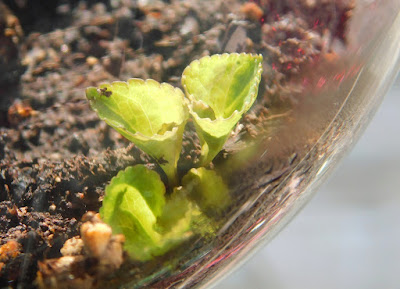
So last week, before the latest snow event occurred, I knew where to go in the backyard with my trowel to find a nice big violet rhizome to dig up. I planted it in some fancy potting soil at the bottom of a small fishbowl-shaped, bubble-ball glass vase.

I’m giving it plenty of water, and it gets oodles of sunshine in our front windows. On gray days, I stick it under an intense desk lamp.

And here’s what we’ve got so far. It’s making me happy!

And for the record, here’s where the idea came from: Leonard Hall’s A Journal of the Seasons on an Ozark Farm (Columbia: University of Missouri Press, 1980), 207.

Thursday, March 6, 2014

Journeys Around the Sun: Leonard Hall

In my previous posts, I talked about natural history books that have an almanac structure: Edwin Way Teale’s A Walk Through the Year, Hal Borland’s Twelve Moons of the Year, and Aldo Leopold’s A Sand County Almanac. Today, I’m continuing in the same vein, with a book of special interest to Missourians. You probably haven’t heard of this author.


Leonard Hall’s A Journal of the Seasons on an Ozark Farm (1956; reprint, Columbia: University of Missouri Press, 1980), like the other books, is arranged chronologically, with a handful of short essays for each month. Hall wrote a regular column about life on his “Possum Trot Farm” (south of Potosi, Missouri) for the St. Louis Post-Dispatch and Globe Democrat from 1946 to 1980.


Hall embraces the conservation ethic that Aldo Leopold so eloquently laid out, and his stories of life on a working Ozark cattle farm show a sustainable land ethic in practice. The changing seasons frame the story of a year’s worth of activities and observations, including migrating geese, cattle auctions, hunting and fishing, gardening, hiking, gathering elderberries, pawpaws, and hickory nuts, and butchering hogs.

If you’re not familiar with Leonard Hall, check out his books. I particularly recommend his Stars Upstream: Life Along an Ozark River, about the Current and Jack’s Fork rivers. It’s a classic every Missourian ought to read.


Since I was inspired to write about these books by my late-winter longing for spring, and being on constant watch for signs that springtime is coming, I’ll quote a few sections from Hall’s Journal of the Seasons on an Ozark Farm.


“This is a time of year we could do without. There are gloomy days when I have a profound sympathy for those furbearers which hibernate or for the birds that fly south in autumn. But then comes a snowy morning when the earth might have just been born and the chickadee sings as if it were summer, or a mild evening when the sunset paints the western sky in vivid colors and the young calves chase each other across the pasture with tails high in the air. Then I decide that one way or another, we’ll somehow ‘make it through to grass.’” (“January: The Sun Starts North,” p. 190.)


One of my favorite signs of spring is the sound of spring peepers, tiny peeping frogs that, in full chorus, sound to my ear like thousands of little jingle bells, though they symbolize anything but Christmastime. Here’s Hall’s description:

“When the worst blizzard of winter struck the western states this week, our thermometer at Possum Trot dropped sharply and a hard wind out of the northwest rattled the shutters, sifted in through the storm sash, and set the phone wires to singing. We hurried out in the morning to have a look at the baby calves, but found them galloping about the pasture with tails high in the air as if it were summer. Then on Sunday afternoon the wind dropped to a whisper and the mercury climbed into the fifties again. After supper, when I went to make sure the biddies were safely shut up in the hen house, I heard the first spring peepers singing, down in the pond in the woods.” (“February: Spring Edges Closer,” p. 205.)


And that’s how you always hear the first spring peepers of the season. It will be some supremely welcome warmish day, and you will be walking outside in a light jacket some evening after supper. And suddenly you hear them, jingling away, in some seemingly insignificant little pond in the woods.


Of course, there’s still an excellent chance it may snow and freeze again, but I agree with Hall: “There is something optimistic about the note of the first spring peepers that braces us against the occasional spell of cold weather which may still lie ahead” (p. 206).


Here’s to the birds who are remembering their songs
and the young birds who are tuning up for the first songs of their lives;
the geese honking, winging north on the heels
of warming weather,
and stopping overnight in marshes in gabbling flocks;
and tiny frogs awakening,
slipping out of cold mud,
and perching at the water’s edge
to peep their riot of love songs.

And here’s to the reawakening of the entire green world.