Showing posts with label Missouri State Capitol. Show all posts

Sunday, February 13, 2022

Jar of Goodness 2.13.22: Adrian’s Island Jefferson City

. . . The weekly virtual “gratitude jar.”

This week, I’m expressing thanks for Jefferson City’s new public park on Adrian’s Island.

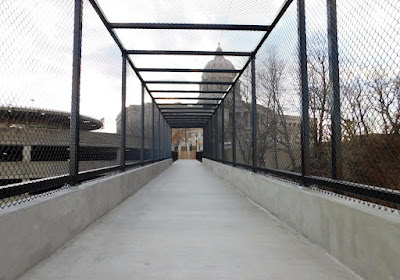
The park is named Deborah Cooper Park, and the soaring pedestrian bridge linking it to the Missouri State Capitol grounds, and over the Union Pacific tracks, is named the Missouri Bicentennial Bridge. And Adrian’s Island isn’t technically an island, since it’s broadly and clearly connected to land. But Memphis has its “Mud Island,” which is about the same thing.

(Oh, and all you naysayers, who've been against the development of this new park? You know, because it's expensive, and because it'll flood? . . . Well you can kindly stay off it. Go someplace else.)

I’m not going to repeat a bunch of stuff that’s already been covered in the papers and elsewhere.

But I will share some pictures I took of the place on a recent visit. If you haven’t been to see it yet, you really should go. Though until it gets genuinely warm, make sure you dress extra warmly. The breezes can be kind of stiff off the river.

And you do get some nice views of the river. And the Highway 50/63 bridge, too.

The views from the soaring bridge over the tracks are pretty nifty, too. Look for waterfowl and gulls and bald eagles!

At this point, landscaping is nonexistent. They had time before winter to plant several swamp white oaks—yes! Beautiful, poetic, hardy native hardwood! And they applied grass seed to the dirt surfaces, and installed some anti-erosion fencing, but that’s about all. By now, after rains and snow and meltwater, erosion is happening anyway, and they’re going to have their hands full reseeding. Hopefully they won’t make it all be just . . . lawngrass. (Aren't there enough places for people to throw balls around in this city?) But we’ll see.

Okay, and you get good views of the dredging barges and the sand plant across the river, and whatever they’re doing.

I appreciate being able to finally see the railroad cut in the bluff on the north side of the capitol. When you stand at the top of that bluff, by the Signing of the Louisiana Purchase statue, you see the river beyond, and you can kind of see a few of the siding tracks, but apart from the brush and weeds, you can’t get a good sense of the actual bluff and the extent of the tracks. It’s neat to see that perspective.

AND, if you’re into trains, the overpass offers great views of those, too! But that’s another post.

Monday, February 17, 2014

Fossil Hunting! A New Adventure at the State Capitol

To paraphrase Lily Tomlin: This year, our winter has been perverse—it can get warmer, but it won’t. I’ve been looking for things to do—but as you know, I’m not keen on ice, and there’s still plenty of that around.


So we found something incredibly fun to do! But first, you should know a little about the state capitol.

When I was a kid, and my family was visiting Grandma S (who didn’t have a/c), on some hot summer days my brother and I would walk up to the capitol and enjoy its cool, dark, marble hallways. It was like spelunking! It was like a mini vacation!


I still find the capitol a good getaway. It’s a breathtakingly beautiful building. As a public building, it’s ours, and we can go in there. I like to take walks around its pleasantly landscaped grounds, and look north at the train tracks and the river. I like to go inside and visit the museum. I also like to admire the art.

But last weekend, Sue and I had a new kind of adventure at the state capitol!


The winter 2014 issue of Missouri Resources, the magazine of the Missouri Department of Natural Resources, had a neat article in it about the fossils visible in the polished limestone walls and floors of the capitol building.


You need to check this out! The article is “Capitol Fossils,” by Patrick Mulvany. You can see the article online, or (even better, I think), looking ahead to more neat articles, you can also subscribe to the magazine. Subscriptions are free to any Missouri resident (super-cheap for anyone else); you only need to sign up for it, which you can do here.


Why are there fossils in the walls of our state capitol? Well, anyone who took Geology 1 with Prof. Houseknecht at Mizzou should know the answer: it’s because the “marble” isn’t true marble. It’s actually limestone that’s been polished.

Limestone’s a sedimentary rock, which, as we Missourians know, can be chock full of cool fossils. You just walk down a creek bed, picking up rocks, and you can see oodles of fossil echinoderms, mollusks, and other invertebrates. These include crinoids (our official “state fossil”), brachiopods, corals, bryozoans, snails, nautiloids, and more.

These are what’s left of the hard shells and other structural materials of saltwater animals that lived here 335 million years ago, when this area was covered by a sea (in the Mississippian Subperiod, if you want to get technical). Here is what you often find in an Ozark creek bed:


True marble (which isn’t found in Missouri) is a metamorphic rock created when limestone undergoes tremendous pressure and/or heating. Any fossils, impurities, or other interesting inclusions that were in the original limestone lose their shape and are reduced to mere swirly patterns in the marble.

The limestone used to build our capitol is named “Carthage marble” because in the commercial stone trade, this hard, dense, high-quality limestone that can take a decent polish without crumbling is called “marble.” Carthage is the town in southwest Missouri near where this limestone was quarried.

By the way, you can find polished limestone used as architectural marble all over the state. As Prof. Houseknecht pointed out to us, the bathroom stalls in UMC’s Memorial Union south wing are made of polished limestone; he asked us to “go” in there and notice the fossils!

The restrooms at the state capitol are included! You might end up taking extra time in a stall examining the nifty fossils in the partitions! Only ladies are allowed to see this cool nautiloid (or maybe it’s just a snail; but look at the chambers within the coils!):


(Yes, I did! I stood there in a bathroom stall and took a picture!)

Another nautiloid is visible to everyone and is mentioned in the magazine article. This specimen is nearly a foot long! The creature that lived in this conical or cylindrical shell (Gomphoceras sp.?) looked something like a squid, tentacles and all.


So, there are these cool fossils at the capitol that you will miss the first 150,000 times you visit. Naturally, the bigger attractions at the capitol are the majestic architecture of the building itself; the museums; the artwork; maybe even the lawmakers, lobbyists, and other governmental denizens.


But there are copies of a veritable treasure map at the welcome desk. With it, you can hunt all over the capitol for the nifty fossils featured in the magazine article. And, more fun yet, make your own discoveries!


It’s a good idea to bring a flashlight and a hand lens. You’ll look a little funny examining the walls so closely, but really, it’s good for the legislators to see that. It helps remind them that they and their pet bills are not the gravitational nucleus of the universe.


One more thing: I was especially eager to go on this treasure hunt because I wanted to see some examples of a type of bryozoan fossil called Archimedes (the genus is named for the screwlike form that commonly remains of the animal).


I’ve recently educated myself about Missouri’s current, living bryozoan species (read more about Missouri’s living bryozoans here), and now I’m wanting to find all kinds of examples of them—fossilized or living!


(Oh, I’ve got big plans for this summer’s explorations, born out of a long winter’s cabin fever! But more on that later!)


Friday, May 20, 2011

The Art of the Missouri Capitol

Well, my friends, here is a book you need to have. It’s been years in the making, and it’s hot off the presses! Ta-dahhh!


If you’re a Missourian, this book will make you proud, because its subject is a source of pride: the marvelous paintings, sculptures, stained glass, and other artworks that decorate our capitol in Jefferson City.

I have to admit, because my grandmas lived in Jeff City and we visited the capitol a lot, I grew up with a skewed idea of what a capitol building should be like. Aren’t they all, basically, big, huge, glorious art and history museums, where hot-air politicians happen to meet occasionally for the purposes of legislation? . . . They aren’t?

The Missouri state capitol is often ranked among the most beautiful in the United States. It was built during the end of the American Renaissance architectural era in a classical-inspired style, before Art Deco and other modern, less majestic styles became popular—so the grandeur of the architecture, by itself, inspires awe.


But what really sets the Missouri capitol apart is the “decoration”—truly an understatement for what we have: a collection of works by some of the finest artists and muralists between the two world wars, which has been augmented with more top-rate art ever since.

Around 1917, when it was clear that the special tax to raise funds for the construction of the new capitol would produce surplus income, the state stuck to its plan for allocating that money for the capitol, and channeled the revenue into the artworks that adorn it today. (Folks, think about our state: this would never happen today! How lucky we are that they made that decision when they did.)


Our state owes great thanks to the “Capitol Decoration Commission,” chaired by Dr. John Pickard (of the University of Missouri—Pickard Hall, home of the Museum of Art and Architecture, is named after him). This group of five prominent and well-connected Missouri art connoisseurs were charged with selecting artists--some of the greatest, from American and abroad--and seeking bids for the paintings, sculptures, and other artwork to adorn what were originally blank walls and plain pediments in the state’s newly built capitol.


The Decoration Commission was also, of course, charged with staying within budget and meeting deadlines, and, as you can imagine, they simultaneously had to deal with artists’ idiosyncrasies and the artistic ignorance and short-sightedness of some outspoken, obstinate legislators. They had to play political games that none of them relished at all.

It wasn’t an easy task! But the commission fulfilled its obligation beautifully, and the result is a collection of breathtaking, priceless artworks owned by the people of Missouri and proudly on display at our state capitol.


This year, 2011, marks the one-hundredth anniversary of the destruction of the old capitol building, an event that paved the way for the construction of the present capitol. It’s also the ninetieth anniversary of the unveiling of the first big batch of artworks, as well as the seventieth anniversary of the completion of the famous mural by Thomas Hart Benton in the capitol’s House Lounge.

Thus it’s appropriate that a book like this be published this year—and unlike most “media” flittering around our culture these days, a volume like this isn’t created “overnight,” or even in a month! (Note sarcasm.) It was at least ten years in the making. The authors, Missouri historian Bob Priddy and art historian Jeffrey Ball, have been researching and studying the artworks and the stories behind their creation for well over a decade (actually, more like twenty years).


Click here to read a statement on the book by Bob Priddy, who, gracious as always, puts the emphasis on the greatness of his subject as opposed to himself.


This book’s publication also required persistence, resolve, and serious fund-raising efforts by numerous state leaders, among them Senator Wayne Goode and Kenneth Winn; and the book has been delivered to us in a lovely and substantial form by the talented staff at the University of Missouri Press (check out their catalog; they’re the publisher for Missouri subjects).

In addition to the stories of how the commission chose and worked with the artists, there’s an added layer of history to the project, since most of the works in the capitol depict some historic episode or person in Missouri’s past, either straightforwardly or symbolically. Indeed, if you study the capitol artworks, and read the commentary in this book, you will essentially receive a crash course in the history of Missouri. (And you’ll have a blast in the process!)


When I first heard about this project about ten years ago, I was thrilled with the idea of there being simply a full-color book containing beautiful color pictures of all the capitol’s artworks—not even counting any informative and authoritative text. And this book “delivers” in that sense, too; it’s like an exhibition catalogue—but so much more.

When you’re visiting the capitol, you’re usually on a schedule; the hallways are rather dark; it’s hard to study the paintings. But in this book, you can see entire murals, sculptures, stained-glass windows, for extended contemplation, even though they are a small fraction of their actual size.


The principal photographer for this project was Jefferson City’s incredibly talented Lloyd Grotjan, who owns Full Spectrum Photo and Audio on High Street. In addition to his dozens of technically flawless, sharp reproductions of all the enormous murals, his many architectural photos capture subtle details of our capitol as well the sweeping vistas of rotundas, staircases, and galleries.

The Missouri state capitol—its structure, its artwork, its museum—is a priceless treasure owned by the people of our state. This book tells the story of its beautiful art; and hopefully, it will remind us of how precious our capitol is, and how important it is to maintain it.


Suggested in This Post----

Visit the Missouri State Capitol

Yep, you can just walk right in and start looking around. This isn’t a monarchy, and we don’t have royalty: this breathtaking, majestic building belongs to the citizens of Missouri. The capitol is deservedly Jefferson City’s number-one tourist attraction.

Make sure you visit the Missouri State Museum on the first floor, which on one side highlights Missouri’s natural history, and on the other, the history of Missouri’s people. But don’t forget to go up to the second and third floors to enjoy the paintings, sculpture, views, and architecture.

I recently spoke with a fellow, a grown man and a business owner, here in Jeff City, who admitted he hadn’t been inside the capitol since he was a child. What the—?! Needless to say, he shall remain nameless, since I don’t want to embarrass this fellow.


Take a Guided Tour the Capitol

Guided tours allow you to see some areas normally unavailable to the public, including the incredible Benton paintings in the House Lounge. These free tours are offered Monday through Saturday, from 9 a.m. to 4 p.m. (except during the noon hour); and Sundays at 10:00, 11:00, 2:00, and 3:00. (If you have more than ten in your group, you need reservations. Click here for more information on guided tours).


Buy the Book!

This book belongs in the home of every proud Missourian. Here are some links so you can purchase it; take your pick: the publisher’s site; Downtown Book and Toy; Amazon.

Step right up!


Thank you, Sue, for sharing some of your beautiful photos for this post. You're a really excellent photographer, and I don't know what I'd do without you! You make my blog look far better than it really is!

Sunday, April 10, 2011

The Pedestrian Bridge Is Open!

Friday morning was the ribbon-cutting ceremony and the official first crossing of the new pedestrian lane on the Missouri River Bridge!


I told you about the groundbreaking ceremony for this project last May. Click here for some scary "before" photos!

The new section is attached by enormous brackets to the eastern edge of the northbound bridge.


This nice, wide path is a huge improvement on how it used to be, when walkers and bicyclists had only a few feet of thin air between themselves and the 50,000 cars and trucks that blast over the river each day.


Not to mention that bicyclists attempting to ride south to reach Jeff City were forced to ride on the left, against traffic, which is kind of suicidal, plus it's ingrained into us all as illegal. Most Katy Trail bicyclists, I suspect, simply opted to stop at Hartsburg instead, with an attitude about Jeff having "nothing worth risking your life to see."

To access the bridge from the south (Jefferson City), park near the intersection of West Main and Clay streets—that’s where the pathway begins, behind bright yellow posts.


Round the curve, and soon you'll be on the bridge.


There is a special section with higher fences over the train tracks; I think it's to prevent the slower among us from throwing objects down on the rails.


The path gives you excellent views of Jefferson City and the state capitol. There are two places over the river where the path widens, where you can pause to enjoy the view.


You can take great photographs from the bridge!


Then, once you’re over the river, a big ramp, shaped like a square spiral, leads you down comfortable grades to the river bottom, near the Noren River Access. From there, a short ride leads to the “North Jefferson City” access point of Katy Trail State Park.


The Katy Trail, I should mention, is the longest rails-to-trails pathway in the United States; at the present, it extends from St. Charles in the east to the city of Clinton in the west; much of it includes incredibly scenic stretches through Missouri’s wine country and between tall limestone cliffs on one side and the beautiful Missouri River on the other.

Although initially it was controversial, especially among landowners who believed the trail would deliver riffraff and trash onto their rural properties, the Katy Trail has proved enormously helpful to many small communities that had seen nothing but “bust” since the decline of the railroads. Now, the Katy Trail brings cyclists (such as me), hikers, big-city residents with disposable income, and family day-trippers to these small towns, and they’re interested in dining, shopping, spending the night at B&Bs, and getting a taste of the “local color.”

Towns such as Boonville, Rocheport, Hartsburg, Hermann, and Sedalia are called “Katy Trail Towns,” and now that Jeff City is officially connected, it becomes a Katy Trail Town, too!

I can’t wait until my ankle’s all better, so I can start riding my bike across! (That ramp looks like a lot of fun!)


One more thing: Although the local and state officials who spoke at the ceremony had lots of thanking to do--and I won't repeat it here, for there were many individuals and businesses who donated to this project (look for their names on pavers and a plaque at the south end of the bridge)--I want to express my appreciation, respect, and admiration for the workers who risked life and limb while constructing the pedestrian bridge. Here are some of them.


Folks, they were out there on the edge of the bridge in the freezing cold, with cars whooshing right past them at ninety miles per hour (in a sixty mph zone), and working high over the river; there were dozens of ways to die out there. And it was a record-snowfall winter, yet they finished on time and on budget. Great work, fellows! I will think of you each time I use the bridge!

Thanks, Sue, for taking such awesome pictures!

Sunday, February 6, 2011

State Capitol on Fire!

Jefferson City residents awoke this morning to the grim knowledge that the Missouri capitol has burned overnight and is a total loss. The fire started last night around 6:15, when lightning from yesterday evening’s thunderstorm struck the building’s dome. The fire spread rapidly along dry pine boards of the roof.

Firefighters from all nearby districts were called in, including the negro firefighters from Lincoln Institute and the German immigrants from the Muenchberg community just south of town. A group of firemen from Sedalia loaded their water pumps and other equipment onto railroad cars and made it to Jefferson City in record time—just over seventy minutes—but they were too late. By the time they arrived, the water main had broken, and there was nothing for anyone to do but simply witness the disaster. And the statehouse burned all night long.


. . . This, of course, is history, and the reason I’m mentioning it is that last night, February 5, 2011, was the one-hundredth anniversary of the disaster.

Sue and I went to the commemoration ceremony last night, and I want to tell you about it. If you weren’t there, you missed a pretty cool event.

Jim Dyke, a local artist and cartoonist, was one of the chief organizers, and what a wonderful thing he did for the community.


It started with a reenactment that had a twenty-first-century twist. At 6:15 p.m., church bells all over started ringing like crazy, and fire trucks, with lights flashing and sounding their horns, drove around the capitol’s circle drive, then parked in front of it, lights blazing, blasting out all the chords of “emergency.”

And, true to history, they represented many local departments—Jefferson City, Cole County, Russellville, Lynn, Osage, Columbia, and several more.

I’m sure that people driving by on High Street, the river bridges, or anywhere else within sight, were shocked by what must have looked like a tremendous emergency at the capitol!


Then, when this stage of the event was concluded, everyone convened in the beautiful rotunda of the capitol for a commemorative presentation.


What good fortune to have Bob Priddy there to tell the story of the 1911 Capitol fire!

In case you don’t know him, he’s one of our favorite historians of Jefferson City and Missouri. He’s a professional journalist with a distinguished career, and for years he did a radio show called Across Our Wide Missouri (and published books based on those programs).


He is one of those people who can relate history in a way that makes it gripping. By the time he’s done, you understand not only the story, but all the enriching context, as well. (More Bob Priddys, please!)

He didn’t just tell the story of the night of the fire; he described the decade or so before that event, when it had become clear that the old capitol was a musty old tinderbox and needed replacing, and when others in the state were trying to relocate the seat of government to their localities. With all the arguing in the legislature, no progress was made in preventing the disaster.

So the capitol fire in 1911 brought those issues to the forefront. And—after much more legislative and journalistic discussion—we all know how it turned out: Jefferson City remained the state capital, and the old capitol was replaced with one that far, far surpassed it, in strength, size, and beauty. Priddy pointed out the strange irony of that devastating fire: It was one of the best things that ever happened to Jefferson City.


I should also mention that he concluded his speech by pointing out that our beloved state capitol presently needs some millions of dollars in maintenance and renovation. And you know, considering that it functions not only as the seat of legislature and symbol of our state’s greatness, but also as a history museum and art museum holding priceless treasures, we really owe ourselves such renovation.

Mayor Landwehr issued a (very fun) proclamation, juxtaposing the situation of a hundred years ago to our lifestyles today. (For example, in 1911, a group of Boy Scouts volunteered the night of the fire, helping to keep people safe; in 2011, it would take at least a week to get all the parental consent forms signed!) He also recognized Mayor Elaine Horn of Sedalia, who was there with representatives of the Sedalia Fire Department.

Sedalia, by the way, was one of the strongest voices wanting to relocate the seat of government away from Jeff City—they believed they would be a much better location. Yet on the night of the disaster, there they were, rushing to get their firemen on the train, to help fight the blaze. Their efforts to acquire the seat of government would continue after the fire, but on February 5, 1911, such discussions were set aside.


Artist Jim Dyke spoke at the end, inviting everyone to proceed to his gallery a block away, as he had assembled a group of artifacts from the old capitol, along with posters and other displays about the fire. As an added incentive, he offered wine and cheese! (There were also sugar cookies shaped like the old capitol, iced with a conflagration of yellow and orange, and lightly dusted with sootlike black sugar sprinkles. I thought that was clever!)

Finally, at the end of the presentation in the rotunda, Mr. Dyke urged all the firefighters present—I think there were at least forty of them—to come stand with him before the audience. Thus there was a procession of uniformed and nonuniformed, professional and volunteer firefighters, who stood together in a line. This, naturally, garnered a standing ovation for them and for all the past-present-future heroes they represent.


It was a memorable evening, though it certainly doesn’t hold a candle to that night a hundred years ago. If you haven’t been to our state capitol, you really should see it. Of the top ten tourist attractions in Jefferson City, the capitol comprises numbers one through seven. And it took a major fire, a hundred years ago, to clear the way.

A Special Thank-You to Susan Ferber, who took these (and numerous other terrific) photos, of moving objects, in poor light, at all distances. Danke schoen, Sue! (The historic photo, at the top, appears on scads of Internet sites.)