Showing posts with label nature. Show all posts

Monday, December 23, 2024

Big Nature, 2024

The year 2024 has been a notable nature year in several ways. Sure, there were some significant tornado, flooding, and other severe-weather events (some part of Missouri gets those every year); but if you lived in any of the places affected, it was definitely a year of “big nature” for you.

And we had an exceptionally mild spring, which is something, and by fall, most of the state was in some level of flat-out drought. (Which affected fall color in our state.)

In October, the drought stress caused our lilacs to bloom even as our green ash tree turned yellow. It was a really odd sight.

But I want to talk about much bigger nature. Like, once-in-a-lifetime nature. Like, there was that amazingly beautiful total solar eclipse in April (I still need to blog about it). Of course, I didn't even try to take pictures of it, but I sure soaked in the time and place—the way the event felt, and how unique it looked—sunny but shady, at once.

And there was that solar storm that ignited aurorae visible exceptionally far-south in May and October. If you got to see that, or get photographs of what you wished you could see with your bare eyes, then bully for you!

But let’s not forget the coolest nature thing that happened in eastern North America: the coincidental emergence of two big periodical cicada broods the same year! It was Broods XIII (17-year) and XIX (13-year). Realize, every “normal” periodical cicada emergence is an amazement in itself. That these insects can live 13 or 17 years below ground, sucking juices from tree roots, then somehow all emerge within the space of a few weeks, the same year, like clockwork, is a staggeringly cool example of big nature.

The last time the two broods emerged the same year was in 1803, the year the Louisiana Purchase was signed!

As of 2024, there appeared to be nowhere that the two broods overlapped, so it was a geeky thing to geek out over. It’s not like there were twice as many cicadas in most places (indeed, cicadas generally decline thanks to habitat disruption, and climate change is affecting them, too).

So it’s a mathematical convergence. When one thing happens every 13 years, and another thing happens every 17 years, it’s rare when they synch up.

So, when will the two broods emerge during the same summer again? How do you figure that out? Well, here you go: 13 x 17 = 221, and 2024 + 221 = 2245. The year 2245!!

What will the year 2245 be like? None of us alive today will see it . . . but Star Trek at least has offered some suggestions. According to Star Trek, 2245 is the year, on April 11, of the launch of the USS Enterprise, NCC-1701 (yes, THAT Enterprise!). Its first captain will be Robert April (who appears in later Star Trek series, including Strange New Worlds). James T. Kirk will take the captain’s chair in 2265.

It’s also the launch year of the Enterprise’s sister starships, the USS Cayuga (NCC-1557), later destroyed by the Gorn, and the USS Constellation (NCC-1017), under Captain Matthew Decker; both are destroyed by the Bugles-shaped planet killer in a memorable Original Series episode, “The Doomsday Machine.”

Star Trek canon also has it that 2245 is the year that Pavel Chekov will be born, and it’s the year that Leonard McCoy will decide to pursue a career in medicine.

I love it that these musings for 2024 have started with astronomical phenomena—the solar eclipse, the aurorae—then took a dive underground to consider the years our cicadas lived in soil, then fast-forwarded to the Star Trek universe. Science can predict, even project natural events: solar cycles, solar and lunar eclipses, and cicada emergences. And what do you think 2245 will be like?

Friday, May 10, 2024

Cicadas: What’s Up With Their Eyes?

It’s just uncanny how insects seem to be looking right at you. No matter how you turn them, and from no matter what angle you look at them, they always seem to be looking right at you.

Right

at

you!

So, what’s up with their eyes? I mean, we “know” they’re compound eyes and that they are quite different from our own. Our eyes are basically a clear-jelly-filled ball, with sensors (retina) at the back, a lens-covered, expandable aperture (pupil) in the front, and muscles that rotate it (so we don’t always have to turn our head in order to look around).

But their eyes are quite different. They are fixed; they don’t rotate. So why does that dark spot on their big, buggy eyes seem to follow around, so it’s always looking at the viewer?

Wet or dry . . . they always are looking at you.

Even while they’re molting!

How does this work? It’s caused by the structure of their compound eyes. It’s essentially a result of tubes, shadows, and mirrors. To understand this, imagine a model: Think of their globe-shaped compound eyes as a cluster of narrow tubes, all pointing outward from a center point, and imagine these tubes are coated, on the inside surfaces, with silver. Closest to you, the tubes are pointed directly at you, and you can see into the whole long (dark) tunnel (you’re not seeing much of the silver), while the tubes increasingly angled away from you appear light-colored, reflecting the light.

That’s basically it: you are looking at a spherical cluster of tubes.

And it’s not just with cicadas; many insects have compound eyes that have this property.

Like this common meadow katydid.

Like this little baby, gray short-horned grasshopper. So cute, sitting on a leaf in his prairie.

And like this pretty green planthopper.

The next question is, why does this seem so freaky to us?

We humans—with our social nature, our interdependence, our allies and enemies, our capacities for trust and for deceit—have evolved to be masters at evaluating each other. We look carefully at one another’s eyes. You can tell so much about someone by their eyes! Yes, “the eyes have it.”

This is why those professional poker players so often wear mirrored sunglasses—they want to conceal their thoughts and feelings. (Why shouldn’t that be considered cheating?)

It’s why people who have eye-alignment problems have a real social disadvantage, because crossed eyes or other misalignments are stereotyped as a sign of severe developmental disability, or head injury, of being dazed or semiconscious.

It’s why silent movie actors wore such heavy eye makeup.

And so we, in our anthropomorphization of insects, can’t help but look into their eyes, too, and try to read their expressions. And what we get back is an unblinking stare, perpetually fixed upon us. Does it freak us out?

Maybe it should. Insects depend on us to not ruin the world for them. They need elbow room. They depend on the existence of their many native food plants; they depend on the habitats—prairies, woodlands, glades, wetlands—that support their various food plants. They need plenty of plants and habitat, because the usual existence strategy for insects is to create a bazillion eggs and offspring, most of which won’t make it to adulthood. On some scale, they need room, like cicadas, to have a bloom, a heyday, and then have a majority eaten by countless predators, and then return to the soil.

So yes, they depend on us.

If you feel stared at, it’s not surprising.

Do things to preserve and increase native habitats.

And vote for the environment.

The above text explaining the dark dot in insect compound eyes is loosely edited from a page I wrote for MDC’s online field guide, Mantids (Mantises). Mantises, of course, are one of the many insects with compound eyes that exhibit this phenomenon.

Friday, March 22, 2024

Uncle Richard

In Memoriam

Richard Andree Schroeder

November 12, 1931 – January 7, 2024

Well, my friends, it happened: Uncle Richard has left us. Although it’s painful to contemplate, we are no longer blessed with his presence. As it is each time we lose someone dear to us, it’s hard to believe there can be a world without him.

As a small memorial, I want to meditate for a while about the things that seemed especially him. The qualities and the interests, the personality, the things he taught me about life just by being himself.

He was, and forever is, my Woodsy Uncle. Even if he were not a conservation agent, he still would have Touched the Earth, knew the names of all the plants and animals, observed and knew their interconnections and stories. Each life-form has a personality. There is a sense of wonder about, and an appreciation of even the least of these. Black morels appear a little earlier than the yellow ones. Black widow silk is intensely strong; you can identify it just by pressing against a single strand of it. Bald eagles, squirrels, leeches, and lichens: the world of nature is complex and beautiful. All critters are welcome.

He was adventurous, apparently from Day One. Where didn’t he go? What was he afraid to do? I don’t know. If something didn’t turn out the way you’d imagined, if you lost your compass or fell in the water, or if you fell onto a cactus in the dark, if you survived, you’ll be fine. In fact, you’re better off, because now you’ve learned something. And best of all, you now have a story to tell! He made a necklace for himself out of his own finger bones.

Which brings us to his artistic, crafty, creative side. From his grandpa, I guess, he inherited his sense of “make do with what you got,” his ability to figure out a way to make it work. His dioramas, his model planes, his ability to carve, his prowess with knots. When I was young, he once created a bow and arrow for me in the space of about five minutes: a small hickory sapling was trimmed at angles, notched, and bent, and a piece of kitchen string looped to each end. . . . Signs of his craftiness remain at our house, where over the years he fixed this and that, or repaired a windchime, or whatever. I can tell it’s his work because of the unique solutions and his attention to detail. He wasn’t afraid to fail, at times, either; he plowed ahead: Several years ago, he had a saying, which I copied and posted above my desktop; it went something like this: “If it’s jammed, force it—if it breaks, it needed fixing anyway.” (It turns out that such cut-to-the-chase advice can apply to manuscript editing, too!)

His artistic side blossomed in watercolors and oils, which sadly he decided to destroy several years ago, but we remember that side of him, that skill and patience. The painter’s eye is unique; it is as clever as the gambler’s dice, and it sees through What Is into all the realms of possibility. I honor his artistry . . . I honor it.

And of course, although he worked in paints, his first medium was words: his stories and poems. The ones he wrote down, and the ones he regaled us with whenever we got together. Soon after he died, Sue shared with me a dream she’d had, in which Uncle Richard was at a gathering with everyone, “holding forth,” telling stories and laughing, getting everyone else laughing, too. I think it was a sign that everything is okay, and we will all be okay without him. With his stories, you could never quite tell at what point the narrative would veer away from total reality into fiction and fantasy. And you know, ultimately, that’s all we’re ever left with: Is this history “true”? We must interpret it, exercise the muscle that distinguishes between the treasure and the sediment, the detritus. Sometimes the best truth is in the fiction. Sometimes what initially appears to be detritus is the real treasure.

Uncle Richard, despite his sometimes gruff demeanor, was a romantic and a nostalgic. He could find meaning and significance in all kinds of seemingly mundane, insignificant objects. His collection of writings bear this out; he teaches his reader (as he taught everyone who listened to him) that you can create from the most pedestrian topic a small, inspirational sermon about the Things That Really Matter. The necklace he made from the last bite of his mom’s last batch of lepkuchen. When we bought the house on Elm Street, there was a note on the refrigerator in Richard’s hand. It was about the aging process. Grandma had adored it: “This morning, I got up and put myself on like an old sweater. Holes in the elbows? I don’t mind—I made them myself!”

Things in our universe cannot last forever. Nature teaches us that everything must be recycled and transformed. Energy is neither created nor destroyed; the quantity of mass is conserved over time; the nutrient cycle, the carbon cycle, geologic cycles; physics, chemistry, biology demonstrate that everything that exists will be transformed. Nothing lasts forever. Raindrops wear away stones. Even our earth will eventually rejoin the sun and be reduced to its fundamental elements—to be combined later into all new, miraculous things. The detritus will become new types of mosses, new trees, new clouds, new rocks, and new fossils for someone to wonder about.

So, reluctantly, I guess it’s okay that Uncle Richard has departed from us. It’s not like there’s a choice; we have to accept it. The holes in the elbows? He made them himself. Was it jammed, was it broken? It needed fixing anyway. He left us with so many . . . so many stories to keep telling, and the impetus to find new adventures and stories to create about them. He’s gone from us and rejoined the cycle of transformation, the universal state of eternity. This is the way of nature; it’s part of the magic and mystery of our world, the Nature he honored his whole life.

Sunday, November 6, 2022

Jar of Goodness 11.6.22: Little House Books

. . . The weekly virtual “gratitude jar.”

This week, I’m expressing thanks for Laura Ingalls Wilder’s Little House books.

Dad’s been clearing out their garage and giving me boxes of children’s books and other items of my childhood. He’d packed them away so well, it’s kind of difficult to get to them. Thus, here I am in my fifties, receiving boxes of my old stuff.

I told you about the old Nancy Drew books. Well, I also got a box containing my old Little House books.

I read these in elementary school, too. I didn’t read all of them, however. I owned four of them and only read about 2.3. The two that were most engrossing were Little House on the Prairie and On the Banks of Plum Creek. I only got partway through By the Shores of Silver Lake before giving up on it. My old bookmark, in which park-ranger Snoopy encourages us to prevent wildfires, was still in place.

Why didn’t I plow through the whole series? . . . I think it was because the books started to focus on social situations, frontier technology and town-building, and sewing. It might also have been that the Little House television show quickly went from amazing (in my kid view) to sickly sweet.

In the books, I liked the parts about spunky young Laura, who walked around in nature, barefoot—in the prairie, along the creek—and noticed things. Kind of how I did as a kid. I was always looking in creeks. Like Laura, I was always peering under creek rocks to see crayfish.

. . . Or wondering at the beautiful glinting snow, or marveling at the array of wildflowers that grew, for free, in the woods.

I distinctly remember reading part of On the Banks of Plum Creek one sultry summer afternoon at Columbia’s Camp Takimina, then the local Camp Fire camp. My parents were probably helping do some kind of maintenance with other adults. I sat on the camp’s one wooden bridge, my feet dangling over the little creek. Then I set the book down and walked around on the big, flat, smooth limestone rocks that formed the creek bed. I saw tiny black toad tadpoles moving around in the water. There were water striders, too.

You never know what things will influence you in certain times of your life. You can’t predict which influences will be profound, or in what ways. Somehow, I never outgrew my childhood curiosity about nature. Rereading Laura Ingalls Wilder recently has reminded me how important those books were for, well, empowering my sense of agency, my willingness to explore, to have outdoor adventures.

Or, let’s put it this way: if I had read these books, and not been able to follow-up with my own outdoor adventures, I would have been frustrated indeed. Instead, I had our backyard, the big drainage ditch and creek behind our house, and Mrs. Ridgeway’s property nearby. And my parents were always taking us on hikes.

So it has been a blessing to reread these Little House books, aloud, with Sue. We discuss them as we read them. And we will continue reading them, including the ones I hadn’t finished reading way-back-when. We will buy the books I didn’t have, and we will plow through all of them.

And then, perhaps next spring, when we ((((finally)))) have a new, reliable car, we can visit Mansfield and see the house where Laura ended up. Who knows, maybe we can do a trip to South Dakota and Minnesota, to see the sights there. Why not?

Sunday, October 30, 2022

Jar of Goodness 10.30.22: Gans Creek

. . . The weekly virtual “gratitude jar.”

This week, I’m expressing thanks for Gans Creek Wild Area.

I’ll never get tired of this view.

Gans Creek is part of Rock Bridge Memorial State Park. I’ve been going there for hikes since the place opened in about 1981. It’s always been a favorite hiking place of mine. Lots and lots of my early journal entries begin “At Gans, at my outlook.”

I had to call it “my outlook” and “my precipice” because that was before anyone declared that it should be named “Shooting Star Bluff.”

Indeed—this was so long ago, there was a sea of perennial wildflowers, yes, called shooting stars, that quite literally carpeted the triangle of ground between the main trail and the V of trail leading to and from the outlook. It was a magical scene each April, with them and bird’s-foot violets all over that outlook.

The shooting stars, violets, and all their topsoil are a memory now at that spot; it’s been trampled to death.

I don’t go to Gans nearly as often as I used to. The old field at the beginning of the trail has turned into second-growth woodland characterized by cedars and autumn olive.

But the older forested areas along the bluffs still feel like a home to me, and it was good to visit the place last Thursday.

Sunday, August 28, 2022

Jar of Goodness 8.28.22: Native Prairies

. . . The weekly virtual “gratitude jar.”

This week, I’m expressing thanks for Missouri’s native tallgrass prairies.

We visited Friendly Prairie and Paintbrush Prairie today (they’re both south of Sedalia). It’s always good to see the flowers.

From a distance, the staggering variety of plants just doesn’t register. You have to wade in there in order to start really seeing things. Each time I go to Friendly Prairie, I see some new plant I didn’t know before. Maybe it should be renamed “Making New Friends Prairie.”

Today’s new friend is slickseed wild bean, Strophostyles leiosperma. I think. There are a few other species in that genus that occur in Missouri, and my pictures don’t show all the characters definitively, but that’s what my money’s on.

I was wading through the grasses, and I just looked down and saw its delicate little tendrils and soft, hairy trifoliate leaves, with oval leaflets, and I thought, What is this new little pea plant? The pods of this demure little legume were only slightly longer than an inch.

Here’s a picture of the prairie taken straight ahead, at eye level. My eyes are well over 5 feet above the ground. The tall stalks are big bluestem (good ol’ Andropogon gerardii), the prime tall grass of the tallgrass prairie. Its flower stalks can reach 8 feet high. Sue’s dad, having read many accounts of pioneers and settlers, used to talk about how crazy it was just to think of American grasses so high. A native of Ohio, he had not ever really seen the tallgrass prairie. So I took lots of pictures like this for him. See? See how high they are? So I still take these pictures.

At Paintbrush Prairie, I noticed an American bluehearts plant abloom. I’ve seen it at Friendly, but not at Paintbrush. Bluehearts is one of those MUAH! *chef’s kiss* wildflowers that pretty much only grow on high-quality native prairie. It’s also a semiparasitic plant, attaching to other plants (usually trees and other woody plants) via the roots and swiping nutrients. Unlike a lot of other parasitic plants, bluehearts does have green chlorophyll and can live okay without a host. And here’s another thing, per MDC’s Field Guide page, “Prairies, by definition, have very few trees. But historically, Missouri’s prairies, glades, savannas, and open woodlands formed a patchwork of open, grassy habitats that were kept open by occasional fires.” You can bet American bluehearts used to take advantage of that patchwork.

American bluehearts is one of the several caterpillar host plants for buckeye butterflies. Yay! And indeed, I saw a common buckeye not long after I spied the bluehearts! Yay! It was on top of a pretty curlytop ironweed plant. Yay! . . . But, hey, it wasn’t moving . . .

Turns out a crab spider was having a happy hunting day! I’m thinking this is a whitebanded crab spider (Misumenoides formosipes) but don’t quote me on that. . . . But yeah, I know. Sad day for the butterfly. But I did notice the butterfly was pretty beat up. Let’s hope it got to mate and create the next generation before its final stroke of luck.

On the subject of insects, there were a lot of grasshoppers flicking around. I managed to capture a picture of this one. No, I don’t know what it is. It’s a juvenile something-something. My first guess is two-striped grasshopper, Melanoplus bivittatus, but seriously, hell’s out for recess on this ID.

Finally, the picture at the top of this post is of wholeleaf rosinweed. It’s sort of become my favorite rosinweed because, well, it don’t get no respect. Unlike compass plant (look at those huge, flat, deeply lobed basal leaves!) . . . and carpenter weed (look at those square stems and opposite, perfoliate leaves!) . . . and prairie dock (look at those gigantic, smooth flower stalks, and those enormous basal leaves!) . . . wholeleaf rosinweed apparently gets written off as “some kind of” sunflower. Its leaves are, well, leaf-shaped.

So that’s the report for today. It’s mainly pictures. If I get behind in posting, it might be that when I’m not working, I’m just out trying to have fun, seeing what I can see. I'm sure you understand.

Sunday, June 5, 2022

Jar of Goodness 6.5.22: Butterflies of June

. . . The weekly virtual “gratitude jar.”

This week, I’m expressing thanks for the butterflies of June.

Really, anyplace flowers are blooming, this time of year, you’ll see butterflies. But today we saw them at Painted Rock Conservation Area; along the drive to the main parking lot, there’s a glade vegetation planting with lots of coneflowers, butterfly weed, and more.

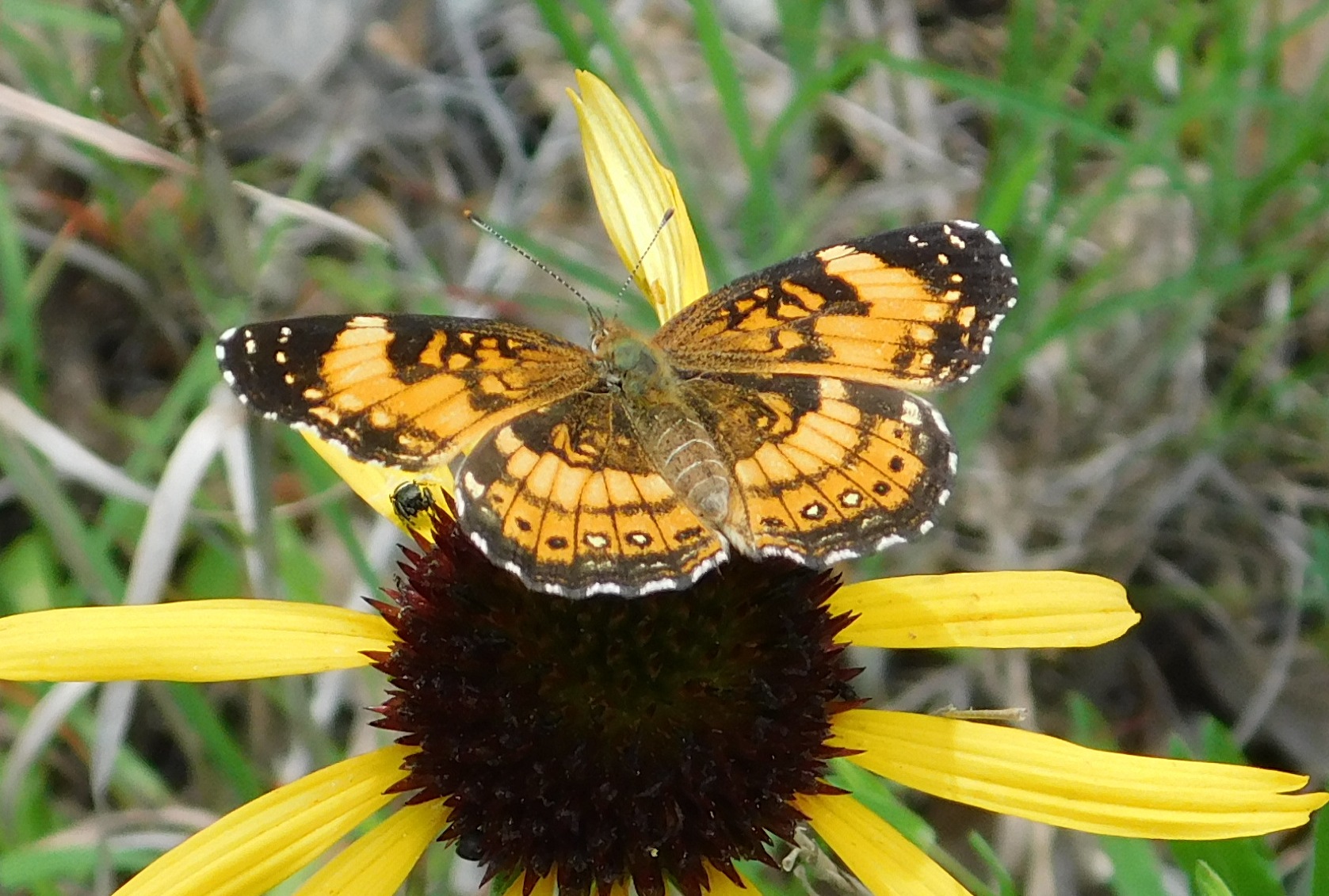
So here are some pictures of a silvery checkerspot and great spangled fritillary. There were many, both butterflies and flowers.

And it just felt magical.

Wednesday, May 18, 2022

The Black Walnut Tree

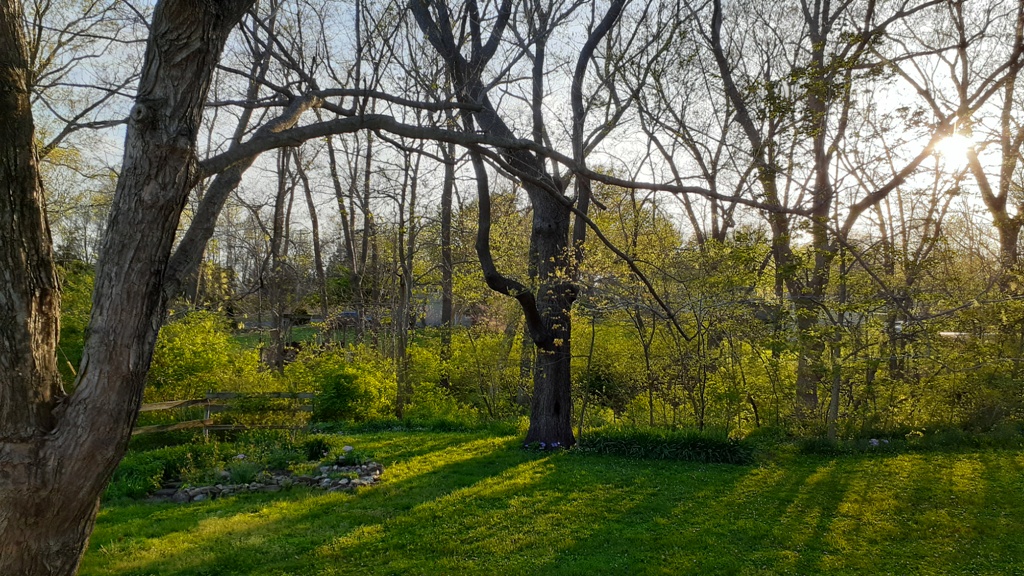
There’s a big old black walnut tree in my parents’ backyard. It’s right in the center, in the back, where the lawn meets the edge of the woods above the drainage ravine.

It was already a giant when they bought the house when I was on the way in sixty-five. All the branches are high out of reach.

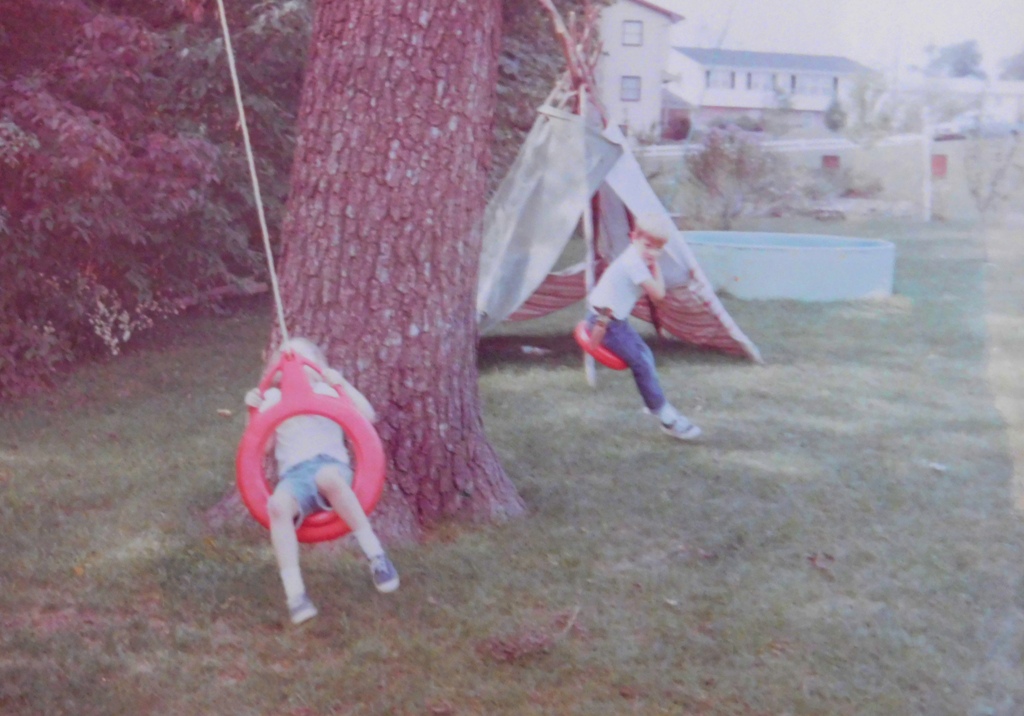
Dad hung swings for us from its huge lower limbs when I was a kid.

The night of Saturday, July 26, 1969, a severe storm blew the top out of the tree. A hard day’s work with saws cleared the debris from the lawn. Mom and Dad had plenty of help.

My brother and I didn't particularly help, but we sure had fun that day.

From that windfall and more, my folks used some of the fallen branches and some old blankets and pieces of canvas to build a tepee for us kids in the backyard. So that summer and following years, our yard was popular among the neighborhood kids.

Some of the large sections of walnut became woodworking projects. Mom squirreled away several nice thick pieces. To this day, I use one of the smaller chunks—which I carefully sanded and polished, as a preteen—as an incense burner. There's a public side and a private side.

Then in the late 1970s, Mom learned about juglenone when she tried to grow a tomato back near the tree. The tomato plant grew tall and spindly, and it begrudged us flowers and fruit. At the time, I didn’t care much, since I never cared much for raw tomatoes. (They’re still not a favorite.)

The nutmeats from the tree didn’t amount to much, as too many of them were dried and shriveled to make it worthwhile to crack them open. The squirrels found plenty of them to eat, however, and nested in its branches and ran around, like rollercoaster cars, on its wide, undulating, spreading limbs. Recently, my parents had a clan of gray squirrels with a lot of white patches in their fur, which was fun to see.

There has always been a vertical split in the trunk facing the house. It’s morphed over time into a more rounded hole. But the split was always a curious thing for me. Over the years, it became an entry way for the carpenter ants, bees, snakes, and other animals that have inhabited its hollow interior.

Paul and I used to pick up fallen walnuts and chuck them into the woods, practicing our pitches by aiming for random tree trunks. My fingers turned black from the juices, but I didn't care, since I wasn’t such a girly-girl. Chucking the nuts into the woods served a useful purpose, too, since it made mowing easier, and walking, too, for that matter.

I have so many memories of enjoying the backyard with that big tree providing us shade. It’s still standing, doing fine, its hollow space quite recently a home for a family of barred owls.

It’s truly a grandmother tree, and I thought I’d sing you this little song of praise.