Showing posts with label botany. Show all posts

Sunday, October 16, 2022

Jar of Goodness 10.16.22: Houseplant Dance

. . . The weekly virtual “gratitude jar.”

This week, I’m expressing thanks for our houseplants.

I think.

Every year, it seems like more work to move them in and out of the house. They love being outdoors in the growing season, and we enjoy having them decorate our yard, so we move them outside in the spring, when the frost danger is over. But to survive winter, they need to move back in before it freezes.

And it’s probably going to freeze tomorrow night. So, the dance of the houseplants.

If I don’t celebrate it, if I don’t cultivate a sense of happiness about them, then I run the risk of them seeming like a complete chore.

So, hooray for houseplants. I need some more ibuprofen, by the way, I’m running out.

Here’s a list of some of the houseplants we’re dealing with today and tomorrow.

Sanseveria, “mother-in-law’s tongue” (Dracaena trifasciata, until 2017 Sansevieria trifasciata), which had been Grandma Schroeder’s as long as I can remember.

Splitleaf philodendron (Thaumatophyllum bipinnatifidum), which had been Grandma Renner’s for many years.

Terrestrial orchids, or jewel orchids (Anoectochilis sp.).

Pothos ivy (Epipremnum aureum).

Several airplane/spider plants (Chlorophytum comosum), plain and variegated.

Scheffleras, or umbrella trees, two types (S. arboricola, with smaller leaves, and S. actinophylla, with larger leaves) rescued from Hickman Hall at Stephens when someone there had disowned the poor things that had gotten full of scales.

Tradescantia zebrina, inch plant or “wandering Jew.”

T. pallida, purple secretia or purple heart.

Plectranthus “Mona Lavender” Swedish ivy.

Dracaena marginata, or what Dad calls a “Dr. Suess plant,” which just grows taller and taller and taller.

Hart’s tongue fern, Asplenium scolipendrium.

Arrowhead plant, Syngonium podophyllum.

. . . Plus the bonsai.

Plus the elephant ears (Colocasia).
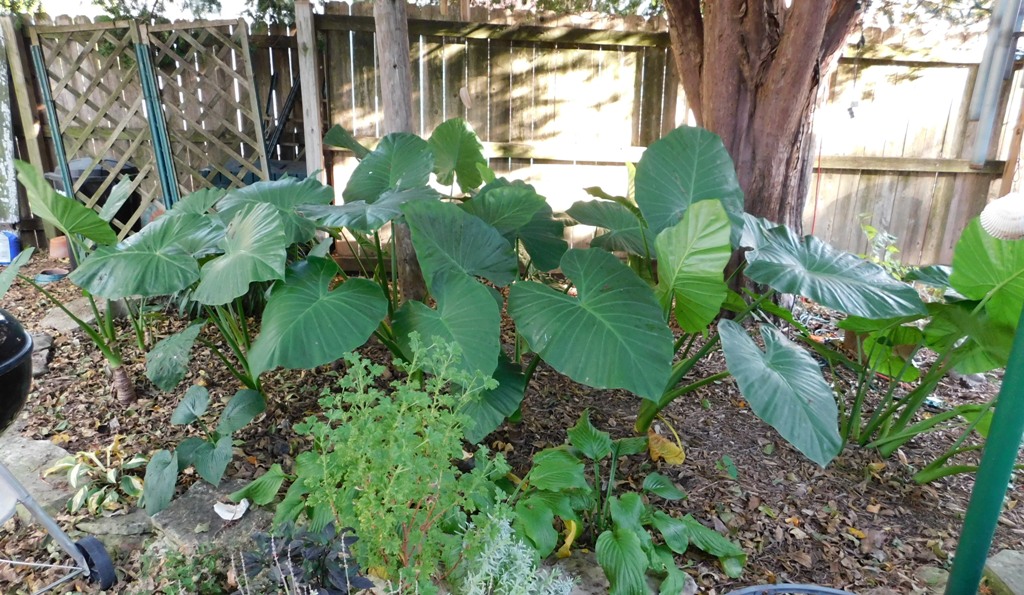
We’ll get to the elephant ears tomorrow, since we have to dig them up, lop off their blades, and tuck them away into the garage; there will be two big garbage cans full of their enormous, loglike corms and stalks.

Sunday, October 9, 2022

Jar of Goodness 10.9.22: Fall Color

. . . The weekly virtual “gratitude jar.”

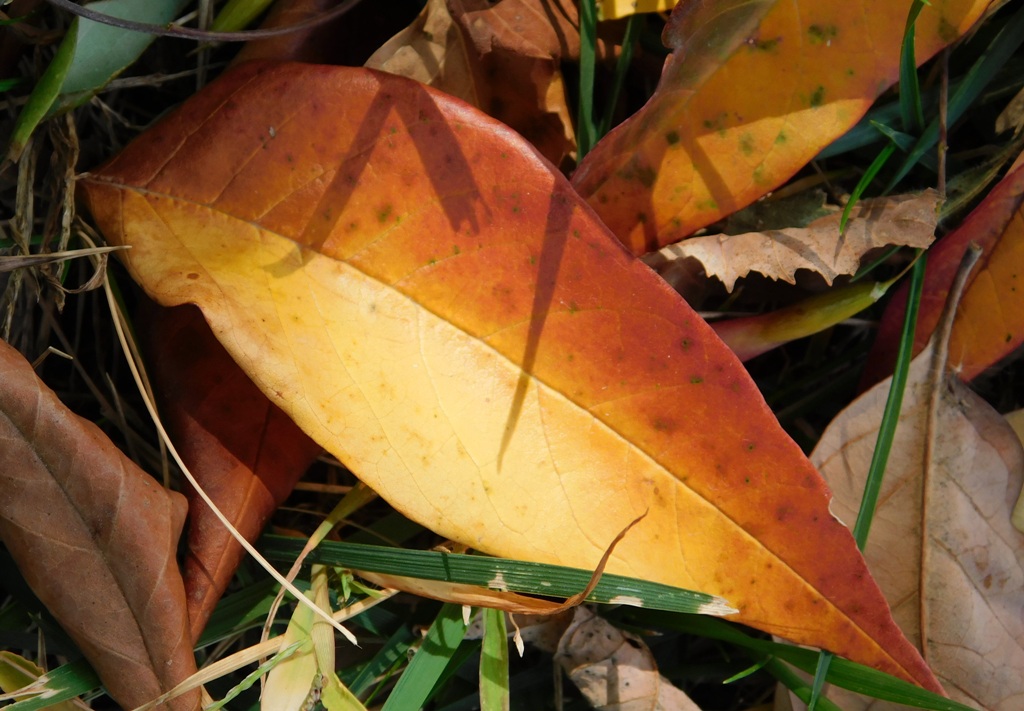
This week, I’m expressing thanks for fall color. For the beautiful leaves!

Leaf Day! Back in high school, one of my best friends and I would select a random day at the height of fall color season, and we would collect a bazillion lovely, bright-colored, fresh-fallen leaves, and then, in each of our various classes, arrive early and place a leaf onto each of our classmates’ desks. Plus the teacher’s. Everyone would be bewildered, but we’d simply reassure them: It’s Leaf Day! We’re celebrating! Aren’t they beautiful?

And our classmates would twirl their leaves and ponder nature during the rest of the class. (The janitors that evening were probably like, “what the hell—?”) Some of our classmates apparently enjoyed it, some thought it was stupid, but most, I think, really understood our point.

I think my friend and I had been inspired somehow to do this by listening to Leo Buscaglia talks on PBS, if that gives you a sense of the time period!

Wait, you haven’t heard of Leo Buscaglia? In the eighties, he was a big star on PBS. He gave lectures. He was a TED talk before there were such things. He was a great story teller, and all his stories made strong points. His favorite topic was love. Love was the title of his first bestselling novel.

We all oughta be reading and listening to Leo Buscaglia again. It would set us to rights again, maybe, for at least a little while. Here’s a video (in two parts) of perhaps his most famous lecture, “What Is Essential Is Invisible to the Eye.” The lecture, this time, was given at the University of Wisconsin–Eau Claire.

The lecture title was from The Little Prince (Le Petit Prince), by Antoine de Saint-ExupĂ©ry, and that was another book we devoured and got deep meaning from. Richard Bach’s Illlusions, another huge bestseller, and all this introspective, pop-psychological stuff set me going on a personal path that has given me a rich life. Not all of what followed was so great, but I’ve mostly managed to keep a balanced view. At any rate, it has helped.

Buscaglia’s lectures were full of humor, poignancy, and basic human wisdom. And emotional intelligence. We internalized tons of it. (And there was tons of it.) “People first, things second.” . . . “Life is God's gift to you; the way you live your life is your gift to God. Make it a fastastic one.”

My parents drove us to see Dr. Buscaglia speak at Kiel Opera House (now Stifel Theatre) in St. Louis. He was touring, and St. Louis’s KETC channel 9, the PBS station, was sponsoring him.

I don’t remember any direct connection our annual Leaf Day celebration had to Leo Buscaglia (his book The Fall of Freddy the Leaf wouldn’t come out until later) . . . but there’s a connection somewhere. (“The trees outside of your home are doing wondrous things; watch them step by step, it’s like magic.”)

But the connection is ultimately about love, and enjoying all the beauty all around us, perfect and imperfect. We don’t have forever; look around and see!

A reminder: to track the progress of fall color in Missouri, make sure you visit the Missouri Department of Conservation's Fall Color Reports page. It gets updated each week, on Thursday, by around 5 pm. Reports come from foresters in MDC's eight regions. And yeah, there's a little bit of me in there. But much better, when you read them, you can tell that the reporters, all professional foresters, really dig their subject.

Sunday, April 3, 2022

Jar of Goodness 4.3.22: The Violets of April

. . . The weekly virtual “gratitude jar.”

This week, I’m expressing thanks for April flowers, specifically violets.

Did you know that seventeen species of violets have been recorded in Missouri? In recent years (like, the past decade or so), I’ve been taking pictures of our different violets as I encounter them. I’ve posted photos of violets—mostly different variations of the common violet (Viola sororia) that grow in our yard—on my blog before.

In early April, it’s still kind of early for a lot of violets, but I know they’re coming, and I relish the opportunity to enjoy them again.

Here are some of my catches.

In 2017, I was really jazzed up to discover this violet, which is uncommon. It’s the plains violet or wayside violet, Viola viarum. There’s a population growing amid rock riprap in a small creek bed near the Katy Trail somewhere in this state. (I’m not saying where.) Most of the violets I’d seen until then had round or heart-shaped leaves, so the leaves of this violet kind of blew my mind.

Once my eyes were opened to that, I started looking more closely at violets. Only about a week later, I found that species’ doppelganger, cleft violet (Viola palmata). It was growing along a gravel roadway on my cousin’s property in Moniteau County. The leaves are really variable on both these species, but the main distinction is that cleft violet has hairy leaves, while plains violet is glabrous.

That same spring, while I was taking pictures of violets willy-nilly, I also took some pictures of Missouri violet (Viola missouriesis), which has distinctively elongated, heart-shaped leaves, whose outer third is not serrated like the rest of the leaf is. The flowers are said to be more of a lilac hue that the similar common violet, with a slightly darker ring around the pale throat.

While I’m on the subject of violets with weird leaves, here’s the only halfway decent picture I have (so far) of an arrow-leaved violet (Viola sagittata), taken on a prairie south of Sedalia in 2012. The flower of this species isn’t anything unusual, but the leaves are remarkable and, among our violets, unique.

In the woodsy-woods in springtime, you should always be on the lookout for yellow violets (Viola pubescens. This is possibly one of our most pleasing violets.

Then there’s pale violet, or cream violet (Viola striata). I don’t think I’ve ever seen this species in nature, but we have scads of it in our yard. I think Grandma or her parents must have introduced it and cultivated it.

Another violet that grows for free in our yard is field pansy, or Johnny-jump-up (Viola bicolor). Unlike the others I’m showing you, this is an annual, and kind of weedy. It volunteers and reseeds in our yard. I’ve seen it growing along the Katy Trail, too. It’s pretty cute, with pansy-like faces.

Well, I’m all enthused now about the possibility of taking some more pictures of violets. I’d like to improve on some of the pictures I’ve taken so far (such as bird’s-foot violet, the queen of eastern North American violets), and I’d like to locate some of the other violet species I haven’t seen yet. Some of that will require traveling to the eastern Ozarks. At least one is found on prairies.

Mainly, though, I’m just enthused about seeing violets, and other wildflowers, in general. Who knows what else I’ll find while I’m at it?

Tuesday, January 26, 2021

Walking Among the Ghosts and Lichens

Here’s a new idea for you. What have you been doing for exercise this winter—this socially distanced, pandemic winter, when half of what we need, really, is to just get out of the house?

Well, we’ve been taking walks out at Riverview Cemetery—one of Jefferson City’s big nondenominational cemeteries with rolling hills, lots of big, mature trees, and curvy, winding paved roads. It dates back to the 1910s.

We first started taking walks there in early December when we went to decorate my peoples’ graves—we realized how ideal it was as a walking location.

You want social distancing? There are very few people there—most folks don’t get out of their cars, and when they do, they stay close to whatever grave they’re visiting (decorating).

You want safety and solitude? Unlike walking on city streets, there’s no one brushing past you, and no traffic or noisy mufflers roaring by. You want fresh air? No stinky black exhaust fumes. Cemeteries are quiet places.

And we’re not superstitious. Neither of us is squeamish about being at the cemetery—we’re always intrigued and interested, reading the stones, noting the fresh graves (“ooh, do you think they died of COVID?”), straightening up dislodged decorations, etc. Indeed, we think of cemeteries as nice places. A place were mortality and eternity walk together in harmony.

Once, we came upon about a dozen deer walking around among the tombstones. When they noticed us, they all ran into the nearby woods. I’m pretty sure that was on Christmas Day. Yeah, indeed. We went walking there after Christmas dinner.

And the lichens! Championship flavoparmelias, bright orange xanthorias, sinewy ramalinas, ruffly parmotremas, etc., etc., etc., on the stones and the trees. Gorgeous, amazing organisms that make you glad to be stationed here on planet Earth for a time.

I guess cemetery trees get just the right amount of open sunshine, combined with lower air pollution and little mechanical disturbance, to grow nice, big perfect circles of lichens.

Sue and I probably look like weirdos out there, peering so closely at the trees and taking pictures. So far, no one has complained about us or asked us to leave.

Taking walks in cemeteries? We can recommend it!

Please enjoy some of the pictures I’ve taken on our walks.