Showing posts with label desserts. Show all posts

Wednesday, March 19, 2025

David’s Pancake

Y’all, this is really good. A friend shared this recipe with me back in about 1987, and I had never made it. She was older than me and had a lot of interesting stories from the 1960s and 70s. For years, I have wondered, “Who was David? . . . Probably an old boyfriend of hers. The Vietnam vet?” Finally, I Googled the recipe and realized she must have copied it right out of The New York Times Cookbook, by Craig Claiborne, published in the 1960s. The “David” is David Eyre, who was a food writer and editor for the NYT. The recipe is actually named “David Eyre’s Pancake.” So it wasn’t some groovy, super-talented, 1960s boyfriend of hers. She just copied it out of a book. See how important it is to cite your references?

The recipe card has languished in my recipe files all this time.

Actually, I think I tried to make it once, but it was a disaster because I didn’t know what I was doing, and I didn’t have the proper equipment. I’m surprised I kept the recipe.

Over the past few years, I’ve been compiling and typing old recipes into a big Word document, and (not knowing if this recipe had gotten a fair shake in my kitchen back in the late 1980s) I decided to try it again.

And hey, it’s really good! Another name for this kind of preparation is “Dutch baby.” It’s like a big popover made in a skillet, or like a soufflé. And just like a soufflé, it can go in a sweet or savory direction. You need to pay attention to technique, but it’s not hard. (If I can do it, then anyone can.)

Here’s how I’ve made it into a resounding success.

Equipment: I use an approx. 6-inch diameter (seasoned) iron skillet (it’s heavy, it holds heat, and it’s fine to go into an oven); also, I use our little toaster oven/convection oven, on the convection setting. The little skillet fits perfectly in there. (Or, if you’re making more than one at a time, or using a larger skillet, use an actual oven; but it must be fully preheated.)

So here's the nutshell version: Preheat your oven. Mix the batter. Then, start on the stovetop: heat a couple tablespoons of butter in the skillet (the skillet should be on a pretty hot burner; once the butter foams, and before it turns brown, it’s ready); pour the rather liquid batter into the skillet; then place the skillet into a preheated 425-degree oven and let it cook, undisturbed, for about 15 minutes.

That technique I just wrote? That’s the part I didn’t understand before, but it’s the principle that makes it turn out well.

Here’s what happens: The batter starts cooking as soon as you pour it into the hot-hot pan. Then, during the 15-minute oven time, the pancake cooks and puffs up. With a 6-inch skillet, some of the butter may seep over the side as the pancake rises, but let it. The pancake usually doesn’t quite get entirely solid in the center. I mean, I don’t think you even would want it to get completely “done” in the middle. The edges balloon up and get done faster, and may even get a little crispy. The eggy, custardy, soufflé-like center will deflate when you pull it out of the oven.

You’ve got to eat it hot, right out of its miniature iron skillet. Very cozy. To protect your tabletop, serve it atop a potholder or trivet.

I like sprinkling over it some fresh lemon juice and powdered sugar, which makes the center kind of like lemon curd. It can be a breakfast, lunch, or snack, or possibly a dessert, if you added, say, a sweet fruit compote on top, or chocolate and whipped cream, or whatever. But see the suggestions at the end.

I think this makes one serving, but if you’re eating it with other foods, such as a fruit salad, it could be enough for two. Especially if you make it in a pan larger than a 6-inch skillet . . . but then you need to slice it in half (very unpretty). Better to use individual little skillets.

  • ¼ c. flour
  • ¼ c. milk
  • 1 egg, slightly beaten
  • pinch of nutmeg
  • 2 T. butter
  • 1 T. confectioner’s sugar
  • Juice of ¼ lemon, or jelly, jam, or marmalade

Preheat the oven to 425°F.

In mixing bowl, combine flour, milk, egg, nutmeg. [I would add a pinch of salt, too.] Beat lightly/don’t overbeat. Leave batter a little lumpy.

Melt butter in a 12-inch or smaller skillet with heatproof handle. When butter is hot [foams/stops foaming], pour in the batter. Bake in oven for about 15 minutes, or until golden brown.

Sprinkle confectioner’s sugar and return to oven (to warm it, if desired).

Sprinkle with lemon juice; maybe add more confectioner’s sugar, or jelly, jam, whatever.

Yield: 1 or 2 servings.

Alternate treatments: Instead of lemon juice and powdered sugar, or jelly or jam, you could top it with chocolate or maple syrup, fruit compote, whipped cream, butter-sautéed sliced banana with brown sugar (and maybe a bit of rum) . . . anything you might put on any other pancakes.

But! You can also stir small-diced ham or crumbled bacon and grated cheese into the batter before pouring it into the pan. Or some chopped baby spinach and herbs. Or a duxelles of mushrooms. Or whatever . . . as you would an omelette. Yum!

Wednesday, February 28, 2024

Marie's Apple Cake

There are so many ways to make apfelkuchen, or “apple cake”! I suspect every ethnic German mother and grandmother has her own recipe. This is just one version—but I know you’ll love it. It’s easy to make. It’s a bit rustic, but you can dress it up with toppings.

Yeah, there’s a whole world of great German desserts out there, and “kuchens” come in all varieties and forms. (It’s not surprising, when you consider that kuchen means “cake,” and of course we have ten thousand types of cakes—sheet cakes, pancakes, crab cakes, coffee cakes, ice cream cakes, rice cakes, etc.)

This is a nice, easy, little apple cake recipe from my Grandma Schroeder’s best friend in the whole wide world, her crony from early girlhood through their entire lives, Marie (Weigand) Korsmeyer (1904–1999). She and her husband, Clay Korsmeyer, lived at 112 W. Atchison Street. The house is still there, across the street from my friend Laura’s house.

I got the recipe from my mom, who had apparently gotten it from Grandma—Edna Schroeder—who had apparently gotten it from Marie . . . even though Grandma clearly had her own recipe(s) for apple kuchen!

Oh, Marie!

Edna and Marie’s friendship resembled a “Lucy and Ethel” relationship in some ways; it was beautiful, lively, fun-filled, and true. I think whenever their shenanigans ended with “trouble,” they generally wound up having a good laugh over it. There are stories about them, as little girls, bingeing on green apples they had snitched from someone’s apple tree, and soon after, regretting it! It would become a hilarious story that got better and better with time.

Marie (left) and Edna (right), having "refreshments" in the backyard at 224 W. Elm, late 1970s or early 1980s. That was back when "poodle" haircuts were all the rage for ladies of a certain age.

Then there’s the story about them as mature adults, having a few too many martinis out in the backyard, and . . . well, that story will remain in the family. And the neighborhood bird population—they’re probably still telling that story, too. (Ha ha ha!)

Edna and Marie were practically sisters, growing up together in the early years of the 1900s on West Elm Street. To my dad and his brothers, Marie was another aunt. And to me, she was in the same category as my great aunts Minnie and Esther, and cousin Marguerite, in that same age group. No family get-together was complete without Marie’s cackling laughter.

I’ve altered the recipe slightly, mainly putting the wet ingredients and dry ingredients together, and adding a pinch of salt, but those are the only changes. Notice that the recipe calls for two cups of apples and one cup of flour—so get a sharp knife and chop the apples finely. (Marie, by the way, had superb knife skills.) Indeed, this cake can be rather crumbly because of all the yummy apple in it. It’s super moist, almost jammy.

It’s up to you if you want to peel the apples or leave skins on. I think it makes a prettier, more tender cake if you peel them. But if you want the fiber and nutrients, you needn’t peel the apples.

Nuts: I’d use black walnuts or pecans. Back in the day, black walnuts were free, if you were willing to hull them and bust them open and pick the nutmeats out. But you can use whatever nuts you want, or omit them altogether.

The batter is pretty stiff and sticky, but not to worry—the apples will provide moisture while this bakes. To spread the batter out in the pan, wet your hands with some water and use them to pat and smooth the surface. I use an 8 x 8 inch baking dish, prepared with some nonstick cooking spray.

It will get a little crisp on top; it’s done when the edges start pulling away from the pan and a toothpick comes out clean. You know. It will be moist and rather crumbly.

This is an excellent coffee cake for breakfast as well as a tasty dessert. For the latter, consider serving it hot, à la mode. Maybe you want to drizzle some icing over it, or garnish it with a bit of cinnamon sugar or powdered sugar.

Marie’s Apple Cake

In a medium bowl, cream together:

  • 1 cup sugar
  • 1/4 cup shortening

Then mix in:

  • 1 egg
  • 1 tsp. vanilla

Set the bowl with the wet ingredients aside.

In a large bowl, combine:

  • 1 cup flour
  • 1 tsp. baking powder
  • pinch of salt
  • 1 tsp. cinnamon
  • 1/4 tsp. nutmeg

Then mix in:

  • 2 cups apples (about 2 large), cut finely (peel if desired) (Jonathan or Granny Smith recommended)
  • 1/4 to 1/2 cup nuts, if desired

Then stir the wet ingredients into the dry ingredients/apples/nuts.

Spread into a greased [8 x 8”] cake pan and bake at 350 degrees for 30 to 40 minutes or until done.

And . . . think of Marie as you enjoy your cake.

------------------------------------------

ADDENDA: For the record, here are the two Southside/Munichburg homes that Marie lived in.

Marie's first Munichburg home was 208 W. Elm, on the same block where my grandma grew up (at 215 and 220 W. Elm) and where my grandma and grandpa lived once they were married (at 224 W. Elm). Here's what Marie's girlhood home, 208 W. Elm, looked like in August 2007.

In the picture below (from Google Map's Street View, ca. 2021), Marie's girlhood home, 208 W. Elm, is the brick house at the right. Grandma's home (224 W. Elm) is the white-stucco house at far left. Today, only 224, 220, and 218 remain standing on that side of the block. I think 208 was razed sometime last year (2023). It was the last house on that end of the block to go. Being brick, it was the sturdiest. (I don't remember the demolition; Sue says I might have been in Columbia that day; the razing crew made quick work of it.)

Marie and her husband, Clay, lived at 112 W. Atchison, within easy walking distance from Elm Street. Here's what it looks like today, again with Google Street View, as of July 2023.

One more bit of information: Dad says that Marie's parents were from Cole Camp, Missouri. Her maiden name was Weigand. Dad says she also has Lumpe ancestors, too. Which is kind of interesting, since Dad and I will be at Cole Camp in April doing a talk at that community's Plattdeutsch club! Maybe one of Marie's relatives will be there.

Saturday, December 30, 2023

Christmas Cookies from Aunt Ann!

Look what WE got! They arrived last Wednesday, December 20, in perfect time for Christmas! They are from Aunt Ann in Michigan!

For the past several years, Sue and I have been the family cookie purveyors, baking and shipping our family heritage Christmas cookies to friends and family. This year, with their various health concerns, and with the year kind of rough overall, my Mom and Dad bankrolled the annual cookie production, so that our cookie-gifts were from all four of us.

But this year, Aunt Ann, who is 96, found a way to make cookies and send them to family, including us! Whoaaa!!!

Can you imagine how this felt, after Sue and I’ve spent years trying to figure out how to make several types of cookies? Baking, tasting, critiquing, comparing the cookies in hand (in mouth) with the cookies in my memory? “The recipe says ‘butter,’ but do you think we should’ve used margarine—?”

I’m honestly not much of a baker. I didn’t learn at my mom’s or grandmas’ side. I’ve asked Mom and others for tips, but when it comes to it, I’ve had to figure it out on my own, trial and error.

And one of the reasons I make all these old-fashioned, family cookies—from my family and from Sue’s—is that I’m one of the few left making them. And I know how much my parents and the others in their generation enjoy having them at Christmas. . . . And Sue and I enjoy them, too, and we know others in our generation like them the way we do.

So we got this box in the mail, and it had cookie tins, and they were filled with these beautiful, gorgeous, precious, delicious creations from my Aunt Ann. Eight kinds! A note with them said that she had help from my cousin Sue Ann and from Aunt Ann’s helper/caregiver, Jennifer. I suppose Sue Ann and Jennifer were the “hands,” while Aunt Ann mostly did “supervision,” but hey, it counts.

Bully for her! Bully for all of them! I feel blessed beyond all reason to have the opportunity to enjoy these cookies, made by my aunt.
So, before we got too far into eating up these cookies, I did a little photo shoot, to the best of my ability. I’m providing the names, and links to possible similar recipes, if I can figure out what kind they are. Aunt Ann and my cousins might have different names for them. Every family has their own traditions, their own suite of “must haves.” So although a few of these are well-known, some of these cookies are rather unfamiliar to me.

But here’s the fun part: even the ones that are “unfamiliar” are still somehow familiar. They are the kind of Christmas cookies that my mom or Sue’s mom might have made. They are midcentury recipes, the kind I grew up with at Christmas bazaars at church, classroom mothers, Blue Bird gatherings, visits to friends’ houses. The kinds of cookies that won bake-off contests in the fifties and sixties. Also, when I was young, we spent some Christmases in Michigan with Aunt Ann and her family, so there’s a good chance I’ve had these very recipes before, made, for the most part, by the same hands.

White Chocolate–Dipped Ginger Cookies; Dipped Gingersnaps

I found a couple of promising online versions of these cookies, here and here. The white chocolate smoothed the edges of the spices. And these cookies weren’t as “snappy” (hard!) as the ones you get at the grocery store. Eighty-two thumbs up!

Lepkuchen!

Everyone’s got their own version of this German and German-immigrant favorite. There are a lot of variations because there are a lot of different ingredients to vary.

  • Germans tend to use honey, while German immigrants used sorghum or molasses—and then the molasses type can vary, too.
  • The leavening varies; eggs usually are included; my usual recipe, from my Dad’s grandma, uses strong, cold black coffee plus baking soda, but I’ve seen other recipes that use buttermilk and baking soda, which yields a richer flavor.
  • The amount and types of dried fruits and nuts varies. I’ll bet that today’s mass-produced candied fruits are horrible compared to whatever was used 150 years ago. (Like, do you think people candied their own citron, lemon, or orange peel in great-grandma’s day? That would be a game-changer!)
  • Also, in both sides of my family, black walnuts are necessary, while Germans in Germany would surely find our strongly flavored New World nut an abomination.
  • And the array of spices varies.

I’ve seen two different recipes that Aunt Ann has used. I wonder which one she used this year. Obviously, she makes hers like bars, in a sheet pan, then cuts them after cooking. I roll out the dough, cut it into rectangles (I use a roller pizza cutter), then bake the rectangular cookies on cookie sheets. Aunt Ann’s were much more tender than the ones I make. But as with most everything else in this world, Variety is the spice of life!

Cherry Christmas Slices; Christmas Jeweled Icebox Cookies

I really, really want her recipe for these. They’re so pretty, they’re delicious, and because they’re icebox cookies, I know they’re fairly easy to make. Also, you can prep them ahead. And the idea of rolling the dough in colored sanding sugar before slicing is genius. I love those candied cherries, and the butter (yeah, real butter!) shortbread base is perfection.

These strike me as a midcentury recipe, one from the 1950s, 60s, or 70s, thus a mom/aunts/friends’ mom cookie, and not one from my grandmas’ and great aunts’ generation. And at this point (creak!) cookies from my own childhood are considered “old fashioned”!

I've found three possible online recipes for these, here, here, and here.

Snickerdoodles

The old favorite. Everybody loves these. I don’t usually make them because they’re pretty easy to make, and they’re often available year round. I put them in the category with chocolate chips and oatmeal-raisin cookies. They’re good on a cookie tray because picky eaters who are skeptical about raisins, dried fruits, nuts, and spices can nosh on them with comfort. And boy, are they a comfort cookie.

I Don’t Know These Cookies

But they were good! They were cake-like, and some kind of drop/ball cookie. With a tasty glaze.

Chocolate or Cocoa Crinkle Cookies

These were nice and chocolaty. There are lots of recipes for these, including this one here. I’ve even made crinkle cookies using Filipino ube, so they were a lovely purple. I’ve also seen recipes for pretty green matcha crinkle cookies! Still, I want Aunt Ann's recipe, because hers were really, really good.

Billy Goats

A Renner family favorite. Akin to “hermits” and “rocks,” these are perhaps the most undersung cookies of Christmas. Lebkuchen have an intriguing pedigree back to the Old World, but billy goats hearken to 1930s kitchens, where mothers tried to push as much nutrition as possible into their family’s foods. High school girls took Domestic Science classes that were abuzz with chemistry, physics, the relatively new discovery of vitamins, the importance of minerals and calories. During the Great Depression, providing your family with calories was considered important, because it gave them energy for all the physical activity Americans did: walking to school, walking to church, walking to stores, walking everywhere, because plenty of people didn’t own cars. Women and men labored physically in almost every job. Even clerical work required moving around a lot; even flinging something in the trash required physical movement, because trash cans were real, not virtual.

But I digress. The best thing about billy goats, hermits, and rocks cookies is not just that they were kind of a precursor to the granola bar, or fruit leather, or trail mix, it’s that they are greater than the sum of their parts. The combination of dates, black walnuts, brown sugar, and cinnamon yields a flavor that can only be called “billy goat.” If you can’t fathom how this can be, try it yourself. Seriously, these are elevated cookies. See here for the recipe I use, that came from Grandma Renner, the mother of my mom and of Aunt Ann.

Meringue Cookies

Unfortunately, these didn’t survive the shipping with a high degree of beauty. I think in order for cookies like these to arrive in a pristine state, they’d need to be wrapped like a wine glass in something fluffy and then tucked into their own hard-sided container, so that heavier cookies wouldn’t jostle and smush them. (These aren’t criticisms; just notes for myself, for future packaging situations.) Anyway, fortunately, and much more importantly, none of the flavor was damaged! There are lots of delicious flavors and morsels that can be incorporated with meringue cookies. I think that these were close, here.

These were very delicious! Again, I think a midcentury recipe; I’d say fifties or sixties. I’d love to have the recipe for this!

There you have it. Delicious cookies, but much sweeter to enjoy them from my dear Aunt Ann. What a nice gift, and a memorable one.

Gratitude.

. . . Okay, if you've read this far, then you deserve to receive one little tip I KNOW that Aunt Ann would want to share with you: Always use real vanilla extract. Not that ersatz stuff! If you're going to the trouble to bake your own cookies, then you want the nice, rich, opulent flavor of real vanilla.

Friday, December 30, 2022

24-Hour Salad (Overnight Fruit Salad)

This recipe is from Alvina Crawford. She and her husband, Fred, were my parents’ dear neighbors across the street on Isherwood. For many years, she would make overnight salads for friends and family at Christmastime. She’d make so many, over so many days, she’d freeze them so she could deliver them all on the same day.

So this is a holiday recipe for me.

I can replay the scene in my memory: our doorbell would ring, we’d go down the stairs to the front door, open it, and there’d be Mrs. Crawford, holding a big container full of salad. It would be a reused plastic ice cream tub, or a disposable aluminum foil casserole container. Her warm, mild voice, with its notes of rural North Dakota and Scandinavian ancestry. Her Christmas greetings—you could hear the smile in her voice. . . . We’d give her and Mr. Crawford a big platter of our homemade Christmas cookies, covered with foil, decorated with a Christmas bow.

There are lots of versions of this dish online; it’s a classic 1950s salad that doubles as a dessert. In this way, it is a lot like a Jell-O dish: “Is it a salad, or a dessert?” How can you tell? If it’s a salad, you serve it on a lettuce leaf—that makes it a salad instead of a dessert. As a dessert, served in a pretty bowl, it’s great with cookies. After a hearty Christmas meal, you might not want a heavy piece of pie or pudding. A fluffy fruit dessert like this is just the ticket! It’s perfect with Christmas cookies!

Grandma Renner made overnight salad, too. I’m not sure if anyone has her recipe. To the best of our memory, she used large, round, juicy red grapes instead of canned sweet cherries. In those days, you couldn’t get seedless red grapes, so each grape needed to be sliced in half, and the seeds picked out with the knife tip. Tedious; a labor of love. If you use seedless grapes (and why not?), slice them in half in memory of the labors of the past.

Other recipes, by the way, use things like drained canned mandarin orange slices, or real orange or tangerine slices, chopped bananas, and nuts. (Though if you’re making it for me, please don’t add nuts.) This recipe is a lot like an ambrosia salad, which has shredded, sweetened coconut, citrus, and pineapple.

My tips and comments are at the end.

24-Hour Salad (Overnight Salad)

Recipe adapted from Alvina Crawford

Dressing ingredients:

1 c. half and half
4 egg yolks, well-beaten
1 T. butter
1/4 t. salt
1/2 cup sugar
2 cups (1 pint) heavy/whipping cream

Make the dressing first (see notes at end, however). Use a double boiler, or use a heavy saucepan and heat gently. Heat the half and half first. Then add the next ingredients (except for the whipping cream), adding the eggs slowly and carefully so they don’t curdle. Cook, stirring, until definitely thickened. Then, set it aside to cool. This is a good time to prepare the fruit ingredients.

Fruit ingredients:

2 cans (20 oz.) sliced pineapple, drained and sliced (see notes below)
1 can (17 oz.) sweet cherries, drained and halved (or further chopped) [or whole]
[optional: large red grapes, halved and seeded if necessary]
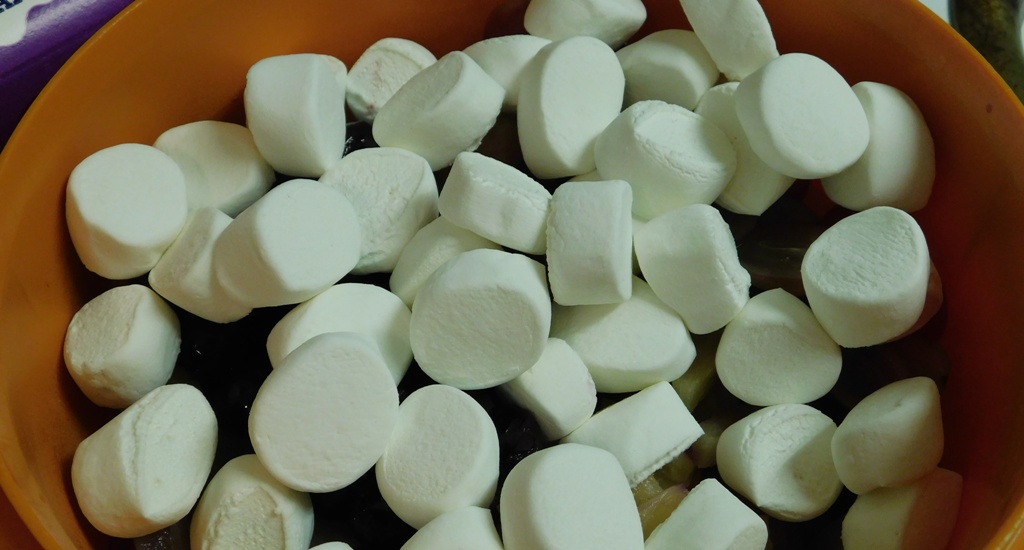
1/2 lb. (24 count) regular-size marshmallows, quartered (or halved)
juice of half a lemon (fold in with the rest)

When fruit ingredients are ready, and collected into a big bowl, and when dressing custard is cooled, whip the heavy/whipping cream until well-whipped. Add the custard/dressing to the fruits, then fold in the whipping cream. Let it stand in the refrigerator for 24 hours (this is an important step).

Serve on lettuce, as a salad, or in dessert dishes as a dessert.

Yield: about 2½ quarts.

Julie’s notes:

Mrs. Crawford noted that, in order to divide the labor, she sometimes would cut up the fruit the day before, then make the custard and whipped cream the second day. “It doesn’t seem like such a long process when divided up.”

Why do you need to buy canned sliced pineapple, and then cut it into smaller pieces? Why not just buy pineapple tidbits? . . . Well, do what you want, but you get prettier pieces, and fewer little blobs of pineapple fragments, if you cut them yourself with a nice sharp knife. (Your knives are sharp, right?)

Also, as I mentioned above, you can freeze this and give it to people frozen; they can decide when to thaw it and enjoy it.

This recipe dates back to the days before they made "mini marshmallows." So you have to buy "regular" marshmallows and cut them! Okay, use mini marshmallows if you want, but quartered or halved "regular" marshmallows are much more fun to eat.

How do you know when the custard is thickened? . . . You will know; it may take a while, but when it thickens, it will happen quickly, and you'll know.

Finally, regarding the canned fruits: in the 1950s, all the canned fruits were in heavy syrup, so that’s the kind I suggest. But use what you want. Although not overly sweet, this isn’t a low-calorie dessert, so avoiding heavy-syrup in the pineapple probably won’t make a big difference.

And what can you do with the syrup you’ve drained off? Here’s an idea: put it in a saucepan, add sugar, maybe also a cinnamon stick, and simmer to reduce it to a bona fide syrup. With the syrup/juice from the canned sweet cherries, the syrup will be pretty purple. You can use this syrup for pancakes! Or, you can add brandy to the syrup and put other canned fruits in it: brandied fruits; great on ice cream!

Friday, December 2, 2022

Notes on Grandma Renner's Billie Goat Cookies

I’ve written about Billie Goats, also spelled Billy Goat Cookies, before. But it’s time for a more nuanced version of the instructions. Look, no matter how you make them, they’ll be delicious. But I’ve been taking notes every year, so I can get the shape and texture just right. Until now, it’s been hit-or-miss. But I think I’ve got the techniques figured out, now. (As Chef John says, “Never let the food win.”) By golly.

So yes, there's a recipe at the end of this post.

A true, enduring gift from my grandma Clara Renner, these cookies take the strong, separately distinctive flavors of brown sugar, cinnamon, black walnuts, and dates and combine them into a new flavor I can only call “Billie Goat.” It’s a genuine meld; the combination is much greater than the sum of its parts. If you don’t like one of the ingredients, don’t rule out these cookies, because each flavor is tempered and transformed by the others. This is one of the best cookies anyone can make, in my opinion.

And for us, it’s a must-have for the Christmas cookie tray.

I have used this combination of brown sugar, cinnamon, dates, and black walnuts in other recipes, and I’ve found they have the same profound, synergistic effect, where they meld into a new, milder, but very unique flavor. I think of it as “Billie Goat seasoning.” I use this combination in my bran muffins, for example. You could also apply it to a bowl of oatmeal, or use it in pancake batter or a quick bread.

Grandma Renner said these are called “Billie Goats” because they are lumpy and have little points that stuck out, like a goat. (This is why the shape and the texture of the dates is important; read on.) I don’t know why Grandma spelled it “Billie” instead of “Billy.” Grandma Renner, her sister, Lydia Meyer, and their friends apparently all started making Billie Goats about the same time.

Billie Goats/Billy Goats are in a family of similar drop cookies that were really popular among mothers in the 1930s and 40s. This was a generation of moms who were keenly conscious of their role as household managers. In school, their “domestic science” classes taught them to be faithful guardians of their family’s health and good stewards of the family food budget. Vitamins were a new discovery with their generation. These women wanted to pack maximum nutrition into the foods they made, including their children’s after-school snacks—while being very economical (first, because of the Great Depression; next, rationing during World War II).

So, instead of sugar cookies or candies, they made these proto-health-food snacks, using nuts, plus raisins, dates, and/or currants, and sweetening with surprisingly small amounts of brown sugar (some recipes call for a combination of brown and white). Other cookies in this group include “hermits” and “rocks”; oatmeal-raisin cookies are also close relatives. Look for all these recipes in old cookbooks and church ladies’ cookbooks. The names “billy goats” and “rocks” both apparently refer to the chunky, knobby look of these cookies. I don’t know how “hermits” got named.

Some notes about texture and form, since I’ve had some time to figure these out. They’ll taste great no matter what you do, but the goal is to have a chewy, cakelike inside, and a lumpy, chunky shape. So here’s a discussion of challenges, and my “pro tips.”

For generations, most American cooks could only get Dromedary brand dates, which were apparently Deglet Noor dates. They were packed tightly in cellophane (this was before plastic), stuffed into cardboard boxes, and, after languishing in a warehouse or on grocery shelves, they were as tough as shoe leather. Clipping them with kitchen shears, as Grandma’s recipe instructs, would literally hurt your scissors hand. (Grandma’s kitchen shears were stainless steel, dull old things; you know the type—the ones with the rounded “claws” for opening bottles at the base of the red-painted, hard metal handles. The base of my thumb still hurts, just thinking of them. This was way before “Fiskars” scissors were available!)

So billy goat cookies, being a midcentury recipe, were developed using the ingredients that, at that time, were available to most people: dried-up dates. The cooking softened them, but not to the point where they lost a distinctive, chewy, chunky presence.

Today, the Dromedary brand seems to have gone out of business, and you just cannot buy dry, hard dates like them; instead, they are all moist and tender, either packed in plastic or shipped absolutely fresh. This is actually a good thing, but it presents a problem for replicating this cookie’s texture, since moist dates tend to dissolve into gooey molasses during baking, producing a flat, uniformly chewy cookie, instead of distinct, chunky, jagged lumps of chewy dates and nuts in a cakey, rounded matrix of dough.

I’ve learned to replicate the type of dates Grandma had by purchasing them (Deglet Noors) a few weeks ahead of baking, clipping them in the prescribed herringbone pattern while they’re still soft (which is a much easier task, now), spreading these out on cookie sheets, and letting them sit (under wax paper) in a quiet place while they dry. The house isn’t at all humid in November. Or, you can put them in the oven warmed only by the pilot light. Or you can try a dehydrator. An alternative might be to try to find one of the so-called bread dates (varieties such as Thoories that are sold rather dry, dry enough you can carry them in your pocket)—but those might lack sweetness. Also, I think it’s cheaper and easier to use regular Dole (or whatever) brand Deglet Noors, cut them, and let them dry. That seems the best way to replicate the texture and flavor of old-fashioned Dromedary dates.

Another point about texture: These cookies have caused me more vexation than any others, except perhaps when I was first figuring out springerles. If you only make a cookie once a year, it’s hard to fine-tune the recipe! My Billie Goats recipe card is full of penciled-in notes: “try doing _____ next time.” You don’t want the cookies to be so soft they spread out, but you don’t want them crunchy or hard. How to get that cakey, chewy texture, and chunky look? Here are some key tips:

  • Use a 50/50 combination of margarine and butter-flavored Crisco. Real butter does make them taste better, but it complicates the texture; the cookies turn out drier, less moist. Save your butter for some other recipe.
  • Pack the flour; forget the rule about spooning fluffed-up flour into your measuring cup and leveling it off with a knife. It turns out Grandma R used her measuring cups as scoops: swipe the cup through the flour, like you’re using a dip net to fish something out of water. You can level it off if you want, or just kind of shake off the excess, but you need to pretty much pack the flour into the cups.
  • Let the dough sit overnight in the refrigerator or on an unheated sunporch. The flour will absorb the liquids and be easier to work.
  • . . . But the dough will still be sticky and hard to handle. Put on some happy music. Use parchment-lined cookie sheets. Try dabbing the dough into little rounds with two spoons, or (if you haven’t much patience for the spoon method) use your fingertips to pinch off bits of dough (put some water on your hands so it doesn’t stick so bad; even then, you’ll have to clean your hands and start again several times).
  • I tend to make smallish cookies, because I figure twenty-first-century people would rather select six different morsels from the tray than settle on just two huge cookies. Big cookies are a joy, but variety is the spice of life. Also, with smaller cookies, a single batch of dough goes farther. A 1¼-inch blob of dough, slightly flattened before cooking, produces about a 1½-inch diameter cookie. Back in the day, Mom and Grandma’s cookies tended to end up about 2 to 2½ inches in diameter. Different sizes account for the difference in cooking time; smaller cookies cook faster.
  • Do a single tray of cookies first and see how they turn out. These shouldn’t flatten very much. If they spread out flat, you may have to add a bit more flour to the dough, or you might need to adjust the size of the cookies.
  • Finally, don’t overcook these, or they will be too hard. Mom says this was a principal criticism Grandma R had about her sister, Lydia’s billy goats: “she bakes them too long, and they get too hard.” (I’ve heard this criticism plenty, too.)
  • But if they come out kind of hard, don’t panic. Seal them in a tin, with the layers of cookies divided by wax paper, and take half of a tart apple, wrap it loosely in wax paper, and nestle it in the tin with the cookies. After a week or so, you’ll discover the cookies have softened and developed a je ne sais quoi in terms of flavor.

. . . Does all this sound too hard? Please don’t be put off by these tips; it’s all stuff I’ve learned the hard way, and I’m sharing it here, so you have a super-duper head start!

Finally, again, you can’t really ruin these. They’ll taste great regardless of the texture and shape.

Billie Goats/Billy Goat Cookies

1½ c. brown sugar
1 c. butter [Pat S. uses margarine, sometimes butter-flavor Crisco; I use half margarine and half butter-flavor Crisco; real butter tastes good, but then the texture will be off]
-----------Cream together butter and sugar.

3 eggs: beat whites [till light; use a hand mixer or whisk] and [then] add [whisk in] yolks

1 level tsp. baking soda dissolved in
¼ c. lukewarm-to-hot water

1 Tbs. cinnamon
1 tsp. vanilla
1 c. black walnuts [chopped]
1 lb. clipped dates [using a scissors, clip whole, pitted dates in an alternating herringbone pattern; the idea is to have them big enough to kind of “poke out” of the cookies; if you buy pre-chopped dates, it’s okay, but the pieces are too small to achieve the characteristic lumpy look.]
2½ c. flour [basically pack it]

Make the cookie dough [let it sit overnight in the fridge] and drop it onto [parchment-lined] cookie sheets by small spoonfuls. Bake in a moderate (ca. 350-degree) oven like you would other cookies, about 8–11 minutes. [Don’t overcook; they should be rather chewy and cakey inside.]

Makes about 100 cookies.

Wednesday, August 3, 2022

Baghdad Cream Jell-O Recipe from the Jack Benny Show, 1939

Look, a new retro Jell-O recipe! And it’s a weird one! It’s buried at the end of an old Jack Benny radio program, a.k.a. The Jell-O Show. Jack Benny’s most memorable sponsor was General Foods’ Jell-O, and the program featured lots of ads and jokes about Jell-O. You can find this episode on various YouTubes, but you have to select one that hasn’t removed the ads!

I haven’t been able to find this recipe anywhere else online, except in the audio recordings of the show. I also haven’t seen it in any old Jell-O cookbooks, either. (Maybe for good reason?)

First the context in the show; next the recipe, transcribed directly from the radio program; after that, my review of the dish itself, since I made it.

This recipe is from the Jack Benny episode that played Sunday, March 5, 1939, and featured “A Day at Santa Anita Park” and “Jesse James Part 2.” The former was a chance to crack jokes about Benny’s supposed penny-pinching, centering on his annoyance at having bet and lost two dollars (which we find out weren’t even his own) at the Santa Anita racetrack the day before.

The second part of the program was a spoof of the 1939 film Jesse James that starred Tyrone Power, Henry Fonda, Nancy Kelly, and Randolph Scott. The movie is notorious for its historical inaccuracies, but Benny and Co.’s rendition makes the movie look like a sober historical documentary by comparison. For starters, in the spoof, the two James brothers are named not Jesse and Frank, but Jesse and Juicy. Benny plays Jesse, disguising his voice quite admirably with a deep cowboy drawl; brother “Juicy” is played by Andy Devine, who couldn’t disguise his wheezy, cracking voice if his life depended on it. (“You ought to do something about that voice of yours, Juicy. It sounds like a man with squeaky shoes, walking on oyster shells, eating peanut brittle”!)

Then you come to the part where they give the recipe.

After the Jesse James spoof concludes, announcer Don Wilson reads the recipe and its preceding ad copy. Here’s what he says:

Did you ever look through those intriguing travel booklets they get out nowadays, and find yourself longing for a taste of foreign lands? Well, here’s a dessert with a fascinating foreign flavor, and it’s easy to enjoy right at home. “Baghdad Cream”: a delicious new idea your family will love—for it’s a grand combination of Orange Jell-O with canned pineapple, prunes, and whipped cream . . . and here’s how you make it:

Dissolve 1 package of Orange Jell-O in 1 pint of hot water, and chill until cold and syrupy. Fold in ½ cup of heavy cream, whipped only until thick and shiny. Then add 1 cup of cooked prune pulp and ½ cup of canned crushed pineapple. Mold until firm.

It’s a swell-looking and swell-tasting dessert—a tangy-smooth combination of pineapple and prunes blended with whipped cream and a shimmering mold of Orange Jell-O, with its delicious extra-rich fruit flavor.

So try Baghdad Cream soon! Ask your grocer tomorrow for Orange Jell-O.

So, what do you think? First, and quite obviously, it’s only marginally Iraqi, and hardly “foreign.” (Unless you're thinking of someplace like Bagdad, Kentucky, or Bagdad, Arizona.) The link with “Baghdad” is that it uses prunes, which, along with dates, figs, and apricots, are notable products of Iraq (though today, most prunes sold in our country come from California). But Jell-O, whipping cream, and pineapple—and the whole concept of a Jell-O dessert or salad—is distinctly American.

That this idea could be marketed at all as a “foreign flavor” really makes you question what we think we know today, with all our love of global foods. Until you travel, you don’t really know. When this radio show aired (March 1939), World War II hadn’t started. The United States didn’t enter the war until the end of 1941 . . . but when it was over, American soldiers who had been deployed overseas came back with a better understanding (and appreciation) for “foreign flavors.” This is one of the factors that led to America’s postwar explorations of pizza-pies (“it’s like a huge pancake, topped with a tomato-cheese mixture, and baked until crust is crisp and golden brown”), French cuisine, and chop suey, chow mein, sukiyaki, and other “Oriental” food.

Is it “swell-looking”? Well, the brownish chunks of cooked prunes sank toward the bottom, and I thought the smooth, creamy-looking top surface looked like flesh. Like, it was pretty close to my own skin color, pinkish-yellowish-tan. I will keep this in mind for Halloween molds. It would look incredibly creepy, molded inside a face mask.

It is unclear how you’re supposed to prepare the “cooked prune pulp.” I diced about ¾ cup of prunes, loosely packed, cooked them with about a cup of water, and the result, after about a half hour of simmering, amounted to about 1 cup. I made sure they were chilled before adding them to the Jell-O. I didn’t put them through a blender or food mill, because I thought it would make the whole dessert an ugly brown. I thought that semi-definable chunks of brown would be preferable to a more even blending of orange and brown. But maybe not. Maybe smoothly puréed pulp is the better way to go.

I think the next time I make this, I’ll add a second layer of orange Jell-O that’s clear, and maybe use the rest of the can of crushed pineapple in that part. And no, I didn’t “mold” this dish; I just put it into a 9-by-9-inch Pyrex baking dish. As a crown, a tower, an . . . edifice, it would've looked more interesting. So no wonder it didn’t look like much. Maybe a garnish would have helped.

Is it “swell-tasting”? Actually, yes. If you’re a grown-up, with grown-up tastes, this is really darned good. The unsweetened whipped cream and the fairly mellow sweetness of the prunes take the edge off the Orange Jell-O’s sugary quality. Also, I used crushed pineapple packed in juice (not heavy syrup, which they probably would have used in 1939) ("Juicy James" would approve), and that, too, was another step away from cloying sweetness. It was pretty darn good, and I’ll certainly make it again.

. . . Maybe even at Halloween!

If you’re interested in Jell-O and its relationship with Jack Benny, there’s some really good information in Jell-O: A Biography: the History and Mystery of “America’s Most Famous Dessert,” by Carolyn Wyman (San Diego: Harcourt, 2001).

Friday, December 24, 2021

World's Best Fruitcake!

Maybe you’re thinking, “Ew, I hate fruitcake.” Too bad for you! Because with an attitude like that, you’ll miss out on something spectacular.

Today I’m celebrating a genuinely superlative fruitcake. The kind to swoon over. The kind to completely hide from people who “don’t like” fruitcake (pearls before swine) . . . and the kind to hide from people who like fruitcakes, too (’cuz no, it’s mine, all mine!). The kind you hide from everybody, because you want every crumb for yourself.

. . . To savor.

We are so happy to have an annual cross-continent gift exchange with our dear friends Steve and Sherri, who live in Seattle. We send them an assortment of my homemade cookies, and they send us one of Sherri’s homemade, made-from-scratch fruitcakes.

It’s totally not a fair exchange. What Sherri sends us is far, far beyond my feeble cookie gifts. (Sherri? Me dilettante, you master.)

I remember the few winters we spent together as neighbors in Montana. Steve and Sherri lived next door to us in an elderly duplex in Helena, midway between downtown and the capitol complex, the last house on South Raleigh as it ascended Sugarloaf Hill. I’ve never had such fun neighbors. One winter, after endless bitter cold, it finally, albeit prematurely, got up above freezing. At almost the same moment, Steve and I both emerged from our respective front doors, glanced at each other, and laughed at each others’ shorts. Look, it’s a heat wave! Steve grinned and purred, “Ahh, another balmy day in beautiful Helena, Montana!”

They are epicures, and they don’t take life too heavily. Steve mountain-biked all over town as well as in the nearby mountains. Sherri created lovely, elaborate dishes, apparently with complete ease, and the four of us had many meals together—often in our shared backyard, or on the front porch, with its gorgeous view of the sunsets behind Mount Helena.

Well, one winter, Sherri decided to put her formal culinary training (yes!) to use in making fruitcake from scratch.

Do you have any idea what that means? It was days in the making, because she candied her own fruit! Orange and lemon peel, apricots, pineapple, pears, cherries, you name it. Their apartment smelled like magic after Sherri spent whole days simmering fruits in sugar syrup. And Sherri used perfect, fresh, whole nuts—hazelnuts, almonds, walnuts, you name it. And luscious prunes, figs, and dates. All this was in preparation for the actual construction and baking of the cakes.

These are works of art. There’s just enough cake batter to hold the gorgeous, colorful, translucent fruits and nuts together. If you slice it thinly enough, it looks like a stained glass window.

It really does.

And the flavor. Mercy!

I’ve been meaning to write again about fruits at Christmas, and how our parents and grandparents, and everyone before them, considered fruits at Christmas a real treat. It wasn’t that long ago that you couldn’t get all kinds of fresh produce in midwinter. Winter was for cabbage, meat, and potatoes, over and over again. So dried fruits at Christmas were a treasure. They were expensive. Apricots, pears, apples, plums, cherries, grapes, strawberries. And fruitcakes celebrate that.

And so I celebrate fruitcake, specifically Sherri’s fruitcake, which we’ve been enjoying annually for several years now. Sherri, you’ve perfected it. In our humble opinion, you could serve this to the queen. You could sell this for about a million dollars. Nobody does it better. You rock.

So on December 25, once again, breakfast will be a slice of Sherri’s beautiful, precious fruitcake and coffee. Maybe the coffee will be elevated by a little Bailey’s Irish Cream, or Kahlua, Grand Marnier, or some such. It’ll have to be good to pair with the fruitcake.

Merry Christmas!

P.S. This year Sherri also sent us some homemade plum chutney! Her modest little comment on the card noted that the chutney was from their plum tree and that it is “pretty good with some blue cheese on a cracker.” . . . “Pretty good,” she says. When Julia Child or Jacques Pépin says something is “pretty good,” it’s time to sit up and take notice, because to us mere mortals, it means, “Try this, it’ll knock your socks off!” I can’t wait!