
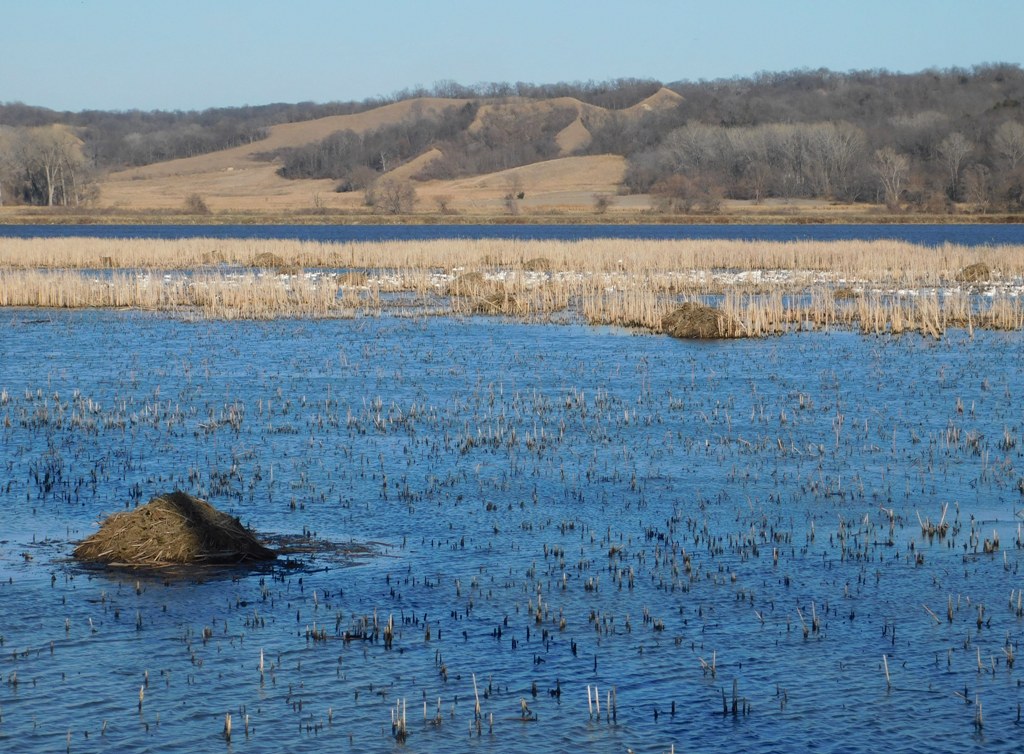
Nearby Mound City is named for the large loess hills in the area.
I hope that people aren’t bent out of shape about the name change. Sure, there’s a Squaw Creek that runs through the area, and that name hasn’t changed, but the NWR’s name isn’t exactly historic, as it goes back only to 1935, when the NWR was created.
Back in 1935, almost every American understood the term squaw to be sort of a Native American equivalent of the German frau, the Spanish señora or mujer, or the French madame or femme. Obviously, no one meant it as a derogative term because they had no idea it had such connotations. People probably thought they were honoring Native American women by naming the creek and later the refuge after them. I hope that in the future, people don’t look back and think that people who used the word squaw were being disgusting, insensitive, insulting. They simply didn’t know about the original meaning of the term. In fact, through their longstanding, benign use of the word, you can argue that they gave it a new, non-insulting meaning.
But finally, Native Americans made it clear to us other Americans (immigrants and children of immigrants, all of us), that squaw was for them a deeply offensive term, used for part of a woman’s private anatomy, so ever since then, place-names of lakes, mountains, trails, and so on, that had long used the word, have been changing.
And it’s a good thing! Some people might grouch and moan about “political correctness,” but I’m convinced it’s simply about being gracious and respectful of others’ feelings. Why continue using a word, a name that essentially insults someone, when we can use a new name that is better, anyway?
So now it’s the Loess Bluffs National Wildlife Refuge. And who knows how to pronounce it? Ha-hahh! Hopefully the people in northwest Missouri have already picked out a pronunciation they can live with, whether it’s “luss,” “less,” or (definitely the weirdest choice) “low-ess.” These are Americanized pronunciations, however, of a German word with a vowel sound we don’t make in English, the German “umlaut o” (spelled ö or oe).
It’s a mix of the vowels “ee” (or “eh”) and “ohh.” In a nutshell, you say “ee” (or “eh”) with your tongue, inside of your mouth, and you say “ooh” with your lips. Try saying “oh” with your lips, rounding them, but position your tongue as if to say “ee” (or “eh”). (Here’s a fun explanation of German umlaut sounds.)
French coeur, German Goethe, and my own surname use the ö/oe sound.
So after listening to these examples, you might start saying it more like “lurse” or “loorse” (light on the r’s, in both cases). I have been trying to pronounce “loess” correctly for about as long as I’ve been able to talk, since my dad is a physical geographer who specializes in Missouri landscapes, and he always taught his students (and my brother and me) how to say loess the original German way. Loess! Loess! Loess!
So! On Saturday, we drove up to the northwest corner of the state not to see the Loess Bluffs National Wildlife Refuge, particularly, but to see the birds taking refuge on it! And what a treat it was!
The big show, of course, was the snow geese, which were so numerous as to look like, yes, large areas of snow. Like, 28,000 of them. (In previous weeks, there’d been as many as 283,000 of them!) White and blue forms. I’ll bet there were some Ross’s geese among them, but picking them out would have distracted me from the main attraction: their multitudes.

Occasionally vast numbers of them would rise and fly off northward, an overwhelming chorus of their thousands of high voices. They were getting a nice brisk tailwind from the south!

They vanished into the whiteness of the northern sky. But there were still thousands left in the wetlands.

We saw lots of other birds, too, of course. There were plenty of Canada geese around; they seemed to love standing on top of the many muskrat homes that poked up out of the water. This one was all “honked off” at something—looking at it through our binoculars, we could see it hissing at something below it, then turning around and complaining the other direction.

Other birds that we saw (in the afternoon) included several trumpeter swans, American white pelicans, mallards, northern shovelers, blue-winged teal, gadwall, American coots, killdeer, common grackles and red-winged blackbirds (but unfortunately we didn’t see any yellow-headed blackbirds, but I certainly looked), and my favorite sight of the day, a female belted kingfisher that was hunting for fish. (Yes, in Squaw Creek itself, so see? It pays to take your eyes away from the vast wetlands and look all around.) Sorry, no pictures of her.
Sue, of course, was the one who first spied the kingfisher. As we watched, the kingfisher flew down to the water and captured a fish. (Judging by the shape, I’m betting it was a green sunfish or something similar.) She flew with it to a nearby wood duck nest box, perched atop the box, and started the process of swallowing it. True to form, she smacked it on the box a few times to subdue it, then got it flipped around so it would go down headfirst (the smooth way).
This was the weekend of Columbia’s True/False film festival, (or as some of my friends who work at restaurants and bars call it, “Hipster Christmas,” “Hipster Homecoming,” or the “Bunning Man” festival). Why would anyone want to be cooped up in a dark movie theater when they could be out watching these miracles of nature? Oh well. Maybe people don’t know you can see these amazing sights for free. Or maybe, because it’s free, they don’t value it as much as something you have to buy a ticket for?

Anyway, during one particularly large and raucous liftoff of zillions of snow geese, we noticed that a few non–snow geese were caught up in the excitement of the crowd. Amid the multitudes of basic sameness were a few different shapes, different wing-flapping patterns: One was a blue heron, and the other an adult bald eagle.
Well! That made our day! Can you pick out the eagle in this photo? (Remember you can click on these pictures to make them bigger.)

It was also great fun to watch some of the muskrats.

One sat on a completely muddy area amid dried cattails near a muskrat home and groomed itself for several minutes. I kept thinking, Dang, with all this mud, it must be a never-ending chore for them to try to keep clean!
As with so many other rodents, you can’t help thinking it’s really pretty cute-looking. Look at the little fist this one made with its left hand while it worked to clean its right arm.

Yeah, pretty cute, huh?
Well, it was a very memorable day. We need to keep going out and seeing these sights. What a beautiful and fantastic world we live in!


 Posts
Posts

