Showing posts with label natural history books. Show all posts

Sunday, November 6, 2022

Jar of Goodness 11.6.22: Little House Books

. . . The weekly virtual “gratitude jar.”

This week, I’m expressing thanks for Laura Ingalls Wilder’s Little House books.

Dad’s been clearing out their garage and giving me boxes of children’s books and other items of my childhood. He’d packed them away so well, it’s kind of difficult to get to them. Thus, here I am in my fifties, receiving boxes of my old stuff.

I told you about the old Nancy Drew books. Well, I also got a box containing my old Little House books.

I read these in elementary school, too. I didn’t read all of them, however. I owned four of them and only read about 2.3. The two that were most engrossing were Little House on the Prairie and On the Banks of Plum Creek. I only got partway through By the Shores of Silver Lake before giving up on it. My old bookmark, in which park-ranger Snoopy encourages us to prevent wildfires, was still in place.

Why didn’t I plow through the whole series? . . . I think it was because the books started to focus on social situations, frontier technology and town-building, and sewing. It might also have been that the Little House television show quickly went from amazing (in my kid view) to sickly sweet.

In the books, I liked the parts about spunky young Laura, who walked around in nature, barefoot—in the prairie, along the creek—and noticed things. Kind of how I did as a kid. I was always looking in creeks. Like Laura, I was always peering under creek rocks to see crayfish.

. . . Or wondering at the beautiful glinting snow, or marveling at the array of wildflowers that grew, for free, in the woods.

I distinctly remember reading part of On the Banks of Plum Creek one sultry summer afternoon at Columbia’s Camp Takimina, then the local Camp Fire camp. My parents were probably helping do some kind of maintenance with other adults. I sat on the camp’s one wooden bridge, my feet dangling over the little creek. Then I set the book down and walked around on the big, flat, smooth limestone rocks that formed the creek bed. I saw tiny black toad tadpoles moving around in the water. There were water striders, too.

You never know what things will influence you in certain times of your life. You can’t predict which influences will be profound, or in what ways. Somehow, I never outgrew my childhood curiosity about nature. Rereading Laura Ingalls Wilder recently has reminded me how important those books were for, well, empowering my sense of agency, my willingness to explore, to have outdoor adventures.

Or, let’s put it this way: if I had read these books, and not been able to follow-up with my own outdoor adventures, I would have been frustrated indeed. Instead, I had our backyard, the big drainage ditch and creek behind our house, and Mrs. Ridgeway’s property nearby. And my parents were always taking us on hikes.

So it has been a blessing to reread these Little House books, aloud, with Sue. We discuss them as we read them. And we will continue reading them, including the ones I hadn’t finished reading way-back-when. We will buy the books I didn’t have, and we will plow through all of them.

And then, perhaps next spring, when we ((((finally)))) have a new, reliable car, we can visit Mansfield and see the house where Laura ended up. Who knows, maybe we can do a trip to South Dakota and Minnesota, to see the sights there. Why not?

Wednesday, October 26, 2016

D. C. Peattie, on the Sugar Maple

It isn't very original to copy stuff outright, but when it's far better than what you could write yourself, I think it's a virtue to tell others about it.

If you've never heard of Donald Culross Peattie, STOP, do not pass GO, and pick up some copies of his books. If you like plants, trees, anything green and living, and if you appreciate well-crafted language, you will love Peattie (1898-1964), who was a botanist and a poet. (His writing style reflects the expansive compositional tastes of his day, but we can't blame him for that. Reading his work, you may even learn an excellent new word or two.)


The selection below is from A Natural History of Trees of Eastern and Central North America, first published in 1948. It is an enormous collection of essays, each on a single species of tree, that provide technical, nuts-and-bolts information on growth habit, lumber value, and botanical description yet also poetical descriptions that give you a true feel for the tree. This book, and its companion volume on Western trees, are a monumental achievement for a natural history writer. Hopefully, some recent reissues of his books will help restore his position as one of our country's best-ever natural history writers.

Happy autumn, everyone!


The most magnificent display of color in all the kingdom of plants is the autumnal foliage of the trees of North America. Over them all, over the clear light of the Aspens and Mountain Ash, over the leaping flames of Sumac and the hell-fire flickerings of poison ivy, over the war-paint of the many Oaks, rise the colors of one tree--the Sugar Maple--in the shout of a great army. Clearest yellow, richest crimson, tumultuous scarlet, or brilliant orange--the yellow pigments shining through the over-painting of the red--the foliage of Sugar Maple at once outdoes and unifies the rest. It is like the mighty, marching melody that rides upon the crest of some symphonic weltering sea and, with its crying song, gives meaning to all the calculated dissonance of the orchestra.

There is no properly planted New England village without its Sugar Maples. They march up the hill to the old white meetinghouse and down from the high school, where the youngsters troop home laughing in the golden dusk. The falling glory lights upon the shoulders of the postman, swirls after the children on roller skates, drifts through the windows of a passing bus to drop like largesse in the laps of the passengers. On a street where great Maples arch, letting down their shining benediction, people seem to walk as if they had already gone to glory.

Outside the town, where the cold pure ponds gaze skyward and the white crooked brooks run whispering their sesquipedalian Indian names, the Maple leaves slant drifting down to the water; there they will sink like galleons with painted sails, or spin away and away on voyages of chance that end on some little reef of feldspar and hornblende and winking mica schist. Up in the hills the hunter and his russet setter stride unharmed through these falling tongues of Maple fire, that flicker in the tingling air and leap against the elemental blue of the sky where the wind is tearing crow calls to tatters.

--Donald Culross Peattie, A Natural History of Trees of Eastern and Central North America (Boston: Houghton Mifflin, 1991), 454.


Photos in this post: Yes, I've taken pictures of pictures. An *abhorrent* practice. The originals are prints that my mom took in the 1990s. You might recognize the Missouri River bluffs overlooking Cedar City along Highway 63. (Remember what it looked like before the sod farm went in, and it was crop fields?) The last picture is of a maple tree growing in my parents' backyard. It's about four times that big today.

Saturday, March 12, 2016

Springtime Crayfish Happiness

Okay, here’s a real “Opulent Opossum” subject for you: the glory of crayfishes in early spring! Plus, the Missouri Department of Conservation has just published a new booklet to help you learn to identify our state’s 36 crayfish species!


Chris Riggert, the Volunteer Water Quality Monitoring Coordinator for the Conservation Department’s Stream Team program, headed up the project. The new booklet is an excellent introduction for identifying the state’s crayfishes—a good “jumping in” place to get you started in learning about (and thus appreciating) our beloved crawdads.


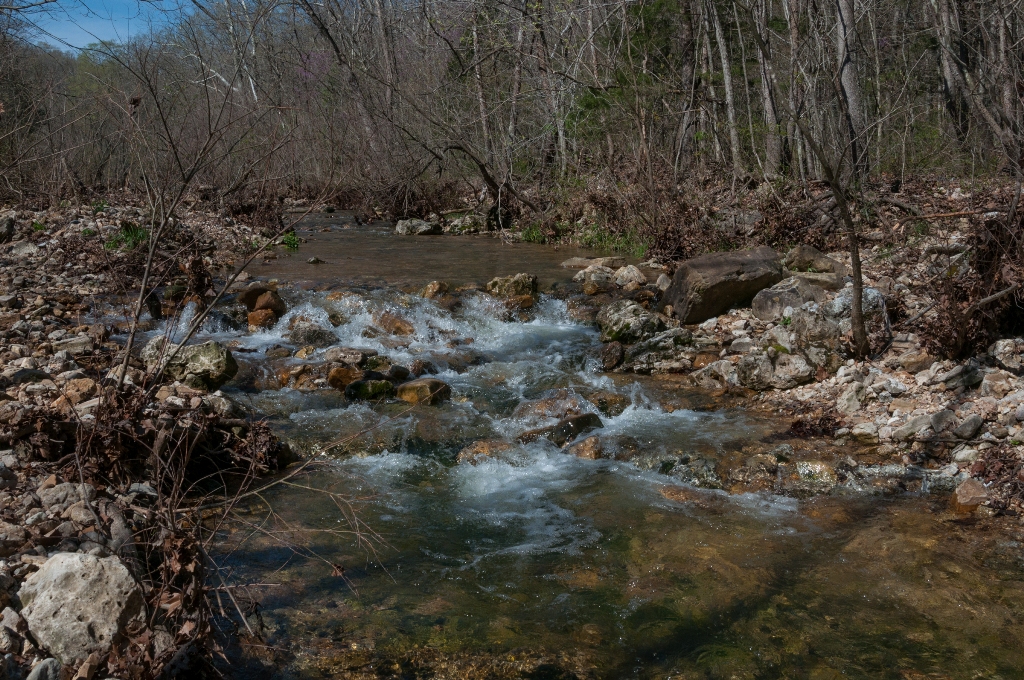
I love to see rocky creeks come alive in early spring.


In early spring, with the leaves still off the trees, light penetrates through the bare branches of the forest canopy and shines on the creekbeds. This light creates a short-lived “bloom,” first, of a matlike brown algae (I think it’s a diatom), and then of a wispy filamentous green algae—like flowing green tresses, wafting in the current. That algae is to creeks what bloodroot, trilliums, and spring beauties are to the springtime forest floor.


And though the water’s pretty cold, it’s no longer frozen, so the animals start getting active. I have spent hours and hours by streams, watching the snails crawl around on the rocks, minnows glide and dart hither and thither, and crayfish explore the miniature aquatic caves and canyons.


It’s our midcontinent version of tidepooling, and it’s a fun as all get-out.


Last weekend, when we had some really nice weather, Sue and I visited Clifty Creek Conservation Area (which is fast becoming my favorite hikin’ place; click here for the MDC web page on it).


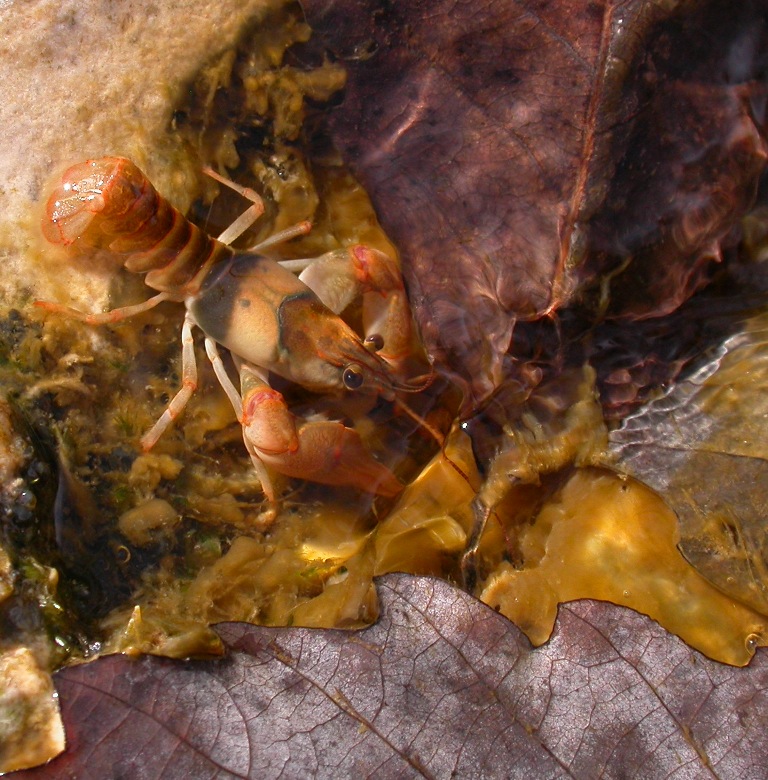
When we were there, we saw lots of golden crayfish (Orconectes luteus) scooting around in that crystal clear water. They were nearly all about one and a half inches long.

See?


One of the things that the new MDC brochure (and their other printed crayfish publications, and the online Missouri field guide) emphasize is that crayfish identification involves more than just colors, spots or stripes, and body shape. First, you narrow your search by habitat and geographic range.

Although a handful of our crayfishes are found nearly everywhere, most are restricted to certain parts of the state, and certain watersheds within those regions.

Some crayfish species occur only in the glaciated and unglaciated plains of north and northwest Missouri, where they live in streams that are rather sluggish and turbid, or where they tunnel clear down to the water table in prairies. Others occur only in the Ozarks, where the streams tend to be clear, brisk, cool, and rocky. And others are found (in our state) only in the Bootheel, where swamps and ditches prevail.

And within those broad ranges and habitat types, many crayfish species are confined to certain particular river drainages. An example is the Neosho midget crayfish, which occurs only in the Spring River and Elk River systems, so in our state, you probably won’t find it anyplace besides our far southwestern corner.

So if you want to identify a crayfish, first, identify the region, habitat, and watershed, and then start looking at the color, the spots or stripes, and peculiarities of pincer shape and so on. The new brochure organizes our crayfishes by location: Ozarks, Prairie, Lowland (Bootheel), and Statewide, and each entry has a distribution map showing watersheds, which helps you immediately narrow down your search.

This, by the way, is the same situation when you’re trying to identify fish, particularly minnows and darters, which are also numerous and diverse—unless you know where they’re from, they can be kind of a pill to identify to species.

I love being able to identify plants and animals. It’s not so much that knowing the name has some kind of magic (though it helps me remember)—it’s that the process of identifying forces me to look, really look, at the organism, and see things I might not notice before. That’s the value; that’s the fun.

For example, did you know that one of the keys to identifying crayfish can be the shape of the rostrum? Crayfish bodies are quite different from ours, so you have to learn a little “Crayfish Anatomy 101.” The rostrum is the triangular little beaklike structure between the eyes. It’s shaped differently in different species of crayfish—pointier or less pointy, long or stubby, ridged or furrowed (or furrowed with a little ridge within), with or without spines flanking the tip . . . Isn’t that fascinating? Now, you can really see it!

Anyway . . . these and many other thoughts pass through my mind as I peer into a creek like Clifty, watching the crayfish explore like little armored vehicles among the rocks and crannies. Crayfish happiness!

It’s my happiness, too.

Do you want a copy of this nifty booklet? It’s hot off the presses, so it hasn’t been promoted much yet. Send an e-mail to pubstaff@mdc.mo.gov, and ask for A Guide to Missouri’s Crayfishes FIS011.”


Friday, September 11, 2015

Audubon’s Paper Menageries: Birds and Quadrupeds

Places to go! Things to do!

If you love art, and you love nature, here’s something you don’t want to miss: An exhibition, at the State Historical Society of Missouri, of several of John James Audubon’s famous, hand-colored engravings and lithographs depicting American birds and mammals.


The State Historical Society (SHS) owns lots of wonderful art pertaining to Missouri the state, and Missouri the territory (that is, the western U.S.). I’ve told you about their collection of Charles W. Schwartz’s artwork before.

They also possess several of the engravings and lithographs that constitute Audubon’s incredible, huge books Birds of America (printed between 1827 and 1838), and The Viviparous Quadrupeds of North America (printed 1845–1848). (Viviparous quadrupeds means “live-bearing four-footed creatures,” that is, the mammals.) (Such as the opossum!)


If you don’t know who Audubon was, or if you want to learn more about him, click here.

Sue and I were pleased to attend the “Curator’s Walk-Through” of the exhibit, led by Dr. Joan Stack, curator of art collections, on August 29. Her presentations are always first-rate, exemplifying the best of the cultural opportunities that college-town life offers.


Her talk, like the exhibit itself, started with Audubon’s image of the eastern bluebird, which is the official bird of Missouri. She pointed out something I have always sensed, but never fully understood, about Audubon’s bird images: Many times, birds are shown offering food to each other, and these poses have a famous artistic predecessor.

For example, in the case of the eastern bluebird, a female is offering a caterpillar to her fledgling.


Stack pointed out that this image recalls Michelangelo’s famous Creation of Adam fresco painting in the Sistine Chapel. One wonders if Audubon had this image in mind as he created his art. . . . Or if Michelangelo had contemplated birds feeding their young as he composed his fresco.

Anyway, those are the kinds of connections that a good lecture inspires, and I love it. During the talk, there were many more interesting, and compelling observations.

Details were pointed out.


History was discussed.


And technical matters were explained.


We’ve all seen Audubon’s prints reproduced in books, but it’s not common to get to see some of the actual prints themselves. Take this opportunity to stand in front of these enormous (life-size, in many cases), incredibly detailed artworks. Plus some major artworks by George Caleb Bingham and Thomas Hart Benton.

Did I mention it’s free to go there and enjoy all this great art?

(Of course, if you’re inclined to do so, however, memberships to the State Historical Society of Missouri are only $30 and include all sorts of perks, including the highly respected quarterly Missouri Historical Review as well as the Missouri Times, not to mention the good feeling you have for supporting the SHS and its vast collections of genealogical resources, photos, city and county histories, manuscripts, and newspapers.)

The Audubon exhibit runs until November 28.

The State Historical Society Gallery in Columbia is located on the University of Missouri campus, on the ground floor of Ellis Library, Hitt Street at Lowry Mall. Detailed directions and parking suggestions are available here.

By the way, the State Historical Society of Missouri is planning a major expansion, and relocation, in the coming few years. This move is long overdue for an organization that has enriched Missouri for more than a century, and it will include a larger gallery for its many valuable paintings, illustrations, maps, and other graphic treasures.

. . . Including artwork of opossums.


Note: Except for two images of opossums, and the photo of Dr. Stack, all the pictures in this post were recklessly, unconscionably photographed from my copy of a modern-printed, downsized reproduction of Audubon’s Birds of America. These are only lame representations of some of the same plates that are on display in the exhibit. The artwork you’ll see at the SHS looks much, much better!!!


Thursday, March 6, 2014

Journeys Around the Sun: Leonard Hall

In my previous posts, I talked about natural history books that have an almanac structure: Edwin Way Teale’s A Walk Through the Year, Hal Borland’s Twelve Moons of the Year, and Aldo Leopold’s A Sand County Almanac. Today, I’m continuing in the same vein, with a book of special interest to Missourians. You probably haven’t heard of this author.


Leonard Hall’s A Journal of the Seasons on an Ozark Farm (1956; reprint, Columbia: University of Missouri Press, 1980), like the other books, is arranged chronologically, with a handful of short essays for each month. Hall wrote a regular column about life on his “Possum Trot Farm” (south of Potosi, Missouri) for the St. Louis Post-Dispatch and Globe Democrat from 1946 to 1980.


Hall embraces the conservation ethic that Aldo Leopold so eloquently laid out, and his stories of life on a working Ozark cattle farm show a sustainable land ethic in practice. The changing seasons frame the story of a year’s worth of activities and observations, including migrating geese, cattle auctions, hunting and fishing, gardening, hiking, gathering elderberries, pawpaws, and hickory nuts, and butchering hogs.

If you’re not familiar with Leonard Hall, check out his books. I particularly recommend his Stars Upstream: Life Along an Ozark River, about the Current and Jack’s Fork rivers. It’s a classic every Missourian ought to read.


Since I was inspired to write about these books by my late-winter longing for spring, and being on constant watch for signs that springtime is coming, I’ll quote a few sections from Hall’s Journal of the Seasons on an Ozark Farm.


“This is a time of year we could do without. There are gloomy days when I have a profound sympathy for those furbearers which hibernate or for the birds that fly south in autumn. But then comes a snowy morning when the earth might have just been born and the chickadee sings as if it were summer, or a mild evening when the sunset paints the western sky in vivid colors and the young calves chase each other across the pasture with tails high in the air. Then I decide that one way or another, we’ll somehow ‘make it through to grass.’” (“January: The Sun Starts North,” p. 190.)


One of my favorite signs of spring is the sound of spring peepers, tiny peeping frogs that, in full chorus, sound to my ear like thousands of little jingle bells, though they symbolize anything but Christmastime. Here’s Hall’s description:

“When the worst blizzard of winter struck the western states this week, our thermometer at Possum Trot dropped sharply and a hard wind out of the northwest rattled the shutters, sifted in through the storm sash, and set the phone wires to singing. We hurried out in the morning to have a look at the baby calves, but found them galloping about the pasture with tails high in the air as if it were summer. Then on Sunday afternoon the wind dropped to a whisper and the mercury climbed into the fifties again. After supper, when I went to make sure the biddies were safely shut up in the hen house, I heard the first spring peepers singing, down in the pond in the woods.” (“February: Spring Edges Closer,” p. 205.)


And that’s how you always hear the first spring peepers of the season. It will be some supremely welcome warmish day, and you will be walking outside in a light jacket some evening after supper. And suddenly you hear them, jingling away, in some seemingly insignificant little pond in the woods.


Of course, there’s still an excellent chance it may snow and freeze again, but I agree with Hall: “There is something optimistic about the note of the first spring peepers that braces us against the occasional spell of cold weather which may still lie ahead” (p. 206).


Here’s to the birds who are remembering their songs
and the young birds who are tuning up for the first songs of their lives;
the geese honking, winging north on the heels
of warming weather,
and stopping overnight in marshes in gabbling flocks;
and tiny frogs awakening,
slipping out of cold mud,
and perching at the water’s edge
to peep their riot of love songs.

And here’s to the reawakening of the entire green world.


Tuesday, March 4, 2014

Journeys Around the Sun: Aldo Leopold

In my previous posts, I talked about natural history books that have an almanac structure: Edwin Way Teale’s A Walk Through the Year, and Hal Borland’s Twelve Moons of the Year. Today, I’m continuing with another classic natural history author.


Today, it’s one of the most famous written celebrations of the annual cycle of nature, by that giant oak of the conservation movement, Aldo Leopold: A Sand County Almanac (New York: Oxford University Press, 1949). It’s not a day-by-day approach; its chronology is monthly. The location is Wisconsin, but the application is global.

If you haven’t read it yet, you can get it for just the cost of shipping; there are over 2 million copies in print; just do it. It is a great classic of natural history writing, full of heart and soul, unflinching truthfulness, a celebration of all that is wild. A bonus thrill is that (in the original edition) the illustrations are by Missouri’s own Charles W. Schwartz.


In keeping with the theme of longing for spring, I’m sharing a sample from this book, also about birds and the coming of springtime, from a section titled “The Geese Return”:


“One swallow does not make a summer, but one skein of geese, cleaving the murk of a March thaw, is the spring.

“A cardinal, whistling spring to a thaw but later finding himself mistaken, can retrieve his error by resuming his winter silence. A chipmunk, emerging for a sunbath but finding a blizzard, has only to go back to bed. But a migrating goose, staking two hundred miles of black night on the chance of finding a hole in the lake, has no easy chance for retreat. His arrival carries the conviction of a prophet who has burned his bridges.” (“March,” p. 18.)


“. . . When it has become warm enough to sit outdoors, we love to listen to the proceedings of the convention in the marsh. There are long periods of silence when one hears only the winnowing of snipe, the hoot of a distant owl, or the nasal clucking of some amorous coot. Then, of a sudden, a strident honk resounds, and in an instant pandemonium echoes. There is a beating of pinions on water, a rushing of dark prows propelled by churning paddles, and a general shouting by the onlookers of a vehement controversy. Finally some deep honker has his last word, and the noise subsides to that half-audible small-talk that seldom ceases among geese.” (Ibid., p. 22.)


Monday, March 3, 2014

Journeys Around the Sun: Hal Borland

In my previous post, I talked about a favorite “essay-a-day” natural history book, Edwin Way Teale’s A Walk Through the Year. Today, I’m continuing on the topic of almanac-format nature books.

A similar book, in a similar vintage, is Hal Borland’s Twelve Moons of the Year (New York: Knopf, 1979).


Borland wrote a weekly natural history or “outdoors” editorial in the Sunday edition of the New York Times for 35 years. This book, which he was finishing when he died, is a collection of those brief editorials—so well written . . . so well written.

I’ve been dipping into this book especially, since he writes so eloquently of our desire in late winter to look for signs of impending spring. Wasps waking and flying groggily about on a prematurely warm day. The courtship of owls and squirrels. The lengthening days. Rising sap. The hope encapsulated in the buds of trees. And the first tentative, brief bird songs.

“There are things to be heard if one is at all attentive. At noontime on a sunny day the dooryard sparrows begin to test a few phrases of remembered song. The chickadees, which will lisp a greeting any winter day, now extend their songs, simple though they are. The nuthatches still say nothing but yank, but they say it more often and with a new intonation. From the woodland the male cardinal whistles as though he really means it.

“. . . Spring is not yet at hand, but there is change, and there are subtle stirrings here and there, if we forget the calendar and listen.” (“Subtle Signs of Spring,” February 15, pp. 46-47.)


He notes a softening of the blue jay’s raucous voice:

“But when February comes and daylight begins to linger, the jays begin to feel, perhaps down in their hollow bones, that life is good and soon will be even better. They whisper this, at first, to themselves. Then they say it aloud, but softly. It is a wholly new note, actually a two-note salute to the season. It is almost musical. It really is the blue jay’s prelude to a love song, a sentimental secret the secretive jay can no longer keep to himself.” (“The Secret,” February 8, p. 41.)


It’s not going to make spring come any sooner, but reading this helps me remember that I’m not alone in looking for “signs,” and that people have always yearned for spring this way.

Sunday, March 2, 2014

Journeys Around the Sun: Edwin Way Teale

It’s still early enough in the year to be thinking of the passage of time, as I do at every new year—jeez, it’s hard to believe it’s the year 2014! I suppose part of my pondering might also have something to do with this year’s lengthy onslaught of snow and bitter cold—I can’t help looking for signs the spring is coming.

And it is. Even if we’re getting yet another dump of ice and snow this weekend!


My evidence? Well, haven’t you been hearing cardinals singing outside your windows in the mornings? I have. And it’s a damn good song they’re singing!

I’ve been dipping into some of my favorite books that celebrate the annual cycle. A recent comment on my blog suggested to me a book by the great natural history writer Donald Culross Peattie, An Almanac for Moderns. (Thanks, Tina, I’m going to check it out!) Peattie’s books describing America’s trees are exquisite blends of science, poetics, and philosophy. Peattie educated his reader while ensouling his subjects.

Of course, the famous quartet of books by Edwin Way Teale is a monument to the changing American seasons, and I’ve written about them before.

But Teale’s more compact, and personal celebration of the changing seasons is A Walk Through the Year (New York: Dodd, Mead, 1978). In it, he writes a brief essay for each day of the year, describing some natural event that happened on his farm in Connecticut. He intended it as a companion to A Naturalist Buys an Old Farm, which tells about the property he purchased later in life, Trail Wood, which he treasured as a natural area.


A Walk Through the Year is pure Teale. In it, one of his later books, he shares his reflections on his and his wife, Nelly’s observations of nature at Trail Wood. It’s a gentle and pleasant conversation, as if you and the aging Teales were chatting in their living room, sitting around their cozy fireplace on some evening after a blizzard. “Guess what we saw at one of our bird feeders yesterday!” And “I was walking on the lane to the road and saw a red fox—guess what it was doing!”

To show you why I’ve been dipping into this book, and to celebrate the springtime we’re all hungry for, here’s an excerpt from A Walk Through the Year. Because the Teales were nuts about birds, I’ve chosen one about birds—specifically, red-winged blackbirds:


February 28. This is the sound we longed for, dreamed about, looked forward to in the darkest days of winter. Rising and subsiding, becoming a storm of mingled voices, then ebbing away, it comes from the treetops along the brook. It is an excited sound, a festive, holiday sound. Like the torrents of spring, it is a rushing, liquid sound that here antedates the spring. It is the great chorus of the first of the homecoming flocks of the redwings.

“Bare only yesterday, the treetops along the brook today are clothed with blackbirds. A hundred and fifty or more swirled down to alight among the leafless branches before dawn today. All are males. The females will arrive later. We watch the birds, in the richness of their breeding plumage, flying from tree to tree, each alighting with its scarlet epaulets exposed. Their surging energy is contagious. We feel a sense of elation, a wave of optimism. The stolid endurance of the deepest winter drops away.

“We listen to the overlapping chorus of ‘okaleees’ or ‘bob-y-leees’ swell and fade and begin again. The interplay of sounds merges into a rolling, trilling clamor. Standing listening, we catch little dropped notes spilling through the chorus. The ‘okaleeeing’ is replaced by sharp metallic calls as all the birds take off in a cloud of black to sweep in curves, to turn and turn again, and then swirl down once more to the tops of the brookside trees.

“It is usually near the end of this shortest month of the year or in the earliest days of March that the redwings come back to Trail Wood. The intermingled tumult that comes down from the treetops seems compounded of relief at the end of a long journey, of ecstasy in reaching an age-old breeding ground, of health at a peak, and life lived intensely. We are swept along by the excitement pulsing through these hundred and more bodies. This wild musical clamor of the first of the returning redwings reechoes in our minds long after it is left behind. For the birds, the farflung journeys of migration now are a thing of the past. For us, the winter—all but a few short weeks—has run its course.”

------------------------------------

And yes: While visiting my parents two weeks ago in Columbia, Sue and I heard our first raucous, cacophonous red-winged blackbird chorus of the spring, and we almost jumped for joy!

Is winter over? Of course not. Look at all this frickin’ ice!

But hey—keep your hopes up! The cardinals are singing, and the redwings have appeared.


Saturday, November 5, 2011

Edwin Way Teale’s Autumn across America

Today we’re celebrating another classic work by the famous midcentury natural history writer Edwin Way Teale: Autumn across America: A Naturalist’s Record of a 20,000-Mile Journey through the North American Autumn (New York: Dodd, Mead, 1956).


This is my third “book report” on Edwin Way Teale this year: I decided that in 2011, I would reread all four of Teale’s “American Seasons” books, in their appropriate seasons! To catch up with me, click here for my post on Teale’s North with the Spring (and an introduction to this remarkable quartet of books), and click here for my post on Teale’s Journey into Summer (including a discussion of the timing of the trips and the publication of the books).

The American Seasons Series: Spring and Summer

Each of the four American Seasons volumes chronicles the automobile travels of Edwin Way Teale and his wife, Nellie, as they traverse the continent for months, following the progress of a season in as many places and aspects they can.

In the spring volume (published in 1951 based on travels made in 1947), they rode the wave of the season from the southern tip of Florida all the way up to Maine: one big, long extended springtime of migrating birds and opening wildflowers—and lots more that you never would have noticed—all the way up the coast, ending as spring does with the summer solstice.

The summer book was published in 1960, based on their travels during the summer of 1957. For that project, they started at the summer solstice in New Hampshire, traced the northern edge of the United States clear to Montana, then wandered south through the Great Plains and explored Colorado and its Rockies. Thus they experienced “the summer of the shore, the summer of the forest, the summer of the Great Plains, the summer of the mountains . . . in vacation spots—along lake shores, on the mountain heights, in the cool north woods . . . [as well as] on salt flats and in corn country, amid swamps and in areas where falling rain would be sucked up by the thirsty atmosphere before it reached the ground.”


The Autumn Project

The autumn travels, and publication of the autumn book, actually occurred between the spring and summer projects. Autumn across America was published in 1956, based on travels that occurred in 1952. Their trip began in late August, looking east across the waves of the Atlantic on Cape Cod. Why in August? Teale explains at the beginning of chapter 3:

The season of summer extends to about September 21 but the summer season ends with Labor Day. Then the newspapers begin referring to summer in the past tense. Vacations are over. Schools commence. To the popular mind, September belongs to autumn as December belongs to winter. (p. 19)


Their autumn trip starts out rather like the summer one, for they travel west from New England taking a somewhat northern route, through Ohio, Michigan, Illinois, Minnesota, and the Dakotas. But here they continue west all the way to the Pacific, visiting Wyoming, Montana (and Yellowstone), Idaho, Utah, Oregon, and Washington.


Then they proceed southward into California, seeing the sequoias, Monterey, the migrating monarchs at Pacific Grove, and Yosemite. They end up on a very windy Point Reyes, north of San Francisco, facing westward across the Pacific, at sunset on the shortest day of the year.

Some Major Themes

Teale was an incredibly organized writer. Each book of the quartet offers about the same blend of topics. In each, there’s a chapter or two spotlighting individuals who make their living from the land, and he marvels at expansive agricultural endeavors, and their picturesque qualities.

And although he’s mostly interested in animals and plants, with chapters spotlighting particular species, he always includes a few chapters focusing on geological matters, on landscapes, on astronomy, and on notable environmental tragedies, or on disasters averted.

But in this volume, more than the others, there are certain subjects Teale weaves through the whole book:

Bird Migration. The Teales were avid birders! It’s no accident that their autumn trip took them across all four major flyways for migration, and Teale writes enthusiastically about the flocks they see. The map in the front endpapers has the four major North American flyways marked on it. Along the Atlantic Coast Flyway, there are “swallow clouds” at Cape May, where bazillions of migrating birds concentrate before crossing the Delaware Bay. The Teales trace the Mississippi Flyway in five states, and see the Central Flyway as they travel through the Dakotas, Wyoming, and Montana.


At some point, if you’re not really into birding, you either get weary of reading about the birds, or you begin to chuckle affectionately at Teale’s enthusiasm. At the Bear River delta on the Great Salt Lake, they experience their “Million-Duck Day,” where Teale, well, positively gushes at the thousands and thousands and thousands of birds they saw.

He keeps returning to his writerly style but always ends up helplessly gushing once again about the huge flocks: “For us who, among the depleted, overgunned ponds of the populous east, were accustomed to counting our flocks of migrant ducks in dozens and scores, the wonder never diminished in these thousands and tens of thousands and hundreds of thousands of waterfowl” (p. 194). (Remember, Teale was writing at a time when conservation laws were still rather new.)

And then later, they visit the Sacramento National Wildlife Refuge (on the Pacific Flyway) and see more zillions of birds: “Wherever we went the roar of waterfowl wings preceded us as mallard and pintail and baldpate and green-winged teal—perhaps some of the very birds we saw at Bear River—shot into the air from behind the curtain of the tule rushes” (p. 316). But the big deal there, that day, for the Teales, was the swarms of blackbirds! (But I’ll let you read about that yourself.)


Tracing the Paths of Explorers. Their route took them west, but they do more than just intersect with the paths of some famous explorers: They trace them. They first join the trail of Lewis and Clark at the juncture of the Knife and Missouri rivers, where, at Fort Mandan, the explorers had met Charbonneau and “his amazing squaw, Sacajawea” (p. 127).

Wait a minute—a note on that loaded term: The word squaw was not a loaded term in standard American English in midcentury. Americans didn’t know it was a deeply offensive term in the Native American language from which it was adopted. As far as any of us knew, it was a Native word for “wife” or for “woman”—same as you might refer to a young French woman as a “mademoiselle,” or a Spanish man as a “señor.” The Russian king was a “czar” and a Muslim sovereign was a “sultan.” I’m pretty sure that nearly all Americans who were not First Nation peoples had no idea that squaw was an offensive term, and Teale was simply using the pleasantly widened vocabulary of an educated man.

So let’s cut him a break, and acknowledge that the word came to have a different meaning in American English than it had in its original language. And, yes, now that we know how offensive it is, let’s please quit using it.

At any rate, it is clear that Teale admired Sacajawea, for he speaks directly about the importance of her contribution to the expedition. He mentions her often and notes places where she has been memorialized in place-names.

And so their path leads them along the Missouri, through the Rockies, all the way to where the Columbia joins the Pacific. Teale quotes from the Lewis and Clark journals, and he notes several plants and animals named for the explorers. He keeps the famous expedition in the reader’s mind as well as his own.

~~~~~~~~~~~~~~~~~~~~~~~~~

(By the way, this is not the "Lewis and Clark" we've been talking about! --Just a bit of humor to see if you're still paying attention!)


~~~~~~~~~~~~~~~~~~~~~~~~~

Another explorer whose path the Teales keep intersecting is less well-known, except among biologists: Thomas Nuttall, and his assistant John K. Townsend, traveled the interior of America in the early 1800s not long after Lewis and Clark, botanizing and collecting biological specimens. Nuttall was the curator of the Harvard Botanic Garden, and as a result of his travels, he added “more new species to the lists of science than any other man in America” (p. 28). The Teales follow Nuttall’s path, off and on, from Cape May on the East Coast all the way to Vancouver and to Monterey. And yes, the parts about Nuttall are more fascinating than those about Lewis and Clark.


Autumn Color. Well, of course, Teale had to write about this subject. But perhaps the most surprising thing about Autumn across America is that the Teales, who lived in New York at the time, began their fall trip by promptly leaving New England! Remarkable, since New England is the official place to see a glorious riot of autumn foliage, picturesque white-painted churches, and so on. But the Teales have big plans—they’ve got to get across the continent, and through Rocky Mountain passes, while it’s still “fall.”

Teale gets around this problem by relating the splendor of New England’s fall color from memory! Then, he proceeds to witness and describe all the different colors of autumn, all across America. Autumn looks different in the Dakotas, in the treeless plains, in the Rockies, in the Pacific Northwest, in Northern California, than it does in the entire eastern half of the country.


One chapter focuses on “dusty autumn”—this is the dustiest time of year. (The early fifties, I understand, were drought years throughout much of America.) Though it is the bane of anyone trying to keep a place tidy, atmospheric dust, Teale points out, is what gives us our brilliant sunrises and sunsets, and it is what forms the nuclei of every single raindrop and snowflake: No dust, no clouds, no rain.


In his ruminations about fall color, Teale provides an especially insightful paragraph about the way we “feel” about autumn—how the lower humidity, the crisp air, the generally clear skies, and, especially, the riots of color in the landscape serve to exhilarate and uplift us:

In the forest, fall is the season of light. The aureate leaves, the golden carpet of fallen foliage reflecting rays upward from the ground, these fill the deciduous woodlands with a luminous radiance unknown at other seasons of the year. Henri Amiel noted in his Journal Intime: “The scarlet autumn stands for vigorous activity; the gray autumn for meditative feeling.” Later in the season there would come slaty skies, brown leaves, gray autumn. But now we wandered in the multicolored early days of fall, the time of vigor and elation. (109–10)


I truly appreciate that distinction between “red autumn” and “gray autumn,” for it helps me to conceptualize this Janus-faced season, so intensely colorful at one end and depressingly drab at the other. It’s almost hard to “picture” autumn for this reason. Thanksgiving usually looks very little like Columbus Day! (The dividing line, of course, is usually the Abscission Wind!)


The Pacific Coast.
Of the quartet of books, this is the only one that explores Northern California, Oregon, and Washington, and it’s clear the Teales glory in these travels. About a third of the book focuses on this leg of the trip. (Here's a photo from the book--the Teales are seeing a group of sea otters, which were then just beginning to come back along the Pacific Coast.)


They’re easterners, writing for an audience that viewed the West Coast as a spectacular vacation destination. So if you like places like Yosemite and the Sierra Nevada, Monterey Bay, the Redwoods, Mount Ranier, the Olympic Peninsula, tidepooling and skirting the coast all down the length of Oregon . . . you will love where this book goes.

End of the Trip

Teale really wraps it up nicely; their autumn travels began in late August, with them standing on Cape Cod, staring eastward across the Atlantic, watching the tide rise to its fullest point and then start to go out—and they complete their journey facing west across the Pacific, on a windy crag at Point Reyes, watching the tide ebb on Winter’s Eve, the shortest day of the year. (Here is a photo from the book, of the lighthouse at Point Reyes, taken that day.)


They return the next day to watch the hands move on Teale’s wristwatch as the minutes slip away from autumn: “The sun, shining from farthest south in the heavens, ‘stood still’ before beginning its long, slow climb to the zenith of June. One instant it was autumn, the next it was winter. In this moment in the sunshine, between breaths, fall had slipped away” (p. 363).

I have to admit, I got a little choked up as I read aloud the final passages of the book. At some point, you just feel like you’re traveling along with Edwin and Nellie, and when their epic adventure—their incredible, once-in-a-lifetime autumn trip across America—draws to a close, you can’t help but feel a pang.

I don’t know if I mentioned it, but Sue and I have been reading these books together, aloud, in the evenings, or when we have some driving to do. We react to it, comment on it, discuss it. It’s very pleasant to share a book this way, and I heartily recommend it.


So now there’s just one more of Teale’s American Seasons books: Wandering through Winter, based on travels that took place during the winter of 1961–1962, and published in 1965. (That’s the year I was born—how about that! This is also the book where Teale visits Jefferson City!) Wandering through Winter was the book that earned Teale the Pulitzer Prize, when Teale was sixty-six and had some thirty books to his credit.

Well, it’s been a long time since I’ve read Wandering through Winter, so stay tuned for the final installment—I’ll probably be blogging about it about three months from now!