Showing posts with label conservation. Show all posts

Friday, May 10, 2024

Cicadas: What’s Up With Their Eyes?

It’s just uncanny how insects seem to be looking right at you. No matter how you turn them, and from no matter what angle you look at them, they always seem to be looking right at you.

Right

at

you!

So, what’s up with their eyes? I mean, we “know” they’re compound eyes and that they are quite different from our own. Our eyes are basically a clear-jelly-filled ball, with sensors (retina) at the back, a lens-covered, expandable aperture (pupil) in the front, and muscles that rotate it (so we don’t always have to turn our head in order to look around).

But their eyes are quite different. They are fixed; they don’t rotate. So why does that dark spot on their big, buggy eyes seem to follow around, so it’s always looking at the viewer?

Wet or dry . . . they always are looking at you.

Even while they’re molting!

How does this work? It’s caused by the structure of their compound eyes. It’s essentially a result of tubes, shadows, and mirrors. To understand this, imagine a model: Think of their globe-shaped compound eyes as a cluster of narrow tubes, all pointing outward from a center point, and imagine these tubes are coated, on the inside surfaces, with silver. Closest to you, the tubes are pointed directly at you, and you can see into the whole long (dark) tunnel (you’re not seeing much of the silver), while the tubes increasingly angled away from you appear light-colored, reflecting the light.

That’s basically it: you are looking at a spherical cluster of tubes.

And it’s not just with cicadas; many insects have compound eyes that have this property.

Like this common meadow katydid.

Like this little baby, gray short-horned grasshopper. So cute, sitting on a leaf in his prairie.

And like this pretty green planthopper.

The next question is, why does this seem so freaky to us?

We humans—with our social nature, our interdependence, our allies and enemies, our capacities for trust and for deceit—have evolved to be masters at evaluating each other. We look carefully at one another’s eyes. You can tell so much about someone by their eyes! Yes, “the eyes have it.”

This is why those professional poker players so often wear mirrored sunglasses—they want to conceal their thoughts and feelings. (Why shouldn’t that be considered cheating?)

It’s why people who have eye-alignment problems have a real social disadvantage, because crossed eyes or other misalignments are stereotyped as a sign of severe developmental disability, or head injury, of being dazed or semiconscious.

It’s why silent movie actors wore such heavy eye makeup.

And so we, in our anthropomorphization of insects, can’t help but look into their eyes, too, and try to read their expressions. And what we get back is an unblinking stare, perpetually fixed upon us. Does it freak us out?

Maybe it should. Insects depend on us to not ruin the world for them. They need elbow room. They depend on the existence of their many native food plants; they depend on the habitats—prairies, woodlands, glades, wetlands—that support their various food plants. They need plenty of plants and habitat, because the usual existence strategy for insects is to create a bazillion eggs and offspring, most of which won’t make it to adulthood. On some scale, they need room, like cicadas, to have a bloom, a heyday, and then have a majority eaten by countless predators, and then return to the soil.

So yes, they depend on us.

If you feel stared at, it’s not surprising.

Do things to preserve and increase native habitats.

And vote for the environment.

The above text explaining the dark dot in insect compound eyes is loosely edited from a page I wrote for MDC’s online field guide, Mantids (Mantises). Mantises, of course, are one of the many insects with compound eyes that exhibit this phenomenon.

Sunday, October 23, 2022

Jar of Goodness 10.23.22: October Day at Painted Rock

. . . The weekly virtual “gratitude jar.”

This week, I’m expressing thanks for today’s trip to Painted Rock Conservation Area.

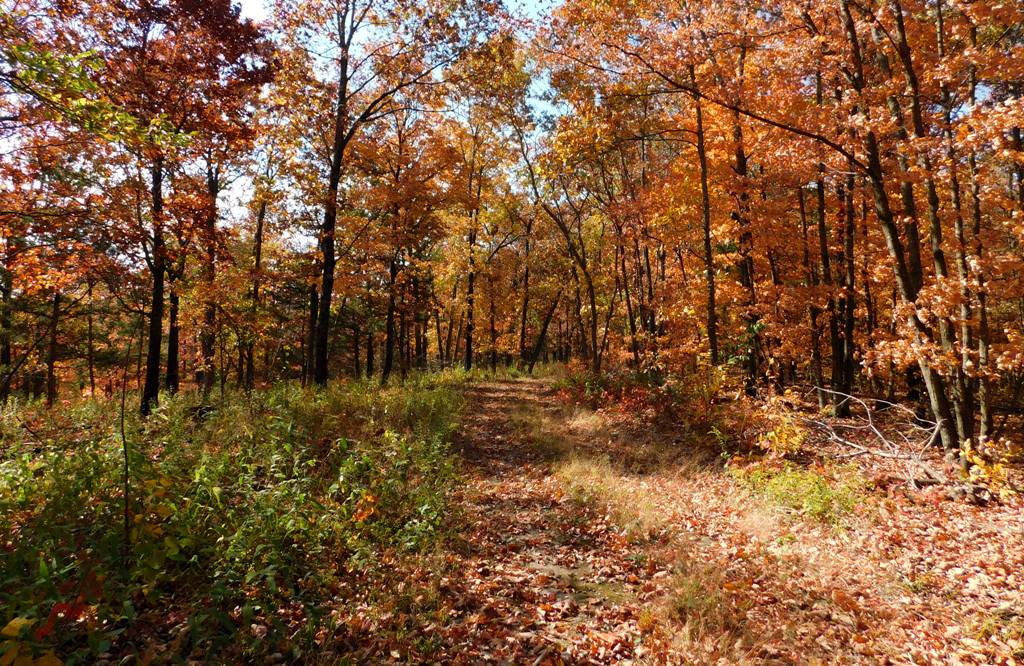
Yeah, mainly I’m talking about the fall color change. It’s simply amazing. Even though you know it’ll happen, you’ll still be speechless when you look out at a landscape that for months had been all the shades of green . . . and you suddenly realize it’s glowing yellow instead.

The whole world is yellow and orange. It’s glowing.

It doesn’t last long.

It’s that sweet transition time between “much too hot and humid; waaaay too many insects” and “freeze-your-ass-off, teeth-chattering cold; hardly anything living outside the window.” In October, you have some warm days and some cool days. Rainy and dry, windy and calm.

When you get a sunny, blue-sky day in the height of fall color, you grab it and get outside. Especially when it’s right near your birthday!

So we went hiking at Painted Rock Conservation Area, since it’ll be overcast and rainy tomorrow.

It’s one of our favorite hiking places nearby, and I’ve blogged about it before. It offers beautiful Ozark landscapes, both upland and lowland areas; a view of a serious river as well as several creeks and a few ponds.

We knew the popular, scenic Osage Bluff Scenic Trail would be busy, since it was such a gorgeous day, so we opted to hike the unnamed middle trail (that is, the other one, which is between it and the “Clubhouse Lake” trail).

This trail has a couple of designated, completely undeveloped camping places near the parking area, at around 800 feet in elevation. Then the trail leads west along a ridge for a while before splitting into a Y: the left branch continues straight west to an upland wildlife food plot (a field of crops planted for wildlife) and apparently to nothing else. Meh. . . . But the fragrant sumac along this upland part of the trail was gorgeous.

All the understory shrubs and trees were being spectacular.

Meanwhile, the right branch of the Y veers northwest, working steadily down along the north side of the east-west ridge. No switchbacks. It’s an antique road that must have been used by the original Painted Rock Country Club, pre–World War II.

You can see hints of its former development—a culvert running below the road at one point; down lower, a concrete slab as a simple bridge over a creek; and more. It tickles me to picture Model A’s putt-putting down this little road, so the mayors and governors and fat ol’ senators could get close to the river.

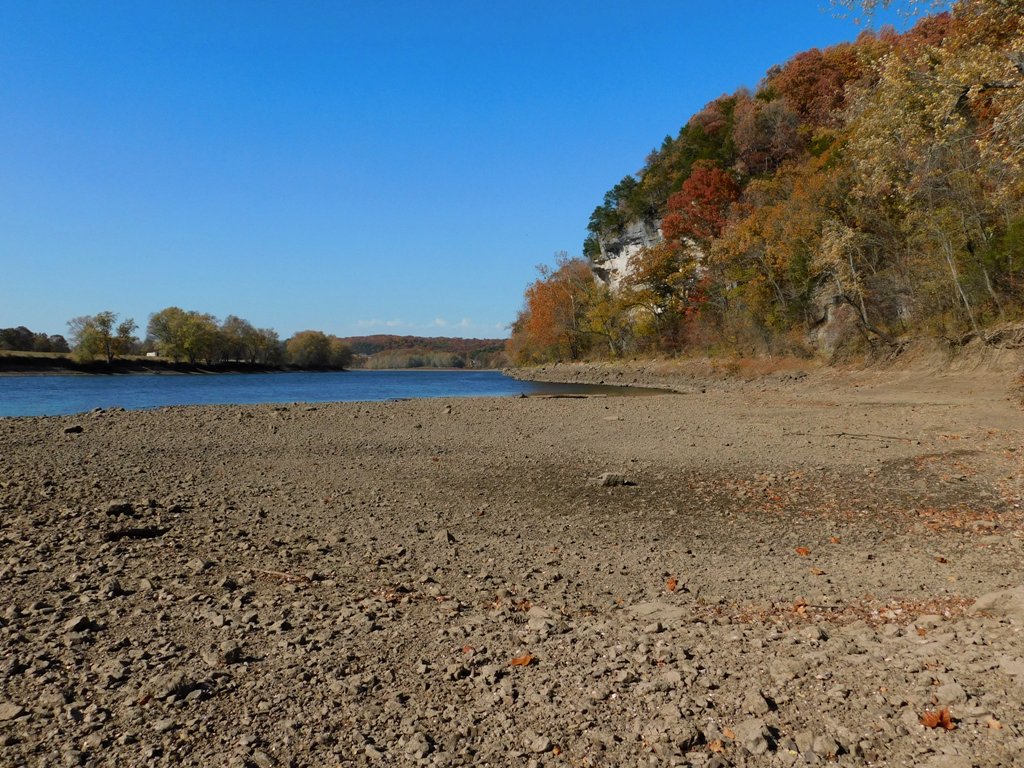
Yes, the trail ends at the Osage River, around 530 feet in elevation . . . though if we’re being honest, the trail peters out before the river. The lowland brush and brambles, fallen branches, and what-not obscure where any official trail might be. And once you beat your way to the precipice, you’re on your own to figure out how to scramble down the steep riverbank. Sometimes you can use exposed tree roots like stairsteps.

Once you’re down the bank, though, there’s a nice wide, rocky gravel bar to explore.

With the river so low, we had a lot to explore! The gravel bar was covered with dried mud; the rocks were not clean-looking as they would have been if we’d had some decent rains this late summer, even as the river levels dropped. Oh well.

Sue loves Nicola White’s videos about mudlarking in the River Thames, in London. So she pokes around looking for seventeenth-century clay pipes, Tudor money boxes, and George III ha’pennies. Naturally, she finds none of these, but she finds fun objects anyway. Old bottles, pieces of broken plates and dishes, old bones (deer bones?), rusty objects.

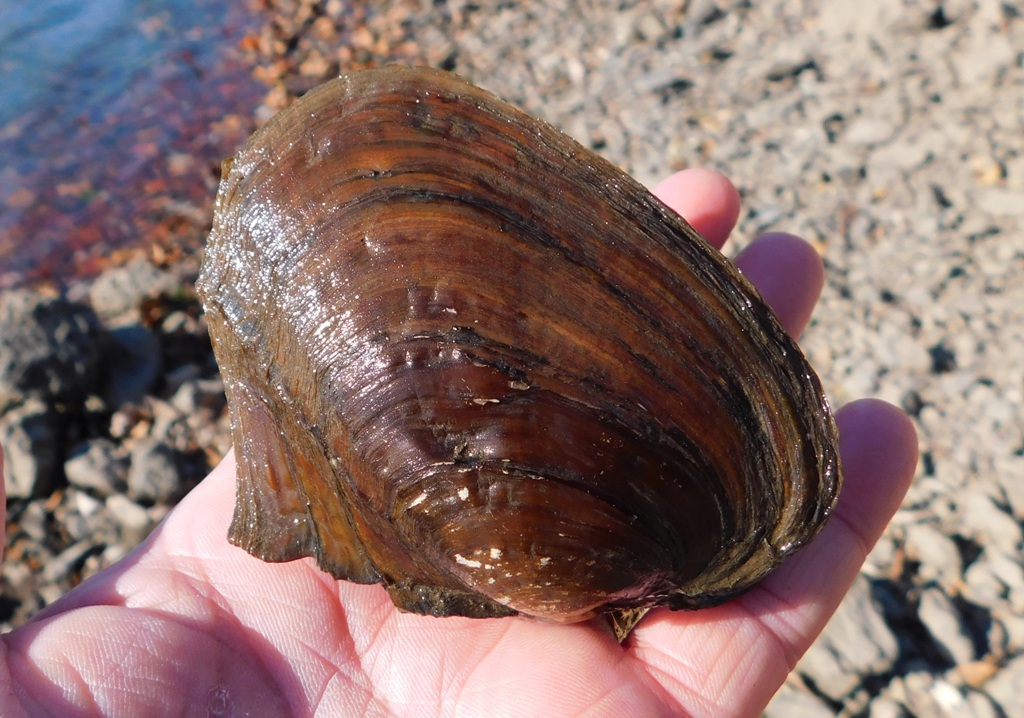
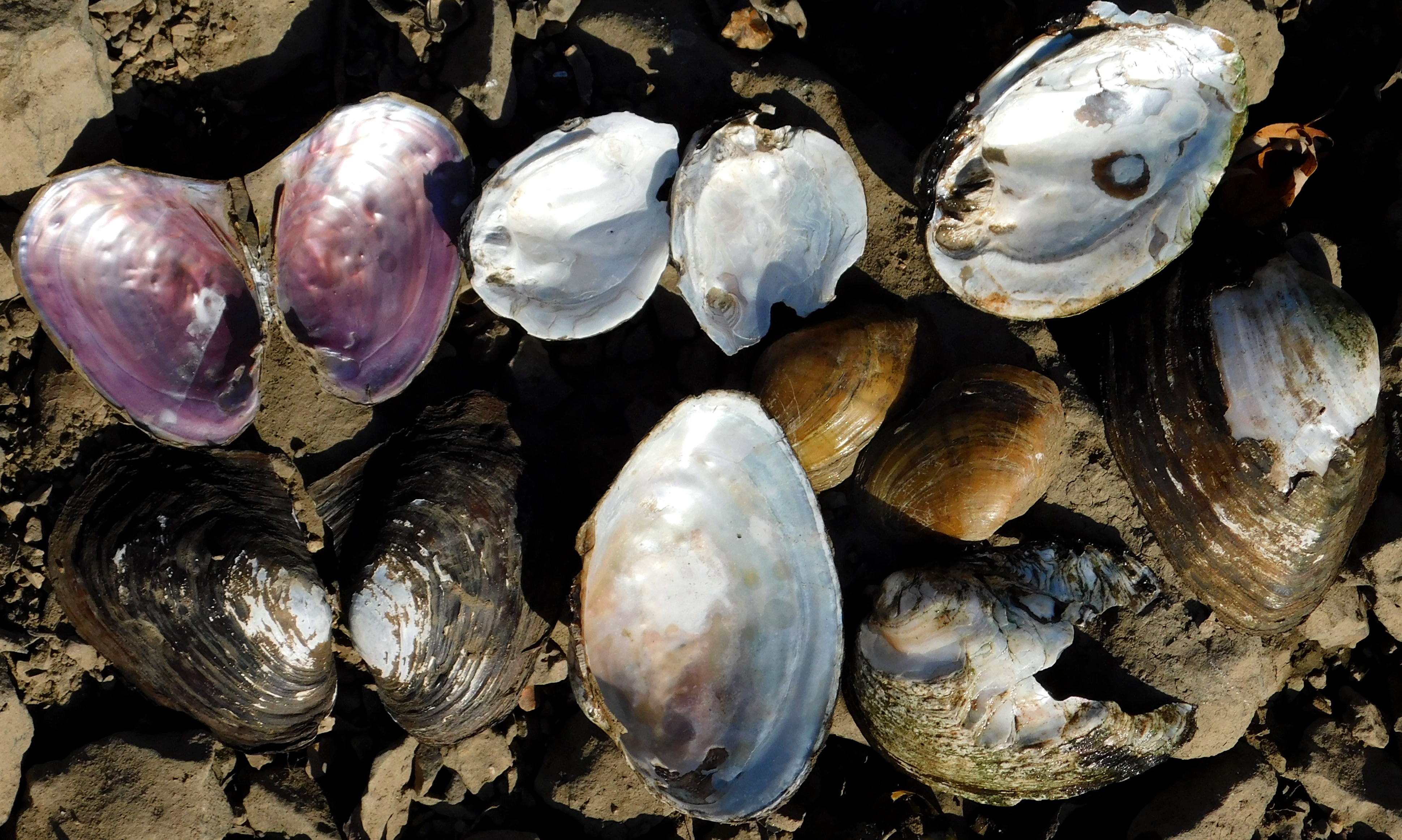
I find fun things, too. Where the bar was still muddy, hornets and some of the last butterflies of the season sought moisture. And did you know that Missouri is basically the global center of diversity for freshwater mussels, with about 70 species occurring within our borders? It’s thanks to our various, separated river systems. About 42 percent of our species are species of conservation concern, including several that are listed as threatened or endangered.

I also found a single Osage orange fruit lying partially embedded in the river mud—of the Osage River.

Who knows what curious things you’ll find when you look around.

I’m always interested in seeing the remains of the country club’s concrete steps leading down to what must have been a dock.

The old steps are gradually being erased by time and the river.

I’ll bet they had a structure here, like a fishing cottage, but I think their bona fide lodge was farther south, where their lake still exists and where you can still drive down a road to park near the river.

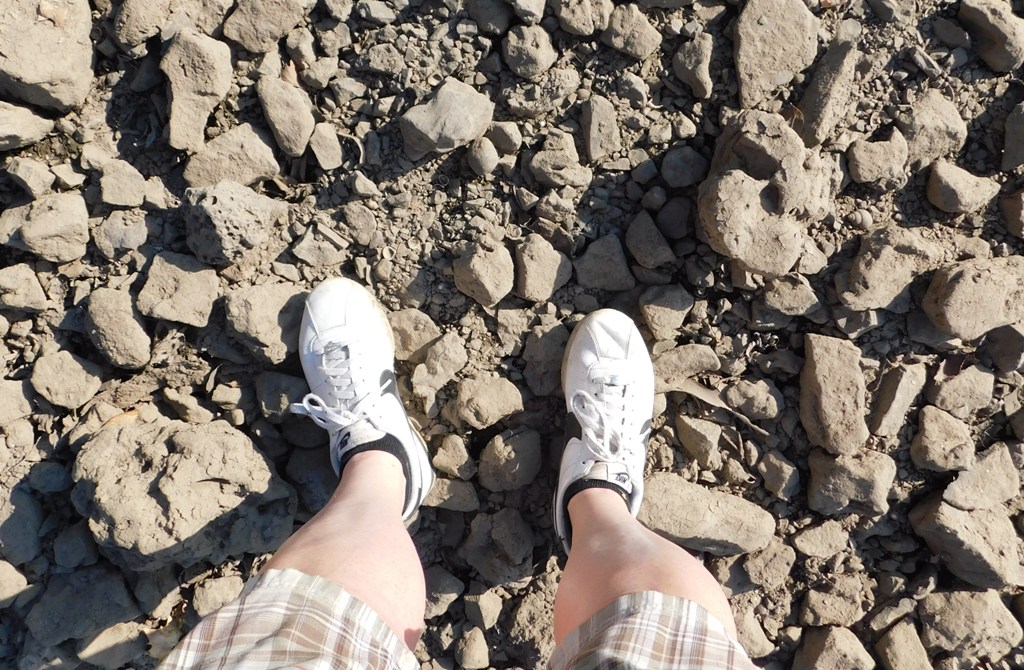
Anyway, I enjoyed taking pictures; breathing the fresh air, letting the gusty breezes flip my hair around. I even took a picture of my feet to show I was there.

It was a good day. Now it can rain for a few days, because we really need it.

I hope you’re enjoying this October, too!

Friday, August 27, 2021

Stone Hill Ozark Hellbender Red: A Great Wine for a Greater Cause

Hey, I want to remind you to pick up a few bottles of Ozark Hellbender next time you’re out buying wine.

Now if you’re going, “whatever is she talking about?” then you need to read on, because this is really cool.

In 2018, Hermann, Missouri’s own Stone Hill Winery—the historic 1847 winery that, with its restoration in the 1960s, almost single-handedly started the renaissance of Missouri’s wine industry—started producing a dry red blend they call Ozark Hellbender.

Why the weird name? A portion of the profits go to help fund the research and restoration efforts of several conservation organizations to restore the Ozark hellbender, an endangered native Missouri aquatic salamander.

Actually, in the past year, both of Missouri’s subspecies of hellbenders have been declared federally endangered, so restoration efforts are more critical ever.

Here are some links to learn more about hellbenders, their conservation status, and the Saint Louis Zoo’s captive breeding and restocking efforts.

In a nutshell—as if you could fit one into such a small place—hellbenders are huge, slimy, brown salamanders with small eyes and loose skin. They spend most of their time hiding under big flat rocks in cool, fast-flowing Ozark streams. Adults can be 11 to 20 inches long, making them the largest salamander in North America (three relatives in the giant salamander group are larger and live in East Asia; all of them range from threatened to possibly extinct in the wild). Missouri is the only state to hold both subspecies of North American hellbenders.

The reasons for their decline are numerous and are compounded by the fact that females usually don’t breed until they’re about seven or eight years of age. And even then, they may only breed every two or three years. They typically live for three decades in nature, but that’s assuming their streams remain habitable for them, and even then, their small, vulnerable offspring need to have a decent shot at surviving to breeding age. One hellbender was documented as living to age fifty-five—no wonder they don’t breed until they’re seven or eight; they’re kinda like us.

And so there’s a captive breeding and restocking program, which, combined with efforts to improve and protect their natives streams, might bring them back to the point where their populations are stable.

A personal reverie: MU’s legendary zoology professor Dean Metter used to keep the university’s herpetology collection (enclosures with live snakes, lizards, and such) in a hallway on the second floor of Stewart Hall. My dad, with the rest of the geography department, had their offices in the basement of that building. Often, when we were there to pick up Dad after work and there was a delay of some kind, I’d go upstairs and visit Doc Metter’s herps.

As a pigtailed Campfire Girl, and before, as a tagalong little sister with my brother’s Cub Scout den, we had a guided tour of the collection by Doc Metter himself. I’ll never forget him gently removing a speckled kingsnake from its cage and letting me hold it.

Along one, rather dark wall was a big, long, galvanized tub about waist-high. It must have had a chiller on it, in addition to the circulation/filtration. It was always humming and moving the water around. And there, in the tub, was a fourteen- or sixteen-inch-long hellbender. It never seemed to move, except to kind of waver a little with the current; it just rested in there like a shadow. It was there forever, it seemed. Knowing what I know now, it’s sad to think of that creature living in a galvanized tub in a lonely university hallway, educating those of us too young or citified to discover hellbenders on our own.

Nature had designed it for a life creeping around on Ozark stream bottoms, exploring amid boulders and bunches of watercress, crawling under large flat rocks, hunting crayfishes. Of living as one with the quick freshness, in the higher oxygen content of springfed sections of the river, and the richness and quietude of the pools.

. . . Anyway, there’s something primordial and shadowy about hellbenders; something uncanny and otherworldly. Very fascinating. It’s heartbreaking that something so . . . so . . . seemingly eternal could become extinct, wiped from existence forever.

So, this wine helps raise funds to help the hellbenders.

But it does a few other things, too.

It shows the maturation of Missouri’s wine industry, when one of its leaders is able to step well beyond the tried-and-true, by now rather formulaic marketing angles of “quaint local winery,” “historic ethnic German winery,” and “have your wedding receptions here, folks!”

I really like how Stone Hill, with this project, is connecting with Missouri's natural history and showing a dedication to its future. The “German heritage” angle is an obvious focus and starting point for most Missouri wineries, but this is showing Stone Hill's maturity as an institution.

Also, German immigrants brought a tremendous love of nature with them to the New World. While the English-derived Americans liked trees, grass, and gardens when they were trimmed, mowed, or planted in rows, the Germans held romantic feelings about wild places, where plants and animals grow free and take the forms and patterns innate to them. Yes, many German immigrants were (or became) master horticulturalists, but alongside their love of cultivation, they held a deep love of untamed nature. So this project, which celebrates an aspect of wild Missouri that many Missourians would feel squeamish about, continues that Germanic love of wilderness.

When I communicated this idea recently on Stone Hill’s Facebook page, I got this nice reply from someone at the company: “Thanks for the kind words! We are really glad we can play a small part in continuing that tradition and supporting this special Missouri species! As farmers, it is so important to keep our natural world healthy for the future.” . . . To which I say, Right On!

I don’t think they’ll mind me flat-out copying their descriptive text for the 2018 Ozark Hellbender wine:

BLEND INFORMATION: Since the Ozark Hellbender spends most of its life secretively hiding under rocks in the bottom of Ozark streams we are keeping our blend a secret as well. But we’ll give you some hints! All variety of grapes used are grown in the Ozark Mountain AVA. Some grapes aged for one year in neutral oak barrels to bring out complexity, softness and drinkability. Then just before bottling, like any good family recipe, we add the final variety which is held secret only for our winemakers to know.

TECHNICAL INFORMATION: Alcohol - 13%; Residual Sugar - 1.5%

TASTING INFORMATION: A smooth red blend with aromas of sweet cherry, blueberry and a touch of toasted oak. Creating a soft, complex and very drinkable wine, made from grapes all grown in the Ozark Mountain AVA. *A portion of the proceeds from every bottle of Ozark Hellbender wine sold is donated to the Saint Louis Zoo and hellbender conservation. (750ml)

AWARDS:

Bronze - 2019 Missouri Wine Competition

Yes, it's an award-winning wine! In fact, just recently, the 2019 Ozark Hellbender won "Best of Class Semi-Dry Red," and the 2018 Ozark Hellbender received a gold medal, at the 2021 Missouri Wine Competition. Way to go, Stone Hill!

Seriously, what are the grapes, you wonder: Here’s what they told me (in response to my Facebook question, subtly hinting if Merlot was one of the ingredients): “No Merlot in it! It is a blend of three grapes: Norton, Chambourcin, and #3 is a secret. [Finger-to-lips "shh!" emoji.] All three are grown on our own vineyards though.”

Norton is the strongest part of the blend. Have you ever tasted Norton wine? It’s distinctive. It’s North America’s native, sophisticated dry red grape variety. It’s Missouri’s premier wine grape. It has a fascinating history; if you want to read more, I heartily suggest Todd Kliman, The Wild Vine: A Forgotten Grape and the Untold Story of American Wine.

Norton isn’t for everybody. It has a distinctive flavor. It’s like this: If you’re hankering for oranges, a grapefruit will taste just wrong; it’s so close, it seems almost an insult to oranges; so close, well—just give me an apple. But the fun of wines is their variety. Thank goodness wines aren’t all the same! There are many really good wines—you simply won’t like all of the types. In his insightful essay “Knowing Nothing about Wine,” John Thorne described it like this: “Needless to say, wines with the same rating don’t taste equally good (Malbec, for instance, is a varietal that tastes rather like ink; a highly rated one tastes like delicious ink).”

But Thorne goes on to talk about how really good wines, highly rated ones—even if you don’t end up liking the variety—will still be worth trying, because you can usually see why some people really like them. They offer food for thought. They’re interesting. I suggest trying Norton with this in mind.

I heard somewhere that Ozark Hellbender red became the top-selling red at Stone Hill Winery in Hermann when it was released (apparently, it still is). That’s pretty remarkable, because the average Missourian typically prefers sweet wine. That Hellbender Red is selling so well could mean that Missourians have suddenly become conscientious consumers, choosing products that give back to good causes . . . or it could mean that Missourians have suddenly developed more cultivated palates . . . or it could mean that Ozark Hellbender red is a deviously clever blend that offers enough berry flavor to satisfy the average palate but enough complexity to make it good for people who prefer dry reds. And serving it chilled makes it smoother for red-wine newbies. Indeed, this blend can be kind of a “gateway drug” for Norton, and even “dry red” appreciation. Or it could be a combination of all three.

I think lot of people would like to drink dry red wines because of their purported health benefits and because, as you sit among your friends, a glass of deep red wine simply looks groovier than white—but many can’t make the leap in terms of flavor. I can see someone trying a Norton varietal and thinking, “I can’t enjoy this.” But after a few weeks enjoying Ozark Hellbender red here and there, you could easily acquire an appreciation for Norton: “Oh, this is that unique flavor I’ve come to enjoy in my Ozark Hellbender red, only more of it.” . . . And if this is what Hellbender red achieves for Stone Hill, then bully for them! Smart-smart-smart-smart-smart.

I hope you will go out and try a bottle of Ozark Hellbender red—for the tasting experience . . . and to help the hellbenders.

Tuesday, August 10, 2021

Boat Ramp Scavenger Hunts

Here’s a new summertime activity that works well with pandemic-inspired desire for social distancing: collecting boat ramps!

Just kidding, sort of. Here’s what it actually is. As some of you know, I’ve been working for several years as a freelance contractor for our state conservation agency providing writing and editorial services for one portion of its website. As I’ve used the site over the years, I’ve noticed that of the hundreds of conservation, natural, and fishing access areas that appear among the “Places to Go” on their website, several don’t have a representational photo—like, not even a thumbnail image to appear as you scroll through the lists of search results. (And a few are kind of lame—like a closeup photo of the area’s sign.)

Mostly, the ones that don’t have photos are access points along rivers (boat ramps—so not very compelling, photographically), and community lakes where the state agency has a partnership with the local government (so, not 100 percent the state agency’s job to promote). Still, it’s the web, and you know . . . pictures!

Anyway, since I have a camera that takes pretty okay pictures (good enough for web, anyway, and in some cases equal or better than the ones used on the website) . . . and since I can edit that part of the site (although I’m not in charge of it), I’ve been adding pictures here and there for the areas that need them. Yeah, for free. In fact, until recently, they invited users to upload their own photos, so it’s not like I’m going crazy here.

It started a few years ago, when I’d use the site myself to find directions and noted there was no image. Well, since we would be there, I might as well take a few clicks and provide a pic here and there.

And so Sue and I have been taking little excursions on weekends. I make a list of places that don’t yet have pictures, we figure out an itinerary, and off we go. We see how many boat ramps and backwoods public lands we can visit in an afternoon. It’s been quite an adventure, connecting these dots, going places we’ve never been before, occasionally missing a turn from one gravel county road onto another because the road sign has been knocked over and is laying in the weeds (Osage County, I’m talking about you) . . . but you know. Adventures.

We’ve seen a lot of beautiful places.

And a lot of boat ramps.

LOTS of boat ramps.

. . . All manner of boat ramps.

We usually have a picnic while we’re at it. It’s easy to find a pleasant place to sit.

It’s nice to get out of the house and do something together. We take pictures of all manner of beautiful and strange nature things. Then we go home and try to identify what we've seen, if it's something new.

Fun fact: this is a lot like something else we did when we first moved back to Missouri—we were living in Columbia, and Sue had never lived there before, and I thought she should get to know the university better. So many buildings! So we made a scavenger hunt out of visiting and entering every campus building we could. Why not? Those are public places, and we’re Missouri residents and taxpayers! Also, many of the buildings at the University of Missouri are beautiful examples of nineteenth- and early twentieth-century public architecture, so it’s a treat to step inside them.

We had a campus map and a checklist. Also, irreverent but in a nondestructive way, we had a roll of adhesive paper dots that we used to mark our conquests. In multiple-story buildings, we sought to put one dot on each floor. We made sure no one saw us while we were marking the buildings this way, and we’d stick the dots in odd, not-quite-conspicuous places. The tops or sides of door frames. The side of a light fixture. The top edge of an elevator door. A few times, in plain sight, but on a surface where the heads of screws, for example, created a pattern where one more little round circle wouldn’t draw notice. I think we might’ve put one above a switch on a classroom’s light-switch plate, which looked like someone might have marked “this switch” as somehow special.

We only put the dots onto metal or painted stuff, nothing that was finished wood. . . . I wonder how many of those are still there. I wonder if other people discovered these dots and wondered about their significance. Hah. We ought to make a new project of going back to those buildings and looking for the dots. We even put them on the parking structures.

We didn’t finish our little project—we didn’t conquer the University of Missouri. But we had fun walking around that beautiful campus in a lot of majestic buildings, marking them as “ours” in an exceedingly mild way. Just like we're having fun visiting all these boat ramps.

I hope you're having a fun summer, and that you're all staying safe and well.