Showing posts with label healing. Show all posts

Thursday, February 27, 2025

Jar of Goodness 2.27.25: Lidocaine

. . . The weekly virtual “gratitude jar.”

This week, I’m expressing thanks for lidocaine.

. . . Or whatever local anesthetic Dr. Powell used on Tuesday to turn the left side of my mouth into concrete while she did her thing on my lowermost left molar. Because I got a crown. (And not the “good” kind.)

This explains why I’m late for my Sunday-goal post. I spent the weekend getting wigged out.

This was a big deal for me, because I’ve been lucky enough to have had very little dental work in my entire life. One tiny cavity a long time ago, then a replacement of the filling for that cavity. I had braces in fourth or fifth grade, but I didn’t need any teeth pulled for that. Indeed, I think the braces helped set me up for decades of good dental health. In college, I had my wisdom teeth removed—but that was done at an oral surgeon’s office, and I was knocked out for that grimness. I know I’m being a big baby about it, but then I don’t have a lot of experience with these kinds of things. So cut me a break.

So I was dismayed my last checkup. “Hey, my molar’s hurting when I bite on it a certain way, or have tortilla chips.” I had thought it was the upper molar, but they determined it was the lower one. She could see the crack, and biting down on a perfectly positioned wicked little plastic pointed device helped demonstrate the precise location. Yeow!

So Tuesday was a new “adventure” for me. I won’t go into the details, but fortunately Sue prepared me for most of it. The worst and best parts were, of course, the injection. I wasn’t prepared for the sensation, or reality, of my lower lip having uncontrollable spasms as she stuck in the anesthetic. Of course, I was grateful to be numb for what followed. The fifteen minutes spent drilling away the exterior of the cracked tooth was an eternity, and then more was needed as they checked and rechecked the shape, drilled again and again, to get it just so.

I wasn’t expecting it, but I was also grateful for a gadget they wedged into the right side of my mouth (the side they weren’t working on) that I could just let my teeth close on, so I didn’t have to hold my mouth open the entire time. I could relax, well, sort of. It also had a suction tube attached, so I didn’t have to swallow. It wasn’t as good as not visiting the dentist at all, but it made the procedure easier to cope with.

As she drilled, and I caught the scent of tooth dust, it struck me as weirdly disturbing to be able, in essence, to smell the dust of my very own bones. Ashes to ashes. Usually such mortifying sensations are limited to battlefields and violent accidents. But hey, I paid money for this little lesson in mortality. (I know they drilled pilot holes in my bones to fix my foot and ankle fractures, but I wasn’t awake for that, hallelujah.)

As one comedian pointed out, “I recently read that a majority of household dust is composed of our own dead skin cells. Hey, I knew we turned into dust, but I didn’t realize it was an ongoing process!

To keep me from overthinking during my dentist visit, I had an earbud playing Tim Clark’s Blue Bamboo, music that I often play in earbuds as I mow the lawn. It is melodic, rhythmic, and intriguing enough that it makes time pass very quickly. So I’m grateful for that music, too.

At this point, I’m living with my temporary crown, I haven’t made it fall off yet, and I’ll go back in a few weeks to get the permanent crown.

Today’s lunch was a peanut-butter-and-banana sandwich, and I’m grateful for that, too!

Sunday, February 9, 2025

Jar of Goodness 2.9.25: OTC Cold Meds

. . . The weekly virtual “gratitude jar.”

This week, I’m expressing thanks for over-the-counter cold remedies.

The reason for this should be obvious, so there’s not much to say. But also, thanks for functioning immune systems.

Naturally, we didn’t go anywhere to watch the big football game, and since we don’t pay for any TV services, we’re not watching it. It’s not like we’re big fans of sportsball, anyway. So, pffft.

I’m trying to keep my cooties to myself. Hopefully, Sue won’t get this.

Monday, March 20, 2023

Where Have I Been?

Well, certainly not on vacation. Any free time I’ve had recently has been spent on things like work (actual billable hours!) and the basics of taking care of our home (including, like, getting another new furnace in January). I don’t think I could have done this without Sue. And my brother came to help for two weeks in February.

If you don’t read anything after this, please get this at least: GET THE SHINGLES VACCINATION IF YOU’RE ELIGIBLE FOR IT. (((Okay?)))

Round One

Here’s what’s up. My mom got shingles in the middle of January. None of us quite knew what was going on, since she didn’t have an obvious rash, nor did she have the excruciating pain shingles is infamous for. There were about three days of increasing overall weakness, redness on half her forehead, swelling in her right eye, and, as she weakened, loss of appetite. Had she just slept "wrong," and not been drinking enough? She didn’t want to go to urgent care. So we tried telehealth. The telehealth doc had us hold the camera up to Mom’s forehead, and he said “go to the emergency room, this looks like shingles.”

So we went to the ER on 1/14, she was diagnosed with eye shingles and secondary bacterial infection. Hours later, she was returned home with a prescription for Valtrex and antibiotics. She’d had no liquids or food that whole day, pretty much. Not even an IV. And since it was now late on a Saturday, the drugstore the ER sent the prescription to was closed and would be closed until Monday. So Sunday, we had to get the ER to send the prescription to a different pharmacy. By the time we tried to get her to swallow the first medications she’d had since the afternoon before, she was too weak and dehydrated to sit up on the edge of the bed.

So, for the second day in a row, she went to the ER. This time, she was admitted, thanks to her overall weakness and dehydration, also because the swelling was starting to extend to the other side of her face, with both eyes nearly swollen shut. Not meaning to be mean . . . but Sue and I both decided Mom looked like “a prizefighter who’d lost the round.” She was in the hospital from 1/15 to 1/20. With IV fluids and antibiotics, she started getting better quickly. We visited her every day.

She didn't have much of an appetite, so we brought her food we were pretty sure she'd like.

Then, she went to a rehab facility from 1/20 to 1/28. She didn’t want to go there. She didn’t remember much (if anything) about her trips to the ER, and she still doesn’t remember much about the days before, and the days in the hospital. All she knew was that she wanted to be home.

I don’t think she really understands, yet, that a stay in a rehab place is not the same as being locked up in a nursing home. Indeed, the rehab place simply does the kinds of things that hospitals used to do “back in the day,” back when people stayed in hospitals doing rehab and getting stronger until they were able to go home. Anyway, Mom hated the rehab place.

. . . The food was pretty miserable.

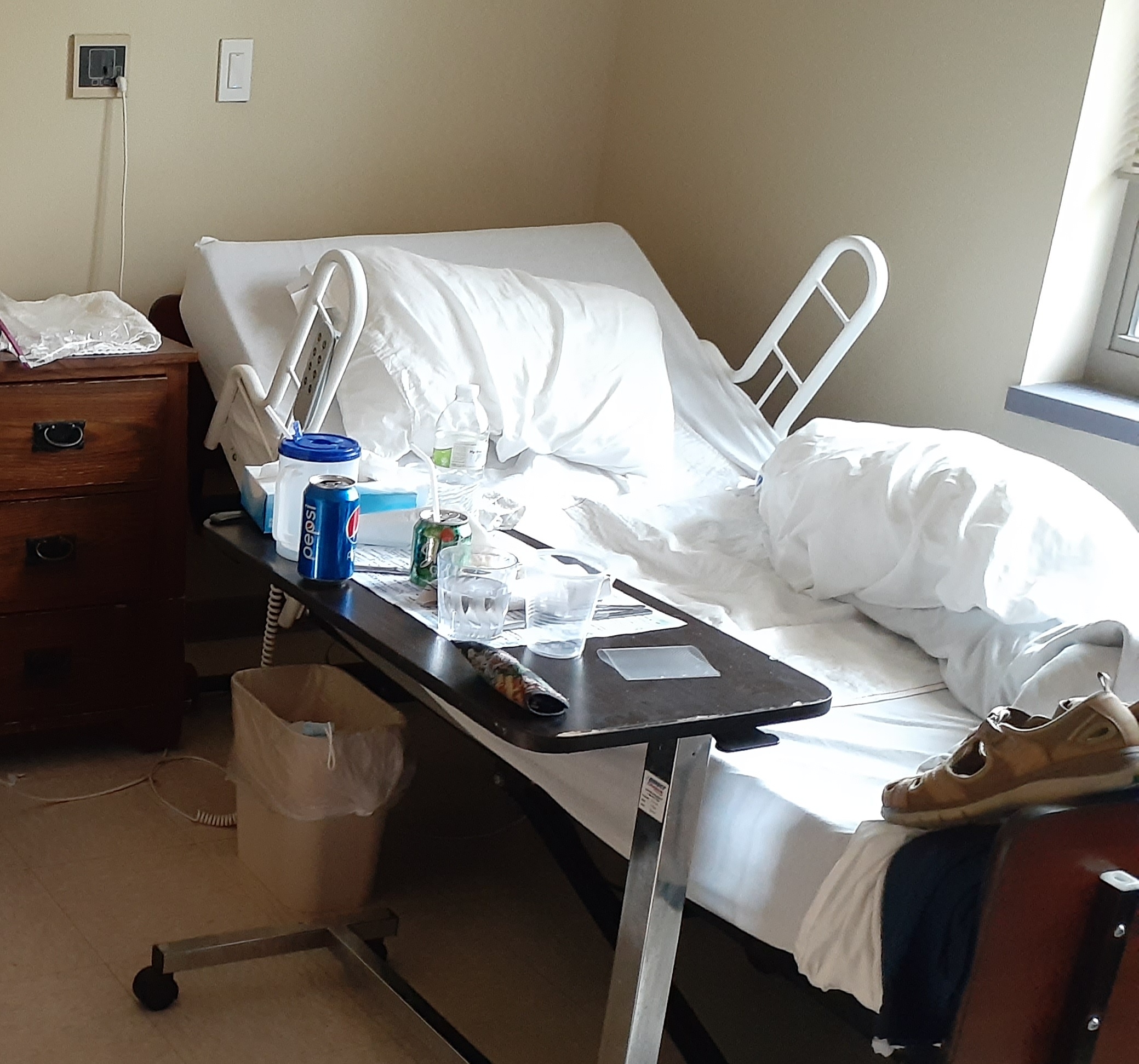
And she felt the chair was uncomfortable. And she had to press her button well before she needed assistance getting to the bathroom. And the TV didn’t work like her TV at home. Also, her eyesight was messed up. She had several days of just having a plain old bad attitude. ("Hmm," I thought; "maybe the inconveniences and less-than-optimal situation can act as an incentive for her to do PT, so she doesn't have to return to a rehab place anytime soon!")

Dad and Sue and I tried to make it nicer for her. We visited her every day. I did my best with the TV. I read to her from her mystery book. Worried that she wasn't eating enough, I brought her Wendy’s burgers (single cheeseburger, no mayo, just the way she likes ’em), Arris pizza, Taco Bell taco supremes. You know—her favorites. As it was in the hospital, my “shift” was in the afternoons and into suppertime; Dad was with her in the mornings, through lunchtime, so he got to see her do her PT and OT.

The Wednesday, January 25 Debacle

A day that will live in infamy. So, until 1/25 (the day the insurance made the decision to deny her a second week in rehab), she was experiencing no pain. But that day was a debacle. First and worst, Mom started getting the excruciating pain associated with shingles early that morning. For the following several weeks, she’d get an attack about once every 3 to 5 hours, and even though the attack would only last about a single minute, it was incredibly draining on her. Her whole body would tense up; she’d cry and whimper. It was so hard to see. So that began early in the morning on Wednesday, 1/25—the same day Mom had an 11 a.m. appointment at the University Hospital’s Mason Eye Clinic. The rehab place said they’d transport her there—we were to meet her at the front entrance to the hospital at 10:30. Dad and I were there at 10:15 (I’d spent the night in Columbia, since snow was predicted overnight, of course).

So, it got to be 10:45, and Mom hadn’t appeared. I called the rehab place (the name rhymes with “The Snuffs”), and the nurses said they were on their way. Around 11, she still hadn’t arrived, and when I called again, “the driver dropped her off; she should be there.” I said, “Well, she’s not here.” More time elapsed. In between these calls trying to find out where the heck my mother was, I was reporting to the receptionists at the eye clinic: “Well, they SAY she should be here!” Wouldn’t it just figure that they’d finally get Mom to her appointment, and the eye place say, “well, you weren’t on time, so we have to reschedule you.” Ughhhhh!!! . . . Next time I called the rehab place nurse, she said, “Okay, they had dropped her off at the eye clinic on Keene Street. She’s on her way now.” So finally Mom showed up, and the eye clinic saw her at noon, a full hour late.

Mom had been dropped off at the wrong University Eye Clinic. The driver hadn’t paid attention to the words “UH - Lobby floor” instruction on her transportation papers. He’d wheeled my mom into the Keene Street eye clinic, asked her if she saw her daughter (me) anywhere, and poor Mom had used her one reasonably good eye and tried to oblige him: “Yes . . . I think that’s her over there.” And the guy just left her there! Without verifying if it was really the right person or not. Jeez!

I don’t know how they figured this out. Was it the rehab place nurse who contacted the driver and told him to go back? Or did eye clinic staff at the Keene Street location go over to my mom, look at her papers, and call the rehab place? The mind boggles.

Anyway, it was a rough damn day. The eye clinic doc had good news for us: her eye is improving. As to the pain that had just started to occur, she said that a regular MD is the one to talk to about starting on pain medication. So as soon as we returned to the rehab place, I got with the nurse and asked if their staff doctor could start her on something. “I’ll relay the message to the doctor.”

End of First Rehab and Back Home

For the rest of Mom’s time at the rehab place, she was never prescribed anything more than the over-the-counter Tylenol she has always taken for her chronic back pain (indeed, I think they effectively took her off that, since they deemed it “upon request,” and Mom wasn’t thinking to “request” it).

So her pain attacks continued, and each agonizing episode strained at muscles she hadn’t used in years. The pain attacks just wrung her out. As a result, even though her first few days in rehab showed steady improvement, she didn’t have much of a net gain in strength while she was at the rehab place. The rehab place's doctor didn't prescribe anything for her shingles pain, although we asked again and again.

Mom felt it was a betrayal for us to try to get a second week of rehab for her, but anyway, our appeal for another week was denied, so she came home on 1/28. On Monday, 1/30, we took her to see her regular doctor, and he started her on gabapentin, a pain medication that must be increased only gradually, to avoid side effects. On 2/1, I had my first entire day at my home. On 2/2, my brother flew to Missouri to be at Mom and Dad’s house. He helped with the transition to visiting PT and OT practitioners, and visiting nurses keeping tabs on Mom’s health. He also helped Dad with Mom’s various medications and with tracking her pain attacks.

Soon after Mom returned home, Sue noticed my parents’ house seemed dry, and we figured out that their humidifier wasn’t turned on. A phone to their HVAC company revealed that their service contract hadn’t been renewed, so we had to get that reestablished (yeah, now we’re in the twenty-first century, with the monthly payments automatically deducted from their checking account, and automatic renewal, instead of being paid by check once a year, and renewal activity having to happen each year). Fortunately, the HVAC company sent a guy out right away to do the maintenance and turn on the humidifier. Hopefully Mom’s eyes and skin wouldn’t seem so dry, right?

Did we all need extra things to take care of? No, but I was so glad my brother was able to help with another issue that my Dad hadn’t gotten to—linoleum removal, cleanup, disinfection, and de-molding of the basement laundry room, where the sewer had backed up a few times, including once while my brother was there (n.b.: “flushable” wipes are not truly flushable). I’m so grateful he was able to assist with dealing with the company doing the work, and with the insurance company, which (yayayay!) is paying for nearly all the work, including duct cleaning and rebuilding part of a closet that had gotten affected by the sewer backup. Indeed, that project isn’t quite finished—but it’s getting close to completion!

We had some good times while my brother was in the state. The family had a little Super Bowl party (and the Chiefs won!); and we served Mom and Dad one of their favorite meals: pork sausage patties, fried apples, and mashed potatoes. Another night, it was my homemade shepherd’s pie! My brother and I even went out for a bro-and-sis lunch at Ozark Mountain Biscuit Company, one of our new favorite restaurants.

The day before he flew back home, we took Mom to another doctor appointment; since her pain attacks didn’t seem to be helped much, he increased her dosage of gabapentin. That night, we had a pre-Valentine’s dinner. The next day, we drove him back to the St. Louis airport. Things were looking hopeful!

More Bumps in the Road

Mom had another eye appointment on 2/16; the doc found uveitis (inflammation between the cornea and iris) and put Mom on prednisone/steroid eyedrops (one drop per waking hour), and started her back on Valtrex (antiviral medication), since the steroid can open the way for a reemergence of the shingles.

Meanwhile, the gabapentin dosage was being ramped up—in hindsight, too much too fast. Mom was getting weaker and her vision was still bleary. By the weekend of 2/18 and 2/19, the pain was finally abating, but within a twenty-four-hour period between 2/19 and 2/20, Mom had ended up on the floor four times. Sooooo . . . another ambulance trip back to the hospital. And another week there.

The pain medication seemed to be the culprit, so they took her off the gabapentin and put her on a different pain medication (pregabalin). They also started her on two blood pressure medications. They’d noticed orthostatic hypotension (BP drop when she stands up) apparently related to the gabapentin, plus old age and poor physical condition. But her BP was rather high when lying down. They put her on two BP medications (midodrine to raise it, lisinopril to lower it—go figure). The eye docs reduced her steroid eyedrops to just twice a day.

Mom was doing pretty poorly, but she really wanted to go home. All the time spent lying in bed hadn’t helped her fitness at all. There was no way she was strong enough to make it up the stairs to the living room. She needed more rehab.

So after about a week in the hospital, Mom was transferred to a (different) rehab place on 2/24 and was there until 3/11—general weakness and a need to keep an eye on her BP. Another trip to the eye docs on 3/7 saw NO inflammation in her eye, and they started weaning her off of the steroid eyedrops. The eye doc took her off Valtrex and antibiotic eye ointment (she couldn’t figure out why they were still giving those to Mom, when she’d said for both to stop, like a week ago). I won’t go into how the rehab place had kept her on Valtrex all this time, and had somehow increased the eyedrops from 2x/day to 3x/day. What the hell?

So after two weeks at the rehab place, Mom came home again on Saturday, 3/11. I had a heck of a time figuring out the medicines, based on the paperwork they sent home with her. Apparently, they hadn’t been tapering off the prednisone at all; apparently they had taken her off it cold-turkey. (Though the next Monday morning, a nurse from the rehab place called and asserted they had, too been reducing it according to instructions. Hmm.) Also apparently, they had not been giving her the Tylenol she’s accustomed to, even though we’d made it clear she gets the maximum dosage every day, to help with her chronic back pain. Finally, I couldn’t figure out why the BP meds were being given so often and at the times of day they said, especially the midodrine, whose third dose they were supposedly giving her in the “evening.” What-what-what? That’s never to be given near bedtime.

Naturally, it’s pretty impossible to talk to medical professionals on a weekend. Why do they release people on weekends? Anyway, we got it figured out. (I think.)

Back Home Again: Time to Blossom

So at this point, Mom’s back at home, her doc’s taken her off of midodrine, she’s winding down on the prednisone drops, but she’s still on the pregablin (which seems to be taking care of the pain attacks, though the right side of her head is still really sensitive and zingy).

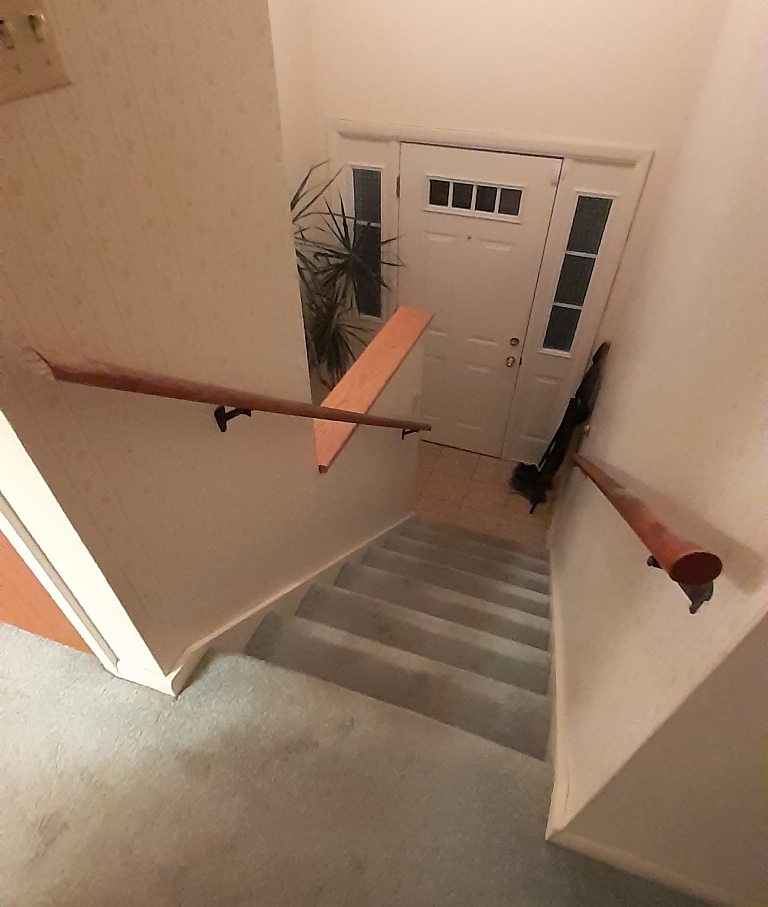
While Mom was at the rehab place, I installed a toilet-seat raiser with handrails onto her toilet, and Dad hired their carpenter/handyman to install additional handrails on the staircases, which made a big difference in Mom's ability to haul herself up from the basement garage to the floor they live on.

Mom's vision is still wonky: ever since her right eye reopened during the initial hospitalization, she’s had double (non-binocular) vision. The right eye isn’t in great alignment with the left. The eye docs think this was caused by inflammation, daily antibiotic ointment treatments (which make vision blurry), and general physical weakness, and so far they have resisted giving her corrective lenses that would act as a crutch; they’ve been hoping that her eyes will return to alignment and binocular vision as she improves overall and uses both eyes together. So Mom’s still struggling to read and watch TV—her two favorite activities.

Also, throughout, Mom has acted as if PT and OT is a hardship, an annoyance, a punitive sentence, an outrage upon her constitutional rights as a senior—but hopefully she will finally see that her doing regular physical activity is a key for her and Dad getting to live safely at home for as long as possible. For years, her doctors have told her to simply get up and walk around the house a little, and Mom always nods and says "yes."

But back at home, she always has an excuse for not doing it: “my back hurts; I just got up; doesn’t walking to the bathroom count?; I’m tired; I’m old; but I can do that!; well, shouldn’t Bud be having to do exercises, too?” (Note that Dad has been doing PT and other exercises of various sorts for years; the issue with him is that he wants to do too much!) The day of her return from the rehab place, I suggested Mom do some little marchy-steps while seated, and she complained that she should get at least one day to relax at home!

Mom does PT when a physical therapist is there to have her do it; and the PT folks have told her again and again to do some exercises during commercial breaks, or get up and walk around between TV shows—but when Dad or I remind her to move, she doesn’t listen to us. She just sits there. Lord knows I’ve beaten this drum enough the last two months. Let’s hope she takes it to heart; I’m tired of nagging her about it.

Yeah, it’s been rough emotionally, too. It’s been so frustrating, trying to convey to my mom the importance of her taking care of her body via three simple things: drinking, eating, and doing even just light exercises. But my frustration really doesn’t matter. We’ve all been frustrated! This has been incredibly difficult for my mom, who did everything she was supposed to do to treat her shingles; she did the PT at the first rehab place, and did it well; then she got discharged half a week after her pain attacks started. The doc and nurses at the rehab place let her down by not addressing the pain right away. Then, once she finally got a prescription for pain medications, nearly a week after the pain began, it took ages for the pain meds to build up to hope to do anything. Then, finally, the pain meds were too much and she started falling down. Then, another stay at a hospital, and then rehab and PT all over again.

For someone who hadn’t spent a night in a hospital in like thirty years, never seen the inside of a “rehab place,” and who’s not used to taking much medicine at all, my mom’s had to swallow a ton of it. And the indignity of people making decisions for her. This has been a huge disruption in her life. And who the heck can figure out the weird TVs in the hospital and rehab places??

She can't even see to read her mystery books. . . . Boy, I'd have my crabby moments, too.

Dan, Mom’s physical therapist at the most recent rehab place, told me he’d told my mom that when she goes home, it’s her “time to blossom.” He, too, encouraged her to get up several times throughout the day to walk around, to do some seated exercises during commercial breaks, and thus reclaim her strength and independence. “Time to blossom.”

We’ve had some crabby conversations, but since she’s been home, Mom has been taking the bull by the horns, sort of. She’s been putting on nicer clothing, she’s more independent with toilet habits, she’s been eating more, drinking more, and not raising a big ruckus about medications. I’m not sure she’s doing much physical movement, but hopefully she’ll get some benefit from home PT visits soon . . . before there’s some other bump in the road.

Friday, January 16, 2015

Watch This Blog: “The Five Pillars of Health”

It’s a new year, and naturally most everyone is thinking (after the holidays): “I need to focus on my health again.”

Well, here’s some good mind-chow to help you with your goals: Doc Bea’s The Five Pillars of Health. What are these five pillars? Love, Sleep, Water, Play, and Eat.


Notice that “diet and exercise” are not named (per se) in that list. And there’s a reason for it, which you’ll learn about in Doc Bea’s January 14 post, “Secrets of Good Health from DOT Drivers.” (I know, you’re thinking, “What-what-what?? Is she talking about truckers?!”)

Well, yes, as a matter of fact, she is.

My disclaimer, here, is also a big part of my endorsement for this young blog (which started in December): Doc Bea is a personal friend of mine. I went to high school with her, and for this reason I’m biased. But it’s also the reason I know this is a blog to watch. Bea (Beatrice) has led an interesting life. She comes from an interesting “place,” with her strong Greek heritage which in several ways set her apart (above, actually) from the rest of us silly, more Americanized high schoolers.

Bea was writing (very good) poetry, excelling in all her classes (even math!), and debating politics and philosophy while the rest of us were obsessing over our silly boyfriends and girlfriends, worrying about who was sitting next to whom during the football games, and hyperventilating over the new Star Wars movie.

While the rest of us were contracting our tight little circles of friends, Bea was expanding hers. She befriended all the kids—including the immigrants, the nerds, the holy kids, the atheists, the shy kids, and the loudmouths. Bea has an insatiable curiosity; she listens carefully, and cares deeply.

Doc Bea is getting close to age 50, yet she’s only recently gone to med school and earned her medical degree. She had already pretty much raised her children. She was a caregiver for her grandmother who had Alzheimer’s, and her father, who died of colon cancer. She has struggled with her own health problems, surgeries, weight issues, and she understands the difficulties of common people leading busy lives, who are trying to find some way to stay healthy.

As she says, “I have lived medicine long before I even considered going to medical school, . . . and I chose to take this journey because I made my dying father a promise to do so, and he made me promise, because he was comforted by my care and advocacy and wanted this for others. I was a non-traditional (aka OLD) medical student in my 40’s. I had a 14-year previous career in Information Systems as a Help Desk Analyst. I helped people to fix their computer issues. Now I have graduated to life issues.”

Actually, Doc Bea has always been involved with life issues, and that’s why I’m watching her blog. Don’t expect the status quo from her. She has strong feelings about the medical and insurance industries, and she has even stronger feelings about the dignity and rights of patients.

So check out her blog. Bookmark it, add it to your blog feed, friend it on Facebook. Because this is one to watch!


Friday, April 8, 2011

Clarification

I hope my previous post didn't get too many folks upset about my welfare--I was recently contacted by one reader who was concerned about my continued swelling and such, and urged me to check in with the doctor, since it could be a sign of a complication, etc.

So let me clarify: I was just complaining--just venting--that's all. It doesn't mean that I'm in any kind of agony. (In retrospect, that post was tactlessly self-indulgent, concerned only with my feelings and problems. It's not a very "Op Op" subject! Should I just delete that post--? Maybe this is not the place for me to "share.")

To me, any swelling is too much swelling. Yes, it's still a bit swollen. But every week the swelling decreases. My leg, ankle, and foot are feeling better than they have since my accident.

I've been through something like this before, and I realize that the recovery will take at least twice as long as "they" say, three times as long as I hope, and eighty times as long as I want.

And the swelling simply fluctuates depending on how I've treated my leg on any given day. On Wednesday, the day I wrote my last post, I dragged our garden hoses into the backyard (all wrapped around the monstrous, semi-convenient "hose reel") and then watered our pansies and filled the birdbaths. And I carried trash (some of it heavy) into the big trash bins.

Also, I swapped the small three storm windows on our back porch for the big but very lightweight screen. Hey, it was a nice day, and I wanted to work on the porch--and although I felt fine carrying the big screen up from the basement alone, I did not carry the storm windows clear down to the basement (I'll let someone more able-bodied do that).

After all that movement, it's no wonder the tendons and muscles of my ankle were warmer and more swollen that evening! Naturally, I was wanting to ice it down some.

So don't get me wrong--I'm definitely on the mend.

It's just not happening overnight.

Sunday, February 13, 2011

Sunday the Thirteenth


Usually, the "thirteenth" of anything is supposed to be bad luck, but I'm feeling pretty optimistic today. It's been a very slow morning. (And why not? my foot is best kept up in the air, higher than my heart, so there's not much to do besides read. Thank God for Jane Austen.)

I've been posting little updates on the foot situation on the Op Op Facebook page, so those of you who have "friended" the Op Op on Facebook already know what's been going on. But here's the summary.

Monday morning (Feb. 7th) I slipped on the ice on our sidewalk and broke my left fibula (the bone just above my ankle, on the outside of my leg). In the ER, they kept asking me "how I fell," and for the life of me, I couldn't tell them. However, upon reflection, I think I have it figured out, working backward from my first clear memory after falling (it happened so fast, and my immediate reaction was to roll over onto my other side).

It was just a small patch of ice--only a few feet wide. My feet slid sideways toward the right, and my left foot must have gripped the good concrete as soon as it ran out of ice to slide on, so that my left foot got turned too much toward the left, with my weight coming down on it.

After I landed (and yes, I heard a "crunch" in my ankle concurrent with the onset of pain), I rolled over onto my right side and stuck my hurt left leg into the air. The foot was bent too far to the left (though I wasn't consciously bending it). (Gross.) I reached down and moved it back into position (another "crunch"). (A few days later, the orthopedic surgeon told me I'd done a pretty good job of setting it.) (I wasn't quite aware that that's what I was doing. Now, I'm kinda proud of myself.)

Here comes the advertisement for cell phones: Mine was in my back pocket. I called Sue, who was just inside the house, and she came out, helped me into my car, near where I fell, and drove us to the Emergency Room.

Pain medication; X-rays; diagnosis (fractured fibula); splinting; an orthopedic surgeon recommended.

The ER doc said he didn't think it very likely that I'd need surgery; it seemed in good position; he guessed only 4-6 weeks in a cast.

So it was a surprise on Wednesday when the orthopedic surgeon told me he strongly recommended surgery--a cast, he said, wouldn't be able to hold it stationary enough for it to heal properly.

And so it was all set up right away; surgery on Thursday morning, preoperative interview and testing at the hospital that very afternoon.

Boom, boom, boom.

Thursday, naturally, was mostly a blur. For all the amazing things that surgeons can do to help us to heal better, perhaps the most remarkable miracles are performed by the anaesthesiologists and narcotic pain medicines, that they can drill on bones and you be up and about within a few hours, without screaming.

Like the last time I had orthopedic surgery, I had a nerve block, but this time, it absolutely worked. (I won't go into the fascinating/gruesome details, which reminded me of the eighteenth-century neuro-electrical experiments that inspired Mary Shelley to write her novel Frankenstein.) It made my lower leg and foot completely numb--indeed, paralyzed--for over twenty-four hours. No pain medicine needed all that time. It was noon the next day when I discovered I could move my toes a little, and three when I started to feel the incision. Pretty awesome, huh?

I won't put a link into my blog, but if you Google on "Youtube fibula fracture," you can find an animated video that shows, I think, pretty much what they did to me; it's basically a contoured mending plate with two or three screws into the sound bone on either side of the fracture.

[Addendum: I didn't know it until some weeks after I wrote this post that he also put a longer screw through the bottom of my fibula and into the tibia, in order to hold in place the ligament that goes between then, which had torn when I broke the fibula.]

After the surgery, the doctor told Sue it went very well and that I have good strong bones. I was amazed to read the postsurgery instruction sheet where the doctor had checked "weight bearing as tolerated"--wow!


[Addendum: That was a total mistake on someone's part; I wasn't supposed to be weight-bearing at that point at all! Good thing I didn't put any weight on it until I'd double-checked about this point!]


You have to understand: I don't have much experience with broken bones, casts, and what-not, and my one experience with it was nightmarish. No one in my immediately family ever had fractures; my brother and I both made it through childhood and adolescence without any broken bones. I never saw what was involved in keeping the cast dry, bathing, getting around, learning how to use crutches, and so on.

So in October 2007, when I broke my foot, my had no hint of what was involved, what to expect, how to do things. It was rude.

And what made it even ruder was the nature of that infirmity--the Jones fracture is notorious for slow healing, and my hopes and expectations for regaining use of my foot were constantly jerked out of my grasp: "No, it's not healed yet; let's see you in another month." So I got pretty dang good at using crutches.

We had to modify our house. We moved furniture. We outfitted the clawfoot tub, using plastic hose and packing tape, for use as a handicap "shower." I learned how to go up and down steps without falling and eventually did it with confidence. I learned that, given a wide, clear, dry sidewalk, my crutching could easily outpace the non-crutching friends I was walking with. I developed respectible callouses on the heels of both palms.

So now, all that stuff is coming back to me. Having been "through this" before, it's not nearly so traumatic. Even when I was lying on the sidewalk, thinking, "oh, shit, my ankle or something's broken," my disbelief was mixed with a sense of resignation instead of a wild, frantic fear of the unknown.

The "been there, done that" aspect has helped tremendously.

The hardest part, all along, has been my fear of what "my" insurance company won't do for me, or will do to me, in response to these claims. They don't like it when you have claims. Now that I've had a big claim, it's certain that I will have to shop for a new insurance company when this one's year is up. (If you don't think there's anything wrong with the health insurance industry, I can say with confidence that you are not having to purchase your policy as an individual.) Indeed, I was crying in the ER, and the nurses assumed it was because of the pain--but instead I was thinking of my deductible. And there's no pill for that. (If there was, my insurance wouldn't cover it, and I probably couldn't afford it.)

One thing that's occurred to me several times in the past few days is that I'm truly grateful that "crutching" is a skill I have already learned. Much of the trauma of my previous fracture was caused by the handicap to my lifestyle. And so I keep thinking, "It would be a terrific idea for everyone to voluntarily spend a week or so on crutches--while they're able-bodied." Yeah: learn how to crutch forward and backward, left and right (like I've had to do on narrowly shoveled sidewalks), up and down stairs. How long can you stand on one foot at a time? Long enough to brush your teeth?

Indeed, it could be something they teach in P.E. classes--an incredibly useful skill. Not that you'd necessarily need it during your life, but hey, if you ever do, you'll be grateful you know how to get around without falling. Much better to learn it when you're feeling good, than to have to learn it when you're in pain or are loopy with pain medications. It would be more useful than knowing how to do a cartwheel, which they tried like crazy to teach me how to do.

So, here's the outlook: At the end of this month (two weeks after the surgery), I'll see the surgeon again. He'll remove the stitches and put me in a cast (I think--or maybe a walking cast?), and then I'll have another four weeks on crutches.

Thus, I'm looking forward to the end of March, when life might get close to normal again.

Sorry this has been a rambly diatribe; it's a sunny day, the first truly "warmish" day we've had for months, and I think I'm going to go to sit outside for a while.

Saturday, April 18, 2009

What Can Happen in the Woods

I haven’t said too much about myself here in this blog, because I’m not sure how “safe” it is to do so. Or sensible. I mean, if I write about my broken foot, will fetishists read my words for reasons I don’t intend? . . . But then I can’t live my life in a box, and neither can I avoid writing about myself. And anyway, why hide it? It’s no huge secret that I recently lost my job through downsizing, after having held the position since 1995. The experience shook me up.

Before the trauma of job loss, I had a long recovery from a broken right foot. (Google “Jones fracture” if you want an idea of what I went through.) There was no driving or walking for about five months. That experience did a lot more than shake me up; it got me off balance, figuratively and literally.

When you feel like the floor has dropped out from beneath you, when your footing is unsure both metaphorically and literally, you desperately look for things that make you feel grounded again.

And one of the things that has helped me recuperate from the last few years of struggling has been “getting out in nature.” I was reminded of the connection this month when I read Jeanette Winterson’s column, in which she writes,

I think that the really bad time of my depression was when I could not find that happiness in simple things. I devised a ritual to help myself through it, and to re-make the connection with the natural physical world that gets lost in depression.

What I did was to sit outside, quietly, raining or not, and concentrate completely on a leaf or a flower or a stone, feeling it, looking at it, putting it to my face, sometimes in my mouth, until I recognised it again, as both separate from and part of me. At my worst I just lay in the rain, or sometimes even the snow, until I could feel something not in my own head.

I am not sure this would work for everyone, but I know that finding the way out of the dark labyrinth has to happen in connection, in relation, and can’t happen in the head alone—where the monsters are.

Reading this, I was reminded of how I felt the first time I hobbled into the woods after being on crutches so long. It was April 2, 2008, and I had just experienced a peak of frustration in my healing process: Six months after my fracture, I was still wearing an Aircast for most of my so-called walking, the doctor was gradually moving me into a stiff-soled shoe, I was finally driving again, but the X-rays still showed abysmally slow healing of the bone.

Emotionally I had hit the wall; I had lost faith in my body’s ability to recover and the doctors’ ability to heal. I had been helpless and cooped up all winter. It was spring, yet the docs hadn’t been able to see any improvement for months. And if anything, my foot was hurting more and more, the more I used it. I hope you never have to know what this feels like, physically or emotionally.

Anyway, on April 2 a year ago, in the midst of all this, I went AWOL at lunch and drove myself to Gans Creek Wild Area, where I encourage you not to go, because the place is overused and trampled and that breaks my heart. Because it is my favorite place to go hiking myself. And by myself.

Something in me was throwing a tantrum that day. So I decided I would take my “inner brat” for a walk. I worried about my foot: “Is this really okay?” But an inner rebel answered: “Who’s telling me no? Who’s giving me any direction in this process at all? It hurts almost as much to walk in the Aircast as it does to walk in this shoe.”

I struck a deal with my internal voices: “I will go slowly and steadily and carefully. As soon as I get any sign of being tired I’ll turn back. I have plenty of time. No one cares where I am right now. It’s all right. Let’s go walking.”

It was an incredibly sunny day, and I felt like a prisoner on his first day back in freedom. I immediately started feeling better, on that well-loved path, hearing the birds singing, the chorus frogs clicking at a nearby farm pond . . . the smell of the cedars, which all seemed intensely alive and green. Tiny, brave, tender blades of grass poking up like bristles in the middle of the trail, where I was trampling them with my lumbering limp.

I decided I was getting tired of limping, so I stopped for a minute, lined up both my feet, carefully distributing my weight evenly on them both, and then resumed walking, slowly, focusing on trying to move smoothly and without limping. “Naturally,” the way I vaguely remembered being able to do.

It was very hard, but not for the reason I had thought: It was hard because limping had become a habit, born of favoring my hurt foot out of fear.

I only got as far as what is called “Shooting Star Bluff” on the maps (sadly, the shooting stars are almost all eroded from the little glade area by now); and I reclined on a big rock, stared up at the intensely bright blue sky, watched a turkey vulture or two glide around up there, closed my eyes, and began to weep tears of homecoming and relief.

On that day I became my own health advisor. That hour in the woods brought me all kinds of revelations; about the toxicity of being around computers too much; my need to be alone on a regular basis, preferably in the woods; the quality of nature that enables me to hear my internal voices (the wise ones) clearly.

I have realized that—contrary to my constant experiences in home, work, and yard, contrary to my internal struggles, my emotions, doubts, and endless confusions—in nature, there is nothing that needs my attention; everything is exactly where it should be (not counting trash or graffiti or stuff like that). Nothing needs “doing” out there. There is no “to-do list” on the trail.

If sticks and fallen leaves clutter the ground in vast disarray, it’s all perfect just as it is. If the detritus of rotting heartwood spills messily from an opening of a thick, senescent tree, that’s okay; in fact, it’s part of natural perfection. I don’t need to do a damn thing. If pretty ferns grow from the base of this rock but not from that similar rock over there, it’s not inconsistent, it’s just a sweet surprise. The woods remove me from my stressed-out, anxious, overwhelmed, day-to-day reality, and I need it.

. . . I’m really looking forward to hiking tomorrow.